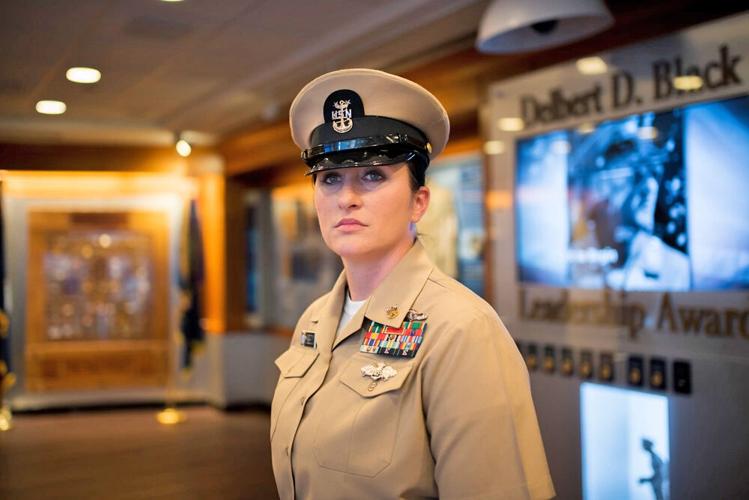
They Called Her Military Service “Abandonment” and Sued Her — Then She Walked Into Court in Full Dress Blues
How One Navy Commander Turned a Family Lawsuit Into a Masterclass in Honor and Dignity
The Envelope That Changed Everything
The envelope didn’t look like a declaration of war. It looked bureaucratic, boring, and beige. I was in the front yard, wrestling with a stubborn azalea bush that had decided to take over the walkway. It was the kind of mindless, physical labor I needed. My knee—rebuilt with titanium and stubbornness after that convoy hit an IED outside Al-Hudaydah—was aching with the incoming humidity, but I ignored it. Pain was just a reminder that I was still here.
Knox, my German Shepherd, was lying in the shade of the porch. He watched me with those soulful, ancient eyes. He had a limp too, a souvenir from his working days. We were a matched set, two retired assets trying to figure out how to be civilians in a world that moved too fast.
The mailman, Steve, who always gave Knox a treat, waved as he put the mail in the box. “Heavy one today, Evelyn!” he called out.
I wiped the sweat from my forehead and limped over to the mailbox. I sifted through the usual junk—flyers for pizza, a water bill, a tool catalog. And then I saw it. Heavy, cream-colored paper. The return address wasn’t a friend or utility company. It was the Portsmouth Family Court, Virginia.
A chill that had nothing to do with the wind ran down my spine. I tore the envelope open right there in the driveway.
Case 4238B. Carter vs. Carter. Petition for Property Division.
I blinked. The words swam for a second. I read it again. Plaintiffs: Robert and Margaret Carter. Defendant: Evelyn Carter.
My parents. My own parents were suing me.
I felt a laugh bubble up in my throat, dry and jagged. I hadn’t spoken to Robert and Margaret in two years. The last time I saw them, I was in a hospital bed at Walter Reed, recovering from surgery that saved my leg. They had visited for twenty minutes. My mother spent fifteen of them criticizing the hospital cafeteria coffee and the other five looking at my bandaged leg with a mixture of horror and “I told you so.”
The Word That Cut Deepest
The legal justification for this betrayal was spelled out in cold, clinical terms: Abandonment. The clause stated that because the property had been “neglected and abandoned” by the owner for a period exceeding five years, and because the plaintiffs had suffered “emotional distress” due to the estrangement, they were entitled to seize the asset.
Abandonment. I stared at the word until it blurred. They called my service abandonment.
I closed my eyes and saw the desert. I saw the heat rising off the tarmac in Djibouti. I saw the faces of the men and women I was responsible for—the logistics, the extraction plans, the late-night watches where we talked about home because we were terrified we’d never see it again.
I had missed Christmases. I had missed birthdays. I had missed my cousin’s wedding. I had missed the funeral of my childhood cat. I hadn’t abandoned them. I had left to stand on a wall and say, “Nothing is going to hurt you tonight.”
And this was their thank you.
Knox hobbled over, sensing the shift in the room’s energy. He rested his heavy head on my knee, letting out a long sigh. I buried my hands in his fur, grounding myself.
“They finally found a way to talk to me, Knox,” I whispered. “They couldn’t pick up the phone, but they could hire a lawyer.”
I looked around the kitchen. I had spent the last eight months restoring this place. I had sanded these floors until my shoulders screamed. I had replaced the rotted drywall. I had fixed the roof during a thunderstorm. This house was the only thing keeping me tethered to the earth.
And they wanted to take it. Not because they needed money—my father was a successful insurance broker. They wanted to take it because they could. Because to them, I was still the rebellious daughter who ran away to play war instead of marrying a nice lawyer and giving them grandchildren.
What Evelyn paid while serving overseas:
• Property taxes: Autopay from credit union in Bahrain
• Insurance premiums: Paid from carrier in the Pacific
• Storm damage repairs: Funded from base in Germany
• Maintenance costs: Hardware store receipts from Norfolk
• What her parents contributed: $0.00
They sued her for abandonment while she paid every bill
Preparing for Battle
I picked up the phone and dialed the court clerk. “This is Evelyn Carter. I received a summons regarding Case 4238B.”
“You are required to appear in person on the 12th if you wish to contest the transfer of the deed,” the bored voice informed me. “Otherwise, a default judgment will be entered.”
“I’ll be there.”
“Do you have legal representation, Ms. Carter?”
I looked down at my leg, at the scar that ran from my knee to my ankle. I looked at the photo on the fridge of me and Chief Petty Officer Daniel Lewis, two days before he died in my arms.
“No,” I said. “I don’t need a lawyer. I’ll represent myself.”
I wasn’t angry anymore. Anger is hot. It burns out. This was something else. This was cold. This was tactical.
The next forty-eight hours were a blur of methodical preparation. In the Navy, we have a saying: Slow is smooth, smooth is fast. Panic kills. Emotion clouds judgment. If you want to win an engagement, you need superior intelligence and flawless execution.
I treated the court date like a mission.
First, reconnaissance. I drove to the county records office. I didn’t just look at the deed; I pulled every single tax record for the property going back twenty years. I found receipts for property taxes I had paid via autopay from a credit union in Bahrain, from a carrier in the Pacific, from a base in Germany. Every single year.
Then I compiled hardware store records. Every nail, every board, every gallon of paint I had purchased since my discharge. My parents claimed they had been maintaining the property, claimed they had been “forced” to pay for upkeep.
I sat at my kitchen table until 3:00 AM, highlighting line items on bank statements. 2015: Property Tax – Paid by E. Carter. 2016: Storm Damage Repair – Paid by E. Carter. 2017: Insurance Premium – Paid by E. Carter.
They were lying. Not just small lies. They were lying on sworn legal documents.
The Uniform Speaks
My father, Robert, was a man who relied on bluster. He was loud. He took up space. He assumed that because I was his daughter, I would be intimidated. He assumed that because I had been away, I wouldn’t have the paperwork. He assumed I was disorganized, a drifter.
He forgot that I spent a decade coordinating logistics for SEAL Team operations. I could track a crate of ammunition across three continents in a war zone. Tracking a tax payment in Virginia was child’s play.
But the paperwork was only the ammunition. The weapon would be the presentation.
The night before the hearing, I walked to the hallway closet. It was locked, and the key was hidden in a fake plant on the bookshelf. Inside sat my sea chest—scratched, dented, and covered in stickers from transit authorities all over the world. It smelled of ocean and jet fuel.
I knelt before it and undid the latches. Inside, wrapped in layers of acid-free tissue paper, lay my dress blues. The wool was dark, almost black. The gold buttons were tarnished but solid.
I hadn’t touched this uniform since Daniel’s funeral. I had sworn I would never wear it again because the weight of it—the weight of the memories attached to it—was too heavy to carry in civilian life.
But my parents didn’t know who I was. They knew the teenager who left. They knew the “failure” they gossiped about to their country club friends. They had no idea who had come back.
I ran my thumb over the gold trident insignia. “Okay, Robert,” I whispered into the quiet house. “You want to talk about duty? You want to talk about what I’ve been doing for the last twelve years? Let’s talk.”
Pinning the Truth
I sat on the couch with the small velvet box, my hands usually steady enough to suture a wound in the back of a moving Humvee, now trembling.
I picked up the National Defense Service Medal. The Global War on Terrorism Expeditionary Medal. The Bronze Star with the “V” device for valor. Each pin prick through the fabric felt like a memory stabbing me.
Click. The Bronze Star. That was for the valley. For getting the team out when the comms went dead. Click. The Purple Heart. That was for the leg. For the fire. Click. The Defense Meritorious Service Medal. That was for Yemen.
My mother had once told me, “We raised a daughter, not a soldier.” She said it with such disdain, as if being a soldier was something dirty. As if I had run off to join a circus.
I pinned the medals in their precise order of precedence. The rack was heavy. It pulled at the fabric of the jacket. I stood in front of the full-length mirror in the hallway.
The woman staring back at me wasn’t the girl who used to cry when her father yelled about her grades. She wasn’t the teenager who hid in the barn to read adventure novels. She was Commander Carter. Her eyes were older than her thirty-four years. There were fine lines around them from squinting into the sun and seeing things no human being should have to see.
The jacket was tight across the shoulders. I had put on muscle doing rehab. But it fit like a second skin. I practiced my stance. Feet shoulder-width apart. Hands clasped behind the back. Chin up.
I didn’t look like a defendant. I looked like a tidal wave.
Entering the Battlefield
The alarm went off at 0500. Old habits. I showered, pulled my hair back into a tight, regulation bun. Not a single flyaway. I put on the uniform.
I drove to the courthouse in silence—no radio, just the hum of the tires. When I pulled into the parking lot, I saw my parents’ car. It was a brand new Mercedes, parked across two spots because my father believed lines were suggestions for other people.
I parked my beat-up truck in the back and walked toward the entrance. A janitor was sweeping the steps. He stopped as I approached, looked at the stripes on my sleeve, then at the ribbons on my chest. He straightened up and gave me a slow, respectful nod.
“Morning,” I said.
“Morning, Ma’am,” he replied.
I walked through the metal detectors. The guards’ eyes went wide. They waved me through with deferential hurriedness that usually didn’t happen in county courthouses.
I found Courtroom B. The door was heavy oak. I could hear voices inside. My father’s voice, booming, probably telling a joke to the bailiff, trying to charm the room before the show started.
I took a deep breath and visualized the breach. 3… 2… 1…
I pushed the door open. The air inside was stale and smelled of floor wax. My father was laughing. My mother was inspecting her manicure.
And then I stepped into the aisle. The sound of my heels on the linoleum was sharp. Clack. Clack. Clack.
My father turned, a smirk already forming on his lips, ready to make a comment about my clothes, about my tardiness, about my life.
The smirk died. It didn’t fade. It shattered.
What the courtroom saw when Commander Carter entered:
• National Defense Service Medal
• Global War on Terrorism Expeditionary Medal
• Bronze Star with “V” device for valor
• Purple Heart for wounds received in combat
• Defense Meritorious Service Medal
• Perfect military bearing and discipline
Twelve years of service made visible in one devastating moment
The Judge’s Recognition
Judge Harold L. Simmons finally walked in from his chambers. The bailiff called the court to order, but the atmosphere was already electric. Judge Simmons stopped when he saw me standing at attention at the defense table. He didn’t just glance at the uniform; he studied it. He looked at the braid, the high collar, the perfectly squared shoulders.
“Case 4238B,” he began. “Carter versus Carter. Plaintiffs Robert and Margaret Carter. Defendant Evelyn Carter.”
He looked at my father. Robert, despite his shock, was quickly recovering his bluster. He adjusted his silk tie and puffed out his chest, the picture of an aggrieved pillar of the community.
“Mr. Carter, Mrs. Carter, you are petitioning to have the property deed transferred to you on the grounds of abandonment and neglect by the defendant. Is that correct?”
“Yes, Your Honor,” Robert boomed, talking to the whole room, making a performance of his suffering. “That house has been sitting empty and wasting away for years. We’ve been forced to step in, Your Honor. The upkeep, the insurance, the repairs—the burden has fallen on us while she was… absent.”
My mother, Margaret, nodded rigidly beside him, her face a mask of martyrly disappointment.
Judge Simmons turned his gaze toward me, his pen hovering over the paper. His eyes met mine with genuine, quiet curiosity.
“Commander Carter,” he said. The title hung in the stale courtroom air—heavy, authoritative, and completely unexpected. My father actually flinched. My mother’s head snapped up, her lips parting in a silent gasp.
“Commander Carter,” the Judge repeated, allowing the title to settle. “Do you have a statement prepared for the court? And do you waive your right to legal counsel?”
“Yes, Your Honor,” I replied, my voice clear and steady—the tone I used to brief a superior officer. “I waive my right to counsel. I am prepared to contest the petition.”
The Documentary Evidence
I reached into the Manila folder and slid the first document across the table toward the bailiff. “Your Honor, I have here a series of documents detailing the expenses associated with the property since my grandfather’s passing in 2013, when the deed was transferred to me.”
The bailiff carefully took the stack of papers and handed them to the Judge. “I can confirm that I have maintained the property, covering all associated expenses, including property tax and insurance, for the last decade. The tax and insurance records will confirm that the plaintiffs have not contributed a single cent to the financial upkeep of the property in the last twelve years.”
Robert lurched forward, his face turning an unhealthy shade of red. The veneer of polite suffering cracked wide open.
“That is an outrageous lie, Your Honor!” he shouted, ignoring the Judge’s tap of the gavel. “She’s trying to mislead the court with—”
“Mr. Carter!” Judge Simmons barked, his voice rising sharply. “One more outburst and I will hold you in contempt. You will address the bench, not the defendant.”
The Judge leaned back, scanning the meticulously organized documentation—the bank transfers from Djibouti, from Spain, from the aircraft carrier’s satellite connection. Hard evidence, printed on official stationery. The silence that followed was crippling.
My father, fueled by a mixture of shame and fury, launched into a tirade of personal attacks. “You left this family, Evelyn! You went off to play soldier while your mother and I stayed here and kept everything together!”
I sat motionless. The uniform made it impossible to fidget. I allowed his toxic words—ungrateful, cold, disrespectful—to wash over me. They were meaningless static. I had spent years tuning out the roar of jets and the shrieks of IED warnings. Tuning out my father’s predictable anger was easy.
The Moment of Truth
“Sir,” I addressed the Judge again, ignoring my father entirely. “My decision to join the Navy was not abandonment. It was service. While the documents clearly show the plaintiffs have no financial claim on the property, I would like to address the claim of ’emotional abandonment’ that Mr. Carter seems determined to present to the court.”
Robert leaned forward, gripping the edge of the table. “You can’t talk about emotion, Evelyn! You have none!”
Judge Simmons held up his hand, silencing Robert with a gesture of deep disappointment. Then, the Judge looked at the ribbons on my chest, squinting slightly. He paused, leaning forward over the bench, his voice losing its formal judicial tone.
“Commander,” he said, holding my gaze. “Forgive me for asking a personal question, but… are you the same Evelyn Carter recognized and highly decorated by the Secretary of Defense back in 2019? The one who led the civilian evacuation from the port city of Al-Hudaydah in Yemen?”
Robert frowned heavily, utterly bewildered. “What evacuation is he talking about?” he demanded under his breath.
I nodded once, my gaze steady. “Yes, Your Honor. I am.”
The Judge smiled—a warm, genuine expression of pride. “I remember reading the full report on that ceremony, Commander. It was one of the proudest operational days the state’s Navy has seen in a decade. That Bronze Star with the ‘V’ device… that is earned, not given.”
The courtroom went utterly, profoundly silent. My father’s face was slack, pale with total shock. He didn’t know about Yemen. He didn’t know about the Secretary of Defense. He only knew the version of me he had invented: the runaway who failed to live up to his expectations.
My mother stared at me openly, her perfectly composed mask finally shattered, a flicker of genuine terror and dawning disbelief crossing her features.
The Inevitable Verdict
Judge Simmons gathered the copious records I had provided—the tax statements, the military commendations—and stated he would issue a written decision soon. But the emotional tide had already turned. There was nothing left to fight for.
I stood straight, maintaining the posture of a Navy officer until Judge Simmons rose and left the room. Robert and Margaret remained seated, unmoving. They were no longer the arrogant plaintiffs they had been. Now, they were two marble statues of humiliation.
Robert’s face had gone pale, his empty eyes staring into space. He couldn’t yell anymore. The judge’s authority had extinguished his anger, leaving only the ashes of embarrassment.
As I walked past their table, Robert muttered a vague curse under his breath—a last attempt to salvage dignity. I ignored it. But Margaret spoke, her voice dry, barely audible:
“Why… why are you wearing it?”
The uniform. She wasn’t asking why I served. Not why I fought. Not why I was wounded. She only questioned the outer shell.
I stopped but did not turn around. I answered calmly—not with resentment or triumph, but with the quiet weight of twelve long years.
“Because, Mother,” I said. “It’s who I became.”
The Path to Reconciliation
Outside the courthouse, I took a deep breath of the humid air. The familiar smell of salt and diesel from the harbor washed over me, but the tension had eased. I had won. Not because the judge had ruled in my favor (though I knew he would), but because I stood there—bare, truthful—before people who had always tried to hide that truth.
The court’s decision arrived weeks later: “Plaintiff’s claim dismissed. Property belongs to Evelyn Carter.” I began restoring the house in earnest. I wasn’t in a hurry anymore. Every board I replaced, every layer of paint I brushed on, wasn’t just fixing a house—it was fixing myself.
My grandfather’s house became sturdy again. One evening, as I sat outside, a familiar car pulled onto the newly graveled road. Robert and Margaret stepped out, followed by my brother Ryan and his wife. They looked awkward, stripped of their usual arrogance.
They came not to challenge, but to see. To witness the result of their mistaken choices.
“The house looks good, Evelyn,” Robert murmured, avoiding my eyes.
“Thank you,” I said. “It’s a work in progress.”
We shared a simple, somewhat tense dinner on the porch. Good, plain food with easy laughter that came in small, hesitant waves. It wasn’t the boisterous family dynamic of my youth; that was gone forever. But this felt genuine. Honest. A fragile truce built on the foundation of shared silence and undeniable hard work.
Robert surprised everyone by lifting his glass of sweet tea. His voice was husky, strained with emotion. “To the Carters,” he said, barely audible. “And to the one who finally made us all truly proud.”
It wasn’t a perfect apology. It wasn’t even a full acknowledgment of wrongdoing. But it was the best he could manage—a grudging admission that the path I had chosen had led to genuine dignity.
I raised my own glass, accepting the truce but refusing to let the sentiment stand uncorrected. “To the ones,” I replied gently, “who taught me what honor and pride really cost.”
What Commander Carter sacrificed for service:
• Christmases missed with family
• Birthdays and celebrations abroad
• Physical wounds requiring titanium reconstruction
• Emotional wounds from family rejection
• Years of isolation and misunderstanding
• What she gained: Unshakeable dignity and true purpose
Honor isn’t free—it’s earned through sacrifice others can’t comprehend
Lessons in True Strength
A few weeks later, I spoke to the local high school for their Veterans Week assembly. The principal introduced me with excessive pride: “This is Commander Evelyn Carter, a decorated Navy SEAL and one of our very own hometown heroes.”
The vast gymnasium fell silent—not out of discipline, but curiosity. They wanted to see the hero who came from their quiet streets.
“I used to think that honor was defined by the medals you earned,” I began, my voice carrying across the acoustic nightmare of the gym. “I used to think it was about the headline-grabbing missions, the victories, the perfect service record. Then I learned that it’s really about the small, difficult choices—the ones you make every day when absolutely no one else is watching you.”
I spoke about Poppy, the legacy of the farmhouse, and the necessity of personal forgiveness. I didn’t mention the hostile courtroom or the trauma. These students didn’t need to hear about vengeance; they needed to hear that true strength isn’t the same as external anger.
“The uniform I wore in court was powerful,” I concluded. “But the true dignity wasn’t in the cloth or the brass. It was in the fact that I chose to show up at all. Fully present. Fully truthful. And when you face your hardest battles, you need to remember that quiet integrity is its own powerful kind of victory.”
The students rose spontaneously to their feet—not out of protocol, but out of genuine respect. The applause shook the rafters.
That night, I sat on the porch swing, listening to the creaking of the wood I had so lovingly restored. Knox rested his head on my lap, sighing contentedly. I thought about that powerful day in the courtroom—my father’s silent shock, my mother’s dawning disbelief, the judge’s quiet recognition.
They needed to see the uniform not as a weapon of revenge, but as undeniable truth—the visible proof of everything they had chosen to ignore about me for decades. And I needed to remember that genuine dignity isn’t what you choose to wear on your body. It is the core of who you choose to be when life tests you to your very limit.
The porch light flickered gently against the growing darkness. I felt no trace of bitterness, only profound gratitude for the hard-won lessons that had shaped me. Because without the pain, the distance, and the relentless pressure, I would never have found the inner strength to come home with enduring peace instead of satisfying pride.
The most beautiful revenge is not destruction—it’s undeniable presence. I had left in silence twelve years ago. Today, I returned with authority.

Lila Hart is a dedicated Digital Archivist and Research Specialist with a keen eye for preserving and curating meaningful content. At TheArchivists, she specializes in organizing and managing digital archives, ensuring that valuable stories and historical moments are accessible for generations to come.
Lila earned her degree in History and Archival Studies from the University of Edinburgh, where she cultivated her passion for documenting the past and preserving cultural heritage. Her expertise lies in combining traditional archival techniques with modern digital tools, allowing her to create comprehensive and engaging collections that resonate with audiences worldwide.
At TheArchivists, Lila is known for her meticulous attention to detail and her ability to uncover hidden gems within extensive archives. Her work is praised for its depth, authenticity, and contribution to the preservation of knowledge in the digital age.
Driven by a commitment to preserving stories that matter, Lila is passionate about exploring the intersection of history and technology. Her goal is to ensure that every piece of content she handles reflects the richness of human experiences and remains a source of inspiration for years to come.