The Black Card
I never told my son about the forty thousand dollars that hit my bank account on the first of every month. I never told him that the “simple office job” he thought I had was actually a corner office overlooking the city skyline, or that the “paperwork” I did at night involved signing multi-million dollar contracts for a multinational corporation.
To Marcus, I was just Mom. The woman who clipped coupons, who lived in the same rent-controlled apartment for two decades, and who wore the same sensible shoes until the soles wore thin. And I liked it that way.
My name is Alara Sterling. To the corporate world, I am Regional Director of Operations for a multinational corporation. To my thirty-five-year-old son, I am a secretary who scraped by to raise him. I never corrected him because I didn’t want him to fall in love with a lifestyle he hadn’t earned. I wanted him to build his own character, not rest on my laurels.
But character is tested in fire, and my fire came in the form of a phone call on a Tuesday afternoon.
“Mom,” Marcus’s voice cracked. “I need a huge favor. Simone’s parents are visiting from overseas. It’s their first time here. They want to meet you. We’re having dinner on Saturday at Le Jardin. Please come.”
Le Jardin. A place where the menu has no prices and the air smells of old money and judgment.
“Do they know anything about me?” I asked.
Silence. Then, the stammer. “I told them you work in administration. That you live alone. That you’re simple. That you don’t have much.”
Simple. The word hung in the air like a slap. He wasn’t describing me; he was apologizing for me. He was lowering expectations so his in-laws wouldn’t be disappointed by his “poor” mother.
“Okay, Marcus. I’ll be there.”
I hung up and looked around my living room. The furniture was comfortable but dated. The television was small. To the untrained eye, this was the home of a woman barely surviving. And in that moment, cold resolve settled over me.
If my son thought I was a poor woman, and if his wife’s parents were coming ready to judge the “simple” mother-in-law, then I would give them exactly what they wanted. I would play the role of the destitute, naive mother perfectly. I wanted to feel, firsthand, how they treated a human being they considered beneath them. I wanted to see their true faces before I showed them mine.
Saturday arrived. I went to my closet, pushing aside the silk blouses and tailored Italian suits hidden in the back. I pulled out a shapeless, wrinkled gray dress I’d bought at a thrift store years ago. I paired it with scuffed loafers and a faded canvas tote bag. I pulled my hair back into a severe, messy ponytail and scrubbed my face clean of makeup.
I looked in the mirror. I looked tired. I looked defeated. I looked like a woman whom life had broken.
Perfect.
The restaurant was a symphony of soft lighting and hushed conversations, designed to make outsiders feel small. I spotted them immediately.
Marcus stood near a window table, looking like he was facing a firing squad. He wore his best dark suit, his posture rigid. Beside him, Simone, my daughter-in-law, looked impeccable in cream silk, but her eyes were darting toward the door with terrified anticipation.
And then, there were the monarchs.
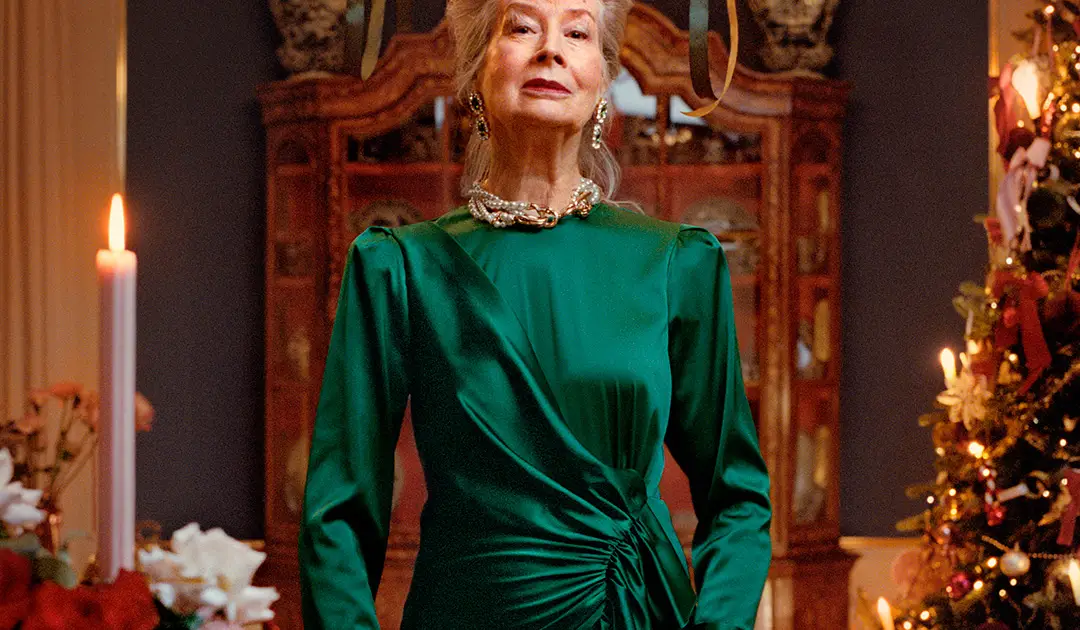
Veronica sat like a queen on a throne. She wore an emerald green dress that screamed for attention, dripping with sequins. Diamonds glittered on her neck, wrists, and fingers—too many, too large, too loud. Beside her, Franklin was a statue in a gray suit, a watch the size of a saucer weighing down his wrist.
I approached slowly, shortening my stride, hunching my shoulders. The act began.
“Mom,” Marcus said, his relief palpable but laced with embarrassment. He scanned my outfit, swallowing hard. “You made it.”
“Of course, son,” I said, my voice small and trembling.
Simone kissed my cheek, a cold, mechanical peck. “Mother-in-law. Good to see you.”
“Dad, Mom,” Simone said, her voice tight. “This is Marcus’s mother, Alara.”
Veronica turned. Her eyes were like scanners at a checkout counter. She started at my messy hair, moved down the wrinkled gray dress, lingered on the canvas tote, and ended at the scuffed shoes. In three seconds, she had calculated my worth and found it close to zero.
“A pleasure,” she said. She extended a hand—limp, cold, dismissive. She didn’t stand.
“Charmed,” Franklin muttered, barely glancing up from his wine list.
I sat in the empty chair at the end of the table. No one helped me. No one poured me water. I was the ghost at the feast.
The waiter arrived, placing a heavy, leather-bound menu in front of me. It was entirely in French.
I opened it, staring at the words I understood perfectly—Escargots de Bourgogne, Filet de Bœuf en Croûte. But I looked up at Veronica with wide, panicked eyes.
“Do you need help, Alara?” Veronica asked. Her smile was sharp, a razor blade hidden in cotton candy.
“Yes, please,” I whispered. “I don’t know what these words mean.”
Veronica sighed dramatically. “Oh, dear. Well, I’ll order for you. Something simple. Something that doesn’t challenge the palate.”
Simple. That word again.
“Thank you,” I murmured.
As we waited for food, Veronica launched into a monologue. It wasn’t conversation; it was a press conference about their wealth.
“The flight was exhausting, even in First Class,” she began. “And this hotel, a thousand dollars a night, can you believe it? But one must pay for security.” She turned her gaze to me. “We’ve been shopping all day. Franklin bought a few watches. Just a few thousand dollars. Nothing major.”
She paused, waiting for my gasp. I gave it to her.
“That sounds very expensive,” I said, lowering my eyes.
“We’ve worked hard,” Veronica said, false modesty dripping from her voice. “We have properties in three countries. Franklin is a titan in his industry. And I manage our investments.” She leaned forward, eyes narrowing. “And you, Alara? What exactly do you do?”
“I work in an office,” I said, picking at the fraying strap of my bag. “Filing. Answering phones. Administrative work.”
Veronica exchanged a look with Franklin. A smirk shared between conspirators. “Ah. Administrative. That’s honest work. All labor has dignity, doesn’t it?”
“Of course,” I said.
The food arrived. Tiny, artistic portions on massive plates. Veronica cut her steak with surgical precision.
“This steak costs eighty dollars,” she announced. “But quality is worth paying for.” She looked at me, at my “simple” chicken dish. “Does your mother live alone, Marcus?”
“Yes,” Marcus said, his voice tight. “She has a small apartment downtown.”
“Oh, you poor dear,” Veronica cooed, tilting her head. “It must be so difficult. Living alone at your age. Without support. Does your salary even cover the basics?”
“I manage,” I said softly. “I save where I can.”
“You are so brave,” she said, and the word sounded like an insult. “Truly. I admire women who struggle. Though, naturally, one always wishes to give one’s children more. But I suppose everyone gives what they are capable of.”
There it was. The dagger to the heart. She wasn’t just calling me poor; she was calling me a failure as a mother.
I smiled, a weak, pathetic thing. “Yes. Everyone gives what they can.”
But under the table, my hands were fists. And the predator inside me was starting to growl.
The wine flowed—two hundred dollars a bottle, as Veronica reminded us three times. I sipped water.
“We believe in supporting our children,” Veronica continued, her gaze fixed on Simone. “We gave them forty thousand dollars for the down payment on their house. We paid fifteen thousand for the honeymoon. Because that’s who we are.” She turned to me. “And you, Alara? Were you able to help Marcus with anything when they married?”
“Not much,” I whispered. “A small gift. A blender.”
Veronica smiled. “How sweet. Every detail counts.”
They spent the next hour inflating their egos. They talked about vineyards, cars, VIP clubs. They asked me about my hobbies.
“I watch TV,” I said. “I walk in the park.”
“Quaint,” Franklin grunted. “Simple pleasures.”
When dessert arrived—gold-flaked cake for them, vanilla ice cream for me—Veronica cleared her throat. The air seemed to drop ten degrees.
“You know, Alara,” she began, her voice shifting to serious. “I think it’s important we speak as a family.”
Marcus stiffened. “Mom, maybe this isn’t the time—”
“Hush, Marcus,” Veronica snapped. She looked at me with dead eyes. “Marcus is our son-in-law. We love him. But as parents, we want stability for our daughter. Financial stability. Emotional stability. We believe it’s important that Marcus doesn’t have unnecessary burdens.”
Burdens.
“I don’t want to sound harsh,” she continued, sickly sweet, “but at your age, living alone on a secretary’s wage, it’s natural for Marcus to worry. To feel he must care for you. But we don’t want that worry to drag down their marriage. Do you understand?”
“Perfectly,” I said.
“Good. So, Franklin and I have a proposal.” She paused. “We are willing to provide you with a monthly allowance. A stipend. To help you live more comfortably. So Marcus doesn’t have to worry.”
I watched her. “And in exchange?”
“In exchange,” she smiled, “we would ask that you respect their space. That you don’t seek them out so often. That you give them the freedom to build their life without interference.”
They were buying me off. They were offering me charity to orphan my own son. They wanted the embarrassing, poor mother to fade into the background for a few hundred dollars a month.
The table was silent. Simone looked ready to vomit. Marcus looked ready to flip the table.
I picked up my napkin. I wiped my mouth slowly, deliberately. I took a sip of water.
And then, I let the mask fall.
I sat up straight. My shoulders went back. My chin lifted. The timid, broken woman vanished, replaced by the Regional Director who negotiated mergers for breakfast.
“That is an interesting offer, Veronica,” I said.
My voice had changed. It was no longer soft. It was resonant, commanding, ice-cold.
Veronica blinked, confused by the shift. “I’m glad you think so.”
“I have a few questions,” I said, locking eyes with her. “Just for clarity.”
“Of course.”
“How much, exactly, would you consider a ‘modest’ allowance?”
“Well,” she hesitated. “We were thinking five hundred. Maybe seven hundred dollars a month.”
“I see,” I said, my voice dry. “Seven hundred dollars to disappear from my son’s life.”
“I wouldn’t put it that way—”
“But that is exactly how you put it.” I leaned forward. “You said you gave forty thousand for the house? And fifteen for the honeymoon? So, fifty-five thousand total?”
“Yes,” she said, puffing up. “When you love your children, you don’t hold back.”
“You’re right,” I said. “When you love your children, you don’t hold back. But tell me, Veronica. Did that fifty-five thousand dollars buy you anything? Did it buy you respect? Did it buy you real love? Or did it just buy obedience?”
Franklin slammed his hand on the table. “Now see here—”
“Quiet,” I said. I didn’t shout. I simply commanded, and Franklin, used to being the loudest in the room, was stunned into silence.
“You have spent three hours talking about prices,” I said, staring Veronica down. “But you haven’t asked me once if I am happy. You haven’t asked who I am. You have only calculated my worth. And apparently, to you, I am worth seven hundred dollars a month.”
“I was trying to help!” Veronica cried, her face flushing red.
“No,” I said. “You were trying to control. You measured me by my wallet and found me wanting. But you made a critical error, Veronica. You assumed that because I am modest, I am poor. And you assumed that because you are loud, you are rich.”
I reached down into my faded canvas tote bag.
“Let me tell you who I really am.”
“Forty years ago,” I began, my voice steady, holding the attention of not just our table but the ones around us. “I was twenty-three. A secretary. Single mother. I ate toast for dinner so Marcus could have milk.” Marcus stared at me. He had never heard this story.
“I didn’t stay a secretary,” I continued. “I studied at night. I learned finance. I learned strategy. I climbed from the mailroom to the boardroom. I didn’t marry a rich man, Veronica. I became the rich man.”
Veronica laughed nervously. “What are you talking about?”
“I am the Regional Director of Operations for a multinational corporation,” I declared. “I oversee five countries. I manage budgets that would make your ‘investments’ look like pocket change. And do you know how much I earn?”
She shook her head, mute.
“Forty thousand dollars,” I said. “Every. Single. Month.”
The silence that followed was absolute. It was the sound of a worldview shattering.
“That is nearly half a million dollars a year in base salary alone,” I said. “Not counting bonuses. Not counting stock options. I have been earning that for twenty years.”
“That’s impossible,” Franklin stammered. “Why do you live like that?” He gestured at my dress.
“Because I don’t need to impress people like you,” I said. “Because true wealth is silent. Because I wanted my son to become a man, not a parasite waiting for an inheritance.”
I looked at Marcus. “I’m sorry I kept it from you, son. But I needed you to know your own strength.”
“Mom,” Marcus whispered, tears in his eyes. “You’re incredible.”
I turned back to Veronica. She looked shrunken. The sequins on her dress suddenly looked cheap.
“You offered me seven hundred dollars,” I said with a dark chuckle. “I spend that on coffee for my staff in a week.”
“You lied!” Veronica hissed, trying to claw back ground. “You deceived us!”
“I held up a mirror,” I corrected. “And you showed me exactly who you are. You are people who treat others like trash if you think they have no value. You have money, Veronica, but you have no class. You have assets, but no dignity.”
I stood up. I reached into my old leather wallet and pulled out a card. It wasn’t just a credit card. It was made of anodized titanium. Black. Heavy.
The American Express Centurion Card. The Black Card.
I tossed it onto the table. It landed with a heavy metallic clank in front of Veronica.
“Pay the bill with this,” I said. “Consider it a gift from the poor, simple mother. Order another bottle of that cheap two-hundred-dollar wine while you’re at it.”
Veronica stared at the card as if it were radioactive.
“I don’t want your money,” she whispered.
“Take it,” I said. “As a lesson. Someday you will run into someone else you think is beneath you. And you will remember tonight. You will remember that the woman you tried to buy off could buy and sell you ten times over.”
I picked up my canvas bag.
“Franklin,” I said. “Your wife speaks four languages, she said? In which one did she learn to be kind? Because I didn’t hear it tonight.”
I turned to Simone, who was weeping silently. “You are not your parents, Simone. You can choose to be better. But you have to choose it now.”
“I’m sorry,” Simone sobbed. “I’m so sorry.”
“Don’t tell me,” I said. “Show me.”
I walked away. I didn’t look back. I heard Franklin calling for the check, his voice panic-stricken as he realized his own cards were likely maxed out from their shopping spree.
I walked out into the cool night air, feeling lighter than I had in years. The mask was gone.
I hailed a taxi outside the restaurant. The driver, a man with graying hair and kind eyes, looked at me in the rearview mirror.
“You look like you just won a war, ma’am,” he said.
I smiled, leaning my head back. “I think I did.”
“Good night?”
“A necessary one,” I said. “I pretended to be poor tonight to see how my son’s in-laws would treat me.”
The driver laughed. “Let me guess. They treated you like dirt until they found out?”
“Exactly.”
“Rich folks,” he shook his head. “They think the price tag on their clothes is the price tag on their soul. My wife, she passed five years ago, she always said honesty is the only real luxury. Everything else is just decoration.”
“Your wife was a wise woman,” I said.
We pulled up to my modest apartment building. It wasn’t a penthouse. It didn’t have a doorman. But it was home.
“How much?”
“Thirty dollars.”
I handed him a hundred-dollar bill. “Keep the change. For the wisdom.”
“Ma’am, this is too much.”
“It’s not,” I said. “Honesty is a luxury. You said so yourself.”
I walked up the five flights of stairs to my apartment. I kicked off the scuffed loafers. I peeled off the gray dress. I put on my soft flannel pajamas and made a cup of tea.
I sat in the silence of my living room. No sequins. No French menus. Just me.
My phone buzzed. A text from Marcus.
I love you, Mom. We left right after you. Simone stood up to them. They’re furious, but we’re free. Thank you.
I smiled, sipping my tea.
Then, another message. From Simone.
Mother-in-law, please forgive me. I want to learn. I want to be like you. Can I come see you?
I put the phone down. I didn’t reply yet. She needed to sit with the discomfort. Growth happens in the silence.
I looked out the window at the city lights. I had spent a lifetime building a fortress of silence to protect myself and my son. Tonight, I had lowered the drawbridge and unleashed the dragon.
And as I sat there, a woman with ten million dollars in the bank and a tea bag that cost five cents, I knew I had never been wealthier.
Veronica and Franklin would go back to their empty mansions and their hollow lives. They would never understand. They would spend the rest of their lives trying to buy what I had earned for free.
I took another sip of tea. It tasted like victory.

Lila Hart is a dedicated Digital Archivist and Research Specialist with a keen eye for preserving and curating meaningful content. At TheArchivists, she specializes in organizing and managing digital archives, ensuring that valuable stories and historical moments are accessible for generations to come.
Lila earned her degree in History and Archival Studies from the University of Edinburgh, where she cultivated her passion for documenting the past and preserving cultural heritage. Her expertise lies in combining traditional archival techniques with modern digital tools, allowing her to create comprehensive and engaging collections that resonate with audiences worldwide.
At TheArchivists, Lila is known for her meticulous attention to detail and her ability to uncover hidden gems within extensive archives. Her work is praised for its depth, authenticity, and contribution to the preservation of knowledge in the digital age.
Driven by a commitment to preserving stories that matter, Lila is passionate about exploring the intersection of history and technology. Her goal is to ensure that every piece of content she handles reflects the richness of human experiences and remains a source of inspiration for years to come.