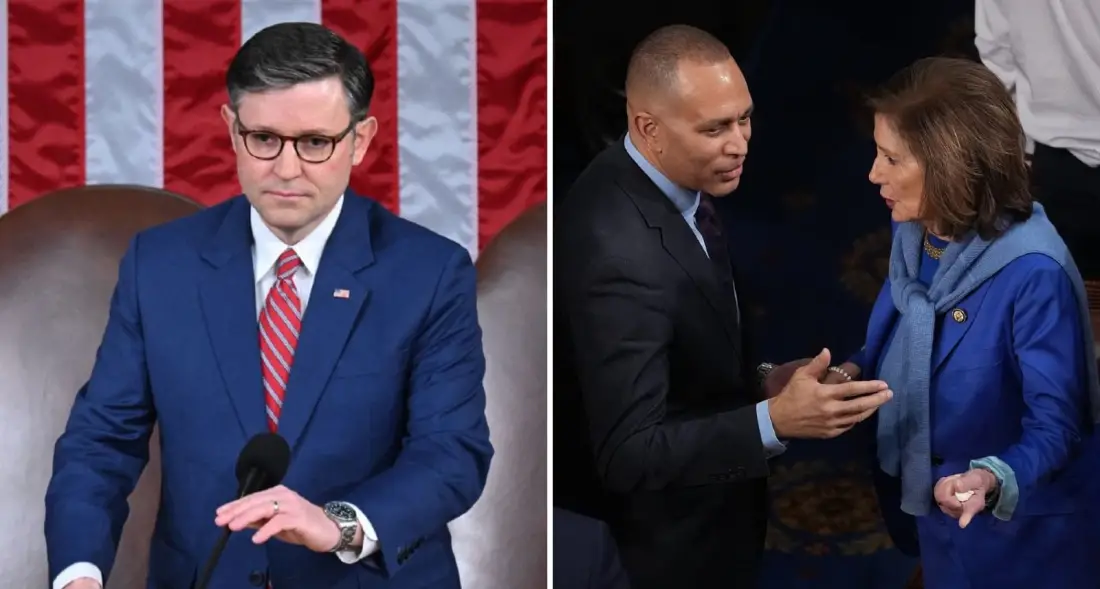
When the U.S. House of Representatives gaveled back into session this week, few expected the chamber to move with the kind of urgency and coordination that unfolded. By the time the votes were cast and the press corps packed up their equipment, Speaker Mike Johnson stood before the country with two announcements that will shape the political and economic landscape for months: a major legislative victory on natural gas exports and a new congressional focus on rising violence against law enforcement.
To Republicans, the moment represented something larger — a turning point in what they see as America’s return to energy leadership and public safety stability after years of what they describe as uncertainty, hesitation, and regulatory volatility under the previous administration.
“This is about unleashing American strength again,” Johnson declared, his voice carrying a mixture of triumph and impatience. “Energy security. Economic security. National security. They all start here.”
The cornerstone of the week’s agenda was the passage of the Unlocking Our Domestic LNG Potential Act of 2025, legislation designed to permanently reverse what GOP lawmakers have characterized as President Joe Biden’s “unnecessary and catastrophic natural gas export freeze.”
A Legislative Clash Years in the Making
The bill’s passage was the culmination of a long-standing political battle over liquefied natural gas (LNG). Supporters argue that LNG exports are one of the most powerful tools the United States can wield in global markets, lowering domestic prices, supporting American jobs, and giving U.S. allies alternatives to Russian or Middle Eastern energy supplies.
Opponents, primarily on the Democratic side, have insisted that expanding LNG export capacity contradicts climate objectives and increases dependency on fossil fuels.
That tug-of-war defined much of the previous administration’s energy agenda — and, according to Republicans, not for the better.
“President Biden’s natural gas export ban was among his most damaging policy decisions,” Johnson said in a press release immediately after the vote. “It harmed American workers. It harmed global partnerships. It harmed families who were paying higher prices while bureaucrats stalled American energy projects.”
The House, now firmly under Republican control, seized the opportunity to codify a different direction. Their bill seeks to end discretionary political interference by eliminating the Department of Energy’s role in LNG export approvals and handing that authority entirely to the Federal Energy Regulatory Commission (FERC).
It is, in many ways, a structural reset — a procedural overhaul intended to wall off energy policy from the political pendulum.
“This legislation depoliticizes the process,” Johnson emphasized. “It ensures that no administration — not this one, not the next one — can arbitrarily ban American LNG exports again.”
A Major Assist From Trump
President Donald Trump, now months into his second presidency, has made energy a central pillar of his domestic agenda, pushing aggressively for policies that lower consumer prices and restore what he calls “energy dominance.”
Since Trump returned to office in January 2025, his administration has:
-
issued at least three new LNG export authorizations,
-
moved $70+ billion worth of LNG projects from planning into investment stages,
-
rolled out executive orders clearing regulatory backlogs,
-
and signed a sweeping energy affordability directive targeting grocery staples, fuel, and pharmaceuticals.
To House Republicans, this was the moment to codify those gains into federal law.
“President Trump and Congressional Republicans are working together to unleash reliable American energy,” Johnson said. “We are not going back to the era of bureaucratic paralysis.”
A Bill With Far-Reaching Economic Implications
Rep. August Pfluger, who authored the bill, framed its passage as an “American comeback moment.”
“Exporting American LNG strengthens our economy,” he said. “It stabilizes prices, increases investment, and reinforces the energy security of our allies. This is what leadership looks like.”
The legislation includes a series of structural changes meant to streamline the export process:
Key Elements of the Unlocking Our Domestic LNG Potential Act
-
FERC becomes the single authority for LNG export approval
-
DOE no longer determines “public interest” requirements
-
A permanent ban on future LNG export bans
-
Procedural guardrails to prevent political interference
-
Legal codification of Trump’s energy-related executive orders
The White House estimates that full implementation could unlock tens of thousands of jobs, reduce dependence on foreign energy sources, and increase America’s market share in global LNG markets.
For Republicans, this is not merely legislative housekeeping — it is ideological anchoring, a way to lock in energy-production authority before a future Democratic administration attempts to reverse course.
The Counterargument: A Political Battle Still Unfolding
Democrats have argued vociferously that expanding LNG exports will:
-
increase global carbon emissions
-
accelerate the construction of fossil fuel infrastructure
-
redirect energy supplies abroad
-
and potentially raise domestic natural gas prices
But their ability to block the legislation is limited. With the House controlled by Republicans and the Senate narrowly divided, the bill’s fate now rests on whether enough Senate Democrats are willing to back it — or at least allow a vote.
Sen. Rick Scott (R-FL), who chairs the Senate’s energy agenda in partnership with the White House, has already said he expects “swift Senate action.”
If the bill reaches President Trump’s desk, he is expected to sign it immediately.
The Bigger Picture: A Reframing of the Energy Debate
Energy analysts say the bill reflects a broader recalibration occurring in Washington.
After years of elite focus on climate-centered energy transitions, the political consensus is shifting — driven partly by inflation fatigue, partly by geopolitical concerns, and partly by consumer frustration.
In short: voters want lower bills, more stability, and less dependence on foreign energy systems.
The House GOP argues that they are delivering precisely that.
Chairman Brett Guthrie, who oversees key portions of the policy portfolio, said:
“Unleashing American energy means supporting reliability, affordability, and security. This is how we protect the grid, strengthen the economy, and lower prices for working families.”
His words reflect a message Republicans intend to carry into the 2026 midterms:
Democrats slowed energy and raised prices. Republicans are restoring affordability.
The New Congressional Focus: Violence Against Law Enforcement
The second major development this week came not from energy policy but from public safety.
Speaker Johnson announced that the House will hold hearings examining the rise in violence against law enforcement nationwide — a crisis that has escalated into a defining national concern.
The move follows the tragic ambush of two National Guard members deployed to Washington, D.C., under President Trump’s anti-crime initiative.
-
20-year-old Army Specialist Sarah Beckstrom died from her injuries
-
24-year-old Staff Sgt. Andrew Wolfe remains in serious condition
The shooting, which occurred just blocks from the White House, has intensified public anger and revived long-standing debates about immigration vetting after it was confirmed the shooter was an Afghan national who entered the U.S. under Biden-era refugee programs.
Johnson did not mince words.
“Americans deserve answers,” he said. “Our law enforcement officers deserve protection. There will be accountability.”
A Broader Trend That Cannot Be Ignored
The hearing will also cover a string of recent attacks targeting law enforcement across the country, including:
-
a deadly shooting at an ICE facility in the Dallas area
-
multiple ambushes targeting police during routine calls
-
a 10-year nationwide high in assaults against officers
The FBI’s latest data showed more than 79,000 attacks on law enforcement in 2023 — a staggering number that has alarmed both local officials and federal lawmakers.
Republicans argue that the rise in violence is connected to:
-
weak immigration vetting during the Biden-Harris administration
-
reduced policing initiatives in major cities
-
demoralization among police forces
-
drug trafficking and transnational criminal networks
Democrats, meanwhile, have criticized Trump’s decision to deploy Guard troops into high-crime urban corridors, arguing it blurs the line between civilian policing and military posture.
But the shooting of Beckstrom and Wolfe changed the tone of the national conversation.
Public support for Trump’s deployment has grown, especially in cities experiencing steep crime spikes or chronic shortages of officers.
And congressional Republicans are determined to seize the moment.
The Immigration Tie-In: A New Era of Enforcement
The White House has grown increasingly aggressive on immigration enforcement following the D.C. attack.
Trump’s administration is pursuing:
-
expedited removals for migrants who entered under Biden-era programs
-
a review of Afghan and Somali refugee cases
-
a pause on discretionary immigration benefits
-
expanded vetting protocols for high-risk countries
Officials have strongly linked the new measures to the National Guard ambush.
“This was preventable,” one senior administration figure said. “This individual should never have been here. We are fixing that broken system.”
The political implications are enormous.
Immigration, crime, and energy — three defining issues of the last decade — are now merging into the core narrative Republicans are carrying into the midterms.
The GOP Strategy Becomes Clear
Taken together, the LNG legislation and the law-enforcement hearings reflect a unified strategy:
1. Energy dominance
Lower household bills, more jobs, and restored global leverage.
2. Public safety restoration
Highlighting rising violence, championing law enforcement, and confronting illegal immigration.
3. Policy contrast with Democrats
Framing Democratic policies as harmful, unproductive, or unsafe.
4. Codifying Trump’s executive actions
Preventing future Democratic administrations from reversing the GOP’s progress.
Republicans are already describing the LNG bill as one of the defining legislative achievements of the new Congress. And the upcoming hearings on violence against law enforcement are expected to dominate political coverage in the weeks ahead.
What Happens Next
With the House energized and aligned with the Trump administration, political analysts expect:
✔ Major Senate votes on LNG
The bill faces intense lobbying pressure from both sides.
✔ National debate over Guard deployments
The D.C. ambush has triggered a shift in public sentiment.
✔ Growing scrutiny of Biden-era immigration vetting
Republicans intend to keep the focus on policy failures.
✔ Sharp partisan messaging headed into the midterms
Each side sees energy and public safety as winning issues — but only one will set the narrative.
A Turning Point in Post-Pandemic Politics
What began as a procedural energy vote has become a broader, deeper political story stretching across multiple policy arenas — energy, crime, immigration, and national security.
For Speaker Mike Johnson, this week was not merely legislative housekeeping.
It was, in his own words, “a clear sign that America is no longer in retreat.”
The White House, now operating under Trump’s renewed leadership, views this as proof of a governing coalition synchronized around two goals:
-
Making life more affordable
-
Making the country more secure
Whether Democrats can counter that message remains uncertain — but Republicans are already moving full speed into the next chapter.
And they appear confident that the political winds are finally at their backs.

Ethan Blake is a skilled Creative Content Specialist with a talent for crafting engaging and thought-provoking narratives. With a strong background in storytelling and digital content creation, Ethan brings a unique perspective to his role at TheArchivists, where he curates and produces captivating content for a global audience.
Ethan holds a degree in Communications from Zurich University, where he developed his expertise in storytelling, media strategy, and audience engagement. Known for his ability to blend creativity with analytical precision, he excels at creating content that not only entertains but also connects deeply with readers.
At TheArchivists, Ethan specializes in uncovering compelling stories that reflect a wide range of human experiences. His work is celebrated for its authenticity, creativity, and ability to spark meaningful conversations, earning him recognition among peers and readers alike.
Passionate about the art of storytelling, Ethan enjoys exploring themes of culture, history, and personal growth, aiming to inspire and inform with every piece he creates. Dedicated to making a lasting impact, Ethan continues to push boundaries in the ever-evolving world of digital content.