The news broke quietly on a Wednesday morning — a short presidential statement, a name many Americans outside Texas hardly recognized, and a legal saga most of Washington had written off as another slow-moving corruption case inching its way through the courts.
But inside the Capitol, the announcement landed like a political earthquake.
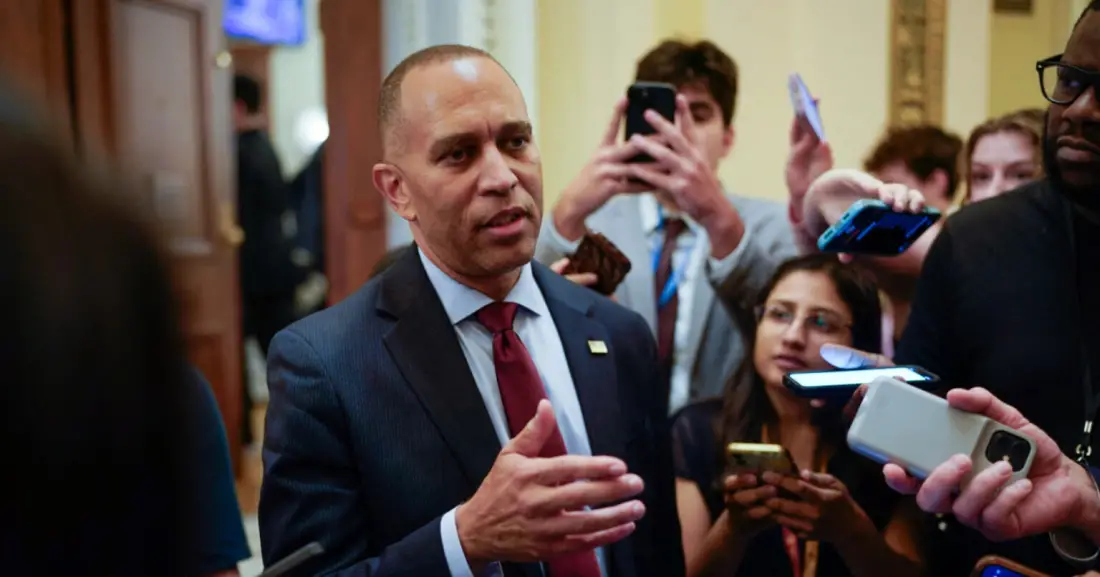
President Donald Trump had issued a preemptive pardon to Rep. Henry Cuellar, the long-serving Democrat from Laredo, Texas, along with his wife, Imelda, wiping away a sprawling federal indictment before it ever went to trial. And within hours, Cuellar — a politician who has spent two decades threading the needle between the national Democratic Party and his deeply conservative border district — stepped in front of a cluster of reporters and declared he wasn’t going anywhere.
Not retiring.
Not switching parties.
Not bowing out.
“I want to thank President Trump for this,” Cuellar said, almost matter-of-factly. “Nothing has changed — and we’re going to be ready to win re-election again.”
In a city addicted to political theater, the moment stunned both sides. And then the real questions began.
Why would Trump — a president who has made border security and anti-corruption crusades central to his identity — extend mercy to a Democrat under indictment?
Why would Cuellar, after receiving a political lifeline that could have justified a graceful exit or a party switch, instead choose to anchor himself harder to the Democratic Party?
And why did Democratic leadership, often furious about Trump’s broad use of pardon powers, suddenly line up to defend this one?
To answer those questions, you have to follow the story far beyond the short clip of Cuellar thanking Trump. This is a tale of a border district defined by contradiction, a political survivor who has outmaneuvered both the left and the right for decades, and a president whose instincts — for both loyalty and spectacle — continue to defy conventional political calculus.
This is the story behind the pardon that rewrote the next chapter of Texas politics.
I. A District of Conflicting Realities
Texas’s 28th Congressional District stretches across a vast and complicated landscape: anchored in Laredo, dotted with ranch towns, drifting north toward the growing suburbs of San Antonio. The district is overwhelmingly Latino, culturally conservative, and fiercely independent — a place where Democratic loyalty is generational, but political ideology often resembles old-school South Texas pragmatism rather than national progressive messaging.
It is not the kind of district that elects ideological warriors or cable-news firebrands. It elects negotiators. Moderates. Deal-makers.
And for the past nineteen years, it has elected Henry Cuellar.
Cuellar is the kind of Democrat whose presence in Congress frustrates young progressives and occasionally angers the national party, but whose longevity reflects a political truth Washington often forgets: America’s political map is not the same as Twitter’s political map.
In Laredo, his record matters more than his rhetoric. He delivers border funding. He cultivates relationships with Customs and Border Protection. He shows up to ribbon-cuttings, small business luncheons, and church festivals. He knows the names of ranching families, mayors, sheriffs, and civic leaders across hundreds of miles.
And in an era when Democrats have lost ground among working-class Hispanic voters, Cuellar remains a rare anchor.
That stability made last year’s indictment all the more stunning.
II. The Indictment That Threatened Everything
In the spring of 2024, federal prosecutors unveiled a sweeping indictment against Cuellar and his wife. The charges were serious: bribery, money laundering, foreign influence schemes. The headlines spread quickly, and opponents on both the far left and far right pounced.
Cuellar insisted he was innocent. His defenders pointed out that the charges felt uncharacteristically thin — long on insinuation, short on clear, actionable evidence. But indictments, as he knew well, aren’t simply legal documents. They are political weapons. And for the first time in his long career, Cuellar looked politically vulnerable.
Republicans smelled opportunity. Progressives saw the potential to finally unseat a Democrat they viewed as too moderate. And the national press began speculating whether one of the last major conservative Democrats would survive the storm.
Inside his orbit, the conversations were darker.
Some advisers urged him to retire quietly. Others said he should switch parties — after all, Republicans had courted him for years.
But Cuellar, who had spent decades navigating the unpredictable currents of Texas politics, held steady.
“I didn’t do anything wrong,” he told allies privately. “And I’m not switching sides. This is my home.”
What he did not expect was a presidential intervention.
III. The Pardon No One Saw Coming
When the news broke that President Donald Trump had pardoned Cuellar and his wife, the initial reaction in Washington was confusion.
Trump’s pardons, critics argued, were usually reserved for political allies, loyalists, or individuals he believed had been wronged by what he calls the “weaponized justice system.” Cuellar didn’t fit neatly into any of those categories.
But Trump’s explanation on Truth Social cut through the speculation:
“Henry, I don’t know you, but you can sleep well tonight — your nightmare is finally over! They charged you because you stood up to Biden on immigration!”
The message was unmistakable: the pardon was not about party; it was about symbolism.
Cuellar had been one of the only Democrats willing to publicly criticize President Joe Biden’s handling of the border, calling it “chaotic,” “unsustainable,” and “a disaster for Texas communities.” In Trump’s eyes, that made him an honest man targeted by a political machine.
What surprised Washington even more was Cuellar’s response.
He did not shift toward Trump.
He did not cast doubt on the Democratic Party.
He did not claim vindication from the right.
Instead, he reaffirmed his political identity:
“I’m a good old conservative Democrat.”
And he filed for re-election the same day.
IV. Private Conversations, Public Consequences
Behind closed doors, senior Democrats — including House Minority Leader Hakeem Jeffries — were already scrambling to assess the fallout. Cuellar’s seat is one of the few remaining battlegrounds where Democrats have historically been competitive. Losing it could jeopardize the party’s slim hopes of reclaiming the House.
But Jeffries surprised observers when he defended both Cuellar and the pardon.
“I think the outcome was exactly the right outcome,” Jeffries said.
“The charges were very thin to begin with.”
For a party that had spent years criticizing Trump’s pardons as unethical or abusive, the shift was notable.
It wasn’t about principle.
It was about political survival.
Democrats had spent months trying to recruit a candidate strong enough to replace Cuellar if he stepped aside. They had failed. And Republicans had already lined up what they believed would be one of their strongest contenders in years.
If Cuellar stayed in the race, Democrats had a fighting chance.
If he left, the district likely flipped.
Jeffries knew it.
Cuellar knew it.
Trump knew it, too.
V. A District Reacts: Relief, Suspicion, and Shrugs
In Laredo, the reaction was strangely subdued — less dramatic than the pundits expected, and more reflective of the district’s grounded realist politics.
Some lifelong Democrats expressed relief. Cuellar had been part of their political landscape for decades; his fall would have been a painful disruption.
Some moderates and independents shrugged, saying a pardon was just “Washington doing Washington things.”
A handful of progressives were furious. They accused Cuellar of being too close to Republicans, too centrist, too willing to criticize Democratic leadership. They had tried to primary him before and failed, but this time they saw an opening.
The Working Families Party in Texas posted angrily that Cuellar had “sold out working families,” and activists began searching for a challenger.
But here’s the problem:
A progressive candidate has never won Texas’s 28th District.
Not in a primary.
Not in a general.
Not in any era of its political history.
Cuellar knows that better than anyone.
VI. The GOP’s Dilemma
Trump’s pardon left Republicans with a political puzzle.
They had spent years attacking Cuellar as a corrupt Democrat and lobbying him privately to switch parties. His defeat was one of their top targets for the 2026 midterms.
But when a president pardons someone, the attack lines disappear. The corruption cloud evaporates. The narrative collapses on itself.
One Republican strategist said privately:
“How do we attack him when our own party leader just said he was wrongfully indicted?”
It didn’t help that Cuellar immediately shut down rumors of flipping parties. He didn’t hesitate; he didn’t stall.
When asked point-blank whether he would leave the Democrats, he didn’t waver.
“No. Nothing has changed. I’m running as a Democrat.”
Republicans were left politically blindsided.
“Very interesting,” Rep. Pete Sessions said — the closest thing anyone on the GOP side offered as a public critique.
Trump’s pardon, intended or not, had made Cuellar harder to beat.
VII. The Bigger Battle: Immigration, Power, and the Border’s Political Realities
Behind the Cuellar saga lies a larger fight — one that stretches far beyond a single congressional district.
Trump has spent his second presidency reorganizing immigration policy, reshaping federal enforcement, and positioning border security as a defining national issue. Democrats remain divided between progressive ideals and local realities.
And nowhere is that tension more intense than in border districts like Cuellar’s.
Cuellar has frequently clashed with his own party on immigration — not because he aligns with Republican rhetoric, but because he lives the consequences daily.
Overflowing migrant shelters.
Strained city budgets.
Border Patrol coordination failures.
Trade disruptions.
Neighborhood anxieties.
Cuellar’s district is the literal frontline.
The national conversation is not.
That’s why a Democrat like Cuellar can both criticize Biden’s immigration policies and retain the loyalty of his district.
And that’s why Trump — aggressively remaking immigration law — saw strategic value in elevating Cuellar as an example of a Democrat who refused to toe the party line.
The pardon was policy symbolism disguised as political mercy.
VIII. The Path to 2026: A Battle Reinvented
Cuellar’s future is anything but settled.
He is now caught in a three-way pressure system:
1. Republicans want his seat.
They smell opportunity and believe 2026 will be a favorable cycle for the GOP. Trump remains immensely popular in South Texas — far more than Democrats expected in previous years.
2. Progressives want him out.
For years, they’ve argued Cuellar’s brand of conservatism is outdated and out of step with the national party. The pardon gives them fresh ammunition to claim he is too willing to align with Republicans, even though Cuellar himself rejects that framing.
3. Democratic leadership needs him.
In a House where every seat matters, Cuellar is not just a member — he is a firewall. A reliable vote on core economic issues. A moderate voice who appeals to working-class Hispanic voters Democrats have struggled to retain.
Despite all of this, he is still standing on his original foundation:
A centrist South Texas Democrat who sees himself as the bridge between competing visions for his party.
IX. A Christmas Reception and an Unlikely Thank-You
In a small moment that captures the surreal nature of this story, Cuellar said he plans to attend the White House Christmas party to thank Trump in person.
Not as a political supplicant.
Not as a man changing parties.
Not as an ally.
But as a Texan raised to say thank you when someone offers help.
It’s hard to imagine a stranger image than Henry Cuellar — a conservative Democrat, a man caught in a legal storm, and a longtime critic of Trump’s rhetorical style — walking through a White House reception line to shake the president’s hand.
But that’s exactly what he intends to do.
And that image may become one of the most defining political photographs of the year.
X. The Final Question: Why Cuellar?
In the end, the Cuellar pardon is not simply the story of a legal case resolved or a political career revived. It is a window into how American politics now works — a place where party lines blur, ideological battles shift beneath our feet, and individual personalities can redefine the outcomes of entire districts.
Trump pardoned Cuellar because he believed the case was politically motivated.
Cuellar accepted the pardon because it cleared his name.
Democratic leadership defended the pardon because it protected a vulnerable seat.
Republicans were blindsided because it scrambled their 2026 strategy.
Progressives were angered because it strengthened a Democrat they’ve been trying to oust for years.
And voters — scattered across South Texas ranches, small towns, and border crossings — will ultimately decide whether the man at the center of it all deserves another term.
One thing is certain:
This is not the end of the Henry Cuellar story.
It is merely the start of its most unpredictable chapter yet.

Adrian Hawthorne is a celebrated author and dedicated archivist who finds inspiration in the hidden stories of the past. Educated at Oxford, he now works at the National Archives, where preserving history fuels his evocative writing. Balancing archival precision with creative storytelling, Adrian founded the Hawthorne Institute of Literary Arts to mentor emerging writers and honor the timeless art of narrative.