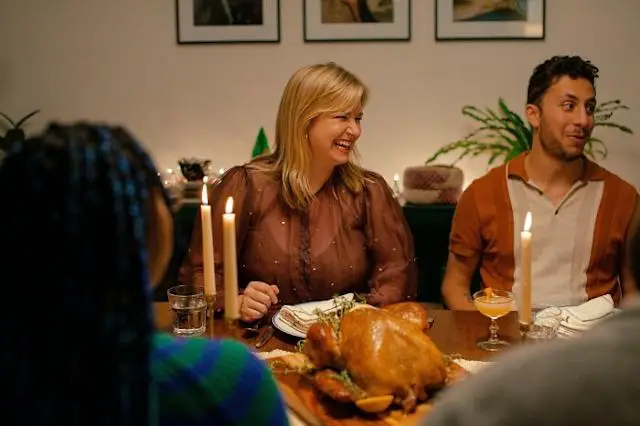
The Thanksgiving That Changed Everything
Forks stopped. Laughter died mid-syllable. In a small house outside Detroit, the glow of a single laptop turned a holiday into a reckoning.
For 38 years, I was the “understanding” one—the extra chair, the extra shift, the extra wallet. They called it family. It felt like erasure. While they told my story for me, I was writing a different one: late nights, quiet contracts, a company built without their applause.
And then—one click.
Net worth: $12,004,731.
Sarah was worth $12 million. Not struggling. Not barely getting by.
It should’ve been pride. Instead, the room curdled. Smiles collapsed into questions that weren’t questions. The weight of years unspoken crashed down at once.
Mom stared at the screen like it owed her an apology. Dad adjusted his napkin like he could fold time back to before he knew. And my sister—the anointed one, the résumé at every table—stepped closer, eyes bright with something that wasn’t joy.
I stood there in a plain sweater, steady, while my family’s world cracked around me.
This storm wasn’t just about money. It was about every memory they had buried, every truth they had denied.
Before the Storm
Let me take you back to understand how we got here.
My name is Sarah Mitchell. I’m 38 years old, the older of two daughters born to Robert and Catherine Mitchell in a working-class Detroit suburb. My sister Emma is 34, and for as long as I can remember, she’s been the sun around which our family orbited.
Emma was born golden. That’s the only way to describe it. Perfect grades without trying. Effortless charm. The kind of child teachers remembered fondly, the kind parents bragged about at church potlucks and grocery store checkout lines.
“Emma made the honor roll again.”
“Emma’s starring in the school play.”
“Emma got into Michigan State with a full scholarship.”
And me? I was Sarah. Reliable Sarah. Quiet Sarah. Sarah who helped Mom with groceries, who covered Emma’s share of chores when she had play practice, who never asked for much because it felt easier not to.
I wasn’t bitter about it then. At least, I told myself I wasn’t. Emma was special. Everyone could see it. And I was… fine. Average grades, a few friends, a job at the library after school. I learned early that my role in the family wasn’t to shine—it was to support the one who did.
After high school, I went to community college while Emma headed to Michigan State for business. I studied computer science in quiet classrooms, working nights at a diner to pay tuition. Nobody came to my community college graduation. Emma had a sorority formal the same weekend, and Mom said it would mean so much to her if they were there.
“You understand, don’t you, Sarah? Emma’s only got one junior year.”
I understood. I always understood.
After graduation, I got a job as a junior developer at a small tech firm in Detroit. The pay was modest, but I was good at it. Really good. I could see patterns in code that others missed, solutions that emerged like constellations from chaos.
Emma, meanwhile, graduated with honors and landed a prestigious position at a marketing firm in Chicago. She moved into a beautiful apartment in Lincoln Park. Every family dinner became an Emma update: her important clients, her impressive colleagues, her glamorous work trips.
When Emma struggled with student loans, Mom and Dad helped her refinance. When she needed a car after a fender bender, Dad co-signed for something nice. When she wanted to attend an expensive industry conference in New York, they found a way to help with the fees.
“It’s an investment in her future,” Dad explained when I overheard them discussing it.
I never asked them for money. I paid off my community college loans myself, a hundred dollars at a time. I drove a 2003 Honda Civic that I’d bought for cash off Craigslist. I lived in a studio apartment with pipes that clanged and neighbors who fought through thin walls.
But I also did something else. Something they never noticed because they never asked.
I built a company.
The Company Nobody Knew About
It started small. So small it barely existed.
At my day job, I kept noticing inefficiencies—ways that small businesses struggled with inventory management, customer tracking, supply chain logistics. The existing software was either too expensive or too complicated for the average small business owner to use effectively.
So at night, after my shifts at the tech firm, I started building something different. A simple, intuitive platform that could handle multiple business needs without requiring a computer science degree to operate.
I called it StreamlineHub.
For the first two years, it was just me. Coding until 2 a.m., testing on weekends, reaching out to small business owners I met at coffee shops and community events. I offered it for free at first, just to get feedback, to see if it actually solved real problems.
It did.
By year three, I had fifty paying customers at $50 a month. By year four, two hundred customers and I’d quit my day job to focus on StreamlineHub full-time. By year five, I’d hired three employees—other developers who believed in what we were building.
And my family? They thought I was still working at the tech firm, maybe doing some freelance work on the side. I never corrected them. Partly because they never really asked, and partly because I’d grown used to being invisible.
When I showed up to family dinners in my usual Target clothes, driving my usual old Civic, they saw what they expected to see: reliable Sarah, getting by, nothing special.
Meanwhile, Emma’s career continued its upward trajectory. She moved to a bigger firm. Then to New York. Then to a corner office with a view of Manhattan that she posted on Instagram with the caption “Grateful for this view and this life.”
Mom printed the photo and put it on the refrigerator.
At Thanksgiving that year, Emma announced she’d been promoted to Senior Vice President. She was 31 years old and making $180,000 a year.
“We’re so proud of you, sweetheart,” Mom said, tearing up.
Dad raised his glass. “To Emma. You’ve worked so hard and it shows.”
They toasted. I smiled and sipped my wine.
Nobody asked what I was doing. They assumed I was still coding away at some forgettable job, maybe still in that studio apartment, still driving that old car.
They were half right. I did still drive that car. I liked it. It was paid off and reliable.
But the studio apartment? I’d moved out three years earlier into a modest but comfortable two-bedroom condo I’d bought outright. No mortgage.
StreamlineHub wasn’t just succeeding. It was thriving.
By the time I turned 35, we had 3,000 business clients across 32 states. We’d expanded into Canada. I’d hired 24 employees, all of whom I paid well above market rate because I remembered what it was like to struggle.
And then came the acquisition offer.
The Deal That Changed Everything
TechVance Solutions was a major player in business software. They’d been watching StreamlineHub for two years, and in August—three months before that fateful Thanksgiving—they made an offer I couldn’t refuse.
$47 million for StreamlineHub.
I negotiated up to $52 million, with conditions that protected my employees’ jobs and benefits for a minimum of three years.
The deal closed in September.
After taxes, after paying out my small team of co-founders and key employees who’d been there from the early days, after setting aside investments and retirement funds, I was left with a personal net worth of just over $12 million.
Twelve million dollars.
At 38 years old, I was wealthier than I’d ever imagined. Wealthier than my parents would earn in ten lifetimes. Wealthier than Emma, even with her impressive salary and bonuses.
But I didn’t tell anyone.
Not because I wanted to hide it exactly. More because… I didn’t know how to explain it. How do you tell your family that while they were celebrating your sister’s corporate achievements, you were quietly building something that made you a multimillionaire?
How do you explain that you never mentioned your company because they never asked what you were doing?
How do you say, “I succeeded without you,” without it sounding like an accusation?
So I stayed quiet. Wore the same Target sweaters. Drove the same Honda Civic. Showed up to family dinners and listened to Emma’s stories and Mom’s plans and Dad’s opinions about the economy.
And inside, I felt more invisible than ever.
Thanksgiving 2024
The invitation came in early November, the way it always did.
“Sarah, you’re coming for Thanksgiving, right?” Mom’s voice on the phone, cheerful but assuming. Not really a question.
“Of course,” I said.
“Wonderful. Emma’s flying in from New York. She’s bringing her boyfriend, Marcus. He’s a consultant. Very successful.”
“That’s great, Mom.”
“We’re so excited. It’s been too long since we’ve all been together.”
The last time we’d “all been together” was Easter, where I’d sat at the kids’ table because Emma and Marcus needed space to spread out their work laptops during dinner. They were working on a “major pitch” and needed to “touch base on strategy.”
At the kids’ table, I’d eaten ham with my eight-year-old cousin and listened to him explain Minecraft.
But Thanksgiving would be different, Mom promised. “A real family holiday. No work. Just us.”
I almost believed her.
I drove to my parents’ house in Dearborn on Thanksgiving morning. The same small brick ranch where I’d grown up, with the same chain-link fence and the same crack in the driveway that Dad kept saying he’d fix.
Emma’s rental car—a sleek Audi—was already parked in front. Of course she’d arrived early. Emma was always early to things that mattered.
I parked my Civic on the street and grabbed the pumpkin pie I’d picked up from the bakery. I’d offered to make one from scratch, but Mom had said, “Oh, don’t worry about it, Sarah. You’re probably so busy. Just grab something from the store.”
Emma had made homemade cranberry sauce with orange zest and posted the recipe on her Instagram story.
Inside, the house smelled like turkey and butter and the particular warmth of a holiday that’s supposed to feel like home.
“Sarah!” Mom hugged me briefly, already turning back toward the kitchen. “Emma’s in the living room with Marcus. Go say hello.”
Emma looked perfect. She always did. Hair professionally highlighted, outfit casually expensive—the kind of “simple” that costs $400. Marcus stood when I entered, tall and handsome in a way that seemed practiced.
“Sarah! So good to finally meet you.” His handshake was firm, confident. “Emma talks about you all the time.”
I doubted that, but I smiled. “Nice to meet you too.”
“Marcus just made partner at his firm,” Emma said, nestling into his side. “Youngest partner in company history.”
“Congratulations,” I said.
“What do you do, Sarah?” Marcus asked politely.
Before I could answer, Emma jumped in. “Sarah’s in tech. Computers and stuff. She’s always been good with that kind of thing.”
“Computers and stuff.” That’s how she summarized a company I’d built from nothing, a platform serving thousands of businesses, a sale worth $52 million.
But she didn’t know any of that. So I just smiled and said, “Yeah, something like that.”
Dinner was the usual orchestrated chaos. Mom directing traffic, Dad carving turkey with the same knife he’d used for thirty years, Emma setting the table with the “good” dishes that only came out for holidays.
I helped where I could, unnoticed as always, carrying dishes and refilling water glasses while Emma and Marcus entertained everyone with stories about New York and Marcus’s impressive client roster.
When we finally sat down, Dad said grace. We held hands around the table—Mom, Dad, Emma, Marcus, and me at the end, my hand in Dad’s calloused grip and my other hand empty because there was no one else.
“Amen,” we said together.
And then the performance began.
The Golden Child Performs
Emma was in her element. She’d always been a natural performer, and Thanksgiving dinner was her stage.
“So Marcus and I are actually considering buying a place together,” she announced, cutting her turkey with delicate precision. “We’ve been looking at apartments in Tribeca.”
Mom gasped. “Tribeca! That’s so exciting!”
“It’s a great investment,” Marcus added. “The market’s hot right now, and with both our salaries, we’re in a strong position to make a competitive offer.”
Dad nodded approvingly. “Smart thinking. Real estate in Manhattan—that’s long-term wealth building.”
I took a bite of stuffing and said nothing.
“The places we’re looking at are between 2 and 3 million,” Emma continued. “Which is actually reasonable for the neighborhood.”
“Two to three million,” Mom repeated, wonder in her voice. “Can you imagine, Robert? Our little girl looking at million-dollar apartments.”
“I’m very proud,” Dad said, and the emotion in his voice was genuine. Raw.
When was the last time he’d sounded that way about me? Had he ever?
“Of course,” Emma said, her voice dropping into a more vulnerable register, “the down payment is substantial. We’re probably looking at $500,000 to make a strong offer.”
Silence fell over the table. Not uncomfortable—calculated.
Mom and Dad exchanged a look. The look. The one I’d seen a thousand times before when Emma needed something.
“Honey,” Mom started carefully, “your father and I would love to help, but that’s a significant amount…”
“Oh, no, no,” Emma said quickly, shaking her head. “I would never ask you for that much. We’re not asking for the full amount. Just… maybe some help with part of it? Even $50,000 or $100,000 would make such a difference in our position.”
I stopped chewing.
$50,000 to $100,000. Said as casually as someone asking to borrow a vacuum cleaner.
Dad’s face went through several expressions—pride, concern, calculation. “Emma, we’d have to look at our retirement funds…”
“I know it’s a lot,” Emma said, reaching across the table to touch his hand. “And I wouldn’t ask if Marcus and I weren’t absolutely certain this is the right move for our future. It’s an investment. In five years, that property will be worth double. You’d essentially be helping us secure our financial future.”
“Our financial future,” Marcus echoed, nodding solemnly.
Mom looked at Dad. Dad looked at Mom. The silent conversation of thirty-five years of marriage.
“We’ll figure something out,” Dad finally said. “We always do.”
Emma’s face lit up. “Really? Oh, thank you, thank you!” She stood up and went around the table to hug them both. “You’re the best parents in the world. Isn’t she lucky, Sarah? We’re so lucky.”
She looked at me when she said it. Really looked at me. And in her eyes I saw something I’d seen my whole life: the assumption that I would agree, support, celebrate her fortune without question.
I was supposed to nod. To smile. To say, “Yeah, you’re really lucky, Em.”
Instead, I heard myself say, “That’s a lot of money.”
Emma’s smile tightened. “Well, yes, but it’s an investment in—”
“In your future. I heard.” I set down my fork. “I just think it’s interesting that you’re asking Mom and Dad to pull from their retirement fund to help you buy a luxury apartment in Manhattan.”
The temperature in the room dropped ten degrees.
“Sarah,” Mom said in her warning tone. The one that meant: don’t make waves, don’t cause problems, don’t ruin Emma’s moment.
“It’s not a luxury apartment,” Emma said, her voice cool. “It’s a practical investment in a strong market.”
“A 2 to 3 million dollar apartment is the definition of luxury,” I replied.
“You wouldn’t understand,” Emma said, and there it was. The dismissal. The casual cruelty of someone who’d never had to think about what things cost because someone always made it work. “The New York market is different. This is how wealth building works at a certain level.”
“A certain level,” I repeated.
“She means professional level,” Marcus interjected, his consultant voice smooth and condescending. “People in high-level positions understand that strategic debt is—”
“I know what strategic debt is,” I said quietly.
“Of course you do, Sarah,” Emma said, her smile patronizing. “But there’s a difference between understanding something theoretically and understanding it in practice. Marcus and I operate in a world where—”
“Where you ask your retired parents for six figures to buy an apartment you can’t actually afford?”
“Sarah!” Mom’s voice was sharp now. “That’s enough.”
“Why is it enough?” I asked, looking at her. Really looking at her. “Why is it enough when I ask a legitimate question, but it’s never enough when Emma asks for money? How much have you given her over the years? For the student loans, the car, the conference fees, the security deposit on her first apartment, the furniture, the—”
“Those were investments in her future,” Dad said firmly. “Emma has worked hard to get where she is.”
“And I haven’t?”
The question hung in the air.
Dad blinked. “Of course you have, Sarah. That’s not what I meant.”
“Then what did you mean?”
He looked uncomfortable, caught. “Just that Emma’s career trajectory has been… exceptional. The return on investment has been clear.”
“Return on investment,” I said slowly. “Is that what children are? Investments?”
“You’re twisting my words,” Dad said.
“No, I’m just repeating them.”
Emma stood up, her chair scraping against the floor. “You know what, Sarah? I don’t know what’s gotten into you, but this jealousy thing? It’s not a good look.”
“Jealousy?”
“Yes, jealousy. You’ve always been like this. The moment I achieve something, you try to tear it down. You can’t just be happy for me, can you?”
I stared at her. “Name one time you asked me about my life. One time in the last year you asked how I was doing, what I was working on, if I needed anything.”
Emma scoffed. “Oh, here we go. The victim card.”
“It’s not a victim card. It’s a question.”
“Fine. Fine!” Emma threw up her hands. “How are you, Sarah? How’s your little tech job? Still coding away in your cubicle?”
“I don’t work in a cubicle.”
“Okay, your apartment then. Your studio. Whatever. Are you happy? Is that what you want to hear?”
“I want to hear that you know anything about my life.”
“This is ridiculous,” Emma muttered, sitting back down. “I’m trying to share good news about my future, and you’re making it about you.”
“Am I?” I asked. “Or are you making Mom and Dad’s retirement about you?”
“Girls,” Mom said desperately. “Please. It’s Thanksgiving.”
“Right,” I said. “It’s Thanksgiving. The holiday where we’re supposed to be grateful. So let me ask, Emma—what are you grateful for?”
“Excuse me?”
“What are you grateful for? Besides Mom and Dad’s money?”
Her face flushed red. “You’re being incredibly rude.”
“And you’re being incredibly entitled.”
“Entitled? I work sixty hours a week! I’ve built my career from nothing!”
“From nothing?” I couldn’t help it—I laughed. A sharp, bitter sound. “You went to Michigan State on a full scholarship. Mom and Dad covered your living expenses. They bought you a laptop, paid your phone bill, sent you care packages, visited you every parent weekend. You graduated and immediately got a job through Dad’s college roommate’s connection. Your first apartment security deposit? Mom’s emergency fund. Your professional wardrobe? Mom took you shopping, remember? I was there. $2,000 at Nordstrom.”
“That’s not fair,” Emma said, but her voice was smaller now.
“What’s not fair,” I said quietly, “is that you’ve convinced yourself you did it alone. That you’re self-made. That you earned everything without help.”
“And what about you?” she shot back. “You’re so high and mighty, but what have you accomplished? You’re 38 years old, Sarah. You live alone, you work a job nobody understands, you drive a car from 2003—”
“Emma, that’s enough,” Dad said.
But Emma was on a roll, years of unexamined superiority pouring out. “No, I’m sorry, but someone needs to say it. We’re all supposed to pretend that Sarah’s choices are just as valid as mine, that we’re both successful in our own ways. But the truth is, I’ve built something. I have a career people respect. I have a partner who’s accomplished. I have a life that matters.”
“And mine doesn’t?”
She hesitated, realizing she’d gone too far. “That’s not what I meant.”
“Yes, it is.”
“Sarah—”
“It’s okay,” I said. “I’ve always known that’s what you thought. What all of you thought. That I was the backup daughter. The consolation prize. The one who was fine, not great. Reliable, not remarkable.”
“Sweetheart, that’s not true,” Mom said, but her voice lacked conviction.
“When was my last birthday?” I asked her.
She blinked. “What?”
“My birthday. When was it?”
“Sarah, I know when your birthday is.”
“When?”
She looked at Dad. “It’s… June? July?”
“August,” I said. “August 14th. I turned 38 this year. Nobody called.”
“That’s not—I’m sure we—” Mom faltered, realizing she couldn’t remember.
“Emma’s birthday is April 7th,” I continued. “You threw her a surprise party for her 30th. Rented out a restaurant. Invited fifty people. Made a video montage.”
“You didn’t want a big party,” Mom said defensively. “You’ve always been private.”
“You never asked what I wanted.”
The silence was deafening.
Marcus cleared his throat. “Maybe we should all take a breath—”
“Stay out of this, Marcus,” I said, not unkindly. “This isn’t about you.”
“Well, it’s about our future,” Emma snapped. “Which you’re trying to ruin because you’re bitter about your own life.”
“My life,” I said slowly, “is not something I’m bitter about.”
“Really? Because it sure sounds like it.”
“You don’t know anything about my life.”
“I know enough.”
“You know what you’ve assumed.”
“Fine!” Emma slammed her hand on the table. “Enlighten me, Sarah. Tell me about your amazing life. Your incredible job. Your impressive accomplishments. Go ahead. I’m listening.”
And that’s when it happened.
The moment everything changed.
The Revelation
I didn’t plan it. I swear I didn’t.
But I was so tired. Tired of being invisible, tired of being dismissed, tired of watching my family pour resources and attention and pride into Emma while treating me like a houseplant that occasionally needed watering.
So I pulled out my laptop.
I’d brought it because I’d been doing some work that morning, reviewing investment portfolios my financial advisor had sent over. The laptop was in my bag, and I took it out and set it on the table.
“What are you doing?” Emma asked.
“Showing you my life.”
I opened the laptop. I logged into my banking portal—the one I used to track all my accounts since the acquisition. With one click, my dashboard loaded.
And there it was.
Net Worth: $12,004,731.
I turned the screen toward them.
Forks stopped. Laughter died mid-syllable.
Mom’s mouth opened. Dad’s hand froze halfway to his water glass. Marcus leaned forward, squinting like he’d misread the number.
And Emma—Emma went white.
“That’s…” Mom started. “Is that…”
“Twelve million dollars,” I said calmly. “Give or take.”
“That’s impossible,” Emma whispered.
“It’s not.”
“You’re lying. That’s Photoshop or—”
I clicked through to my account details. Bank of America. Morgan Stanley. Vanguard. Real accounts. Real balances.
“How?” Dad’s voice was strangled.
“I built a company,” I said. “StreamlineHub. A business software platform. I started it nine years ago. Sold it three months ago for $52 million.”
“Fifty-two million?” Mom repeated faintly.
“After taxes, after paying my team, after investments, I kept about $12 million. Personally.”
The room was so quiet I could hear the refrigerator humming in the kitchen.
“You never said anything,” Dad said.
“You never asked.”
“But…” Emma was still staring at the screen. “But you drive a 2003 Civic.”
“I like my car.”
“You shop at Target.”
“I like Target.”
“You live in a—” She stopped, realizing she didn’t actually know where I lived.
“A two-bedroom condo,” I supplied. “I own it outright. Bought it three years ago.”
“This doesn’t make sense,” Emma said, and I heard something crack in her voice. “You’re not—you can’t be—”
“Richer than you?” I asked gently. “Is that what you’re trying to say?”
She flinched.
“Sarah,” Mom said, and her voice was strange. Not proud. Not excited. Something else. Something that made my stomach turn. “Why didn’t you tell us?”
“I tried to, once,” I said. “Two years ago. Remember? I mentioned at dinner that I’d started a company. You said, ‘That’s nice, dear,’ and then changed the subject to ask Emma about her promotion.”
Mom’s face went red. “I don’t remember that.”
“I know. That’s the problem.”
Dad was still staring at the laptop screen. “Twelve million,” he said softly. “My God, Sarah. You’re… you’re wealthy.”
“Yes.”
“You could buy Emma’s apartment three or four times over.”
“Yes.”
And then Emma said something that made the entire room go still.
She looked up from the laptop, looked at me with eyes that weren’t just surprised or shocked. They were calculating.
And she said four words I’ll never forget:
“You owe me half.”
The Demand
At first, I didn’t understand. I actually thought I’d misheard her.
“What?”
Emma’s voice was stronger now, more certain. “You owe me half. That money—that success—you couldn’t have done it without everything I did for this family.”
I stared at her. “What are you talking about?”
“I’m talking about all the times I took the pressure off you. All the times I was the one who had to succeed, who had to make Mom and Dad proud, who had to be perfect. You got to coast, Sarah. You got to fly under the radar while I was the one carrying the weight of this family’s expectations.”
My mouth opened. No sound came out.
“Emma has a point,” Mom said slowly.
I turned to her. “Excuse me?”
“Well, sweetheart, you have to admit—Emma’s achievements did take a lot of the focus. That gave you freedom to… to work on your little project without pressure.”
“My little project?”
“Your company,” Mom corrected quickly. “I just mean, if Emma hadn’t been so successful, there would have been more pressure on you to… to be more traditional. More visible.”
“So I owe Emma money because she was the favorite child?”
“She wasn’t the favorite,” Dad said, but he wouldn’t meet my eyes.
“She absolutely was,” I said. “And you know what? I’m fine with that. I made peace with it. But what I’m not fine with is this.” I gestured at Emma. “This idea that because you all ignored my success, I somehow owe her for the privilege of being invisible.”
“You’re twisting this,” Emma said, standing up again. “I’m not saying you owe me because we ignored you. I’m saying you owe me because—because we’re family. Because family shares. Because when someone in the family succeeds, everyone succeeds.”
“Like when you succeed and ask Mom and Dad for $100,000?”
“That’s different.”
“How?”
“Because I’m trying to build something! Marcus and I are investing in our future, and—”
“And I already built something. Without asking for a single dollar from anyone in this family.”
“But you could have asked!” Emma’s voice rose, frantic now. “You could have asked, and we would have helped you, and then we’d all be part of this together!”
“Would you have?” I asked quietly. “Would you have helped me? Or would you have told me I was being unrealistic? That a software company was risky? That I should get a stable job with benefits?”
Silence.
“That’s what I thought.”
“Sarah,” Dad said, his voice taking on a tone I recognized. The reasonable one. The one that meant he was about to tell me why I was wrong. “I think what Emma’s trying to say—badly—is that families support each other. And if you have the means to help your sister achieve her dreams, shouldn’t you consider it?”
“Help her achieve her dreams,” I repeated. “You mean give her money.”
“Not give,” Marcus interjected. “Think of it as an investment. We’d pay you back, of course. With interest.”
“How much?” I asked.
“Sorry?”
“How much interest? What’s the rate? What’s the timeline for repayment? Do we draft a contract?”
Marcus blinked. “Well, we’d have to discuss—”
“Because if we’re talking about an investment, I’d want to see your financials. Debt-to-income ratio. Credit scores. Business plan. Projected return.”
“Sarah, don’t be ridiculous,” Emma said. “We’re family.”
“Exactly,” I replied. “We’re family. So why are you asking me for money when Mom and Dad already offered to give you some?”
“Because you have more!”
And there it was. The truth, raw and ugly.
“I have more, so I should give it to you.”
“Yes! Why do you need twelve million dollars? What are you going to do with it?”
“That’s none of your business.”
“It absolutely is my business! We’re sisters!”
“We’re strangers,” I said, and the words came out harder than I intended. “We’re strangers who share DNA and a childhood home, Emma. You don’t know me. You’ve never tried to know me. And now that you’ve discovered I have something you want, suddenly I’m supposed to what? Bankroll your Manhattan fantasy?”
“It’s not a fantasy—”
“It is! It’s a fantasy that you can afford a $3 million apartment on your salary. It’s a fantasy that Mom and Dad should drain their retirement to help you. And it’s a fantasy that I owe you anything just because we’re related.”
Emma’s eyes filled with tears. “I can’t believe you’re being so selfish.”
“Selfish?”
“Yes! You have all this money—more than you could ever need—and you won’t share it with your own sister. That’s the definition of selfish.”
I looked at Mom and Dad. “Do you agree with her?”
Mom twisted her napkin. “Sarah, honey, I think what Emma’s saying is that it would be generous of you to help. Not that you have to, but… wouldn’t it be nice to give back to the family that raised you?”
“Give back,” I said slowly. “To the family that forgot my birthday. That never asked about my work. That seated me at the kids’ table at Easter so Emma could spread out her laptop. That family?”
“We didn’t forget your birthday,” Mom said weakly.
“You did, Mom. Every year. But it’s okay. I stopped expecting you to remember.”
“This is so typical,” Emma said, wiping her eyes. “You’re playing the victim again.”
“I’m not playing anything. I’m just stating facts.”
“Facts? Fine. Here’s a fact: You’re sitting on twelve million dollars while your sister is asking for help, and you’re saying no. That’s who you are, Sarah. That’s who you’ve always been. Cold. Distant. Unable to connect.”
“Unable to connect?” The words hit like a slap. “Emma, I have tried to connect with you for 38 years. Every time you came home from college, I asked about your classes. Every time you got promoted, I congratulated you. Every holiday, every birthday, every milestone—I showed up. I was there.”
“Physically, maybe—”
“No, actually there. Present. Interested. While you talked about your life, your achievements, your plans. And when it was my turn? When someone asked about me? You changed the subject. Every time.”
“That’s not true—”
“It is true. Easter 2019. Mom asked how my job was going. I started to answer, and you interrupted to talk about your new office. Thanksgiving 2021. Dad asked if I was dating anyone. I said I’d been seeing someone, and before I could finish the sentence, you announced you’d met Marcus. Christmas 2022—”
“Okay, okay,” Emma said. “So maybe I interrupted sometimes. But that doesn’t mean—”
“It means exactly what I said. You’ve never tried to know me. And now you want my money.”
Marcus stood up. “I think we should all calm down—”
“Sit down, Marcus,” I said. “This isn’t about you.”
“It’s about our future—”
“It’s about my family taking for granted that I’ll always be the understanding one. The one who doesn’t make waves. The one who gives without asking for anything back.”
I closed my laptop and stood up.
“Sarah, where are you going?” Mom asked.
“Home.”
“You can’t leave. We haven’t had dessert.”
“I’m not hungry.”
“Sarah, please,” Dad said. “Let’s talk about this rationally.”
“Rationally? Okay. Rationally, here’s what I know: For 38 years, I have been the invisible daughter. The backup plan. The one you forgot to mention at parties. And I accepted that. I built my life anyway. I succeeded anyway. And now that you know I succeeded, you think you deserve a piece of it. That’s not rational. That’s delusional.”
“We don’t think we deserve—” Mom started.
“Yes, you do. Emma literally said I owe her half.”
“I was upset,” Emma said quickly. “I didn’t mean—”
“You meant it,” I said. “And honestly? I think you believe it. I think you genuinely believe that your achievements matter more than mine, that your dreams are more important, that your life is more valuable. And I can’t change that. But I also don’t have to fund it.”
I picked up my bag.
“If you leave now,” Emma said, her voice cold, “don’t expect things to be the same.”
I looked at her. Really looked at her. Saw the golden child who’d never learned to lose, never learned to share the spotlight, never learned that other people had value too.
“Things were never the same, Emma. I was just the only one who noticed.”
I walked to the door.
“Sarah!” Mom called. “Please. Let’s talk about this tomorrow. After we’ve all calmed down.”
I paused with my hand on the doorknob.
“Mom, when you call me tomorrow—if you call me—don’t ask me about money. Don’t ask me to reconsider. Don’t tell me I’m being unreasonable. Ask me how I built my company. Ask me what I’m proud of. Ask me what it felt like to succeed while my family looked right through me.”
“Sarah, we never—”
“You did. Every day. For 38 years.”
I opened the door. Cold November air rushed in.
“Goodbye.”
The Aftermath
I didn’t go straight home. I drove to Belle Isle, the island park in the Detroit River, and sat in my car watching the water.
My phone buzzed constantly. Text messages, missed calls, voicemails piling up.
Emma: “I’m sorry I said that. Can we talk?”
Mom: “Honey, please come back. We can work this out.”
Dad: “Sarah, you’re right to be upset. Let’s discuss this calmly.”
Emma again: “You’re really going to throw away our relationship over money?”
I turned off my phone.
The truth was, I wasn’t throwing away anything. There was nothing to throw away. The relationship Emma thought we had—the one where I was the supporting character in her story—had never been real.
As I sat there, I realized something: I’d spent 38 years waiting for my family to see me. Really see me. And they never would. Not because they were evil or malicious, but because they’d constructed a narrative where Emma was the star and I was the stage crew.
And I’d let them. I’d stayed quiet, stayed small, stayed grateful for scraps of attention.
But I wasn’t going to do that anymore.
Six Months Later
It’s May now. Six months since that Thanksgiving.
I haven’t spoken to Emma since that night. She sent emails for the first few weeks—apologizing, explaining, justifying. I read them all. I didn’t respond.
Mom calls once a week. The conversations are brief, awkward. She asks how I am. I say I’m fine. She says she misses me. I say I miss her too. We don’t talk about that night. We don’t talk about Emma. We don’t talk about money.
Dad sent a letter. Actual paper, actual stamp, actual handwriting. In it, he apologized. Not for that night specifically, but for “not being more present in your life.” He didn’t ask for forgiveness. He just said he understood if I needed space.
I wrote back. Told him I appreciated the letter. Told him I was okay. Told him that space was exactly what I needed.
As for Emma? I heard through Mom that she and Marcus didn’t get the apartment. Without Mom and Dad’s money, and without mine, they couldn’t make a competitive offer. They’re still in their rental.
Mom didn’t say it like it was my fault. But I could hear the weight in her voice. The implication that things would have been different if I’d been “more generous.”
But here’s what they don’t understand: I am generous.
I’ve donated over a million dollars to scholarship funds for community college students. I’ve invested in three women-owned startups. I’ve fully funded the retirement accounts of my former employees who helped build StreamlineHub from nothing.
I’m generous with people who see me.
What I’m not anymore is convenient.
I won’t be the person who shows up with a smile and a checkbook just because we share a last name. I won’t be the one who swallows hurt feelings so everyone else can be comfortable.
I won’t be invisible anymore.
The Present Day
Last week, I got a call from an unknown number. I almost didn’t answer, but something made me pick up.
“Sarah?” A small voice. Emma.
“Hi.”
“I…” She paused. “I wanted to apologize. Really apologize. Not just for what I said at Thanksgiving, but for… for all of it. For not knowing you. For not trying to know you.”
I didn’t say anything.
“I’ve been in therapy,” she continued. “Since January. And my therapist had me do this exercise where I had to describe you. And Sarah, I couldn’t do it. I couldn’t describe my own sister. I didn’t know your favorite color or your favorite food or what you did on weekends. I didn’t know anything.”
“My favorite color is blue,” I said quietly. “Dark blue, like the sky right before night. My favorite food is Thai curry, the kind that’s so spicy it makes your eyes water. And on weekends, I volunteer at a coding bootcamp for underprivileged kids.”
She was quiet. I heard her crying softly.
“I’m so sorry,” she whispered.
“I know.”
“Can we…” She took a shaky breath. “Can we start over? Not pretend Thanksgiving didn’t happen, but actually start over? As two people who want to know each other?”
I looked out my condo window at the Detroit skyline. The city where I’d grown up invisible, where I’d built something remarkable, where I’d learned that being unseen wasn’t the same as being worthless.
“I don’t know,” I said honestly. “Maybe. But Emma, if we do this, it has to be different. I can’t be your backup anymore. I can’t be the person you call when you need something. I need to be your sister. Actually your sister.”
“I want that,” she said. “I really want that.”
“Then we’ll start small. Coffee. Just us. And you’re going to tell me about your life, and I’m going to tell you about mine. Really tell you. And we’ll see.”
“Okay,” she said. “Thank you, Sarah.”
We hung up.
I don’t know if Emma and I will rebuild our relationship. I don’t know if Mom and Dad will ever truly understand what they did, or didn’t do. I don’t know if Thanksgiving will ever feel like a safe holiday again.
But I know this: I’m not hiding anymore.
I’m 38 years old, and I’m finally visible. To myself, if nobody else.
And that’s worth more than $12 million.
That’s worth everything.

Lila Hart is a dedicated Digital Archivist and Research Specialist with a keen eye for preserving and curating meaningful content. At TheArchivists, she specializes in organizing and managing digital archives, ensuring that valuable stories and historical moments are accessible for generations to come.
Lila earned her degree in History and Archival Studies from the University of Edinburgh, where she cultivated her passion for documenting the past and preserving cultural heritage. Her expertise lies in combining traditional archival techniques with modern digital tools, allowing her to create comprehensive and engaging collections that resonate with audiences worldwide.
At TheArchivists, Lila is known for her meticulous attention to detail and her ability to uncover hidden gems within extensive archives. Her work is praised for its depth, authenticity, and contribution to the preservation of knowledge in the digital age.
Driven by a commitment to preserving stories that matter, Lila is passionate about exploring the intersection of history and technology. Her goal is to ensure that every piece of content she handles reflects the richness of human experiences and remains a source of inspiration for years to come.