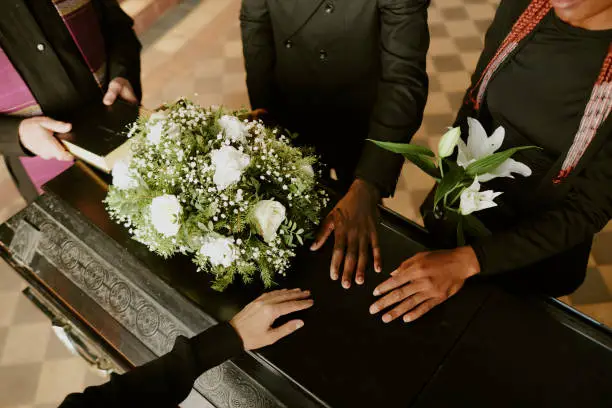
The funeral home smelled of lilies and something else—something thick and cloying that coated the back of my throat like old water and manufactured grief. Two tiny white coffins sat at the front of the chapel, heartbreakingly small, each one barely three feet long, positioned side by side as if the babies inside might take comfort in each other’s proximity even in death.
My twin boys, Oliver and Lucas, had been alive just five days ago. They were seven months old, still so impossibly small, still discovering the world with wide eyes and reaching fingers. They had just started laughing—that wet, hiccupping baby laugh that makes time stop, that makes every exhausted moment of parenthood suddenly worth it. Oliver would laugh when you tickled his belly. Lucas would laugh at absolutely nothing, just pure joy bubbling up from inside him for no reason except that he was alive and the world was new.
Now they were gone. Victims of what the coroner had provisionally ruled as Sudden Infant Death Syndrome, striking twice in one terrible night. A statistical anomaly so rare the doctors kept using words like “unprecedented” and “astronomical odds.” But statistics and odds meant nothing when you were staring at two coffins that should never have existed.
I stood in the receiving line on legs that felt like they were filled with wet sand, mechanically accepting condolences from people who wouldn’t meet my eyes for more than a second. I could feel their judgment radiating off them like heat from pavement, see it in the way they touched my hand briefly before pulling away, in the pitying looks that held more suspicion than sympathy. How does a mother let two babies die? What did she do wrong? What wasn’t she watching?
My mother-in-law, Diane Morrison, stood fifteen feet away but might as well have been on a stage, commanding every eye in the room. She wore mourning black from head to toe—an expensive designer suit with a dramatic lace veil that obscured her face but somehow amplified her theatrical sobbing. She dabbed at completely dry eyes with a monogrammed handkerchief while relatives swarmed around her like bees around their queen, patting her shoulders, murmuring sympathies about the unbearable burden she now carried, about how she would somehow find the strength to go on.
The burden she carried. As if these were her children. As if her grief trumped mine.
My husband, Trevor, stood beside his mother like a sentinel. He looked like a man who had been hollowed out from the inside, his skin stretched too tight over bones, his jaw set in a hard, brittle line that might shatter if touched. Every time he glanced in my direction, his eyes were ice. He wasn’t standing with me. He hadn’t stood with me since the moment we found our sons cold and still in their cribs at his mother’s house. He was his mother’s son first, her loyal guard dog, protecting her grief while his wife stood alone in the frozen wasteland of her own devastation.
I knew something they didn’t. My body knew it. My heart knew it with a certainty that kept me awake every night, staring at the ceiling, replaying every moment of that last evening. The police said SIDS. The doctors nodded and spoke about tragic coincidences. But my instincts—those deep, primal mother instincts that had kept humans alive for millennia—screamed murder.
I had no proof. Just a hollow, gnawing ache in my womb where life had once grown, and the memory of Diane practically begging to take the twins for the night. “You look so tired, dear,” she had said, her voice dripping with false concern. “Let me take all three children. You and Trevor can have a date night. You need to reconnect as a couple before you lose yourselves completely to these babies.”
I had been so tired. Bone-deep, soul-crushing exhausted from months of broken sleep and twin feeding schedules. I had said yes. I had handed my babies over to her. And they had come back in body bags.
Pastor John began the service, his voice a monotonous drone speaking of God’s mysterious plans and heaven’s newest angels, about how the Lord works in ways we cannot understand. Each platitude felt like a serrated knife dragging slowly across my exposed skin. I wanted to scream at him to stop, to tell him that nothing about this was part of any loving plan, that if God existed He was a sadist who snatched laughing babies from their cribs for no reason at all.
My four-year-old daughter, Emma, sat beside me in the front pew, her small legs swinging nervously, her fingers picking at the hem of her scratchy black dress—a dress I’d had to buy for this nightmare because little girls aren’t supposed to need funeral clothes. She had been at Diane’s house that night too, sleeping in the guest room. She was the only survivor of what was supposed to be a fun sleepover with Grandma.
Emma had been different since that night. Quieter. She watched Diane with wide, frightened eyes and wouldn’t let her grandmother touch her anymore. She had nightmares about “bad powder” and woke up crying for me multiple times each night, her small body shaking with terror she couldn’t articulate. When I asked her what happened at Grandma’s house, she would go very still, her eyes darting to wherever Diane was in the room, and whisper, “Grandma said it’s a secret.”
Then Diane stood up to give the eulogy, and the air in the room shifted like the pressure change before a tornado.
She approached the podium with slow, deliberate steps that suggested a woman barely holding herself together through sheer force of will. Her hands gripped the wood until her knuckles turned white, her shoulders trembling with what everyone assumed was grief. She began speaking about her “precious grandbabies” in a voice thick with emotion, about how she had prayed for their souls from the moment they were born, how she had loved them with every fiber of her being.
It was a performance. A masterclass in manipulation. And everyone in the room was buying it completely.
But then her tone changed. The grief morphed into something else—something sharp and calculated and mean.
“These babies were innocent,” Diane said, her voice growing stronger, projecting clearly to the back of the chapel. “Pure. Untouched by the sin and corruption of this world. Sometimes—and I know this is difficult to understand—but sometimes God takes the innocent to spare them from what lies ahead. He sees the future we cannot see. He sees the rot before it has a chance to set in deep. He sees the environment they would be raised in, the influences that would shape them.”
The implication hung in the air like poison gas slowly filling the room. The low murmuring in the pews stopped abruptly. People shifted uncomfortably, glancing between Diane and me, starting to understand what she was really saying.
“God knows what kind of influences might have shaped these boys had they lived,” Diane continued, her eyes boring into mine through the delicate lace of her veil, pinning me in place like a butterfly on a board. “He knew what kind of mother they had. He saw the future that awaited them, and in His infinite mercy, He showed them compassion. He took them home before they could be damaged beyond repair.”
My vision went red at the edges. A roaring sound filled my ears—the rushing of my own blood, the screaming of every nerve in my body.
“Can you shut up? Can you at least shut up on this day?”
The words tore out of my throat before I could stop them, raw and animalistic and desperate. They echoed off the vaulted ceiling, shattering the reverent silence into a thousand jagged pieces.
The chapel fell into a quiet so profound it felt like the vacuum of space, like all the oxygen had been sucked out of the room in an instant. Two hundred people stopped breathing simultaneously. Diane’s face contorted behind her veil, the mask of the grieving grandmother slipping for just a fraction of a second to reveal the predator beneath—something cold and calculating and utterly without mercy.
She descended from the podium with shocking speed for a woman who had been claiming fragility and devastation just moments before. Before I could flinch, before I could even raise my hands to protect myself, her palm connected with my cheek with a crack that echoed like a gunshot.
The pain was white-hot and immediate, but I didn’t have time to process it before she grabbed a handful of my hair, her manicured fingers twisting cruelly into the roots, yanking my head down with vicious strength. She forced me forward, bending me over until my face was inches from the nearest coffin—Oliver’s coffin, his name engraved on a small brass plate.
“You ungrateful, worthless wretch!” she hissed, her voice low and venomous, meant only for me. Then she slammed my forehead down onto the polished wood of my son’s casket.
The hollow thud of my skull against wood made Emma scream—a high, piercing sound of pure terror that cut through the shocked silence of the chapel.
Diane’s grip on my hair tightened, pulling until I felt strands ripping from my scalp. She leaned in close, her breath hot against my ear, smelling of peppermint and something rotten underneath.
“You better shut your mouth right now if you don’t want to end up in there with them,” she whispered. “I’ve done it twice. I can do it again.”
My heart stopped. I’ve done it twice. The confession, whispered in rage, confirmed everything my instincts had been screaming. But I couldn’t move, couldn’t breathe, pinned by her grip and her words and the horror of understanding.
I looked desperately toward Trevor, my eyes pleading. Help me. Please, for the love of God, help me. See what your mother is doing.
Trevor moved. For a split second, I thought he would save me. But instead, he grabbed my arm, his fingers digging into my bicep hard enough that I would find five perfect bruises there later, and he yanked me backward—not to rescue me from his mother, but to pull me away from her like I was the aggressor, like I was the problem.
“Get lost this instant!” he shouted, his face twisted with a rage I had never seen before, every word dripping with contempt. “How dare you disrespect my mother at my sons’ funeral? How dare you make a scene like this? Get out! Get out right now!”
I stared at him—this man I had married six years ago in a garden ceremony, the man who had promised before God and everyone we knew to protect me, to honor me, to stand by me in the worst moments of our lives. In the defining crisis of our marriage, when I needed him most, he had chosen his mother. The betrayal cut deeper than the slap, deeper than the grief threatening to swallow me whole. It severed something fundamental, some last thread of hope I had been clinging to that we would survive this together.
Trevor’s Aunt Pamela moved toward us, reaching for Emma with gentle hands. “Come on, sweetie,” she said softly. “Let’s go outside. You don’t need to see this.”
But Emma twisted away from her aunt’s grasp with sudden, fierce determination. Instead of running to me or letting herself be led away, she ran to the altar where Pastor John stood frozen in shock, his mouth slightly open, completely unprepared for the violence that had erupted in his sanctuary. Emma grabbed the heavy velvet fabric of his robe with both her small hands, bunching it in her fists.
The pastor looked down, his expression shifting from shock to confusion. “Emma?”
My daughter turned to face the congregation, her small chest heaving with rapid breaths. She looked at her father, then at her grandmother, her eyes holding a clarity that seemed impossible for someone so young, like she had aged years in just a few days.
“Pastor John?” Emma’s voice rang out clear as a bell in the silent church, cutting through two hundred held breaths. “Should I tell everyone what Grandma put in the baby bottles?”
The silence that followed wasn’t just quiet. It was the complete absence of sound, the kind of stillness that exists in the microsecond before catastrophe. Every head in the chapel turned toward the small girl in the black dress. Time seemed to slow, each second stretching into eternity.
Diane’s face drained of all color, going from flushed rage to ash-white in an instant. She took a stumbling step toward Emma, her hand outstretched, her voice suddenly honeyed and desperate. “Emma, sweetheart, you’re confused. You’re traumatized, baby. You don’t know what you’re saying. Come to Grandma. Come here right now.”
“No!” Emma shouted, shrinking back behind Pastor John’s legs, using him as a shield. “I’m not confused! I’m not! I saw you! I saw what you did!”
“Saw what, Emma?” Trevor asked, his voice shaking, all the anger draining out of him and being replaced by something that looked like the first creeping edge of dread. He looked at his mother, then at his daughter, a crack appearing in his wall of denial. “What did you see, baby?”
“I saw Grandma in the kitchen,” Emma said, and now that she had started, the words came tumbling out like a dam breaking, fast and desperate and unstoppable. “I came downstairs because I was thirsty and my throat hurt. Grandma was talking on the phone in the kitchen. She didn’t see me. She said mean things about Mommy. She said Mommy was bad and stupid and ruining everything. She said the babies were too expensive and they were making Daddy too tired. She said they would be better off in Heaven where they wouldn’t cost any money.”
“That is a filthy lie!” Diane shrieked, her composure completely shattered now, her carefully constructed facade crumbling. “She is making this up for attention! She’s four years old! She doesn’t know what she’s saying!”
“Then Grandma took the white powder,” Emma continued, her voice trembling but growing louder, more insistent, like she knew this was her only chance to tell the truth. “From the big jug in the garage. The blue jug with the scary skull picture on it. She poured the white powder into the special bottles—the ones with the blue tops that were just for Oliver and Lucas. She mixed it with the milk and shook them really hard. I asked her what she was doing and she jumped really high and told me it was sleeping medicine. She said it was special medicine so Mommy and Daddy wouldn’t have to worry about money anymore. She said the babies would go to sleep and then go to Heaven and everyone would be happier.”
My heart stopped. Every molecule of oxygen left the room. The blue jug in the garage. Antifreeze. She had poisoned my babies with antifreeze.
Trevor stepped forward, his face a mask of forced calm that was rapidly disintegrating, cracks spreading like a windshield about to shatter. “Mom… what is she talking about? What blue jug? We don’t keep anything in your garage. What is she—”
“Nothing!” Diane whirled on him, her eyes wild, looking around the chapel desperately for an ally, for anyone who would support her. But the relatives who had been nodding along with her eulogy just minutes ago were now backing away, horror and understanding dawning on their faces. “She’s four years old! Four-year-olds make up stories! They confuse dreams with reality! She probably saw something on TV—”
“I didn’t see it on TV!” Emma insisted, tears streaming down her face now, her small body shaking. “I saw it in real life! In Grandma’s kitchen! She gave me chocolate chip cookies after and told me it was our special secret game. She said if I told anyone, especially Mommy, that Mommy would go away forever and I would never see her again. She said it was a secret between me and her and God.”
Pastor John moved then, stepping between Diane and Emma, his expression transforming from shock to something like granite determination. “Mrs. Morrison,” he said quietly, his voice carrying the weight of absolute authority. “I think we need to pause this service immediately. Someone call the police. Right now.”
“You will do no such thing!” Diane screamed, her voice cracking, her face contorting into something ugly and desperate. “I am a pillar of this community! I have attended this church for thirty years! I have donated thousands of dollars! You would believe a confused, traumatized child over me? Over everything I’ve done for this church?”
“I believe,” Pastor John said with devastating calm, “that this child knows specific details she shouldn’t possibly know. She mentioned a blue jug with a skull—that’s antifreeze. She mentioned special bottles with blue tops. She mentioned sleeping medicine and Heaven. And if there is even the smallest chance that she is telling the truth, then those babies deserve justice. And you, Mrs. Morrison, need to answer some very serious questions.”
Trevor’s Aunt Pamela already had her phone to her ear, her hands shaking. “Yes, I’m at Riverside Chapel on Oak Street. We need police here immediately. There’s been a… I think there’s been a confession to murder. A child just— Please, just send someone now.”
Diane tried to run. She actually bolted toward the side exit like a cornered animal, her heels clicking frantically on the marble floor, her veil flying behind her. But three men from the congregation—Trevor’s cousins who had been sitting in the third row—moved to block the doors, their arms crossed, their faces hard.
She spun back around, trapped, cornered, and in that moment the mask didn’t just slip—it shattered completely. The grieving grandmother vanished. The concerned matriarch disappeared. In their place stood something cold and reptilian and utterly devoid of humanity.
“They were ruining everything!”
The confession exploded from her lips like vomit, shocking the chapel into absolute paralysis. No one moved. No one breathed.
Diane’s chest was heaving, her eyes manic, and she pointed a shaking finger directly at me with pure hatred radiating from every pore. “She was never good enough for my son! Never! She was a nobody from a nothing family with no connections and no class! She trapped Trevor with that first pregnancy—we all know it was deliberate! And we tolerated the girl, we dealt with it, we made the best of it. But then twins? Two more screaming, expensive mouths? Two more reasons for my son to work himself into an early grave providing for her mistake? Two more anchors dragging him down, keeping him from reaching his potential?”
Trevor sank to his knees in the aisle, a guttural, wounded animal sound ripping from his throat. “Mom… what are you saying? What did you do?”
“I did what needed to be done!” Diane’s voice took on a manic, self-righteous edge that made my skin crawl. “I protected my son! I protected our family from her and her parasitic children! A little antifreeze in the formula, that’s all. Sweet tasting. Completely undetectable. Just enough to stop their little hearts gently, peacefully. They didn’t suffer! I made absolutely sure of that! I’m not a monster! I held them while they went to sleep! I sang to them! I just… I just gave them back to God before they could become the burden that destroyed my son’s life!”
The chapel erupted into chaos. Screams. Gasps. Someone was sobbing. I couldn’t breathe. My vision was tunneling. Antifreeze. She had murdered my sons—my babies who laughed and reached for me and smelled like milk and powder—because she thought they were too expensive. Because she thought I wasn’t good enough. Because in her twisted, poisonous mind, dead babies were better than a daughter-in-law she deemed unworthy.
The police arrived within six minutes, sirens wailing outside like the screams I couldn’t release. They found a chapel full of witnesses and a woman who had just confessed to double infanticide in front of two hundred people. Diane tried to recant immediately, her lawyer instincts kicking in, claiming grief-induced hysteria, temporary insanity, confusion. But the damage was irreversible. Too many witnesses. Too many phones recording. Her words had been captured digitally by at least a dozen people.
They arrested her right there in front of the altar, handcuffing her while she screamed about her rights and false accusations. They read her Miranda rights over her shrieks. I watched them lead her away and felt absolutely nothing—no satisfaction, no relief. Just a vast, howling emptiness.
The investigation moved with devastating speed. Emma’s testimony, combined with Diane’s public confession, gave the police probable cause for everything. They executed a search warrant on Diane’s home within hours. They found the blue jug of antifreeze in her garage, her fingerprints all over it. They found the bottles Emma had described—special ones with blue tops that Diane had purchased separately, that she had used exclusively that night. They found her computer search history: “ethylene glycol dosage for infants,” “how much antifreeze to cause death,” “SIDS symptoms,” “undetectable poisons.”
She had researched it. Planned it. Calculated the exact amount needed to stop two tiny hearts.
The coroner ordered immediate toxicology testing, and forty-eight hours later, Detective Sarah Mitchell sat across from me in a sterile room at the police station, her eyes red-rimmed with exhaustion and vicarious trauma.
“High levels of ethylene glycol in both boys,” she said, her voice barely above a whisper. “It confirms everything Emma said. Everything. The levels were… it was deliberate. Calculated. She knew exactly how much to use.” Detective Mitchell pressed her palms against her eyes. “I have kids. I can’t… I can’t understand how someone could do this.”
I sat there feeling nothing. I was beyond tears, beyond screaming. I had entered some gray wasteland of shock where nothing could touch me anymore.
Trevor tried to call me that night. He was staying with his father, Robert, in a hotel because he couldn’t bear to be in our house. I let the call go to voicemail. He left a message that was three minutes of broken sobbing and begging.
“Sarah, please. I’m so sorry. I didn’t know. I couldn’t have known. She’s my mother. I trusted her. Please let me see Emma. Please. I need to see my daughter. I need to— please answer. Please.”
I deleted it without listening to the whole thing. He had grabbed me. He had screamed at me to leave my own sons’ funeral. He had chosen the murderer over the mother, over me, over truth. Whatever marriage we’d had died the moment he yanked me away from his mother’s assault.
The trial date was set for four months out. And I knew, with a certainty that felt like destiny, that I was going to make sure Diane Morrison never knew a moment of peace again.
The trial of The State versus Diane Morrison became a media circus. News vans set up permanent camps on my front lawn. Reporters ambushed me at the grocery store. Headlines screamed: “Grandmother Poisons Twin Grandsons,” “The Antifreeze Killer,” “Death by Grandma.”
I attended every single day of the trial. I sat in the front row of the gallery where Diane could see me every time she turned her head. I wanted her to look into my eyes, to see the woman whose life she had tried to obliterate, to know that I was still standing while her world burned.
Diane’s defense attorney, a shark in a pencil skirt named Patricia Hendrix who had built a career on defending the indefensible, tried every strategy in the book. She argued temporary insanity. She argued that the confession at the funeral was the result of a psychotic break induced by overwhelming grief. She brought in psychiatrists who testified about how elderly people could experience delusional episodes. She tried to paint Diane as a confused, mentally unwell woman who had snapped under pressure.
But the prosecution was methodical and merciless. They played the 911 call from the funeral. They played the cell phone video recorded by Trevor’s cousin Marcus—the video where Diane, in crystal-clear audio, explained that she had poisoned the babies because they were burdens, because they were expensive, because they were ruining her son’s life.
They brought in toxicology experts who explained exactly how ethylene glycol poisoning worked, how it caused acute kidney failure, how the babies would have seemed sleepy at first, then lethargic, then unresponsive. How they would have suffered despite Diane’s claims that it was peaceful.
They presented her search history, her purchase history for the antifreeze, the bottles, everything.
But the linchpin of the entire case was Emma.
The judge, a stern woman named Justice Ellen Ramirez, made the compassionate decision to allow Emma to testify via closed-circuit television to spare her the additional trauma of being in the same room as her grandmother. I sat in a small viewing room with Emma, holding her hand while she answered the prosecutor’s gentle, age-appropriate questions, her small face broadcast on monitors throughout the courtroom.
“Emma,” the prosecutor asked softly, “can you tell us what you saw at Grandma’s house that night?”
Emma’s voice was small but steady, and I had never been more proud of her courage. “I saw Grandma put white powder in Oliver and Lucas’s bottles. She used the blue jug from the garage. She told me it was special sleeping medicine to help Mommy and Daddy not worry about money.”
“Did Grandma tell you to keep this a secret?”
“Yes. She said if I told Mommy, Mommy would go away forever and I’d be all alone.”
The jury—twelve strangers holding our fate and justice in their hands—looked physically ill. Two women were crying silently.
Patricia Hendrix tried her best during cross-examination, attempting to gently discredit Emma by suggesting she might have been confused or coached.
“Emma, sweetie,” Hendrix said in her most soothing voice, “isn’t it possible that maybe your mommy talked to you about what to say? Maybe she helped you remember things?”
Emma looked directly into the camera with those clear, honest eyes that had never learned to lie convincingly. “No. Mommy didn’t tell me to say anything. When I told Mommy what I saw, she threw up. She cried for a really long time. It was Grandma who told me not to tell. Grandma said it was our special secret.”
That exchange sealed Diane’s fate.
When Trevor took the stand, he was a broken shell of the man I’d married. He had lost at least thirty pounds, his clothes hanging off his frame, his eyes hollow and haunted. The prosecutor asked him about his mother’s attitude toward our family, toward me specifically, toward the twins.
“She… she hated the idea of more children,” Trevor whispered, his voice so quiet the judge had to ask him to speak up. “When Sarah got pregnant with twins, Mom said it was a disaster. She said we’d never recover financially. She told me more than once that I needed to ‘handle it’ or God would handle it for me.”
“And at the funeral,” the prosecutor pressed, “when your wife was being physically assaulted by the defendant, whose side did you take?”
Trevor’s face crumpled. “My mother’s. I… I grabbed Sarah. I yelled at her. I told her to leave. I chose wrong. I chose so wrong.”
“Why did you choose your mother over your wife?”
“Because I’d been choosing her my whole life,” Trevor said, tears streaming down his face. “Because she raised me to believe that questioning her was betrayal. That she was always right. That anyone who opposed her was the enemy. I was programmed, and I didn’t even know it.”
The jury deliberated for only two and a half hours—barely enough time to eat lunch.
When the bailiff read the verdict—”We find the defendant, Diane Morrison, guilty of two counts of murder in the first degree”—Diane didn’t cry. She didn’t scream or collapse. She simply turned in her seat and stared at me with pure, concentrated hatred, her lips curling into something that wasn’t quite a smile.
Judge Ramirez sentenced her to two consecutive life terms without the possibility of parole. “You murdered two helpless infants because of your own twisted sense of entitlement,” the judge said, her voice ringing with righteous anger. “You deserve to spend every remaining day of your life behind bars.”
As the bailiffs moved to take Diane away, she leaned slightly toward me as she passed, close enough that only I could hear her whispered words.
“You think you’ve won? You’ll never be free of me. I’ll haunt you forever.”
I looked her dead in the eye, my voice steady and cold. “I’m already free. You’re the one who’s going to die in a cage, forgotten and alone. My sons will be remembered with love. You’ll be remembered as a monster.”
Her face twisted, and then she was gone, led away in handcuffs to spend the rest of her life in a cell.
But I wasn’t done. Not even close.
Trevor’s father, Robert Morrison, had stood by Diane throughout the entire ordeal. He had paid for her expensive defense team. He had given television interviews calling his wife a saint who had been wrongly accused. He had known about Diane’s hatred for me, about her comments about the twins being burdens, about her veiled threats, and he had done absolutely nothing to stop her. His silence had been permission. His cowardice had enabled murder.
Robert had money—millions accumulated through real estate investments and retirement accounts. I wanted it. All of it.
I hired James Cardwell, the most aggressive civil attorney in the state, a man known for absolutely destroying defendants in wrongful death suits. Our first meeting lasted three hours.
“We’re going to take everything,” James told me, his eyes glinting with the kind of righteous fury that comes from a genuinely good lawyer being handed a genuinely evil defendant. “The house where your babies were murdered, the cars, the investment portfolios, the retirement accounts. We’re going to leave him with nothing but the clothes on his back and the knowledge that his cowardice cost him everything.”
Robert tried to settle before the civil case even went to trial. He showed up at my door on a rainy Tuesday morning, looking old and pathetic and broken.
“Please, Sarah,” he begged from my porch, his voice shaking. “I didn’t know she would do this. You have to believe me. I thought she was just venting, just complaining. I never imagined— please don’t destroy me. I’m an old man. I’ll give you half. Half of everything. Just please.”
I stood in my doorway, looking at this man who had raised the woman who murdered my children, who had enabled her every toxic impulse, who had prioritized his own comfort over the safety of his grandsons.
“You knew she hated me,” I said, my voice quiet but hard as diamond. “You heard her call my children burdens. You heard her say they’d be better off dead. And you laughed it off. You told Trevor I was being too sensitive when I tried to set boundaries. Your silence gave her permission. Your cowardice paved the road to my sons’ graves.”
“I’ll give you half,” he repeated desperately. “Three million dollars. You’d never have to work again.”
“I don’t want half, Robert. I want it all. I want you to feel a fraction—just a tiny fraction—of the helplessness I felt putting my babies in the ground. Of knowing someone deliberately killed them and got away with it for even one second. You’re going to lose everything, and you’re going to spend whatever years you have left knowing you helped murder your own grandchildren.”
I closed the door in his face.
The civil jury awarded me 5.2 million dollars in damages. Robert was forced to liquidate everything. His business, sold. His investment portfolio, liquidated. The house where my babies were poisoned was sold at auction. He ended up in a subsidized one-bedroom apartment in the worst part of town, working part-time at a hardware store at seventy years old because his entire retirement had been seized.
Trevor was collateral damage in all of this, and I felt no guilt. With his family’s money gone and his name forever associated with the “Antifreeze Grandmother,” he spiraled. He lost his job at the financial firm where he’d worked for eight years—they couldn’t have someone with his baggage representing their company. He started drinking, showing up at the house at odd hours, begging to see Emma.
But Emma was terrified of him. The court-appointed psychologist, Dr. Sandra Hernandez, ruled unequivocally that contact with Trevor was detrimental to Emma’s healing.
“She doesn’t see you as her father anymore,” Dr. Hernandez told him during one of their sessions, which I attended via conference call. “She sees you as the man who yelled at her mother when Grandma was hurting her. She sees you as someone who chose the bad person. Until she’s older and can process this differently, contact would be retraumatizing.”
Eventually, Trevor signed over full custody. He moved to Oregon to start over where nobody knew his last name, where he could pretend to be someone new. He sends a card on Emma’s birthday every year. She throws them away without opening them.
I don’t feel guilty. Not for a second.
Three years have passed since that funeral.
Emma is seven now, in second grade, where her teacher says she’s reading at a fifth-grade level and has a particular talent for art. She’s resilient in the way children can be, brilliant and kind and surprisingly funny. But she still has nightmares about white powder and blue jugs. We see Dr. Hernandez every Thursday afternoon without fail. We talk about “big feelings” and how adults can make terrible choices that aren’t children’s fault. We talk about how her brothers loved her even though they were babies.
We moved to a different town, two hours away from all the memories and reporters and whispers. We changed our last names legally—we’re no longer Morrisons. We’re Sarah and Emma Chen now, my mother’s maiden name, starting fresh.
I used part of the settlement money to buy a house with a massive backyard that backs up to woods. It’s quiet here. Peaceful. Far from the ghosts.
Last spring, on what would have been the boys’ third birthday, Emma and I planted a garden.
“This one is for Oliver,” she said seriously, patting the dirt around the roots of a young maple sapling. “He would have liked climbing trees when he got bigger. And this one is for Lucas.” She planted the second maple tree right next to the first. “So they can grow together.”
We planted two red maple trees side by side, exactly six feet apart. They’re growing strong now, their roots digging deep into the earth, their branches reaching toward the sky. Every year on the boys’ birthday, we have a picnic under those trees. We eat chocolate cupcakes with vanilla frosting—Oliver’s favorite combination, I’m certain, though I’ll never really know. We talk about them. I tell Emma stories I’ve told her a hundred times before about how Oliver had a serious little frown when he was concentrating, and Lucas would laugh at absolutely nothing, pure joy bubbling up from inside him.
We keep them alive the only way we can—through memory and love and maple trees that will outlive us all.
People ask me sometimes if I have closure. They ask if seeing Diane in prison brings me peace, if the money helps, if time has healed the wounds.
The truth is there is no closure when your children are murdered. There is no “moving on” from burying babies who should have grown up to be men. There is only moving forward, one foot in front of the other, breathing in and out because that’s what survival looks like. The hole in my heart is exactly the shape of two little boys, and it will never be filled. I’ll carry it until the day I die.
But I’m not broken.
Diane Morrison tried to destroy me. She tried to paint me as an unfit mother, to erase me from the narrative of my own family, to grind me into dust so thoroughly that I would cease to exist as anything but a cautionary tale. She wanted to break me so completely that there would be nothing left.
Instead, she forged me into steel.
She sits in a cell today at the women’s correctional facility, spending twenty-three hours a day in isolation after three separate inmates attacked her—apparently even criminals have a code about people who murder babies. She’ll die there, forgotten by everyone except as the answer to a trivia question about female killers. Her husband is destitute and alone, estranged from his remaining family. Her son is broken and exiled. Her legacy is nothing but ash and horror.
But mine?
I look out my kitchen window, coffee cup warm in my hands. Emma is in the backyard, running through the grass between her brothers’ trees, chasing a monarch butterfly. She’s laughing—loud and free and joyous—and the sound is the most beautiful thing I’ve ever heard.
I survived. My daughter survived. We built a life full of color and light and possibility, a life that Diane Morrison can never touch again, no matter how many threats she whispers or letters she sends that I burn without reading.
My boys are gone, and that will hurt until I stop breathing. But in their death, they saved us. They revealed the monster before she could take Emma too. They gave us the truth when it mattered most. In some terrible, cosmic way, they protected their sister even though they couldn’t protect themselves.
I place my hand against the cool glass of the window, watching my daughter play in the dappled shade of her brothers’ trees.
“We’re okay,” I whisper to the empty kitchen, to the memory of two babies who never got to grow up. “We made it. I promise I’m taking care of her. I promise I’m taking care of me. You can rest now.”
And for the first time since that terrible night, surrounded by the evidence of our survival—the house we own, the trees we planted, the daughter who’s healing—I believe it.
We’re going to be okay.

Sophia Rivers is an experienced News Content Editor with a sharp eye for detail and a passion for delivering accurate and engaging news stories. At TheArchivists, she specializes in curating, editing, and presenting news content that informs and resonates with a global audience.
Sophia holds a degree in Journalism from the University of Toronto, where she developed her skills in news reporting, media ethics, and digital journalism. Her expertise lies in identifying key stories, crafting compelling narratives, and ensuring journalistic integrity in every piece she edits.
Known for her precision and dedication to the truth, Sophia thrives in the fast-paced world of news editing. At TheArchivists, she focuses on producing high-quality news content that keeps readers informed while maintaining a balanced and insightful perspective.
With a commitment to delivering impactful journalism, Sophia is passionate about bringing clarity to complex issues and amplifying voices that matter. Her work reflects her belief in the power of news to shape conversations and inspire change.