The Air Conditioner
My husband often disappeared on business trips. He would leave for weeks, sometimes without even warning me. The apartment was filled with a heavy, suffocating silence, and only his strict rules echoed constantly in my mind.
One of them—never call repairmen, especially for the air conditioner, and never try to fix it myself. No matter what I asked, he always replied the same way: “Don’t touch it. I’ll fix it.”
When Viktor left again and his silver SUV disappeared around the corner, I felt relief for the first time in months.
But suddenly the air conditioner screeched, thumped, and shut down completely. Already the fifth time that week. My husband kept fixing it, and it kept breaking again.
The room suddenly became stifling hot. The children—Maya, seven, and Daniel, five—lay on the floor, sluggish and sleepy, their faces shiny with sweat.
I called Viktor. He didn’t pick up right away. In the background I heard voices, a woman’s laughter… and a child’s cry.
“The air conditioner broke again,” I said. “I’m calling a repairman. You clearly don’t know how to fix it.”
“Don’t you dare!” he shouted sharply. “No repairmen. No one is allowed inside the house. I said so!”
The call dropped so abruptly it felt intentional.
I stood still for a minute, staring at my phone. Something in his voice—the panic beneath the anger—made my stomach turn. But the apartment was sweltering. Maya was already complaining of a headache. I couldn’t let my children suffer because of Viktor’s irrational rules.
I opened the app anyway and ordered a repairman. An hour later, a man with a toolbox rang the doorbell.
He was maybe fifty, with graying hair and kind eyes. He introduced himself as Dmitri and got straight to work, examining the unit with practiced efficiency.
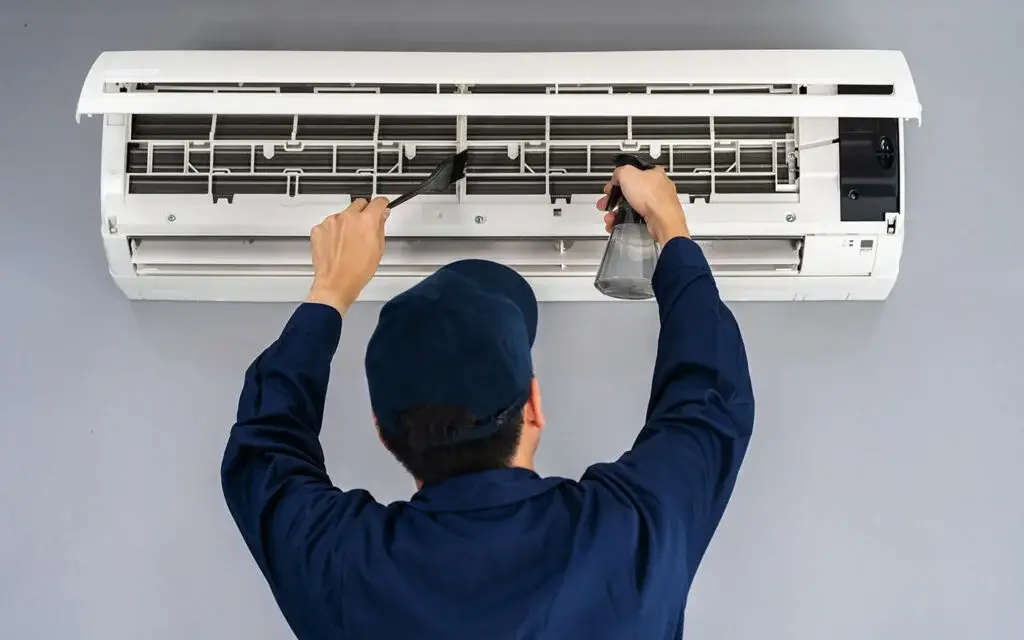
He set up a ladder, climbed up, and carefully removed the air conditioner’s cover.
And then his expression changed. His eyes became hard, tense. As if he had seen something he was never meant to see.
“Ma’am, has anyone worked on this air conditioner before?” he asked.
“Yes, my husband. Many times. It breaks almost every day.”
“Where are your children?” he asked quietly but sharply.
“In the kitchen… Is something wrong?”
He took a respirator out of his toolbox, put it on as if preparing for dangerous work, and only then looked back at me. There was panic in his eyes.
“Take your children and get out of this house right now. Immediately.”
I couldn’t breathe. “What did you find?”
He pulled out a flat block from the top of the air conditioner, covered in dust. At first I thought it was a filter. But inside I saw tiny diodes. A small lens. Soldering. An antenna.
“This is not part of the air conditioner,” he said. “It’s a camera. A good one. It records 24/7 and sends the data to a remote server.”
My hands turned cold. “You mean… someone was watching us?”
“For a long time,” Dmitri replied. “And professionally. This equipment costs thousands. Someone installed this deliberately and has been monitoring everything that happens in this room.”
I stood there, unable to breathe. Thoughts spun in my head: Viktor’s long “business trips,” his sudden fits of jealousy, his strange questions about who visited me during the day, his accusations that seemed to come from nowhere. And the fact that he forbade me to touch the air conditioner, as if it hid something sacred.
“There might be more,” Dmitri said quietly. “Do you have other air conditioners? Smoke detectors? Anything your husband insisted on installing himself?”
My throat tightened. “The bedroom. There’s another unit in the bedroom.”
Dmitri climbed down from the ladder, his face grim. “Ma’am, I need to be honest with you. What I found here—this isn’t amateur work. Whoever installed this knows what they’re doing. And if there’s one camera, there are probably more.”
I thought about every moment of the past two years. Every conversation I’d had with my mother. Every time I’d changed clothes. Every private moment with my children.
Someone had been watching it all.
“Should I call the police?” I whispered.
Dmitri hesitated. “That’s your decision. But first, let’s check the rest of the house. You need to know the full extent of this before you decide what to do.”
Over the next hour, Dmitri methodically checked every room. The bedroom air conditioner contained an identical camera. The smoke detector in the hallway—another one. Even the digital clock Viktor had given me for our anniversary had a tiny lens embedded in the frame.
By the time Dmitri finished, we’d found six cameras. Six different angles covering nearly every room in the apartment.
“The only place without surveillance is the bathroom,” Dmitri said. “Either he drew a line there, or he ran out of equipment.”
I sat on the sofa, my whole body shaking. Maya and Daniel were still in the kitchen, oblivious, watching cartoons on a tablet.
“Why would he do this?” I asked. “Why would my own husband spy on me?”
Dmitri placed all the cameras carefully in a plastic bag. “That’s something only he can answer. But in my experience, people who go to these lengths—they’re either extremely paranoid, or they’re hiding something themselves.”
The woman’s laughter from the phone call echoed in my mind. The child’s cry.
“He’s cheating on me,” I said suddenly. “Isn’t he? He suspects me of what he’s doing himself.”
Dmitri didn’t answer, but his expression confirmed everything.
“What should I do?” I asked.
“Document everything. I’ll write you a detailed report about what I found. Take photos. Get copies of everything. And then you need to decide—do you confront him, or do you go straight to a lawyer?”
After Dmitri left, I sat in the kitchen for a long time, keeping my children close. Maya noticed something was wrong.
“Mama, why are you crying?”
“I’m not crying, sweetheart. Just tired.”
But I was crying. Silent tears that I wiped away quickly so they wouldn’t see.
Only then did I fully understand that Viktor’s “business trips” were just a cover. He lived with another woman, cheated on me, and at the same time spied on me. He suspected me of exactly what he himself was doing.
The projection of a guilty conscience.
I spent that evening making copies of everything. I photographed the cameras. I saved Dmitri’s detailed report. I went through Viktor’s study—something I’d never dared to do before—and found a laptop hidden in his desk drawer.
The laptop was password-protected, but Viktor wasn’t as clever as he thought. The password was Maya’s birthdate.
What I found inside made my blood run cold.
Folders. Dozens of folders. Each one labeled with a date. Inside each folder—hours upon hours of video footage. Me cooking dinner. Me helping Maya with homework. Me folding laundry. Me crying after our last argument.
Every moment of my life for the past two years, catalogued and stored like evidence in an investigation.
But there was another folder. This one simply labeled “H.”
I opened it.
Photos. Hundreds of photos. A woman—younger than me, prettier, with long blonde hair and a bright smile. In some photos, she was alone. In others, she was with Viktor. And in several, she was holding a baby.
A baby that looked exactly like Viktor.
I stared at the screen until my vision blurred. He had another family. Another life. While I was here, trapped in an apartment filled with his cameras, he was building a completely different world.
The phone on his desk started ringing. I almost didn’t answer it. But something made me pick it up.
“Viktor?” A woman’s voice. Young, uncertain. “Viktor, are you there? Sasha has been crying all night. I don’t know what to do. When are you coming back?”
I stood there holding the phone, listening to this woman—this other woman—beg for my husband’s attention.
“He’s not here,” I said quietly.
Silence. Then: “Who is this?”
“His wife.”
The line went dead immediately.
I sat down heavily in Viktor’s chair, my hands shaking. The apartment suddenly felt even smaller, the walls closing in. How long had this been going on? How long had he been living this double life?
My phone buzzed. Viktor.
Is the AC fixed?
I stared at the message for a long time before typing my response.
Yes. The repairman found something interesting. We need to talk when you get back.
Three dots appeared, then disappeared. Then appeared again.
What did he find?
Everything.
No response for five minutes. Then:
I can explain.
I’m sure you can. Come home. Now.
I’m three hours away.
Then you’d better drive fast.
I hung up and looked at my children, still watching cartoons, still innocent, still unaware that their entire world was about to change.
I called my sister, Irina. She answered on the first ring.
“Can we stay with you tonight?” I asked.
“Of course. What’s wrong?”
“Everything. I’ll explain when I get there. I just need to get the kids out of here before Viktor comes back.”
Twenty minutes later, I had packed bags for all three of us. I left Viktor a note on the kitchen table.
We’ll be at Irina’s. Don’t come there. Don’t call. Don’t text. When I’m ready to talk to you, I’ll let you know.
P.S. I found the laptop.
At Irina’s apartment, I finally broke down. I told her everything—the cameras, the other woman, the baby, the years of surveillance. She held me while I cried, her face growing harder with each detail.
“You’re getting a lawyer,” she said. “Tomorrow. First thing. And you’re documenting everything.”
“I already did.”
“Good. Because this man doesn’t deserve a second of sympathy. He doesn’t deserve an explanation or a conversation. He deserves to lose everything.”
That night, I couldn’t sleep. I kept thinking about all the moments he’d watched. All the times I’d cried alone, thinking I had privacy, thinking I was safe in my own home.
Every argument we’d had where he seemed to know exactly what to say to hurt me—because he’d been studying me, analyzing me, learning my weaknesses through hours of footage.
Every time he’d accused me of things I hadn’t done—projection, guilt, paranoia from his own betrayal.
My phone buzzed constantly. Viktor calling, texting, leaving voicemails. I didn’t answer. Finally, at 2 AM, I listened to one.
“Please, just let me explain. It’s not what you think. I can explain everything. Please, just call me back. Please.”
But his voice had no power over me anymore. The spell was broken. I saw him clearly now—not as my husband, not as the father of my children, but as a stranger who had violated every boundary, every trust, every sacred space.
The next morning, I met with a lawyer named Svetlana Petrova. She was in her fifties, with steel-gray hair and eyes that had seen everything.
I showed her the cameras. The report from Dmitri. The laptop. The photos of the other woman and baby.
She listened without interruption, taking notes, her expression growing darker.
“This is one of the worst cases of domestic surveillance I’ve seen,” she said finally. “What your husband did is illegal on multiple levels. Unauthorized surveillance, violation of privacy, potential child endangerment.”
“Can I use this in divorce proceedings?”
“Absolutely. In fact, this evidence is so damaging that I doubt he’ll even fight the divorce. He’ll want to settle quickly and quietly before any of this becomes public.”
“What about the other woman?”
“That’s separate. But if he has another child, that complicates the financial settlement significantly. Any money he spent supporting that household came from marital assets. You have a claim to that.”
Over the next week, Svetlana worked quickly. She filed for divorce, filed for full custody, filed restraining orders. She sent Viktor a letter detailing everything we’d found, along with copies of all the evidence.
His response came through his own lawyer—a weak, desperate attempt at damage control.
Client denies all allegations. Claims surveillance was for home security purposes. Requests opportunity for mediation.
Svetlana’s response was brutal.
Your client installed six hidden cameras in a marital home without his wife’s knowledge or consent. He recorded her in private moments for over two years. He maintained a second household and fathered a child with another woman while married. There will be no mediation. See you in court.
But we never got to court. Two days before the hearing, Viktor’s lawyer called with a settlement offer.
Viktor would give me the apartment, full custody of the children, seventy percent of all marital assets, and child support well above the legal requirement.
In exchange, I would agree to seal all records and evidence, never speak publicly about the surveillance, and never contact the other woman.
“He’s terrified,” Svetlana said. “If this becomes public, it destroys him professionally and personally. He’s willing to pay almost anything to make this go away.”
“What do you think I should do?”
“Take the deal. It’s more than you’d get in court, and it’s guaranteed. Plus, you never have to see him again except for supervised visitation with the kids.”
I thought about it for a long time. Part of me wanted him to suffer publicly, wanted everyone to know what he’d done. But a larger part of me just wanted it to be over.
“I’ll take it. But I want one more thing.”
“What?”
“I want him to write a letter to Maya and Daniel explaining why we’re divorcing. I want him to take responsibility. I want it in his own words, admitted, documented, so when they’re older and ask questions, I can show them the truth.”
Svetlana smiled grimly. “I’ll add it to the terms.”
Three weeks later, the divorce was final. Viktor signed everything. He wrote the letter—a pathetic, self-pitying document that tried to minimize his actions while technically admitting to them.
I never read it all the way through. I sealed it in an envelope and put it in my safe deposit box. Someday, when Maya and Daniel are old enough to understand, I’ll give it to them. They deserve to know the truth about their father.
The last time I saw Viktor was at the final signing. He looked terrible—unshaven, dark circles under his eyes, twenty pounds lighter. He tried to speak to me.
“I’m sorry. I’m so sorry. I never meant—”
“You meant every bit of it,” I said quietly. “You planned it. You executed it. You watched me for two years like I was a subject in an experiment. Don’t insult me by pretending it was anything other than what it was.”
“Can we at least—”
“No. We can’t. You’ll see your children every other weekend, supervised, as agreed. You’ll pay your support. And you’ll stay away from me for the rest of my life.”
He opened his mouth, then closed it. There was nothing left to say.
Six months later, I’m sitting in my apartment—my apartment now, solely mine—watching Maya and Daniel play. The air conditioner runs smoothly. Dmitri came back and installed a completely new system, one I personally watched him set up, one I know contains no cameras, no surveillance, no hidden eyes.
Every smoke detector is new. Every clock. Every electronic device. I went through the entire apartment with Dmitri and replaced anything that could possibly contain surveillance equipment.
The apartment feels different now. Lighter. Like I can finally breathe.
Viktor sends child support on time. His supervised visits happen at a neutral location with a court-appointed supervisor. He never tries to contact me directly. Whatever guilt or shame he feels, he keeps to himself.
I heard through mutual friends that his relationship with the other woman fell apart. Apparently, she didn’t react well to discovering he’d been married with children the whole time. The baby—his baby—is being raised by her alone now, with Viktor paying support for two families.
He destroyed everything trying to control everything.
Meanwhile, I’m rebuilding. I got a better job. I’m saving money. I’m in therapy working through the trauma of those two years of surveillance. Maya and Daniel are adjusting, attending counseling, learning that sometimes families change but love doesn’t.
On bad days, I still think about all those hours of footage. All those moments he stole from me. All that privacy violated. But on good days—and there are more good days now—I remember that I survived. I found the cameras. I got out. I protected my children.
And I’m free.
The apartment is truly mine now. The air conditioner runs smoothly. The children laugh without being recorded. And I can finally, after two long years, live my life without invisible eyes watching my every move.
Sometimes Maya asks about her father. “Why doesn’t Daddy live with us anymore?”
And I tell her a version of the truth appropriate for a seven-year-old. “Daddy made some choices that hurt our family. But he still loves you, and you’ll still see him. Some people just can’t live together anymore.”
“Because he was mean to you?”
I think about the cameras, the other woman, the years of lies and surveillance. “Yes, sweetheart. Because he was mean.”
“I’m glad he’s gone,” she says simply. “You smile more now.”
And she’s right. I do smile more. I laugh more. I breathe more easily.
Three months ago, I started dating again. Nothing serious—just coffee dates, getting to know people, remembering what it feels like to be seen as a person rather than a subject under surveillance.
His name is Alexei. He’s kind, patient, understanding when I explain why I need to take things slowly, why I panic if I see a camera, why I’m sometimes suspicious of kind gestures.
“You’ve been through something terrible,” he said on our third date. “Take all the time you need. I’m not going anywhere.”
I don’t know if it will work out with Alexei. I don’t know if I’m ready for anything serious. But I know that I’m healing. Slowly, painfully, but genuinely.
And I know that I’ll never again ignore my instincts. When Viktor forbade me from touching the air conditioner, some part of me knew something was wrong. I just didn’t trust that instinct.
I trust it now.
Last week, I received a message from an unknown number. When I opened it, I saw a photo of Viktor with yet another woman—not the mother of his other child, but someone new. Someone young and smiling, someone who doesn’t know yet what she’s getting into.
For a moment, I considered warning her. Considered reaching out, woman to woman, to tell her to run.
But I didn’t. Some lessons you can only learn by living through them. Some people you can’t save because they don’t know they need saving yet.
Instead, I deleted the message and blocked the number.
Viktor is no longer my problem. His patterns, his lies, his need for control—none of it touches me anymore.
I’m free.
And that freedom, I’ve learned, is worth more than any settlement, any apology, any explanation he could ever offer.
The air conditioner hums quietly in the background. A sound that once filled me with dread now brings comfort. It’s just a machine now. Nothing more.
I’m home. Truly home. In an apartment with no hidden cameras, no invisible eyes, no secrets buried in the machinery.
Just me and my children and the life we’re building together.
And it’s enough.
It’s more than enough.
It’s everything.

Lila Hart is a dedicated Digital Archivist and Research Specialist with a keen eye for preserving and curating meaningful content. At TheArchivists, she specializes in organizing and managing digital archives, ensuring that valuable stories and historical moments are accessible for generations to come.
Lila earned her degree in History and Archival Studies from the University of Edinburgh, where she cultivated her passion for documenting the past and preserving cultural heritage. Her expertise lies in combining traditional archival techniques with modern digital tools, allowing her to create comprehensive and engaging collections that resonate with audiences worldwide.
At TheArchivists, Lila is known for her meticulous attention to detail and her ability to uncover hidden gems within extensive archives. Her work is praised for its depth, authenticity, and contribution to the preservation of knowledge in the digital age.
Driven by a commitment to preserving stories that matter, Lila is passionate about exploring the intersection of history and technology. Her goal is to ensure that every piece of content she handles reflects the richness of human experiences and remains a source of inspiration for years to come.