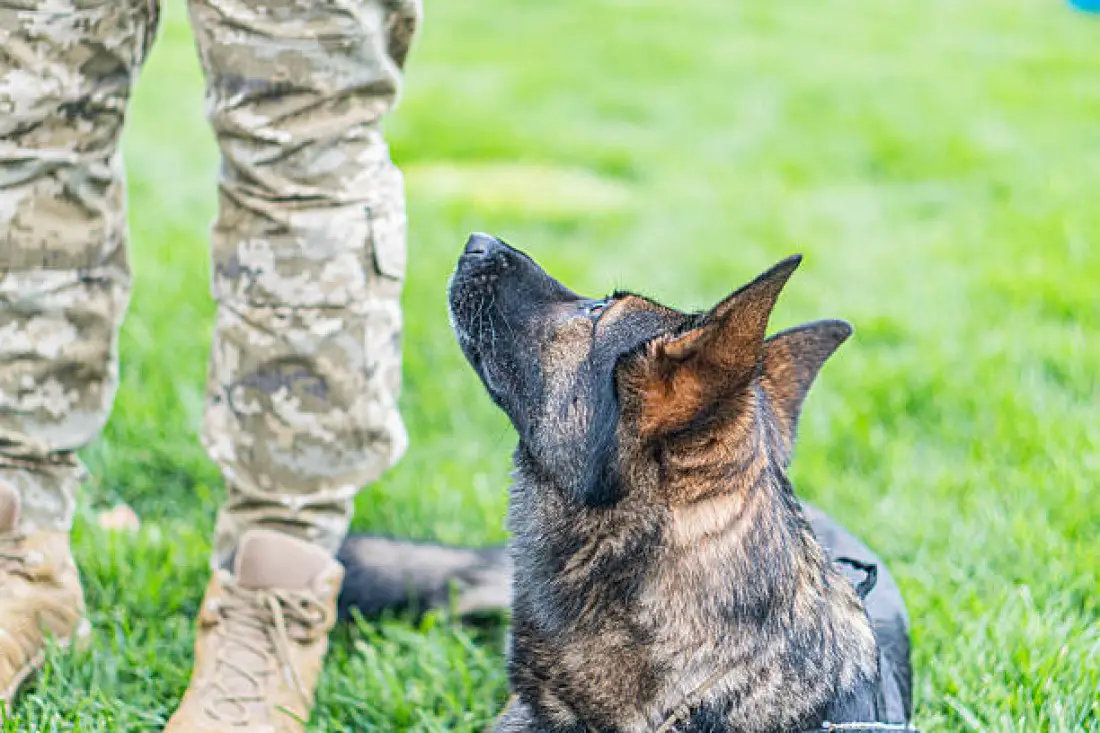
The Arizona sun hung low over the desert mountains, painting the sky in shades of copper and violet that reminded Jack Reynolds of the countless sunsets he’d watched from guard towers in places whose names he still couldn’t say aloud. He stood in the parking lot of the Desert View Animal Shelter, his worn combat boots rooted to the cracked asphalt, staring at the peeling paint on the building’s facade as if it held answers to questions he hadn’t yet learned to ask.
Two years. It had been two years since Jack had come home from his final deployment, two years since he’d traded his rifle for a tool belt and his unit for an empty house on the outskirts of town. Two years of waking up at 0400 with his heart hammering against his ribs, two years of jumping at car backfires and avoiding crowded spaces, two years of feeling like he’d left the most important parts of himself scattered across foreign desert sand.
His older sister Emily believed a dog might help. She’d said it gently over coffee at her kitchen table three weeks ago, her voice careful in that way people used when they were afraid you might shatter if they spoke too loudly. “Just go look,” she’d urged, placing her hand over his. “You don’t have to commit to anything. Just see if there’s a connection.”
Jack hadn’t told her that he’d already had the most important connection of his life, and that connection had been ripped away from him the day Rex—his military working dog, his partner, his brother in everything but blood—had been declared medically retired after taking shrapnel meant for Jack’s squad. He hadn’t told her that he’d tried for months to adopt Rex through proper channels, only to be buried in bureaucracy and red tape until he’d finally given up, assuming some other handler had claimed the dog he’d trained with, fought beside, and loved more than he’d thought possible to love an animal.
But Emily had been persistent, and Jack had learned long ago that his sister possessed a stubbornness that could wear down mountains. So here he stood, thirty-seven years old and feeling ancient, preparing to walk through doors he wasn’t sure he wanted opened.
The shelter was small and desperately underfunded, with chain-link fencing patched in places with wire and determination. The smell hit him first when he entered—disinfectant layered over the unmistakable scent of too many dogs in too little space, underlaid with the sharp tang of fear that animals carry when they’ve been abandoned by the humans they trusted. The cacophony of barking started immediately, a chorus of desperation that made Jack’s chest tighten with empathy he hadn’t known he still possessed.
A young woman with kind eyes and a shelter volunteer badge that read “Maria” greeted him at the front desk. She had the look of someone who’d seen too much suffering and had decided to fight it anyway, one adoption at a time.
“Mr. Reynolds? Your sister called ahead. I’m so glad you came.” Her smile was genuine, and Jack found himself relaxing fractionally. “Let me show you around.”
They walked through narrow aisles lined with kennels, and Jack observed each occupant with the same careful attention he’d once used to scan buildings for threats. Some dogs hurled themselves at the chain-link, desperate for attention and connection. Others cowered in corners, eyes haunted by whatever circumstances had landed them here. A pit bull mix with scarred ears wagged hopefully. A small terrier yapped with the frantic energy of someone who’d learned that noise was the only currency that mattered.
None of them called to something in Jack’s chest. None of them felt like what he’d lost.
He was preparing to make polite excuses and leave when Maria stopped walking. “Actually, Mr. Reynolds, there’s one more dog you should meet. He came to us three weeks ago from a rural shelter in New Mexico. German Shepherd. He’s… well, he’s been through something. We can tell he’s had training—military or police, we think—but he doesn’t trust easily. Most people who’ve looked at him have walked away.”
Jack felt his pulse quicken. “Where is he?”
Maria led him to a quieter section of the shelter, away from the main kennels, to an area that seemed reserved for special cases. In the last enclosure, pressed into the far corner as if trying to disappear into concrete and shadow, was a large German Shepherd with distinctive black-and-tan markings.
Jack’s heart stopped. Then it started again, hammering so hard he thought Maria might hear it.
“Rex.” The name came out as a whisper, barely audible even to his own ears.
The dog’s head lifted slowly, ears swiveling toward the sound. For one breathless moment, Jack thought he saw recognition flash in those dark eyes—the same eyes that had watched his six in Kandahar, that had alerted to IEDs that would have killed half his squad, that had looked at him with complete trust and unwavering loyalty through the worst days of his life.
But then the moment passed. Rex’s gaze went flat again, empty and distant. There was no tail wag, no joyful bark of recognition, no scramble to reach the human who’d once been his entire world. Just the hollow stare of a dog who’d learned that connections were temporary and trust was dangerous.
“He doesn’t recognize me,” Jack said, the words scraping past the sudden constriction in his throat. He took an involuntary step backward, feeling the rejection like a physical blow.
Maria looked between them, confusion evident on her face. “You know this dog?”
Jack couldn’t speak for a moment. When he finally found his voice, it came out rough and unsteady. “He was my partner. Three years in Afghanistan. He saved my life more times than I can count. They told me he was placed after his medical retirement, but I could never find out where. I thought…” He stopped, unable to finish the sentence.
Maria’s eyes went wide. “Oh my God. That explains so much.” She fumbled with the kennel latch. “Let me get him out. Maybe if you have some time together—”
“No,” Jack said quickly, then softer: “No, I mean… can we take this slow? I don’t want to overwhelm him.”
But even as he said it, he knew he couldn’t walk away. Not from Rex. Not after finding him against impossible odds, even if the dog had no idea who Jack was anymore.
They moved to an outdoor enclosure where Rex could have space without feeling trapped. The German Shepherd emerged from his kennel with the careful, calculating movements of someone who’d learned that environments could turn hostile without warning. He was thinner than Jack remembered, and there were new scars—a puckered line along his right hind leg, a notch missing from one ear. The marks of trauma written on a body that had already given so much.
Jack sat down on a bench and waited. He didn’t approach, didn’t try to touch, just existed in the space and let Rex come to terms with his presence on the dog’s own timeline. It was the same technique they’d used during their initial bonding training, a lifetime ago when they were both younger and the world had seemed less complicated.
Rex circled the perimeter of the enclosure, nose working, processing information Jack couldn’t access. The dog paused occasionally to glance at him, head tilted in that way shepherds do when they’re trying to solve a puzzle. But he maintained distance, maintaining the safety buffer that trauma had taught him to require.
“I know you’re in there somewhere,” Jack said quietly, not caring if Maria thought he was crazy for talking to a dog that wouldn’t respond. “I know this is hard. God, I know. But I’m not leaving you again. Not this time.”
They sat like that for nearly an hour, Jack patient and unmoving, Rex hypervigilant and tense. When Maria finally suggested they call it a day, Jack made a decision that felt simultaneously reckless and absolutely necessary.
“I’m taking him home.”
Maria blinked. “Mr. Reynolds, I should tell you—he has severe anxiety. He doesn’t sleep well. He startles easily. The behavioral assessment suggests he might never fully—”
“I don’t care,” Jack interrupted, his voice carrying a certainty he hadn’t felt in years. “He came back to me. I don’t know how or why, but he did. And I’m not going to abandon him just because he’s having a hard time. He never gave up on me. I won’t give up on him.”
Maria studied his face for a long moment, then nodded slowly. “Alright. Let’s do the paperwork.”
The drive to Jack’s house on the outskirts of town was silent except for the hum of the truck’s engine and the occasional shift of Rex in the back seat. Jack had spread out a blanket for him, but the dog remained tense, eyes fixed on the passing landscape as if memorizing escape routes.
Jack’s property was modest—a small single-story ranch house with peeling paint and a yard that had gone to desert scrub and determined weeds. It wasn’t much, but it was quiet and isolated, which was exactly what Jack had needed when he’d bought it with his discharge money. Now he wondered if the isolation had been healthy or if he’d just been hiding.
He opened the truck door and let Rex exit on his own terms. The dog took his time, sniffing the air, evaluating this new environment with the thoroughness of someone who’d learned that complacency killed. Jack unlocked the front door and propped it open, then walked inside without looking back, trusting that Rex would follow when he was ready.
Inside, Jack had prepared a corner of the living room with a new dog bed, water and food bowls, and a few toys he’d picked up that morning in a burst of optimistic planning. Rex entered eventually, moving with the slow caution of someone navigating a minefield, and stationed himself near the door—closest exit identified, defensive position established.
“Home sweet home,” Jack said with a lightness he didn’t feel. “I know it’s not much, but it’s safe. I promise you that.”
That first night was long and difficult. Rex wouldn’t eat, wouldn’t drink, wouldn’t settle. He paced the house until well after midnight, checking windows and doors, mapping the territory, refusing to let his guard down. Jack sat on his couch and watched, recognizing in the dog’s behavior every symptom he saw in his own mirror—hypervigilance, lack of trust, inability to find peace even in safe spaces.
Around 0300, exhausted beyond reason, Jack went to his bedroom and left the door open. “You know where I am if you need me,” he called out softly.
Hours later, he woke to find Rex lying in the hallway just outside his door—not close, but closer than he’d been. It was a small thing, but Jack felt hope kindle in his chest for the first time in months.
The days that followed established a rhythm. Jack learned to move slowly, to telegraph his intentions, to respect Rex’s space while consistently offering presence. He talked to the dog constantly, narrating his actions, sharing stories from their time overseas, reminiscing about missions and moments that Rex showed no sign of remembering.
“Remember that night in Kandahar when you found the IED under the market stall?” Jack asked while preparing dinner on the fourth day. “The whole squad thought I was being paranoid when I called for EOD, but you knew. You always knew.”
Rex, lying in his corner, didn’t respond. But his ears swiveled toward Jack’s voice.
Progress came in increments so small they might have been invisible to anyone who wasn’t paying attention with the intensity of someone whose life depended on it. On day five, Rex ate a meal while Jack was still in the room. On day seven, he took a treat from Jack’s outstretched hand, though he immediately retreated to his safe space afterward. On day nine, during a walk around the property, Rex walked slightly closer to Jack’s side for nearly thirty seconds before his anxiety spiked and he dropped back.
Each tiny victory Jack catalogued like a soldier counting ammunition—each one precious, each one potentially life-saving.
The breakthrough came during a summer storm. Jack was on the porch, coffee growing cold in his hands, watching lightning illuminate the desert in stark, dramatic flashes. Thunder rolled across the sky, deep and ominous, and Jack felt the familiar tightness in his chest that storms always brought—too much like artillery, too reminiscent of nights spent under mortar fire.
He heard Rex approach and looked down to find the German Shepherd standing beside him, not quite touching but closer than he’d ventured before. The dog’s nose was lifted, scenting the ozone-sharp air, and something in his posture had shifted—less hunted, more alert in the way Jack remembered from their deployments.
“You always loved storms,” Jack said softly, afraid to move and break whatever spell was being woven. “Used to drive the other handlers crazy because you’d get excited instead of nervous.”
As if confirming this, Rex’s tail moved—not a full wag, but a small, tentative movement that made Jack’s vision blur with unexpected tears.
On impulse, Jack reached into his pocket and pulled out the old training whistle he’d carried since his discharge. He’d kept it as a talisman, a connection to a past he couldn’t quite release. Now he brought it to his lips and gave two short, sharp blasts—the recall signal he and Rex had used hundreds of times.
Rex’s entire body went rigid. His ears snapped forward, and he turned to stare at Jack with an intensity that stole breath. For a long moment, nothing happened. Then, slowly, Rex took one step forward. Then another. Then he closed the distance between them and pressed his body against Jack’s leg.
Jack’s hand dropped to Rex’s head, fingers finding the familiar contours of skull and ears, the exact pressure points that used to calm the dog during stressful operations. “There you are,” he whispered. “I knew you were in there somewhere. Welcome back, partner.”
The rebuilding wasn’t instantaneous or miraculous. Trust, once shattered, requires patient reconstruction, piece by careful piece. But after that storm, something had shifted in the foundation. Rex began to seek Jack’s presence rather than merely tolerating it. He started sleeping closer to Jack’s bed. He played fetch with an old tennis ball, his movements stiff at first but gradually loosening as muscle memory overcame traumatic hesitation.
Dr. Patel at the local veterinary clinic confirmed what Jack had suspected—the microchip registered to military kennel records, the distinctive tattoo inside Rex’s ear marking him as a certified military working dog. She provided a contact for a veterans’ service dog program that could help with official certification if Jack wanted to pursue it.
“He’s been through hell,” she said bluntly after the examination. “But so have you, from what I understand. Maybe you’re exactly what each other needs.”
The gas leak incident happened on a Tuesday evening three weeks after Jack had brought Rex home. Jack was preparing a simple dinner when the power flickered and died, plunging the house into darkness. He lit candles and continued cooking, not thinking much of it—monsoon season meant temperamental electricity.
Rex appeared in the kitchen doorway, body language immediately alerting Jack that something was wrong. The dog’s posture was tense but focused, nose working the air with the intensity Jack recognized from their explosive detection training. Before Jack could ask what was wrong, Rex moved to the stove and pawed at the base, then sat and stared at Jack—the exact alert behavior they’d drilled endlessly overseas.
Jack’s training kicked in automatically. He dropped to his knees and heard it immediately—the faint hiss of gas escaping from a burner valve that hadn’t fully closed. He shut it off, threw open windows, and called the gas company while his heart hammered with the realization of what might have happened if Rex hadn’t alerted him.
The technician who arrived forty minutes later confirmed it: “Another few hours and this place could have been a disaster. Lucky your dog caught it.”
Jack looked at Rex, who sat calmly nearby, and felt something unlock in his chest that he hadn’t even known was closed. “Yeah,” he said quietly. “Lucky isn’t the right word. He wasn’t being lucky. He was doing his job. Still doing his job, even after everything.”
That night, for the first time since coming home, Rex slept at the foot of Jack’s bed. And for the first time in two years, Jack slept through the night without nightmares.
The invitation to the Veterans Day ceremony at the local high school came via Emily, who’d somehow gotten herself appointed to the planning committee. “They’re doing a tribute at the football game,” she explained over the phone. “Honoring local veterans at halftime. I know crowds aren’t your thing, but I think it might be good for you. You could bring Rex.”
Jack’s first instinct was to refuse. Crowds still made his skin crawl, made his pulse spike, made him want to scan for threats and exits and elevated positions. But then he looked at Rex, who was lying on the living room rug with one of his new toys, and thought about how the dog had been facing his fears daily.
“Okay,” he heard himself say. “We’ll come.”
The high school stadium was a revelation of small-town Americana—string lights wrapped around goalposts, the smell of hot dogs and popcorn mixing with desert air, families spread across bleachers with blankets and team colors. The American flag rippled against a darkening sky, and the marching band’s brass section glinted under the lights as they warmed up with scattered notes that would eventually cohere into patriotic anthems.
Jack and Rex found seats high in the bleachers near an aisle—exit strategy always mapped, old habits impossible to break. Rex settled into a down position beside Jack’s legs, body angled so that he created a physical barrier between Jack and the crowd. It was classic blocking behavior, something Jack hadn’t taught him here at home but that Rex had apparently remembered from their service days.
A small boy with grass-stained knees and untied sneakers approached cautiously. “Mister? Is that a police dog?”
Jack looked at Rex, who watched the child with calm attention. “He was a military working dog. He’s retired now.”
“Can I pet him?”
“Not right now, buddy. He’s working—he’s helping me out. But you can wave at him if you want.”
The boy waved enthusiastically. Rex’s tail thumped once against the bleacher, and the boy’s face lit up with joy before he scampered back to his parents.
When the national anthem began, Jack stood on unsteady legs, his hand automatically moving to his heart. The band found the notes they’d been chasing all week, and the stadium fell into that particular American silence—not empty but full, weighted with shared meaning and divergent understandings of what the flag represented. Jack felt Rex lean slightly against his leg, a warm pressure that said I’m here, you’re not alone, and suddenly the lights weren’t too bright and the crowd wasn’t too close and his breathing was steady.
At halftime, the announcer called all veterans to the field. Jack hadn’t expected this, hadn’t prepared for it, and his first instinct was to decline. But Emily found him in the crowd, her eyes bright with emotion, and said, “Please. Let them thank you. Let them see Rex.”
So Jack descended the bleachers, Rex at his side, and walked across freshly mowed grass that smelled like every football field in America. Other veterans joined the line at the fifty-yard line—older men with VFW caps, younger women in service organization shirts, a scattering of different eras and different wars united by shared experience. The applause rolled across the stadium, genuine and sustained, and Jack felt something in his chest that might have been pride or might have been grief or might have been both.
Then chaos erupted near the concession stand. A mother’s voice rose in panic—”Lily! Lily, where are you?”—and the ambient hum of the crowd shifted into something sharp and urgent. Jack turned instinctively toward the sound, and so did Rex.
The dog’s ears pricked forward, his entire body focusing with the intensity Jack recognized from their detection work. Without waiting for a command, Rex moved toward the commotion, pulling slightly against the leash but not frantically—methodical, purposeful, trained.
Jack followed, trusting the dog’s instincts. They reached the frantic mother, who was describing her daughter to a cluster of concerned adults. “Blue hoodie, unicorn design, five years old, brown pigtails—”
“Her name is Lily?” Jack asked.
“Yes, please, I can’t find her—”
Rex was already working, nose lifting to parse the complex mixture of scents—popcorn, spilled soda, hot dogs, hundreds of humans, and somewhere in that olfactory chaos, one small girl. He moved along the concourse with Jack close behind, weaving through legs and coolers and groups of teenagers, until he stopped at the base of the bleacher section. He looked up at Jack once, then ducked underneath the metal structure.
Jack dropped to his hands and knees, flashlight from his phone illuminating the dim space beneath the stands. There, wedged between support beams with her shoelace caught on a bolt, was a little girl in a blue unicorn hoodie, tears streaming down her face.
“Hey there,” Jack said gently. “I’m Jack, and this is Rex. We’re going to get you back to your mom, okay?”
Rex low-crawled forward and gently nosed the child’s hand. She looked at the dog, hiccupped, and wrapped her arms around his neck. Jack freed her shoelace and guided them both out into the light, where the mother collapsed in relieved sobs.
The stadium erupted in applause—louder than before, genuine and overwhelming. The announcer’s voice crackled over the PA system: “Ladies and gentlemen, looks like we have a real hero here tonight. Let’s hear it for Jack Reynolds and his partner Rex!”
Jack stood frozen in the moment, Rex pressed against his leg, the little girl safely returned to her mother’s arms, and felt something fundamental shift. This was what he and Rex had trained for—not glory or recognition, but the simple, profound act of finding the lost and protecting the vulnerable.
The mayor materialized with handshakes and promises of formal recognition. Emily was crying openly, pride written across every feature. But what mattered most to Jack was the way Rex looked up at him—alert, present, engaged, the fog of trauma finally lifted enough to reveal the exceptional dog who’d always been there underneath.
They drove home in comfortable silence, the kind of quiet that didn’t need filling. Jack pulled into his driveway as the desert moon rose huge and silver over the mountains, casting shadows that looked almost friendly.
“We did good tonight,” he said to Rex, who was sitting upright in the back seat, tongue lolling in what Jack chose to interpret as a smile.
Inside, Jack filled Rex’s water bowl and settled onto the couch with a sense of bone-deep exhaustion that was somehow different from the fatigue he’d carried for two years. This was earned tiredness, the kind that came from doing something difficult and meaningful rather than just surviving another day.
Rex drank deeply, then padded over to the couch and, after a moment’s hesitation, jumped up beside Jack. It was the first time he’d voluntarily sought this level of closeness, and Jack froze, afraid to move and shatter the moment.
“Is this okay?” Jack asked softly, slowly lifting his hand to rest on Rex’s back.
The dog sighed—a deep, releasing sound—and settled his head on Jack’s thigh.
They sat like that for a long time, man and dog, both wounded and both healing, both finding in each other what they hadn’t been able to find alone: purpose, connection, and the permission to finally come home from the war that had never really ended.
Jack thought about the long road that had led them both to this moment—deployments and explosions, separations and reunions, trauma and slowly-won trust. He thought about the impossibility of finding Rex in that shelter, the improbability of rebuilding what had been broken, the miracle of small victories accumulated over weeks of patient work.
“I missed you,” Jack whispered into the quiet house. “Every single day, I missed you.”
Rex’s tail thumped against the couch cushion.
Outside, the desert night settled in with the particular silence that comes after storms pass, and inside, two veterans found the beginning of the peace they’d both been seeking. It wasn’t a perfect peace—there would still be hard days, flashbacks, moments when the world felt too sharp and too loud. But they’d face those days together, the way they’d faced everything else: one step at a time, one quiet victory at a time, trusting the bond that had survived war and distance and the thousand small ways trauma tries to steal what matters most.
Jack fell asleep there on the couch, his hand resting on Rex’s warm fur, and for the first time in longer than he could remember, he dreamed of nothing but a vast, open desert where he and his dog walked side by side under endless sky, finally home in all the ways that mattered.

Sophia Rivers is an experienced News Content Editor with a sharp eye for detail and a passion for delivering accurate and engaging news stories. At TheArchivists, she specializes in curating, editing, and presenting news content that informs and resonates with a global audience.
Sophia holds a degree in Journalism from the University of Toronto, where she developed her skills in news reporting, media ethics, and digital journalism. Her expertise lies in identifying key stories, crafting compelling narratives, and ensuring journalistic integrity in every piece she edits.
Known for her precision and dedication to the truth, Sophia thrives in the fast-paced world of news editing. At TheArchivists, she focuses on producing high-quality news content that keeps readers informed while maintaining a balanced and insightful perspective.
With a commitment to delivering impactful journalism, Sophia is passionate about bringing clarity to complex issues and amplifying voices that matter. Her work reflects her belief in the power of news to shape conversations and inspire change.