The first thing I need you to understand is that my sister Gwendolyn has always been the golden child. Not in the affectionate way some families joke about favoritism, but in the soul-crushing, undeniable way that shapes every interaction, every holiday, every moment of your childhood until you can barely remember what it feels like to be seen.
Growing up in our household meant accepting an unspoken hierarchy where Gwendolyn occupied the throne and I existed as background scenery—present but irrelevant, necessary but unimportant. Our mother, Patricia, treated her like a precious heirloom passed down through generations, something to be displayed and protected and celebrated. She treated me like an obligation she’d reluctantly accepted, a duty she performed without enthusiasm or warmth.
Our father, Donald, followed Patricia’s lead in everything. He never once questioned her priorities, never once stood up for me when Gwendolyn would steal my belongings or sabotage my friendships or claim credit for my accomplishments. His silence was its own form of rejection, possibly more painful than Patricia’s active preference because at least her favoritism was honest in its cruelty.
My earliest memory of this dynamic involves my seventh birthday party. Patricia had planned what should have been a magical celebration—a princess theme with elaborate decorations, a three-tier cake from an expensive bakery, and a magician hired to entertain my classmates. I remember feeling special for once, worthy of attention and effort. That feeling lasted approximately forty minutes.
Gwendolyn, who was nine at the time and should have understood that birthdays belonged to the person being celebrated, threw herself on the floor in the middle of the party and screamed that she wanted presents too. Not just one present as a gesture—she wanted her own pile of gifts, her own moment of unwrapping and exclaiming and being photographed.
Instead of explaining that my birthday was my special day, that Gwendolyn would have her own celebration in two months, Patricia rushed out to the nearest toy store and returned with shopping bags full of expensive items. Gwendolyn opened her unearned presents before I could even blow out my candles, beaming with satisfaction while my friends watched in confusion. The photographs from that party tell the story perfectly—Gwendolyn positioned in the center of every shot, surrounded by torn wrapping paper and bows, while I stand at the edges looking small and forgotten.
That pattern established itself early and never wavered. When I made the honor roll in sixth grade, bringing home a report card with straight A’s that I’d worked incredibly hard to achieve, Patricia glanced at it for approximately five seconds before returning to her magazine. When Gwendolyn passed a math class she’d been failing—barely squeaking by with a D-minus—our parents threw her a congratulatory dinner at the most expensive restaurant in town. They invited extended family, ordered champagne, made toasts celebrating her “academic comeback.” I sat at that table pushing pasta around my plate, wondering what I would have to accomplish to warrant even a fraction of that enthusiasm.
My high school graduation gift was a card containing fifty dollars and Patricia’s signature without any personal message. Gwendolyn’s graduation gift, despite her significantly lower grades and complete lack of college plans, was a brand-new car. Not used, not practical—a brand-new convertible in her favorite color with custom leather seats and a premium sound system. Donald presented it to her with tears in his eyes, telling her how proud he was of the woman she was becoming.
I stood in the driveway watching this presentation, my fifty-dollar bill folded in my pocket, and felt something inside me go quiet and cold. That was the moment I understood with absolute clarity that nothing I did would ever be enough, that the game was rigged from the start, that I was fighting for crumbs of affection from people who had already decided I didn’t deserve the whole meal.
High school brought its own particular torments. Gwendolyn joined the cheerleading squad during her sophomore year, and Patricia immediately transformed into the ultimate stage mother. She attended every practice, organized fundraisers that consumed weeks of her time, sewed custom accessories for the uniforms with meticulous care. The kitchen table disappeared under fabric and sequins and ribbon for months.
That same year, I auditioned for the school play and landed the lead role in our spring production of “Our Town.” It was a significant achievement—dozens of students had tried out, and the drama teacher told me I had real talent, that I should consider studying theater in college. I was so excited to tell my parents, imagining for one foolish moment that this might be the thing that finally made them proud.
Patricia’s response was to ask whether rehearsals would interfere with my ability to drive Gwendolyn to cheerleading practice. Donald said “that’s nice” without looking up from his newspaper. Neither of them attended a single performance. Not opening night, not closing night, not the special Sunday matinee where the cast received awards and recognition.
Donald did show up for opening night, arriving late and sitting in the back row. But halfway through the second act, Gwendolyn texted that she needed a ride home from a party, and he simply stood up and walked out. I saw him leave from the stage, saw the empty seat where my father should have been, and somehow delivered the rest of my lines without crying.
The summer before my senior year, I worked three jobs simultaneously. Morning shifts at a coffee shop that opened at five a.m., afternoon hours at a bookstore in the mall, and weekend evenings babysitting for a family down the street whose three children were exhausting but paid well. I was awake before dawn and fell into bed after midnight most days, my hands perpetually smelling like espresso and my feet aching from standing for twelve-hour stretches.
Every single dollar I earned went into a savings account I had opened without telling my parents. I understood instinctively that my future would depend entirely on my own efforts, that no college fund existed with my name on it, that I would receive no parental contribution toward tuition or housing or books. The bank statements I received each month showed my balance growing—five thousand, then eight thousand, then twelve thousand—and each number represented hours of my life traded for the independence I knew I’d need.
Gwendolyn spent that same summer lounging by our neighborhood pool, charging designer clothes and accessories to Patricia’s credit card, and totaling a car our parents had given her in what she called a “minor accident” but which the insurance company classified as reckless driving. She blamed the other driver, of course. She always blamed someone else. And our parents always believed her without question.
My college applications consumed every spare moment of my senior year. I applied to twelve schools, researching each one thoroughly, tailoring my essays to highlight what I could offer their specific programs. I requested recommendation letters from teachers who had actually witnessed my dedication and capability. I filled out financial aid forms with meticulous accuracy, understanding that scholarships were my only pathway to higher education.
When acceptance letters arrived that spring, I sorted through them alone in my bedroom. Boston University offered a nearly full scholarship based on my academic record and demonstrated financial need. The irony wasn’t lost on me—my parents’ refusal to save anything for my education had actually helped my application, since their income went almost exclusively toward maintaining Gwendolyn’s lifestyle rather than building any college fund.
I accepted Boston University’s offer and told my parents over dinner one evening. Patricia said “that’s far away” with clear disapproval. Donald asked how I planned to pay for what the scholarship didn’t cover, as if the answer wasn’t obvious after watching me work three jobs all summer. Gwendolyn asked if I’d have a roommate, then launched into a story about her friend’s sister’s terrible roommate situation that dominated the rest of the meal.
No one said congratulations. No one said they were proud of me. No one acknowledged that getting into Boston University with a full scholarship was an actual achievement worth celebrating.
College became my escape route, my opportunity to build an identity separate from the shadow Gwendolyn cast over everything. The physical distance—over nine hundred miles between Boston and our hometown—allowed me to finally breathe without the constant weight of comparison crushing me.
I discovered strengths I hadn’t known I possessed. Professors praised my analytical thinking and writing ability. Classmates sought my friendship for genuine reasons rather than to get closer to my more popular sister. I joined clubs and organizations, took on leadership roles, made the Dean’s List every semester. My confidence grew incrementally, like a plant that had finally been moved into sunlight after years in darkness.
After graduation, I landed a position at a prestigious marketing firm in Chicago. The starting salary exceeded my expectations, and within three years, I’d been promoted twice. My apartment overlooked Lake Michigan, all floor-to-ceiling windows and modern furniture I’d selected myself. My social circle consisted of intelligent, accomplished people who valued me for who I was rather than tolerating me out of family obligation. Life finally felt like it belonged to me.
But holidays remained a minefield. Each year, I would return home carrying hope like fragile cargo, believing that surely this time would be different, that distance and success might have shifted the family dynamics. And each visit would shatter that hope within hours of my arrival.
Thanksgiving of my sophomore year stands out with particular clarity. I had just completed a brutal midterm season, earning straight A’s despite working twenty hours a week at the campus library to cover my expenses. I was exhausted but proud, looking forward to a few days of rest and maybe, finally, some recognition from my parents.
Patricia greeted me at the door with barely concealed irritation. “Oh good, you’re here,” she said without any warmth. “Gwendolyn invited several friends to join us for dinner, so they’ll need your bedroom. We’ve set up an air mattress in the basement for you.”
I spent that Thanksgiving holiday sleeping on a deflating air mattress in our unfinished basement, shivering under a thin blanket while strangers occupied my childhood bedroom. When I came upstairs Thanksgiving morning, the guest bathroom was occupied, and one of Gwendolyn’s friends was using my shower, my shampoo, my towels. Patricia told me not to be selfish when I expressed frustration.
Christmas brought similar disappointments year after year. Gifts for Gwendolyn would pile beneath the tree like offerings at an altar—designer handbags, expensive jewelry, the latest electronics, clothes with tags from stores I couldn’t afford to browse. My presents typically fit into a single small box: a generic sweater in the wrong size, a gift card to a restaurant chain that didn’t exist in Boston, and a card containing twenty dollars with Patricia’s signature but no personal message.
The year I graduated college, my Christmas gift was a set of dish towels. Dish towels. Gwendolyn received a week-long trip to the Bahamas.
After that, I stopped going home for holidays entirely. Patricia didn’t even notice my absence until February, when she called to ask why I hadn’t responded to a group text about Easter plans. The group text, I discovered, had been sent to everyone in the family except me. She claimed it was an oversight, a technological error, her phone acting strangely. I accepted the excuse without argument because fighting for acknowledgment only exhausted me further, and I’d learned that some battles aren’t worth the energy they consume.
Then I met Nathan.
He walked into my office for what was supposed to be a routine business meeting, and something in the atmosphere shifted. Tall and lean with warm brown eyes and an easy smile, Nathan possessed a quiet confidence that drew me in immediately. Our professional discussion about a potential collaboration between his company and mine extended into dinner, then drinks at a bar overlooking the river, then a walk along the waterfront where we talked until the sun began rising over the lake.
He listened to me in a way I’d never experienced before, asking thoughtful questions and actually remembering my answers, building on what I’d shared rather than just waiting for his turn to speak. Our relationship developed naturally over the following months. Nathan understood my complicated family history without judgment or attempts to minimize it. He held me when old wounds resurfaced and celebrated my victories with genuine, unrestrained enthusiasm.
When he proposed after two years together, kneeling in the same spot where we’d watched our first sunrise, I accepted with tears streaming down my face and my heart feeling like it might burst. For the first time in my entire life, someone had chosen me first. Not as a consolation prize, not as a backup option, not as the acceptable alternative—but as the person they wanted most in the world.
Nathan’s family embraced me with a warmth that felt almost foreign after a lifetime of conditional acceptance. His mother, Rosemary, welcomed me into her kitchen and taught me recipes that had been passed down through three generations, treating each lesson like a precious gift she was honored to share. His father, Thomas, asked about my career with genuine interest, listening to my answers and offering thoughtful insights based on his own business experience. His younger brother, Peter, joked that Nathan had finally found someone good enough to join their family, and the teasing felt affectionate rather than cruel.
Holiday dinners at their home felt like glimpses into an alternate reality where daughters were valued simply for existing, where achievements were celebrated without comparison, where love flowed freely without conditions or scorekeeping. The contrast made my own family’s treatment even more stark and painful.
Nathan witnessed it firsthand during the one and only time I brought him home to meet Patricia and Donald. I’d warned him extensively about what to expect, but seeing it proved different than hearing about it. We’d barely arrived when Gwendolyn showed up unannounced with her latest boyfriend, and suddenly the carefully planned dinner meant to introduce my serious partner to my parents became a showcase for Gwendolyn’s newest acquisition.
Patricia interrogated Gwendolyn’s boyfriend about everything—his job, his family background, his education, his five-year plan, his intentions toward her daughter. She asked Nathan only whether he wanted more potatoes. Donald gave the boyfriend a full tour of his workshop in the garage, a space he’d never once invited me to enter despite my childhood requests to learn woodworking. Nathan held my hand under the table throughout the meal, squeezing gently each time the slight became more obvious, offering silent support when words would have only made things worse.
On the drive back to Chicago, Nathan pulled over at a rest stop halfway home and turned to face me directly. “I finally understand,” he said quietly. “I finally understand why you were hesitant to introduce me to them, why you change the subject when family comes up, why you flinch slightly whenever your phone shows your mother’s name. And I want you to know something.”
He took both my hands in his. “We’re going to build our own family. One founded on respect and kindness and choosing each other every single day. What they’ve done to you your entire life—it’s not normal, it’s not acceptable, and it’s not going to continue. You deserve better than crumbs of affection from people who should love you unconditionally.”
I cried harder that night than I had since childhood, releasing decades of accumulated grief and disappointment and hope I’d been too afraid to fully acknowledge. Nathan held me in that rest stop parking lot until my tears subsided, promising over and over that I was worthy of real love, that my family’s inability to see my value reflected their limitations rather than my worth.
Planning the wedding became my passion project. Nathan and I agreed on an elegant celebration that reflected who we were as a couple—sophisticated but warm, traditional yet deeply personal. We selected a historic venue outside Chicago, a restored mansion with gardens and a ballroom that could accommodate two hundred guests. We hired a renowned caterer whose reputation for excellence matched our vision. We budgeted eighty thousand dollars for a day we would remember forever, and every decision brought me joy because it represented the life I had built entirely on my own, far from the family that had always made me feel worthless.
I debated whether to invite Patricia, Donald, and Gwendolyn at all. Nathan left the decision entirely to me, supporting whatever choice I made without pressure or judgment. His parents offered to walk me down the aisle if Donald refused, a gesture that moved me beyond words and made me wish even more desperately that these kind, generous people had been my parents from birth.
Ultimately, I decided to extend the invitation because some naive part of me still harbored hope that things might be different. Perhaps seeing my success, my happiness, my loving partnership would finally earn Patricia’s respect. Maybe Donald would express pride in the daughter he had largely ignored. Possibly, Gwendolyn would set aside her competitiveness for one day and simply be happy for me.
That hope was foolish, but hope often is.
The nine-month engagement period revealed exactly how little had changed. Patricia called exactly once during the entire planning process, and that single conversation centered entirely on whether Gwendolyn could bring a plus-one despite not being in a relationship at the time. She never asked about the venue, my dress, the flowers, the menu, or any detail that might indicate genuine interest in her daughter’s wedding.
Donald’s involvement consisted of forwarding a single email about tax deductions for wedding expenses—information that didn’t even apply to our situation, suggesting he hadn’t bothered reading it before sending it along.
Meanwhile, I fielded constant calls from Rosemary, who wanted to help with everything from addressing invitations to selecting centerpieces. She flew to Chicago twice during the planning process—once for dress shopping, spending an entire day visiting boutiques until we found the perfect gown, and once for a tasting at our chosen caterer, where she carefully evaluated each menu option and offered thoughtful feedback. These mother-daughter experiences that should have belonged to Patricia became precious memories with a woman who had known me for less than three years but loved me more genuinely than my own mother ever had.
Six months before the wedding, I received an unexpected call from my aunt Darlene, Patricia’s younger sister. She had heard about the engagement through family gossip and wanted to offer her congratulations. Our conversation stretched for two hours as she shared observations about Patricia’s favoritism that I had always suspected but never had confirmed by someone outside my immediate family.
Aunt Darlene revealed that Patricia had resented me from the moment I was born—a colicky baby who demanded attention she didn’t want to share with anyone except Gwendolyn, who had been her focus for two years before my arrival disrupted the dynamic. The favoritism hadn’t developed gradually over time; it had been installed from my first breath, baked into our family structure before I was old enough to understand what was happening.
“Your mother saw you as competition for Gwendolyn’s spotlight,” Aunt Darlene explained, her voice heavy with old regrets. “She couldn’t stand the idea that people might pay attention to anyone except her favorite daughter. So she made sure you were always positioned as less important, less deserving, less everything. And your father went along with it because he’s never stood up to Patricia about anything in forty years of marriage.”
Aunt Darlene attended my wedding with her husband and their two adult children. She sat in the front row on my side of the aisle, beaming with the pride that should have radiated from my actual parents. Her presence reminded me that family could be chosen as well as inherited, that biology didn’t guarantee love or loyalty or even basic decency.
The wedding preparations proceeded smoothly for months. Gwendolyn accepted her invitation without requesting any special role, which genuinely surprised me. She didn’t demand to be a bridesmaid, didn’t try to insert herself into the planning process, didn’t create drama about her seating assignment or meal selection. This unusual restraint should have alarmed me—Gwendolyn had never been content with simply attending an event when she could make it about herself instead. But I was so busy with final preparations that I chose to interpret her silence as maturity, as genuine happiness for my milestone.
I should have known better.
Three weeks before the ceremony, Gwendolyn called to ask what color she should wear as a guest. I appreciated what seemed like considerate attention to wedding etiquette, and I mentioned casually that guests typically avoided white at weddings, but any other color would be lovely.
She laughed—a light, friendly laugh that sounded almost sisterly. “Oh, I know that! I was actually looking at this gorgeous emerald green dress that would really complement my skin tone. Just wanted to make sure you hadn’t chosen green for your bridesmaids or anything.”
The conversation felt almost normal, almost like what sisters might sound like in functional families. I hung up feeling cautiously optimistic, wondering if maybe, finally, we were moving toward a healthier relationship.
The morning of my wedding arrived with perfect autumn weather. Golden October sunlight filtered through crimson and amber leaves, making everything look like it had been touched by magic. I prepared in the bridal suite surrounded by my closest friends, my maid of honor Kristen who had been my college roommate, and two cousins from Nathan’s side who had become dear friends during our engagement.
Makeup artists and hairstylists worked their magic while champagne flowed and laughter filled the room. Someone had created a playlist of my favorite songs, and we sang along while getting ready, the joy feeling pure and uncomplicated.
Patricia had declined to join us, claiming she needed to help manage arriving guests and ensure the venue was properly prepared. Her absence felt more like relief than rejection. I had stopped expecting her participation in anything that mattered to me years ago.
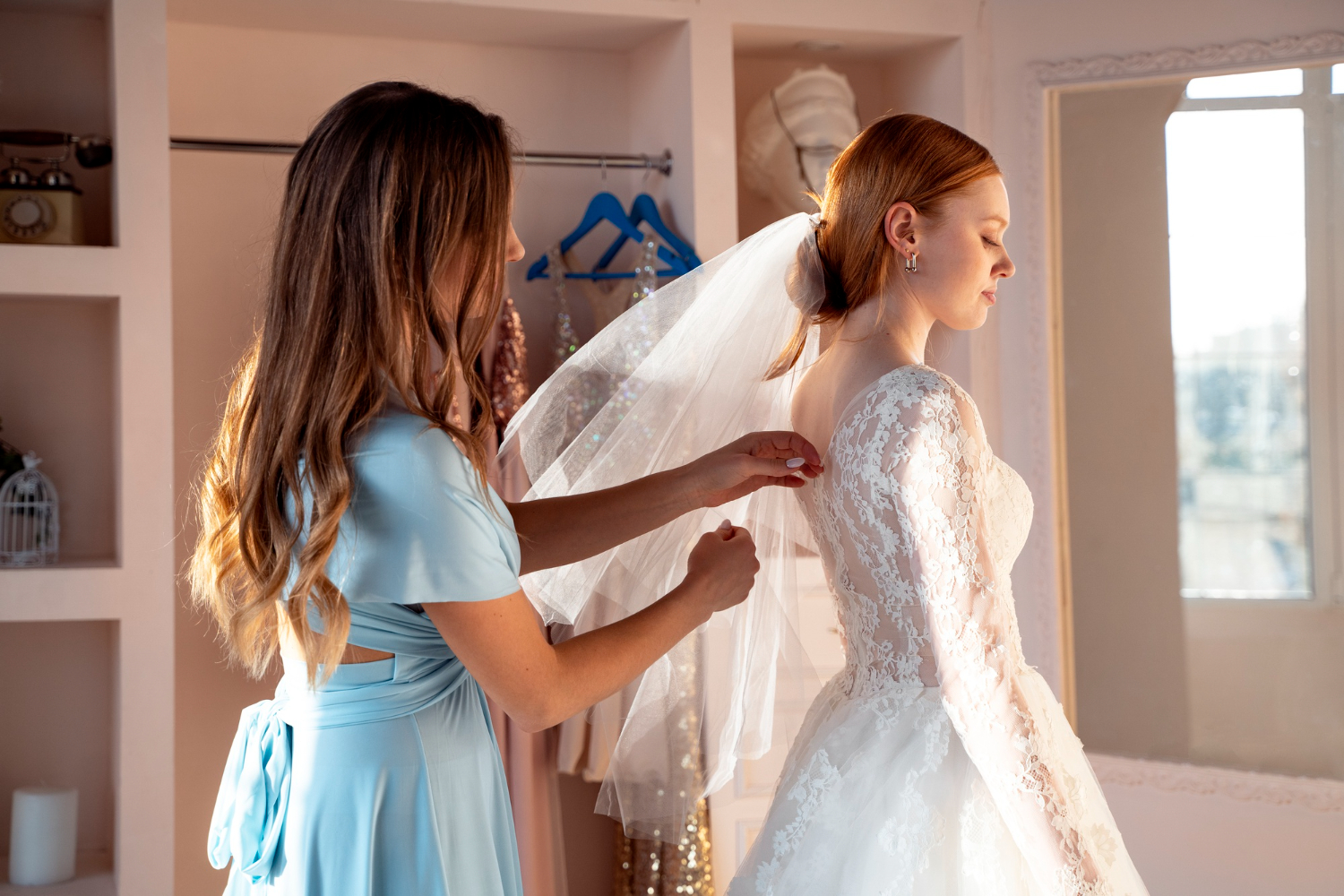
My dress was everything I had dreamed about since childhood—an ivory A-line gown with delicate lace sleeves, a modest train that wouldn’t impede dancing, and subtle beading that caught the light without overwhelming the elegant simplicity of the design. The back featured tiny pearl buttons running down the spine, each one fastened by Kristen’s careful fingers.
Rosemary had accompanied me to the bridal salon months earlier, wiping tears from her eyes when I emerged from the fitting room in this exact dress. “You look like a princess,” she’d whispered, her voice thick with emotion. “You look absolutely perfect.” The saleswoman had assumed she was my mother, and neither of us corrected her because in every meaningful way except biology, she was more maternal than Patricia had ever been.
When I looked in the mirror that morning, I saw a woman who had overcome years of being invisible. Tears pricked my eyes as Kristen squeezed my hand. “You made it,” she said softly. “You got here despite everything. You’re marrying an amazing man who loves you completely. This is your day, and it’s going to be perfect.”
Nathan sent a note before the ceremony, passing it through the door without seeing me in my dress, respecting the tradition we’d chosen to honor. His handwriting filled an entire page with words about our future, our partnership, our love. He wrote that meeting me had changed everything he understood about relationships, that watching me navigate impossible family dynamics with such grace had shown him the kind of strength he wanted in a life partner.
The note ended with a promise: “Today marks the beginning of everything we deserve, everything we’ve built together, everything we’ll create for the rest of our lives. I can’t wait to see you walking toward me. I can’t wait to call you my wife. I can’t wait for forever.”
I tucked the letter into a hidden pocket of my gown, wanting his words close to my heart during the ceremony.
The ceremony itself became one of the most beautiful moments of my existence. Walking down the aisle on Thomas’s arm—Nathan’s father had offered when Donald showed minimal interest in the role—I felt tears streaming down my face before I was halfway to the altar. Nathan’s voice cracked with emotion as he recited vows we’d written together, promises that acknowledged our complicated pasts while celebrating the future we were choosing.
My hands trembled as I placed the ring on his finger, the physical symbol of our commitment feeling impossibly weighty and precious. When we kissed as husband and wife, the applause from our guests felt like a standing ovation for everything we had overcome individually and everything we’d built together.
Walking back down the aisle, I noticed Gwendolyn seated near the back wearing what appeared to be a white dress, but I was too euphoric to process it fully. My brain registered the color briefly before moving on to the joy of the moment, the feeling of Nathan’s hand in mine, the knowledge that we were married and beginning our real life together.
The reception began in the adjacent ballroom, a stunning space we had transformed with thousands of fairy lights, towering floral arrangements in cream and blush tones, and elegant table settings that looked like they belonged in a magazine spread. Guests mingled and offered congratulations as servers circulated with champagne and hors d’oeuvres. Nathan never left my side, his hand warm in mine, his smile constant and genuine and directed only at me.
Then I actually saw what Gwendolyn was wearing, and my stomach dropped like I’d been pushed off a building.
She hadn’t just worn white. She had commissioned what could only be described as a wedding gown—a custom ball gown that would have been appropriate for a royal ceremony. Layers of pristine white organza cascaded from a fitted bodice absolutely encrusted with crystals and pearls that caught every light in the room. The massive skirt extended at least four feet in every direction, forcing guests to navigate carefully around her to avoid stepping on the fabric.
A ten-foot train followed her wherever she moved, and she’d even attached a cathedral-length veil to an elaborate headpiece that looked like a tiara. She looked like a bride. She looked like she was deliberately trying to out-bride the actual bride at her own wedding.
My vision went slightly blurry. Kristen noticed my expression and followed my gaze, her jaw going slack with disbelief. Nathan’s grip on my hand tightened protectively, his body tensing beside me.
Patricia rushed over to Gwendolyn, cooing over the gown like it was the most magnificent thing she had ever witnessed. “Oh darling, you look absolutely stunning! Like a princess! This dress is incredible!” Donald trailed behind his wife, nodding approvingly and taking photographs of Gwendolyn from multiple angles.
Several confused guests photographed her as well, clearly uncertain about who they should be focusing on—the actual bride in her elegant ivory dress, or this woman who looked like she’d raided a bridal salon. Gwendolyn posed graciously for every camera, tilting her head at flattering angles, touching her elaborate updo with perfectly manicured fingers, basking in attention that should have been directed at me.
Nathan leaned close to my ear, his voice tight with barely controlled anger. “We can ask her to leave right now. Security is standing right outside. Say the word and she’s gone.”
I shook my head slowly, something cold and calculating settling in my chest. “Let me see how this plays out,” I whispered back. “I have a feeling she’s not done yet.”
Dinner service passed without major incident, though Gwendolyn positioned herself at a center table despite being assigned seating near the back with distant relatives. She commanded attention from everyone around her, gesturing dramatically with her hands, laughing loudly at her own jokes, ensuring that no one could ignore her presence or her ridiculous gown.
Patricia abandoned our family’s designated table to sit beside Gwendolyn, leaving Donald to make awkward small talk with Nathan’s parents, who looked increasingly uncomfortable with the bizarre dynamics playing out.
After dinner, the toasts began according to our carefully planned schedule. Nathan’s best man delivered a heartfelt speech that made both of us emotional, sharing stories about Nathan’s character and expressing genuine happiness that he’d found a partner who matched his kindness and integrity. Kristen followed with funny anecdotes from our college years and genuine warmth that had most guests reaching for tissues.
Then it was my turn to thank our guests and express gratitude for their presence on this important day. I walked to the microphone stand positioned near the head table, my heart full of love and appreciation for everyone who had traveled to celebrate with us. The room quieted as I began speaking, thanking people for coming, acknowledging the love and support that had brought Nathan and me together, expressing joy about beginning this new chapter.
I was mid-sentence, maybe two minutes into my prepared remarks, when I felt someone grab the microphone from my hands.
Gwendolyn had materialized beside me, her massive gown knocking against my legs as she wrestled the microphone away from me. Her smile stretched across her face, all teeth and no warmth, as she turned to address the stunned crowd.
“Sorry, everyone!” she announced brightly, one hand pressed dramatically against her stomach. “I know this is supposed to be my sister’s moment, but I just have to share some exciting news. I’m pregnant! With twins!”
The room erupted into chaos. Gasps transformed into cheers and applause as guests processed this information. Cameras that had been pointed at me—the actual bride at her own wedding—swiveled toward Gwendolyn. She spun slightly so her enormous gown caught the light from multiple angles, playing to every camera like she was at her own event.
Patricia screamed with joy, tears streaming down her face as she rushed from table to table, hugging guests and announcing loudly that she was going to be a grandmother of twins. Donald pumped his fist in the air like his favorite football team had scored a winning touchdown. The wedding photographer, clearly confused about his priorities, began capturing Gwendolyn from every angle, her white gown making her look like the bride in every shot.
My eighty-thousand-dollar wedding had just become her pregnancy announcement party.
I reached for the microphone, trying to reclaim what was mine. “Gwendolyn, this is my wedding. You can’t just—”
She shoved me. Hard. The force caught me completely off balance in my heels and I stumbled backward into the head table. Crystal glasses toppled and shattered. My elbow connected painfully with the edge of the table. The carefully arranged centerpiece—three hundred dollars worth of flowers and crystals—crashed to the floor, water and petals spreading across the white tablecloth.
Nathan surged forward, ready to physically remove my sister from the premises, but I caught his arm. Something in me had shifted, had gone cold and sharp and absolutely certain.
“Wait,” I whispered, though my voice shook with barely contained rage. “Just wait. Trust me.”
Patricia rushed over, and for half a second, relief flooded through me. My mother was finally coming to my defense, finally choosing me over Gwendolyn, finally acknowledging that this behavior was unacceptable.
Instead, she grabbed my shoulders and slapped me across the face.
The sound echoed through the suddenly silent ballroom. My cheek burned. Tears sprang to my eyes from shock and pain.
“Don’t you dare ruin her moment,” Patricia hissed, her fingernails digging into my skin through the delicate lace of my sleeves. “This is important. She’s sharing wonderful news.”
Donald appeared beside her, gripping my arm with bruising force. “Sit down and let her have this,” he commanded, his voice low and threatening. “You’ve had enough attention today. Let your sister enjoy her announcement.”
I stood there—my face stinging from my mother’s hand, my arm aching from my father’s grip, my wedding ruined by my sister’s calculated sabotage—and watched Gwendolyn glow in the spotlight of my reception. She continued speaking into the microphone about her pregnancy, about how she couldn’t wait to be a mother, about how blessed she felt, about how this was the happiest moment of her life.
Guests who should have been celebrating my marriage instead congratulated her, photographed her, focused entirely on her announcement. She had stolen my wedding as thoroughly as if she’d literally taken my place at the altar.
Nathan trembled with fury beside me, his hands clenching and unclenching, every muscle in his body coiled with the desire to end this spectacle, to defend his wife, to restore order to what should have been our perfect day.
But I had spent my entire life being overshadowed by Gwendolyn. Every milestone stolen or diminished. Every achievement ignored in favor of her mediocrity. Every moment meant for me somehow transformed into a celebration of her.
This time would be different.
“Wait,” I repeated to Nathan, squeezing his hand hard. “Trust me. Please.”
Gwendolyn finished her speech to thunderous applause and handed the microphone back to me with a patronizing smile, patting my burning cheek exactly where Patricia had slapped me.
“Thanks for letting me share, big sister,” she said sweetly, loudly enough for nearby tables to hear. “Aren’t you happy for me? This is so exciting!”
I took the microphone in hands that had stopped shaking. Years of presenting in boardrooms, of closing difficult deals with executives who tried to intimidate me, of maintaining composure under pressure that would have broken weaker people—all of that training crystallized into perfect calm.
I smiled at the crowd. Not a genuine smile, but the professional expression I’d perfected over years of hiding my true feelings behind a pleasant mask.
“How wonderful,” I said, my voice carrying clearly through the speakers. “Since we’re sharing big news today, I suppose now is as good a time as any for me to share something I’ve been holding onto.”
Gwendolyn’s expression flickered with uncertainty. Patricia stopped mid-hug with some distant relative. Donald froze in place, his phone still raised to take another photograph of his golden child.
“Many of you know that I work in marketing,” I continued, addressing the crowd with the same confidence I used in high-stakes presentations. “What you don’t know is that three months ago, I was promoted to senior vice president of my firm. It’s a position I worked incredibly hard to achieve, and it came with a significant bonus and stock options that have positioned Nathan and me quite comfortably.”
Polite applause rippled through the room. I let it die down completely before continuing.
“What you also don’t know,” I said, “is that for the past two years, I’ve been quietly documenting something very interesting about my sister’s life. Specifically, her financial situation and the truth behind her supposedly successful career.”
The color drained from Gwendolyn’s face so quickly I thought she might faint.
“You see, Gwendolyn has been telling our parents and really anyone who would listen that she’s a successful interior designer with a thriving business,” I explained. “She lives in a beautiful condo that she claims to own. She drives—or rather, drove—a luxury vehicle she supposedly purchased outright. She wears designer clothes and carries expensive handbags that she says come from her impressive income from all her high-end clients.”
Patricia stepped forward, her expression hostile and defensive. “What do you think you’re doing? Stop this right now. This is inappropriate—”
I ignored her completely, keeping my eyes on the crowd.
“The truth,” I said clearly, “is that Gwendolyn hasn’t had a single paying client in over four years. Her supposedly successful interior design business exists only on a website she pays fifty dollars a month to maintain with stock photos she didn’t create. The beautiful condo she’s been living in belongs to her landlord, Gregory Mitchell, who has been chasing her for eight months of unpaid rent totaling nearly twenty thousand dollars. The luxury car was leased, not purchased, and it was repossessed three weeks ago when she stopped making payments. And those designer clothes and handbags? They’re counterfeits, purchased from overseas websites that specialize in knockoff merchandise.”
Murmurs spread through the crowd like wildfire. Guests leaned toward each other, whispering furiously. Gwendolyn’s mouth opened and closed wordlessly, like a fish gasping for air.
“And here’s the part that might interest you, Mom and Dad,” I continued, turning to face my parents directly. “Every single month for the past three years, you’ve been sending Gwendolyn five thousand dollars to help with her business expenses. That’s sixty thousand a year. Over three years, that’s one hundred eighty thousand dollars of your retirement savings handed over based on complete and total fabrications.”
Patricia clutched Donald’s arm, her face going pale. “That’s not true,” she insisted, but her voice wavered. “Her business is successful. She shows us her client projects all the time. Beautiful work, such talent—”
“She shows you Pinterest boards created by actual designers and claims them as her own work,” I interrupted. “I have the original sources documented and verified. Every single project she’s ever shown you was stolen from someone else’s portfolio.”
I reached into the hidden pocket of my gown—the same pocket where I’d tucked Nathan’s love letter—and produced a small USB drive, holding it up for everyone to see.
“This contains bank statements showing her actual income and expenses, email correspondence with her landlord detailing the eviction proceedings he’s initiating, the repossession notice for her vehicle, and screenshots proving the origin of every single client project she’s ever claimed as her own work.”
Gwendolyn lunged forward, trying to grab the flash drive from my hand. Her massive gown impeded her movement and she stumbled, barely catching herself on a nearby chair before falling completely.
“But that’s not even the biggest news I have to share tonight,” I said, stepping out of her reach.
The room had gone absolutely silent except for the sound of Gwendolyn’s breathing, ragged and panicked.
“The pregnancy she just announced,” I continued, my voice steady and clear, “those twins she’s so excited about sharing with everyone—the father isn’t her boyfriend Marcus, the investment banker she’s been telling everyone about for the past six months.”
My sister went completely still.
“Marcus doesn’t actually exist,” I explained. “There is no investment banker boyfriend. There never was. The man in the photographs she’s shown you, Mom and Dad—the one she claimed to be dating, the one you believed was the father of these twins—his name is Steven Kovalski. He’s a stock photography model based in Toronto. His images appear on hundreds of websites selling everything from luxury watches to life insurance. He’s never met Gwendolyn in his life.”
Patricia’s face crumpled with confusion and denial. “But we’ve seen so many pictures,” she protested weakly. “Them together at restaurants, on vacation, looking so happy—”
“Stock photographs,” I said. “Easily purchased or downloaded and repurposed. All documented on this drive.”
The ballroom had achieved a level of silence so complete I could hear my own heartbeat.
“The actual father of Gwendolyn’s twins,” I said, turning to face my parents directly, “is her married boss at the part-time job she actually holds. She works part-time at Brennan’s Furniture Showroom for twelve dollars an hour, barely twenty hours a week. Theodore Brennan owns the showroom. He’s forty-eight years old, married for twenty-two years to a woman named Caroline, and they have three teenage children together.”
Gwendolyn burst into tears—ugly, gasping sobs that shook her entire body.
“You’re lying!” she screamed. “You’re making all of this up because you’re jealous! Because you’ve always been jealous of me!”
“Theodore’s wife Caroline discovered the affair three months ago,” I continued, my voice cutting through her sobs. “She found text messages, hotel receipts, credit card charges. She’s already filed for divorce. And since Theodore and Caroline reside in North Carolina, where the showroom’s headquarters are located, Caroline is also suing Gwendolyn for alienation of affection under state law. That’s an actual legal claim in North Carolina—you can sue someone for destroying your marriage. The lawsuit seeks damages of half a million dollars.”
I held up the flash drive again. “The lawsuit documentation is on here, along with screenshots of text messages between Gwendolyn and Theodore that Caroline’s attorney obtained during legal discovery. Some of them are quite explicit. I won’t read them aloud at my wedding reception, but they’re available for anyone who wants to verify what I’m saying.”
The guests sat in stunned silence. Patricia had sunk into a chair, her face buried in her hands. Donald stood frozen, looking like he’d been hit by a truck.
“My sister wore a white ball gown to my wedding,” I said, addressing the entire room. “She physically took my microphone to announce a pregnancy that will destroy another woman’s marriage and family. Our mother slapped me for trying to reclaim my own moment. Our father grabbed my arm hard enough to bruise for daring to expect basic consideration on my wedding day.”
I walked over to Patricia and Donald, whose faces had transformed into masks of horror and shame.
“You gave her one hundred eighty thousand dollars—probably most of your retirement savings—while telling me you couldn’t afford to contribute even a small amount to my wedding,” I said. “You chose her over me at every single opportunity for thirty-two years. You struck me and restrained me on what should have been the happiest day of my life. So consider this my wedding gift to you: the complete, documented truth about your golden child.”
I pressed the USB drive into Patricia’s trembling hand.
“Nathan and I will be leaving now for our honeymoon,” I continued. “Two weeks in Bali, already paid for, non-refundable. When we return, we’ll be beginning our life together without any of you in it. Don’t call. Don’t write. Don’t show up at our home. You made your choice decades ago. You can live with the consequences.”
Nathan took my hand, his expression filled with pride and love and fierce protectiveness. We walked through the parted crowd toward the exit, and the silence followed us like a wave.
Behind us, I could hear Gwendolyn’s hysterical crying, Patricia’s demands for explanation, Donald’s stammering attempts to process what had just happened. But their voices faded as we pushed through the doors and emerged into the cool October evening.
Kristen caught up with us in the hallway, tears streaming down her face—but they were tears of barely suppressed laughter mixed with shock.
“That was the most incredible thing I have ever witnessed in my entire life,” she said, pulling me into a fierce hug. “Your guests are going to be talking about this wedding for the rest of their lives.”
“Make sure the photographer got everything,” I told her. “I want professional documentation of the moment my family finally learned the truth about who they’d been supporting all these years.”
“Oh, he got it all,” Kristen assured me. “Every single second.”
Nathan and I climbed into the limousine waiting outside to take us to our hotel. As the vehicle pulled away from the venue, I finally allowed myself to exhale fully. My hands shook as the adrenaline began to fade, the reality of what I’d just done settling over me.
“Are you okay?” Nathan asked, pulling me close against his side.
“I’ve never been better,” I answered, and I meant it completely. “I’ve been carrying that information for two years, waiting for the right moment. She handed it to me on the most public stage imaginable.”
He kissed my forehead gently. “How did you even find all of that out?”
“Remember my friend Wesley from college?” I asked. “The one who went into investigative journalism? He owed me a favor after I helped his wife land a position at my firm. It took him about six weeks to compile everything. The hardest part was sitting on it, knowing what I knew, watching my parents pour money into her lies.”
The investigation had started innocently enough. I’d mentioned to Wesley that some things about Gwendolyn’s supposed success didn’t add up—she claimed high-end clients but never traveled, her portfolio seemed beyond her demonstrated abilities, her luxury lifestyle didn’t match up with the reality of running a small design business. Wesley’s curiosity had transformed into a professional exercise, and he’d treated Gwendolyn’s fabricated life as a case study for his journalism students.
Within three weeks, they’d compiled a dossier that would have impressed federal investigators. The discovery about Theodore Brennan had come later, when one of Wesley’s students tracked Gwendolyn’s actual employment and found the affair through cross-referencing public records and social media patterns.
We spent our honeymoon in Bali, and it was everything we’d dreamed about—pristine beaches, incredible food, complete disconnection from the chaos we’d left behind. My phone stayed off for two full weeks. When I finally turned it on during our flight home, I had hundreds of messages.
Most were from wedding guests expressing shock, support, and in several cases, pure entertainment value about what they’d witnessed. Kristen texted that Gwendolyn had fled the venue in her ridiculous gown, struggling to fit through the doors and into her rideshare. Patricia had apparently collapsed into a chair and refused to speak to anyone. Donald had left without her, driving home alone.
Three weeks after we returned, a letter arrived from an attorney in North Carolina. Caroline Brennan’s alienation of affection lawsuit was proceeding, and my wedding speech had been entered into the public record as part of the evidence. Caroline had requested a meeting with me, wanting to thank me personally for exposing the affair so publicly.
A second letter came from Gregory Mitchell, Gwendolyn’s landlord. He’d finally initiated formal eviction proceedings, emboldened by the public revelation that her financial claims were complete fabrications.
My parents sent nothing. No letter, no email, no text message, no phone call. Their silence spoke volumes about where their loyalties remained, even after learning the extent of Gwendolyn’s deceptions.
Six months later, Gwendolyn gave birth to twin girls. Theodore Brennan’s name appeared on the birth certificates. His divorce from Caroline had finalized two months prior. According to mutual acquaintances who couldn’t resist sharing gossip, Theodore and Gwendolyn tried to build a relationship, but foundations built on lies and betrayal proved unstable. He sought custody of the twins and won, citing Gwendolyn’s documented history of deception and financial irresponsibility.
Patricia and Donald lost most of their retirement savings—one hundred eighty thousand dollars they’d handed to Gwendolyn based entirely on fabrications. They sold their family home and moved into a small apartment. Their golden years transformed into a struggle for basic financial security.
I built the life I’d always deserved. Nathan and I welcomed our first child, a son we named after his grandfather. My career continued flourishing—another promotion, more responsibility, genuine respect from colleagues who valued my contributions. Our home filled with love and laughter and mutual respect.
And I never looked back.
Some people might think my revenge was cruel, that I should have handled things privately, that family loyalty should have mattered more than public humiliation. Those people have never been slapped by their mother for wanting attention on their wedding day. They’ve never watched their parents choose a liar over them repeatedly while demanding gratitude for the privilege of being ignored.
The truth is simple: I spent thirty-two years being gracious about mistreatment. I absorbed every slight, forgave every betrayal, excused every act of favoritism. My reward was violence and dismissal on what should have been the happiest day of my life.
So I stopped being gracious. I stopped forgiving. I stopped excusing.
And I started living.
My sister showed up to my wedding in a white ball gown bigger and more elaborate than my dress. She announced her pregnancy with another woman’s husband using my microphone at my reception. Our mother slapped me. Our father bruised me. They demanded I surrender my moment to her comfort.
I smiled and destroyed her instead.
And given the same circumstances, I would do it again without a moment’s hesitation.

Lila Hart is a dedicated Digital Archivist and Research Specialist with a keen eye for preserving and curating meaningful content. At TheArchivists, she specializes in organizing and managing digital archives, ensuring that valuable stories and historical moments are accessible for generations to come.
Lila earned her degree in History and Archival Studies from the University of Edinburgh, where she cultivated her passion for documenting the past and preserving cultural heritage. Her expertise lies in combining traditional archival techniques with modern digital tools, allowing her to create comprehensive and engaging collections that resonate with audiences worldwide.
At TheArchivists, Lila is known for her meticulous attention to detail and her ability to uncover hidden gems within extensive archives. Her work is praised for its depth, authenticity, and contribution to the preservation of knowledge in the digital age.
Driven by a commitment to preserving stories that matter, Lila is passionate about exploring the intersection of history and technology. Her goal is to ensure that every piece of content she handles reflects the richness of human experiences and remains a source of inspiration for years to come.