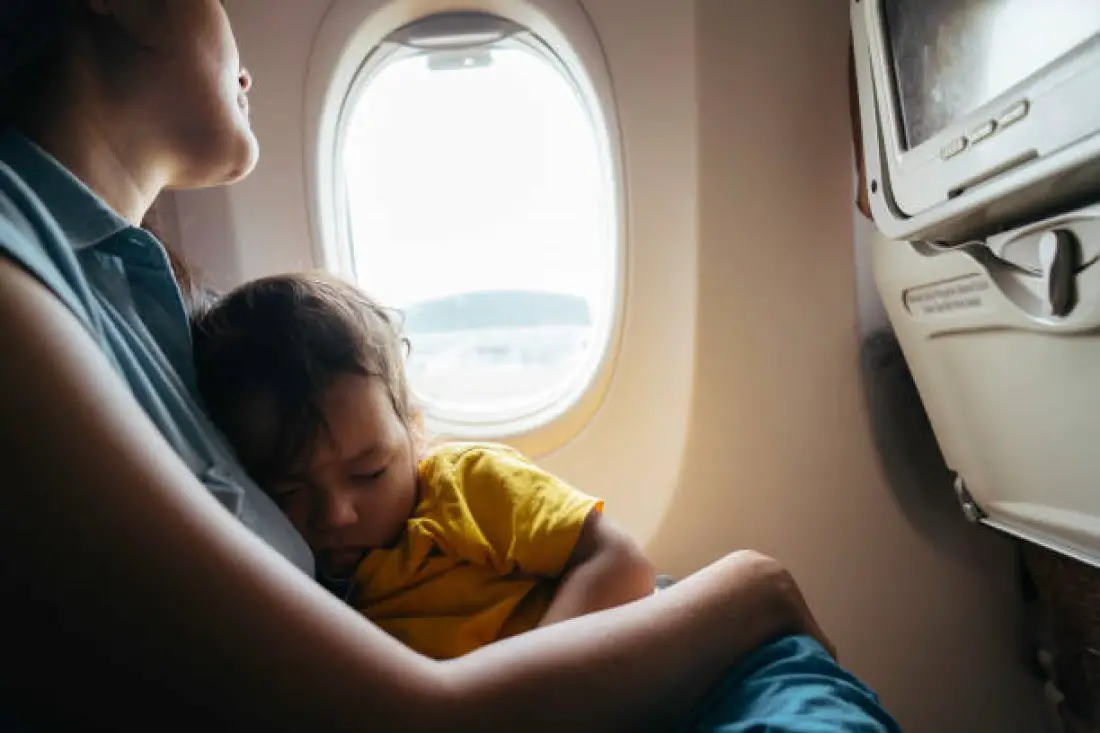
Exhaustion has a weight to it. Not metaphorical, but physical—a heaviness that settles into your bones and muscles, making every movement feel like you’re wading through water. By the time I boarded the red-eye flight from Denver to New York at 11:47 PM, that weight had become so familiar I barely noticed it anymore. It was simply part of who I was now: Emily Carter, twenty-nine years old, single mother, running on fumes and coffee and the desperate hope that I could hold everything together for just one more day.
My eight-month-old daughter Lily whimpered against my chest as I navigated the narrow airplane aisle, my diaper bag catching on armrests and shoulders as other passengers shot me looks ranging from sympathy to thinly veiled annoyance. I muttered apologies like a mantra—”Sorry, excuse me, so sorry”—as if I could apologize my way into invisibility, into being less of an inconvenience to everyone around me.
Seat 24B. Middle seat. Of course it was a middle seat, because the window and aisle had been twice the price and I was barely making rent as it was. I’d flown to Denver for my grandmother’s funeral, using the last of my emergency savings, and now I was returning to New York with a sleeping baby, a heart full of grief, and exactly forty-three dollars in my checking account until next Friday’s paycheck.
I collapsed into the seat, every muscle in my body screaming relief at finally being stationary. Lily curled against me, her small body radiating warmth, her breathing gradually evening out as the familiar exhaustion that had plagued her all day finally pulled her under. I pressed my lips to her fine dark hair and whispered, “We’re almost home, baby. Just a few more hours.”
That’s when I became aware of the man in seat 24A.
He was tall—I could tell even though he was seated—with broad shoulders that took up more than his fair share of the narrow seat. He wore a charcoal suit that looked expensive even to my untrained eye, the kind of tailored perfection that cost more than my monthly rent. His dark hair was slightly disheveled, as if he’d been running his hands through it, and he had the kind of sharp jawline and intense focus that suggested he was used to commanding rooms full of important people.
He glanced up from his phone as I struggled to buckle my seatbelt one-handed while holding Lily, and I caught a glimpse of striking gray eyes before looking away, embarrassed by my own dishevelment. I was wearing leggings with a mysterious stain on one knee, an oversized sweater that had seen better days, and I hadn’t washed my hair in three days. The contrast between us was almost comical.
“Sorry,” I mumbled, adjusting my diaper bag so it wasn’t invading his foot space. “I’ll try to keep her quiet.”
He looked at Lily, then back at me, and something in his expression softened. “How old?”
“Eight months.”
“Rough day?” The question held genuine curiosity rather than polite small talk.
I let out a sound that was half laugh, half sob. “You have absolutely no idea.”
He offered a small smile that transformed his face from intimidating to approachable. “Try me.”
But the announcement for departure crackled through the speakers before I could respond, and the moment passed. He returned his attention to his phone while I fumbled with Lily’s pacifier, trying to prepare for takeoff. Babies’ ears hurt during pressure changes, and I’d learned the hard way that nursing or sucking on a pacifier helped. Thankfully, between her exhaustion and the pacifier, Lily barely stirred as the plane taxied and lifted into the night sky.
The cabin lights dimmed once we reached cruising altitude, leaving only the small reading lights above scattered passengers still awake. Most people immediately pulled out phones or tablets, donning headphones to disappear into their own worlds. The man beside me—24A, I thought of him, since I didn’t know his name—pulled out a laptop and began working on what looked like complex spreadsheets.
I tried to stay upright, to maintain proper boundaries, to not be the exhausted mother who inconvenienced everyone around her. But my body had other plans. I’d slept maybe two hours in the last thirty-six. Between flying to Denver, the funeral, comforting family members while my own grief sat like a stone in my chest, and managing an infant through all of it, I’d pushed myself past every reasonable limit.
My eyelids grew heavy. My head began to list to the side, drawn by gravity and exhaustion and the treacherous comfort of sleep. I jerked awake twice, three times, each time mortified to find myself leaning toward the stranger beside me.
The fourth time, I didn’t jerk awake. My head came to rest on his shoulder.
I surfaced briefly, horror flooding through my consciousness, and tried to pull away. “Oh my god, I’m so sorry—”
A hand—his hand—gently pressed against my shoulder, keeping me in place. “It’s alright. You need to rest.”
“But I can’t just—”
“You can,” he said quietly. “You’re exhausted. Your daughter’s asleep. Just close your eyes.”
Maybe it was the exhaustion that made his words feel reasonable. Maybe it was the grief that had hollowed me out and left me too depleted to argue. Maybe it was simply that someone had given me permission to stop fighting for just a moment. Whatever the reason, I felt my muscles go slack, felt myself sink into a sleep so deep it felt like falling into dark water.
I didn’t dream. I simply ceased to exist for a while, my consciousness shutting down completely, my body finally getting the rest it had been screaming for.
When I woke, it was because of movement—small, familiar movement against my chest. Lily stirring. My daughter’s distinctive little whimper that meant she was about to wake fully and demand attention.
I blinked, orienting myself. Airplane. Right. We were still in the air. The cabin lights had come back on, brighter now, suggesting we were approaching our destination. I could hear the quiet sounds of passengers stirring, preparing for landing.
My head was still resting on the stranger’s shoulder. That realization hit first, accompanied by a wave of embarrassment. But before I could fully process that, I noticed something else.
Something that made my blood turn cold.
There was a blanket draped over me. Not the thin airline blanket that came in plastic wrap, but a soft, expensive-looking throw that certainly hadn’t been there when I fell asleep.
And Lily—my daughter, my baby—wasn’t in my arms.
Panic exploded through me. I sat bolt upright, my heart hammering, my breath coming in short gasps as my eyes frantically scanned the immediate area.
The man beside me—24A—was holding her.
My eight-month-old daughter was cradled in his arms, her head resting against his chest, sleeping peacefully while he rocked her with the practiced ease of someone who’d done this before. He looked down at her with an expression of such gentle tenderness that it momentarily froze my panic response.
“I—what—why are you—” The words tangled in my mouth, coming out as a strangled gasp.
He looked up, meeting my eyes, and I saw understanding there. “She woke up about forty minutes ago. You were deep asleep—I mean, really gone—and I didn’t want to disturb you. So I…” He glanced down at Lily. “I hope that’s okay. I have a daughter. I remember this age.”
Before I could formulate a response, a flight attendant materialized beside us. She was younger than me, with her hair pulled back in a severe bun, and she looked at me with an expression I couldn’t quite read—something between concern and excitement.
“Ma’am, I’m so glad you’re awake. We tried not to disturb you—he told us you hadn’t slept in days and needed the rest.”
I stared at her, confusion cutting through my panic. “I don’t understand. What’s—”
“Do you know who you’ve been sitting with?” she asked, her voice dropping to an almost reverent whisper.
I shook my head mutely.
She glanced at the man holding my daughter, then back at me. “That’s Ethan Ward. CEO of WardTech.”
The name meant nothing to me for about three seconds. Then it clicked. WardTech—the massive technology company that had been in the news constantly over the past few years. Cloud computing, artificial intelligence, something about revolutionizing data security. I didn’t understand the technical details, but I knew the name represented serious money and serious power.
I looked at him—Ethan Ward, apparently—with new eyes. He still just looked like a tired man in a nice suit, holding a baby with the comfortable competence of practiced fatherhood.
“We need to talk,” he said quietly. “Something happened while you were asleep.”
His expression was serious. Almost urgent. A muscle ticked in his jaw.
My stomach dropped. “What happened?”
Ethan didn’t answer immediately. The flight attendant excused herself with a look that suggested she’d been dismissed, and I watched as the plane continued its descent, passengers around us gathering belongings and checking phones. The normal end-of-flight bustle. But nothing about this moment felt normal.
“Let’s wait until we’ve landed,” he said, still rocking Lily gently. “I’ll explain everything then. But I need you to stay calm and trust me for the next twenty minutes. Can you do that?”
Every maternal instinct screamed at me to grab my daughter and demand answers immediately. But something about his tone—the seriousness, the concern that seemed genuine—made me nod.
The landing was smooth. As soon as we were cleared to deplane, Ethan carefully transferred Lily back to me. She barely stirred, settling against my shoulder with a contented sigh that made my heart clench. Whatever else had happened, she felt safe. That had to mean something.
“Come with me,” Ethan said quietly, gathering both his bag and mine before I could protest. “We’re going to exit through a different door. Just follow my lead.”
I followed him, clutching Lily, my mind racing through possibilities. Had something happened to my apartment? Had there been some kind of emergency? But why would a billionaire CEO be the one telling me about it?
We bypassed the normal exit, instead being guided by two flight attendants toward the front of the plane. The pilot emerged from the cockpit, gave Ethan a respectful nod, and we were ushered through a door that led to a jetway I didn’t recognize—wider, emptier, clearly not meant for regular passengers.
Once we were alone in this strange liminal space, Ethan finally stopped walking. He turned to face me, and I saw tension in every line of his body.
“While you were asleep,” he began, his voice low and controlled, “a woman from row twenty-seven started filming you.”
My blood went cold. “What?”
“She was recording you sleeping on my shoulder. Recording me holding your daughter. She was taking pictures, shooting video, and narrating the whole thing like she was some kind of investigative journalist exposing a scandal.”
My throat constricted. I knew where this was going. Social media had destroyed people for less. One viral video, one misleading caption, and I’d be torn apart by strangers who didn’t know me, didn’t know my circumstances, didn’t care about the truth.
“What did she say?” I managed to whisper.
“She called you irresponsible. Said you were endangering your child. Called it ‘disgusting’ that you would fall asleep on a stranger and ‘dump your baby’ on someone else.” His jaw tightened. “She said you were a negligent mother using your child to get close to wealthy men.”
Each word landed like a physical blow. Tears burned behind my eyes. “I didn’t—I didn’t even know who you were. I just—”
“I know,” he said firmly. “I know that. But she didn’t care about the truth. She cared about creating a narrative.”
“Why?” The question came out as a broken whisper. “Why would she do that to me?”
Ethan’s expression darkened. “Because she recognized me. And she decided to twist the situation to serve her own agenda.”
I felt the world tilting around me. “I don’t understand.”
“The woman’s name is Andrea Watkins. She’s been following me for months. Showing up at events, sending letters to my office, trying to manufacture situations where we’re in close proximity. My security team flagged her six weeks ago after she somehow got my private cell number and started sending messages about how we’re ‘meant to be together.'”
Ice slid down my spine. “She’s stalking you.”
“Yes. And when she saw you sleeping on my shoulder, saw me holding your daughter, she decided you were a threat. Competition. So she tried to destroy your reputation before you could become… whatever she imagined you might become to me.”
The pieces clicked together with sickening clarity. Her anger. Her accusations. Her desperate need to paint me as terrible. It had never been about me at all. I was just collateral damage in someone else’s delusion.
“What did she do with the video?” I asked, my voice trembling. “Did she post it?”
“No,” Ethan said. “I made sure of it.”
“How?”
He pulled out his phone, showing me a series of messages between him and someone labeled “Marcus—Security Lead.” “I have a security team that travels with me. When I realized what she was doing, I had them alert the flight crew. They confiscated her phone, escorted her to the back of the plane, and kept her there until we landed. She’s being held by airport security right now.”
Relief flooded through me, so intense it made my knees weak. “You protected me.”
“You were exhausted. You were taking care of your daughter. You did absolutely nothing wrong.” His gray eyes held mine. “Anyone who’s ever traveled with a young child knows how hard it is. You don’t deserve to be attacked for being human.”
Something in my chest cracked open at those words. No one had defended me like this in—well, maybe ever. My ex-husband certainly hadn’t. He’d left when I was five months pregnant, deciding that fatherhood looked too difficult from where he was standing. My own parents had been supportive but distant, their help always accompanied by subtle judgment about my choices. And strangers? Strangers saw a struggling single mother and either pitied me or resented me for existing in their space.
But this man—this stranger who happened to be a billionaire—had seen me as someone deserving of basic dignity and protection.
“There’s more,” Ethan said quietly. “Andrea wasn’t just filming you. While you were asleep, she started making her way toward our row. She was trying to get close, maybe confront you, maybe do something worse. The flight attendants had to physically block her.”
My arms tightened around Lily automatically. “She tried to get to my daughter?”
“She didn’t get within six feet. I promise you, she never got close. But…” He hesitated. “Emily—it is Emily, right? I saw your name on the boarding pass.”
I nodded mutely.
“Emily, the problem is that she saw you. She knows what you look like. She knows you were traveling with your daughter. And people like this, when they fixate on someone as an obstacle to their delusion, they don’t just let it go.”
Understanding crashed over me like a wave. “You think she’ll come after me.”
“I think it’s a possibility we need to take seriously.”
My apartment suddenly felt very far away and very unsafe. I lived alone with Lily in a fourth-floor walkup in Queens, with locks that probably wouldn’t stop a determined twelve-year-old, let alone an unhinged adult with a mission.
“What do I do?” The question came out small and scared, and I hated how helpless I sounded.
Ethan’s expression softened. “First, you let me help. I have resources—security, legal team, connections with law enforcement. We’re going to handle this properly. But right now, I need to get you somewhere safe.”
“I can’t afford—”
“You’re not paying for anything,” he said firmly. “This happened because of me, because she fixated on me. I’m not going to leave you and your daughter vulnerable.”
Twenty minutes later, I found myself in the back of a black SUV, Lily sleeping in a hastily procured car seat, watching the lights of New York blur past the tinted windows. Two security personnel sat in the front—Marcus, who Ethan had been texting, and a woman named Sarah who’d introduced herself as a former police detective now working private security.
Ethan sat beside me, scrolling through his phone, coordinating things I didn’t fully understand. I heard words like “safe house” and “protective detail” and “legal action,” and it all felt surreal, like I’d accidentally wandered into someone else’s movie.
“Where are we going?” I finally asked as we crossed into Manhattan, heading away from Queens and my apartment.
“WardTech maintains a residential property in Tribeca for out-of-town employees and business partners who need temporary housing. It’s secure, comfortable, and most importantly, Andrea doesn’t know it exists.”
“How long do I need to stay there?”
He looked at me, his expression unreadable. “Until we’ve dealt with the threat. Could be a few days, could be longer. It depends on what happens with the charges we’re filing and what our security assessment shows.”
The building, when we arrived, was sleek and modern, with a doorman who clearly knew Ethan and a private elevator that required a keycard. The apartment itself was on the twenty-third floor, with floor-to-ceiling windows offering a view of the city that probably cost more per month than I made in a year.
“I’ve arranged for a crib to be delivered within the hour,” Ethan said as Sarah did a quick security sweep of the space. “There’s food in the kitchen—I had someone stock it earlier. Anything you need that isn’t here, just let me know.”
I stood in the middle of the living room, holding Lily, trying to process the past three hours. “Why are you doing all this?”
He paused in the doorway, meeting my eyes. “Because it’s the right thing to do. And because…” He hesitated. “I told you I have a daughter. Had a daughter. Emma. She died four years ago. Car accident. She was six.”
The grief in his voice was so raw, so immediate, that it felt like the air had been sucked out of the room.
“I’m so sorry,” I whispered.
“When I held Lily tonight, when I rocked her to sleep while you finally got the rest you clearly desperately needed, it was the first time in four years that holding a child didn’t hurt. It just felt… right. Like maybe some part of me could still do this, could still protect someone.” He cleared his throat. “So when someone threatened you, threatened her, I couldn’t just walk away. Do you understand?”
I nodded, tears streaming down my face. “Thank you. For everything.”
He left me his card with three different phone numbers and instructions to call immediately if I needed anything. Then he and his security team departed, leaving me alone in this beautiful, strange apartment with my sleeping daughter.
Over the next week, my life became something I couldn’t have imagined. Ethan’s legal team moved with frightening efficiency. They gathered evidence from the airline, obtained the video footage Andrea had recorded, documented her history of stalking behavior. They filed charges: harassment, stalking, making terroristic threats, interfering with flight crew. The case was solid.
But more than that, Ethan checked on me. Daily. Sometimes multiple times a day. He’d text to ask if Lily was sleeping okay, if I needed anything, if the apartment was comfortable. He sent over a delivery of baby supplies when I mentioned running low on diapers. He arranged for a doctor to do a house call when Lily developed a slight fever.
“You don’t have to do all this,” I told him during one of his visits, watching as he sat on the floor building a tower of blocks for Lily to knock down.
“I know,” he said, stacking another block. “I want to.”
The trial was brief. Andrea’s behavior was so well-documented, her delusion so evident in the videos and messages, that her own lawyer advised her to plead guilty. She received a suspended sentence with mandatory psychiatric treatment and a five-year restraining order keeping her away from both Ethan and me.
“It’s over,” Ethan told me the day the judge issued the final order. We were in the Tribeca apartment, Lily playing happily on a blanket between us. “You can go home now. You’re safe.”
I looked around the apartment that had become familiar over the past three weeks. Then I looked at this man who’d protected me, supported me, treated me with a kindness I’d almost forgotten existed.
“What if I don’t want to go home?” I asked quietly.
His gray eyes met mine. “What are you saying?”
“I’m saying that these past few weeks, despite everything, have been the first time in a long time that I’ve felt like I wasn’t alone. That someone actually saw me as more than just a struggling single mom.” I took a breath. “I’m saying that when you hold my daughter, when you make her laugh, when you look at us like we matter… I don’t want that to end.”
Ethan was quiet for a long moment. Then he moved closer, reaching out to take my hand. “Emily, I need to be clear about something. When I first helped you on that plane, it was the right thing to do. But somewhere in these past weeks, it became more than that. You’re strong and brave and you’re raising an incredible little girl despite impossible circumstances. And I…” He paused. “I haven’t felt this way since I lost my wife and daughter. I didn’t think I could feel this way again.”
“What do you feel?” I whispered.
“Like maybe I could have a family again. Not to replace what I lost—nothing could do that. But to build something new. If you’re willing.”
I squeezed his hand. “I’m willing.”
Six months later, I was no longer living in that fourth-floor walkup in Queens. Lily had her own nursery in Ethan’s townhouse, with a crib that converted to a toddler bed and more toys than any one child could possibly need. I’d gone back to school, studying child psychology, with Ethan’s encouragement and financial support.
But more than the material changes, I’d found something I’d stopped believing in: partnership. Ethan was there for the 2 AM feedings and the teething screams and the endless exhausting beautiful chaos of raising a child. He’d fold himself into our little family unit as if he’d always belonged there.
On a Tuesday evening in November, after putting Lily to bed, he found me on the couch looking at old photos on my phone.
“What are you thinking about?” he asked, settling beside me.
“That plane,” I admitted. “How I almost didn’t book that flight because of the cost. How if I’d chosen a different seat, or if you’d been in a different row, none of this would have happened.”
“Do you wish it hadn’t?” His voice was carefully neutral.
I looked up at him, this man who’d appeared in my life at my absolute lowest moment and somehow seen me as worth protecting, worth knowing, worth loving. “Not for a second.”
He smiled, pulling me close. “Good. Because I plan on spending a very long time proving to you that you deserve every good thing that comes your way.”
Lily’s voice crackled through the baby monitor—”Mama? Dada?”—and we both smiled at the way she’d started calling Ethan “Dada” without any prompting, as if some part of her child’s instinct recognized what the three of us were building together.
“I’ll go,” Ethan said, pressing a kiss to my forehead. “She probably just needs her stuffed elephant repositioned.”
I watched him head toward the nursery and thought about exhaustion and trust and the strange ways life can pivot in a single moment. About how sometimes the worst day of your life—when you’re running on no sleep and falling apart and feeling like you can’t possibly hold it together for one more minute—can become the doorway to something you never imagined possible.
I thought about that blanket he’d placed over me while I slept. About the way he’d held my daughter like she was precious. About the split-second decision to intervene when someone threatened us.
And I thought about the fact that sometimes, when you’re at your absolute most vulnerable, when you have nothing left to give and you’re simply trying to survive the next few hours, grace appears in unexpected forms.
Mine appeared at 35,000 feet, in a middle seat, wearing a charcoal suit.
And I would spend the rest of my life grateful that I was too exhausted to fight when he told me to rest.

Lila Hart is a dedicated Digital Archivist and Research Specialist with a keen eye for preserving and curating meaningful content. At TheArchivists, she specializes in organizing and managing digital archives, ensuring that valuable stories and historical moments are accessible for generations to come.
Lila earned her degree in History and Archival Studies from the University of Edinburgh, where she cultivated her passion for documenting the past and preserving cultural heritage. Her expertise lies in combining traditional archival techniques with modern digital tools, allowing her to create comprehensive and engaging collections that resonate with audiences worldwide.
At TheArchivists, Lila is known for her meticulous attention to detail and her ability to uncover hidden gems within extensive archives. Her work is praised for its depth, authenticity, and contribution to the preservation of knowledge in the digital age.
Driven by a commitment to preserving stories that matter, Lila is passionate about exploring the intersection of history and technology. Her goal is to ensure that every piece of content she handles reflects the richness of human experiences and remains a source of inspiration for years to come.