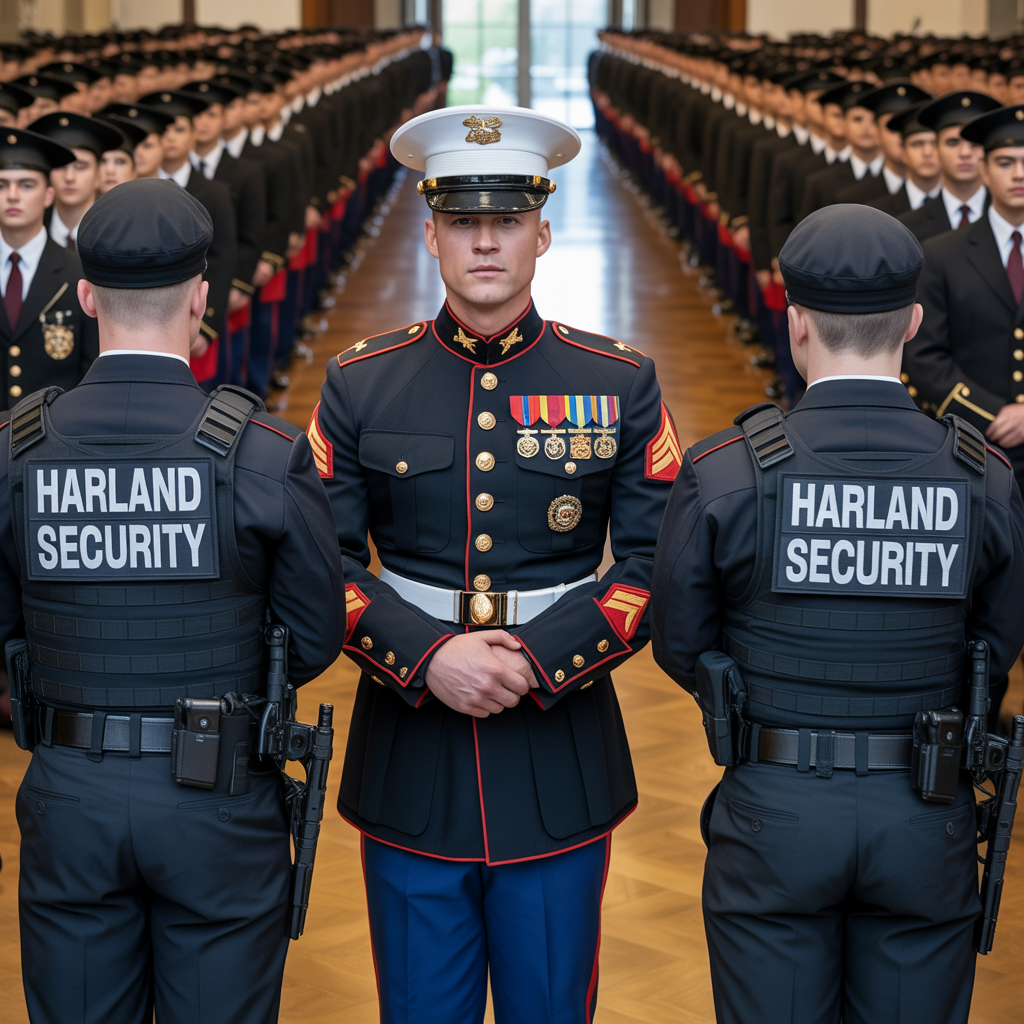
Security Tried to Remove This Marine Dad From His Son’s Graduation—Then 6 Navy SEALs Stood Up and Everything Changed
The Promise He Refused to Break
Solomon Dryden had not driven eight hours through the unforgiving Texas sun to pick a fight. He had driven eight hours to keep the most important promise of his life.
His late wife’s 2018 Dodge Charger felt different now—emptier, despite being filled with memories. The leather seats still smelled faintly of her perfume, and the radio was still set to the country station she loved. In the passenger seat, placed carefully facedown but never forgotten, lay a worn photograph that had traveled with him through three combat deployments: his son Tyran as a newborn, sleeping peacefully in his mother’s arms.
On the back, in Catherine’s careful handwriting, were the words that had driven him across two states: “You better be there when he graduates.”
“I made it, baby,” he murmured to the empty car. “I didn’t miss it.”
The Marine dress blue uniform still fit perfectly despite the years since he’d last worn it to a formal occasion. The gold buttons caught the late morning sun, and the ribbons and medals on his chest told the story of a man who had served with honor in places most Americans had only heard about on the evening news.
Three tours in Afghanistan. Two in Iraq. A Purple Heart from an IED blast that had taken his hearing in one ear and left shrapnel scars along his left shoulder. A Bronze Star for actions he still didn’t like to talk about. And underneath it all, the weight of a man who had missed too many birthdays, too many school plays, too many of the ordinary moments that make up a life.
But not this day. Not his son’s graduation day.
Solomon stepped out into the heat, dress hat under his arm, and walked toward the gymnasium with the steady, measured pace of a man who had learned that dignity was something you carried with you, regardless of where you found yourself.
Finding His Place
The sounds of graduation wrapped around Solomon as he entered the gymnasium—folding chairs scraping against the polished floor, toddlers fussing in their parents’ arms, grandparents laughing too loudly at shared jokes, someone testing the microphone and creating feedback that made everyone wince. It was life in all its ordinary, beautiful, noisy glory.
Solomon slipped quietly into the back of the gym and found a seat halfway up the bleachers. From this vantage point, he could see almost everything: the decorated stage with its podium and backdrop reading “Class of 2024,” the sea of matching graduation caps, the nervous principal shuffling through note cards while trying to look composed.
And then he saw him.
Solomon’s back straightened automatically, the way it had on countless parade grounds and formal inspections. This time, the salute was silent, held somewhere deep in his chest where pride and grief lived side by side.
Around him, families chatted excitedly, taking photos and saving seats for late arrivals. Solomon sat alone, but he didn’t feel lonely. He felt present. After years of missing important moments due to deployments and training exercises, he was exactly where he needed to be.
The graduation program in his lap showed Tyran’s name circled in red ink—a small detail that revealed how much this moment meant to him. Next to his son’s name, he’d written “Catherine would be so proud,” in handwriting that looked remarkably similar to his late wife’s.
Whatever else this day held, Solomon told himself, he would watch his boy walk across that stage. He would see Tyran receive his diploma, shake hands with the principal, and step forward into the next chapter of his life.
Nothing and no one was going to take that moment from either of them.
The Unwelcome Interruption
They came just after the school band finished a slightly unsteady version of “Pomp and Circumstance,” their instruments gleaming under the gymnasium lights as families applauded politely.
Two men in black polo shirts moved down the aisle with the slow, deliberate confidence of people who were accustomed to not being questioned. “Harland Security” was embroidered over their hearts in professional white stitching. Earpieces curved behind their ears, and they carried themselves with the kind of authority that came from dealing with “problems” all day.
The shorter guard leaned down, his voice low but carrying the unmistakable tone of authority.
“Sir, we’re going to need you to come with us.”
Solomon’s eyes never left the stage, where the principal was beginning to call names alphabetically. His voice, when he responded, was quiet and controlled.
“Is there a problem?”
“Just need a quick word outside,” the guard said, already angling his body so that Solomon would have to stand or be physically boxed in. “We’ve had a concern reported about your presence here.”
“A concern,” Solomon repeated softly. His tone was quiet—too quiet. It was the kind of quiet that had once made young Marines straighten their backs and choose their next words very carefully.
“Yes, sir,” the guard continued, clearly uncomfortable with Solomon’s calm response. “We’d appreciate your cooperation in stepping outside so we can discuss this privately.”
Solomon turned his head slightly, just enough to look directly at the man who was trying to remove him from his son’s graduation ceremony.
“And if I decline to cooperate?”
The question hung in the air like a challenge, though Solomon’s voice remained perfectly level.
From two rows behind Solomon, there was a quiet scrape of chair legs against the gymnasium floor.
Then another.
Then another.
Brothers in Arms
Six men stood up.
Not dramatically. Not with angry shouts or threatening gestures or any of the confrontational behavior that might have escalated the situation into something ugly.
They simply rose to their feet in almost perfect unison, like a tide coming in or birds taking flight together.
The effect was immediate and unmistakable. These weren’t angry civilians or concerned parents intervening in something that didn’t concern them. These were professional warriors who had recognized one of their own being treated with disrespect and had made a collective decision not to allow it to continue.
One of the SEALs stepped down into the aisle, moving with the easy, controlled precision that came from years of high-stakes operations. His name tag read “Medina,” and his face was calm, but his eyes held the kind of steady intensity that left very little room for nonsense.
“Gentlemen,” he said evenly, his voice carrying clearly through the gymnasium, “is there a specific reason you’re attempting to remove a decorated Marine from his son’s graduation ceremony?”
The shorter security guard straightened, clearly not having expected to face an audience—especially not this kind of audience.
“We received a call,” he said, his voice less confident than it had been moments before. “Someone reported a suspicious person in military uniform. Possibly disruptive. We’re just following standard protocol.”
“Suspicious,” Medina repeated slowly, letting the word hang in the air. His gaze moved deliberately from the guard to Solomon, who sat straight as a flagpole with white gloves folded precisely on his lap, holding a graduation program with his son’s name circled in red. “This man here in the family section, holding a program with his son’s name highlighted, that’s your suspicious person?”
Standing for Truth
The taller security guard shifted his weight uncomfortably, his fingers instinctively moving toward the radio microphone clipped to his shoulder.
“Look, we’re just doing our jobs here,” he said. “If we could speak with him outside for a few minutes—”
“Outside?” Medina’s voice wasn’t loud, but it carried with the clarity of someone who had given commands in life-and-death situations. Heads throughout the gymnasium turned toward the commotion. Conversations gradually quieted as people began to notice what was happening. “You want to escort a Marine father out of his own son’s graduation because someone thought he looked out of place?”
Solomon finally turned his head, meeting the security guard’s gaze directly.
“Out of place,” he repeated quietly, and somehow those three words carried the weight of every time a person in uniform had been treated as a threat rather than as someone who had sworn to protect others.
Medina didn’t look away from the guards as he continued.
“If wearing the uniform of his country and sitting quietly at his son’s graduation looks ‘suspicious’ to you gentlemen, then I would suggest that your company needs to either retrain you or replace you.”
The words were delivered without anger, without raised voices, but with the kind of absolute authority that comes from men who have faced actual threats and know the difference between danger and discrimination.
The shorter security guard swallowed visibly. The taller one murmured something into his radio microphone, clearly seeking guidance from a supervisor who was nowhere near the situation.
A few tense seconds passed, during which the entire gymnasium seemed to hold its breath. Parents pulled out phones, some recording what was happening, others texting frantically to family members about the confrontation unfolding.
Finally, the taller guard nodded once, curtly, and touched his partner’s arm.
“Let’s go,” he said.
Just like that, they turned and walked away. No apology. No explanation. No acknowledgment of what they had attempted to do or why it had been wrong.
But the entire gymnasium had witnessed it.
The Moment That Mattered
The energy in the room had shifted dramatically. There was no applause, no cheering—just a deep, respectful silence that seemed to acknowledge what had just taken place. A few camera phones remained raised discreetly, capturing the final moments of the confrontation.
Solomon didn’t sit down immediately. He let his gaze travel slowly across the crowded bleachers, looking not for thanks or recognition, but for something else entirely.
He was looking for the source of that “concern” that had brought the security guards to his seat.
Two rows behind where the SEALs had been sitting, he found her: a middle-aged woman in a floral blouse, her arms folded tightly across her chest, her lips pressed into a thin line of disapproval. Her teenage daughter sat beside her, cheeks flushed with embarrassment, eyes fixed firmly on the gymnasium floor.
Solomon looked at the woman for a long moment, then gave her a small, polite nod. Not angry. Not mocking. Just a quiet acknowledgment: I see you. I know what you did. And I’m still here.
Then he sat back down, straightened his uniform jacket, and turned his attention back to the stage.
The principal smiled as he handed over the diploma. A photographer captured the moment with a flash. The band played a triumphant musical flourish.
But for Solomon, time seemed to slow as he watched his son claim this moment that they had both worked toward for so many years.
He saw a toddler in footed pajamas playing with wooden blocks on a living room floor.
He saw a schoolboy with a backpack that seemed too big for his small frame, waving goodbye from a school bus window.
He saw a teenager speaking through pixelated video calls from military bases half a world away, sharing homework struggles and teenage worries across impossible distances.
And now here he was—a high school graduate, crossing a threshold that represented years of hard work and determination, stepping forward into adulthood with confidence and purpose.
As Tyran took his diploma and shook hands with school officials, his eyes began scanning the crowd. They found the dress blue uniform immediately.
Solomon lifted two fingers in the smallest possible salute—a gesture so subtle that only someone looking for it would notice.
Tyran’s answering grin could have powered the entire gymnasium.
The Truth About Service
After the ceremony ended and families began spilling out into the parking lot for the traditional festival of hugs, photographs, and celebration, Tyran spotted his father across the crowd and ran toward him with undisguised joy.
“Dad!” he called out, his graduation cap in one hand and his gown flapping behind him like wings.
He practically collided with Solomon, wrapping him in the kind of hug that reminded both of them of all the embraces they’d missed over the years due to military service.
“Did you see me up there?” Tyran asked breathlessly. “Did you hear them call my name?”
“Like you were the only graduate on that stage,” Solomon replied, pulling back to study his son’s face, noting how much he’d changed and how much he still looked like his mother. “She would have been so proud of you.”
They didn’t mention the security guards or the confrontation. Not yet. There would be time for those conversations later.
A man in a beige suit approached them near the gymnasium doors, adjusting his tie nervously as he walked.
“Mr. Dryden?” he asked. “I’m Principal Halvorsen. Do you have a moment to speak?”
Solomon placed a protective hand on Tyran’s shoulder. “Of course.”
“You mean any concerns about people like me,” Solomon corrected gently, his tone matter-of-fact rather than accusatory.
The principal’s shoulders sagged under the weight of that truth.
“I suspect that’s exactly what happened,” he admitted. “And I suspect the call didn’t come from anyone on our staff or anyone who actually knows you or your family.”
Solomon remained silent, letting the principal’s words speak for themselves.
“This will not happen again,” Halvorsen said firmly. “I can promise you that. And I’m truly sorry it happened at all.”
Solomon extended his hand for a handshake that conveyed both forgiveness and a clear expectation that the promise would be kept.
“Thank you for telling me the truth, Principal Halvorsen. That means more than most people would understand.”
Before they left the school grounds, they took a photo together—principal, Marine father, and new graduate—right beside the school’s main sign. It was a picture that would later hang in the principal’s office as a reminder of the day he learned the difference between security and discrimination.
Barbecue and Brotherhood
At Tyran’s favorite barbecue restaurant, they shared ribs and cornbread while catching up on all the conversations they’d had to compress into phone calls and video chats over the past few months. Tyran talked enthusiastically about his part-time job at a local bike repair shop, about the classes he’d enjoyed and the ones he’d struggled through, and about a young woman named Jasmine whom he wasn’t quite ready to call his girlfriend but clearly thought about often.
Then he set down his drink and grew serious in the way that reminded Solomon of his wife when she had something important to say.
“Dad,” Tyran said quietly, “I saw what happened in there.”
Solomon carefully wiped barbecue sauce from his hands, buying himself a moment to consider his response.
“I figured you might have noticed.”
“I didn’t want that to be what people remembered about today,” Tyran continued. “I wanted them to remember the ceremony, the speeches, the fact that we all worked hard to get here.”
Solomon nodded. “And that’s exactly what they’ll remember.”
Solomon thought about that perspective for a moment.
“They’ll remember how you walked across that stage,” he said finally. “Head up, shoulders straight, claiming your moment. That’s the part that actually matters.”
Tyran reached into his backpack and pulled out something carefully wrapped in soft cloth.
“I was going to give you this at home tonight, but this feels like the right moment.”
He placed a hand-carved wooden plaque on the table between their plates. The words had been burned carefully into the smooth grain with obvious attention to detail:
For every step you took
so I could take mine.
Solomon’s throat tightened as he ran his fingers over the words, feeling the careful craftsmanship that had gone into creating this gift.
“You made this yourself?”
“Shop class project,” Tyran said, suddenly shy about his creation. “It’s not perfect. The edges are a little uneven, but I wanted—”
“It’s perfect,” Solomon interrupted, his voice rougher than usual. “It’s more than perfect.”
He studied the plaque, memorizing every detail the way he had once memorized mission briefings and deployment orders.
“Thank you, son,” he said quietly. “For this, and for everything else.”
The Call That Changed Everything
Back at his modest hotel room that evening, Solomon placed the wooden plaque carefully on the dresser, propping it up against the mirror. Next to it, he positioned the old photograph of Catherine holding newborn Tyran—sunrise and sunset, past and future, side by side.
His phone buzzed on the nightstand with an unknown number. He almost ignored it, but something prompted him to answer.
“Hello?”
“Is this Staff Sergeant Dryden?” The voice belonged to a man who sounded tired but determined.
“It is.”
“This is Medina. From the ceremony today.” There was a pause. “I hope this isn’t a bad time to call.”
Solomon sat down on the edge of the bed, suddenly very interested in what this man had to say.
“Not at all. Thank you for what you and your teammates did today.”
Solomon closed his eyes, feeling the familiar mixture of pride and grief that came whenever he met someone who had served with his wife.
“When you walked into that gymnasium today, I wasn’t completely sure it was you at first,” Medina continued. “But when I saw that photograph you were holding—sir, she never went anywhere without that same picture. It was taped above her bunk, and she showed it to anyone who would look.”
Solomon’s voice came out as barely more than a whisper. “She loved that photo.”
“She talked about you and Tyran constantly,” Medina said. “About missing birthdays and holidays, about the promises she’d made, about making sure she’d be there for the important moments even if the military made it complicated.”
He cleared his throat before continuing.
“When I realized who you were, sitting there alone at the back of your son’s graduation, being treated like a problem by people who have never served anything larger than themselves… we weren’t going to stay seated. Not for her memory. Not for what she sacrificed.”
Solomon couldn’t speak for a long moment. When he finally did, his voice was steady despite the emotions threatening to overwhelm him.
“Thank you,” he said. “For standing for her. For remembering her. For everything you did today.”
“We’re the ones who owe thanks, sir,” Medina replied firmly. “She’s the reason some of us made it home. Standing up for her husband at their son’s graduation was the least we could do.”
Going Viral for the Right Reasons
Within a week, a short video clip from the graduation ceremony surfaced on social media platforms across the internet. The footage was simple and undramatic—just a Marine in dress blues being approached by two security guards, followed by six Navy SEALs quietly rising to form a protective presence.
The caption that accompanied most shares read: “They tried to remove a Marine dad from his son’s graduation. Watch who stood up instead.”
People shared the video for different reasons. Some shared it for the military respect it demonstrated. Others for the principle of standing up against discrimination. Many shared it because they had once been that quiet person at the edge of a room, treated like they didn’t belong in a place where they had every right to be.
Comments poured in from across the country:
“My father wore that same uniform. I wish someone had stood up for him when he needed it.”
“This is what real strength looks like—calm, respectful, and absolutely unshakeable.”
“Schools should be welcoming veterans, not treating them like threats.”
“Those SEALs understood something about brotherhood that goes beyond words.”
A few days after the story gained national attention, Solomon received a call from Vincent Belrose, a member of the local school board.
“I’d like to meet with you,” Vincent said. “There are some things I believe you need to see.”
They met at a quiet café on the outskirts of town. Vincent arrived carrying a thick folder and wearing the expression of someone who had been doing uncomfortable research.
“I watched your video,” he said without preamble. “And then I started asking questions about Harland Security and their practices in our district and others.”
He opened the folder and spread its contents across the small table—printed emails, incident reports, documented complaints, and notes from other school districts.
“These reports aren’t all from our school,” Vincent explained carefully. “Harland Security has had similar incidents across multiple districts. Military families asked to leave events. Parents in uniform questioned and sometimes removed. People from certain communities consistently flagged as ‘suspicious’ or ‘potentially disruptive.'”
Patterns of Discrimination
Solomon studied the documents with the careful attention of someone who had reviewed many official reports during his military career. What he saw made his stomach turn with a familiar, sick feeling.
“Most of the targeted families,” Vincent continued, his voice tight with controlled anger, “were from communities that some people prefer to overlook. Single parents working multiple jobs. Grandparents raising grandchildren. Military families. Immigrant families who were obviously proud to be at their children’s school events.”
Solomon closed the folder, having seen enough to understand the scope of what had been happening.
“What are you planning to do about this?” he asked.
Vincent didn’t hesitate. “The school board met in emergency session yesterday evening. We voted unanimously to terminate our contract with Harland Security, effective immediately. We can’t undo every wrong they’ve committed, but we can make sure we don’t pay them to commit more.”
He reached into his jacket and pulled out a sealed envelope.
Solomon looked at the envelope but didn’t immediately reach for it.
“Only if it goes to students like Tyran,” he said quietly. “Young people who feel out of place sometimes, who are easy to underestimate until someone takes the time to hear their story.”
Vincent smiled—the first genuinely happy expression Solomon had seen from him.
“That was our thought exactly,” he said. “Students who understand that belonging isn’t about fitting in, but about having the courage to stand where you have the right to be.”
He pushed the envelope a little closer across the table.
“So let’s call this a beginning,” Vincent said.
Standing Tall, Never Alone
Summer settled over Texas with its familiar rhythm of slower mornings and long, heat-soaked evenings. Tyran picked up additional hours at the bike shop and began volunteering with a local nonprofit organization that mentored children whose parents were deployed overseas or had served in the military.
He didn’t lead with the viral graduation story when he spoke to these kids. Instead, he talked about the things they would understand: missed holidays, phone calls that cut out due to bad connections, staring at the same family photograph on the refrigerator and hoping the person in uniform was safe wherever they were serving.
Eventually, he would tell them about graduation day too. About the security guards who walked down the aisle with misplaced authority. About the six men who refused to allow discrimination to masquerade as security. About a father who had driven eight hours to keep a promise and stayed long enough to see it fulfilled.
Solomon attended as many of these evening sessions as his work schedule allowed, sitting quietly in the back row with his hands folded, listening to his son give voice to experiences and feelings that had never been fully articulated before.
Sometimes he brought the wooden plaque that now sat on his mantelpiece at home.
Sometimes he was joined by one or two of the SEALs, who seemed to understand that their presence meant something to the military children in the audience.
He always brought the photograph of Catherine.
Because the longer he reflected on graduation day, the clearer it became that the six men had stood not just for him, not just for Tyran, but for every person who had ever been treated like a problem in a place where they belonged.
And at the center of it all was a woman who had once taped a baby picture above her military bunk and promised to come home to the family she loved more than life itself.
Her steps, her service, her ultimate sacrifice—those were the foundation that made everything else possible.
The Ripple Effect
Six months after graduation day, the Catherine Dryden Memorial Scholarship had awarded its first recipients—five students whose essays about service had moved the selection committee to tears. The winners included the daughter of a deployed Air Force sergeant, a young man who had been caring for his disabled grandmother since age fourteen, and a teenager who had organized community support for refugee families.
Tyran was beginning his freshman year at a state university, majoring in social work with a focus on military family support services. He called his father every Sunday evening, sharing stories about his classes, his new friends, and his growing understanding of how he wanted to use his life to help others.
Solomon had returned to his work as a veterans’ counselor with a renewed sense of purpose. The viral video had brought him speaking invitations from military family support groups, school districts working to become more inclusive, and organizations training security personnel to recognize the difference between actual threats and unconscious bias.
The six Navy SEALs had become lifelong friends, meeting regularly for barbecue and brotherhood, sharing stories about Catherine’s service and impact, and supporting each other through the challenges that came with transitioning from military to civilian life.
Principal Halvorsen had implemented new training for all school staff about recognizing and addressing bias, and the district had created policies ensuring that military families would always be welcomed with the respect they deserved.
And in a small corner of Texas, every time someone felt out of place or unwelcome, a few more people remembered the power of simply standing up—not with anger or confrontation, but with quiet dignity and unshakeable conviction.
Because sometimes the most important battles are won not with weapons or harsh words, but with the courage to stand where you belong and the strength to help others do the same.
The Catherine Dryden Memorial Scholarship has now provided college assistance to over thirty students who demonstrate commitment to service and community. Tyran graduated with honors and works for a nonprofit supporting military children. Solomon retired from counseling but continues speaking about inclusive communities and veteran recognition. The six Navy SEALs remain close friends and advocates for military family support. Principal Halvorsen implemented bias training that became a model for school districts nationwide. Most importantly, the story inspired policy changes ensuring military families receive appropriate recognition rather than suspicion at school events. Harland Security lost contracts with twelve school districts following investigations into discriminatory practices. The viral video has been viewed over fifty million times and continues to remind viewers that standing up for others requires no special training—just the courage to recognize what’s right and the strength to act on it.

Lila Hart is a dedicated Digital Archivist and Research Specialist with a keen eye for preserving and curating meaningful content. At TheArchivists, she specializes in organizing and managing digital archives, ensuring that valuable stories and historical moments are accessible for generations to come.
Lila earned her degree in History and Archival Studies from the University of Edinburgh, where she cultivated her passion for documenting the past and preserving cultural heritage. Her expertise lies in combining traditional archival techniques with modern digital tools, allowing her to create comprehensive and engaging collections that resonate with audiences worldwide.
At TheArchivists, Lila is known for her meticulous attention to detail and her ability to uncover hidden gems within extensive archives. Her work is praised for its depth, authenticity, and contribution to the preservation of knowledge in the digital age.
Driven by a commitment to preserving stories that matter, Lila is passionate about exploring the intersection of history and technology. Her goal is to ensure that every piece of content she handles reflects the richness of human experiences and remains a source of inspiration for years to come.