My 3-Star General Father Called Me a “Paper Pusher”—Then a Navy SEAL Asked for Ghost 13
The Briefing Room Hierarchy
The air in the strategic briefing room at MacDill Air Force Base smelled of burnt coffee, industrial floor wax, and the metallic tang of aggressive air conditioning. It was the olfactory signature of bureaucracy and absolute power, a scent I’d learned to associate with invisibility.
I sat in the back row, seat Z-14, my spine fused to the hard plastic chair in perfect military posture. My blonde hair was pulled into a regulation bun so tight it tugged at my temples, my uniform pressed sharp enough to draw blood. I had perfected the art of making myself small, invisible—a survival mechanism honed over three decades, not in SERE school, but at the dinner table.
“That’s rich, Johnson! That’s rich!” my father bellowed, slapping his knee. The surrounding officers chuckled in unison, a chorus of sycophants who didn’t laugh because it was funny, but because he was a three-star General and their mortgages depended on his mood.
I looked down at my hands. They were steady. They had to be. I thought of Marcus Aurelius, the stoic emperor I read before bed each night: “The best revenge is to be unlike him who performed the injury.”
Then the atmosphere shifted—not a sound, but a drop in barometric pressure that made seasoned warriors straighten unconsciously.
The Navy SEAL Entrance
The heavy double doors didn’t creak open; they exploded inward with controlled violence. Every conversation died instantly. Even my father’s laughter was severed mid-boom, caught in his throat like shrapnel.
A man stalked in—he didn’t walk, he occupied territory. Navy Working Uniform, digital camouflage looking alien in our sea of Air Force blue. On his collar: the silver eagle of a full Colonel. On his chest: the Trident of a Navy SEAL.
He ignored two hundred heads turning toward him, ignored protocol entirely. He walked straight down the center aisle, boots thudding rhythmically against carpet, and stopped ten feet from the stage, staring directly at the panel of generals.
“General Neves,” Hale said. His voice wasn’t loud, but it carried with the terrifying clarity of a slide racking on a pistol. Gravel and sandpaper, forged in combat zones.
My father blinked, clearly annoyed at having his spotlight stolen. He adjusted his tie, donning the mask of benevolent leadership. “Colonel Hale. To what do we owe this… interruption? We’re in the middle of a strategic assessment.”
“I don’t have time for assessments, General,” Hale cut him off with surgical precision. “I have a situation developing in the Sierra Tango sector. I need a Tier One asset. Immediate deployment.”
Hale scanned the room with predatory precision. “I was told the asset is in this room.”
My heart hammered against my ribs like a trapped bird trying to escape. This was it. Do it, Lucia.
I stood up.
The sound of my chair scraping against the floor echoed like a gunshot in a cathedral. Two hundred pairs of eyes pivoted from the stage to the back row. I stood at attention, shoulders back, chin up, a perfect statue of military discipline.
Marcus Hale turned slowly, his eyes locking onto mine. No recognition—just professional assessment. He nodded once.
But before he could speak, a voice boomed from the front like thunder before lightning.
“SIT DOWN!”
The Public Humiliation
My father wasn’t looking at Hale anymore. He was looking at me with the expression I remembered from childhood room inspections—white gloves searching for dust, finding failure. His face twisted with embarrassment and rage.
“Apologies, gentlemen,” my father said, tone shifting to dismissive chuckle. He pointed at me—a finger that felt like a weapon. “My daughter… she gets confused. She works in administration. Logistics. Paper clips and fuel trucks. She has a tendency to overstate her importance.”
The room exhaled collectively. Tension broke like a snapped cable. Ripples of laughter spread through the crowd.
“Admin,” someone whispered nearby. “She stood up for a sniper request? That’s rich.”
I stood there for three seconds that felt like three lifetimes. Heat rose in my cheeks—not from shame, but from cold, hard fury. He didn’t just dismiss me; he erased me. To him, the uniform I wore was a costume, the rank on my shoulder mere decoration.
I slowly lowered myself back into the chair, but I wasn’t looking at the floor anymore. I lifted my head and looked straight at my father’s back. That look—it was identical to the contempt I’d seen fifteen years ago.
And the briefing room melted away.
Thanksgiving Memory: The Original Dismissal
Eighteen years old again. Thanksgiving Day in Northern Virginia. Our house was a sprawling colonial monument to my father’s ego: framed photos of senatorial handshakes, shadow boxes of medals, an American flag folded into perfect triangular reverence on the mantle.
My mother froze mid-gravy pour, eyes wide, silently pleading with him to show kindness. Just this once.
My father slowly placed his fork down. The clink against china echoed like a gavel. He looked at me with confused disappointment, as if I’d announced plans to join the circus.
“Nursing?” he asked. “Or logistics?”
“Combat operations,” I corrected, sitting straighter. “I want to fly. Or maybe Intel.”
He laughed—a short, sharp bark. He swirled expensive Cabernet, considering my future like a wine he might send back. “Lucia, honey, let’s be realistic. The military is hard. It’s not for someone of your… disposition. You want to help people? Be a nurse. Find a nice Medical Corps officer. Don’t play soldier.”
He turned away, dismissing my entire future with a hand wave, then looked at my brother Jason—college dropout sleeping on our couch for three months.
“Jason,” my father’s voice softened instantly. “How’s the job hunt, son? No rush. Take your time. We’re proud of you for knowing your limits.”
That night, lying on my bedroom floor, I pulled out a Nike shoebox from under my bed. Not love letters or diaries—blue ribbons from the shooting range. Certificates for “High Scorer.” Every time I’d tried to show him target sheets with tight groupings, he’d sneer: “Guns are for men, Lucia. A woman holding a rifle looks ridiculous. Desperate.”
I learned to hide my talent. I learned shame about the one thing I was truly gifted at.
But touching those ribbons in the dark, I made a vow: I would become the weapon he couldn’t control.
Forged in Georgia Mud
Hell isn’t fire and brimstone. It’s a Georgia drainage ditch at 3 AM with forty-degree mud seeping into your soul.
My father had trained me well without knowing it. He taught me to sit still, stay quiet, occupy space without drawing attention. He thought he was suppressing me. Actually, he was forging a sniper.
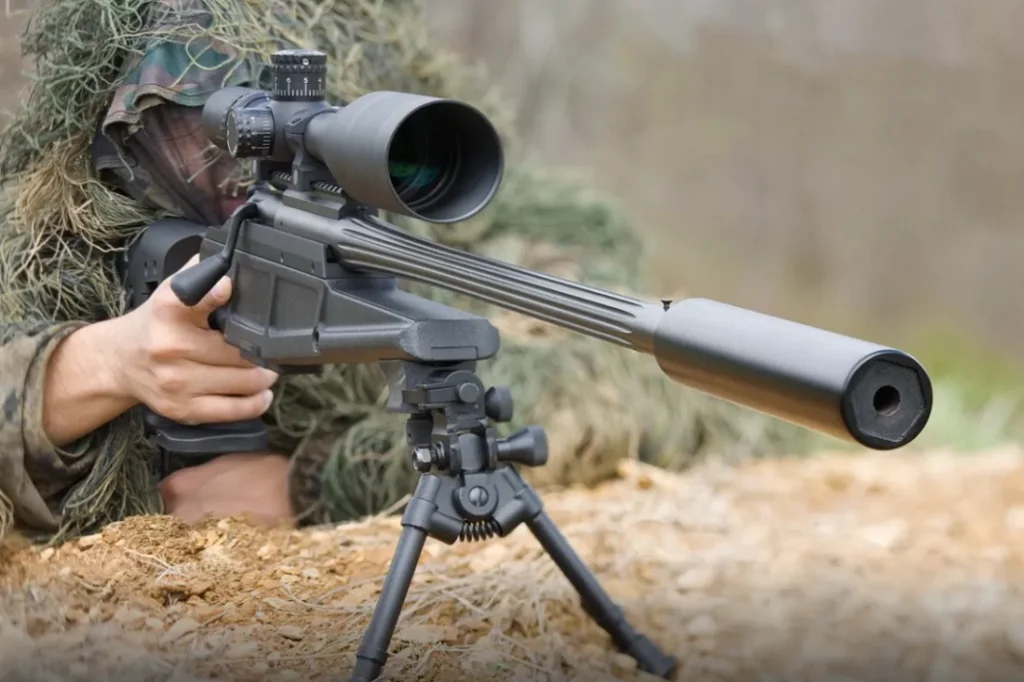
Six months later, Georgia mud was replaced by Korengal Valley dust. I was perched on a ridge, eight hundred yards out, looking through a Schmidt & Bender scope while a SEAL platoon took heavy fire below.
“Taking fire! Three o’clock high!” comms crackled.
I saw him—fighter with an RPG popping up from behind rock wall. My world narrowed to crosshairs. Windage three clicks left. Elevation adjusted. Breath in. Breath out. Pause at the bottom. Squeeze.
The M24’s recoil kicked my shoulder. A second later, pink mist sprayed against gray rock. Fighter dropped.
Two tours. Confirmed kill count that would make my father’s staff officers envious. When I finally got top-secret clearance and joined Special Activities Division, I chose my call sign: Ghost 13. The number thirteen for bad luck—my father’s bad luck. He thought he’d buried me under his lies. He didn’t realize that by forcing me into shadows, he’d given me perfect cover.
The Revelation Moment
“Major Neves.”
Marcus Hale’s voice brought me back to MacDill’s briefing room. He hadn’t moved, hadn’t acknowledged my father’s tantrum. He’d turned his back on a three-star General—protocol breach so flagrant it drew gasps from the front row.
He was looking directly at me. “Colonel,” I replied, voice steady.
Hale didn’t turn around. Eyes stayed locked on me. “I’m asking you a question, Major. Status and identifier.”
This was it. Point of no return. I took a breath. Let go of the daughter who cleaned patio furniture. Let go of the girl who hid ribbons under her bed.
“Ghost 13,” I said. The name hung in the air like cordite.
“Sector?” Hale asked.
“Sierra Tango. Hindu Kush. Operation Valley of Death. Overwatch for Team Six.”
Hale nodded, expression unreadable. “Clearance level?”
The reaction was immediate and catastrophic. My father’s hand, holding his water glass, began trembling. Water sloshed over the rim, dripping onto polished shoes.
Level Five. He knew what that meant. My father was a three-star General with Level Three clearance. He thought he was God. But Level Five? That was the stratosphere. Need-to-know so classified that even generals weren’t read in unless mission-critical. It meant I reported to shadows. It meant I knew things that would imprison him if I whispered them.
“Sir,” Rohr said quietly. “If she knows the Sierra Tango designator… we don’t have access to those files. That’s Black Ops.”
My father turned back to me, eyes wide, searching for the child he thought he owned. But she wasn’t there.
“Lucia,” he whispered. “You… you never told me.”
“You never asked,” I said. “You were too busy telling everyone I was backpacking in Europe.”
The Mission Orders
A murmur erupted through the room. Two hundred officers whispering at once. The General didn’t know. The man who claimed omniscience didn’t know his own daughter was a Tier One operator.
I stepped out of the row, walked past officers who’d snickered minutes ago. They pulled their legs in, scrambling out of my way. Some started standing—instinctive reaction to a superior warrior’s presence.
I reached the center aisle. My father blocked my path. He looked smaller now, shoulders slumped, confidence evaporated like morning mist.
He reached out a trembling hand. “Lucia, wait. We need to discuss this. You can’t just leave. I forbid—”
“Lucia…” his voice cracked.
“Goodbye, Dad,” I said. “Enjoy your meeting.”
I walked past him toward the double doors where Marcus Hale waited. Bright Florida sunlight poured in, blinding and white. As I crossed the threshold, I heard glass shattering against the floor.
I didn’t turn back. I walked into the white light and onto the tarmac where a Blackhawk’s rotors were already cutting the air.
Yemen: The Real Work
Three hours later, I sat in a Tactical Operations Center in Yemen. No service dress blues anymore—multicam fatigues, dusty and sweat-stained. In front of me: the instrument of my trade. A CheyTac M200 Intervention, firing .408 rounds that remained supersonic beyond two thousand yards.
My personal sat-phone buzzed on the corner table, lighting up the dim room.
DAD: 20 MISSED CALLS
He was destroying my phone. Not from worry about my safety—he didn’t know where I was. He was calling because he’d lost control of the narrative, terrified of what I might say.
For thirty-three years, that phone had been a leash. When it rang, I answered. When he commanded, I obeyed.
Back to the scope. “Solution set. Windage three mils left. Elevation one-two-zero.”
“Send it,” Hale ordered.
I exhaled. Squeezed the trigger. Recoil was a mule kick to the shoulder.
One. Two. Three. Four.
On drone feed, the heat signature in the minaret jerked backward and collapsed. Pink mist sprayed against ancient stone.
“Target down,” I reported, voice flat. “The window is open.”
“Good effect on target,” Hale replied. “Moving.”
The Reckoning: Three Months Later
The fallback was nuclear. My father tried bullying Colonel Rohr into accessing my personnel file. Rohr, a man with a steel spine, recorded the call and threatened the General with felony charges under the Espionage Act.
General Arthur Neves—the great man himself—became a pariah. Officers avoided him at the club. The rumor mill devoured him. He was the man who didn’t know. The emperor with no tactical awareness.
Classic defense: I did it for your own good.
I placed my hands flat on the table. “Dad,” I said, voice low, level, absolute. “I am not a child you need to protect. I am a field-grade officer. I have saved lives. I don’t need your protection.”
“But—”
“I’m not finished. We are going to have a new relationship, or no relationship at all.”
I laid out the rules. No dismissing my rank. No taking credit for achievements. No disrespect.
He looked at me, stunned. Arrogance drained out of him, leaving a tired old man. He nodded slowly.
“Respect,” he repeated. “Okay, Lucia.”
It wasn’t a hug. Wasn’t a movie ending. But it was peace.
Ten Years Later: Full Circle
The auditorium at Langley was full. I stood at the podium, looking out at the sea of blue. My uniform had evolved—gold oak leaves replaced by silver oak leaves of a Lieutenant Colonel. I was their commander now.
After the ceremony, a young Second Lieutenant approached. Uniform stiff, eyes terrified.
“Ma’am, Lieutenant Sarah Jenkins. I just… my dad’s a Colonel in the Marines. He wanted me to be a lawyer. Says I’m wasting potential in Intel.”
I froze. Different words, same destructive melody.
I stepped into her personal space—not to intimidate, but to shield.
She straightened up. A spark ignited in her eyes. “Yes, ma’am. Thank you, Lieutenant Colonel.”
I watched her walk away, standing taller.
I walked into Virginia sunshine. I wasn’t Little Lucia anymore. I wasn’t even Ghost 13—that was a name for shadows.
My name is Lucia Neves. And for the first time in my life, I wasn’t running away from anything.
I was flying.
Today, Lieutenant Colonel Lucia Neves commands a classified Special Operations unit with personnel across six continents. Her father, retired General Arthur Neves, volunteers at a veterans’ support center in Tampa, where he tells anyone who’ll listen about his daughter “the real hero.” When asked about their early relationship, he simply says: “I taught her to be invisible. She taught me that invisible and powerless aren’t the same thing.” Lucia’s military awards remain classified, but her impact on military families dealing with generational trauma has become her unofficial legacy. She speaks at military academies about the difference between protection and suppression, and how sometimes the greatest service to your country comes from defying the very people who claim to love you most.

Sophia Rivers is an experienced News Content Editor with a sharp eye for detail and a passion for delivering accurate and engaging news stories. At TheArchivists, she specializes in curating, editing, and presenting news content that informs and resonates with a global audience.
Sophia holds a degree in Journalism from the University of Toronto, where she developed her skills in news reporting, media ethics, and digital journalism. Her expertise lies in identifying key stories, crafting compelling narratives, and ensuring journalistic integrity in every piece she edits.
Known for her precision and dedication to the truth, Sophia thrives in the fast-paced world of news editing. At TheArchivists, she focuses on producing high-quality news content that keeps readers informed while maintaining a balanced and insightful perspective.
With a commitment to delivering impactful journalism, Sophia is passionate about bringing clarity to complex issues and amplifying voices that matter. Her work reflects her belief in the power of news to shape conversations and inspire change.
Great story. USMC 9/66-9/69