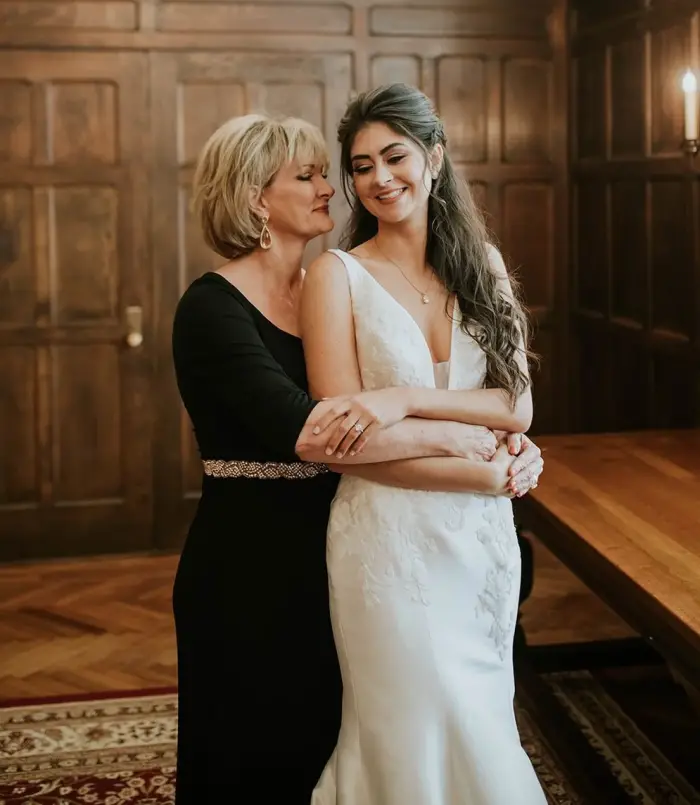
The Bouquet’s Secret
My daughter was marrying the son of a millionaire. All the guests in that sprawling estate outside Dallas, Texas, admired the perfect couple. They lifted champagne flutes and called it a fairy tale, the American dream wrapped in lace, marble, and money. They had no idea what darkness hid beneath the surface of all that gleaming perfection.
Doris Jones stood near the edge of the dance floor, unable to tear her eyes away from her daughter. Simone, in a snow-white gown embroidered with pearls and crystals, looked like a fairy-tale princess come to life. The ballroom of the Sturgis Ancestral Estate, about thirty miles outside Dallas, glowed with warm golden light from massive crystal chandeliers that hung from the high coffered ceiling. The light shimmered on Simone’s dark hair, styled in an elaborate updo that must have taken hours to perfect, and her train floated behind her like a soft cloud whenever she moved. Delicate beading caught the light with every step, scattering tiny rainbows across the polished marble floor.
Standing next to her was Preston Sturgis, tall, distinguished, and wearing a perfectly tailored black tuxedo that probably cost more than Doris made in three months. He smiled at the guests with the confident smirk of a man accustomed to getting whatever he desired. His cufflinks were platinum, his shoes Italian leather, his hair expertly styled with just the right amount of calculated casualness. Even from where she stood near the back, Doris could see that he looked like every successful son of old money she had ever seen on TV—polished, composed, and utterly sure the world would bend around him without resistance.
The wedding was being held at the Sturgis Ancestral Estate, the kind of property people in Doris’s part of Dallas only ever saw in glossy magazines or on streaming dramas about the lives of the wealthy and powerful. The mansion sat on rolling Texas acreage that seemed to stretch forever, with white columns that rose like temple pillars, marble staircases both inside and out, and a circular driveway where black SUVs and luxury sedans were lined up neatly under the watchful eyes of valet attendants in crisp uniforms. Inside, the foyer gleamed with polished floors that reflected the light like still water, and oil paintings of stern-faced Sturgis ancestors in gilded frames lined the walls, their painted eyes seeming to follow visitors with aristocratic judgment.
Outside, in the sprawling garden where tables were set up for the guests, hundreds of roses perfumed the warm May air with a fragrance so heavy it was almost overwhelming. A clear tent stretched over the dance floor, strung with thousands of fairy lights that twinkled like captured stars and decorated with garlands of fresh flowers imported from California and Florida at what must have been staggering expense. Waiters in white gloves glided between the tables like graceful dancers, refilling flutes with French champagne whose labels Doris recognized from food magazines. On a separate table near the far end of the tent stood a four-tiered wedding cake, each layer a careful work of art, frosted with smooth white icing and decorated with sugar flowers so realistic they looked like they might smell sweet if you leaned close enough.
Doris mechanically adjusted her own outfit, a modest beige dress she’d bought on sale at a local department store in Dallas. The fabric was polyester, practical and washable, chosen because it wouldn’t wrinkle too badly during the drive out to the estate. Standing next to guests in designer gowns and tailored suits, she felt completely out of place, like a sparrow who had wandered into a peacock’s garden. The women around her sparkled with diamonds that caught the light with every gesture, their manicures perfect and expensive, their hair styled at salons Doris had only seen from the outside while driving through uptown Dallas. The men discussed business deals, markets, and Florida vacation homes, throwing around words like “portfolio” and “acquisition” as if they were discussing the weather or the latest Cowboys game.
Doris, a certified public accountant for the Dallas County Health Department, could only nod and smile politely when someone glanced her way. She understood numbers, budgets, tax codes, and public health expenditures. She didn’t understand this world of casual wealth, where people spent more on a single dinner than she spent on groceries in a month.
“Doris, you must be so happy,” chirped some distant relative of the groom, a woman dripping in gold jewelry and wrapped in a fur stole despite the warm Texas evening that still held the day’s heat. Her perfume was expensive and strong, a cloying floral scent that made Doris want to step back.
“Your daughter made such a match,” the woman continued, her voice carrying the particular enthusiasm of someone who valued money above all else. “Preston is the heir to an entire empire, you know—real estate, construction, investments across three states. She’ll never want for anything now. Never have to work another day in her life if she doesn’t want to. Can you imagine?”
“Yes, of course,” Doris replied, forcing a polite smile that felt like it might crack her face. “I’m very happy for Simone.”
The woman kept talking about European investors and the Sturgis family’s latest project in Austin, something involving a new high-rise development and partnerships with international firms, but Doris was no longer listening. Her eyes were drawn back to her daughter like a magnet pulling iron. Simone stood next to Preston, accepting congratulations from a steady stream of guests who approached like courtiers before royalty. But something in her posture made Doris’s heart clench with maternal instinct that went deeper than thought.
Her back was too straight, her shoulders too tense, her smile too fixed. It looked painted on, rehearsed, like an actress playing a role she didn’t fully understand. Doris knew every curve of her daughter’s face, every habitual expression, every tiny shift of mood that flickered across those familiar features. She had watched Simone grow up in a small rented house in a working-class Dallas neighborhood, from scraped-knee childhood to awkward adolescence to college graduation. And right now, despite the designer gown and the perfect setting, she saw that Simone was not relaxed, not basking in the easy joy a bride should feel on her wedding day. She looked like she was enduring something, holding herself together by sheer force of will.
Doris remembered how, just six months ago, Simone had come home to her little duplex off Interstate 35, beaming with genuine excitement, to tell her about meeting Preston.
“It happened at that trendy café downtown—Bean & Barrel, you know, the one with the exposed brick walls and Edison bulbs hanging from the ceiling,” Simone had said, dropping her purse on the kitchen table and almost bouncing in place with excitement. “I was there with Kendra and Sierra after work, just unwinding, complaining about a difficult client. He walked up to our table, apologized for interrupting, and said he couldn’t leave without meeting ‘the woman with the most unforgettable smile in Dallas.'”
Simone had laughed when recounting the moment, her whole face lit up. “Mom, you should have seen the way Kendra and Sierra stared at him,” she said excitedly, gesturing with her hands. “He’s so dashing, so confident, and his eyes are this sharp gray—like storm clouds before rain. And the compliments he gave me weren’t tacky or crude like some guys. They were… sophisticated. Respectful. He said I looked like someone who could design dreams into reality.”
Doris had rejoiced with her daughter then, sharing in that infectious enthusiasm. It had been ten years since her divorce from Simone’s father, a decade of building a life as a single mother in Dallas. Simone had grown up watching her mother struggle and scrimp, put herself through a state university with the help of scholarships and part-time jobs, earned a degree in interior design, and was working at a small design studio in downtown Dallas. She’d dated here and there—engineers, grad students, a bartender from Deep Ellum who wrote poetry—but nothing serious, nothing that seemed to stick.
And now she had met a man who, from the first glance, courted her beautifully and lavishly. Flowers arrived at Simone’s studio every other day—not gas station carnations but elaborate arrangements of orchids and exotic blooms. Preston took her to restaurants Doris had only ever seen on food shows—places in uptown and downtown where appetizers cost more than Doris’s weekly grocery budget and where reservations had to be made weeks in advance. Gifts weren’t simple trinkets, but expensive jewelry nestled in velvet boxes and designer handbags, all delivered in crisp branded packaging that screamed luxury.
Preston quickly invited Simone to meet his parents. They received her graciously at their estate, welcoming her with practiced warmth and perfect manners, showing her around the mansion as if she already belonged there. Everything unfolded like a movie, fast, bright, and thrilling, each scene more glamorous than the last.
After only three months of dating, Preston proposed. It happened right there in the same Dallas café where they had first met, a calculated romantic gesture. He dropped to one knee in front of the entire room as people pulled out their phones to record the moment, their faces lit up with vicarious excitement. He opened a velvet box with a diamond ring that sparkled so brightly under the café lights that Simone had to squint. The stone was massive, easily three carats, set in platinum.
“Of course I said yes,” Simone had told her mother afterward, her voice breathless and quick. “Who would turn down a prince like that? Who would say no to a man who can offer everything?”
The excitement in her voice had been unmistakable, almost manic. But for some reason, the soft, grounded warmth that usually accompanied real love was missing. There was an anxious edge to it, a brittleness, as if Simone were trying to convince herself this was the right thing to do, talking herself into happiness.
“Mom, do you understand what a chance this is?” Simone had asked, pacing Doris’s small living room, her hands gesturing restlessly. “He’s smart, successful, wealthy beyond anything I ever imagined. I won’t have to bust my butt working two or three jobs like you did after the divorce. I can pursue my passion without worrying about bills, open my own studio, travel—finally see New York, L.A., maybe even Europe. Paris, Rome, all the places we looked at in magazines when I was growing up.”
Doris had decided then that it was normal, that every bride got nervous before such a big step. Her daughter was excited and thinking practically about her future, which was smart in today’s world. Love was one thing, but you had to have something to live on in America, where one medical bill or one lost job could topple everything you’d built. She herself had married Simone’s father not out of a thunderbolt of passion, but from a desire to build a family, have children, and find a reliable shoulder to lean on.
That reliable shoulder, however, had turned out to be capable of cheating right and left over fifteen years of marriage before finally leaving for a younger woman he’d met at work. He moved to Colorado, leaving Doris in Dallas to raise a teenage daughter alone, working overtime to make ends meet, skipping meals sometimes so Simone could have new school clothes.
Perhaps that was why Doris so desperately wanted to believe things would be different for Simone. That Preston was truly a decent man who would love and cherish her, and that money and status this time came packaged with integrity and respect instead of betrayal and abandonment.
The wedding preparations were lightning fast, a whirlwind that left Doris feeling dizzy. Preston’s parents insisted that everything be top-tier, the absolute best money could buy. They hired a celebrity event planner who proudly mentioned she’d worked on weddings in Los Angeles and Palm Beach, dropping names of actors and tech moguls. Simone’s gown was couture, shipped from a boutique in Milan by way of New York, with multiple fittings and alterations to ensure absolute perfection. The mansion began to be decorated a full week before the ceremony—florists arriving with trucks full of blooms, lighting technicians rigging elaborate systems, rental trucks driving up and down the long driveway delivering chairs, tables, and equipment.
The guest list was drawn up for two hundred people, though Doris personally knew maybe twenty of them—some relatives she saw at Christmas, a few of Simone’s friends from college, and a couple of Doris’s coworkers from the health department who had watched Simone grow up. Everyone else was part of the Sturgis family’s wide network of business partners, political acquaintances, golf buddies from upscale country clubs, and long-time society friends whose names appeared in the Dallas society pages.
Doris felt almost like an outsider at this wedding, as if she had come to an event that didn’t really belong to her, where she was tolerated rather than welcomed. She wasn’t even seated near her daughter. Instead, place cards put her at a table off to the side with distant relatives of the groom, people she had never met before that day and who showed little interest in making conversation with her.
When Doris had gently tried to hint to Simone a few days earlier that she would have liked to sit closer to her at the reception, maybe with Simone’s friends who at least knew her, Simone had given her a strange, apologetic smile that didn’t quite reach her eyes.
“Mom, Preston and his parents assigned the seats,” she’d said, her voice tight. “They have some kind of protocol, you know—business partners sit here, family there, status and all that. It’s very complicated. Please don’t be offended. It’s not personal.”
“Okay,” Doris had answered, swallowing her hurt. She wasn’t offended exactly, but a bitter residue remained, settling in her chest like sediment. And now, standing apart from the general merriment, watching her daughter from a distance, that residue felt sharper than ever, cutting into her with every breath.
The music changed and a slow song began to play, something classical and romantic that Doris didn’t recognize. Preston took Simone’s hand and led her to the center of the dance floor with practiced grace. Guests stepped back, forming a circle around them, and everyone pulled out their phones to film the newlyweds’ first dance, little screens glowing like a ring of tiny moons in the dimmed light. The moment was picture-perfect, exactly the kind of scene that would be shared on social media with hearts and congratulations.
Doris fumbled for her own old smartphone, its cracked case taped neatly at the corner where it had been dropped one too many times. She opened the camera with fingers that suddenly felt clumsy and aimed it toward her daughter, trying to capture this moment that should have been beautiful.
Preston placed his hand on Simone’s back, pulling her close. Doris noticed how tightly he was gripping her, his fingers digging into the delicate fabric of her gown. He wasn’t gently holding her, guiding her through the steps the way a loving partner would. He was clutching her, his fingers digging into her back, his knuckles pale with the force of his grip. Simone flinched for just a moment, so quickly most people wouldn’t have caught it, as if in pain, then quickly pasted her smile back on and tilted her head, looking up at her groom at just the right angle for the cameras. A perfect pose. A beautiful picture. But Doris saw that her daughter’s gaze was empty, distant.
As if she weren’t there in the moment at all, but somewhere far away. As if she had rehearsed this routine over and over and was now simply performing it by rote. Step left. Step right. Smile. Turn. Lean in. Smile again.
“What a lovely couple,” exclaimed a nearby aunt in a purple dress and a feathered fascinator that bobbed when she moved. “Real love, the kind you read about in romance novels. You just can’t look away from them.”
Doris wanted to object, to say that something was wrong, that her mother’s intuition was screaming alarm bells so loud they drowned out the music. But she kept silent, pressing her lips together. Who would listen to her? Everyone else saw the ideal picture: the handsome millionaire groom, the charming bride, the lavish Texas wedding with all the trimmings. How could anyone be unhappy in a fairy tale like this? What kind of ungrateful woman would throw this away?
The dance ended, and the guests applauded enthusiastically. Preston dipped Simone in a dramatic flourish and then pulled her into a long, theatrical kiss while cameras flashed and phones recorded from every angle, capturing the moment for posterity and Instagram. When he finally pulled away, Doris saw Simone subtly wipe her lips with the back of her hand. It was a fast, almost imperceptible movement, the kind of gesture you make when something tastes bad or feels wrong, but Doris saw it. And everything inside her turned ice-cold, a chill that started in her chest and spread through her entire body.
She remembered the last few months before the wedding with new eyes, seeing patterns she’d missed before. Simone had been visiting less and less, the gap between their meetings stretching from days to weeks. They used to call almost every day, chatting about everything—work frustrations, friend drama, trivial things like traffic on the interstate or a funny thing that happened at a Starbucks drive-thru. Then the conversations became shorter and strained, each one feeling more forced than the last.
When Doris asked how she was, Simone would answer in monosyllables, her voice flat. “Fine, Mom, just tired. The wedding, you know. So much to get done. So many decisions to make.”
One day, Doris had called her daughter just to chat, wanting to invite her over for the weekend to bake a pie together like they used to when Simone was in high school, when they would spend Saturday afternoons making apple pie and talking about everything and nothing.
Simone spoke softly, almost in a whisper, as if afraid someone might overhear. “Mom, I can’t right now. Preston’s home. We’re busy planning something. I’ll call you back later.”
But she never called back. When Doris called again two days later, worried and missing her daughter, Simone’s voice had been sharp and frantic, an edge to it Doris had never heard before.
“Mom, why are you calling so often? I’m an adult. I have my own life. I’ll call you when I have time. Please stop checking up on me.”
Doris had felt a sting of hurt then, sharp and unexpected. They didn’t speak for a whole week after that, a silence that stretched painfully between them. Then Simone called first, apologized profusely, and said she was just stressed from wedding preparations and that her nerves were shot. Doris had understood and forgiven her immediately, but the residue of unease remained, a nagging worry she couldn’t quite shake.
Now, from her spot at the edge of the reception tent, Doris watched how Preston didn’t leave Simone’s side for a single second. When her friends—Kendra and Sierra—came over to congratulate the bride, laughing and hugging her, he stood right there, listening to their conversation and interjecting with comments, inserting himself into every exchange. When Simone headed toward the drink table, he followed close behind like a shadow. When she suggested stepping away to touch up her makeup, he took her hand and said something that made Simone nod quickly and stay put, abandoning the idea.
A thoughtful groom, the guests would say. A caring husband who doesn’t want to let his wife out of his sight for even a minute, who wants to share every moment of this special day. How romantic, how devoted.
But Doris saw something else in it—control, surveillance, an invisible leash that kept Simone tethered to his side no matter what she wanted to do.
She tried to push the thoughts away, telling herself she was imagining things, working herself into a panic over nothing. Maybe she was overthinking, letting her own bad marriage color her perception of her daughter’s. After all, they had just gotten married only hours ago. Of course the groom didn’t want to let his bride out of his sight. That was normal, even romantic in its way. Newlyweds were supposed to be inseparable.
But when Doris looked at her daughter’s face again, really looked beyond the makeup and the smile, her heart skipped a beat. Simone stood there, clutching the bouquet of white roses to her chest like a shield, looking past the people, past the luxurious setting, past all the splendor and celebration. In her eyes, Doris saw something she had only seen once before, years ago.
When Simone was twelve, she had come home bruised and shaken after being bullied by a group of classmates who had cornered her after school. The girl had been silent then, not crying, just sitting at the kitchen table with an absent, hollow gaze that frightened Doris more than tears would have. It had taken Doris two hours to coax the truth out of her, sitting beside her and holding her hand until Simone finally felt safe enough to speak.
The same look was in Simone’s eyes now—the look of a person enduring something unbearable, holding on with all her strength, but perilously close to breaking. The look of someone who had learned to hide their fear behind a practiced smile.
The emcee’s voice cut through the music, amplified and cheerful. “And now our beautiful bride will toss the bouquet! All the single ladies, please come to the dance floor and get ready!”
Simone’s friends ran over, laughing and squealing, scrambling for position like they’d seen in countless American rom-coms and viral videos. About fifteen young women clustered in the center of the dance floor, reaching out their hands, nudging each other playfully and giggling, each one hoping to catch the bouquet and the promise of future marriage it supposedly carried.
Doris remained standing on the sidelines, one hand resting on a nearby chair for support. At forty-six, she had no business shoving her way into a crowd of twenty-somethings to catch a bouquet, no interest in the superstition or the spectacle.
Simone stepped onto a small raised platform at the edge of the dance floor and turned her back to the crowd, the traditional pose for the bouquet toss. Preston stood beside her, wrapping his arms around her waist possessively and leaning in to murmur something in her ear, his mouth close to her skin. Simone nodded mechanically, her movements stiff, then lifted the bouquet over her head with both hands.
The guests began the countdown, their voices building in volume and enthusiasm. “One… two… three!”
The bouquet soared into the air in a graceful arc, spinning as it flew over the dance floor—and sailed nowhere near where the girls were standing with their hands outstretched. It flew over their heads, past several rows of tables, past guests holding champagne flutes and dessert plates, and dropped directly toward Doris like a guided missile.
She instinctively reached out and caught the bundle of roses, feeling the stems thump softly against her palms, the weight of it heavier than she expected. The blooms were tightly bound with a satin ribbon, the petals cool and smooth against her skin.
The guests laughed good-naturedly at the unexpected trajectory. Someone applauded. A few people whistled.
“Oh, look! The mother of the bride caught it!” someone called out cheerfully.
“That’s good luck,” someone else said, chuckling. “It means Doris is going to get married soon, too! A second chance at romance!”
Doris offered a confused smile, pressing the bouquet to herself, unsure how to respond to the attention. The roses were heavy, tightly bound with the white satin ribbon that dug slightly into her fingers. Their scent was thick and almost suffocating, cloying rather than sweet, making it hard to breathe deeply.
She raised her gaze to the platform and met her daughter’s eyes across the distance of the dance floor. For just a moment, the crowd seemed to fade away, all the noise and movement dimming to nothing.
Simone looked at her as if she desperately wanted to say something—something important, urgent, vital. Her lips moved soundlessly, and Doris almost read the word “Mom…” forming there, a silent plea visible only to someone who knew her face as well as her own reflection.
But then Preston turned Simone toward him with firm hands, kissed her again for the cameras, and the moment slipped away like water through fingers. The connection broke. The noise rushed back. Simone’s face went blank again, that painted smile returning.
Doris stood with the bouquet in her hands, unsure what to do with it, feeling suddenly conspicuous and awkward. The roses’ fragrance was beginning to give her a headache, a dull throb starting behind her eyes. She tried to adjust them, shifting her grip, arranging the stems more comfortably, looking for a better way to hold the unwieldy bundle.
That was when she noticed something white between the tightly packed flowers. An edge of paper was sticking out between the stems, barely visible among the greenery and baby’s breath. It must be a note from the florist, Doris thought at first. Or maybe a little wish from the bridesmaids, some sweet message about luck and love.
She carefully pinched the edge of the paper between her fingers and pulled. A twice-folded piece of plain printer paper slid into her hand, slightly crumpled as if it had been stuffed there hastily. The paper was warm from being pressed against her palm.
Doris unfolded it, her fingers moving slowly. And froze, her breath catching in her throat.
The letters were uneven and shaky, as if written by someone in a hurry—or in fear. The handwriting slanted at odd angles, the pressure inconsistent. Only four words were written there, but they hit Doris with such force that it felt like the ground had dropped out from under her feet.
Mom, save me.
The handwriting was Simone’s. Doris would have known it anywhere—the same rounded letters, the same characteristic slant she remembered from school notebooks and birthday cards and grocery lists on the refrigerator. Only now the letters were crooked, the pen strokes uneven and desperate. At the end of the phrase, the ink had bled slightly, as if a drop of water—or a tear—had fallen there, smudging the final letter.
Doris looked up sharply, her eyes scanning the room with sudden intensity. The guests continued to celebrate, oblivious to the silent drama unfolding. The band kept playing a light jazz tune that felt jarringly cheerful. Waiters circled with trays of canapés and petit fours. People were laughing, drinking, taking selfies. No one was paying attention to her, just an ordinary mother of the bride holding a bouquet, probably touched by the sentimental gesture. No one saw the paper trembling in her hand.
Doris squeezed the note in her fist and pressed her hand against her chest, hiding the paper in the folds of her dress, her heart hammering so loudly she was sure someone must hear it. Her ears rang with a high-pitched whine and her mouth went dry. Her hands were shaking.
She looked back toward the platform where Simone and Preston were now posing for the photographer, his arm around her shoulders, both of them smiling perfectly for the camera. Simone wore the same painted smile, but now, behind that smile, Doris saw what she should have seen all along—a silent scream, a desperate plea for help that had been there the whole time, hidden just beneath the surface.
Save me.
What did it mean? Save her from what? From whom? From the handsome, well-off groom in the expensive tuxedo who was currently wrapping an arm around her shoulders and kissing her temple for the cameras? From this entire luxurious fairy tale that everyone around them was admiring, snapping pictures of, and posting to Instagram with captions about #goals and #blessed and #weddingoftheyear?
Doris tried to gather her thoughts, forcing herself to think clearly despite the panic rising in her throat. Panic wouldn’t help Simone. Hysteria wouldn’t save her. She needed to think, to act—but how? What could she possibly do in a room full of two hundred people, surrounded by Preston’s family and their money and their power?
Should she walk up to Simone right there, in front of all the guests and the Sturgis family, grab her daughter’s hand, and drag her out? She imagined the scene—marching up the steps to the platform, shouting that the wedding was over, declaring that her daughter was leaving with her right now, this instant. A scandal, a horror, a public disgrace that would be filmed and shared and talked about for years.
Guests gasping in shock. Phones raised higher to capture every second. Preston’s parents calling security, their faces tight with fury. Men in suits grabbing her arms, dragging her out while she fought and screamed. And Preston himself? She remembered how tightly he had squeezed Simone’s waist during the dance, the possessive grip of his fingers. He simply wouldn’t let her go. He would fight for what he considered his property, and in a room full of his family’s guests and security, Doris would lose.
No. She needed a plan, something smarter than raw emotion and maternal fury. She needed help. She needed allies.
Doris scanned the tables quickly and spotted Simone’s friends—Kendra and Sierra—sitting together with another friend from college, a petite woman with dark hair named Aubrey. The four of them had been close since freshman year at the University of North Texas, bonded by late-night study sessions and shared struggles and the thousand small moments that create true friendship. If anyone could help, if anyone would believe her and act without hesitation, it was them.
Doris moved quickly toward their table, clutching the bouquet so tightly the stems bit into her palm, leaving red marks. A wild, risky plan was forming in her mind. It was insane, desperate, the kind of thing that could backfire spectacularly. But she saw no other way, no other path that didn’t end with Simone trapped.
She slipped into the empty chair next to Kendra and leaned in close, her voice low and urgent. “I need your help. Right now. This very second.”
Kendra, a cheerful young woman with round cheeks and a riot of red curls piled on top of her head, turned toward her. She had been Simone’s closest friend the longest, since freshman orientation, and knew her inside and out. The smile on her face faded when she saw Doris’s expression.
“Ms. Jones, is something wrong?” Kendra asked, her voice dropping to match Doris’s serious tone, anxiety creeping into her eyes.
“Simone is in danger,” Doris said firmly, looking her straight in the eyes, willing her to understand the urgency. “I can’t explain everything here, not now, but I need to get her out of this place. And I need your help to do it. All of you.”
Sierra, a tall blonde with a sharp gaze and an athlete’s build from her college volleyball days, leaned closer, her expression alert. Aubrey, small and dark-haired with quick, intelligent eyes, looked at Doris in alarm, her hand frozen halfway to her champagne glass.
“Are you serious?” Sierra whispered, glancing around to make sure no one else was listening. “Right now? In the middle of the wedding reception with two hundred people watching?”
“Especially in the middle of the wedding,” Doris replied, her voice steady despite the fear coursing through her. “While everyone’s distracted. While Preston thinks he’s won.”
She reached into her purse, pulled out a pen, grabbed a paper napkin from the table, and quickly wrote a few words in capital letters for clarity. In 5 minutes, go to Simone. Tell her you need her urgently. Do not leave her alone for a second. She slid the napkin to Kendra.
The girl read it and went pale, all the color draining from her face. Her eyes widened. “Oh my God,” Kendra whispered, her hand shaking slightly as she set the napkin down. “Is this because of Preston? Did he hurt her?”
“I’ll explain later,” Doris said, already writing on another napkin. “Will you do it? I need to know you’re with me before we start this.”
Kendra hesitated for only a heartbeat, her eyes flickering to where Simone stood on the distant platform, then back to Doris. Then she nodded decisively, her jaw setting with determination. “Of course I will. Simone’s my best friend. I’d do anything for her.”
Doris took two more napkins and scribbled short instructions for Sierra and Aubrey, her handwriting rushed but legible. Sierra was to approach from the other side, mention some made-up tradition about the bride needing a moment with her bridesmaids, and insist that Simone needed to step away to change or fix her dress—any excuse that sounded plausible. Aubrey was to act as cover, distracting Preston or his parents if necessary, keeping their attention diverted while the others moved Simone away from the crowd.
The girls read their napkins silently, their eyes moving quickly over the words. They exchanged quick glances, a whole conversation happening in the space of a few seconds without words. Doris watched their faces shift—from surprise to dawning understanding, from understanding to hardening determination, the kind of resolve that comes when you realize your friend needs you and there’s no time to second-guess.
“Have you noticed anything wrong with her?” Doris asked quietly, needing to know if her instincts were shared, if she was the only one who had seen the signs. “Over the past few months? Any changes in how she acted?”
Sierra slowly nodded, her lips pressing into a thin line. “She’s been different the last couple of months,” Sierra said, her voice barely above a whisper. “Withdrawn. Distant. We used to see each other every week without fail, just hanging out around Dallas—brunch at our favorite spots, shopping at NorthPark Mall, movie nights at Kendra’s apartment with popcorn and wine. Then she started canceling plans out of nowhere, saying she was busy, that Preston needed her for something. And when we did manage to get together, she was constantly checking her phone, jumping whenever it rang like she was expecting bad news.”
She paused, swallowing hard. “I just thought she was in love,” Sierra admitted, guilt flickering across her face. “You know, the way people get weird at the beginning of a relationship. All consumed and distracted. I thought it was just… the effect of a new relationship making her act different. I didn’t think…”
“I saw a bruise,” Aubrey said suddenly, her voice small but firm. She touched her own shoulder as if feeling phantom pain. “Three weeks ago, when we went shoe shopping for the wedding at NorthPark Mall, trying to find the perfect heels. She tried on a dress in one of those boutiques, and the strap slipped down her shoulder. I saw the mark on her skin—dark purple and yellow, the colors of an old bruise. She said she’d bumped into a door frame at Preston’s place, that she was clumsy, but the bruise was… odd. Not the round shape you get from hitting something. Like the shape of fingers, like somebody had grabbed her hard and held on.”
Doris’s stomach twisted painfully, nausea rising. Fingers. So it had started even then, maybe earlier. And she—her own mother—hadn’t seen anything, hadn’t known, had been too busy being happy about the wedding to notice that her daughter was being hurt.
“I tried to talk to her once,” Kendra added, nervously twisting the edge of her napkin until it tore slightly. “About a month ago. I asked straight up, just the two of us in my car after lunch. ‘Simone, are you really happy? This seems so fast. Maybe you should wait, get to know him better before jumping into marriage.’ She looked at me like she was scared, like I’d said something dangerous, and said, ‘Kendra, everything’s fine. I’m just nervous. It’s the wedding, you know, all the stress. Please don’t make this harder.’ But I knew she was lying. I could see it in her eyes. And I still didn’t push. I still didn’t do anything. I was afraid to interfere, afraid I was wrong. I thought, ‘What if I’m imagining things? What if they really are happy and I ruin it?'”
“Stop blaming yourselves,” Doris said sharply, reaching out to grip Kendra’s hand. “There’s no time for guilt or second-guessing. We’re going to fix this right now. We’re going to get her out.”
She looked each of them in the eye, making sure they understood the stakes. “Are you ready? Because once we start, we can’t stop. We’re committed.”
All three girls nodded, their expressions resolute.
“Then listen very carefully,” Doris said, leaning in closer so her voice wouldn’t carry. “In five minutes—I’ll check my watch and signal you—Kendra, you go to Simone. Tell her you have to carry out some important tradition, that the bride needs a moment alone with her friends to make a wish or do some ritual. Improvise if you have to, make it sound authentic. The important thing is to get her away from Preston. If he refuses to let her go, Sierra, you back her up immediately. Say it’s a mandatory part of the program, some Southern wedding tradition the planner mysteriously forgot to include in the schedule. Preston won’t want to come off as the guy who ruins traditions in front of his parents’ guests, not with everyone watching.”
She took a breath, her mind racing through the plan, looking for holes. “Aubrey, you distract his parents—ask them a question about the estate, mention some relative, anything that keeps their attention off Simone for a few crucial minutes. Keep them talking.”
Doris exhaled slowly, trying to calm her racing heart. “I need you to get her away for at least a couple of minutes,” she finished. “Just far enough that I can talk to her privately, that she can tell me what’s happening. After that, I’ll handle it. I have a plan. Sort of.”
She wasn’t sure the plan would actually work. All she had was a desperate, blazing desire to get her daughter out of that tent, off that estate, and away from these people who seemed to think they could own her. But she would figure out the details as she went. She had to.
She glanced back at the platform. Preston was holding Simone’s hand possessively, his grip tight even from this distance, talking to an older man in an expensive suit who looked like he’d flown in from New York or Chicago just for this event, someone important in the Sturgis business empire. Simone stood silently beside him, eyes downcast, hands clasped in front of her, like a beautiful doll in a display case, decorative and silent.
The five minutes passed agonizingly slowly. Doris stood near one of the tent poles, counting the seconds by her pulse, squeezing the bouquet so tightly her knuckles ached and the thorns hidden beneath the ribbon cut into her palm. The note remained clenched in her other fist, the paper growing damp with sweat. She watched the girls prepare themselves, saw them exchange one last look of determination.
Finally, Kendra pushed back her chair with a soft scrape, straightened her emerald bridesmaid dress, took a deep breath that lifted her shoulders, and walked toward the platform. Doris watched every step, her own breathing shallow.
Kendra reached Simone, hugged her warmly, and said something in a bright, cheerful tone that carried just far enough. Doris couldn’t hear the exact words but saw Simone’s face light up briefly with genuine pleasure at seeing her friend. Preston turned to them, his face carefully neutral but his eyes cold, calculating, immediately suspicious of any intrusion.
Kendra kept talking, gesturing animatedly with her hands, putting on a performance of enthusiastic friendship and tradition. Simone nodded, seeming to relax slightly, then said something to Preston. His mouth tightened into a hard line, his jaw clenching. Doris saw his lips shape the word no, saw him start to pull Simone closer to his side.
Then Sierra approached from the other direction and slipped her arm through Simone’s from the other side, beaming with that practiced cheerfulness that came from years of customer service jobs and dealing with difficult people, her voice bright and carrying. Two friends against one groom, bracketing Simone protectively.
Preston was clearly annoyed, his face darkening. His fingers tightened on Simone’s hand until Doris could see the tendons in his wrist stand out, see Simone wince at the pressure. But some of the nearby guests had begun to look in their direction, curious about what was happening, phones already half-raised in case something interesting occurred. Preston couldn’t make a scene, couldn’t be the groom who manhandled his bride in front of two hundred witnesses. Not without consequences to his image.
Slowly, visibly reluctant, he unclenched his fingers. Simone pulled her hand free quickly, rubbing her wrist subtly. With her friends bracketing her on both sides, creating a protective buffer, she stepped down from the platform. Together, the three of them headed for the edge of the tent, moving with purpose.
Preston took a step as if to follow, his face darkening further with anger barely contained. But Aubrey rushed up to him right on cue, talking quickly and pointing toward his parents’ table, her small hands fluttering expressively, her voice rising just enough to be distracting. Something about a family friend wanting to speak with him, some important connection he couldn’t ignore. Preston turned in annoyance, torn between following Simone and dealing with whatever Aubrey was saying.
In that moment of hesitation, Simone and her friends disappeared behind one of the white tent columns, slipping out into the evening air.
Doris exhaled for what felt like the first time in minutes, her chest loosening slightly. Phase one had worked. The hardest part was still ahead, but they’d gotten Simone away from Preston’s immediate control. That was something.
She moved quickly, skirting the tables, nodding distractedly at anyone who tried to speak to her, mumbling apologies and excuses. She slipped out of the tent into the cooler evening air, the temperature dropping as the sun sank lower. The Texas sky was turning shades of orange and purple, beautiful and indifferent to the human drama unfolding below.
It didn’t take long to find them. At the far end of the manicured garden, near a small stone fountain lit by soft landscape lights that cast dancing shadows on the water, Simone sat on the low stone rim, her white dress spilling around her like a puddle of milk. Kendra, Sierra, and Aubrey stood close by, their faces worried, talking in hushed, urgent tones.
“Simone, what’s going on?” Kendra was asking, her voice tight with concern and fear. “Your mom said you were in danger. Is that true? Please, talk to us.”
Simone didn’t answer immediately. She sat hugging herself despite the warm evening, her shoulders rigid, her whole body trembling like a leaf in a storm. In the soft lantern light, Doris saw that her daughter’s makeup was smudged, mascara tracking down her cheeks in dark lines, the carefully applied foundation cracking.
“Simone,” Doris said softly, stepping closer, her heart breaking at the sight. She crouched down in front of her daughter with effort, her knees protesting, and gently took Simone’s cold hands in hers. They were ice-cold despite the warm Texas evening, trembling violently.
“I got your note,” Doris said quietly, squeezing her hands. “I understand. I’m here. Whatever you need, whatever is happening, I’m here now.”
Simone lifted her head slowly, and when their eyes met, Doris saw her daughter’s carefully maintained composure finally shatter. Her eyes flooded with tears that had been held back all evening, probably for weeks, finally breaking free. Her lower lip trembled uncontrollably.
“Mom, I couldn’t—I didn’t know how else—” she whispered hoarsely, her voice breaking on every word. “He watches me all the time, every second. I can’t even talk to you alone. He checks my phone, monitors my calls. I couldn’t call you, couldn’t text, couldn’t say anything. This was the only way I could think of to get a message to you without him knowing.”
The words came in broken pieces, fragmented and desperate. Simone pressed her mother’s hands to her face and finally cried—quiet, muffled sobs, as if even now she was afraid someone might hear and drag her back to that tent, back to Preston’s side where she belonged according to the marriage license they’d signed just hours ago.
“It’s okay,” Doris murmured, stroking her daughter’s hair with one hand, feeling anger ignite in her chest like a Texas brushfire, hot and consuming. “Everything’s going to be okay. I promise you. We’re leaving now. Right now. You’re not going back in there.”
“No.” Simone shook her head quickly, almost violently, panic flaring in her eyes. “We can’t. You don’t understand. He won’t let me. His parents—they said if I call off the wedding, if I try to leave him, they’ll destroy you, Mom. They said they’d get you fired from your job with one phone call, that you’d never find work in Dallas again, that they have connections everywhere. They said they have people who can make your life hell, who can ruin your credit, freeze your accounts, make sure no one in the county will hire you.”
She was speaking faster now, the words tumbling out. “They said they’d make sure everyone knows you’re a troublemaker, unreliable, that they’d spread rumors about you being unstable or stealing or anything they needed to say. They have money, Mom. They have power. They can do things we can’t even imagine. Preston said if I tried to run, he’d find me no matter where I went, that there’s nowhere in Texas I could hide that his family couldn’t reach.”
“Let them try,” Doris said, and there was so much steel in her voice that Simone flinched, her eyes going wide. “I’m not that easy to destroy, sweetheart. I’ve survived worse than rich people with connections. And I won’t let anyone hurt you. You’re my daughter. If I have to fight their whole family, their money, all their connections, every lawyer they can afford, I will. I will burn every bridge and fight every battle to keep you safe.”
She stood up, pulling Simone to her feet with gentle but firm hands. “But you,” Doris said, cupping her daughter’s tear-stained face, “are going to stand up right now, and we are going to walk out of here together. You and me. Like we’ve always done. Like we did when your father left us with nothing. We survived that, and we’ll survive this.”
“Ms. Jones is right,” Kendra said firmly, crouching beside Simone and taking her other hand, her own voice shaking but determined. “We’re not going to let anyone hurt you. Not Preston, not his parents, not their whole empire. We’re here. We’ve got you. All of us.”
“But you don’t understand,” Simone whispered, wiping her cheeks and smearing her mascara further, black streaks across her pale skin. “He’s not who he seems. Not at all. In public, he’s perfect—charming, generous, thoughtful. But when we’re alone, he changes completely. He says I’m his property now, that I belong to him. That I have to obey every word he says. That if I try to leave, if I embarrass him, if I make him look bad in any way…”
She trailed off, her voice breaking.
“What will he do?” Sierra asked gently, sitting down on Simone’s other side on the fountain’s rim, putting an arm around her shoulders. “Simone, please. Tell us the truth. Did he hit you? Did he hurt you physically?”
“No,” Simone said quickly, shaking her head. “He never hits. He’s too smart for that, too careful about leaving evidence. He grabs instead. He squeezes so hard it hurts, leaves bruises shaped like fingers, but the marks barely show under clothes. He knows exactly where to grab so it won’t be visible. And he says it’s my fault, that I provoke him with my behavior. That if I behaved properly, if I was a good wife, he wouldn’t have to ‘discipline’ me.”
“Oh my God,” Aubrey whispered, covering her mouth with both hands, her eyes filling with tears. “Simone, no. That’s abuse. That’s textbook abuse.”
“How long has this been going on?” Kendra asked, her voice tight with suppressed fury. “When did it start?”
“About three months,” Simone replied, her voice hollow, speaking faster now as if afraid that if she stopped, she wouldn’t have the courage to continue. “At first he was perfect. You all saw it—the flowers, gifts, compliments, fancy dates in Uptown Dallas, taking me to places I’d only dreamed about. He was everything I thought I wanted. Then after we announced the engagement, after he put that ring on my finger, he started changing bit by bit.”
She spoke quickly, the words she’d been holding inside for months finally spilling out. “It began with little things I didn’t recognize as warning signs. He’d say that lipstick didn’t suit me, that my dress was too short and made me look cheap, that my friends were a bad influence and I should spend less time with them. Then he started checking my phone constantly, demanding passwords to my social media accounts, my email, everything. He said we were family now, going to be married, so there shouldn’t be any secrets between us, that privacy was a form of lying.”
Her voice dropped lower. “He forbade me to meet you guys without him there to supervise,” Simone went on, looking at her friends. “He said you were a bad influence, that you encouraged me to be independent when I should be focused on being a good wife. When I tried to argue, when I said you were my friends and I loved you, he just gave me this look—cold and flat, like I was an object that had malfunctioned.”
She shuddered, wrapping her arms around herself. “Then he grabbed my shoulders hard and pinned me against the wall of his apartment. Not hard enough to leave obvious marks, nothing that would show in photos, but enough to make sure I understood the message. I couldn’t argue with him. I couldn’t disagree. I couldn’t even breathe properly with his weight against me and his fingers digging into my shoulders.”
“Why didn’t you tell me?” Doris burst out, anger and hurt swirling together in her chest, her voice cracking. “Why didn’t you come to me right then? Why did you stay silent and let this continue?”
“I tried,” Simone said, her voice breaking completely now, tears streaming down her face unchecked. “Remember when I called you, and then I said I couldn’t talk and you were upset that I didn’t call back? I wanted so badly to come over and tell you everything, to confess what was happening. But he found out I’d called you. He always finds out somehow—he checks my phone records, tracks my location. He said if I tried to ruin the wedding, if I told anyone what was really happening, his parents would ‘take care’ of you.”
Her voice dropped to a whisper, forcing them all to lean closer to hear. “Preston’s father knows people, Mom. Powerful people. Politicians, judges, business leaders. He bragged about it. He said they can get you fired with one phone call to the right person, make sure you can’t get a job anywhere in the county ever again, that they’d blacklist you from every government position in Texas. And Preston promised that if I tried to run, if I left him, he’d find me no matter where I went. He said there’s no corner of this country where his family’s reach doesn’t extend. He said he’d make my life, and your life, a living hell.”
“Simone.” Doris took her daughter’s face in both hands, making her look up, making her focus. “Listen to me very carefully. No one—no one—is going to hold you against your will. I don’t care about their money or their connections or their threats. You have the right to leave. Right now, this instant. And we are all with you. Every single one of us.”
“But how?” Simone sobbed, her whole body shaking. “We just signed the papers an hour ago. I’m his wife now legally. He’ll say I’m hysterical, having a breakdown, that brides get overwhelmed. Everyone will believe him because look at him—he’s perfect on paper. Rich, successful, handsome, from a good family. Everyone thinks I’m the luckiest woman in Dallas. Who’s going to believe me over him?”
“Then everyone is wrong,” Sierra said fiercely, standing up, her jaw set with determination. “Simone, we’re not going to let him keep you like some kind of prisoner. We’ll get you out of here. We just need to be smart about it, have a plan.”
Doris rose too, her knees protesting, and helped Simone to her feet. Her daughter swayed slightly, unsteady, and Doris supported her weight.
“We’re going back into that tent,” Doris said, her voice steady despite the fear coursing through her. “You’re going to tell the truth in front of everyone. You’re going to say you’re leaving, that this marriage was a mistake. That way, he can’t twist the story later and say you vanished or had a breakdown or were kidnapped. He doesn’t get to control the narrative. You take that power back right now.”
“He won’t let me talk,” Simone whispered, fear evident in every word. “He’ll stop me. He’ll grab me or his parents will intervene or they’ll call security. They won’t just let me walk out.”
“He will let you talk,” Kendra replied, taking Simone’s hand firmly. “Because we’ll be right there with you, all four of us. A wall between you and him. And if he tries to stop you, if he tries anything, there are two hundred witnesses with cameras. Let’s see him explain that away.”
“Let them try to stop us,” Sierra added, her voice hard. “I played volleyball at UNT. I can take a hit and keep going. So can we all.”
They started back toward the tent together, a strange little procession moving through the manicured garden in the Texas twilight—a bride in a stained, slightly torn designer gown, her mother in a modest beige dress, and three friends in matching emerald bridesmaid gowns. Doris walked in front, still clutching the heavy bouquet with the note hidden carefully in her dress pocket. Her heart pounded like a drum, but the raw terror had burned away in the minutes by the fountain. What remained was something colder, sharper, more dangerous. Resolve. Maternal fury. The absolute certainty that she would move heaven and earth to protect her child.
When they stepped back into the tent, the band was still playing cheerful music and the guests were still celebrating, but conversations dipped noticeably and then swelled again with whispers and speculation as people noticed the returning bride. A murmur ran through the tables like a wave spreading outward from where they entered.
“Look, the bride is back. Where did she go?”
“What happened to her dress? It’s dirty at the hem.”
“Her makeup is smudged all over. Was she crying?”
“Oh my God, is something wrong?”
Preston stood near the head table, talking intensely to his father, Sterling Sturgis—a tall man with silver-streaked hair and the kind of expensive suit that never came off a rack, custom-tailored to perfection. The two of them turned as one when they sensed the shift in the room’s energy, their heads swiveling toward the entrance. Their eyes locked onto Simone approaching with her protective escort, and Doris saw Preston’s face darken with barely contained rage.
He strode toward them quickly, his movements controlled but aggressive, cutting through the crowd. “Where have you been?” he asked sharply, his voice low enough not to carry far but there was unmistakable steel in it, a threat wrapped in a question. “I told you specifically not to leave my side. I was worried. You can’t just disappear like that.”
“Step away from her,” Doris said firmly, stepping between him and Simone, blocking his path with her body despite being six inches shorter and fifty pounds lighter. “Don’t touch her. Don’t come near her.”
Preston looked at her with a mixture of surprise and contempt, as if a piece of furniture had suddenly spoken. “Ms. Jones, please don’t interfere in the affairs of the newlyweds,” he said softly, his voice dripping with condescension. “This is between me and my wife. Simone is my wife now. We made vows. She belongs with me.”
“She is no one’s property,” Doris replied, her voice rising, loud enough now for the closest tables to hear clearly, loud enough to cut through the music. “She is not a possession you bought with that ring. She is my daughter, a human being with rights. And she is leaving here with me right now.”
The music faltered and then stopped altogether, the band trailing off awkwardly mid-song. The emcee lowered his microphone, uncertain what to do. Conversations died throughout the tent like lights being switched off. Heads turned from every direction. Phones lifted instinctively, dozens of cameras suddenly recording. This was better than the bouquet toss, better than the first dance—this was drama, conflict, something worth posting about.
“What nonsense is this?” Preston demanded, trying to sidestep Doris and reach Simone, his hand outstretched. “Stop this ridiculous scene. You’re embarrassing yourself, embarrassing your daughter.”
Sierra and Kendra moved with practiced instinct, stepping in front of Simone, forming a wall of satin and sequins and absolute determination. Aubrey moved to the side, blocking his angle of approach, making a triangle of protection around their friend.
“Get out of the way,” Preston snapped, his careful facade cracking, real anger showing through now. “You’re making fools of yourselves. This is my wedding. Move aside right now.”
“These ‘fools’ are protecting their friend,” Kendra shot back, folding her arms across her chest, her red curls seeming to bristle with indignation. “From someone exactly like you.”
“From someone like me?” Preston scoffed, but there was a flicker of rage in his eyes that made his whole face look different, harder, cruel. “What are you accusing me of, exactly? Being successful? Being generous? This is my wedding. I spent millions on it. Millions to make her happy.”
“You can’t buy a person with money,” Doris said, stepping even closer, refusing to be intimidated by his height or his anger or the power radiating from him. “You can buy things, services, even experiences. But you cannot buy a human soul. Oh, but you thought you could, didn’t you?” she added, her voice steady and cutting. “You thought that because you have millions in the bank, you’re entitled to control people, to intimidate them, to keep them in fear. You thought money meant ownership.”
Whispers rippled through the tent like wind through tall grass, building in volume. Preston’s parents got up from their table and walked toward the scene with measured, controlled steps, their faces tight with displeasure. The guests parted for them instinctively, creating a path.
“What is happening here?” Sterling Sturgis asked, his tone that of a man who expected answers immediately and obedience always. “Preston, explain this situation right now.”
“The mother-in-law and the bridesmaids are putting on some kind of show,” Preston said with a tight shrug, trying to sound amused and failing, his voice strained. “Some ridiculous stunt, delusional accusations they’ve made up. I have no idea what this is about.”
“They are not delusional,” Simone said, her voice trembling but audible. She stepped out from behind her friends, standing on shaking legs but standing nonetheless. “It’s all true. Every word my mother said is true.”
She looked straight at Preston, meeting his eyes for what might have been the first time in months without fear forcing her to look away. “You intimidated me,” she said, her voice growing stronger with each word. “You controlled me. You monitored my phone, isolated me from my friends and family, threatened my mother. I married you not out of love—but out of fear. Fear of what you’d do to me, to her, if I refused.”
“Oh, darling, sweet Simone,” Celeste Sturgis, Preston’s mother, cooed as she moved closer, dripping false sympathy, her diamond necklace catching the light with every movement. “You’re exhausted, overwhelmed by all of this. It’s completely normal on a day like this—the stress, the attention, all the decisions. Come, sweetheart, I’ll give you something to help you calm down, help you relax. We’ll get you somewhere quiet.”
She reached for Simone’s arm with perfectly manicured fingers.
“Don’t touch me,” Simone said sharply, pulling back, her voice cutting through the false sweetness like a knife. “Don’t you dare touch me.”
The tent went utterly silent, everyone holding their breath.
“You knew,” Simone added, her voice shaking but growing stronger, fueled by months of suppressed rage finally finding voice. “You knew what he was like. You knew he was controlling and cruel. You had to know—you raised him, shaped him. And you still pushed this wedding because you needed a wife who would keep quiet and obey, who would look good in photos and not cause problems. Someone to produce heirs and smile for cameras and never, ever question anything.”
“You don’t know what you’re saying, girl,” Sterling Sturgis said, stepping forward, using his considerable height to loom over her intimidatingly. “Think very carefully about what you’re doing right now. You are about to destroy your entire future over what? A case of wedding day jitters? Our family can give you everything—wealth, social standing, connections that reach across this country and beyond. And you would throw that away to go back to… what? A cramped apartment and a paycheck-to-paycheck life? Working in some tiny design studio for minimum wage?”
He let his words hang in the air, the threat implicit.
“Better a small place and freedom than a mansion and fear,” Simone replied, straightening her spine, lifting her chin despite the tears still streaming down her face. “Better to be poor and safe than rich and terrified. Better to own myself than to be owned by anyone.”
Her words made several guests gasp audibly, hands going to mouths, eyes widening.
“Enough of this circus,” Preston snarled, his control finally snapping completely. He lunged toward Simone, his hand reaching for her arm with clear intent to drag her away by force if necessary.
Kendra and Sierra grabbed his arms simultaneously, holding him back with surprising strength. “Let go!” he barked, trying to wrench free, his face contorting with rage. “Simone, stop this insanity right now. You are my wife, and you are staying here. This is where you belong.”
“I am not your anything,” Simone said quietly, but the words carried in the shocked silence, reaching every corner of the tent. “I was never yours. I am not a thing to be owned. I am a person with rights. And I am leaving this place right now.”
Preston wrenched free from Kendra and Sierra with violent force and reached for Simone again, his face twisted with fury, his hand closing into a fist.
Before his hand could close around her arm, another hand seized his wrist with iron strength, stopping him mid-motion.
A man had stepped out from the crowd of onlookers, tall and broad-shouldered in a simple dark suit.
“Don’t you dare touch my daughter,” the man said. His voice was calm, almost conversational, but there was a threat in it that made even Sterling’s eyes narrow with recognition of real danger.
Doris’s heart stumbled, missing a beat. “Michael,” she whispered, shock rendering her momentarily speechless.
Her ex-husband. Simone’s father.
Michael Washington, who had moved to Colorado years ago after the divorce and only rarely flew back to Texas, usually just for Simone’s birthday or Christmas, stood there now in his simple dark suit looking older than she remembered but solid, real, present. His fingers dug into Preston’s wrist with visible pressure until the younger man winced and tried to pull away.
“I heard your conversation by the fountain,” Michael said, still holding Preston’s wrist in an unbreakable grip, his voice steady. “I was outside the tent having a smoke, trying to avoid the crowd. I heard everything she said. I’m sorry, Simone. I thought you were happy, thought this was what you wanted. I was wrong to assume, wrong not to look closer. But I’m here now. And this boy is never laying a hand on you again. Not while I’m breathing.”
“You’ve all lost your minds,” Sterling roared, his face reddening with fury and something that looked like panic. “Security! Where is security? Get them out of here immediately!”
Two burly men in suits began pushing their way through the crowd, hands reaching for weapons or radios, expressions hard.
Doris felt the situation spiraling rapidly out of control. This could turn into a physical fight, could end with arrests and lawsuits and headlines that would follow them all for years. Violence erupting at a high-society Dallas wedding would be news for weeks.
“Stop!” she shouted, her voice cutting through the chaos. The tent seemed to hold its collective breath, two hundred people freezing mid-motion.
“Everyone, just stop for one second,” Doris said again, more quietly, moving to the center of the circle that had formed, still holding the bouquet with Simone’s desperate note pressed against her palm like evidence. “Please. Let’s all think clearly here.”
She stepped into the center of the circle, facing Sterling directly, a middle-aged accountant in a discount dress standing up to a multimillionaire in his custom suit.
“Mr. Sturgis,” she said, keeping her voice calm and reasonable, like she was explaining a budget line item at work. “You’ve built an empire over decades. You sit on corporate boards. You donate to political campaigns and hospital wings. Your name is on buildings. Your reputation matters to you deeply, doesn’t it? Everything you’ve built depends on that reputation staying intact.”
Sterling frowned, his eyes narrowing suspiciously. “What are you getting at?” he asked, his voice tight with barely controlled anger.
“I’m getting at the fact that there are about two hundred people here right now,” Doris said evenly, gesturing around the tent at all the faces watching, all the phones recording. “Half of them are already filming this scene on their phones, capturing every word, every action. Tomorrow morning, this entire confrontation could be all over the internet—on TikTok, Instagram, Facebook, Twitter, local Dallas news stations. The viral story of how your son intimidated a young woman, kept her in fear through threats and violence, and pushed her into a wedding she didn’t want.”
She let that sink in, watching Sterling’s face carefully.
“Can you imagine what that would do to your business reputation?” she asked softly, twisting the knife. “What your political friends would think? What your board members would say? What your business partners would do when they see evidence that the Sturgis family forces women into marriages through intimidation?”
She let the silence stretch.
Celeste had gone pale as paper, her hand clutching her husband’s arm. Sterling’s jaw clenched so hard Doris could see the muscles jumping in his cheek.
“Or,” Doris continued, her voice still calm and reasonable, offering an alternative, “we can end this quietly right now. Simone, her father, her friends, and I walk out of this tent peacefully. No fights. No shouting. No one drags anyone anywhere. No police called. You announce to your guests that the bride suddenly felt unwell, overwhelmed by the heat and the excitement. The wedding reception is ending early. Clean. Controlled. Dignified.”
She paused.
“Then, in a week or two, Simone files for divorce quietly through her lawyer,” Doris finished. “And you do not interfere. No threats against her or me. No harassment. No using your connections to destroy anyone. You leave her alone to rebuild her life. You let this whole thing fade away quietly.”
She held Sterling’s gaze steadily.
“And then this story stays in this tent,” she said quietly. “It never leaves your property. No videos posted. No news coverage. No viral scandal. Your reputation remains intact. Your business relationships continue unaffected. Your political connections stay solid. Everyone moves on with their lives.”
Sterling stared at her for a long moment, his face working through calculations.
“Are you blackmailing us?” he asked through clenched teeth, the words forced out.
“I am protecting my daughter,” Doris replied calmly, without apology. “By any means necessary. That’s what mothers do. Now decide quickly, Mr. Sturgis. Every second you hesitate is another camera angle being recorded. Another video being uploaded to the cloud. Another potential headline. Another screenshot being shared. Think about how fast things go viral these days. Think about damage control.”
Sterling looked around at the sea of faces, at the raised phones glowing in the dimming light, at the guests who also had reputations they wouldn’t want dragged into a viral scandal—lawyers, business owners, politicians, society figures who couldn’t afford to be associated with controversy. He did the sort of calculation powerful men did constantly—balancing cost against risk, weighing short-term loss against long-term damage.
Finally, his shoulders sagged slightly in defeat. He turned to his son with visible effort.
“Preston,” Sterling said, his voice hard as stone. “Let her go. Now.”
“Father—” Preston started, his face a mask of disbelief and rage, looking between his father and Simone.
“I said, let her go,” Sterling repeated, his voice leaving absolutely no room for argument or discussion. “I will not sacrifice our family name and our current business dealings over one marriage. Not when we’re in the middle of negotiations with our European investors. Not when we have three major projects pending city approval. Not when half the state legislature is watching what we do. It’s done, Preston. Accept it.”
Preston stared at his father as if he’d been physically slapped, his mouth opening and closing soundlessly. Then he looked at Simone, and the pure hatred in his eyes made Doris’s skin prickle with fear for her daughter’s safety.
“You’ll regret this,” he whispered, his voice low and venomous. “All of you. Every single person involved in this. You think you can humiliate me in front of everyone I know? You think there won’t be consequences? You think my family will forget this?”
“Threats,” Michael said dryly, finally releasing Preston’s wrist and stepping back, placing himself between Preston and Simone. “In front of two hundred witnesses with cameras recording. Real smart move there, son. Keep digging that hole.”
Doris took Simone’s trembling hand in hers. Her daughter was shaking violently, her whole body tremoring with released tension and fear and relief. Kendra, Sierra, and Aubrey moved in close, forming their protective ring around her again. Michael stepped slightly ahead of them all, between them and Preston, his body language clearly protective.
“Let’s go,” Doris said quietly, her voice gentle now, meant only for her daughter. “It’s over. You’re free. Let’s go home.”
They began to walk toward the exit of the tent, the crowd parting for them like the Red Sea in the Bible story. Some faces held sympathy and understanding. Others showed judgment and disapproval. Still others just looked shocked, mouths hanging open. Doris heard fragments of whispers following them like a wake.
“Poor girl… She looked terrified…”
“What a scandal. The Sturgises must be mortified.”
“Can you believe she just walked out of her own wedding?”
“Good for her. Did you see how he was grabbing her?”
“She’s brave. I could never do that in front of all these people.”
“My God, what will people say about this?”
By the time they stepped out into the warm Texas night, the sky now deep purple with the first stars appearing, Simone’s legs were shaking so badly she could barely walk. She stumbled on the gravel path, her expensive shoes not made for actual walking. Doris caught her, and Simone sagged against her mother, finally letting go of all the control she’d maintained, her whole body going limp.
“Mom, I was so scared,” Simone sobbed against her shoulder, her voice muffled and broken. “I didn’t think I could do it. I thought he’d stop me, drag me back. I thought I’d never get out.”
“You did do it,” Doris murmured, stroking her back with one hand, her other arm wrapped tight around her daughter. “You wrote that note. You asked for help. You stood up to him in front of everyone. You did it, my brave, strong girl. I’m so proud of you.”
Kendra, Sierra, and Aubrey took turns hugging Simone, their own eyes shining with tears, whispering encouragement and support, telling her how brave she was, how proud they were.
Michael stood a little apart from the group, lighting another cigarette with slightly shaking hands, the flame from his lighter trembling. He looked older than Doris remembered, grayer, the lines around his eyes deeper, but something in his stance was familiar—the man she’d once married, before everything fell apart.
“Thank you,” Doris said quietly as she approached him, leaving Simone supported by her friends for a moment. “For helping her when it mattered. For being here.”
“She’s my daughter,” Michael replied, flicking ash into the gravel drive. “I was a lousy husband to you, Doris. I know that. I cheated, I lied, I abandoned you both when things got hard. But I’m not such a bad father that I’d stand by and let her be hurt. When I heard what he’d done, how he’d threatened her…” He shook his head. “I couldn’t walk away from that.”
Guests began trickling out of the tent behind them, some quickly getting into their cars to leave before the drama escalated further, others standing in clusters talking excitedly about what they’d just witnessed. The wedding that would be talked about in Dallas society for years—not for its beauty but for its spectacular implosion.
“We should go before anyone changes their mind or decides to press charges for something,” Sierra said urgently, looking back at the tent where security guards were still visible. “Come to my place. I’ve got a big apartment in Uptown with plenty of space. We can all stay there for the night, figure out next steps in the morning.”
“No,” Doris said, shaking her head firmly. “We’re going to my place. Simone needs home. A real home, where she’s safe and loved. Not a fancy apartment—home.”
They piled into three cars that they’d driven separately. Michael drove Doris and Simone in his rental car, a practical sedan. The friends followed in their own vehicles, a small convoy leaving the Sturgis estate behind. As the mansion disappeared behind them, swallowed by the Texas night and the distance, Simone finally exhaled a shaky breath that sounded like it came from her soul.
“I’m free,” she whispered, the words barely audible. “I’m actually free. It’s over.”
“Free,” Doris repeated, kissing her daughter’s hair, breathing in the familiar scent beneath the expensive perfume and hairspray. “And you will never be anyone’s property again. Never. I promise you that.”
The first few days after that disastrous wedding passed in a blur of exhaustion and healing. Doris took a week off from her job at the county health department, using emergency family leave. Simone barely left the couch in her mother’s small two-bedroom apartment in a modest Dallas neighborhood, the same apartment where she’d grown up, where every corner held memories of better times.
She wrapped herself in an old throw blanket she remembered from childhood, a faded quilt they used to curl up under on movie nights, its fabric soft from years of washing. Doris cooked her daughter’s favorite comfort foods—meatloaf and mashed potatoes like Sunday dinners from her childhood, chicken soup when Simone felt too anxious to eat solid food, blueberry pancakes like the ones they’d shared on slow Saturday mornings when money was tight but love was abundant.
Simone ate very little at first, her stomach too knotted with anxiety and the aftermath of trauma, but Doris didn’t push or nag. She simply sat nearby on the couch, holding Simone’s hand for hours at a time, stroking her hair the way she had when Simone was a little girl with nightmares, letting the silence be whatever it needed to be—comfortable, healing, safe.
Sometimes Simone cried quietly, tears slipping down her cheeks without sound. Sometimes she sat staring out the window for hours, watching cars glide past on the street below, lost in thoughts she wasn’t ready to share. Sometimes, late at night when the apartment was dark and quiet, she started talking in fragments, memories spilling out in broken pieces.
“He said I was stupid,” Simone murmured one rainy afternoon, her knees drawn to her chest, her voice barely above a whisper. “That my design work was childish, amateur. That real professionals would laugh at me if they saw my portfolio. I showed him a project I’d worked on for a month, poured my heart into. He looked at it for five seconds and said, ‘Well, it’s not bad for an amateur. Maybe with proper training you could be competent.’ Then he said I shouldn’t work at all after we married. That a millionaire’s wife shouldn’t be stuck in some ‘pathetic little studio’ working for pennies like a shop girl.”
“You are not pathetic,” Doris said firmly, sliding closer on the couch and putting an arm around her trembling daughter. “And you’re not an amateur. You’re talented and creative and hardworking. You graduated with honors. Your professors loved your work. And you did something incredibly brave when you wrote that note and asked for help. That takes more courage than most people ever find.”
“I wrote it in the restroom at the estate,” Simone said, her voice hoarse and rough from crying. “My hands were shaking so bad I almost dropped the pen. He even tried to follow me there—can you imagine? He knocked on the door and asked what was taking so long. I barely managed to make an excuse about fixing my makeup. I wrote the note on a scrap of paper from my purse, tore a sheet from my planner, and stuffed it into the bouquet while it was sitting on the counter. I just kept praying with everything in me that it would end up in your hands and not someone else’s. That you’d see it and understand.”
“And it did reach me,” Doris said softly, squeezing her tighter. “You found a way when there seemed to be no way. That’s strength, sweetheart. That’s your father’s stubbornness and my determination all wrapped up together.”
Her friends came by every single day without fail. Kendra brought pastries from a local bakery Simone had always loved, the same place they used to go after exams in college. Sierra arrived with a stack of old DVD comedies and streaming passwords scribbled on sticky notes—mindless entertainment, nothing too heavy or emotional. Aubrey brought photo albums from their college years—tailgate parties at UNT football games, study sessions that lasted until dawn, cheap road trips across Texas in Kendra’s beat-up car that broke down twice but got them to the beach anyway.
“Remember when we slept in the campus library before that brutal descriptive geometry exam?” Kendra said one afternoon, pointing at a picture of the four of them sprawled across study tables, textbooks everywhere, looking exhausted but laughing. “The security guard kicked us out three times, and we kept sneaking back in through the side door. That’s when I tore my brand-new jeans climbing through that window.”
Simone gave a small, genuine smile for the first time in days, the expression reaching her eyes. “Mom, remember?” she said, turning to Doris. “You had to sew them up for her after, and you scolded her the whole time for being careless and reckless.”
“I remember,” Doris said, her chest tight with affection for these young women who loved her daughter so fiercely. She had mended those jeans at the small kitchen table while the girls chattered about finals and boys and their dreams for the future. That kind of normal, chaotic life felt like a different lifetime now, like something from before a war.
A week later, Simone said she was ready to step outside for the first time since the wedding. She and Doris walked slowly to a small café on the corner, a cozy place with mismatched chairs and local art on the walls and the best carrot cake in that part of Dallas.
“I need to see a lawyer,” Simone said, stirring sugar into her coffee with careful, deliberate movements. “I need to file for divorce officially. I need to close this chapter of my life and move forward. I can’t heal until it’s legally over.”
Doris pulled a business card from her purse, one she’d been carrying for days. “I already found someone,” she said, sliding it across the small table. “Vanessa Thompson. She specializes in family law and domestic abuse cases. A coworker at the health department recommended her very highly. She said Vanessa’s tough, smart, doesn’t back down from powerful opponents.”
“Thank you, Mom,” Simone said, taking the card and tracing the raised letters with her finger. “You’re doing so much for me. I don’t know how to repay you.”
“Just live,” Doris said, covering her hand across the table. “Be happy. Build the life you deserve. That’s all I want. That’s all any mother wants—to see her child happy and free and thriving.”
The meeting with Vanessa Thompson, whose office sat in a modest brick building a few blocks from the Dallas County Courthouse, went smoother than Simone had feared. The lawyer was a woman in her fifties with kind eyes and a no-nonsense manner, her office walls covered with certificates and commendations.
“This is a textbook case of coercive control and emotional abuse,” Vanessa said after listening carefully to Simone’s story, her pen moving across a yellow legal pad, taking detailed notes. “The isolation, the surveillance, the threats, the physical intimidation disguised as discipline—all classic warning signs. It’s very good you left immediately before it escalated to more serious physical violence. Many women don’t get out this early.”
She slid a form across the desk. “We’ll file for divorce on the grounds of impossibility of maintaining the marriage due to emotional harm and coercive control,” Vanessa explained. “Texas allows for fault-based divorce in cases like this. The main thing now is that you don’t talk to him or his family directly under any circumstances. Any and all communication goes through me. Let me worry about their lawyers and their supposed ‘connections.’ That’s what you’re paying me for.”
“What if they try to use their influence to delay things or make this harder?” Simone asked, her hands clenched together on the desk. “They have money, connections with judges—”
“Let them try,” Vanessa said with a thin smile that held no warmth. “I’ve gone up against men like Preston Sturgis before—rich boys who think money means they can own people. I’ve dealt with their expensive lawyers and their political connections and their attempts to intimidate. You’re not alone in this fight, Simone. We’ll win this case. I promise you that.”
Leaving the office, Simone felt lighter than she had in months, as if a physical weight had been lifted from her shoulders. It was only the first step of many, but it was a step forward instead of backward, progress instead of paralysis.
Next came the harder question of what to do with her life going forward. She didn’t want to go back to her old studio job where everyone would whisper about her, where the failed wedding would follow her like a shadow. The story of her wedding escape had spread through local gossip and across social media with the speed of wildfire. Pictures had leaked from guests’ phones. Anonymous comments had appeared on blogs and forums.
“Don’t read that garbage,” Sierra said firmly one evening when she caught Simone scrolling through her phone with tears streaming down her face, reading cruel comments from strangers. “It’s not worth your time or your tears. Those people don’t know you.”
“They say it’s my fault,” Simone whispered, her voice thick. “That I trapped him with the promise of marriage and then dumped him cruelly. That I just wanted his money and changed my mind when I realized how hard being rich would be. They say I’m ungrateful, selfish, probably mentally ill.”
“Who cares what anonymous trolls on the internet say?” Kendra said, sitting next to her and taking the phone gently from her hands. “They weren’t there. They don’t know what you went through. They don’t know Preston or what he’s really like behind closed doors.”
Simone deleted all her social media apps for a while, cutting herself off from the endless stream of opinions and judgments. She lived in a small cocoon of safety—her mother’s apartment, daily visits from friends, weekly sessions with a therapist Dr. Elizabeth Harris recommended by Vanessa, a calm woman with gray hair and kind eyes who specialized in trauma recovery.
“You made an incredibly brave choice,” Dr. Harris told her during their first session, her voice warm and reassuring. “You broke the cycle at the very beginning, before it could progress to more serious violence. Do you understand how many people wish they had done exactly what you did? How many women spend years or even decades trapped because they didn’t find the courage to leave early? You are free now, Simone. And now you get to decide what your life will look like going forward. You’re in control of your own story.”
Two months after the wedding, the court ruling came through faster than anyone expected. Divorce granted. No division of property since they’d never actually lived together. No alimony since the marriage lasted less than a day. No further claims from either party. The Sturgises hadn’t contested anything, probably deciding that a quiet exit was smarter than a messy public fight that would keep the scandal alive in the Dallas papers.
Simone received the official decree in the mail on a Tuesday afternoon. That same evening, she and Doris and her three friends opened a cheap bottle of champagne in the small apartment, plastic cups instead of crystal flutes, but the relief and joy were real.
“To what comes next,” Kendra said, raising her plastic cup high. “To freedom and new beginnings and second chances.”
“What is next?” Simone asked, half laughing, half nervous, taking a small sip. “What do I actually do now? I’ve been so focused on getting out, on surviving, that I haven’t thought about building something new.”
“I’ve been thinking about that actually,” Simone said after a pause, setting down her cup. “I don’t want to work for someone else right now, don’t want to go back to that studio where everyone knows what happened. I want to start my own interior design business. Small at first—just me, a laptop, some software, and a portfolio. I want to choose my own projects and build something that’s completely mine, that no one can take away or control.”
“That’s expensive though,” Sierra said with concern, her practical side showing. “Websites cost money, software licenses, business registration, rent if you need office space. Living expenses while you build a client base.”
“I’ll start as small as possible,” Simone said, determination creeping into her voice. “Work from Mom’s apartment at first since I’m already here. Build a portfolio with small projects—friends, their families, people in the neighborhood. Start a website on a basic platform. Once I have some clients and income, then I can think about expanding, maybe renting a small office space.”
“I’ll help with the money,” Doris said immediately, reaching for her daughter’s hand. “I have some savings set aside. It’s not a fortune, but it’s enough to get you started—cover the software, the website, business cards, initial expenses.”
“Mom, no,” Simone protested, shaking her head. “Those are your savings. Your retirement fund. Your security. I can’t take that.”
“They’re for my happiness,” Doris replied firmly, squeezing her hand. “And what could possibly make me happier than helping my daughter build a life she loves? A life where she’s independent and free and doing work that matters to her? That’s worth more than any retirement account.”
Simone hugged her mother tightly, fresh tears flowing, but these were different tears—tears of gratitude and hope instead of fear and pain. “Thank you,” she whispered against Doris’s shoulder. “For saving me that day. For believing in me even when I didn’t believe in myself. For loving me exactly as I am. You’re the best mother anyone could ask for.”
“Always,” Doris said, kissing the top of her daughter’s head, breathing in the scent of her shampoo. “You’re my girl. My brave, brilliant girl. And I will always fight for you.”
The next few months passed in a blur of productive activity. Simone built a simple but professional website, launched social media pages for her new business—Simone Jones Designs—and started sharing photos of small projects she’d done for friends and neighbors. A living room makeover for Kendra’s cousin. A home office redesign for one of Sierra’s coworkers. Cozy Dallas apartments transformed into little sanctuaries of comfort and style on modest budgets.
Doris handled the bookkeeping and tax questions, her years of experience at the health department finally feeling like a valuable asset outside government work. Mother and daughter worked side by side at the small kitchen table, laptops open, coffee perpetually brewing, slowly building something new from the ashes of what had been destroyed.
They grew closer than ever during those months, their relationship deepening in ways it hadn’t when Simone was younger. They talked late into the night about everything—Simone’s fears and dreams, Doris’s own experiences with her failed marriage, what they both wanted from life going forward. It felt like a second chance for both of them.
Six months after the divorce, Simone received an inquiry through her website. A young woman named Lena wanted help redesigning a small apartment she’d just bought near downtown Dallas, something modern but warm.
They agreed to meet at a neutral café to discuss the project.
“Sorry we’re late,” a man in his early thirties said as he walked in with Lena, slightly out of breath. “Traffic on I-30 was an absolute nightmare. Construction everywhere.”
“No problem at all,” Simone said, standing to shake his hand professionally. “I’m Simone Jones, the designer.”
“Julian Harper,” he replied with a warm smile. “Lena’s brother—and an architect by trade. We’re redoing the apartment together, combining our skills. She’ll handle the furniture and decor choices, I’ll handle any structural changes or built-ins.”
Julian turned out to be easy to work with—professional, respectful, collaborative. He treated Simone like an equal partner in the project, listening carefully to her ideas and offering his own suggestions without ever talking over her or dismissing her input. He had a quiet sense of humor and a genuine enthusiasm for good design that matched her own.
A couple of months into working together, after a successful site visit where they finalized the plans, he asked casually if she wanted to grab coffee to celebrate.
Coffee turned into long walks along the Katy Trail in the pleasant Texas weather. Those walks turned into shared meals at tiny neighborhood restaurants they discovered together. Then movie nights, bookstore visits, conversations that lasted for hours about architecture and art and their shared love of creating beautiful spaces.
Julian never pushed for more than she was comfortable giving. He never demanded explanations or pried into her past. He seemed content to move at whatever pace felt right to her, to build friendship first and see where it led naturally.
One evening, as they sat on a park bench watching the Texas sunset streak the sky in brilliant shades of orange and pink, he cleared his throat nervously.
“Simone, can I ask you something kind of personal?” he said, his voice gentle.
Simone tensed instinctively but nodded. “Sure. Go ahead.”
“Were you ever married?” he asked carefully, watching her face. “I heard something vague from Lena, but I wanted to ask you directly instead of listening to gossip.”
Simone exhaled slowly, deciding on honesty. “For a few hours,” she said with a wry smile that didn’t quite reach her eyes. “The wedding didn’t quite go the way people expected. It was… complicated.”
“Got it,” Julian said simply, nodding. “Do you want to talk about it at all? Or is it something you’d rather not discuss?”
“Not yet,” Simone admitted, grateful for his understanding. “Maybe later, when I’m ready. When I trust you more. It’s still… raw.”
“That’s completely fine,” he said, his smile soft and genuine. “Whenever you’re ready, or never if that’s what you prefer. Just know that whatever happened before doesn’t change who you are now. You’re talented, strong, creative, and I really enjoy spending time with you. The past is the past.”
Simone rested her head on his shoulder tentatively, and when he didn’t pull away or make assumptions, she relaxed against him. They sat like that until the sun disappeared completely and the stars began to emerge.
A full year after the divorce, Simone opened a small office of her own—two sunny rooms in a modest building downtown, nothing fancy but hers completely. Big windows overlooked a busy Dallas street, letting in natural light that made the space feel welcoming.
Her mom, all three of her friends, and even her dad flew in from Colorado for the opening day celebration. Julian arrived with a huge bouquet of her favorite flowers and a bottle of good champagne with a ribbon tied around it.
“To new beginnings,” he said, raising his glass in the small office crowded with people who loved her. “May all your dreams come true and all your troubles retreat into distant memory.”
“To freedom,” Simone added, her voice strong and clear. “To building something real on my own terms.”
Doris stood off to the side, watching her daughter with a full heart. Simone was laughing genuinely now, her eyes bright and alive, her cheeks flushed with excitement, her movements relaxed and confident. She looked like herself again—the girl Doris remembered from before Preston, before fear, before control. She looked alive and free and whole.
“You did good, Ms. Jones,” Kendra said, slipping an arm around Doris’s shoulders. “You saved her that day. You gave her back her life.”
“I’m her mother,” Doris replied simply, her eyes never leaving Simone’s happy face. “What mother wouldn’t save her daughter? What mother wouldn’t fight with everything she had?”
Later that evening, after the last guest had gone home and the lights in the office were dimmed, Simone and Doris sat together on the windowsill, looking out at the city lights of Dallas spreading in every direction.
“Mom,” Simone said, taking her hand. “I need to tell you something important. If it hadn’t been for that note, if you hadn’t understood what I was trying to say, if you hadn’t pulled everyone together and walked me out of there with such courage—I would be living in a nightmare right now. You didn’t just help me. You literally saved my life. I will never, ever forget that. You are the best mother in the entire world.”
Doris hugged her daughter tightly, her throat tight with emotion. “Then do one thing for me in return,” she said.
“Anything,” Simone said.
“Live your life fully,” Doris said. “Be happy. Chase your dreams. Fall in love when you’re ready. Build the life you deserve. You’ve earned it.”
“I will,” Simone promised. “I am. And you deserve happiness too, Mom. You deserve more than just worrying about me and working. Maybe it’s time you started dating again, doing things for yourself. You’re only forty-six. You have so much life ahead of you.”
“We’ll see,” Doris said, waving a hand but feeling something warm stir in her chest at the possibility. “One step at a time.”
A few months later, when Simone and Julian officially became a couple, making their relationship public and real, Doris knew that somehow, in ways she couldn’t have predicted, everything had unfolded exactly the way it needed to.
The terrifying wedding that ended before it began. The desperate note hidden in a bouquet. The confrontation in front of two hundred witnesses. The escape into freedom. None of it had been easy, but all of it had been necessary.
It hadn’t been an ending at all. It had been a beginning—the first chapter of Simone’s real life, the life she chose for herself.
One evening months later, Simone came over to Doris’s apartment for their weekly dinner together. They sat at the familiar kitchen table drinking tea, comfortable in the easy silence of people who know each other completely.
“Mom, remember that note?” Simone asked suddenly. “The one I hid in the bouquet that day?”
“Of course I remember,” Doris said. “I keep it in my jewelry box with your old birthday cards and baby pictures and school photos. That note is a symbol of your strength and courage, not your weakness or fear.”
Simone was quiet for a moment, then smiled—a real smile that reached her eyes. “You’re right,” she said thoughtfully. “I was trapped then, caught in something I couldn’t see a way out of. But I found a way anyway. I asked for help. And you heard me. We really are incredible women, you know that?”
Doris laughed softly, her heart full. “Yes, we are. Stubborn, brave, and incredibly hard to defeat.”
They clinked their tea mugs together gently, the sound soft in the quiet apartment.
Another year passed. Julian proposed to Simone in the simplest, most perfect way—no grand gestures or expensive displays. Just the two of them on the same park bench where they had first really talked, where she had first trusted him enough to let her guard down.
“I’m not a millionaire,” he said, taking her hands in his, his voice sincere. “I can’t promise you mansions or yachts or lives of luxury. But I can promise to respect you always, to listen when you speak, to support your dreams and celebrate your successes. I promise you’ll always be free—even when you’re my wife. Especially then. Simone, will you marry me?”
“Yes,” she whispered, tears streaming down her face, but these were tears of joy. “Yes. A thousand times yes. I love you.”
Their wedding was everything the first one hadn’t been—small, intimate, genuine. About thirty close friends and family members gathered at a modest restaurant with good food and a warm atmosphere. No crystal chandeliers or imported flowers or designer gowns. No cameras or performance or pretense.
Simone wore a simple white dress she’d chosen herself. Julian wore a suit without a tie, relaxed and comfortable. When it was time for the bouquet toss—and both of them laughed at the irony—Simone turned to face the small crowd of people who loved her.
Then she walked directly toward Doris instead of throwing it, crossing the small room with purpose.
“This is for you, Mom,” she said, placing the modest bouquet of wildflowers directly in her mother’s hands. “Because you deserve your own happiness. You’ve given me so much—your time, your love, your courage, your everything. And now I want you to know that your happiness matters too. It’s coming. I know it is. You deserve every good thing life has to offer.”
Doris took the bouquet, pressing it to her chest, breathing in the sweet scent of the simple flowers. She looked at her daughter—happy, free, loved, and finally, finally safe—and felt her heart overflow.
“This,” Doris thought, blinking back tears of joy, “is real happiness. Not money or mansions or social status. Not luxury or performance or pretense. But seeing the people you love safe and smiling and thriving. Building something real together. Choosing freedom over fear. Choosing love over control.”
“Thank you, darling,” she said, hugging Simone tightly. “For being you. For being strong. For teaching me to be strong too. For showing me what real courage looks like.”
“You taught me first,” Simone replied, leaning into her mother’s embrace. “You showed me that love isn’t a cage, it’s wings. That real care doesn’t lock you in—it sets you free to fly.”
Doris thought about how strange and wonderful life was—how the most beautiful things could be born from the most terrifying moments. How one little note crumpled between flower stems could change absolutely everything. How a mother’s love could be the difference between captivity and freedom.
And she was grateful. Grateful for the wedding that didn’t really happen, for the note she almost missed, for the courage she found when she needed it most.
Because thanks to that day, their real life—free, honest, and truly happy—had finally begun.

Lila Hart is a dedicated Digital Archivist and Research Specialist with a keen eye for preserving and curating meaningful content. At TheArchivists, she specializes in organizing and managing digital archives, ensuring that valuable stories and historical moments are accessible for generations to come.
Lila earned her degree in History and Archival Studies from the University of Edinburgh, where she cultivated her passion for documenting the past and preserving cultural heritage. Her expertise lies in combining traditional archival techniques with modern digital tools, allowing her to create comprehensive and engaging collections that resonate with audiences worldwide.
At TheArchivists, Lila is known for her meticulous attention to detail and her ability to uncover hidden gems within extensive archives. Her work is praised for its depth, authenticity, and contribution to the preservation of knowledge in the digital age.
Driven by a commitment to preserving stories that matter, Lila is passionate about exploring the intersection of history and technology. Her goal is to ensure that every piece of content she handles reflects the richness of human experiences and remains a source of inspiration for years to come.