THE WEIGHT OF SECRETS
The rain hadn’t stopped for three days.
I stood at the corner of Maple and Third, watching water cascade off the striped awning of Henderson’s Hardware Store, my suitcase at my feet slowly surrendering to the storm. Everything I owned was getting soaked—clothes, books, the cheap jewelry box my mother gave me before she died. But I couldn’t bring myself to move. Not yet.
Moving meant accepting what had just happened was real.
My phone buzzed again. Another message from my stepmother, Linda. I didn’t need to read it to know what it said. Something about “drama” or “growing up” or “learning consequences.” She had a gift for making cruelty sound like wisdom. I turned the phone off and shoved it deep into my coat pocket.
The street was empty except for a delivery truck splashing through puddles and an elderly woman struggling with an umbrella across the intersection. This was Millbrook—a town so small that everyone knew your business before you did, where secrets were currency and gossip was the local sport. By tomorrow morning, half the town would know that Sarah Kelly, the quiet girl who worked at the library and never caused trouble, had been thrown out of her own home.
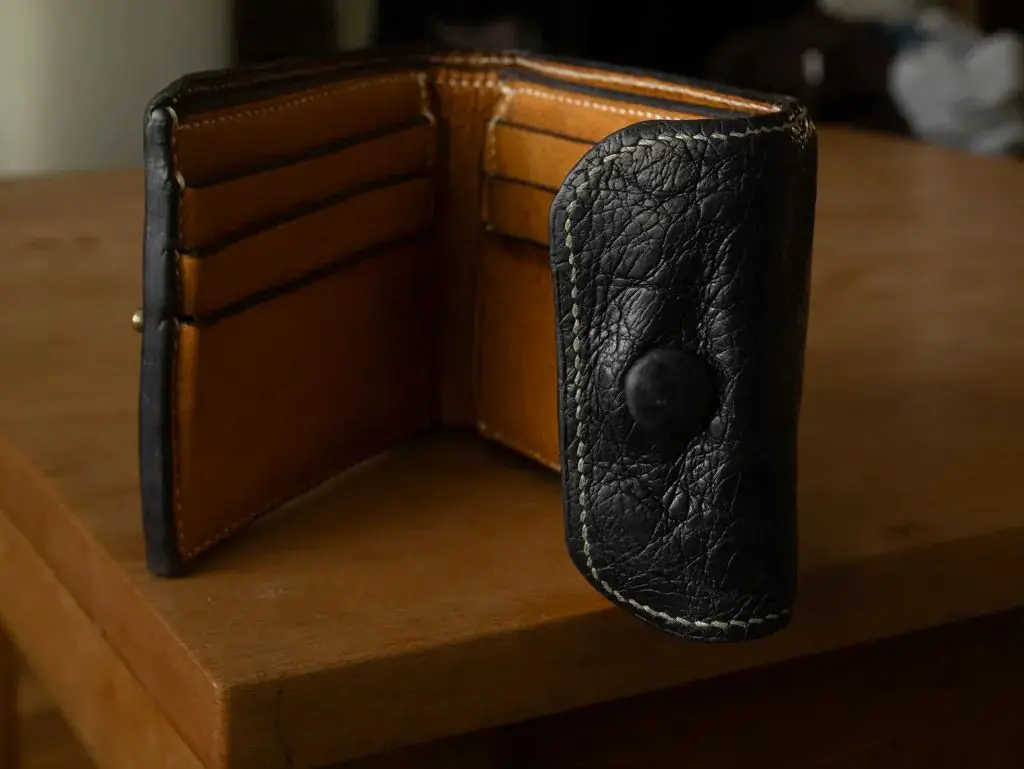
My fingers found the wallet in my other pocket.
Grandfather’s wallet. The leather was so worn it felt like fabric, darkened by years of handling, creased at every fold. I remembered the day he gave it to me—I was sixteen, sitting on his porch while he told stories about the war, about meeting my grandmother, about choices he’d made that he couldn’t take back. He pressed it into my hands with an urgency that seemed strange at the time.
“This is yours now, Sarah,” he’d said, his voice rough with something I didn’t understand. “Keep it close. Keep it safe. And whatever you do…” He’d looked around as if someone might be listening from the azalea bushes. “Don’t let your father know you have it. Promise me.”
I had promised, confused but obedient. Grandfather died three weeks later—heart attack, they said, though I’d always wondered if the sadness in his eyes those final days had something to do with it.
That was eight years ago. I’d carried the wallet ever since, but I’d never really examined it. It was just… there. A memorial. A connection to someone who’d loved me without conditions or negotiations.
Until tonight.
The fight had started over nothing, really. Or everything, depending on how you looked at it.
Linda had been redecorating the living room—again—and had thrown away a box of my mother’s things without asking. Old photographs, letters, a scarf that still smelled faintly of her perfume. I’d rescued them from the trash and said, perhaps too sharply, that she had no right.
“No right?” Linda’s voice had climbed three octaves. “I have every right. This is MY house now. YOUR mother is dead, Sarah. Dead. And you need to accept that and move on instead of clinging to garbage like some pathetic—”
“That’s enough.” My father’s voice cut through the room like a blade.
For a moment, I thought he was defending me. Eight years of watching him choose Linda over me, over my brother Marcus, over common decency—maybe this time would be different.
But he was looking at me, not her.
“Apologize to Linda,” he said flatly. “Now.”
“For what? For not wanting my mother’s memory erased?”
“For being disrespectful. For causing drama. For making this harder than it needs to be.”
The room went silent except for the clock on the mantel—my mother’s clock, though Linda had already talked about replacing it—ticking away seconds that felt like hours.
“I didn’t do anything wrong,” I said quietly.
“Then I guess you don’t belong here anymore.” My father’s face was stone. “Pack your things. I want you gone by morning.”
Marcus had laughed. Actually laughed. My younger brother, who I’d defended countless times, who I’d helped through every crisis, who’d promised we’d always stick together—he’d laughed like it was the punchline to a joke he’d been waiting years to hear.
Linda’s smile was worse than Marcus’s laughter. It was the smile of someone who’d finally won a war they’d been fighting in secret.
I’d packed one suitcase. I didn’t bother with most of my things. What was the point? They’d already been erased, reduced to “clutter” in Linda’s remodeled house, in my father’s recalibrated life.
And now I stood under an awning in the rain, homeless at twenty-four, with nowhere to go and nobody to call.
That’s when I really looked at the wallet for the first time in years.
Under the harsh fluorescent light of the hardware store’s overhang, I opened it carefully. The leather was softer than I remembered, almost fragile. Inside was forty-three dollars in cash, a faded photo of my grandmother, and a receipt from a restaurant that had closed a decade ago.
But there was something else.
The wallet had a seam along the back that I’d always assumed was just craftsmanship. But when I pressed on it, looking for… I don’t know what, maybe just something to do with my shaking hands—it opened.
A hidden compartment. So cunningly designed that you’d never find it unless you were looking.
And inside was a card.
Not like any card I’d ever seen. It wasn’t plastic—too heavy for that. Metal, maybe? The surface was brushed and dark, catching the light strangely. There was no bank logo, no name, no magnetic strip or chip like modern cards. Just a series of numbers engraved along the bottom and three symbols I didn’t recognize etched into the top corner. They looked almost… old. Ancient, even.
I turned it over. The back was blank except for a single word in tiny letters: “BEARER.”
My hands were shaking harder now, and not from the cold.
Why would my grandfather hide this? Why warn me to keep it from my father? What was I holding?
Questions flooded my mind, each more unsettling than the last. But I was too tired, too hurt, too wet and cold and angry to think clearly. I needed shelter. I needed answers. I needed… something. Anything that made sense.
The card was the only thing I had that my family didn’t know about. The only secret that was mine alone.
So I made a decision that would change everything.
I spent that night in a motel six blocks from my father’s house—our house, though I suppose it had never really been mine. The Paradise Inn was anything but paradisiacal: stained carpet, a bathroom that smelled of mildew and broken promises, a bed that groaned under the slightest movement. But it was dry and private, and the night clerk didn’t ask questions when I paid cash.
I sat on that bed for hours, turning the metal card over and over in my hands, trying to understand what I was looking at. The numbers were long—sixteen digits, like a credit card, but arranged differently. The symbols looked vaguely like letters but weren’t from any alphabet I recognized.
Around two in the morning, exhausted and desperate, I tried searching for similar cards online. Nothing matched. There were articles about rare credit cards, about metal cards for elite banking members, about ancient coins and tokens. But nothing looked like this.
Whatever it was, it wasn’t common. And it wasn’t meant to be found.
Grandfather’s words echoed in my memory: “Don’t let your father know you have it.”
Why? What would my father do if he knew? And why had Grandfather given it to me instead of to his own son?
I fell asleep with more questions than answers, the card clutched in my hand like a talisman.
Morning came gray and heavy with humidity. The rain had stopped, but the sky threatened more. I dressed in the least-wrinkled clothes I could find, finger-combed my hair, and stared at myself in the motel’s spotted mirror.
I looked like someone who’d been erased.
But maybe that was exactly what I needed to be. Erased from my father’s life. Free from Linda’s manipulations. Released from the obligation to pretend everything was fine.
I put the metal card in my pocket and walked to the bank.
Millbrook had two banks—First National, where everyone in town had their accounts, and Heritage Trust, a smaller branch that catered to old families and older money. I’d never had reason to visit Heritage Trust. My accounts, such as they were, lived at First National alongside everyone else’s.
But something told me the card belonged at Heritage Trust.
The building was everything First National wasn’t—marble floors that echoed with footsteps, brass fixtures polished to a mirror shine, wood paneling that smelled of lemon oil and history. The waiting area had leather chairs and a table scattered with financial magazines nobody read. Classical music played softly from hidden speakers.
There was one teller on duty, a woman in her fifties with precise makeup and a practiced smile. Her nameplate read “Margaret Winters.”
I approached the counter, my heart hammering so loudly I was sure she could hear it.
“Good morning,” she said in a voice that was professionally pleasant. “How can I help you today?”
I pulled the card from my pocket and placed it on the marble counter between us, carefully, as if it were made of glass instead of metal.
“I need to know what this is,” I said.
Margaret’s smile didn’t just fade—it vanished as if it had never existed. Her eyes locked onto the card, then jumped to my face, then back to the card. The transformation was instant and complete. The friendly bank teller disappeared, replaced by someone else entirely.
Someone afraid.
She didn’t touch the card immediately. She stared at it as if it might bite her. Then, moving with deliberate slowness, she reached under the counter and pressed something I couldn’t see.
“Ma’am,” she said, and her voice had changed too—quieter, more careful—”would you mind waiting just a moment?”
“Is something wrong?”
“No, nothing wrong. Just… please wait.”
She was lying. Everything about her body language screamed that something was very, very wrong.
Two security guards appeared from a side door I hadn’t noticed—middle-aged men in dark suits that were too formal for small-town bank security. They moved with military precision, flanking me without crowding me.
“Ms. Kelly?” one of them said. How did he know my name? “Would you please come with us? Just for a moment. A private room.”
This was the moment I could have run. Should have run, maybe. Whatever this card was, it had triggered something I didn’t understand. Security guards. Secret buttons. The sudden replacement of courtesy with barely concealed alarm.
But I had nowhere to run to. No home, no family, no plan beyond surviving the next day.
And I needed to know.
“Alright,” I said.
They led me down a hallway I wouldn’t have known existed, past offices with frosted glass doors and nameplates I didn’t have time to read. At the end of the hall was a conference room that looked like it belonged in a much larger bank in a much bigger city.
Heavy wooden table. Leather chairs. A painting on the wall that was probably worth more than I’d earned in my entire life. No windows.
“Please, have a seat,” one guard said. “Mr. Aldrich will be with you shortly.”
They left, closing the door with a soft, ominous click.
I sat. What else could I do?
My phone was off—I’d kept it off since leaving my father’s house, afraid of the messages that would be waiting. But even if it were on, who would I call? Who would believe that a card I’d found in my grandfather’s wallet had somehow triggered a security response at a small-town bank?
Minutes passed. Five. Ten. Fifteen.
Just when I was starting to wonder if I’d been forgotten—or imprisoned—the door opened.
The man who entered was in his sixties, distinguished in the way of people who’d spent their lives around money and power. His suit was impeccable. His silver hair was precisely cut. He carried a leather portfolio that looked older than I was.
“Ms. Sarah Kelly,” he said, and it wasn’t a question.
“Yes.”
“I’m David Aldrich, senior manager of Heritage Trust.” He sat across from me and placed the portfolio on the table. “I apologize for the… theatrical nature of your arrival. But given what you presented to Ms. Winters, certain protocols must be followed.”
“Protocols for what? It’s just a card.”
“No, Ms. Kelly.” He opened the portfolio and removed a pair of reading glasses, settling them on his nose with the air of someone about to deliver difficult news. “It’s decidedly not just a card. Do you know what you have?”
“If I knew, I wouldn’t be here.”
“Fair enough.” He pulled out a single sheet of paper covered in dense text and numbers. “This is a bearer instrument. Are you familiar with the term?”
“No.”
“A bearer instrument is a financial document that grants ownership to whoever physically possesses it. Whoever bears it, hence the name. No identification required. No verification needed. Possession is proof of ownership.” He looked at me over his glasses. “They’re exceedingly rare these days, for obvious reasons. But your grandfather’s generation understood them well.”
“My grandfather’s…?”
“This card,” Aldrich continued, tapping the paper, “is linked to an account established in 1962 by Jacob Edward Kelly. Your grandfather, I believe?”
The room tilted slightly. “Yes.”
“The account has been… dormant for many years. Untouched, unaccessed, simply existing. We were beginning to wonder if anyone would ever claim it.” He removed his glasses and met my eyes. “Ms. Kelly, do you understand what I’m telling you?”
“Not really.”
“Your grandfather left you something. Something he evidently went to great lengths to keep secret. The card you presented is the key to accessing it.”
My mouth had gone dry. “How much?”
“I can’t disclose exact figures in this preliminary meeting. But…” He consulted his paper. “Sufficiently substantial that you needed to be brought to a private room, and that I needed to be informed immediately of your arrival.”
“Define substantial.”
“Life-changing,” Aldrich said simply. “Now, before we proceed further, I need to ask you several questions. The first and most important being: How did you come to possess this card? And does anyone else know you have it?”
And suddenly, horribly, I understood why Grandfather had warned me to hide it from my father.
I told Aldrich everything. Not because I trusted him—I didn’t know him well enough for trust—but because I needed someone to help me make sense of what was happening. I told him about my grandfather’s gift, about the fight with Linda, about being thrown out of my home. I told him about finding the hidden compartment and the card inside.
He listened without interrupting, taking occasional notes in precise handwriting.
“And your father,” Aldrich said when I finished. “Does he know about the card?”
“No. Grandfather specifically told me not to tell him.”
“Wise.” Aldrich closed his notebook. “Ms. Kelly, I’m going to be frank with you because I believe you deserve the truth, and because the situation is… delicate. Your grandfather and your father had a complicated relationship. Your father made certain financial decisions that Jacob—your grandfather—disagreed with strongly. Very strongly. There was an estrangement of sorts.”
“I never knew that.”
“I imagine there’s a great deal you don’t know. Families have a tendency to bury their most important truths.” He folded his hands on the table. “Your grandfather established this account as a safeguard. He believed that your father’s judgment regarding money was impaired. He wanted to ensure that his grandchildren—you and your brother—would have resources independent of your father’s… influence.”
“But he only gave the card to me.”
“Yes. He came to this bank three weeks before he died and made a specific change to the account structure. He removed your brother’s name entirely and named you as the sole beneficiary. He said…” Aldrich consulted his notes. “He said, ‘Marcus is too much like his father. But Sarah has her grandmother’s sense. She’ll know what to do.'”
Tears burned my eyes. Grandfather had seen something in me I’d never seen in myself.
“What happens now?” I asked.
“Now, we verify your identity thoroughly—I apologize, but protocols exist for a reason. Then we arrange access to the account. And then…” Aldrich’s expression softened slightly. “Then you decide what kind of life you want to build.”
“That simple?”
“That complicated,” he corrected. “Money doesn’t solve problems, Ms. Kelly. It just gives you different problems. Wealthier problems, but problems nonetheless.”
“I’ll take wealthy problems over being homeless.”
“Fair point.” Aldrich stood. “Wait here. This will take some time.”
“Some time” turned out to be four hours.
They brought me water, coffee, a surprisingly good sandwich from somewhere. Aldrich returned periodically with forms to sign, questions to answer, documents to review. A notary appeared. A lawyer appeared. People whose names and titles I immediately forgot appeared, asked questions, disappeared.
Through it all, I sat in that leather chair in that windowless room, feeling like I’d stumbled into someone else’s life.
Finally, as afternoon light would have been slanting through windows if there had been any windows, Aldrich returned with a thick folder and a satisfied expression.
“Everything is in order,” he said. “Your identity is confirmed. The account is now active and accessible. You can make withdrawals, transfers, whatever you need.”
“How much?” I asked again, because I still didn’t have an answer.
Aldrich opened the folder and turned it toward me, pointing to a number near the bottom of the first page.
I stared at it.
Read it again.
Counted the zeros to make sure I hadn’t miscounted.
“That’s…”
“Yes.”
“But that’s…”
“Indeed.”
Three point seven million dollars.
My grandfather—the man who’d driven a pickup truck until it literally died in the driveway, who’d shopped at discount grocery stores, who’d complained about the price of coffee—had left me three point seven million dollars.
“How?” I whispered.
“Smart investments over many years. Your grandfather was a clever man, Ms. Kelly. He bought land when it was cheap, sold when it was valuable. He invested in companies that seemed risky at the time but paid off handsomely. He lived modestly and saved aggressively. And he did it all quietly, without fanfare or attention.” Aldrich smiled. “He understood something most people never learn: the best wealth is invisible wealth.”
“Why didn’t he tell me?”
“Because telling you would have meant telling your father. And your father, from what I understand, was not good with money. Jacob feared that if your father knew about this account, he would find ways to access it, spend it, waste it. So he kept it secret until he could ensure it went directly to you, protected and secure.”
I was crying now, ugly tears that I couldn’t stop. Not from happiness exactly, though there was happiness in there somewhere. But from grief, from relief, from the overwhelming weight of being seen by someone who’d died eight years ago.
Grandfather had known. He’d known that Linda would come into our lives and poison everything. He’d known that my father would choose her over his children. He’d known that I would need this, someday, even if he couldn’t predict the exact circumstances.
He’d loved me enough to plan for my survival.
“There’s one more thing,” Aldrich said gently. “A letter. Your grandfather left it with instructions that it should only be given to you when you claimed the account.”
He handed me an envelope—cream-colored, expensive paper, my name written on the front in my grandfather’s shaky handwriting.
I opened it with trembling fingers.
My dearest Sarah,
If you’re reading this, then I’m gone and you’ve found the card. Good. That means I planned something right at least.
I’m not much for fancy words, so I’ll be plain: your father is a fool with money and a coward with family. I raised him better, or tried to, but something went wrong along the way. Maybe I was too hard on him, or not hard enough. Maybe his mother’s death broke something in him that never healed. I don’t know. What I do know is that he’s going to make choices that hurt you, and I won’t be there to protect you from them.
So this is my protection. This money—it’s not charity and it’s not inheritance in the normal sense. It’s a tool. Use it wisely. Use it to build a life that’s yours, not shaped by your father’s failures or anyone else’s expectations.
Your grandmother always said you had steel in your spine, even when you were little. She was right. You’re stronger than you know, Sarah. Stronger than your father, stronger than Marcus, stronger than me in a lot of ways.
Don’t let anyone make you small. Don’t let anyone convince you that their dreams matter more than yours. And don’t ever apologize for taking up space in the world.
I love you, kid. I’m proud of you. And wherever I am now, I’m watching to see what amazing things you do next.
Grandpa
I folded the letter carefully and put it back in the envelope, tucking it into my coat pocket next to the card that had started everything.
“Thank you,” I said to Aldrich, though the words felt inadequate for what had just happened.
“Thank your grandfather,” he replied. “He was quite insistent that we take care of you if you ever arrived. Now, let’s discuss practical matters. Do you need immediate access to funds? A place to stay? We can arrange for a hotel, a temporary apartment, whatever you need while you sort out your next steps.”
“Yes,” I said. “All of that. Yes.”
Within two hours, I had a suite at the nicest hotel in Millbrook—not that Millbrook had many nice hotels, but this one had a working shower and a bed without mysterious stains, which felt like luxury after the Paradise Inn. I had a cashier’s check for twenty thousand dollars in my purse, enough to cover immediate expenses while Aldrich arranged longer-term financial management. I had business cards for a wealth manager, an attorney, and a real estate agent, all personally vetted by Heritage Trust.
I had options.
That night, lying in a actual comfortable bed, I finally turned on my phone.
Fifty-three messages. Forty-seven from Linda, three from Marcus, three from my father.
Linda’s messages followed a predictable arc: anger, manipulation, false concern, more manipulation, threats, more false concern. She wanted me to apologize, to come home, to admit I was wrong, to beg forgiveness.
Marcus’s messages were worse somehow. Casual. Joking. As if nothing significant had happened. “When you’re done being dramatic, Mom made pot roast lol”
My father’s three messages were identical: “We need to talk.”
I deleted everything without responding.
Let them wonder. Let them worry. Let them feel, for just a little while, what it’s like to be erased.
The next morning, I went shopping.
Not extravagant shopping—I wasn’t ready for that yet, wasn’t sure I’d ever be ready for that. But practical shopping. New clothes that fit properly. A good winter coat. Boots that didn’t leak. A laptop to replace the ancient one I’d left behind. Toiletries that came in bottles instead of tiny hotel containers.
It felt strange, paying for things without checking price tags first, without calculating whether I could afford them, without that constant anxiety about money that had been my companion for so long.
Everything was different now. I was different now.
Or maybe I’d always been this person, and I’d finally been given permission to exist.
Three days later, I met with Diana Chen, the real estate agent Aldrich had recommended. She was sharp-eyed and straightforward, with the kind of direct honesty I’d learned to appreciate.
“What are you looking for?” she asked over coffee in her office.
“Something small. Nothing ostentatious. A place that’s mine.”
“Renting or buying?”
“Buying.” The word felt strange in my mouth, impossible. I’d never imagined owning property, never even considered it as a realistic possibility.
“Budget?”
“I… don’t know. What’s reasonable?”
Diana studied me for a moment. “How much do you have, if you don’t mind me asking?”
I told her. Not the full amount, but enough that she understood my situation.
Her eyebrows rose slightly. “Then you can afford whatever you want in this town. Hell, you could afford half the town if you wanted. But since you asked for something small, I have a few properties that might interest you.”
We spent the afternoon looking at houses. Most were too big, too new, too perfect. I didn’t want perfect. I wanted… I wasn’t sure what I wanted until Diana pulled up in front of a small craftsman bungalow on Cedar Street, three blocks from the library where I’d worked, surrounded by oak trees that were older than anyone alive.
“It needs work,” Diana said apologetically. “The owners moved to Arizona for health reasons and didn’t maintain it well the last few years. It’s been on the market for six months with no offers.”
But I was already in love.
It looked like a house my grandmother would have lived in. Shingled roof, front porch with a swing, windows that let in actual light. Inside was dated but solid—hardwood floors under ugly carpet, good bones under bad wallpaper. The kitchen needed updating, the bathroom needed everything, but the house had something most houses lacked.
It had soul.
“I want it,” I said.
“Don’t you want to think about it? See some other properties?”
“No. This one. How much?”
Diana named a figure that was higher than I’d expected but still absurdly reasonable given what I had in the bank.
“Done,” I said. “How quickly can we close?”
Three weeks later, I had keys to my own house. My house. Not my father’s house, not Linda’s remodeled prison, not a motel room or hotel suite.
Mine.
I didn’t tell anyone where I was. Not my father, not Marcus, not anyone from my old life. I blocked their numbers, deleted my social media accounts, created new email addresses. I became a ghost in my own town, visible to strangers but invisible to family.
It was easier than I expected.
Millbrook was big enough to get lost in if you tried, especially if you avoided the places your family frequented. I shopped at different stores, ate at different restaurants, took different routes. When I encountered people who knew me—and it happened occasionally, inevitably—I was pleasant but vague. “Yes, I moved. No, not far. Things are good. Thanks for asking.”
I started renovating my house slowly, doing much of the work myself. I’d never been particularly handy, but I learned. YouTube tutorials taught me to paint, to install tile, to repair drywall. The work was meditative, transformative. Each wall I painted was a wall that didn’t belong to my father. Each fixture I installed was proof that I existed independently.
I was building something new.
Six weeks after I’d walked out into the storm, my doorbell rang.
I almost didn’t answer it. I’d been careful about keeping my location secret, had told the real estate agent and the bank to maintain my privacy. Who would know where I lived?
But curiosity won.
I opened the door to find my brother standing on my porch, looking uncomfortable and slightly wet from the drizzle that had started an hour ago.
“Hey,” Marcus said.
“How did you find me?”
“Wasn’t hard. Millbrook’s small. And you’re still working at the library three days a week. I just followed you home.” He shrugged, as if stalking me was perfectly reasonable. “Can I come in?”
Every instinct said no. But he was my brother. Despite everything, he was still my brother.
“Five minutes,” I said.
He came inside, looking around with undisguised interest. “Nice place. How did you afford this on a library salary?”
“That’s not your concern.”
“Dad’s going crazy, you know. He keeps asking where you are, what you’re doing. Linda thinks you’re living with some guy you met online.” Marcus laughed. “Are you?”
“No.”
“Then how—”
“Marcus, you have four minutes left. What do you want?”
His expression shifted, became something almost sincere. “I wanted to apologize. For laughing. For… everything. It was messed up, what happened. And I was a dick about it.”
“Yes, you were.”
“So… I’m sorry.”
I waited for more, for some indication that he understood the depth of what he’d done. But there was nothing. Just those two words, delivered like they should fix everything.
“Apology noted,” I said flatly.
“That’s it? Come on, Sarah. I said I was sorry.”
“And I heard you. But sorry doesn’t undo anything. Sorry doesn’t give me back the family I lost.”
“You didn’t lose us. You left.”
“I was thrown out.”
“Because you wouldn’t apologize to Linda!”
“Because I refused to pretend that what she did was okay.” I opened the door. “Time’s up. You should go.”
“Sarah—”
“Go, Marcus.”
He left, but not before turning back with a confused, almost hurt expression. “You’ve changed.”
“Yes,” I agreed. “I have.”
The truth was, I hadn’t changed so much as I’d finally been allowed to become who I’d always been underneath the performance of being the good daughter, the dutiful sister, the person who swallowed her own needs to keep peace.
I enrolled in online courses through the local community college. Business management, finance, art history—subjects I’d always been interested in but never had time or money to pursue. I volunteered at the animal shelter. I took long walks through the park where my grandmother used to take me as a child. I read books without interruption, cooked meals without criticism, made decisions without consulting anyone.
I lived.
And slowly, carefully, I began to understand what my grandfather had given me.
Not money, though the money mattered.
He’d given me permission to exist on my own terms.
Four months after claiming my inheritance, I received a letter from my father.
It came through certified mail, which meant I had to sign for it, which meant I couldn’t pretend I’d never received it. The envelope was thick, official-looking.
Inside was a legal document. A lawsuit, essentially, though phrased in the language of “family reconciliation” and “estate disputes.”
My father was suing me for half of my grandfather’s estate, claiming that as the son and primary heir, he was entitled to a portion of any inheritance that had been “improperly diverted” to me.
I sat at my kitchen table—my table, in my kitchen, in my house—and read the document three times to make sure I understood what was happening.
My father hadn’t cared where I was living or whether I was safe. He hadn’t worried about whether I had food or shelter or support.
But the moment he’d learned about the money—and how he’d learned, I could only guess; probably Marcus had mentioned my house, and my father had started digging—he’d decided I owed him something.
I called Aldrich.
“I expected this,” he said calmly. “Your grandfather expected it too, which is why he structured the account the way he did. You were explicitly named as the sole beneficiary. The account was established independently of his general estate. Your father has no legal claim whatsoever.”
“Will he win?”
“No. But he’ll make the process unpleasant. That’s rather the point—he’s hoping you’ll settle to make him go away.”
“I won’t.”
“Good. I’ll connect you with our litigation attorney. We’ll handle this.”
And they did. The lawsuit dragged on for six months—six months of depositions and filings and court dates. Six months of my father’s lawyers arguing that I’d unduly influenced my grandfather, that the account was improperly structured, that I’d hidden assets that rightfully belonged to the family.
Six months of being called greedy, manipulative, ungrateful.
I sat through every hearing, calm and composed in suits I’d bought specifically for court appearances. I answered every question truthfully. I provided every document requested.
And when the judge finally dismissed the case with prejudice—meaning my father couldn’t refile—I felt nothing but tired relief.
“Will he appeal?” I asked my attorney afterward.
“He can try, but he won’t win. The law is clear, and more importantly, your grandfather’s documentation is impeccable. He planned for this, Ms. Kelly. Every possible challenge was anticipated and addressed.”
One last gift from a man who’d died eight years ago: protection from his own son.
A year after I’d placed the metal card on the bank counter, I was living a life I wouldn’t have believed possible.
I’d finished renovating my house, turning it into something that felt like mine in every detail. I’d quit my job at the library—not because I had to, but because I wanted to. I’d started a small foundation focused on helping young people from troubled homes, giving them the kind of support I’d never had.
I’d forgiven Marcus, mostly, though we’d never be close again. Some fractures don’t heal completely.
I hadn’t forgiven my father. Maybe someday, but not yet. Possibly not ever. And I’d made peace with that.
Linda, I heard through the grapevine, had left my father for someone wealthier. The irony was not lost on me.
But more than any of that, I’d learned something that my grandfather had tried to teach me with that hidden card, that secret account, that careful planning:
You are responsible for your own survival.
Not your family. Not your parents. Not the people who are supposed to love you but who fail you anyway.
You.
And if you’re lucky, someone who loved you left you the tools you need. And if you’re brave, you use them.
I kept my grandfather’s wallet in the drawer of my nightstand, along with his letter. The metal card stayed in its hidden compartment. I didn’t need it anymore—I had regular credit cards, bank accounts, the normal tools of financial existence.
But I kept it anyway. As a reminder. As a memorial.
As proof that someone had believed in me when I hadn’t believed in myself.
Sometimes, on quiet evenings, I’d sit on my front porch swing—the same swing that had been there when I bought the house—and think about the storm I’d walked out into with nothing but a soaking suitcase and an old wallet.
I’d think about the moment in the bank when everything changed.
I’d think about my grandfather, planning for my future from years in the past.
And I’d think: I survived.
Not just survived—I thrived.
And that, more than any amount of money in any secret account, was the real inheritance.
The steel in my spine that my grandmother had seen.
The strength my grandfather had believed in.
The life I’d built from nothing but rain and rage and an old man’s love.
THE END

Adrian Hawthorne is a celebrated author and dedicated archivist who finds inspiration in the hidden stories of the past. Educated at Oxford, he now works at the National Archives, where preserving history fuels his evocative writing. Balancing archival precision with creative storytelling, Adrian founded the Hawthorne Institute of Literary Arts to mentor emerging writers and honor the timeless art of narrative.