The Gift That Changed Everything
Christmas morning felt ordinary until my husband opened a gift that sent his past rushing back like a whirlwind. What came next changed not just the way we celebrated the holidays, but the very shape of our family and everything I thought I understood about the life we had built together.
My husband Greg and I had built the kind of life that didn’t need explaining. It was simple in the best possible way, constructed from small rituals and shared understanding that had accumulated over twelve years together. We had grocery lists stuck to the fridge with alphabet magnets Lila had arranged into nonsense words. Half-finished puzzles perpetually scattered across the dining table that we would work on for ten minutes here, fifteen minutes there, never quite completing but never quite abandoning either. Inside jokes no one else would understand, like the way Greg would say “executive decision” whenever he added extra cheese to anything, or how I’d hum the Jeopardy theme whenever he took too long choosing a restaurant.
Our mornings were a carefully choreographed dance of coffee travel mugs balanced between our seats during school runs, the same playlist rotating through the speakers until we all knew every word. Birthday celebrations happened at the same Italian place we’d been going to for a decade, where the owner knew our order and always brought Lila extra breadsticks without being asked. Occasional spontaneous dinner dates punctuated our weeks when we managed to escape the workweek chaos, though even those followed a pattern—the Thai place on Third Street or the burger joint with the outdoor patio and string lights.
The biggest Sunday dilemma was choosing between pancakes and waffles, a debate that could stretch twenty minutes and involve PowerPoint-style arguments from our daughter about which breakfast food represented superior engineering. We weren’t flashy or complicated. We didn’t have the kind of marriage that made people turn their heads or inspired romantic comedies. But we were steady, and honestly, I thought that was beautiful. I thought steady was the prize you won after surviving the chaos of early adulthood, after finding the right person and building something sustainable and real.
Our daughter Lila was eleven, poised on that delicate edge between childhood and whatever came next. She had her father’s soft heart, the kind that broke over commercials with sad dogs and insisted we leave extra food out for the neighborhood strays. She had my confidence, the kind that made her raise her hand in class even when she wasn’t entirely sure of the answer, the kind that let her make friends easily at the park or the library or anywhere she happened to be.
Lila still believed in Santa, or maybe she just believed in the magic of believing, in preserving something sacred and untouchable in a world that seemed increasingly determined to strip away wonder. Every year she wrote a thank-you note in her careful handwriting and left it with the cookies and milk, her contribution to the mythology we maintained together.
This year’s note said, “Thank you for trying so hard. I know it’s a lot of houses.” That one brought tears to my eyes when I read it Christmas Eve while checking that the presents were arranged properly, imagining my daughter’s earnest face as she wrote those words, her absolute faith that somewhere out there, someone was working through the night to bring joy to children everywhere.
Last Christmas was supposed to be just like the others—familiar, warm, predictable in the best possible way. The kind of predictable that meant cocoa spills we’d wipe up laughing, ribbon fights that left scraps of wrapping paper in the couch cushions for weeks, and the comforting certainty that came from knowing exactly how the day would unfold.
But a week before Christmas, something arrived in the mail that changed everything.
It was a small box, maybe six inches square, wrapped in expensive cream-colored paper that felt like velvet against my fingers when I picked it up from our porch. The wrapping was immaculate, the kind of perfect that suggested professional hands rather than someone wrestling with tape at their kitchen table. There was no return address, just Greg’s name written across the top in looping, feminine handwriting I didn’t recognize—elegant script that looked practiced, deliberate, like someone who had spent time perfecting their cursive in a way most people didn’t bother with anymore.
I was sorting mail at the kitchen counter, creating the usual piles of bills, catalogs, and holiday cards from relatives who sent photographs of their children in matching outfits. The mysterious box stood out immediately, too fancy for our normal correspondence, too personal in its presentation.
“Hey, something came for you,” I called out to Greg, who was by the fireplace adjusting the garland that Lila had insisted we hang even though it was slightly lopsided.
He walked over slowly, wiping dust from his hands onto his jeans, and took the box from me. The moment his fingers touched it, something shifted in his expression. His entire body went still. His thumb ran over the handwriting on top, tracing the loops of his name like he was reading Braille, like those letters contained information beyond what was visible.
He stared at it like it had whispered something only he could hear, something private and devastating. Then he said it—one word, but it knocked the air right out of the room.
“Callie.”
That name. I hadn’t heard it in over a decade, maybe longer. It belonged to a time before me, before us, before the life we had so carefully constructed.
Greg had told me about her once, years ago. One summer night early in our relationship when we were lying on our backs in the grass at a park, looking at stars and sharing the kind of deep confessions that new couples exchange. He told me she was his college girlfriend, his first love, the person who made him believe in forever and then shattered that belief so completely he wasn’t sure he’d ever recover.
They had dated for three years, he said. She had been everything to him—his study partner, his best friend, the first person he wanted to call when anything good or bad happened. He had assumed they would get married after graduation, had started looking at rings even though they were broke college students with nothing but student loans and dreams.
But Callie had broken up with him right after graduation, out of nowhere, with no real explanation beyond saying she “needed to find herself” and that “they were too young to make forever promises.” It broke him, he admitted, left him hollow and confused for years afterward, unable to understand how someone who said they loved you could just walk away without looking back.
When he met me three years later, he said, he finally understood what real love looked like. Real love was steady. Real love showed up. Real love didn’t vanish without explanation. He stopped speaking to Callie in their early twenties and never mentioned her again. She became a ghost, a footnote in his history that didn’t require discussion.
“Why would she send something now?” I asked, staring at the box in his hands like it might explode.
He didn’t answer. He just walked to the Christmas tree—our beautiful tree that Lila had helped decorate with her characteristic enthusiasm, ornaments clustered heavily on the bottom branches where she could reach—and slid the box beneath it like it was just another gift in the pile.
But it wasn’t. I felt it immediately, that shift in the air between us, like the first crack in ice before it gives way completely. Something had entered our home that didn’t belong, something that threatened the careful equilibrium we had maintained.
I didn’t push. Lila was too excited about Christmas to notice anything was off, still counting down the days on a hand-drawn calendar she’d made, adding glitter stickers for each day that passed. Her joy was a bubble I didn’t dare pop. She had been planning Christmas for weeks, making lists of cookies we needed to bake, designing elaborate scenarios for how Santa would navigate our chimney situation.
So I let it go, or I pretended to. But the box sat there under the tree for the next week like a ticking bomb, its cream-colored wrapping paper somehow brighter than all the other gifts, drawing my eye every time I walked past. I found myself staring at it when I should have been wrapping presents or addressing cards, wondering what could possibly be inside, what could make Greg’s face drain of color like that.
I noticed Greg looking at it too, when he thought I wasn’t watching. He’d pause while carrying laundry past the tree, or stop mid-sentence during dinner with his gaze drifting toward the living room. Whatever was in that box had already changed things, and we hadn’t even opened it yet.
Christmas morning arrived wrapped in the usual warmth and chaos. The living room glowed with twinkling lights that we’d spent an entire Saturday afternoon untangling and arranging. The scent of cinnamon rolls filled the house, the good kind from scratch that took me two hours to make and filled every room with the smell of butter and sugar and Christmas magic.
Lila had begged us to wear matching pajamas this year—red flannel with tiny reindeer—and even though Greg grumbled that he was “too old for this nonsense,” he wore them with a smile because making Lila happy was worth any amount of personal embarrassment. She had insisted we take pictures before opening presents, all of us posed in front of the tree, capturing this moment of ordinary happiness before everything changed.
We took turns opening gifts the way we always did, youngest to oldest, savoring each one instead of tearing through the pile. Lila squealed over every box, even the practical things like socks and underwear, because “Santa knows I like fuzzy ones with patterns.” Greg handed me a silver bracelet I had circled in a catalog months ago and then forgotten about, the kind of thoughtful gift that showed he paid attention to small things.
I gave him noise-canceling headphones he’d been eyeing for work, complaining that the office was too loud for him to concentrate. We laughed about Lila’s dramatic reactions, took pictures of her surrounded by wrapping paper, savored the warm and familiar rhythm of this day we’d been celebrating together for over a decade.
Until that moment came.
Greg reached for Callie’s package.
His hands trembled—I mean visibly shook, the kind of shaking you can’t hide or control. He tried to steady them by gripping the box tighter, but that just made the trembling more obvious. I saw him take a deep breath, saw him glance at me with something that looked like apology or dread or both.
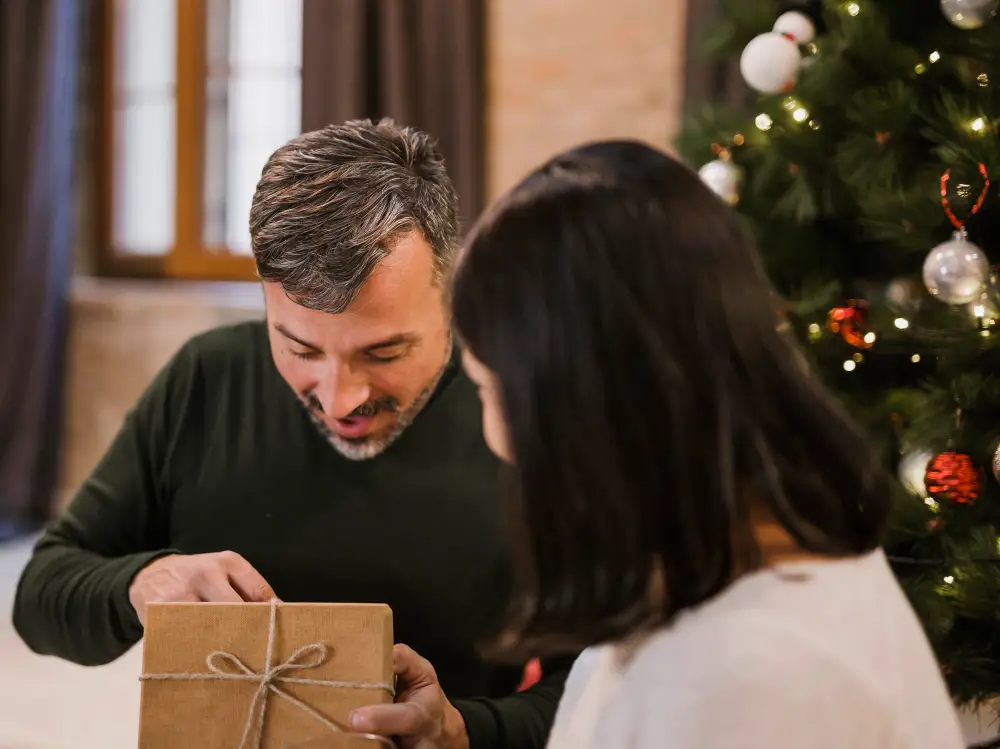
Lila leaned in, curious, probably thinking it was from one of us, some surprise we’d orchestrated. I didn’t breathe as he carefully peeled back the tape, as he lifted the cream-colored wrapping paper to reveal a plain white box underneath.
The moment he lifted the lid, something in him cracked open.
The color drained from his face so completely he looked gray, corpse-like. Tears welled up in his eyes so fast he didn’t have time to stop them, didn’t have time to compose his expression or hide his reaction. They spilled over, running down his cheeks in long, silent streaks while he stared into the box like it contained something holy or horrifying or both.
His entire body went still, as if the world had stopped moving and taken him with it. He wasn’t breathing right, these shallow gasps that sounded painful. His grip on the box turned white-knuckled.
“I have to go,” he whispered, his voice ragged and broken, barely recognizable as belonging to the man who’d been laughing minutes ago about Lila’s excitement over fuzzy socks.
“Dad?” Lila said, her voice small and confused, her smile faltering. “What happened? What’s wrong?”
“Greg,” I said, trying to keep the panic out of my voice and failing completely. “Where are you going? It’s Christmas morning. What about our family? What about Lila?”
But he didn’t answer. He just stood abruptly, still holding the box, moving like someone in shock, operating on autopilot. He knelt down to Lila’s level, cupped her face tenderly between his shaking hands, and kissed her forehead with a kind of desperate gentleness.
“I love you so much, sweetheart,” he said, his voice cracking. “More than anything in this world. Dad needs to attend to something urgent, okay? I promise I’ll be back. I promise.”
She nodded, but I could see the fear blooming in her eyes, see her trying to understand what was happening and failing. She clutched her new stuffed animal tighter, a unicorn she’d unwrapped just minutes ago, seeking comfort in something soft and safe.
Greg rushed into our bedroom. I followed him, my heart hammering so hard I could feel it in my throat, in my ears, everywhere.
“What’s happening?” I demanded, blocking the doorway, making him look at me. “You’re scaring me. You’re scaring Lila. What was in that box?”
He didn’t even look at me as he pulled on jeans and a sweatshirt, his movements jerky and uncoordinated. His hands fumbled with the zipper. He couldn’t seem to get his shoes on right, struggling with the laces.
“Greg, talk to me. Please. What was in the box?”
“I can’t,” he said, his voice hollow. “Not yet. I have to figure this out first. I have to understand what this means.”
“Figure out what?” I said, my voice rising despite my efforts to stay calm. “This is our life. You don’t get to walk out on Christmas morning without any explanation. You don’t get to leave our daughter sitting there terrified without telling me what’s happening.”
He finally looked at me, really looked at me, and what I saw in his face made my stomach drop. His eyes were red and wild, filled with something I couldn’t name. Pain. Shock. Maybe terror.
“I’m sorry,” he said quietly, helplessly. “Please. I need to do this alone. I’ll explain everything when I get back, I swear. But right now I can’t—I can’t process this with you watching. I need to think.”
And with that, he grabbed his coat and left. On Christmas morning. Left his daughter surrounded by half-opened presents and his wife standing in the doorway trying to understand how the day had gone so wrong so fast.
The front door closed with a soft click that somehow felt louder than a slam, more final, more devastating.
Lila and I sat in silence for what felt like hours but was probably only minutes. The Christmas lights kept blinking their cheerful pattern, oblivious to the disaster unfolding. The cinnamon rolls in the kitchen burned because I forgot about them completely, filling the house with the acrid smell of ruined sugar. Time crawled forward in that terrible way it does when you’re waiting for something you dread.
I told Lila that Daddy had an emergency, that he would be home soon, that everything was fine. The lies felt thick on my tongue. She didn’t cry, but she didn’t talk much either. She just sat on the couch holding her unicorn, occasionally asking in a small voice when Daddy was coming back.
I must have checked my phone a hundred times, maybe more. I texted Greg repeatedly. “Where are you?” “What’s happening?” “Please just tell me you’re okay.” “Lila is asking for you.” He didn’t call, didn’t text, gave me nothing. The silence was somehow worse than any explanation could have been.
I tried to salvage the day. I made hot chocolate. I suggested we watch Christmas movies. I attempted enthusiasm about the presents still unwrapped. But it all felt hollow, performative. We were both just going through motions, waiting for Greg to come back and explain why he had shattered our Christmas.
When he finally came home, it was almost nine p.m. The winter sun had set hours ago. Lila had finally fallen asleep on the couch, exhausted from crying and confusion. Greg looked like he had been through a war.
His coat was dusted with snow from the storm that had started in the afternoon. His face was gaunt, hollow, aged years in a single day. His eyes were bloodshot from crying or maybe from hours of staring into some abyss I couldn’t see. He didn’t even take his shoes off, just walked over to where I sat in the darkened living room, reached into his pocket, and held out the small, crumpled box.
“Are you ready to know?” he asked, his voice rough and tired.
My heart thudded painfully as I reached for the box. My hands were shaking now too, mirroring his from this morning. I opened it slowly, unsure of what I was bracing for. A letter? A keepsake from their relationship? A piece of jewelry he’d given her years ago that she was returning for some reason?
What I found was far more devastating than anything I had imagined.
Inside was a photograph. Slightly faded, with the soft-focus quality of images that have been handled too many times, examined too closely, kept in drawers and wallets and secret places. In it, a woman stood beside a teenage girl in front of what looked like a coffee shop, the kind with outdoor seating and hand-painted signs.
The woman—Callie—looked older than the version I’d seen once in an old college album Greg had briefly shown me years ago. Her hair was shorter, cut in a practical bob. Her face had lines around the eyes and mouth that hadn’t been there in her twenties. Her expression was complicated, tired, a half-smile that looked more like regret than joy, like someone posing for a photograph they didn’t really want taken.
But the girl beside her. Oh god, the girl.
She was maybe fifteen or sixteen, that awkward age where teenagers haven’t quite grown into their features yet. She had chestnut hair that fell past her shoulders, the exact shade of Greg’s. She had the same slope to her nose, the same shape to her eyes, the same way of tilting her head slightly to one side. She looked nothing like Callie, everything like him. The resemblance was striking, undeniable, the kind that made you do a double-take.
My hands shook as I turned the photograph over. On the back, written in the same looping handwriting from the package, was a short message that made the world tilt sideways:
“This is your daughter. Her name is Audrey. On Christmas Day, from 12 to 2, we’ll be at the café we used to love. You know which one. If you want to meet her, this is your only chance. She deserves to know her father. You deserve to know the truth. I’m sorry it took me this long. —Callie”
My breath caught in my throat. I read the words three times, four times, trying to make them mean something different. I looked at Greg, who had sunk onto the couch with his head in his hands, his entire body curved into itself like he was trying to disappear.
“Greg…” I couldn’t even form the question. My voice cracked and broke. “What does this mean? How is this possible?”
He didn’t lift his head. When he spoke, his voice was muffled by his hands, thick with emotion. “It means everything I thought I knew about my past, about my present, about who I am, just changed. It means I have a daughter I never knew existed. It means Callie has been keeping this secret for sixteen years.”
The room spun. I felt dizzy, unmoored, like gravity had stopped working properly. “You saw her? You went to meet them?”
He nodded, finally looking up at me. His face was destroyed, torn apart by whatever had happened today. “I drove across town to that old café with the green awning. The one we used to study at during college. The one with chipped tables and coffee that tasted terrible but we went anyway because it was open late.”
He took a shuddering breath. “And they were there. Callie and the girl. Audrey. Our daughter. My daughter.”
The possessive pronoun hit me like a physical blow. His daughter. Not our daughter, not Lila’s sister, but his daughter from another woman, from another life that had somehow reached forward and grabbed our present.
“I walked in and I froze when I saw her,” he continued, the words pouring out now like he’d been holding them back for hours. “My heart recognized her before my mind could catch up. She looked just like my sister at that age—same eyes, same way of standing with her arms folded tight, like she was protecting herself, like she was afraid to take up too much space.”
He ran his hands through his hair, pulling at it. “Callie looked up when I came in and said quietly, ‘Thank you for coming. I wasn’t sure you would.’ And Audrey just stared at me with this expression I couldn’t read. Not angry exactly, but not welcoming either. Just… searching. Like she was trying to decide if I measured up to whatever she’d imagined.”
“What happened?” I whispered.
“The three of us sat at a corner table,” he said. “Speaking in these cautious words, like we were negotiating a hostage situation. Audrey asked me questions. Where did you grow up? What was your favorite movie in college? What do you do for work? These getting-to-know-you questions that should have happened fifteen years ago.”
His voice broke. “She asked me why I wasn’t there. Why I wasn’t part of her life. And I had to tell her I didn’t know she existed. I had to watch her process that, watch her realize that I hadn’t abandoned her, but that her mother had kept us apart.”
I felt something cold settling in my chest. “What did Callie say?”
Greg’s expression darkened. “She explained it all in this hollow voice, like she’d rehearsed it. She said she found out she was pregnant about a month after we broke up. But she had already started dating someone else by then—Marcus, the rich guy she eventually married. He came from money, old money, the kind with trust funds and summer houses.”
He stood up and started pacing, unable to sit still with this story inside him. “She said she panicked. She was twenty-two, broke, didn’t know what to do. Marcus was already talking about marriage, about taking care of her. So she told him the baby was his. She convinced herself it was the best choice for everyone. That I didn’t need to know, that Marcus would be a better father anyway because he could provide stability.”
“And he believed her?” I asked.
“Why wouldn’t he? They were sleeping together. The timeline worked. Audrey was born, and he raised her as his own. Apparently he was a good father for a while. Took her to soccer games, helped with homework, did all the dad things. But he was also controlling, demanding, always pushing Audrey to be perfect, to represent the family name properly.”
Greg’s hands were shaking again. “Everything was fine until Audrey got curious about her ancestry. She’s into science, wants to study genetics. For her sixteenth birthday, she asked for one of those DNA ancestry kits. Just for fun, she said. Just to see where her family came from.”
I closed my eyes, seeing where this was going.
“She did the test and got the results back last month,” Greg continued. “Found out Marcus wasn’t her biological father. The numbers didn’t match. She confronted Callie, demanded the truth. And Callie finally broke down and told her everything. About me. About the lie she’d been living for sixteen years.”
“So she sent the photo,” I said.
“Audrey insisted on it. She wanted to meet me. Wanted answers. Wanted to know why I wasn’t in her life. Callie tried to put her off, tried to manage the situation, but Audrey threatened to find me on her own if Callie didn’t help. So Callie panicked and sent the package. Gave me one chance, Christmas Day, because she knew I’d be with my family and it would hurt.”
I sat down slowly, my legs suddenly unable to support me. “So she knew this whole time and just… never told you?”
“She said she thought she was protecting everyone,” Greg said bitterly. “Protecting Audrey from an uncertain future with a broke college graduate. Protecting me from responsibility I wasn’t ready for. Protecting Marcus from the truth that might destroy his marriage. Protecting herself from the consequences of her choices.”
He turned to me, his eyes pleading for understanding. “But Audrey wasn’t just a name on a piece of paper or a theoretical what-if. She was real. She’s been real this whole time, growing up without me, wondering about me, creating stories in her head about who I was and why I left.”
“What did she say to you?” I asked.
“She was angry,” he admitted. “Furious at Callie for lying. Confused about me. She said, ‘I spent sixteen years thinking my father didn’t want me, that something was wrong with me that made him leave. And now I find out he didn’t even know I existed.’ She was crying, and I wanted to hold her, but I didn’t know if I had the right.”
I felt tears on my own cheeks now, though I wasn’t sure who I was crying for—Greg, Audrey, our family, or the future we’d thought we had.
“Callie wants Audrey to meet you, to have some kind of relationship,” Greg said quietly. “But she also doesn’t want Marcus to find out the whole truth. She’s terrified of what he’ll do when he realizes she lied to him for sixteen years. She’s trying to control the narrative, manage the damage.”
I rubbed my temples, feeling a headache building behind my eyes. “Do you still have feelings for Callie?”
He looked at me with a sharp kind of clarity, the first clear emotion I’d seen since this morning. “No. Absolutely not. After what she did? Keeping something like this from me? She didn’t just destroy my past—she wrecked Audrey’s entire life. That girl had to grow up thinking her father didn’t want her when I didn’t even know she existed. I could never forgive that.”
He crossed the room and took my hands in his. “I don’t know what’s going to happen next,” he said, his voice rough. “But if she is my daughter—and I believe she is, I saw it in her face, in the way she moves—then I want to be in her life. She deserves that. She deserves to know her father. I need to be there for her.”
He squeezed my hands. “But I need to know if you can handle this. If we can handle this together. Because I won’t do this if it means destroying our family.”
I stared at our Christmas tree, at the twinkling lights that suddenly felt like they belonged to a different life, a simpler life that had ended this morning. I thought about Lila asleep on the couch, about the family photos on our walls, about twelve years of building something steady and safe.
But I also thought about that photograph, about a sixteen-year-old girl who’d just discovered her entire life was built on a lie, who deserved to know her father.
How could I look at that photo and turn my back on a girl who had only just learned her truth?
I nodded slowly. It was the only answer I could give. “We’ll figure it out,” I whispered.
Over the next few weeks, the truth came barreling in like a freight train that couldn’t be stopped. Greg insisted on a DNA test, needing official confirmation even though he said he already knew in his heart. We went to a clinic, had samples taken, and waited three agonizing days for results that would change everything.
When the email arrived with the test results, Greg’s hands shook so badly he could barely open it. I stood behind him, reading over his shoulder as the words appeared on screen: 99.9% probability of paternity.
Greg’s voice broke. It was a mix of relief and heartbreak, joy and grief all tangled together. He had a daughter. He’d always had a daughter. He just hadn’t known.
The man who’d raised Audrey—Marcus—didn’t take the news well. That same week, after Callie finally confessed the full truth under pressure from Audrey’s demands, he filed for divorce. The revelation wasn’t just a crack in their marriage; it was a complete shattering. Sixteen years of what he thought was his life turned out to be built on deception.
But then Callie did something none of us expected. Two weeks after the divorce filing, Greg received a letter from her lawyer. She was demanding child support arrears—not just for the future, but for all the years he hadn’t been in Audrey’s life. For all the birthdays missed, the braces and doctor’s appointments, the private school tuition, the music lessons and summer camps.
She wanted sixteen years of support, with interest, calculated at the maximum amount allowable by law.
Greg was furious when he showed me the letter. “She’s trying to punish me for her own choices,” he said, pacing our kitchen like a caged animal. “She kept Audrey from me deliberately, and now she wants me to pay for the privilege of not knowing my own daughter existed? It’s insane. It’s cruel.”
“She’s scared,” I said, trying to understand even though I was angry too. “Marcus is leaving her. He’s probably cutting off her access to his money. She’s desperate.”
“I don’t care,” Greg snapped. “She made her choices. She doesn’t get to rewrite history now and make me the villain. Audrey is the one who’s going to suffer if this turns into a war.”
He didn’t fight the support request openly, not in court. He let the lawyers handle the negotiations while he stayed focused on what mattered—building a relationship with Audrey. But I could see the stress wearing on him, the late nights reviewing legal documents, the phone calls with attorneys discussing settlements and parenting plans.
Through it all, he and Audrey began meeting regularly. Coffee shops first, neutral territory where they could talk without too much pressure. Then bookstores, where Greg learned she loved mystery novels and science fiction. The park, where they walked and talked about everything and nothing.
He took her to a science museum once and told her about the paintings he’d loved as a kid, sharing pieces of himself in careful doses, not wanting to overwhelm her but desperate to make up for lost time.
The first time he brought her to our house, I was more nervous than I’d been on my wedding day. I’d spent all morning cleaning, rearranging pillows, making sure everything looked perfect even though I knew perfection didn’t matter. Lila watched from behind the living room curtains as Greg’s car pulled up, curious about this stranger who was somehow her sister.
Audrey was nervous too. I could see it in the way she clutched her bag, the way she hesitated before getting out of the car. She wore jeans and a sweater, her hair pulled back in a ponytail. She looked so much like Greg it was almost eerie.
I opened the door before she could knock, trying to smile warmly despite my own anxiety. “Hi, Audrey. I’m so glad you’re here.”
She gave me a tentative smile. “Thanks for having me. This is… this is weird, isn’t it?”
“So weird,” I admitted. “But maybe that’s okay.”
Lila, in that beautiful eleven-year-old way that hadn’t yet learned to be guarded, ran up before I could stop her, carrying a plate of cookies we’d baked that morning. “You look like my dad,” she said matter-of-factly.
Audrey’s smile widened, became more genuine. “I’ve been told that.”
“Do you like chocolate chip cookies? We made extra.”
“I love chocolate chip cookies.”
And that was it. Something in the room relaxed. Lila grabbed Audrey’s hand and pulled her into the kitchen, chattering about the gingerbread house kit she’d been saving, asking if Audrey wanted to help build it.
I watched them work together at the kitchen table, Lila explaining her elaborate design plans while Audrey listened and offered suggestions. Greg stood beside me in the doorway, his arm around my waist, both of us afraid to move and break whatever fragile magic was happening.
Over the following months, Audrey became part of our routine. Not all at once—that would have been too much for everyone. But gradually, carefully, she wove herself into the fabric of our lives. Sunday dinners every other week. Movie nights where she and Lila argued good-naturedly about what to watch. A birthday party where she met our extended family and answered the same questions about school and interests over and over with patient grace.
She and Lila became friends in a way I hadn’t expected. They were five years apart, an age gap that should have created distance, but somehow they clicked. Lila looked up to Audrey with something like hero worship, fascinated by this older sister who knew about high school and college plans and all the mysterious things that awaited her. Audrey seemed to soften around Lila, showing a gentler side than the guarded teenager we’d first met.
One evening after Audrey had gone home, Lila climbed into my lap even though she was getting too big for it. “Mom, are we Audrey’s family now?”
I stroked her hair, thinking about how to answer. “We’re becoming family. It takes time to build that. But yes, sweetheart. She’s your sister.”
“Good,” Lila said simply. “I always wanted a sister.”
One night, after the girls had gone to bed—Audrey sometimes stayed over now in our guest room—Greg and I sat on the couch with all the lights off except the lamp in the corner. The photo of Audrey, the first one Callie had sent, sat on the mantle now, next to pictures of Lila at various ages.
“I never thought our life would look like this,” Greg said quietly.
“Neither did I,” I replied.
He turned to me, vulnerability written across his face. “Are you angry with me? For how complicated this has made everything?”
I thought about the question carefully, trying to be honest. “No,” I said finally. “You didn’t choose this. You didn’t betray me or lie to me. This was done to you—to all of us. But you’re choosing what comes next. And that’s what matters.”
He leaned over and rested his head on my shoulder, and I felt the tension drain from him. “I love you,” he whispered.
“I know.”
And I did. Love wasn’t just the easy moments, the matching pajamas and cinnamon rolls and predictable Sundays. Sometimes love was messy and complicated. Sometimes it showed up on your doorstep in cream-colored wrapping paper and demanded that you expand your capacity for grace and acceptance.
But sometimes love also looked like a second chance for a teenage girl who deserved to know her father. Sometimes it looked like an eleven-year-old sharing her parents with grace and enthusiasm. Sometimes it looked like holding your husband while he processed a trauma he didn’t ask for.
That Christmas, I learned that life doesn’t care about your carefully wrapped plans. It will throw you a curveball wrapped in expensive paper, and it will change everything you thought you knew about your family.
But if you’re lucky, if you’re brave enough to stay open when everything in you wants to close down and protect what you have, it might also give you someone new to love.
Audrey came to our house on New Year’s Eve, bringing sparkling cider and homemade cookies. She and Lila stayed up until midnight making noise with pots and pans, shrieking with laughter as the clock struck twelve. Greg held my hand and whispered “thank you” for the hundredth time.
I watched my expanded family celebrate, and I realized the gift Callie had sent wasn’t just a photograph. It was a truth that set everyone free—Audrey from wondering, Greg from not knowing, and even Callie from carrying the weight of her secret.
The legal battles would continue. The child support negotiations would drag on for months. Callie’s bitterness about the divorce would occasionally spill over into complications with custody arrangements. Marcus would struggle with anger and betrayal that manifested in awkward moments when he saw Greg at Audrey’s school events.
But in our living room, watching my daughters laugh together while my husband smiled with a completeness I’d never seen before, I knew we would survive it all.
Sometimes the best gifts aren’t the ones you ask for. Sometimes they’re the ones that break your heart open and force it to grow bigger than you thought possible.
And that Christmas, despite everything, gave us exactly that.

Lila Hart is a dedicated Digital Archivist and Research Specialist with a keen eye for preserving and curating meaningful content. At TheArchivists, she specializes in organizing and managing digital archives, ensuring that valuable stories and historical moments are accessible for generations to come.
Lila earned her degree in History and Archival Studies from the University of Edinburgh, where she cultivated her passion for documenting the past and preserving cultural heritage. Her expertise lies in combining traditional archival techniques with modern digital tools, allowing her to create comprehensive and engaging collections that resonate with audiences worldwide.
At TheArchivists, Lila is known for her meticulous attention to detail and her ability to uncover hidden gems within extensive archives. Her work is praised for its depth, authenticity, and contribution to the preservation of knowledge in the digital age.
Driven by a commitment to preserving stories that matter, Lila is passionate about exploring the intersection of history and technology. Her goal is to ensure that every piece of content she handles reflects the richness of human experiences and remains a source of inspiration for years to come.