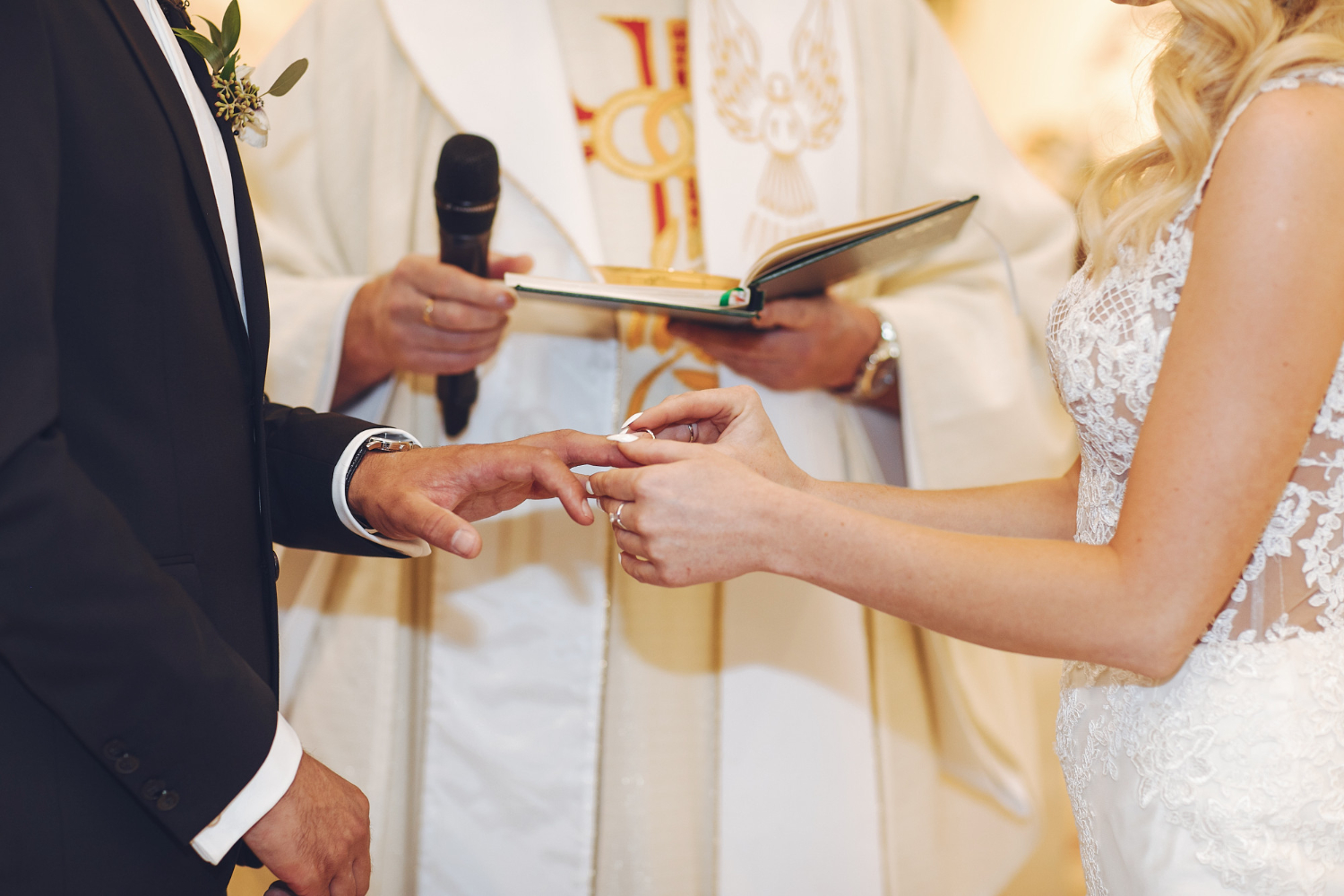
The church was overflowing with over three hundred guests when I pushed open the heavy oak side doors and stepped inside. The air smelled of imported white roses—two thousand of them, to be precise, flown in from Ecuador at my expense. A string quartet played Pachelbel’s Canon with practiced precision, the notes echoing off vaulted ceilings decorated with garlands I’d personally approved. Every eye in the sanctuary was fixed on the altar where my son David stood in his custom-tailored tuxedo, his face glowing with anticipation as he waited for his bride to appear.
I had not been invited to witness this moment. In fact, I had been explicitly uninvited three weeks earlier, told in no uncertain terms that my presence would “complicate things” and that it would be “better for everyone” if I stayed away. But there I was anyway, walking down that side aisle with my chin lifted and my grandmother’s pearls—the ones I’d foolishly loaned to the bride—glinting under the dim golden light filtering through stained glass windows.
My name is Nadine Fletcher. I’m sixty-seven years old, a widow of three years, and not the kind of woman who enjoys making scenes. I’ve spent most of my life avoiding conflict, smoothing over rough edges, keeping the peace. Yet there I was, disrupting what should have been the happiest day of my son’s life, about to shatter an illusion I’d helped create with my checkbook and my desperate need to see him smile again.
Jessica Miller—the woman standing at the front of that aisle in her twelve-thousand-dollar Vera Wang gown, her golden hair cascading in perfect waves beneath a cathedral-length veil—froze when she saw me. Her hands trembled around her bouquet of white peonies and roses, the same flowers I’d spent hours selecting with her at the florist, the same arrangements I’d paid for with money I’d borrowed against my house. Her practiced smile faltered as she whispered, loud enough for the first three pews to hear, “What are you doing here? You were not invited. You are not supposed to be here.”
I touched the pearls at my neck, steadying my breath, and allowed a calm smile to spread across my face. “My dear Jessica,” I said, my voice carrying in the sudden silence, “did you really believe I wouldn’t show up?”
The crowd shifted uncomfortably, whispers rippling through the pews like wind through wheat. David turned sharply from the altar, confusion and something that looked like dread flashing across his face. The officiating minister—a man I’d never met, hired by Jessica from some online directory—cleared his throat uncertainly.
And then, as if on cue, the doors behind me opened again. The guest I had promised to bring, the one person Jessica Miller feared more than anyone else in the world, stepped inside. His name was Marcus Reed, and the moment Jessica’s eyes landed on him, every drop of color drained from her face until she looked like a ghost beneath that expensive lace veil.
This was the moment she realized her perfect performance was about to collapse. And I was the director who’d orchestrated the finale.
Until six months earlier, I’d thought my biggest worry would be finding a suitable mother-of-the-groom dress and deciding whether salmon or chicken would be better for the reception dinner. My son David is thirty-four, a quiet, thoughtful software engineer who’d become even more reserved after his father—my husband Richard—died suddenly of a heart attack three years ago. Richard’s death had hollowed David out, left him going through the motions of life without really living. When David first mentioned he’d met someone, a woman named Jessica Miller who worked as a pediatric nurse, I felt hope bloom in my chest for the first time since the funeral.
I still remember the night he brought her to dinner at my house. Jessica arrived carrying a bouquet of lilies—my favorite, though I’d never told her that, she claimed David had mentioned it—and wearing a soft blue dress that made her look both elegant and approachable. “It’s such a pleasure to finally meet you, Mrs. Fletcher,” she said, her voice musical and warm. “David talks about you constantly. I feel like I already know you.”
Over dinner—pot roast, Richard’s favorite recipe that I still made out of habit—Jessica told stories that painted her as exactly the kind of woman any mother would want for her son. She volunteered at an animal shelter on weekends, teaching children how to care for rescue dogs. She’d grown up on a farm in Iowa, learning the value of hard work and family. She dreamed of having three children and a house with a big backyard where they could play. And with a well-timed tear that she brushed away quickly, she revealed that her own family had disowned her when she chose to pursue nursing instead of the lucrative corporate career they’d demanded.
“They wanted me to marry someone from their social circle,” she said, her voice breaking slightly. “Someone wealthy and connected. When I told them I’d fallen in love with David, that I’d chosen my heart over their approval, they cut me off completely. I haven’t spoken to my mother in two years.”
My heart ached for her. I reached across the table and squeezed her hand. “Well, you have a family now,” I told her. “You have David, and you have me. I’ll be the mother you deserve.”
Her eyes welled with tears. “Thank you, Mrs. Fletcher. That means more to me than you could possibly know.”
Looking back now, with the clarity that only betrayal can provide, I realize that was the moment the trap closed around me. That was the night Jessica Miller—or whatever her real name was—recognized me as the perfect mark: a lonely widow with life insurance money, grieving the loss of her husband, desperate to see her son happy again, willing to do anything to feel like she had family around her once more.
Their relationship moved with dizzying speed. They’d only been dating for two months when David showed up at my door one Sunday morning, grinning wider than I’d seen him smile since before Richard died, to show me the engagement ring—a two-carat diamond solitaire that must have cost him several months’ salary.
“When you know, you just know, Mom,” he said, his eyes shining with certainty. “Jessica is everything I’ve been looking for. She makes me feel alive again.”
How could I argue with that? How could I dim that light in his eyes by suggesting maybe they should wait, maybe they should date longer, maybe something about this felt too perfect to be real? I wanted so badly to believe in his happiness that I silenced every doubt before it could fully form.
The wedding planning began immediately, and Jessica proved to have expensive tastes that she presented as necessary rather than extravagant. Every conversation started with “I’ve always dreamed of…” and ended with me writing another check. A prestigious venue with sprawling gardens and a view of the city skyline. A designer gown that required three fittings in New York. Those two thousand imported roses because domestic flowers just wouldn’t photograph as beautifully. A string quartet flown in from Boston because they’d played at some celebrity wedding she’d seen in a magazine.
“Mrs. Fletcher,” she would say, taking my hands in hers, looking at me with those innocent blue eyes, “you’re like the mother I never had. The mother I always wished for. I want this wedding to be perfect because it represents not just David and me coming together, but me finally having a real family. Your generosity means everything to me.”
What do words like that do to a woman’s heart? What do they do to a widow who’s spent three years eating dinner alone, who’s spent countless nights lying awake wondering if her son would ever recover from his grief, who’s desperate to believe that happiness might still be possible? They unlock every protective instinct, every generous impulse, every foolish hope.
So I opened my wallet. I pulled from my savings account, the one Richard and I had built over forty years of careful planning. I cashed out certificates of deposit that were supposed to fund my retirement. I even took out a home equity loan, borrowing against the house Richard had worked so hard to pay off, telling myself it was an investment in my son’s future happiness.
Fifteen thousand dollars to reserve the venue. Twelve thousand for the Vera Wang gown. Eight thousand for the photographer and videographer Jessica insisted were “the best in the region.” Six thousand for the flowers. Four thousand for the cake—a seven-tier masterpiece covered in sugar flowers and gold leaf. Three thousand for invitations engraved on imported Italian paper. The numbers kept climbing, and I kept signing checks, telling myself this was what it looked like when love entered your family.
My friends congratulated me on being such a generous mother-in-law. I smiled and nodded, but deep inside, a voice whispered that it was too much, too fast, too perfect. The fairy tale Jessica was creating didn’t feel quite real, like a movie set designed to look authentic from the right camera angle but hollow when you looked too closely.
I chose to ignore that voice. I chose to see only what Jessica wanted me to see.
The first real crack in the facade appeared about three months before the wedding. I’d stopped by David’s apartment to drop off some family photos Jessica had asked to scan for a display at the reception. I let myself in with the spare key David had given me years ago, calling out to announce my presence. The apartment was quiet, but I heard Jessica’s voice drifting from the bedroom—not the gentle, melodious tone I’d grown accustomed to, but something sharp and impatient, almost cruel.
“Marcus, I told you not to call this number,” she snapped. “No, the wedding is still on schedule. Stop panicking.”
I froze in the hallway, my hand still on the doorknob, instinct telling me to be quiet.
“Yes, I’ll have full access to the accounts once we’re married,” Jessica continued, her voice dripping with contempt. “The joint account will be simple to drain, and the old lady has already given us over forty thousand. She’ll hand over more after the honeymoon when I tell her we’re buying a house.”
The old lady. That was me. My knees went weak, and I had to lean against the wall to stay upright.
“This fool is worth at least two hundred thousand once we liquidate everything,” she said with chilling calculation. “No, Marcus, he suspects absolutely nothing. He’s completely hooked. The mother is even easier—she’s so desperate to see him happy she’d sell her kidneys if I asked sweetly enough.”
I don’t remember how I made it out of that apartment without being discovered. Somehow my body moved on autopilot, carrying me down the stairs, across the parking lot, into my car. I drove three blocks before I had to pull over, my hands shaking so violently I couldn’t control the steering wheel.
Then the shock broke, and I sobbed until my ribs ached. I pounded the steering wheel with my fists, screaming at my own stupidity. How had I missed it? How had I been so blind? All those little inconsistencies I’d noticed and dismissed came flooding back—the stories that didn’t quite match from one telling to the next, the phone calls she always took in private, the way she never had photos of her supposed family, the fact that David had never met a single one of her friends.
It had all been a performance, and I’d funded it. I’d written checks to finance my own son’s destruction.
But as the tears dried and my breathing steadied, something shifted inside me. The grief and shame hardened into something colder, sharper. I’d survived Richard’s death. I’d survived raising a child mostly alone while Richard worked seventy-hour weeks to build his career. I’d survived my mother’s long decline into dementia, my father’s stroke, every blow life had delivered. I would survive this too.
And I would make damn sure my son survived it as well.
That evening, I began researching private investigators. By the next morning, I had an appointment with Patricia Harris, a former police detective who’d gone into private practice specializing in fraud investigations. I met her in her modest office above a dry cleaner, the walls covered with commendations and photos from her years on the force.
I told her everything—the whirlwind romance, the expensive wedding plans, the overheard phone conversation. Patricia listened without interrupting, taking notes in a small leather notebook.
“What you’re describing is textbook romance fraud,” she said when I finished. “These people are professionals. They study their targets like actors studying a script. They learn exactly what you want to hear, what you’re hungry for, and they become that person. They create an entire character designed specifically to exploit your vulnerabilities.”
Her words gave me a strange sense of relief. It wasn’t my stupidity alone—we’d been targeted by someone who made a career of this kind of manipulation.
“How long will it take to find out who she really is?” I asked, sliding a check across her desk.
Patricia tucked the check into a folder without looking at the amount. “For someone careless enough to use her real voice and real name on a phone call in a target’s apartment? Not long. Most of these con artists are smarter about operational security. She’s either arrogant or sloppy, and either way, that works in our favor.”
The next ten days were the longest of my life. I had to continue playing my role—the grateful future mother-in-law, the generous benefactor, the woman who believed in Jessica’s fairy tale. Jessica still visited twice a week, always with new lists of wedding expenses, new must-have details that would make the day “absolutely perfect.” Each time she hugged me and whispered “Thank you, Mom,” my skin crawled. But I smiled and signed the checks and asked about dress fittings and floral arrangements, all while waiting for Patricia’s call.
It came on a Tuesday afternoon while I was pretending to care about whether the reception napkins should be ivory or champagne.
“Nadine,” Patricia said without preamble, “you need to sit down. Jessica Miller doesn’t exist. The woman your son is planning to marry is actually Sophie Collins, twenty-nine years old, originally from Dallas, Texas. She’s been arrested three times in the past seven years for various fraud schemes—romance scams, charity cons, identity theft. She’s currently wanted in two states.”
I gripped the edge of my kitchen counter, the room tilting slightly. “Sophie Collins,” I repeated, testing the unfamiliar name on my tongue.
“She works with partners,” Patricia continued. “The Marcus she was talking to on the phone is Marcus Reed, her most frequent accomplice. They were romantically involved until about two years ago when Sophie ran a scam on him—cleaned out his bank accounts and disappeared with about fifteen thousand dollars. He’s been trying to track her down ever since. Interestingly, he filed a police report, which is how I found him.”
The pieces clicked into place with sickening clarity. Sophie was a professional predator, and my son was just her latest victim. The performance had been perfect because she’d rehearsed it dozens of times with dozens of other marks.
“I want to speak with this Marcus Reed,” I said.
Patricia hesitated. “Nadine, he’s not exactly a choir boy himself. He’s been involved in several of her schemes—”
“I don’t care what he is. If he wants revenge on the woman who stole from him, we want the same thing. Give me his number.”
That evening, I called Marcus Reed from my car, parked in an empty grocery store lot where no one could overhear. He answered on the third ring, his voice rough and wary.
“Who is this?”
“My name is Nadine Fletcher,” I said. “I understand you’re looking for Sophie Collins.”
The silence that followed was electric. When Marcus finally spoke, his voice had changed completely. “Where is she?”
“Planning her wedding to my son. She’s conned me out of over forty thousand dollars and is about to take him for everything he’s worth. I want to stop her.”
Another pause. Then: “When and where?”
We spent forty-five minutes on that call, planning every detail. Marcus would drive to our city on the wedding day. I would text him when the ceremony was about to begin. He would arrive at the perfect moment—after the guests had gathered, after Sophie had committed fully to her performance, but before any legal documents could be signed.
“I’ve been dreaming of this moment for two years,” Marcus said before we hung up. “Sophie Collins destroyed my life, cleaned me out, and disappeared while I was in jail for crimes she’d pinned on me. I can’t wait to see her face.”
“Neither can I,” I said, and meant it.
The morning of the wedding arrived gray and heavy with the threat of rain. I woke at five a.m., unable to sleep, and spent an hour staring at my reflection in the bathroom mirror, asking myself if I was doing the right thing. I could call David, warn him privately, let him cancel the wedding quietly. But I knew my son. He loved Sophie so deeply, so completely, that he’d never believe me without proof. He’d think I was jealous or controlling or unable to let him go. No—this had to be public, undeniable, impossible to explain away.
I dressed in a simple black dress and fastened my grandmother’s pearls around my neck—the same pearls Sophie had asked to borrow for “something old,” the same pearls I’d have to take back from her before this day ended.
By one p.m., I was parked two blocks from the church, watching well-dressed guests arrive, watching the photographer set up, watching the florist make final adjustments to the arrangements I’d paid for. My phone buzzed with a message from Marcus: I’m here. Waiting on your signal.
At two p.m. sharp, the string quartet began playing. Through the church windows, I could see guests standing, craning their necks toward the back. The ceremony was beginning. I typed one word to Marcus: Now.
Then I waited exactly ninety seconds—long enough for Sophie to appear at the back of the church, long enough for the gasps of admiration as she glided down the aisle, long enough for David’s eyes to fill with tears at the sight of her. Long enough for Sophie to believe she’d won.
That’s when I pushed open the side doors and stepped inside, my heels clicking against marble floors with crisp authority. Heads turned. The music faltered slightly. And Sophie, standing at the altar in all her borrowed glory, locked eyes with me and whispered those words I’ll never forget: “What are you doing here? You were not invited.”
I walked halfway down the aisle, close enough for everyone to hear me clearly. “My dear,” I said, touching my pearls, “did you really believe I wouldn’t show up? That I’d miss the wedding I paid for?”
Confusion rippled through the crowd. David stepped toward me, his face torn between embarrassment and concern. “Mom, what are you—”
But before he could finish, the main doors at the back of the church flew open with a bang that echoed off the vaulted ceiling. Marcus Reed strode in, rain from the threatening storm still clinging to his dark suit, his face set in an expression of righteous fury.
“Sophie Collins,” he announced, his voice thundering through the sanctuary, “did you really think you could hide forever?”
The bouquet tumbled from Sophie’s hands, white peonies scattering across the altar steps. David turned toward Marcus, confused and protective. “I’m sorry, but you have the wrong person. This is Jessica Miller, my fiancée—”
Marcus let out a harsh laugh. “Jessica Miller is just the name she’s using this time. Her real name is Sophie Collins, and she’s a professional con artist. I should know—I was her partner until she stole fifteen thousand dollars from me and disappeared, leaving me to take the fall for our crimes.”
“He’s lying!” Sophie’s voice cracked, the sweet musicality replaced by something raw and desperate. “I don’t know this man! David, please, he’s lying!”
But Marcus was already opening a folder, pulling out photographs and documents, holding them up for the crowd to see. “Here’s Sophie in Acapulco, Mexico, running a credit card scam at tourist hotels. Here she is in Chicago, posing as a cancer patient collecting donations for treatment she didn’t need. And here—” he pulled out another photo, “—here she is leaving a hotel room in Tijuana with my wallet, my watch, and the engagement ring I’d bought her.”
Gasps rippled through the pews. David’s face drained of color as he turned slowly to Sophie, searching her eyes for a denial that didn’t come.
“David, please,” Sophie whispered, reaching for him with trembling hands. “I love you. Yes, I made mistakes in the past, but I’ve changed. I’ve completely changed. You have to believe me—”
“Changed?” Marcus pulled out his phone, his smile cold and triumphant. “How about we listen to something from three weeks ago?”
He pressed play, and Sophie’s voice filled the church, crystal clear through the excellent acoustics: “The old lady has already given us forty grand and she’ll hand over more after the honeymoon. This fool is worth at least two hundred thousand. He suspects nothing—he’s completely hooked.”
The sound of Sophie’s own voice, dripping with contempt for my son, for me, for everyone she’d manipulated, hit the congregation like a physical blow. Someone gasped. Someone else swore softly. And David—my beautiful, trusting son—stood there with his world collapsing around him, staring at the woman he’d believed loved him.
“You called my mother a fool,” he said, his voice barely above a whisper but cutting through the silence like broken glass. “You called me… you called us…”
He couldn’t finish the sentence. Sophie reached for him again, mascara running down her face in black rivers, but he stepped back, putting distance between them.
And then, as if the universe had decided one revelation wasn’t enough, the church doors opened again. Two people in dark suits stepped inside, badges visible on their belts.
“Sophie Collins,” one of them announced, “you’re under arrest for fraud, identity theft, and conspiracy. You have the right to remain silent…”
Sophie’s scream echoed off the stone walls. “This is a mistake! I didn’t do anything wrong! David, tell them! Tell them who I am!”
But David just stood there, silent and broken, as federal agents handcuffed the woman he’d planned to marry and led her down the aisle she’d walked minutes before as a blushing bride. The Vera Wang gown’s long train dragged behind her, collecting dirt from shoes and spilled flowers, the fairy tale ending in exactly the way fairy tales do when you scratch the surface and find rot underneath.
The church fell into stunned silence after Sophie was removed. Three hundred guests sat in their designer clothes, makeup running, champagne wishes evaporating, unsure whether to leave or stay or speak or just stare at the train wreck they’d witnessed.
David remained frozen at the altar, his hands clenched at his sides. Then, slowly, he turned to face the congregation. When he spoke, his voice was hoarse but steady, carried by the same acoustics that had just broadcast his humiliation.
“Well,” he said with a broken laugh, “this is definitely not how I expected today to go.”
A ripple of nervous laughter ran through the pews, relieved to have permission to react.
“Obviously the wedding is cancelled,” David continued, “but the reception is already paid for—God knows it’s already paid for—and there’s food and an open bar and a seven-tier cake that cost more than my car. So if anyone wants to stay for what will probably be the world’s most awkward reception dinner, you’re welcome to join me while I figure out how to process what just happened.”
The laughter grew, tension breaking like fever. And I—having hidden in the shadows during Sophie’s arrest—stepped forward into the light, making my way down the aisle toward my son.
David’s eyes found mine. All the confusion and hurt and betrayal swirled in them, but also something else: understanding, maybe, or the beginning of it.
“I’m so sorry, Mom,” he said as I reached him, his voice cracking. “I should have listened to you. I should have questioned things. I should have—”
“You weren’t foolish,” I interrupted gently, reaching up to straighten his crooked boutonniere. “You were in love. Or at least you believed you were in love with who she pretended to be. That’s not something to be ashamed of. That’s not a character flaw. It just means you have a good heart.”
“But she played me. She played both of us.”
“She did. But she’s gone now, and we’re still here.” I reached into my clutch and pulled out the pearl necklace—the one I’d taken from Sophie’s neck before the agents led her away, reclaimed during the chaos. “These belong to our family,” I said, holding them up. “Your grandmother’s pearls. And one day, when you meet someone who truly deserves them, they’ll belong to her. But not today. Today they come home where they belong.”
David pulled me into a fierce hug, and I felt his shoulders shake with silent sobs. Around us, guests began standing, some approaching to offer quiet words of support, others slipping out to give us privacy.
Later, at the reception hall that had been transformed into something between a wedding celebration and a wake, Marcus Reed found me by the dessert table, where I was staring at a seven-tier cake that would feed an army.
“Mrs. Fletcher,” he said, extending his hand. “I want to thank you for giving me the chance to finally face her. I’ve spent two years imagining that moment.”
I shook his hand firmly. “No, I should thank you. I could never have exposed her alone. David would have thought I was being a jealous mother trying to control his life.”
Marcus smiled faintly. “Most mothers would have just begged their sons to walk away. You, on the other hand, you played chess while the rest of us were playing checkers.”
“Maybe,” I said. “Or maybe I just did what needed to be done. Sometimes protecting the people you love means becoming the villain in their story. At least temporarily.”
“For what it’s worth,” Marcus said, “I don’t think you’ll be the villain for long. Your son will understand. The evidence was overwhelming. You saved him from something that would have destroyed his life.”
I looked across the room to where David sat surrounded by friends, his tie loosened, his eyes red but his posture straighter than it had been in months. “I hope you’re right.”
When I finally returned home that evening—exhausted, emotionally wrung out, my feet aching from hours in heels—I placed the pearls back into their velvet-lined box in my bedroom. I made a cup of tea and sat in Richard’s favorite chair, the one I’d kept even though it clashed with everything else in the living room, because sometimes you need to hold onto things that remind you of better days.
I thought about what had happened, about the lessons wrapped up in this catastrophe. Love can blind us—I’d seen it happen to David, but I’d been blind too, so desperate to see my son happy that I’d ignored every red flag waving in my face. Sophie had understood exactly what we needed to believe, and she’d sold us that belief with remarkable skill.
But I’d also learned something else: that protecting the people you love sometimes means doing hard things. Uncomfortable things. Things that make you the bad guy in the short term so you can be the hero in the long term.
Trust, I realized, is a gift that should never be handed over without careful consideration. Appearances can deceive. Words rehearsed too perfectly often hide dangerous truths. And real love—the kind that lasts, the kind that matters—protects even when protection requires causing pain.
Three days after the wedding that never was, David came to my house. He looked thinner, tired, but his eyes were clearer than I’d seen them in months.
“I owe you an apology,” he said, standing in my kitchen where this had all begun six months ago. “And an explanation. And probably about forty thousand dollars.”
“Sit down,” I told him, pouring coffee. “We can talk about the money later. Right now I just want to know how you’re doing.”
He sat, wrapping his hands around the mug like he needed the warmth. “I keep replaying everything, looking for signs I missed. And they’re everywhere, Mom. Everywhere. I just… I didn’t want to see them. After Dad died, I felt so hollow. And then Sophie—or Jessica, or whoever she really was—she filled that hollow space. She made me feel alive again. I got addicted to that feeling and I didn’t want to examine it too closely because I was afraid it would disappear.”
I reached across the table and covered his hand with mine. “That’s what con artists do, sweetheart. They find your wound and they sell you the cure. It doesn’t mean you were stupid or weak. It means you were human and grieving and trying to find happiness again.”
“How did you know?” he asked. “How did you figure it out?”
So I told him. About the overheard phone call, about Patricia Harris, about Marcus Reed and the investigation and the plan we’d constructed. I told him about the sleepless nights and the constant acting and the fear that I was wrong, that I’d ruin his life for nothing.
“You risked everything,” David said quietly. “If you’d been wrong, I would have hated you.”
“I know. But if I’d been right and done nothing, I’d have hated myself more.”
He nodded slowly, processing. “The money—”
“Is gone,” I said. “And I made peace with that. Some of it the FBI might recover, but I’m not counting on it. I took the risk when I gave it to her. That was my choice.”
“But I’ll pay you back. Every penny. It might take me years, but—”
“David.” I squeezed his hand. “I’m sixty-seven years old. I have enough money to be comfortable. What I don’t have enough of is time, and I’m not spending whatever time I have left worrying about money I chose to give away. Let it go. Consider it an expensive education for both of us.”
He started to protest, but I held up my hand. “However, I will let you take your old mother out to dinner once a month. Someplace nice. And you have to actually talk to me, not just scroll through your phone. Deal?”
A small smile finally cracked his grieving expression. “Deal.”
Six months later, I received a letter from Marcus Reed. He was serving time for his role in several fraud schemes Sophie had masterminded, but he’d gotten a reduced sentence for cooperating with federal investigators. His letter was surprisingly articulate and honest.
Mrs. Fletcher,
I wanted you to know that Sophie pled guilty to seventeen counts of fraud across four states. She’s looking at fifteen years minimum. The prosecutors said your son’s case was the final straw that convinced them to pursue maximum charges—apparently there were six other similar scams in various stages across the country, all built on the same playbook. Your willingness to come forward and testify made all the difference.
I also wanted to apologize, belatedly, for my role in all this. I was Sophie’s partner in crime before I became her victim, and I’m not proud of the person I was. But watching her get arrested at your son’s wedding gave me something I didn’t even know I needed: closure. And a reason to change.
I’m working on my GED in here, and I’ve been meeting with a prison ministry group. Not asking for forgiveness—I don’t deserve it. Just wanted to say thank you for giving me the chance to finally stop running from what we did.
Sincerely, Marcus Reed
I never responded to the letter, but I kept it in my desk drawer alongside the pearls, a reminder that even the villains in our stories are human, are complicated, are capable of change.
David, for his part, threw himself into therapy and work and slowly rebuilding his life. He sold the engagement ring and donated the money to a fraud victim advocacy organization. He started volunteering at a grief support group, finding meaning in helping others navigate the losses he understood so intimately.
And one Sunday, about a year after the wedding that never was, he showed up at my house with a woman named Catherine—a software engineer from his office, quiet and smart and refreshingly unpretentious. They’d been friends for months, taking things slowly, building on foundation instead of fantasy.
“I wanted you to meet her,” David said, and the look in his eyes was different this time. Calmer. More certain. Built on something real instead of desperate need.
Catherine shook my hand with genuine warmth and didn’t try too hard, didn’t perform, didn’t claim to be anything other than who she was: someone who liked my son and wanted to get to know his family.
We had dinner—nothing fancy, just pot roast and vegetables and honest conversation. And when they left, Catherine hugged me and said simply, “Thank you for raising such a good man.”
Not “You’re like a mother to me.” Not “I’ve always dreamed of meeting you.” Just a sincere compliment with no strings attached.
After they left, I sat in Richard’s chair again, this time with a sense of peace I hadn’t felt in years. The pearls were still in their box, waiting for the right moment. The money was still gone, unrecovered. But my son was healing, finding his way back to himself, learning to love more carefully but not less deeply.
Sometimes, I’ve learned, the best weddings are the ones that never happen. Sometimes protecting the people you love means becoming the villain in their story, at least temporarily. Sometimes trust has to be broken before it can be rebuilt stronger.
And sometimes, just sometimes, a mother’s love means showing up uninvited, disrupting the performance, and refusing to let the people you love destroy themselves on beautiful lies.
I never regretted opening those church doors. Not once. Not ever.
Because in the end, what matters isn’t the perfect wedding or the fairy-tale romance or the expensive dress. What matters is truth, and family, and the courage to fight for both even when the fight costs you everything.
My name is Nadine Fletcher. I’m sixty-eight now. And I’m the mother who saved her son by refusing to be anything other than what I am: someone who shows up, invited or not, when the people she loves need her most.
That, I’ve discovered, is the truest kind of love there is.

Sophia Rivers is an experienced News Content Editor with a sharp eye for detail and a passion for delivering accurate and engaging news stories. At TheArchivists, she specializes in curating, editing, and presenting news content that informs and resonates with a global audience.
Sophia holds a degree in Journalism from the University of Toronto, where she developed her skills in news reporting, media ethics, and digital journalism. Her expertise lies in identifying key stories, crafting compelling narratives, and ensuring journalistic integrity in every piece she edits.
Known for her precision and dedication to the truth, Sophia thrives in the fast-paced world of news editing. At TheArchivists, she focuses on producing high-quality news content that keeps readers informed while maintaining a balanced and insightful perspective.
With a commitment to delivering impactful journalism, Sophia is passionate about bringing clarity to complex issues and amplifying voices that matter. Her work reflects her belief in the power of news to shape conversations and inspire change.