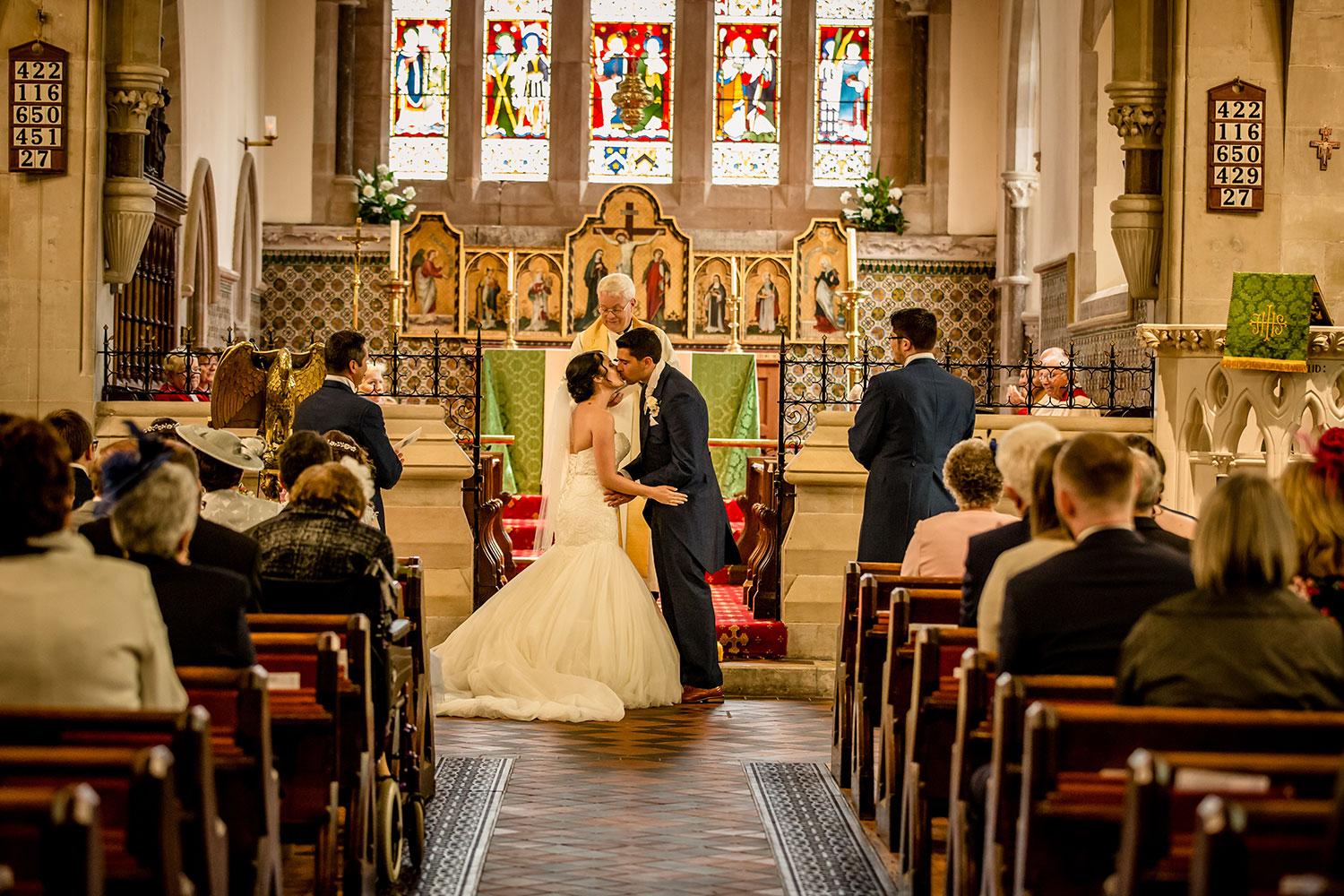
When the Groom Lifted the Bride’s Veil, the Priest Suddenly Said: “The Ceremony Must Be Stopped”
A Perfect Wedding Day
The morning had dawned bright and clear, with golden sunlight streaming through the magnificent stained glass windows of St. Nicholas Church, casting rainbow patterns across the stone floors that had been polished to perfection for the occasion. The ancient building, with its soaring Gothic arches and hand-carved wooden pews, provided the ideal setting for what everyone expected to be a joyous celebration of love and commitment.
Father Feofan had arrived early, as was his custom, to ensure every detail of the ceremony would proceed flawlessly. At sixty-three years old, he had officiated hundreds of weddings during his four decades of ministry, but his enthusiasm for uniting couples in holy matrimony had never diminished. He took particular pride in creating ceremonies that honored both the sacred traditions of the church and the unique love story of each couple who stood before his altar.
The church filled gradually with guests representing both families—Dmitry’s relatives and friends occupying the pews on the right side of the aisle, while spaces on the left had been reserved for Liliya’s family and friends. The atmosphere was warm and expectant, with gentle conversations about the couple’s courtship, predictions about their future happiness, and appreciation for the beautiful floral arrangements that decorated the sanctuary.
Dmitry had spent the morning in nervous preparation, adjusting and readjusting his formal suit, checking his appearance repeatedly in every available mirror, and practicing the vows he had written for his bride. At thirty-one, he had waited longer than many of his friends to marry, determined to find the kind of deep, lasting love that would sustain a lifetime commitment.
Liliya, twenty-eight and working as a translator for an international consulting firm, had prepared for this day with equal care and considerably more complexity of emotion. Her wedding dress, a stunning creation of silk and lace that had required months of savings to afford, represented not just her dream of a perfect wedding, but her hope for a future unmarked by the painful experiences of her past.
As she completed her final preparations in the church’s bridal chamber, surrounded by her closest friends who helped with last-minute adjustments to her hair and makeup, Liliya felt the familiar mixture of joy and anxiety that had characterized her relationship with Dmitry from the beginning. She loved him completely and genuinely, but that love was complicated by secrets she had never found the courage to share.
The traditional wedding veil, a family heirloom that belonged to Dmitry’s grandmother, completely covered Liliya’s face and hair in the customary way that would allow for the dramatic moment of revelation when the groom would lift the delicate fabric to see his bride clearly for the first time during the ceremony.
The Sacred Ceremony Begins
When the wedding march began to play, performed by the church’s accomplished organist on the magnificent instrument that had graced St. Nicholas for over a century, the congregation rose in unison to witness Liliya’s entrance. The music filled every corner of the sacred space, creating an atmosphere of reverence and celebration that had marked countless weddings within these walls.
Liliya moved slowly down the aisle with the measured pace that tradition demanded, her hand resting lightly on her father’s arm as he escorted her toward the altar where Dmitry waited with obvious emotion. Her dress sparkled in the candlelight and afternoon sun, creating an almost ethereal effect that drew admiring glances from every guest.
Dmitry watched his bride’s approach with his heart racing, alternately wiping his damp palms on his suit and adjusting his tie as nervous energy coursed through him. The closer Liliya came to the altar, the more rapid his breathing became, though whether from anticipation, anxiety, or simple overwhelming emotion, he couldn’t quite determine.
Father Feofan observed the couple with the benevolent satisfaction that came from years of witnessing young people commit their lives to each other in the presence of God and community. He had met with Liliya and Dmitry several times during their required pre-marriage counseling sessions, and he had been impressed by their obvious affection for each other and their thoughtful approach to the challenges and joys of married life.
The moment was supposed to be one of pure joy and symbolic revelation—the groom seeing his bride clearly as they prepared to make their sacred vows to each other. Guests leaned forward slightly in their pews, anticipating the sweet moment when Dmitry would see Liliya’s face and smile with love and pride at the woman who had chosen to share her life with him.
The veil lifted slowly, revealing first Liliya’s chin, then her lips, then her nose, and finally her eyes as the delicate fabric was drawn back to rest behind her shoulders. For a brief moment, the scene was exactly what everyone expected—a beautiful bride revealed to her devoted groom on the most important day of their lives together.
But then something went terribly wrong.
Recognition and Shock
Father Feofan’s face, which had been wearing the gentle smile appropriate for such a sacred moment, suddenly transformed with an expression of shock so profound that it was immediately visible to everyone in the church. His eyes widened with recognition, his lips parted in disbelief, and his entire demeanor shifted from benevolent officiant to someone who had just witnessed something that challenged his understanding of the situation.
The change in the priest’s expression was so dramatic and unexpected that even the church choir, who had been preparing to sing the traditional hymn that accompanied the exchange of vows, fell silent in confusion. Guests exchanged puzzled glances as they tried to understand what could have caused such a reaction in their respected spiritual leader.
The silence in the church became absolute and oppressive, broken only by the sound of Father Feofan’s sharp intake of breath as he continued to stare at Liliya’s newly revealed face. His reaction was so intense and strange that it created an atmosphere of tension and foreboding that no one could ignore.
Dmitry froze in place, his hand still holding the edge of Liliya’s veil, his face showing the complete confusion of someone whose world had just shifted without explanation. He looked from Father Feofan to Liliya and back again, searching for some understanding of what was happening and why their joyous ceremony had suddenly become something frightening and inexplicable.
“Father Feofan,” Dmitry managed to say in a voice that shook with confusion and growing dread, “what’s wrong? What’s happening? This is Liliya. This is my bride. We’re supposed to be getting married.”
The priest moved closer to the couple, never taking his eyes off Liliya’s face, studying her features with the intense concentration of someone trying to reconcile present reality with memories that were slowly becoming clearer. His expression showed the struggle of a man accessing recollections that he wished were incorrect but knew with growing certainty were absolutely accurate.
The Devastating Truth Emerges
Father Feofan’s voice, when he finally spoke, carried the weight of authority and the pain of someone delivering news that would destroy lives. “I know this woman,” he said quietly, but loudly enough that his words carried to every corner of the stunned church. “I have seen this face before, standing in this very place, in circumstances that make today’s ceremony impossible.”
A wave of murmurs and gasps swept through the congregation as guests tried to process the implications of the priest’s words. What could he possibly mean? How could he know Liliya in a way that would prevent her marriage to Dmitry? The questions multiplied faster than answers could be found.
Liliya flinched as if she had been physically struck, her fingers tightening around her wedding bouquet until her knuckles went white with the pressure. The color drained from her face as she realized that the moment she had hoped would never come had arrived with devastating clarity.
The priest’s words hit the assembled guests like physical blows. Some women immediately crossed themselves in response to Father Feofan’s gesture, while others gasped audibly at the implications of what they were hearing. The sacred space that had been filled with joy and anticipation just moments earlier was now heavy with shock, confusion, and growing scandal.
“According to the laws and traditions of our church,” Father Feofan continued with obvious reluctance but unwavering authority, “a second religious wedding ceremony is absolutely forbidden for someone who has already been married in a church. This prohibition is not negotiable or subject to circumstances. She has no right to stand here as a bride seeking God’s blessing on another marriage.”
Dmitry’s face went white as the blood drained from it, leaving him looking as if the floor had suddenly given way beneath his feet. He turned toward Liliya with an expression that combined disbelief, betrayal, and desperate hope that somehow there had been a terrible mistake.
“Liliya,” he whispered, his voice barely audible above the stunned silence of the congregation, “is this true? Have you been married before? Is what Father Feofan is saying actually true?”
The Hidden Past Revealed
Liliya lowered her head as tears began to fall, no longer able to maintain the pretense that had allowed her to reach this altar. The weight of her deception became physically visible as her shoulders sagged with the burden of secrets that could no longer be contained.
“I wanted to tell you,” she said softly, her voice breaking with emotion and shame. “I tried so many times to find the words, but I was afraid you would leave me if you knew the truth. I was terrified that my past would destroy any chance we had for happiness together.”
The confession continued as if a dam had finally burst: “My first marriage was a nightmare that I barely survived. I was young and naive, and I married someone who turned out to be controlling, abusive, and dangerous. I stayed as long as I could, trying to make it work, trying to honor the vows I had made in this church. But eventually, I had to run away to save my life and my sanity.”
The pain in her voice was evident to everyone listening as she concluded: “I love you, Dmitry. I love you more than I ever loved anyone, and I wanted to marry you more than I’ve ever wanted anything in my life. But I was so afraid that the truth would make you see me differently, would make you think I was damaged or not worth the risk of loving.”
Father Feofan, his face showing both compassion for Liliya’s obvious pain and unwavering commitment to church law, spoke with gentle firmness: “The church remembers what happens within these walls, my child. And so do I. The sacred nature of marriage means that previous vows cannot simply be forgotten or ignored, regardless of the circumstances that followed them.”
The guests in the congregation were processing this revelation with a mixture of shock, sympathy, and judgment. Some felt profound sadness for Liliya’s obvious suffering, while others were scandalized by what they saw as deliberate deception that had wasted everyone’s time and made a mockery of sacred traditions.
Dmitry’s Heartbreak
Dmitry stepped backward as if he could no longer bear to stand so close to the woman he had thought he knew completely. His face cycled through emotions too rapidly to follow—confusion giving way to understanding, understanding giving way to hurt, hurt giving way to anger, and anger giving way to a devastating sense of betrayal that seemed to hollowCout his entire being.
“Liliya,” he repeated her name as if he were trying to reconcile the woman he had loved with the stranger who had been deceiving him for their entire relationship. “You hid something this important from me? You let me plan our future, let me believe we were building something honest together, while keeping a secret that makes our marriage impossible?”
His voice grew louder with each word as the full implications of her deception became clear: “I told you everything about my past—my previous relationships, my mistakes, my fears about marriage. I trusted you completely because I thought you were trusting me the same way. But you were planning to marry me based on a lie.”
Father Feofan, recognizing that the situation had moved beyond his ability to provide spiritual guidance and into territory that required pastoral care, spoke with final authority: “I cannot and will not perform this marriage ceremony. According to church law and my obligation to uphold sacred traditions, this wedding is concluded without the exchange of vows.”
The pronouncement fell on the stunned congregation like a physical blow. Wedding guests who had arrived expecting to celebrate love and commitment instead found themselves witnesses to heartbreak, deception, and the collapse of what they had believed was a beautiful relationship.
The Aftermath of Truth
In the moments that followed Father Feofan’s final pronouncement, the church remained in stunned silence as everyone processed what they had witnessed. Guests sat frozen in their pews, unsure whether they should leave, offer comfort, or simply pretend they hadn’t heard the devastating exchange between the couple who would not be married.
Liliya stood at the altar in her wedding dress that now seemed to mock her rather than celebrate her, tears flowing freely as she understood that her worst fears had been realized. Not only had she lost the man she loved, but she had lost him in the most public and humiliating way possible, in front of their families and friends who would remember this day as a cautionary tale about deception and broken trust.
The bouquet in her hands, which had represented hope and new beginnings just minutes earlier, now felt like evidence of her own capacity for self-deception. She had convinced herself that love could overcome anything, including the truth, but she was learning that love without honesty was not love at all—it was simply a beautiful lie that eventually destroys itself.
Dmitry remained frozen in place beside her, looking as if he were still waiting for someone to explain that this had all been a terrible mistake. The man who had arrived at the church that morning believing he was about to marry the love of his life was now facing the reality that the relationship he had treasured was built on fundamental deception.
As the shocking ceremony concluded without celebration, guests began to file out of the church in subdued confusion, speaking in hushed whispers about what they had witnessed and wondering what would happen to the reception that had been planned for later that afternoon.
Some family members approached Liliya and Dmitry to offer support or comfort, though it was unclear what comfort could be offered in such circumstances. The mothers of both bride and groom struggled with their own emotions—disappointment, embarrassment, concern for their children’s happiness, and anger about the public nature of the revelation.
Liliya’s best friend, who had been designated to serve as maid of honor, helped gather the bride’s belongings while trying to provide emotional support. But there were no words adequate to address the magnitude of what had occurred, and platitudes about everything working out seemed insulting in the face of such obvious devastation.
Reflections on Deception and Truth
In the days that followed the interrupted wedding, both Liliya and Dmitry were forced to confront difficult truths about themselves, their relationship, and the choices that had led them to that devastating moment at the altar. The experience became a painful lesson about the importance of honesty in intimate relationships and the destructive power of well-intentioned deception.
For Liliya, the public exposure of her secret brought both relief and regret. While she no longer had to carry the burden of hiding her past, she also had to face the consequences of her choices and the realization that her attempt to protect her relationship had actually destroyed it. She began to understand that real love requires the courage to be vulnerable and honest, even when the truth might be painful or risky.
The failed marriage had taught her that healing from past trauma couldn’t be accomplished by simply hiding that trauma from others. Instead, she needed to work through her experiences in ways that would allow her to enter future relationships with honesty and emotional health rather than secrets and fear.
Dmitry struggled with his own complex emotions about what had occurred. While he felt betrayed and hurt by Liliya’s deception, he also had to examine his own role in creating a relationship dynamic where she felt unable to share difficult truths about her past.
Father Feofan, despite the necessity of his actions, felt genuine sorrow for the pain his recognition had caused. In his decades of ministry, he had learned that truth often comes with a cost, but that the cost of living with lies is ultimately much higher than the price of facing reality, no matter how painful that reality might be.
The interrupted wedding became a topic of discussion throughout the community, with different people drawing different lessons from what they had witnessed. Some focused on the importance of pre-marital honesty and the need for couples to share difficult truths before making lifetime commitments. Others emphasized the complexity of human relationships and the challenge of balancing past trauma with present hope.
Lessons in Love and Honesty
The story of Liliya and Dmitry’s interrupted wedding spread beyond their immediate community, becoming a powerful reminder about the foundation necessary for lasting relationships. Marriage counselors began using their story as an example of how secrets—even secrets kept with good intentions—can destroy the trust that healthy relationships require.
Mental health professionals pointed to Liliya’s experience as illustration of the importance of processing past trauma before entering new relationships. Her attempt to simply hide her previous marriage rather than dealing with its emotional aftermath had set up a dynamic where her current relationship was built on incomplete foundations.
Religious leaders used the incident to discuss the meaning and importance of church laws that might seem harsh or inflexible to modern couples. Father Feofan’s recognition of Liliya and his adherence to church doctrine, while painful in the moment, represented the kind of institutional memory and consistent principles that religious traditions are designed to preserve.
For many couples planning their own weddings, Liliya and Dmitry’s story became a catalyst for difficult but necessary conversations about their own pasts, their fears about honesty, and their commitment to building relationships based on complete truthfulness rather than selective disclosure.
Years later, both Liliya and Dmitry had moved on to build new relationships based on greater honesty and self-awareness. Liliya eventually found love with someone to whom she revealed her complete history from the beginning, discovering that the right person could love her more completely when they knew her whole story rather than just the parts she felt comfortable sharing.
Dmitry learned to create space in his relationships for difficult conversations and painful truths, understanding that his partner’s ability to be honest with him depended partly on his ability to receive honesty with compassion rather than judgment.
The church where their wedding had been interrupted continued to serve the community, with Father Feofan officiating many successful ceremonies for couples who had learned from Liliya and Dmitry’s experience to approach marriage with complete honesty about their pasts, their fears, and their hopes for the future.
Sometimes the most painful revelations are also the most necessary, teaching us that authentic love requires the courage to be completely truthful, even when the truth threatens everything we think we want.
Father Feofan continued his ministry at St. Nicholas Church for several more years before retiring, becoming known for his pre-marriage counseling sessions that emphasized complete honesty between partners. Liliya eventually remarried in a civil ceremony after receiving proper annulment documentation for her first marriage, building a healthy relationship based on full disclosure of her past experiences. Dmitry found love again with someone who appreciated his commitment to truth and honesty in relationships. The church implemented additional pre-marriage screening procedures to prevent similar situations, while maintaining compassionate support for couples dealing with complex pasts. The story became part of marriage preparation programs throughout the region, helping countless couples understand the importance of complete honesty before making lifetime commitments. St. Nicholas Church’s reputation for conducting meaningful ceremonies was enhanced rather than damaged by Father Feofan’s adherence to church law, with couples appreciating the institution’s commitment to sacred traditions and honest relationships. The interrupted wedding became a community reminder that love built on truth, however difficult, is stronger than love built on comfortable deceptions.

Sophia Rivers is an experienced News Content Editor with a sharp eye for detail and a passion for delivering accurate and engaging news stories. At TheArchivists, she specializes in curating, editing, and presenting news content that informs and resonates with a global audience.
Sophia holds a degree in Journalism from the University of Toronto, where she developed her skills in news reporting, media ethics, and digital journalism. Her expertise lies in identifying key stories, crafting compelling narratives, and ensuring journalistic integrity in every piece she edits.
Known for her precision and dedication to the truth, Sophia thrives in the fast-paced world of news editing. At TheArchivists, she focuses on producing high-quality news content that keeps readers informed while maintaining a balanced and insightful perspective.
With a commitment to delivering impactful journalism, Sophia is passionate about bringing clarity to complex issues and amplifying voices that matter. Her work reflects her belief in the power of news to shape conversations and inspire change.