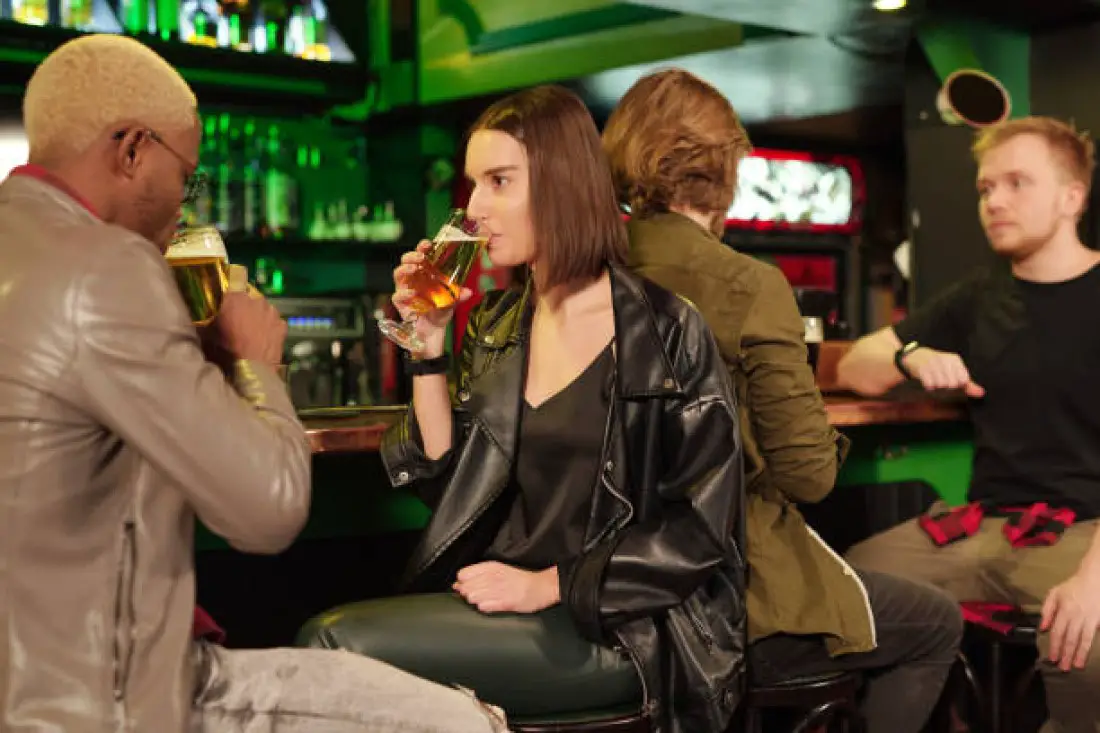
O’Malley’s on a Friday night sounded like every military town’s heartbeat—pool balls cracking against each other with that distinctive click, classic rock humming from speakers that had probably been mounted in the eighties, neon beer signs casting colored halos on wood scarred by decades of elbows and empties. A small American flag sat in a tarnished brass stand by the cash register, catching the draft from the AC unit every few beats like it was waving at the ghosts of Marines, sailors, and soldiers who’d passed through these doors over the years.
Virginia Beach had that particular military town energy—part beach community, part warrior culture, all wrapped in the humid coastal air that never quite left your lungs. O’Malley’s was the kind of place where you didn’t ask questions about the guy drinking alone at the end of the bar, where conversations about deployments happened in careful code, and where the bartender knew which regulars needed their drinks strong and their company quiet.
At the bar itself, about halfway down the polished mahogany, a woman in a gray flannel shirt and worn black jeans nursed a Corona with a lime wedge floating in the neck. She sat with the kind of posture that was somehow both relaxed and alert—shoulders loose, spine straight, eyes that tracked movement in the mirror behind the liquor bottles without seeming to look at anything in particular. Her dark hair was pulled back in a simple ponytail, practical and clean. No jewelry except a basic sports watch with a black band. No makeup to speak of. She looked like graduate school and night classes, like someone who spent days in libraries and evenings grading papers.
Nothing about her said war.
Near the dartboard in the back corner, four men occupied their usual Friday territory with the comfortable confidence of people who belonged. Navy SEALs, obvious to anyone who knew the type even without the Trident tattoos and Coronado tan lines. Lieutenant Derek Patterson—who everyone called “Hammer” for reasons involving a door breach in Ramadi and a story that got bigger every time he told it—had the loudest voice in the group, the broadest shoulders, and a deployment story currently tuned to that sweet spot between classified and impressive enough to turn heads.
His audience of three—two other SEALs and a Marine who’d wandered into their orbit—leaned in with the practiced attention of men who knew good war stories were currency in places like this. Patterson had the floor, and he knew how to work a room.
“So there we are, three klicks from the objective, and the terp is telling us the compound’s empty because it’s Friday prayers, right?” Patterson gestured with his beer bottle, his voice carrying across the bar. “And I’m thinking, this is either gonna be the easiest snatch-and-grab we’ve ever done, or we’re about to walk into the world’s worst ambush.”
He spotted the woman at the bar not watching, not turning around, not even pretending to be impressed. In his experience, civilians in places like this usually angled for proximity to operators, asked careful questions, bought rounds in exchange for stories. This one seemed content to ignore them entirely, which registered in Patterson’s alcohol-tuned brain as either refreshing or insulting, and after his fourth beer, he was leaning toward insulting.
“Hold that thought,” he told his audience, setting down his bottle and pushing off from the dartboard with the casual arrogance of someone who’d never met a social situation he couldn’t dominate.
He crossed the space between the dartboard and the bar in that particular swagger that comes from years of being part of an elite community, that walk that said “I belong to something you don’t understand.” He slid onto the stool next to the woman without asking if the seat was taken, planting his elbow on the bar with practiced ease.
“Hey there,” he said, his voice pitched to sound friendly with an undertone of cocky confidence. “You military, or just here for the atmosphere?”
The woman glanced at him briefly—gray eyes, direct but not hostile—before returning her attention to her beer. “Just having a beer,” she said. Her voice was neutral, Midwestern vowels that suggested Wisconsin or Minnesota, somewhere that valued understatement. “Finished my master’s degree at Old Dominion last month. Celebrating with some quiet time before I figure out what’s next.”
“Master’s in what?” Patterson asked, genuinely curious now. The detail about Old Dominion University placed her as local, at least temporarily.
“International relations,” she replied, taking a measured sip of her Corona. “Focus on conflict resolution and peacekeeping strategies.”
Patterson laughed, the sound carrying back to his friends at the dartboard who perked up with interest. This was going to be entertainment. “Conflict resolution? That’s hilarious. We do a lot of conflict resolution too. Just the hands-on version. Less theory, more kinetic problem-solving.”
His buddies laughed on cue. The bartender—Eddie, a former Marine with full sleeves of faded ink depicting an eagle, globe, and anchor along with various deployment locations—polished the same glass for the third time and drifted closer, his sixth sense for bar trouble starting to tingle.
Patterson leaned in, dropping his voice to what he probably thought was charming. “Tell you what—since you read about our world in all those fancy books—I’m willing to bet you don’t even know what a call sign is, sweetheart.”
The word “sweetheart” hung in the air like gun smoke, cheap and acrid. Several conversations at nearby tables paused mid-sentence. The woman’s jaw didn’t move, didn’t tighten, but something in her spine shifted—an almost imperceptible straightening that Eddie caught immediately from years of reading body language.
“An earned identifier,” she said, her voice still even but with an edge that could cut if you were paying attention. Patterson wasn’t. “The kind you don’t put on résumés or LinkedIn profiles. The kind that follows you through your career and usually has a story attached that’s either embarrassing or classified or both. The kind that means something to the people who gave it to you.”
Patterson blinked, momentarily thrown by the precision of her answer, but he recovered quickly. Being knocked off balance just made him lean harder. “Look at you, professor. Did you Wikipedia that, or did you actually meet someone who matters?”
His friends were watching now, grins spreading. This was turning into a show. The Marine with them—Gunnery Sergeant Rodriguez from 2nd Recon—looked less entertained, more uncomfortable, like he’d seen this movie before and didn’t like how it ended.
“I mean, it’s cute that you study this stuff,” Patterson continued, warming to his theme. “But there’s knowing about something and then there’s living it. See, my call sign is Hammer. Got it in Ramadi in 2008 when I—”
“—breached a door with a sledgehammer because your explosive charge was a dud, taking fire the whole time, and pulled three Marines out of a kill zone before the building collapsed,” the woman finished, her tone suggesting she was reciting a grocery list rather than a combat action. “Purple Heart, Bronze Star with V device. Got written up in the SEAL community newsletter and made E-6 ahead of schedule. The story’s gotten about thirty percent more dramatic in the retelling, but the core facts are solid. You earned the call sign. Congratulations.”
The bar went quiet enough to hear the AC unit rattling. Patterson’s face cycled through confusion, surprise, and something approaching concern. “How the hell do you know that?”
“Because I pay attention,” she said simply. “And because the special operations community isn’t as big as people think. Stories travel.”
She turned slightly on her barstool to face him fully for the first time, giving him her complete attention in a way that somehow felt more intimidating than her earlier dismissal. “But since you asked about call signs, and since you seem very interested in credentials and who’s earned what, I should probably answer your original question.”
Patterson opened his mouth, then closed it, suddenly uncertain whether he wanted her to continue. Eddie stopped moving entirely, one hand frozen on the bar towel. At a corner table near the men’s room, a gray-haired man in a faded Navy ballcap—Master Chief Petty Officer Thomas Brennan, retired SEAL Team 3—went completely still, then slowly reached for his cell phone without taking his eyes off the woman at the bar.
She set her Corona down on the bar with careful, deliberate precision. The bottle made a soft sound against the wood that seemed loud in the silence. She turned her body fully toward Patterson so he could see both her complete calm and her total control of this moment, and when she spoke, she let two syllables cut through every conversation in the room.
“Ghost Nine.”
The effect was immediate and profound. Patterson’s beer bottle—he’d been holding it loosely, confidently—slipped from his suddenly nerveless fingers and shattered against the hardwood floor, Corona and glass spreading in a foamy puddle that nobody moved to clean up. Every conversation in O’Malley’s collapsed into silence. At the corner table, Master Chief Brennan stood up so fast his chair scraped backward, his phone already at his ear. Eddie the bartender stopped breathing along with everyone else who understood what they’d just heard.
Patterson’s face lost all its swagger and found a color closer to truth, somewhere between pale shock and the dawning realization that he’d just stepped on a landmine made of his own arrogance. The woman in the gray flannel didn’t blink, didn’t smile, didn’t move. She just waited.
“Sir,” Patterson started, the word coming out automatic, muscle memory from years of military protocol kicking in even though she wore no uniform, no rank, no identifier except a call sign that carried more weight than any medal.
The woman—Ghost Nine—raised one hand slightly, a minimal gesture that somehow conveyed both “at ease” and “you really need to stop talking now.”
“I’m not ‘sir,'” she said, her voice still even. “I’m retired. Have been for three years. I’m just a civilian having a beer and minding my own business, which I was doing quite successfully until you decided I needed education on call signs and the nature of real military service.”
Patterson looked like he wanted the floor to open up and swallow him. His buddies at the dartboard had gone silent, the dynamic completely reversed. The cocky energy had evaporated, replaced by the kind of awkward tension that comes when someone realizes they’ve profoundly misread a situation.
Master Chief Brennan had reached whoever he was calling. “Yeah, it’s Tom Brennan… No, I’m at O’Malley’s… Because Ghost Nine is sitting at the bar and one of your lieutenants just made an ass of himself… Yes, that Ghost Nine… Yeah, I’ll keep an eye on things… You might want to make a phone call or two… Yeah, I know… Okay.”
He hung up and walked over to the bar, moving with the careful deliberation of someone approaching something dangerous that might startle. When he reached the woman, he extended his hand with genuine respect.
“Master Chief Thomas Brennan, ma’am. SEAL Team 3, retired 2015. I served with Chief Markowitz on your task force in ’09. He told stories.”
Ghost Nine shook his hand, a brief, professional grip. “Tom Brennan. I remember the after-action report. You pulled off that helicopter extraction in Nuristan that everyone said was impossible. Thirty-degree angle on a mountain LZ at eleven thousand feet in a brownout. How’s Marcus doing?”
“Retired. Running a security consulting firm in Colorado Springs. Two kids, happy marriage. Still talks about the night you walked into the firebase in Kandahar with intel that saved his entire element.”
She nodded. “That was a good night. Glad he made it home.”
Patterson was still standing there, frozen, his brain trying to catch up with the reality unfolding in front of him. Finally, he managed: “Ghost Nine is… I thought that was… Everyone said that operator was…”
“Was what?” Ghost Nine asked, turning her gray eyes back to him. “Dead? Retired? A myth? All of the above at various times, depending on which story you heard?”
She picked up her beer—her hand was absolutely steady—and took a sip before continuing. “Call signs in special operations have weight, Lieutenant. You know that. Yours has a story about courage under fire and getting the job done. That’s worth respecting. But some call signs carry different weight. Ghost Nine isn’t just a cool name someone thought up after too many beers. It’s a operational designation that got attached to me during a very specific period of time doing very specific work that nobody talks about at bars.”
“JSOC,” Patterson said, the pieces finally clicking together. “You were Joint Special Operations Command. Task Force… oh shit. You were Ground Branch.”
“CIA Special Activities Center, Ground Branch, attached to JSOC for direct action operations,” she confirmed. “Eight years, four continents, operations I still can’t discuss and probably never will be able to. ‘Ghost’ because I specialized in long-duration solo reconnaissance in denied areas. ‘Nine’ because I was the ninth woman to make it through the full selection pipeline, and the first to complete a full operational rotation without washing out or transferring.”
The bar was still silent, but the quality of the silence had changed. It was no longer shocked silence—it was the reverent quiet of people in the presence of someone who’d done things they couldn’t imagine, survived situations they’d only heard whispered rumors about.
Eddie finally found his voice. “Your money’s no good here, ma’am. Tonight or any other night.”
“I appreciate that, Eddie, but I can pay for my beer.”
“Not what I meant,” Eddie said firmly. “I meant you don’t pay. Ever. House rule, effective immediately.”
Ghost Nine smiled for the first time, a brief expression that softened her features. “I’m not looking for special treatment.”
“Not special treatment. Respect.” Eddie looked at Patterson. “And you’re going to clean up that broken glass, Lieutenant. And then you’re going to apologize properly. And then you’re going to shut your mouth and think about what you almost did tonight.”
Patterson grabbed bar towels and dropped to his knees, carefully picking up glass shards with shaking hands. When he stood up, he faced Ghost Nine with something approaching genuine contrition.
“Ma’am, I… I’m sorry. That was completely out of line. I made assumptions, I was disrespectful, and I…” He trailed off, struggling to find words adequate to the situation.
“You were showing off,” Ghost Nine said, not unkindly. “You’ve done real things, earned real respect, and you wanted to remind everyone in here of that fact. I understand the impulse. But you forgot the first rule of operational security: you never know who you’re talking to. The woman in the flannel shirt might be a graduate student. Or she might be someone who’s done things you can’t imagine. You assumed, and assumptions in our world get people killed.”
“Yes, ma’am.”
“I’m not your ma’am, and you don’t need to keep apologizing. You made a mistake. Learn from it. Be better.” She glanced at his teammates, still frozen at the dartboard. “All of you. You’ve earned your Tridents. You’ve deployed to bad places and done hard things. But the minute you think that makes you better than everyone else, the minute you think you’ve got nothing left to learn, that’s when you become a liability.”
Master Chief Brennan nodded approvingly. “She’s right. I spent thirty years in the teams, and the best operators I ever worked with were the ones who stayed humble, stayed curious, stayed ready to learn from everyone. The loudest guys were usually compensating for something.”
Patterson’s phone buzzed. He looked at the screen and went pale again. “It’s the team commander. He wants to see me Monday morning, 0600.”
“Then I suggest you show up on time, sober, and with a better attitude,” Ghost Nine said. She finished her Corona and set the empty bottle on the bar. “Gentlemen, it’s been educational, but I have an early morning. I’m volunteering at the VA hospital tomorrow, helping with a PTSD support group.”
She stood up, pulling a twenty from her pocket and setting it on the bar despite Eddie’s protest. “For whoever needs it,” she said. Then she looked at Patterson one more time. “Lieutenant, you’ve got a good career ahead of you if you don’t sabotage it with ego. The SEALs need operators who can do the job and keep their mouths shut about it. Be that guy.”
She walked toward the door, moving through the silent bar with the same quiet confidence she’d had all evening. As she reached the exit, Gunnery Sergeant Rodriguez—the Marine who’d been watching the whole thing with growing discomfort—called out: “Ma’am? Ghost Nine? Thank you for your service.”
She paused, hand on the door, and turned back. “Thank you for yours, Gunny. Semper Fi.”
Then she was gone, the door closing behind her with a soft sound that seemed to release everyone from a spell. Conversation slowly resumed, but the energy in the bar had completely changed.
Master Chief Brennan sat back down at his corner table, shaking his head. One of Patterson’s teammates—a younger SEAL named Mitchell—came over, his expression serious. “Chief, who was that really? I mean, we’ve all heard rumors about Ground Branch, but…”
“That,” Brennan said, “was someone who did things you’ll never read about, in places that officially don’t exist, against enemies whose names you’ll never know. Ground Branch doesn’t just take special operations soldiers—they take the best of the best and then run them through a selection process that makes BUD/S look like summer camp. The failure rate is over ninety percent. And she made it through, then spent eight years operating in denied areas where if she got caught, the United States would have disavowed any knowledge of her existence.”
“Jesus,” Mitchell breathed.
“Ground Branch operators don’t get medals you can see,” Brennan continued. “They don’t get their pictures on walls. They don’t get recognition or glory or even basic acknowledgment most of the time. What they get is the knowledge that they did the job, got it done, and kept this country safer in ways that can never be made public. And Ghost Nine was a legend even by those standards.”
He looked at Patterson, who was still standing at the bar looking shell-shocked. “You know what the real kicker is, Lieutenant? She wasn’t trying to embarrass you. She gave you information you needed, taught you a lesson that might save your life or your career someday, and did it without making you feel smaller than you already did. That’s leadership. That’s what the quiet professionals look like. And you just got a masterclass in it for free.”
Patterson nodded slowly. “I need to be better.”
“Yes, you do. And the fact that you can recognize that means maybe you will be.”
Eddie was wiping down the bar where Ghost Nine had been sitting, and he noticed something she’d left behind—not the twenty-dollar bill, which he was planning to frame and hang behind the bar, but a business card tucked under the empty Corona bottle.
He picked it up and read it aloud: “Sarah Chen, M.A. International Relations. Conflict Resolution Consultant.” A phone number and email address. Nothing about CIA, nothing about Ground Branch, nothing about Ghost Nine. Just a woman with a graduate degree offering her professional services.
“That’s her civilian name?” Mitchell asked.
“That’s her real life,” Brennan corrected. “Ghost Nine was what she did. Sarah Chen is who she is. The fact that she can separate the two, that she can do the work and then come back and build a normal life—that’s maybe the most impressive thing about her.”
The door opened again, and everyone tensed, but it was just a couple of Marines coming in for their Friday night ritual. The bar slowly returned to its normal rhythms, but something had fundamentally shifted. The story of what happened would spread through the Virginia Beach military community with the speed of good gossip and the weight of important lessons.
Patterson sat down at the bar, ordered water instead of beer, and stared at his phone. The message from his commanding officer was brief: “See me Monday 0600. We need to discuss professional conduct, operational security, and knowing when to keep your mouth shut. Also, you need to read the Ground Branch declassified history. All of it. That’s an order.”
“Chief Brennan,” Patterson called over. “Do you think she’ll accept an apology if I email her?”
Brennan considered it. “I think she’d prefer you just become a better operator and a better man. That’s the real apology. Let your actions speak louder than your words for once.”
Patterson nodded, understanding. He’d spent years cultivating a reputation as Hammer, the door-kicking action hero with the cool story. In fifteen minutes, a quiet woman in a flannel shirt had shown him that the real heroes—the ones who’d done things that actually mattered—didn’t need to announce themselves. They carried their history quietly, let their actions speak, and moved through the world without demanding recognition.
It was a lesson he’d carry for the rest of his career.
Across town, Sarah Chen—Ghost Nine to a select few, just Sarah to everyone else—unlocked her apartment and kicked off her shoes. She made herself a cup of tea, changed into comfortable clothes, and sat down at her laptop to review her notes for tomorrow’s PTSD support group at the VA.
Her phone buzzed with a text from Tom Brennan: “Sorry about tonight. Are you okay?”
She typed back: “I’m fine. He’s young. He’ll learn. Thanks for having my back.”
“Always. Coffee next week?”
“Sounds good.”
She set the phone down and looked at the wall above her desk where a single frame hung—not medals or commendations or photographs, but a quote attributed to George Orwell: “People sleep peaceably in their beds at night only because rough men stand ready to do violence on their behalf.”
Someone had amended it in pen: “And rough women too.”
She smiled, sipped her tea, and thought about the work she’d done, the people she’d saved, the missions that would never be acknowledged. Then she thought about the work she was doing now—helping veterans transition back to civilian life, using her operational psychology training to facilitate healing, building a new life that honored her past without being defined by it.
Ghost Nine had retired three years ago after a mission went sideways in Yemen and she’d spent four days evading capture in the desert with a broken leg, surviving on training, willpower, and the absolute certainty that she had more to do with her life. She’d been medically cleared for duty eventually, but something had shifted. She’d given enough. Done enough. Sacrificed enough.
Time to come in from the cold and build something new.
Most days, she didn’t miss it. She didn’t miss the adrenaline or the fear or the weight of knowing that mistakes meant death. But some nights, when the dreams came, she’d wake up in tactical mode, hands reaching for weapons that weren’t there, heart racing with the memory of operations she could never discuss.
Those nights, she’d remind herself: You’re Sarah now. You’re home. You’re safe. You earned this peace.
And in the morning, she’d go back to the work of helping others find their own version of peace, using everything she’d learned in the darkest places to bring light to people who needed it most.
That was the real legacy of Ghost Nine—not the operations or the kills or the missions, but the life she’d built after, the work she continued to do, the quiet understanding that service takes many forms.
As she prepared for bed that night, she thought about Lieutenant Patterson and hoped he’d take the lesson to heart. The military needed warriors, absolutely. But it needed wise warriors, humble warriors, operators who understood that strength without wisdom was just violence, and courage without compassion was just cruelty.
She’d been all those things once—violent, cruel, merciless when the mission required it. But she’d also been more than that, and she’d worked hard to hold onto the more in the face of everything that tried to strip it away.
Now, in her second act, she got to be fully human again. Sarah Chen, conflict resolution consultant, veteran support volunteer, quiet professional who’d traded her rifle for a master’s degree and her call sign for a business card.
But on Friday nights at O’Malley’s, when some cocky operator needed a reminder about humility and respect, Ghost Nine could still make an appearance.
And that, she thought as sleep finally claimed her, was exactly how it should be.

Sophia Rivers is an experienced News Content Editor with a sharp eye for detail and a passion for delivering accurate and engaging news stories. At TheArchivists, she specializes in curating, editing, and presenting news content that informs and resonates with a global audience.
Sophia holds a degree in Journalism from the University of Toronto, where she developed her skills in news reporting, media ethics, and digital journalism. Her expertise lies in identifying key stories, crafting compelling narratives, and ensuring journalistic integrity in every piece she edits.
Known for her precision and dedication to the truth, Sophia thrives in the fast-paced world of news editing. At TheArchivists, she focuses on producing high-quality news content that keeps readers informed while maintaining a balanced and insightful perspective.
With a commitment to delivering impactful journalism, Sophia is passionate about bringing clarity to complex issues and amplifying voices that matter. Her work reflects her belief in the power of news to shape conversations and inspire change.