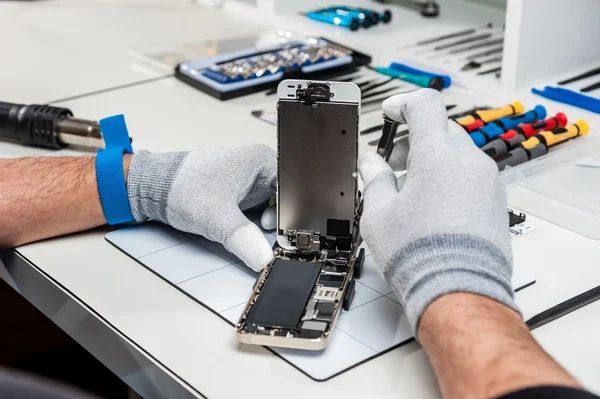
The Phone That Changed Everything
It started with a simple favor—the kind any mother-in-law would do without thinking twice. My daughter-in-law needed her phone repaired, and I knew just the place to take it. What should have been a routine errand turned into the most terrifying discovery of my life. When the repair technician called me over with a grave expression and showed me what he’d found on that phone, three words changed everything: “Get out immediately.”
But I’m getting ahead of myself. Let me start from the beginning.
The Visit
It was a Wednesday afternoon in late autumn when Emily knocked on my door. The leaves had turned that brilliant shade of gold that makes everything look like it’s glowing, and there was a crisp bite in the air that promised winter wasn’t far behind. I had been in the kitchen, working on a batch of my famous apple pie—the one my son Michael had loved since he was a boy.
When I opened the door, Emily stood there alone, which was unusual. My son and his wife typically visited together on weekends, a routine we’d established years ago. But here she was, midweek, without Michael, and she looked distressed.
“Susan,” she said, her voice higher than normal, almost breathless. “I’m so sorry to bother you like this.”
“Nonsense,” I said, ushering her inside. “You’re never a bother. Come in, dear. What’s wrong?”
Emily had been part of our family for five years now. When Michael first introduced us, I’d been impressed. She was intelligent, articulate, and had a successful career in financial consulting. She worked long hours, traveled frequently for work, and had an air of sophistication that seemed almost out of place in our modest suburban neighborhood. I’ll admit, I’d initially worried she might look down on us—Robert and I were both retired teachers, hardly moving in the same circles as her corporate colleagues. But she’d always been polite, if somewhat reserved.
Looking back now, I realize I’d mistaken her distance for professionalism. I’d told myself she was just busy, stressed from work, preoccupied with her demanding career. I’d made excuses for the way she sometimes seemed to be calculating something behind her eyes, the way she’d steer conversations toward our retirement savings or our insurance policies. I’d been so eager to welcome her into our family that I’d ignored the warning signs.
“My phone,” she said, pulling the device from her purse. The screen was completely shattered, spiderwebbed with cracks that made it nearly impossible to see anything on the display. “I dropped it this morning getting out of my car. I have a crucial meeting with a client tomorrow morning, and I need all my files and contacts. Michael’s out of town on that business trip to Chicago, and I don’t know where to get it fixed quickly.”
I looked at the damaged phone and nodded sympathetically. “Don’t worry about it. I know just the place. Tom’s shop downtown—he’s the son of an old colleague of mine from my teaching days. I took my phone there just last week when I had battery issues. He’s fast, reliable, and reasonable.”
Emily’s face flooded with relief. “Would you mind taking it for me? I have back-to-back meetings all afternoon, and I’m already running late.”
“Of course,” I said. “I’d be happy to help.”
She handed me the phone, and for a moment, our hands touched. Her fingers were ice cold despite the warmth of the house. “The password is 2800218,” she said. “Our wedding date—February 18, 2008. I’ll come by tonight after work to pick it up, probably around seven.”
“Perfect,” I said, walking her to the door. “Don’t worry about a thing. I’ll take care of it.”
After she left, I stood in the doorway for a moment, watching her silver sedan pull away. Something felt off, though I couldn’t put my finger on what. Maybe it was the way her hands had trembled slightly when she handed me the phone, or the way she wouldn’t quite meet my eyes. I shook my head, dismissing the feeling. She was stressed about work, that’s all.
I went back to the kitchen, finished my pie, and set it in the oven. Then I grabbed my purse and headed out to Tom’s shop.
The Repair Shop
Tom’s shop was tucked between Murphy’s Pharmacy and Sweet Treats Bakery on Main Street, a small storefront with a hand-painted sign that read “Fast Phone Repair” in cheerful blue letters. I’d known Tom since he was a boy—his mother Helen had taught mathematics at the same high school where I’d taught English for thirty years. Tom had been a brilliant student, gifted with technology in a way that seemed almost magical to my generation.
When I walked in, a small bell chimed above the door. Tom was hunched over a workbench, peering through one of those magnifying lamps while he worked on the internal circuitry of someone’s phone. He looked up and broke into a warm smile.
“Mrs. Sullivan! Good to see you again. Is your phone acting up already?”
“No, no,” I said, returning his smile. “Actually, it’s my daughter-in-law’s phone this time. Poor Emily dropped it, and she needs it fixed urgently for work.”
I explained the situation while Tom examined the damaged device, turning it over in his hands with the practiced eye of an expert. He nodded thoughtfully.
“Screen replacement,” he said. “Pretty straightforward. I can have this done in a couple of hours. The internal components look fine—she’s lucky she had a case on it.”
I gave him the password Emily had provided and left the phone with him. “I’ll do some shopping and come back this afternoon,” I said.
Tom assured me it would be ready, and I spent the next few hours wandering through the shops on Main Street. I bought fresh flowers from the florist, picked up Robert’s prescription from the pharmacy, and stopped by the bookstore to browse the new releases. It was a pleasant afternoon, the kind I’d grown to love in retirement—no rush, no pressure, just the simple pleasure of a leisurely day.
When I returned to Tom’s shop around three o’clock, the cheerful bell chimed again. But this time, when Tom looked up, his expression wasn’t welcoming. His face was pale, his jaw tight, and there was something in his eyes I’d never seen before—fear, maybe, or anger. Perhaps both.
“Susan,” he said, his voice low and urgent. He glanced toward the front window, then quickly moved to the door, turning the lock and flipping the sign to “Closed.”
My heart began to race. “Tom? What’s wrong? Is the phone not fixable?”
“The phone is fine,” he said, moving back behind the counter. “I fixed the screen. It’s working perfectly. But…” He paused, running a hand through his hair. “Susan, you need to sit down.”
“I don’t want to sit down,” I said, though my legs suddenly felt weak. “Just tell me what’s going on.”
Tom picked up Emily’s phone from the counter. His hand shook slightly. “When I was running diagnostics to make sure everything was working after the repair, I noticed the notes app was open. I wasn’t trying to snoop, I swear. But I saw something that…” He trailed off, then met my eyes. “Susan, I think you might be in danger.”
The words seemed to hang in the air between us, impossible and absurd. “Danger? Tom, what are you talking about?”
Instead of answering, he unlocked the phone—2800218, the wedding date—and opened the notes application. There were dozens of notes with innocuous titles: “Grocery List,” “Meeting Notes,” “Travel Plans.” But one title made my blood run cold: “Plan B.”
Tom tapped on it, and the note opened. What I saw on that screen would haunt me for the rest of my life.
The Discovery
It wasn’t a shopping list or meeting notes. It was a conversation, a back-and-forth exchange that had clearly been typed out over time, with dates attached to each entry. The most recent one was from just two days ago.
Michael – Oct 15: Mom’s memory is getting worse. Dr. Harrison noted it in her file again today. This is perfect timing. No one will question anything when it happens.
Emily – Oct 15: Are you sure about the dosage? We can’t have any mistakes.
Michael – Oct 15: I’ve researched it thoroughly. Small amounts over time. Symptoms mirror natural cognitive decline. By the time anyone thinks to test for it, it’ll be untraceable.
Emily – Oct 16: The life insurance policies are worth $1.8 million combined. Plus the house—in this market, we’re looking at another $600K minimum. We can finally get out of this miserable town.
Michael – Oct 16: We have to be patient. Do Mom first. Dad’s already showing signs of grief—everyone will expect his health to decline after. We wait three weeks, maybe a month. Make it look like he couldn’t cope with losing her.
Emily – Oct 17: I’m meeting with the lawyer tomorrow to make sure we’re the beneficiaries on everything. Your parents trust us completely. This is going to work.
I read it once. Then again. And again. The words swam before my eyes, each reading making them more real and more impossible at the same time. My legs gave out, and I found myself sitting on the small chair Tom kept for customers, though I had no memory of moving there.
“This can’t be real,” I whispered. “This has to be some kind of sick joke. Michael wouldn’t—he couldn’t—”
But Tom was already scrolling through more notes, more conversations. There were detailed plans about the substance they planned to use—something that would mimic the symptoms of dementia and eventually heart failure. There were discussions about how to manipulate our family doctor, Dr. Harrison, into documenting my supposed cognitive decline. There were calculations about exactly how much money they would inherit.
And there were messages about Robert. About how his depression and anxiety—things he’d struggled with for years—made him the perfect second victim. How no one would question it if he took his own life a few weeks after losing me. How they could make it look entirely natural.
My son. My only child. The boy I’d carried for nine months, nursed through midnight fevers, taught to ride a bike, sent off to college with tears in my eyes. The man who’d called me every Sunday for years, who’d asked my advice about everything from career decisions to which house to buy. He was planning to murder me.
And Emily, the woman I’d welcomed into our family with open arms, was helping him.
Tom poured me a glass of water from the small cooler in the corner of his shop. My hands shook so badly I nearly dropped it. “We need to call the police,” he said firmly. “Right now.”
“No.” The word came out stronger than I expected. I set down the water and looked up at Tom. “No one will believe this. Look at me—I’m seventy-two years old. They’ll think I’m confused, paranoid. They’ll say it’s just notes, that it could mean anything. That I’m misinterpreting.”
“Susan—”
“And if we tip them off, they’ll destroy the evidence. Or worse, they’ll act faster.” I stood up, my mind suddenly sharp and clear despite the horror of what I’d just learned. “We need to document everything. We need proof that can’t be denied or explained away.”
Tom stared at me for a long moment, then nodded slowly. “Okay. Okay, let me help you.”
For the next hour, we worked methodically. I used my phone to photograph every note, every message, every detail in that damning file. Tom showed me how to check the metadata, proving when each entry had been made. We found more evidence in other apps—calendar entries for meetings with lawyers and financial advisors, searches for “untraceable poisons” and “how to fake dementia symptoms” in the browser history.
The deeper we dug, the more elaborate the plan revealed itself to be. They’d been planning this for months. Maybe longer.
Finally, Tom carefully restored the phone to exactly how it had been when Emily dropped it off, making sure there was no indication that anyone had accessed these files. He even took photos of the phone’s position on his workbench, the exact angle, so he could place it back precisely.
“What are you going to do?” he asked as I prepared to leave.
“I’m going to go home,” I said, my voice steady despite the terror coursing through my veins. “I’m going to act like everything is normal. And I’m going to protect my husband.”
Tom gripped my arm gently. “Be careful, Susan. If they even suspect you know—”
“They won’t,” I said. “Not until it’s too late.”
The Revelation
The drive home felt like the longest twenty minutes of my life. My hands were steady on the wheel, but my mind was racing. How long had Michael been planning this? What had I missed? What signs had been there that I’d been too blind—or too trusting—to see?
I thought back over the past year. Emily’s sudden interest in our financial planning. Michael’s insistence that we update our wills. The way he’d suggested we make him and Emily the executors of our estate “just to make things simpler.” His recommendation that we switch to Dr. Harrison, a younger doctor who’d recently joined the practice—someone who didn’t know our medical history as well.
Oh God. How many pieces had been carefully moved into place while I’d smiled and nodded, trusting my son completely?
When I pulled into our driveway, I sat in the car for a moment, collecting myself. I couldn’t fall apart. Not now. I had to be strong. I had to protect Robert.
Robert was in the living room when I walked in, settled in his favorite armchair with a book. He looked up and smiled, that same warm smile that had made me fall in love with him forty-five years ago.
“How was your day, sweetheart?” he asked. “Did you get Emily’s phone fixed?”
I set my purse down carefully. “Yes. But Robert, I need you to put down your book. We need to talk.”
Something in my tone made him sit up straight, his smile fading. “What’s wrong?”
I sat down on the couch across from him. “I need you to listen to me. I need you to hear everything I’m about to tell you, and I need you to stay calm.”
“Susan, you’re scaring me.”
“Good,” I said. “You should be scared. We both should be.”
I pulled out my phone and showed him the photographs I’d taken. I watched his face as he scrolled through them, saw the color drain from his cheeks, saw his hands begin to tremble. He read in silence, his breathing becoming more rapid with each passing moment.
“No,” he finally whispered. “No, this isn’t possible. Michael loves us. He wouldn’t—”
“Look at the phone number,” I said gently. “Look at the metadata. That’s his phone, Robert. Those are his words.”
Robert’s face crumpled. For a moment, I thought he might cry, but instead, a terrible, wounded anger filled his eyes. “How could he do this? We gave him everything. We loved him. We—” His voice broke.
I moved to sit beside him, taking his hand. “I don’t know. I don’t understand it either. But right now, we can’t think about the why. We need to think about survival.”
“We should call the police,” he said.
“And tell them what? That we found some notes on our daughter-in-law’s phone? Notes that could be explained away as fiction, as dark humor, as a misunderstanding?” I squeezed his hand. “Tom said the same thing. But I know how this will go. They’ll talk to Michael and Emily. Michael is a successful architect—respected, articulate. Emily works in finance. They’ll seem credible. And we’re just a retired couple in our seventies. They’ll think we’re paranoid. Confused.”
“Then what do we do?”
“We gather evidence. We document everything. We protect ourselves. And we set a trap.”
Over the next several hours, we worked systematically. We changed every password to every account—banking, email, insurance, medical records. We called our bank and set up requirements that any transfer over five thousand dollars required both of us to appear in person with identification. We removed Michael and Emily as authorized users on all our accounts.
We called our lawyer—Jennifer Chen, a sharp woman in her fifties who’d handled our estate planning for years—and scheduled an emergency meeting for the next morning. We made copies of the photographs and created a secure cloud backup that only we could access.
Robert wanted to call Michael immediately, to confront him, to demand answers. I stopped him.
“If we tip our hand now, we lose our only advantage,” I said. “They think we don’t know. They think we’re easy targets. We need to let them believe that.”
“So we just wait?” Robert’s voice was anguished. “We just pretend everything is normal while our son plots to kill us?”
“Yes,” I said firmly. “Because if we panic, if we react emotionally, we make mistakes. And mistakes will get us killed.”
The doorbell rang at exactly seven o’clock. Emily, punctual as always.
The Performance
I took a deep breath, looked at Robert, and saw my own fear reflected in his eyes. But I also saw determination. We’d survived wars, economic depressions, personal tragedies. We would survive this too.
I opened the door with a smile.
“Emily! Come in, dear. Your phone is all fixed.”
She stepped inside, and I studied her with new eyes. Had she always looked so predatory? Or was I only seeing it now because I knew the truth?
“Thank you so much, Susan,” she said, her smile bright and false. “How much do I owe you for the repair?”
“Don’t be silly,” I said, waving her off. “Tom gave me a family discount. It was only fifty dollars. Consider it an early Christmas present.”
Robert emerged from the kitchen, and I watched Emily’s eyes flick toward him, assessing. Did she see any suspicion there? Any fear?
“Hello, Robert,” she said pleasantly.
“Emily.” His voice was carefully neutral. “How was work?”
“Busy as always,” she said. “The quarterly reports are killing me.”
We made small talk for a few minutes—the weather, her upcoming business trip, our plans for Thanksgiving. The whole time, I kept thinking about those notes on her phone. “Do Mom first.” As if I was an item on a to-do list.
Finally, Emily said she needed to get home. As I walked her to the door, she turned back. “Oh, Susan, I’ve been meaning to ask—have you been feeling all right? Michael mentioned you’ve seemed a bit forgetful lately.”
There it was. The setup. Planting seeds of doubt about my mental state, creating a narrative that would support their plan.
I smiled warmly. “I’m feeling wonderful, dear. Perhaps Michael is just worried. You know how sons can be protective of their mothers.”
Something flickered in her eyes—frustration, maybe, or annoyance that I wasn’t playing along with the script she’d written. “Well, it might be worth mentioning to your doctor at your next appointment. Just to be safe.”
“I’ll keep that in mind,” I said pleasantly. “Drive carefully.”
After she left, Robert and I stood in the foyer, not speaking. Finally, he said, “She looked you right in the eye and lied.”
“Yes,” I said. “She’s good at it. They both are.”
That night, neither of us slept.
Building the Case
Over the next two weeks, we became investigators of our own lives. We installed hidden cameras in our home—small, discreet devices that Tom helped us set up. We kept detailed logs of everything we ate and drank, every medication we took, every interaction we had with Michael and Emily.
Jennifer Chen, our lawyer, was horrified when we showed her the evidence. “This is conspiracy to commit murder,” she said bluntly. “You need to go to the police.”
“Not yet,” I insisted. “We need more. We need something undeniable.”
She reluctantly agreed to help us, documenting everything, creating a paper trail that would be impossible to ignore.
Michael visited twice during those two weeks, always friendly, always concerned. “Mom, you left the stove on last night,” he said during one visit, his voice full of worry. “Dad told me. I’m really concerned about you.”
“Did I?” I said vaguely, playing the part he’d written for me. “I don’t remember that.”
“That’s exactly what worries me,” he said, placing a hand on my shoulder. I resisted the urge to flinch away. “I think you should see Dr. Harrison. Get some tests done.”
“Maybe you’re right,” I said softly.
But I knew I hadn’t left the stove on. Robert had checked specifically. Michael was lying, creating false evidence of my supposed cognitive decline.
Emily was more subtle. She brought over a bottle of my favorite wine one evening, insisting we share it. We poured three glasses, and when she wasn’t looking, I switched my glass with an empty one from the cabinet. Robert and I later had that wine tested. It contained a significant amount of a sedative that, over time, could indeed cause memory problems and confusion.
We had them.
But we needed one more piece—something that would prove intent beyond any possible doubt.
The Trap
I called Emily three weeks after the phone repair. “Emily, dear, I’m having some trouble with my computer. You’re so good with technology—could you come help me with something?”
She agreed immediately, probably thrilled that I was exhibiting more “confusion” that could be documented.
When she arrived the next afternoon, I had everything prepared. The hidden cameras were recording. Robert was “out,” but actually waiting in Tom’s shop down the street, monitoring the camera feeds on his laptop.
“What seems to be the problem, Susan?” Emily asked, sitting down at my desk.
“I’m trying to access our bank accounts,” I said, deliberately sounding muddled. “But I can’t remember the password. Michael said you two might need to help manage our finances soon. Could you help me reset everything?”
I watched her eyes light up. This was exactly the access she’d been working toward. “Of course,” she said. “Let me help you with that.”
For the next thirty minutes, I played confused and forgetful while Emily tried to gain access to our accounts. When she encountered the new security measures we’d put in place, I saw her frustration grow.
“Susan, did you change these recently?” she asked.
“Did I?” I said vaguely. “I don’t think so. Maybe Robert did? He’s been so paranoid about scammers lately.”
Finally, Emily excused herself to make a phone call. She stepped into the hallway, but the cameras caught everything.
“Michael, we have a problem,” she said quietly into her phone. “They’ve locked down the accounts… No, I can’t get in… I think Robert suspects something… We might need to move faster than we planned… Yes, I have enough of the compound left… Tomorrow night?… Okay. I’ll make sure I’m there for dinner.”
She came back into the room, her smile bright. “I’ll have Michael help you with the computer stuff tomorrow,” she said. “He’s better with this technical stuff than I am.”
“Thank you, dear,” I said warmly. “You’re always so helpful.”
After she left, I immediately called Robert and Jennifer. We had everything we needed—motive, means, and now, on camera, clear intent to act.
“Tomorrow,” I said. “We end this tomorrow.”
The Confrontation
The next evening, Michael and Emily arrived for dinner at six o’clock, just as we’d planned. They had no idea that Detective Sarah Morrison and Detective James Park were sitting in an unmarked car across the street, waiting. They didn’t know that every room in our house was being recorded. They didn’t know that Jennifer had spent the entire day with the district attorney, presenting our evidence.
I served the meal I’d prepared—pot roast, Michael’s childhood favorite. As we ate, we made small talk. Emily complimented the cooking. Michael talked about a new architectural project. They were relaxed, confident. They thought they’d won.
After dinner, as I was serving coffee, Emily pulled a small bottle from her purse. “Susan, I brought you these vitamin supplements,” she said. “They’re supposed to help with memory and focus.”
“How thoughtful,” I said, taking the bottle. “Should I start taking them tonight?”
“Absolutely,” Emily said, her smile never wavering. “The sooner the better.”
Michael nodded eagerly. “They really do help, Mom. Emily’s been taking them for years.”
I looked down at the pills, then up at my son. “Michael, can I ask you something?”
“Of course, Mom.”
“When did you decide to kill me?”
The room went silent. Emily’s smile froze on her face. Michael’s eyes widened.
“What?” he said, his voice tight. “Mom, what are you talking about?”
“I’m talking about Plan B,” I said calmly. “I’m talking about the life insurance money. I’m talking about the compound you’ve been planning to poison me with—the same compound, I believe, that’s in these pills Emily just handed me.”
Emily stood abruptly. “We should go, Michael. Your mother is clearly having an episode—”
“Sit down, Emily,” Robert said, speaking for the first time. His voice was hard, authoritative in a way I’d never heard before. “Both of you sit down.”
Michael and Emily exchanged a glance. I saw the calculation happening—could they bluff their way out? Could they deny everything?
“I don’t know what you think you know,” Michael began, but I cut him off.
“I know everything,” I said. “I’ve known for three weeks. Every note, every message, every plan you two made. Tom saw it all when he repaired Emily’s phone.”
The color drained from Emily’s face. Michael’s jaw clenched.
“You have no proof,” Emily said coldly, all pretense of warmth gone from her voice. “Some notes on a phone? That could be anything. A creative writing project. A joke.”
“True,” I said. “If that’s all we had. But we also have the camera footage of you trying to access our bank accounts. We have the recorded phone call where you told Michael to ‘move faster.’ We have the wine you brought over two weeks ago—it’s been tested, and it’s full of sedatives. And we have those pills.”
I held up the bottle Emily had just given me. “These aren’t vitamins, are they?”
Michael stood suddenly, his chair scraping against the floor. “This is insane. You’re paranoid. You need help.”
“Maybe,” I said. “Or maybe you need to turn around and see the two detectives standing in our doorway.”
They turned. Detective Morrison and Detective Park stood there, badges out.
“Michael Sullivan and Emily Sullivan,” Detective Morrison said, her voice formal. “You’re both under arrest for conspiracy to commit murder.”
The Aftermath
I won’t forget the look on Michael’s face as they put him in handcuffs. It wasn’t fear or regret. It was rage. Pure, undiluted rage that his plan had failed.
“You stupid old woman,” Emily spat at me as they led her away. “You were supposed to just die quietly. That’s all you had to do.”
Robert put his arm around me as we watched the police car drive away with our son inside.
The trial lasted four months. The evidence was overwhelming—the notes, the recordings, the poison in the wine and the pills, the financial records showing their mounting debts and desperate need for money. Michael’s emails to Dr. Harrison, manipulating him into noting my “cognitive decline” in my medical files. The searches on Emily’s computer for untraceable poisons.
They were both convicted. Michael got thirty years. Emily got twenty-five.
Michael’s lawyer tried to argue that they’d never actually harmed us, that it was just planning. But the prosecutor pointed out that Emily had already started poisoning me—the wine, the pills—and that the plan was actively in motion when we stopped it.
At sentencing, the judge asked if I wanted to make a statement. I stood, looked at my son—the boy I’d raised, the man who’d tried to kill me—and said, “I loved you more than life itself. And you threw it all away for money.”
He didn’t look at me. He hasn’t looked at me since the day he was arrested.
Moving Forward
It’s been a year now. Robert and I sold the house—too many bad memories. We moved to a smaller place in a different town, somewhere Emily and Michael don’t know about. We’ve made new friends, started new routines.
Tom checks in on us regularly. He feels guilty, though I keep telling him he saved our lives. Jennifer helped us completely restructure our estate. Everything will go to charity now. Not a penny to Michael.
People ask if I regret having him. The answer is complicated. I don’t regret the child he was. I don’t regret the years of love and joy he brought me before greed poisoned him. But do I regret what he became? Every single day.
I think about the signs I missed, the red flags I ignored. Emily’s coldness. Michael’s sudden interest in our finances. The way they’d exchange glances when we talked about retirement, about our plans for the future. Were those looks always calculating? Were we always just insurance policies to them?
I’ll never know exactly when my son stopped seeing me as his mother and started seeing me as an obstacle. Maybe it was gradual. Maybe it was sudden. Maybe Emily corrupted him, or maybe the darkness was always there, waiting for the right trigger.
Robert and I go to therapy twice a week. Some days are harder than others. Some nights I wake up from nightmares where Emily’s poison worked, where we died not knowing what our own son had done. Other nights I dream of Michael as a little boy, laughing as I pushed him on a swing, and I wake up crying for the child I lost long before I ever knew I’d lost him.
But we survived. We’re still here, still together, still making new memories that aren’t tainted by betrayal. We’ve learned to trust again, slowly. We’ve learned that family isn’t always blood, that the people who truly love you would never see you as an obstacle to overcome.
Last week, we received a letter from Michael. Robert wanted to throw it away, but I opened it. It was short:
“I’m sorry you were too weak to do what needed to be done. We would have gotten away with it if you’d just been a little more forgetful, like we planned.”
No remorse. No acknowledgment of the monstrosity of what he’d tried to do. Just anger that we’d been smart enough to survive.
I burned the letter. I don’t know if I’ll ever hear from him again. Part of me hopes I won’t. Part of me, the part that will always be his mother, hopes that someday, somehow, he’ll understand the magnitude of what he threw away.
But I’m not holding my breath.
Robert and I are seventy-three now. We’re healthy, happy, and planning a trip to Ireland next spring—something we always talked about but never got around to doing. We’re living the retirement Michael tried to steal from us. Every sunrise feels like a gift. Every ordinary day is a victory.
The pills Emily brought that final night? The police tested them. They contained enough poison to kill an elephant, let alone an elderly woman. If I’d taken even one, I would have been dead within hours. All our precautions, all our planning—none of it would have mattered.
Sometimes Robert asks if I wish we’d confronted them sooner, if we’d gone to the police right away when Tom first showed me those notes. But I know the truth: if we had, they would have denied everything, destroyed the evidence, and tried again later. Our patience, our willingness to wait and gather undeniable proof, is the only reason we’re alive.
Tom has become like a son to us, ironically. He and his wife invite us for dinner. He calls to check on us. When my actual son threw me away, a young man I barely knew stepped up to save my life and then stayed to be the family Michael should have been.
That’s the thing about betrayal—it shows you who people really are. And sometimes, it shows you that family is a choice, not just an accident of biology.
I’m writing this down because someone needs to know the truth. Someone needs to understand that evil doesn’t always look like a monster. Sometimes it looks like your own child, smiling at the dinner table while plotting your murder. Sometimes it looks like a daughter-in-law bringing you wine, her gift laced with poison.
Trust your instincts. If something feels wrong, investigate. Don’t make excuses for people just because you love them. And remember: blood may be thicker than water, but it’s not thicker than arsenic.
We survived because Tom cared enough to look closer, because we were smart enough to plan carefully, and because we were lucky enough that our son was too arrogant to believe we could outwit him.
Not everyone is so fortunate.
If you’re reading this and something feels wrong in your own life, don’t dismiss it. Don’t make excuses. Don’t assume that love is enough to keep you safe. Sometimes the people who are supposed to protect you are the ones you need protection from.
Emily was denied parole last month. Michael has fifteen years left on his sentence. I’ll be nearly ninety when he gets out, if I’m even still alive.
I don’t know if I’ll ever see him again outside a courtroom. I don’t know if I want to.
But I do know this: Robert and I are here, alive, together. We’re having the retirement we worked for, the life we earned. We’re making new memories, good ones, untainted by the shadow of what our son tried to do.
And every morning when I wake up, I thank Tom, I thank our lawyer, I thank the police who believed us and acted quickly. But mostly, I thank whatever instinct made me photograph those notes instead of confronting Emily immediately. That one decision, that moment of clear thinking in the midst of horror, saved our lives.
We won. Michael and Emily lost. And we’re going to spend whatever time we have left living fully, freely, and gratefully.
Because in the end, that’s the best revenge of all.
THE END

Adrian Hawthorne is a celebrated author and dedicated archivist who finds inspiration in the hidden stories of the past. Educated at Oxford, he now works at the National Archives, where preserving history fuels his evocative writing. Balancing archival precision with creative storytelling, Adrian founded the Hawthorne Institute of Literary Arts to mentor emerging writers and honor the timeless art of narrative.