The Woman on Route 9
My girlfriend’s parents hated me. That much I knew with absolute certainty. What I didn’t know, as I drove down Route 9 that evening with my heart hammering against my ribs, was that the next few hours would reshape everything I thought I understood about proving yourself, about worth, and about the strange ways the universe sometimes conspires to show us who we really are.
The sky was already bleeding orange and purple when I left my apartment, the tie around my neck feeling more like a noose with each passing mile. I had rehearsed my answers to the inevitable questions. Yes, I enjoyed my work as a mechanic. No, I didn’t see it as temporary. Yes, I had savings. Yes, I had plans. Plans that involved their daughter, if they’d let me get that far.
Emma had tried to prepare me. “They’re just protective,” she’d said that morning, her fingers tracing circles on my chest as we lay in bed. “My father especially. He thinks because I went to Yale, I should be with someone who… you know.”
I knew. Someone who wore suits to work instead of coveralls. Someone whose hands didn’t carry the permanent shadow of engine oil under the fingernails. Someone whose idea of problem-solving didn’t involve a wrench and elbow grease.
“I don’t care what they think,” she’d insisted, kissing my shoulder. “But it would be nice if they tried to see what I see in you.”
That’s what tonight was about. One dinner. One chance to show them I wasn’t the grease monkey they’d dismissed in their minds. I’d bought a new shirt—crisp white cotton that felt foreign against my skin. I’d practiced eating with my napkin in my lap. I’d even watched a video on proper dinner conversation etiquette, which made me feel ridiculous but desperate enough to try anything.
The road unwound before me, familiar and safe. Route 9 was old highway, the kind that curved through forest and farmland before it reached the manicured suburbs where Emma’s parents lived. I’d driven it a hundred times, but tonight every mile marker felt loaded with significance.
That’s when I saw the car.
At first, it was just a shape on the shoulder, hazard lights pulsing rhythmically in the dimming light. A forest-green Jaguar, vintage by the lines of it, sitting motionless like a beautiful broken thing. My foot moved toward the brake instinctively. I was a mechanic. I saw broken things and wanted to fix them. It was reflex, almost cellular.
But I checked the dashboard clock. Six forty-five. Dinner was at seven thirty. The house was still twenty minutes away, and I’d need time to compose myself, check my appearance, maybe sit in the driveway for a few minutes doing breathing exercises like Emma had suggested.
Someone else would stop. Someone who wasn’t already running on borrowed courage and a too-tight schedule.
I pressed the accelerator.
Made it maybe a quarter mile before guilt twisted in my chest like a wrench turning the wrong direction. I thought about every time someone had passed me on the side of a road, every time I’d been the one needing help. I thought about the code mechanics live by—you don’t leave someone stranded if you have the skill to help.
I thought about what Emma loved about me, and it wasn’t my ability to show up on time in a pressed shirt.
Cursing under my breath, I pulled onto the shoulder and backed up.
The woman standing beside the Jaguar was not what I expected. She stood with perfect posture, one hand resting lightly on the car’s roof, as if she were waiting for a taxi rather than stranded with a mechanical failure. Silver hair pulled back in a neat chignon. Silk blouse tucked into tailored slacks. Reading glasses hanging from a chain around her neck. She looked like she should be hosting dinner parties, not standing on the side of a highway at dusk.
But when I stepped out of my truck, she was already rolling up her sleeves.
“Fuel line,” she said before I could even introduce myself. No preamble, no damsel-in-distress helplessness. Just a clean diagnosis delivered with the confidence of someone who knew cars. “These old models, the fuel system clogs when they sit too long. I should have run it more often.”
I blinked. “You want me to take a look?”
“Unless you stopped just to admire the view.” There was the faintest hint of amusement in her voice.
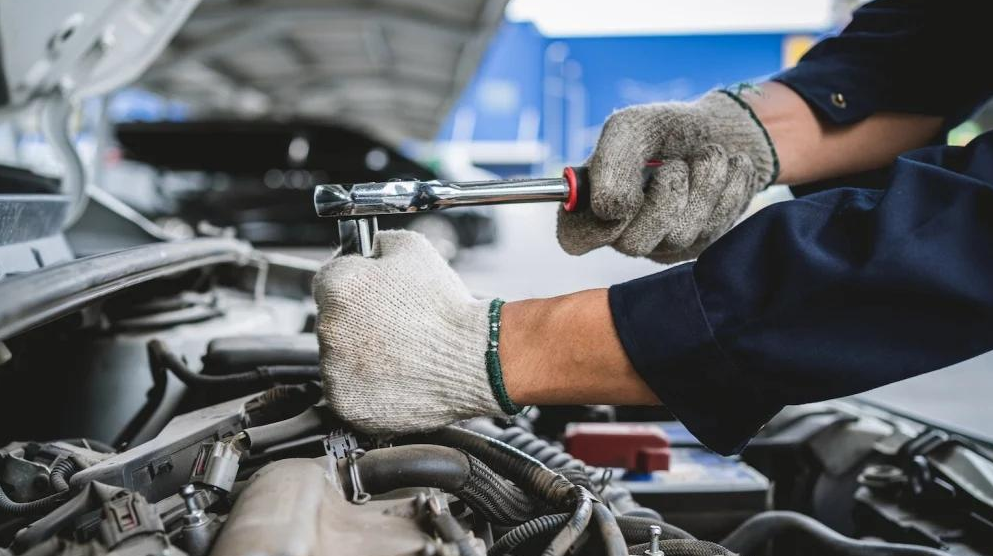
I popped the hood. The engine was immaculate—clearly maintained with care and probably significant expense. But she was right. The fuel line showed signs of blockage, the kind that comes from months of sitting idle in a garage.
“Do you have tools?” I asked.
She produced them from the trunk like a magician pulling rabbits from a hat. Not just any tools—quality ones. Professional grade. The kind I coveted in catalogs but couldn’t quite justify buying.
We worked together in a silence that felt oddly comfortable. She didn’t hover or ask nervous questions. Instead, she watched with keen attention, occasionally handing me what I needed before I asked for it. When I explained what I was doing, she nodded with understanding, asked precise questions that showed she actually comprehended the mechanics of what was happening beneath her car’s elegant hood.
Time did something strange out there on Route 9. The world narrowed to the engine, the problem, the solution. The evening air cooled. Traffic thinned to occasional headlights that swept past without slowing. My shirt—my new, carefully chosen shirt—acquired its first grease stain, then another. I loosened my tie. Forgot about it entirely.
“You’re good at this,” she observed at one point, her voice quiet but clear. “How long have you been a mechanic?”
“Ten years, professionally. Longer if you count helping my dad in his shop as a kid.” I adjusted a connection, tested it. “It’s not glamorous work, but I like it. I like taking broken things and making them whole again.”
“There’s more dignity in that than most people understand,” she said.
Something in her tone made me glance up. She was studying me with an expression I couldn’t quite read—assessing, but not judgmental. Curious, perhaps.
“You’re dressed awfully nice for car repair,” she noted. “Were you going somewhere important?”
I almost laughed. “I’m supposed to be meeting my girlfriend’s parents. First time. They already think I’m not good enough for her, and now I’m going to show up late and covered in grease. Perfect first impression.”
“Why do they think you’re not good enough?”
The question was direct, almost startling in its lack of pretense. I sat back on my heels, considering how to answer. “Her father’s a surgeon. Her mother used to be a corporate attorney. They live in a house with a circular driveway and actual oil paintings on the walls. Emma went to Yale. I went to technical school. They look at me and see someone who fixes things for a living, and they think that’s… less than.”
“And what do you think?”
“I think I love their daughter. I think I work hard. I think I’m honest and kind and I make her laugh. But I also think none of that matters if they convince her I’m not worth the trouble of defending.”
The woman was quiet for a moment, her gaze still steady on me. “People who measure worth by job titles and tax brackets rarely see value in anything they can’t quantify. But go. Don’t rush. Arrive as you are.”
Her words settled over me like a benediction, or maybe a challenge.
I turned back to the engine, made the final adjustments, and gestured for her to try the ignition. The Jaguar roared to life with a purr that sounded like satisfaction itself.
“Thank you,” she said, and there was genuine warmth in it. “You’ve saved my evening.”
“You might have saved mine,” I replied, though I wasn’t entirely sure what I meant.
She smiled—a small, knowing expression that suggested she understood something I didn’t. “Good luck tonight. Remember—character shows in how we handle the unexpected, not how well we perform the rehearsed.”
Then she was gone, the Jaguar’s taillights disappearing into the growing dark, and I was standing alone on the shoulder of Route 9 with grease on my hands and a strange sense that something significant had just occurred, though I couldn’t name what.
By the time I reached Emma’s parents’ house, full night had fallen. The neighborhood was the kind where streetlights were decorative rather than necessary, where every lawn looked professionally maintained, where the houses seemed to glow from within with the kind of warm, expensive lighting that spoke of permanence and prosperity.
The Hastings house sat at the end of a cul-de-sac, three stories of colonial architecture with columns flanking the entrance and a garden that probably required a team of landscapers. I pulled my truck—my very ordinary, very used truck—into the circular driveway and killed the engine.
In the rearview mirror, I looked like exactly what they expected me to be. Rumpled. Stained. Late. The product of poor planning and questionable priorities.
I considered leaving. I could text Emma some excuse. I could reschedule, try again another time when I hadn’t stopped to help a stranger and destroyed my carefully constructed image before I’d even walked through the door.
But something about the woman’s words—arrive as you are—stopped me.
I got out of the truck. I rang the bell.
Emma answered, her face flooding with relief that immediately shifted to concern as she took in my appearance. “Oh God, what happened?”
“Car trouble,” I said quietly. “Not mine. I stopped to help someone.”
Behind her, I could see into the house—hardwood floors, crystal chandelier, the kind of formal dining room that probably only got used for occasions like this. Emma’s mother appeared in the hallway, her expression doing an impressive job of hiding what she must have thought seeing me like this.
“You must be Ethan,” she said, extending a hand that felt delicate and cool in mine. “I’m Patricia. Please, come in.”
Emma’s father materialized next, tall and silver-haired, his handshake firmer, more evaluative. “Richard Hastings. We were beginning to worry something had happened.”
“Something did,” I admitted. “I stopped to help someone with car trouble. I apologize for my appearance and for being late.”
Richard’s eyes moved over me, cataloging every grease stain, every wrinkle. I watched him file me away in whatever mental category he’d already constructed. Unreliable. Unprofessional. Not suitable.
“How thoughtful,” Patricia said in a tone that suggested it was anything but. “Well, you’re here now. Dinner is nearly ready.”
The dining room was exactly as intimidating as I’d imagined. A table that could seat twelve, currently set for five. China that probably cost more than my monthly rent. Three different forks per setting, which I’d prepared for but still found ridiculous. Emma squeezed my hand under the table as we sat, her eyes apologetic.
The fifth setting, I noticed, remained empty. “Is someone else joining us?” I asked.
“My mother,” Richard said, checking his watch with barely concealed annoyance. “She’s running late, apparently. Nothing new there.”
The meal began with painful politeness. Patricia asked about my drive. Richard asked about my work. Both questions felt like traps disguised as conversation.
“I own a small auto repair shop,” I explained. “We specialize in older vehicles, classic cars, things that require more hands-on work than modern computerized systems.”
“How interesting,” Patricia said in a tone that meant the opposite. “And is that sustainable? As a business, I mean. It seems like such a specialized market.”
“It is. But there are enough enthusiasts who prefer quality restoration work to make it viable. We do well.”
“For now,” Richard added, as if he couldn’t help himself. “But long-term, as the market shifts toward electric vehicles, autonomous systems… don’t you worry about obsolescence?”
Emma’s grip on my knee tightened. I took a breath.
“Every industry evolves,” I said carefully. “Good mechanics learn to evolve with it. But there will always be old cars that need care, people who prefer the analog to the digital. I’m not worried about obsolescence as much as I’m committed to excellence in what I do.”
Richard made a noncommittal sound, cutting into his salmon with surgical precision.
The conversation limped forward. Patricia asked about my family—both parents gone, just a sister in Portland I didn’t see often enough. Richard asked about my education—technical school, apprenticeship, no degree. Each answer felt like I was confirming their worst assumptions.
Emma tried valiantly to redirect, talking about a gallery opening we’d attended, a weekend trip we’d taken, anything to show them we were good together. But her parents’ politeness never warmed. They were performing tolerance while waiting for me to fail completely.
Then headlights swept across the dining room wall.
An engine sound I recognized—smooth, powerful, distinctly vintage—purred outside the house.
Everyone looked up as a car door closed. Footsteps on the walkway. The doorbell chimed, and Richard frowned, checking his watch again.
“Finally,” he muttered, rising from his seat.
The front door opened. Voices in the hallway—Richard’s surprised, someone else’s calm and familiar.
And then the woman from Route 9 stepped into the dining room.
She’d changed clothes but was unmistakably the same person. Same silver hair, same composed bearing, same assessing eyes that now landed on me with something that might have been satisfaction.
“I apologize for being late,” she said, surveying the table. “There was traffic. And car trouble, briefly, but a kind stranger helped me fix it.”
Emma’s father stood so fast his chair scraped against the hardwood floor.
“Margaret,” he breathed, and I heard something in his voice I hadn’t heard before—respect, maybe even nervousness.
“Richard,” she replied warmly, moving to kiss his cheek. Then Patricia, with genuine affection. Then Emma, with obvious delight. “Grandmother! I didn’t know you were coming tonight!”
Grandmother.
My brain struggled to process the information. The woman I’d helped on Route 9 was Richard Hastings’ mother. Emma’s grandmother. The matriarch of the family whose good opinion I’d been so desperate to earn.
And I’d met her covered in grease on the side of a highway.
Her eyes found mine across the table, and there was something dancing in them—amusement, approval, perhaps a touch of mischief.
“And you must be Ethan,” she said, extending her hand. “Margaret Hastings. I’ve heard so much about you.”
I stood automatically, shaking her hand, speechless.
“Actually,” she continued, addressing the table but keeping her eyes on me, “we’ve already met. Ethan is the kind stranger who helped me with my car trouble this evening. The Jaguar’s fuel line clogged again. I was stranded on Route 9, and Ethan stopped, got his hands dirty, and had me running again in under an hour.”
The silence that followed was profound.
Richard and Patricia exchanged glances, recalculating something in real-time.
“That explains your appearance,” Patricia said slowly, and for the first time, her tone held something other than disdain. Confusion, perhaps. Uncertainty.
“He was on his way here,” Margaret continued, settling into the empty chair with the ease of someone entirely comfortable in her own authority. “Late for this dinner, meeting you all for the first time, and he stopped anyway. Didn’t hesitate. Didn’t complain about ruining his nice shirt or losing time. Just saw someone who needed help and provided it.”
She smiled at me, that same knowing expression from earlier. “And he knew his way around that engine. Diagnosed the problem immediately, explained every step he was taking. It’s rare to find someone who truly understands the old machines, who respects them.”
“Mother, you could have called a service,” Richard said, but his voice had lost its edge.
“I could have,” Margaret agreed. “But then I wouldn’t have met Ethan. And I wouldn’t have the perfect story to tell about character revealing itself in unexpected moments.”
Emma was staring at me, then at her grandmother, then back at me, a smile breaking across her face like sunrise.
“You stopped to help my grandmother,” she said. “You were already late, you knew how important tonight was, and you still stopped.”
“I couldn’t just drive past someone who needed help,” I said simply. “It’s not… I couldn’t do that.”
Margaret raised her wine glass slightly in my direction. “That’s exactly my point. Now, Richard, Patricia, shall we start this dinner over? I believe we’ve all gotten off on the wrong foot, and I’d very much like to hear more about Ethan’s work. That Jaguar runs better now than it has in months.”
The rest of the evening unfolded like a different story entirely. With Margaret there, the tone shifted. She asked about my shop with genuine interest, laughing when I described my more difficult customers, nodding seriously when I explained my approach to restoration work.
“There’s an art to it,” she said. “Preserving the original character while ensuring modern reliability. It requires patience and respect for history. Those aren’t common qualities.”
Richard, I noticed, watched his mother carefully. When she praised something, he paid attention. When she laughed at my stories about learning the trade from my father, his expression softened incrementally.
Patricia asked, with what seemed like actual curiosity, about the kinds of cars I worked on. I told her about a 1967 Mustang I’d recently restored, and Margaret’s eyes lit up.
“I had one of those,” she said. “Drove it until Richard here convinced me it was ‘unsafe’ and ‘impractical.'”
“It leaked oil in the driveway,” Richard protested.
“Character,” Margaret countered, winking at me. “It had character.”
By the time dessert arrived, something fundamental had shifted. Richard asked about the business aspects of running my shop—not condescendingly, but as if he were genuinely interested in understanding. Patricia mentioned a friend whose son was looking for a good mechanic for his vintage Mercedes.
Emma’s hand stayed in mine under the table, her thumb tracing gentle circles on my palm.
As coffee was served, Margaret leaned back in her chair with the satisfied expression of someone who’d orchestrated exactly the outcome she’d intended.
“You know,” she said, addressing her son and daughter-in-law directly, “when Emma first told me about Ethan, I was curious. She spoke about him differently than she’d spoken about anyone else. With certainty. With joy. But I wanted to see for myself what kind of man had captured my granddaughter’s heart.”
She turned to me. “So when my car trouble became apparent this afternoon, and I knew I’d be late, I decided to take the old highway route instead of the interstate. I thought, if he’s the man Emma believes he is, he’ll stop. He’ll help. He’ll prioritize character over convenience.”
“Mother,” Richard said slowly, “are you saying you arranged this?”
“I’m saying I created an opportunity for character to reveal itself,” Margaret replied serenely. “And Ethan passed with flying colors. He was late to the most important dinner of his life, and he stopped anyway. He ruined his carefully chosen outfit, and he didn’t complain. He treated me with respect, treated my car with expertise, and when I asked him about you both, he spoke with honesty, not flattery.”
She looked at Richard and Patricia with the gentle firmness of a woman accustomed to being heard. “This young man stopped to help a stranger at personal cost because it was the right thing to do. That tells me everything I need to know about his character. The question is, does it tell you?”
The silence that followed felt weighted with possibility.
Richard cleared his throat. Patricia looked down at her coffee. Then, slowly, Richard extended his hand across the table toward me.
“I apologize,” he said quietly. “I’ve been… judgmental. Unfairly so. Anyone who would stop to help my mother, who makes my daughter as happy as she clearly is… perhaps I’ve been measuring worth with the wrong instruments.”
I shook his hand, feeling the knot in my chest finally begin to loosen.
Patricia smiled—a real smile this time, reaching her eyes. “Emma speaks very highly of you. We should have trusted her judgment from the beginning.”
“And my Jaguar has never run better,” Margaret added cheerfully. “So I’d say tonight worked out rather well for everyone.”
Emma leaned into my shoulder, her whisper warm against my ear. “I can’t believe you met my grandmother on the side of the road.”
“I can’t believe she set the whole thing up,” I whispered back.
“She’s extraordinary,” Emma said. “Wait until you really get to know her.”
As the evening wound down, Margaret pulled me aside while Emma helped her mother clear the table.
“Thank you,” she said simply. “Not just for fixing my car, but for being exactly who Emma said you were. That girl has excellent judgment, but parents sometimes need proof they can see with their own eyes.”
“Did you really plan the whole thing?” I asked.
Her smile was enigmatic. “Let’s say I created conditions for truth to emerge. The rest was up to you. You could have driven past. Many people would have.”
“I couldn’t,” I said honestly.
“I know. That’s why you’re right for our Emma. That’s why, despite your current appearance and social standing, you’re one of the good ones.” She patted my arm. “Character, Ethan. It matters more than anything else. Don’t let anyone convince you otherwise.”
The evening ended with warmth I hadn’t dared hope for. Richard shook my hand again at the door, mentioning something about golf next month if I was interested. Patricia kissed Emma’s cheek and told her she’d been right all along. Margaret winked at me and drove away in her perfectly purring Jaguar.
Emma and I stood on the front steps after everyone had gone inside, the night air cool and clean around us.
“So,” she said, grinning up at me. “How do you think it went?”
I looked down at my ruined shirt, my grease-stained hands, the evening that had gone so differently than planned. I thought about the woman on Route 9, about the strange blessing of getting lost and then found in the same night, about proving yourself when you aren’t trying to prove anything at all.
“I think,” I said, pulling Emma close, “that your grandmother is terrifying and wonderful, and I think I just learned something important about showing up as yourself instead of who you think people want you to be.”
“And what’s that?”
“That the right people will see you for who you actually are, grease stains and all. And the wrong people never will, no matter how perfect your performance.”
She kissed me there on her parents’ front steps, under the warm glow of their porch light, and I tasted like coffee and relief and the beginning of something that finally, finally felt possible.
Three months later, I worked on Margaret’s Jaguar again—this time in my shop, with Emma watching from a stool in the corner, and Richard stopping by to see the restoration work I was doing on a client’s vintage Porsche. He asked questions, good ones, and listened to my answers with what seemed like genuine respect.
Patricia had already referred two of her friends to my shop. Emma had a key to my apartment. And Margaret called every Sunday to ask if I’d stopped to help anyone interesting on the highway lately.
Life, it turned out, had a way of working out when you stopped trying to be someone else’s version of acceptable and started being exactly who you already were—grease stains, late arrivals, and all.
THE END

Lila Hart is a dedicated Digital Archivist and Research Specialist with a keen eye for preserving and curating meaningful content. At TheArchivists, she specializes in organizing and managing digital archives, ensuring that valuable stories and historical moments are accessible for generations to come.
Lila earned her degree in History and Archival Studies from the University of Edinburgh, where she cultivated her passion for documenting the past and preserving cultural heritage. Her expertise lies in combining traditional archival techniques with modern digital tools, allowing her to create comprehensive and engaging collections that resonate with audiences worldwide.
At TheArchivists, Lila is known for her meticulous attention to detail and her ability to uncover hidden gems within extensive archives. Her work is praised for its depth, authenticity, and contribution to the preservation of knowledge in the digital age.
Driven by a commitment to preserving stories that matter, Lila is passionate about exploring the intersection of history and technology. Her goal is to ensure that every piece of content she handles reflects the richness of human experiences and remains a source of inspiration for years to come.