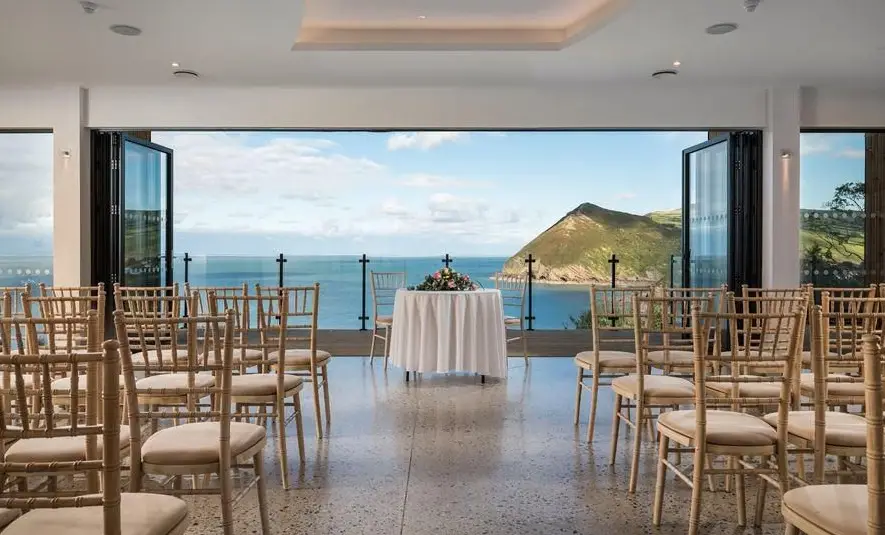
The Wedding at Rosecliffe Estate
The wedding planner’s heels clicked against the marble floor with a rhythm that felt like a countdown. I followed her through the ballroom, my hand instinctively smoothing the navy fabric of my dress—the one I’d finally found after searching through boutique after boutique, each one more expensive than the last. The orchestra played something classical and refined, the kind of music that whispered wealth in every note.
We walked past table after table of guests who belonged here, who fit seamlessly into this world of crystal chandeliers and champagne towers. I didn’t recognize most of them. Colleagues from William’s firm, Veronica’s society friends, people whose names appeared in the social columns of newspapers I’d never thought to read.
The planner’s smile never wavered as we moved deeper into the ballroom, past the beautifully dressed tables with their towering centerpieces, past the guests who barely glanced our way. My stomach began to tighten with each step, a growing awareness that we weren’t heading toward the family section.
We weren’t heading toward anywhere that mattered.
She stopped beside the kitchen doors—those swinging double doors that servers rushed through with loaded trays and harried expressions. The table she gestured toward was small, tucked behind an enormous arrangement of hydrangeas that blocked the view of almost everything except the kitchen entrance.
“This is your seat, Mrs. Clark,” she said with practiced cheerfulness.
My place card sat at the edge of the table, my name written in the same elegant calligraphy as everyone else’s. But the names surrounding mine were strangers. I recognized none of them. Later, I would learn they were vendors’ family members, distant acquaintances of Veronica’s parents, people invited out of obligation rather than affection.
A server backed through the kitchen doors, his tray loaded with appetizers, and bumped against my chair without a word of apology. He probably didn’t even notice me.
I sat down slowly, arranging my purse on my lap, and allowed myself one long look across the ballroom.
There, at the head table beneath a chandelier that looked like it cost more than my house in Savannah, sat my son. William looked magnificent in his tuxedo, every inch the successful attorney he’d become. His hand was wrapped around Veronica Bennett’s—his new wife, radiant in a gown that had required three fittings and a designer I’d never heard of.
The light hit them perfectly, as if someone had staged it. Which, knowing Veronica, someone probably had.
William didn’t look toward my corner once during the toasts. Not when his best man spoke about his journey from small-town Georgia to Newport society. Not when Veronica’s father welcomed him into the Bennett family with the kind of speech that suggested ownership rather than kinship. Not even during the moment when the officiant had asked the mothers to stand for recognition.
I had stood, alone in my corner by the kitchen, while Veronica’s mother rose at the head table to gracious applause.
My name is Martha Clark. I’m sixty-seven years old, a retired literature professor from Savannah, Georgia. I spent thirty years teaching young people about the subtext in novels, the hidden meanings in poetry, the way authors use silence as powerfully as words. I should have recognized the symbolism of my seating arrangement immediately.
But mothers have a remarkable capacity for denial when it comes to their children.
Three days before the wedding, William had called me. I was in my garden, pruning the roses that climbed the fence of my small Victorian house—the house where William grew up, where I’d raised him alone after his father left when he was four.
“Mama?” His voice carried that particular tone I’d learned to recognize over the years. Gentle, slightly embarrassed, apologetic before he’d even asked for anything.
“Yes, sweetheart?”
“I hate to ask this, but there’s been a complication with the honeymoon package.”
I set down my pruning shears, already knowing where this conversation was heading. “What kind of complication?”
“The resort in Bora Bora—the overwater bungalows Veronica has her heart set on—they need the full payment by Friday to hold the reservation. And with the wedding expenses, we’re a bit stretched at the moment.”
A bit stretched. William made over three hundred thousand dollars a year at his law firm. Veronica came from a family whose name appeared on hospital wings and university buildings. But somehow, they were stretched.
“How much?” I asked.
The number he gave me made my hands go cold. It was more than I’d spent on two years of college tuition when William was in school. More than I’d paid for my car. Nearly as much as a year of my retirement income.
But he was my son. My only child. And old habits—the habit of sacrificing, of making sure he had what he needed, of being the safety net beneath his ambitions—die harder than they should.
“I’ll handle it,” I said quietly.
“Mama, you’re amazing. I knew I could count on you. Veronica will be so relieved.”
Would she? I wondered if Veronica even knew who was paying for her dream honeymoon. But I didn’t ask. I transferred the money that afternoon, watching my retirement account balance drop by a sum that made my financial advisor send me three concerned emails.
I handled it quietly, the way I always had. The way William expected me to.
Now, sitting at my small table by the kitchen doors, I watched servers rush past with plates of food I couldn’t afford to order in a restaurant. The entrée they placed before me looked beautiful—some kind of sea bass with microgreens arranged like art—but my throat felt too tight to swallow.
The smell from the kitchen—garlic, butter, the sharp scent of something burning that was quickly corrected—began to cling to my dress. That navy dress I’d searched so hard for, trying to find something elegant enough for Newport but not so expensive that I’d spend another month eating ramen to compensate.
At the head table, Veronica laughed at something William said, her hand on his arm, her diamond bracelet catching the light. That bracelet had been a wedding gift from the Bennetts—three generations of family diamonds reset in a modern design. I’d given William his grandmother’s simple gold band for the ceremony. I never saw him wear it.
A woman beside me—someone’s aunt, I think—leaned over with a sympathetic smile. “First wedding?” she asked.
I looked at her, confused. “I’m sorry?”
“William’s first wedding. I heard it was beautiful. Small ceremony in Savannah, very intimate. All family and close friends. Veronica mentioned it was lovely.”
My chest tightened. William’s first wedding. To Sarah, his college sweetheart. It had been in our backyard, under the magnolia tree that had shaded our house for decades. Twenty-five people, a minister who’d known William since he was a boy, homemade cake, and laughter that lasted until the fireflies came out.
I remembered William searching for me that day, wanting me beside him for every moment. Remembered him dancing with me in the grass, telling me he’d never stop needing his mama, no matter how old he got.
“Yes,” I managed. “It was warm. Simple.”
The woman nodded knowingly. “Well, this is certainly grand. The Bennetts do everything beautifully, don’t they?”
Beautifully. Yes. Everything arranged with precision and taste. Everything perfect. Except for the mother of the groom, tucked away near the kitchen like an embarrassing relic from a past they’d rather not acknowledge.
I excused myself during the salad course, murmuring something about needing air. No one at my table seemed to notice.
The terrace stretched along the back of Rosecliffe Estate, overlooking the Atlantic. The wind hit me immediately—sharp, cold, carrying salt and the promise of storms. I gripped the stone balustrade and let myself breathe deeply for the first time in hours.
The waves rolled in with a rhythm that felt ancient and indifferent, crashing against rocks that had withstood centuries of storms. The sound drowned out the orchestra, the laughter, the clinking of glasses that celebrated a union I was apparently meant to fund but not witness up close.
I thought about my teaching career. Thirty years of helping young people understand that characters in novels make choices, and those choices reveal who they really are. Not who they say they are, not who they pretend to be, but who they actually are when faced with decisions.
What did William’s choices say about him? What did my choices say about me?
“Mama?”
I turned to find William standing in the doorway, his tuxedo jacket unbuttoned, his face carrying an expression I knew too well. Not remorse. Not apology. Urgency.
“You left your table,” he said, as if I’d abandoned some important post.
“I needed air.”
He stepped onto the terrace, glancing back toward the ballroom where Veronica was visible through the glass, watching us with the kind of attention that suggested she’d sent him to find me.
“I’m glad I caught you,” William said. “There’s something I need to discuss.”
Of course there was. William only sought me out these days when he needed something.
“A complication has come up with the honeymoon transfer,” he continued. “The resort needs final confirmation on the villa upgrade tonight. It’s just a formality, but they need authorization from the account holder. I can send you the details right now—you just need to approve it through the app.”
I stared at my son. At his perfectly styled hair, his designer tuxedo, his face that had learned to arrange itself into expressions of entitlement that he probably didn’t even recognize anymore.
“The villa upgrade,” I repeated slowly.
“It’s included in the package,” he said quickly. “Well, mostly included. There’s a small additional fee, but it’s nothing compared to what you’ve already—” He stopped himself, but not quickly enough.
“Compared to what I’ve already spent?”
William had the grace to look uncomfortable. “That’s not what I meant.”
“What did you mean?”
He shifted his weight, suddenly looking younger. For a moment, I saw the boy who used to climb into my lap with scraped knees and hurt feelings, who trusted me to make everything better.
But that moment passed quickly.
“Mama, I don’t have time for this right now. It’s my wedding day. Can you please just approve the transfer so I can get back to my guests?”
His guests. Not our guests. His.
I looked at my son’s smooth, confident face—the face that had learned to move through Veronica’s world with ease, that had somehow forgotten the world he came from—and asked the question that had been building in my chest all evening.
“Do the Bennetts know who paid for this honeymoon, William?”
His expression cracked. Just for a second, but I saw it. The flash of guilt, the awareness of something shameful.
“That’s not relevant,” he said finally.
“It’s extremely relevant.”
“Mama, the financial arrangements are complicated. Veronica’s family covered the wedding, and I—we—I told them I was handling the honeymoon. Which I am. I’m handling it.”
“By asking your retired mother who lives on a fixed income to spend nearly six figures?”
William flinched at the number said aloud. “You offered,” he said quietly.
“You asked.”
“You could have said no.”
Could I have? I wondered if that was true. I wondered how many times over the past thirty years I’d said yes when I wanted to say no, given money when I didn’t have it to spare, sacrificed my own needs for his wants because that’s what mothers do.
Except at some point, it stops being sacrifice and starts being expected. Assumed. Taken for granted.
My purse buzzed against my side. I pulled out my phone and saw the notification from William. He’d already sent me the authorization form, the account details, the confirmation button. Sent it during our conversation, assuming my agreement was automatic.
Assuming I existed to solve his problems, to fund his life, to be the invisible support system that kept him comfortable while he pretended to be self-made.
“I need to think about this,” I said.
William’s face hardened. “There’s nothing to think about. Either you approve it tonight or they give the villa to someone else. It’s non-refundable, Mama. The money’s already spent.”
“Then you’ll have a lovely honeymoon in a regular room instead of an upgraded villa.”
“You’re being unreasonable.”
I almost laughed. Unreasonable. After funding his education, his first car, his bar exam fees, the down payment on his condo before he met Veronica, the engagement ring when his savings fell short, and now this honeymoon. After being seated by the kitchen at his wedding like a stranger.
“Did you choose where I sat?” I asked suddenly.
William looked away. “The seating arrangements were complicated. Veronica’s mother handled most of it.”
“But you knew where they put me.”
His silence was answer enough.
Through the glass doors, I could see Veronica making her way toward us. She moved through the ballroom like a ship in full sail, gracious and commanding, her dress trailing behind her like a statement of victory.
“Your wife is coming,” I said.
“Mama, please. Just approve the transfer. We can talk about everything else later.”
Later. There was always a later with William these days. Later became never, and never became forgotten, and forgotten became the status quo.
I thought about the document in my writing desk back home in Savannah. The desk Veronica had called “outdated” during her only visit to my house, suggesting I might donate it to make room for something more contemporary.
That desk had belonged to my grandmother, then my mother, then me. In its lower drawer, hidden beneath old manuscripts and teaching notes, was the revised will I’d drawn up six months ago when I’d begun to see the pattern of William’s requests clearly.
My retirement account was nearly depleted. My savings had dwindled. But I still had the house—that Victorian in Savannah worth three times what I’d paid for it thirty years ago. I’d always assumed it would go to William, that he’d keep it in the family, maybe bring his own children to visit their grandmother’s garden.
But six months ago, after the fourth emergency request for money, after the third cancellation of a visit because something more important came up, after William forgot my birthday for the second year in a row, I’d made changes.
I’d left the house to the university. They’d promised to use it as a residence for visiting writers, a place where artists could create without worrying about rent, where creativity mattered more than wealth.
William didn’t know. I’d never told him. There had never been a right time to mention that his inheritance had been redirected to strangers who would appreciate what I’d built.
Veronica reached us, her smile bright and cold. “Martha, darling, you’re missing the party.”
Darling. She’d never called me that before. Only when she wanted something.
“William was just telling me about the villa situation,” I said.
Her smile didn’t waver, but something in her eyes sharpened. “Oh, that silly resort complication. So annoying when these luxury places have ridiculous policies. But I’m sure you don’t mind helping us sort it out.”
She said it so confidently. So certain of her power, her position, her right to expect things from people she’d barely bothered to know.
“Actually,” I said slowly, “I do mind.”
Both of them stared at me.
“Mama—” William started.
“I mind being seated by the kitchen. I mind being treated like a vendor instead of family. I mind that neither of you thought to mention where I’d be sitting, or whether I’d be in any of the family photos, or if anyone at this wedding besides your ex-wife’s aunt would even know who I am.”
Veronica’s face went very still. “We seated people according to their comfort level. We thought you’d prefer somewhere quiet.”
“By the kitchen?”
“By the terrace access,” she corrected smoothly. “You always say you love ocean views.”
The lie was so polished it almost sounded true.
“And the honeymoon?” I asked. “Did you think I’d be comfortable quietly funding your dream vacation while you tell everyone that William handled it?”
Veronica’s expression flickered—just for a moment—with something that might have been respect. Then it hardened into something else.
“I think you’re overwrought,” she said carefully. “Weddings are emotional. Why don’t you go back inside, have some champagne, and we can discuss this rationally tomorrow.”
Rationally. As if my objection to being used was irrational.
I looked at my son, standing beside his new wife, and saw him clearly for perhaps the first time in years. Saw the man he’d become—someone who’d learned that money could solve problems, that other people existed to smooth his path, that his mother’s love meant unlimited access to her resources without requiring anything in return.
I’d taught him that. Through years of saying yes when I should have said no, of sacrificing when I should have set boundaries, of loving him so much that I forgot to require him to love me back with actions instead of just words.
“No,” I said simply.
“No?” William repeated, as if the word were foreign.
“No, I won’t approve the transfer. No, I won’t be manipulated into funding more of your life while being treated as disposable. No, I won’t pretend this is acceptable.”
Veronica’s mask slipped entirely. “You’re making a scene at our wedding.”
“Am I? From where I’m standing, by the kitchen, I don’t think anyone can even see us.”
“Mama, be reasonable,” William pleaded. “Don’t ruin this for us.”
Ruin it. As if my refusal to be used was somehow destructive. As if I owed him my financial stability as a wedding gift.
“I think I’m going to leave,” I said. “I have a long drive back to Savannah.”
“You’re leaving?” William’s voice rose. “In the middle of the wedding?”
“I was never really here, William. That was made clear by where you seated me.”
I moved toward the door, but William caught my arm. “Mama, wait. Please. I’m sorry about the seating. I’m sorry I haven’t been more present. But you can’t just leave like this.”
“Why not?”
He struggled for an answer, and I could see him realizing that he had no good reason beyond expectation and habit.
“Because I love you,” he said finally.
The words should have meant something. They should have softened me, broken through my resolve. But they felt hollow, like something he’d said because it was the right line for the moment rather than something he felt in his bones.
“I love you too,” I said. “But love isn’t supposed to be one-sided. Love isn’t about what I can give you. It’s about respect, consideration, basic human kindness.”
Veronica made a sound of disgust. “This is ridiculous. You’re going to regret this, Martha. When you’re alone in that shabby house, don’t come crying to us for attention.”
I looked at her—this woman my son had chosen, who somehow brought out the worst in him or perhaps just revealed what had always been there—and smiled.
“I won’t,” I said simply.
I walked back through the ballroom, past the tables full of people who belonged in this world of wealth and appearance. Some of them glanced at me—the older woman in the navy dress who didn’t quite fit—but most didn’t notice.
At my table by the kitchen, I collected my purse and the small clutch I’d brought with me. The woman who’d mentioned William’s first wedding looked up sympathetically.
“Leaving early?” she asked.
“Yes. I’ve been here long enough.”
She nodded knowingly, as if she understood something I hadn’t said. Maybe she did. Maybe she’d been in my position once, treated as peripheral by people who should have cherished her.
I walked out of Rosecliffe Estate into the cold November night. The wind had picked up, carrying the promise of rain. My rental car sat in the far corner of the lot—not valet parking, I’d been told those spots were reserved for primary guests.
I sat in the driver’s seat for a long moment, my hands shaking on the steering wheel. Then I opened my phone and declined William’s transfer request. Added a note: “This is the last time I say no when I should have said it years ago.”
Then I called my attorney and asked her to send William a copy of my revised will. He should know, I decided. He should know that his choices had consequences, that treating people as resources eventually meant losing access to those resources.
The drive back to Savannah took fourteen hours. I stopped twice, once for gas and once at a small diner in South Carolina where the waitress called me “hon” and brought me coffee without asking if I wanted it.
I reached my house just as the sun was rising over the magnolia tree in my backyard. The Victorian looked tired but dignified, its purple trim faded but still beautiful in the early light.
Inside, everything smelled like home. Like books and tea and the lavender sachets I kept in every drawer. Like the life I’d built, small but mine, full of meaning if not money.
I made coffee and sat at my grandmother’s writing desk—the outdated one—and pulled out the manuscript I’d been working on for two years. A memoir about teaching, about the lessons we learn from our students and the ones we fail to learn from our own lives.
I added a new chapter title: “The Seating Arrangement.”
My phone rang throughout the day. William called seven times. Veronica called twice. I didn’t answer.
Finally, a text message from William: “We need to talk about your will.”
So he’d received it. Good.
I wrote back: “There’s nothing to talk about. It’s my house, my decision.”
His response came quickly: “You’re being vindictive.”
Was I? Maybe. Or maybe I was finally being clear about what I valued—people who wrote books instead of people who wrote off their mothers. Community instead of status. Generosity of spirit instead of expectation of generosity.
Three weeks later, I received a letter in the mail. Formal, typed, from a law office in Newport. Veronica and William were requesting that I reconsider my will, citing their “reasonable expectation” of inheritance and the “emotional distress” my decision was causing.
I showed it to my attorney, who laughed until tears ran down her face.
“They can’t sue you for not leaving them your house,” she said. “They’re just trying to intimidate you.”
“Is it working?” I asked.
She looked at me over her reading glasses. “Is it?”
I thought about that wedding at Rosecliffe Estate. About sitting by the kitchen while my son celebrated his new life without me. About being asked for money while being denied dignity.
“No,” I said. “It’s not working.”
I wrote them back myself. No lawyer, no formal language. Just a simple letter explaining that my decision stood, that I hoped they had a lovely life together, and that if they ever wanted a relationship based on something other than my bank account, they knew where to find me.
I never heard from them again.
Years passed. I finished my memoir and found a small publisher who loved it. It sold modestly but meaningfully, mostly to other retired teachers who saw themselves in my stories. I volunteered at the local library, taught community writing classes, traveled to places I’d always wanted to see but never had the money for because I’d been funding someone else’s dreams.
I made new friends. Found joy in small things. Discovered that being alone wasn’t the same as being lonely, and that family was something you built through choice and respect rather than something you were stuck with through biology.
On my seventy-fifth birthday, I sat in my garden under the magnolia tree—the same tree where William had been married the first time—and felt something unexpected.
Peace.
Not happiness, exactly. There was still sadness for what could have been, grief for the relationship I’d hoped to have with my son. But underneath that, something steady and true: the knowledge that I’d finally chosen myself. That I’d stopped sacrificing my dignity for someone who didn’t value it.
That evening, as fireflies began to light up the garden, my phone rang. Unknown number.
I almost didn’t answer.
“Hello?”
“Mama?”
William’s voice, older now. Tired.
“Hello, William.”
A long silence. Then: “I’m sorry. For everything. For how I treated you. For choosing wealth over you. For not seeing what I had until it was gone.”
I closed my eyes, feeling the weight of those words. Too late, perhaps. But still something.
“Thank you for saying that.”
“Can I… could I come visit? Just to talk. Not to ask for anything. Just to try to understand who I became and how to be different.”
Could people change? I’d taught literature for thirty years, and the great novels always suggested they could. But it required choice, recognition, genuine transformation.
“Yes,” I said finally. “You can visit.”
He did, a month later. We sat in my garden and talked for hours. About his marriage, which was struggling under the weight of Veronica’s expectations. About his career, which felt empty despite his success. About the night of his wedding, when he’d watched me leave and realized something important had broken.
We didn’t fix everything in one conversation. That’s not how healing works. But it was a beginning. A small opening in a door that had been closed for too long.
I never changed my will. The house would still go to the university, would still become a haven for writers who needed space to create. But William and I found something more valuable than inheritance—we found a relationship based on honesty instead of obligation, respect instead of expectation.
Years later, when I finally passed on at eighty-three, surrounded by friends and students and the characters in books I loved, William gave the eulogy. He talked about the wedding in Newport, about the lesson I’d taught him by walking away, about the difference between love that enables and love that liberates.
“My mother taught me the hardest lesson a parent can teach,” he said. “She taught me that love doesn’t mean accepting whatever someone offers. It means requiring them to be their best selves, even when—especially when—it costs you something.”
The writing retreat in my Victorian house opened the following spring. They named it the Martha Clark House for Literary Arts. Young writers came and went, filling the rooms with creativity and hope, sitting at my grandmother’s “outdated” desk and producing work that mattered.
And sometimes, when the magnolia tree bloomed and the fireflies came out, I like to think my presence lingered there—not as a ghost, but as a reminder that the stories we tell about ourselves, the choices we make about who we are and what we’re worth, matter far more than the money we leave behind or the weddings we attend.
Sometimes the most important seat at the table is the one we choose to walk away from.
THE END

Lila Hart is a dedicated Digital Archivist and Research Specialist with a keen eye for preserving and curating meaningful content. At TheArchivists, she specializes in organizing and managing digital archives, ensuring that valuable stories and historical moments are accessible for generations to come.
Lila earned her degree in History and Archival Studies from the University of Edinburgh, where she cultivated her passion for documenting the past and preserving cultural heritage. Her expertise lies in combining traditional archival techniques with modern digital tools, allowing her to create comprehensive and engaging collections that resonate with audiences worldwide.
At TheArchivists, Lila is known for her meticulous attention to detail and her ability to uncover hidden gems within extensive archives. Her work is praised for its depth, authenticity, and contribution to the preservation of knowledge in the digital age.
Driven by a commitment to preserving stories that matter, Lila is passionate about exploring the intersection of history and technology. Her goal is to ensure that every piece of content she handles reflects the richness of human experiences and remains a source of inspiration for years to come.