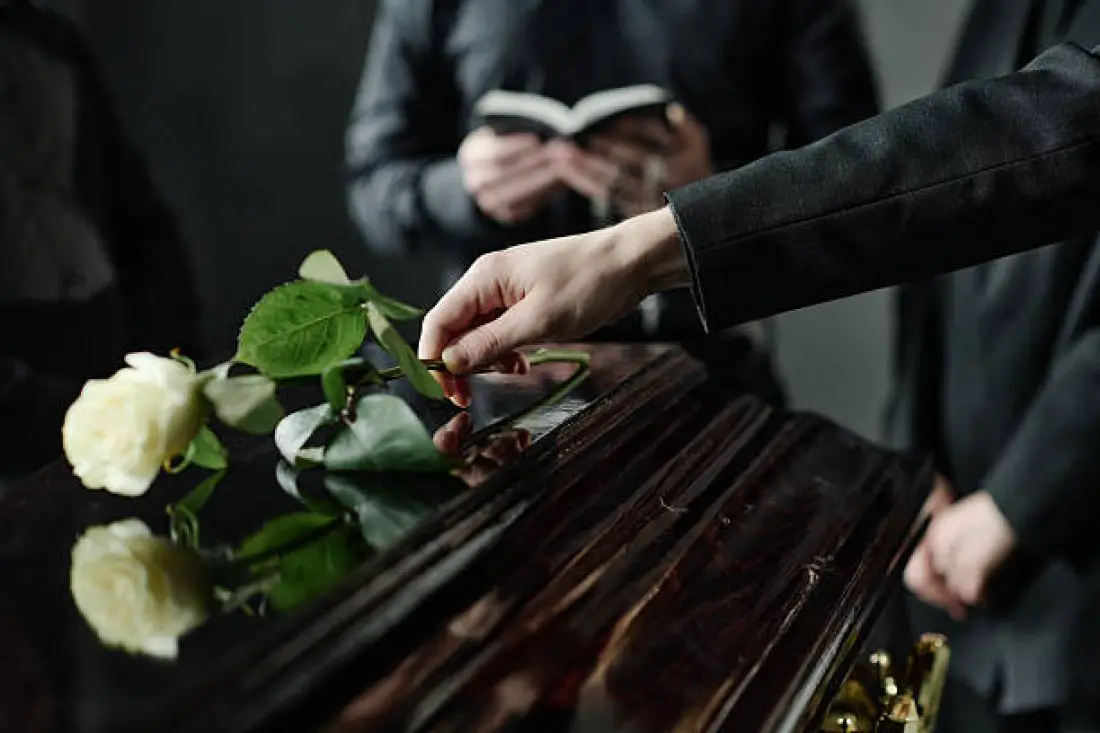
I stood at the chapel entrance clutching a wreath of white roses, my hands trembling not from the cold November air but from the weight of six months of guilt pressing against my chest. I hadn’t spoken to my mother in half a year—not a fight exactly, just a drifting silence that had calcified until neither of us knew how to break it. Now she was gone, and I’d never get another chance.
The call had come from a hospital administrator, not my family. “Denise Marlo, cardiac arrest, pronounced dead at 9:00 a.m.” The words felt too clinical, too small to contain the magnitude of losing your mother.
I’m Kinsley Roberts, thirty-eight years old, a senior forensic auditor for Harborgate Forensics in Richmond, Virginia. My job is finding the invisible bleed of money people think they’ve scrubbed clean—following the three-dollar coffee charge that brings down a CEO’s empire, tracking the hesitation in a handwritten signature, reading the silence where numbers should speak. I’m trained to spot anomalies instantly, to see patterns others miss.
But standing at that chapel door, I wasn’t an auditor. I was just a daughter who’d waited too long to call her mother back.
I reached for the heavy oak door handle, but it swung open from inside before I could turn it. Graham Kesler—my mother’s second husband—stepped out, flanked by his children Belle and Trent. They formed a wall of expensive black wool and barely concealed hostility.
Graham looked at me with dry, hard eyes. He didn’t look like a grieving widower. He looked like a bouncer at an exclusive club where my name wasn’t on the list.
“Kinsley,” he said flatly. “You shouldn’t be here.”
The words took a moment to process through the fog of grief. “What are you talking about? She’s my mother. Move.”
“She was your mother,” Belle corrected, her voice dripping with false sympathy. “But you lost that right months ago. You abandoned her.”
“I didn’t abandon anyone,” I said, heat climbing my neck. “We were both busy. Life happens. I’m here now. Let me in.”
Graham stepped closer, invading my space. He smelled of scotch and peppermint. “Denise gave specific instructions. She was heartbroken by your silence. She told us clearly that if anything happened to her, she didn’t want you parading your guilt at her funeral.”
He leaned in slightly, as if cruelty would land better at close range. “You’re not on the family list. You’re not welcome.”
My mind reeled. That sounded nothing like my mother. Denise was soft, forgiving to a fault. She would never ban her only daughter from her funeral. It was illogical—a deviation from thirty-eight years of baseline behavior.
“You’re lying,” I said, my voice trembling with cold rage. “Show me her written instructions. Show me proof.”
“This isn’t a deposition,” Graham snapped.
“Kinsley,” Trent sneered from behind his father, “it’s a funeral. Have some respect and leave.”
“I’m not leaving until I see her.”
Graham sighed theatrically and signaled to two men in tactical security uniforms standing in the shadows. “Escort Miss Roberts to her vehicle. Ensure she leaves.”
As the guards moved toward me, my phone buzzed. It was a reflex to check it—a habit from years of high-stakes auditing where a single notification could change everything.
The screen showed a calendar reminder from months ago when I’d synced my mother’s appointments to mine: “Wells Fargo—10:30 a.m. Today.”
My trained mind immediately overlaid this with the obituary I’d read that morning: “Denise Marlo passed peacefully in her sleep at 9:00 a.m. yesterday.”
But there was something else. I opened my banking app—I was still a co-signer on her emergency account. There was a pending transaction dated yesterday, timestamped 4:00 p.m.: witness-stamp fee, $15.
My heart stopped.
The death certificate said she died at 9:00 a.m. But seven hours later, someone used her debit card to pay for document authentication at a bank.
Dead women don’t authenticate paperwork.
“Wait,” I said, looking up at Graham. The tears were gone from my eyes, replaced by the cold clarity of an auditor spotting fraud. “Why did Mom have a witness-stamp transaction yesterday afternoon—seven hours after you said she died?”
Graham’s face went pale—a subtle tightening around his mouth, a flicker in his eyes. He knew. He didn’t know that I knew, but he knew there was a loose thread.
“You’re hysterical,” he hissed. “Get her out. Now.”
The guards grabbed my arms, their grip bruising. I struggled, digging my heels into concrete. “Let go of me! You’re hiding something, Graham. Why are you rushing the cremation? Why is the timeline wrong?”
“Drag her,” Graham spat, losing composure. “Throw her in the street if you have to.”
I was being hauled backward toward the parking lot, my heels scraping stone. The chapel doors slammed shut with a final booming thud, sealing secrets inside.
I screamed—raw and guttural—but I was alone with the guards, being dragged toward my rental car.
Then the sound cut through everything: the screech of tires. Not just one car—a convoy. Four black sedans tore into the church driveway with aggressive precision, swerving around the hearse and screeching to a halt directly in front of the chapel entrance.
The synchronized sound of doors opening was like the loading of weapons. Click. Clack.
The guards holding me froze, their grip loosening just enough for me to wrench free.
From the lead car, a driver in what looked like paramilitary dress stepped out and opened the rear passenger door. A leg emerged—a black heel, sharp and terrifyingly high. Then the rest of her followed.
The woman was tall, her posture erect as steel. She wore a black morning suit that looked like it cost more than the chapel itself. Her silver hair was cut in a sharp bob that framed a face of angles and ice. Even behind dark sunglasses, I felt the weight of her gaze.
I stopped breathing.
I knew that face. I’d seen it in newspapers, magazines, and nightmares. I’d seen it five years ago on the front page of the Wall Street Journal under the headline: “Billionaire matriarch Evelyn H. Hallstead perishes in helicopter crash off the Amalfi Coast.”
Evelyn Hallstead. My grandmother. The woman who’d disowned my mother twenty years ago for marrying a mechanic. The woman who was supposed to be dead.
She stood there adjusting her leather gloves, very much alive.
Graham and his children burst from the chapel doors, likely alerted by the commotion. They stopped dead on the steps. Graham’s mouth opened, but no sound came out.
Evelyn walked straight toward the chapel, her heels clicking with terrifying rhythm. She removed her sunglasses, revealing eyes the same storm-gray as mine.
“You buried an empty casket, Graham,” she said, her voice carrying like thunder though she didn’t raise it. “And now you’re trying to bury my daughter before the ink is dry on her death certificate.”
She glanced at me—brief, assessing, devoid of warmth but full of recognition. Then she looked back at Graham.
“Get out of my way. You have no authority here.”
Graham stammered, stepping back. “This is a private funeral. Denise is—”
“I am the authority,” Evelyn said with perfect clarity. “And I’m telling you once: Do not bury my daughter yet. I have not signed off on her death.”
She pushed past him into the chapel. The physical contact shocked everyone into silence.
I stood in the parking lot, my wrist throbbing where the guards had held me. My world had tilted. The mother I loved was dead. The grandmother I’d feared was alive. And the stepfather I despised was shaking.
I looked at my phone—at the bank notification, the impossible timeline, the numbers that didn’t add up. Evelyn had just bought me time. Now it was my turn to find out why those numbers were wrong.
I straightened my jacket and followed the dead woman into the church.
Inside the chapel’s vestry—a small wood-paneled room off the altar—Evelyn locked the door behind us with a definitive click. For just a second, her steel posture softened, revealing an eighty-year-old woman carrying tremendous weight.
“Grandmother,” I said, the word foreign on my tongue. “You’re supposed to be at the bottom of the Mediterranean.”
“And you’re supposed to be a forensic auditor,” she snapped, steel returning. “Stop staring at me like I’m a ghost and start thinking like a professional.”
“You faked your death. Why?”
“There was a hostile faction within my consortium,” Evelyn said, checking the window blinds. “Men who solve board disputes with car bombs. They wanted me out to strip the assets. Dying on paper was the only way to save the legacy and keep your mother safe.”
“You left us,” I said, anger flaring. “You let Mom believe she was an orphan.”
“I protected her. If they knew we were in contact, she would’ve been leverage.” Evelyn pulled a thick envelope from her bag and tossed it on the table. “But I came back because Denise called me three weeks ago. She sounded terrified. She just said: ‘Mother, if anything happens to me, don’t let them bury me too fast. Promise you’ll stop the clock.'”
A chill went down my spine. “She knew something was going to happen.”
“She suspected.” Evelyn leaned forward, eyes boring into mine. “Does it sound like the Denise you knew? The woman who documented everything? Being cremated within thirty-six hours with no autopsy?”
“No.”
“You’re not at a funeral, Kinsley. You’re standing in the middle of an asset transfer. They’re not saying goodbye—they’re disposing of evidence so they can unlock the vault.”
I pulled up my phone, showing her the bank transaction. “Mom had a witness-stamp appointment yesterday afternoon—hours after the death certificate says she died. The fee was paid.”
Evelyn nodded, unsurprised. She pulled a surveillance photo from the envelope—grainy black-and-white from a bank security camera. It showed a woman in my mother’s coat and sunglasses signing documents. Behind her stood a figure in a hoodie, hand on the chair back, wearing a distinctive chunky silver bracelet.
“That’s not Graham,” I said, studying the photo.
“No. And look at the timestamp: 4:15 yesterday afternoon. She was supposed to be dead.” Evelyn’s voice turned to iron. “Either the death paperwork is a lie, or that’s not your mother—or worse, your mother was alive yesterday afternoon, forced to sign, and then killed immediately after.”
I felt bile rise. “Graham has to be involved.”
“He’s involved, but he’s not smart enough to do this alone.” Evelyn grabbed my shoulders. “Listen carefully. I’ve stopped the cremation, but my legal hold is tenuous. I’m technically dead. We have forty-eight hours before Graham finds a judge to overturn my order.”
“What do I do?”
“Find out what really happened. You’re going to dig into the numbers, follow the paper trail Graham thinks he burned, and prove they killed my daughter.”
She released me, opening the door. “Go now. And Kinsley—don’t trust anyone. When a billion dollars is on the table, loyalty is just a line item in a budget.”
I walked past the shocked mourners and out into the humid Virginia air. I wasn’t just a daughter anymore. I was an auditor conducting the most important audit of my life.
The address Evelyn gave me belonged to a squat brick building in Richmond’s financial district—the kind that houses bail bondsmen and private investigators. Caleb Ror’s office was on the third floor, behind a door with peeling letters on frosted glass.
When I knocked and identified myself as Evelyn’s contact, the door cracked open to reveal a pale, anxious man in his late fifties. “Come in quickly,” Caleb Ror hissed, glancing past me before engaging three separate locks.
His dimly lit office smelled of stale coffee and fear. Papers were stacked everywhere.
“You shouldn’t have come,” he said, wiping his hands nervously. “It’s not safe.”
“My mother is dead. Safety isn’t my priority. Evelyn said you have answers.”
Caleb sank into his creaking chair. “Your mother hired me because she knew she couldn’t trust Graham’s lawyers. She was terrified, Kinsley. Paranoid. She made me install encrypted servers and buy burner phones.”
He pulled out a manila folder with shaking hands. “She told me that if she died under any circumstances that weren’t clearly natural—and I mean clearly, like a lightning strike in a public park—I was to file immediately for an independent autopsy.”
“She expected to be killed,” I said.
“She expected an accident. She told me specifically: ‘If I fall down the stairs, don’t believe it. If my heart stops, don’t believe it.'” His voice dropped. “She knew they’d make it look medical.”
He pulled out a silver USB drive. “But Denise was a fighter. She started photographing documents Graham brought home. She compiled a dossier—a shadow ledger showing how Graham and his partners are funneling money through shell companies. All the money eventually flows to one entity: Blue Hollow Freight.”
“Give me the drive,” I said, extending my hand.
He hesitated. “There’s a second file—audio. Denise recorded a conversation between Graham and a man named Miles. It’s damning.”
Just as he was about to hand it over, his phone buzzed. Caleb looked at the caller ID and went corpse-white. He silenced the ringer, staring at it like a bomb.
“Who is it?” I asked.
“We’re done,” he said abruptly, shoving the USB back in his pocket. He grabbed my arm and dragged me toward a side door. “You need to leave right now. You were never here.”
“Caleb, if they know I’m here, I’m already a target. The drive is safer with me.”
“They don’t know you’re here—but they know I’m here. They just signaled my time is up.” He shoved me through the door into a service corridor. “If you want to help your mother, stay alive.”
The door slammed and locked behind me.
I left through a side exit, checking constantly for surveillance. I had information about the shell companies and the recording, but no physical proof.
When I reached my car, I called Evelyn from a burner phone I’d picked up at a convenience store. Before she could respond, I asked: “Can you get someone to monitor Caleb’s building? I think he’s in danger.”
It was too late.
That night, watching the local news from a motel on the city’s outskirts, I saw the breaking story: downtown office building fire, massive blaze, law office on the third floor, early indications pointing to electrical failure.
It was Caleb’s building. The flames had consumed everything—every document, every deposition, every note my mother had written. The reporter grimly noted the office was occupied at the time, but rescue crews hadn’t been able to enter due to the intensity of the fire.
They hadn’t just burned the office. They’d burned the paper trail. And Caleb, who hadn’t given me the drive, was almost certainly dead.
I sat in that motel room staring at the television, feeling rage and grief and cold determination crystallize into something harder than diamond.
They thought burning the paper erased the problem. But they’d made a critical mistake: arson is a felony. They’d escalated from fraud to violence. And fire leaves traces that can be read by someone who knows how.
I called Evelyn. “The lawyer’s office is gone. But they just gave us a new crime scene.”
The next morning, I walked into Harborgate Forensics and logged into systems that could access corporate registries and financial databases unavailable to ordinary citizens. I started with Blue Hollow Freight.
The company was registered in Delaware—opaque by design—formed nine months ago. Nine months ago was when my mother had first mentioned feeling “foggy” during our calls, when Graham had started taking over household finances.
I pulled banking data from the emergency account I shared with my mother. There was a $5,000 payment to Apex Consulting for “advisory services.” I traced Apex—it was a shell with no website, no employees. It sent monthly payments to Meridian Logistics, which in turn sent eighty percent of its income directly to Blue Hollow Freight.
Classic layering—money flowing through pipes designed to scrub its origin. The amounts were specific: $9,000, $9,500, $9,800. Always under the $10,000 reporting threshold. This was structuring, the hallmark of someone who knew the law well enough to skate its edge.
A secure chat window appeared on my screen: “Cipher: The network is secure. Evelyn sends her regards. I’m your extraction team for data.”
Evelyn had promised resources. This was one of them—a cybersecurity expert who’d bypassed Harborgate’s firewalls to contact me.
“Cipher: Open the folder.”
A folder appeared on my desktop—my mother’s phone backup. Graham had wiped the physical device an hour after death, but he’d missed the cloud sync.
The photo gallery was gone—every picture of me, every memory before Graham, emotionally erased. But the banking apps remained untouched. They needed her alive digitally to access accounts and authenticate transfers.
Then I found the health data. My mother’s smartwatch had tracked her heart rate the day she died. The official story said she’d fallen down stairs at 9:00 a.m., and the trauma stopped her heart.
But the data told a different story. At 8:30, her heart rate spiked from seventy to one-fifty—panic or exertion. At 8:45, it became erratic—PVCs, arrhythmia. The pattern of a heart attack or drug interaction.
The accelerometer—the sensor detecting falls—didn’t register significant impact until 9:15.
She was in cardiac distress for thirty minutes before she fell. The fall didn’t cause the heart attack. The heart attack happened, and thirty minutes later her body was thrown down the stairs.
“You monsters,” I whispered, staring at the graph that showed my mother’s final moments.
My phone buzzed: “Cipher: You have a tail. Gray SUV, tracker planted on your car at the funeral. Leave now. Don’t go to your hotel. Safe house coordinates incoming.”
I grabbed my bag, pulled the hard drive from my tower—a fireable offense—and left through the service exit. I caught a cab, gave random directions to shake the tail, and eventually made it to the safe house where Evelyn was waiting.
She took one look at my face and knew. “You found it.”
I showed her the heart rate data. “They watched her suffer for thirty minutes, then staged the fall to cover the autopsy findings.”
Evelyn’s expression was terrifying—cold, hard rage. “I know. Cipher sent me the data.” She handed me a new phone. “Graham has called a family meeting tonight. He wants to offer you a settlement. He thinks he can buy you off.”
“I won’t take it.”
Evelyn smiled like a shark. “No. You’ll go. You’ll sit in that house and record every word while we prepare the final move. Tomorrow, the dead are coming to dinner.”
A lawyer named Sterling Vance arrived at my motel with a settlement offer: $200,000 in exchange for signing a waiver stating I had no standing to contest the will or funeral arrangements due to my “prolonged estrangement.”
I refused. They were weaponizing my guilt, turning six months of silence into legal evidence of abandonment.
After Vance left, my phone rang—family members calling to say Belle Kesler had told them I was having a breakdown, that I was making up conspiracy theories. They were salting the earth, inoculating everyone against anything I might find.
Then a young woman named Sarah from Wells Fargo reached out. She was the junior actuary who’d processed my mother’s beneficiary change paperwork the day before she died. “I’ve seen your mother’s signature hundreds of times,” Sarah told me at a hurried coffee meeting. “She had a tremor in her handwriting from arthritis. The signature on those documents was perfect—too perfect. Someone practiced it but missed the tremor.”
She slid me a printed log. “The woman who came in to sign wasn’t your mother. The security sensor logged her at 5’8″. Your mother was 5’4″. Even in six-inch heels, the gait pattern would read differently. The woman in the video moved like a dancer—long stride, athletic. That wasn’t your mother. It was a performance.”
A body double. They’d hired an actress who looked enough like Denise from a distance but couldn’t replicate the frailty of a dying woman’s hand.
That evening, Agent Miller—a federal contact Evelyn had vetted—reviewed everything I’d compiled: the shadow ledger, the forged signatures, the height discrepancy, the heart rate data. He pulled up one final piece of evidence from the medical examiner.
“Preliminary toxicology is back,” he said grimly. “Deoxin and elevated potassium. Deoxin is a heart medication—but your mother wasn’t prescribed it. Given to someone with a healthy heart or combined wrong, it causes arrhythmia. And the high potassium confirms Caleb’s note about potassium chloride. They chemically stopped her heart, then staged the fall.”
“We have them,” I said. “Money trail, forgery, and the weapon.”
“Tomorrow’s the injunction hearing,” Miller said. “Graham thinks he’ll walk in and paint you as unstable. But we’re bringing the dead with us.”
The courtroom was packed. Graham and his legal team sat on the left, confident and smiling. On the right sat my attorney Eleanor Vance, provided by Evelyn, and me.
Evelyn wasn’t physically present—technically still dead in public records—but she watched via secure feed from a van outside.
Graham’s lawyer argued I was a disgruntled daughter trying to desecrate remains. Eleanor Vance stood and produced a sworn affidavit from the funeral director, Mr. Abernathy, admitting Graham had paid him $5,000 cash to bypass the state-mandated forty-eight-hour waiting period for cremation.
“He didn’t cite grief,” Eleanor said. “He cited a deadline.”
The judge granted our motion immediately. “The body of Denise Marlo is now a ward of the court. It will be transferred to the state medical examiner for full independent autopsy. Any interference will result in contempt and immediate incarceration.”
Graham’s face went gray.
During recess, Agent Miller showed me enhanced surveillance footage from my mother’s neighborhood—grainy black-and-white from 2:00 a.m. the night she died. A car pulled up. A slender figure got out, walked to the house with confident strides—someone who had a key—and emerged thirty minutes later carrying my mother’s leather accordion case file.
“It’s not Graham,” Miller said. “Too small. Looks like a woman.” The figure paused under a streetlamp long enough for us to see the outline of hair, jaw structure. “We’re running facial recognition, but resolution is low. The car traced to a rental paid for by a Blue Hollow Freight shell company.”
Before I could process this, Belle Kesler found me in the courthouse bathroom. She looked wrecked—hair fraying, eyes red-rimmed.
“I didn’t know they were going to kill her,” she sobbed. “I swear, Kinsley. Graham said it was just restructuring, that Denise was being difficult about the trust. I thought they’d just pressure her to sign. I didn’t know about the medicine or the stairs.”
“You knew enough to lie to police,” I said coldly.
“Graham told me if I didn’t stick to the story, Miles would come for me next. He said I was an accessory.”
“You are an accessory. But you can be a witness.”
Belle broke. She told me Graham had called her at 3:00 a.m. the night my mother died, manic, saying “It’s done. The problem is solved.” She told me about overhearing an argument, about a man named Miles Ardan arriving at 2:00 a.m. with a medical bag.
“Graham called her ‘the closer,'” Belle whispered. “The woman Miles sends when signatures need forcing. They called her the architect.”
When court reconvened, Eleanor filed an emergency motion to compel Graham to surrender all financial records. The judge, reviewing the Harbor Ledger analysis I’d prepared, ruled in our favor: “Mr. Kesler, you have twenty-four hours to produce these records. If a single email is deleted, I will hold you in contempt.”
Then the judge received a fax—preliminary findings from the medical examiner. She read it aloud to the stunned courtroom: “Cause of death was not the fall. The deceased suffered cardiac event induced by toxic levels of Deoxin and potassium chloride. The physical trauma shows lack of vital reaction—meaning the victim was already dead when she fell. Manner of death: homicide.”
The judge revoked Graham’s bail and issued a warrant for his arrest.
As bailiffs handcuffed him, Graham looked at me with wild eyes. “You think you won? Miles will burn it all down. He’ll burn you down.”
“Let him try,” I said.
In the interrogation room, facing Graham across a metal table, I laid out everything: the pharmacy record where he’d signed for Deoxin under a fake name that was an anagram of his honeymoon hotel, the handwriting match, Belle’s testimony about the 2:00 a.m. visitor, the medical examiner’s findings.
Graham collapsed. “He made me do it,” he sobbed. “Miles said if I didn’t help, he’d frame me for embezzlement. He said Denise was going to ruin us.”
“So you held her down while he injected her?”
“I didn’t touch the needle. Miles did it. He said it would be quick, that she wouldn’t feel it.” His voice cracked. “But she looked at me. She looked right at me while her heart stopped.”
The confession was recorded. It was over.
But Graham’s final words as they dragged him away echoed in my mind: “You think that’s Evelyn Hallstead? Ask her about the scar. Ask her why she never takes off the gloves. You think the dead come back? You’re just a pawn in a game between two devils.”
I remembered something from childhood—my real grandmother had a jagged scar on her left hand from a glass bottle accident. The woman who’d arrived at the funeral wore gloves constantly. I’d never seen her hands.
But when I confronted her about Graham’s accusation, she slowly removed her left glove. There, running from knuckles to wrist, was the distinctive scar.
“I’m sorry to disappoint Graham,” she said, “but the dead don’t have scars. Only survivors do.”
The trial lasted three weeks. I testified, showing the jury the Harbor Ledger, the timeline discrepancies, the forged signatures, the medical evidence. Evelyn took the stand, producing a sealed envelope my mother had mailed to her three days before she died—a signed affidavit detailing how Graham and Miles had threatened her, how they’d forced her to practice copying her own signature.
At the bottom, in my mother’s trembling hand: They are going to kill me to stop the audit.
Graham Kesler was convicted of first-degree murder and conspiracy to commit fraud. He received life without parole. Belle, who cooperated fully, received probation in exchange for testimony. Miles Ardan was arrested attempting to flee to Switzerland, facing RICO charges.
The Hallstead Trust was unfrozen, and as the court-appointed special administrator—the only person meeting the specific qualifications my mother had encoded into the trust—I took control of the estate.
I stood on the courthouse steps after the verdict, reporters surrounding me. Someone asked how I felt.
“My mother spent her final weeks building a legal fortress around her estate, knowing she wouldn’t survive to see it activated. She encoded her own daughter’s resume into the trust qualification because she knew I was the only one who could read what she’d written in the numbers.”
I looked at the chapel across the street, where this had all begun. “They tried to lock me out, but they forgot something: my mother gave me the key. It wasn’t made of metal. It was made of numbers, of decimal points that told stories, of the Harbor Ledger that turned their lies into evidence.”
I took Evelyn’s gloved hand. “Let’s go home, Grandmother.”
“Yes,” she said. “Let’s go home.”
We walked away from the courthouse together—two women who’d survived different kinds of deaths to bring the truth into light. My mother couldn’t be at her own funeral, but she’d orchestrated the reckoning that followed, leaving breadcrumbs only a forensic auditor daughter could follow.
The door had finally opened. And this time, I walked through it not as a victim, but as the woman my mother had known I could become: someone who read the silence between numbers and heard the truth her mother had whispered from beyond the grave.

Adrian Hawthorne is a celebrated author and dedicated archivist who finds inspiration in the hidden stories of the past. Educated at Oxford, he now works at the National Archives, where preserving history fuels his evocative writing. Balancing archival precision with creative storytelling, Adrian founded the Hawthorne Institute of Literary Arts to mentor emerging writers and honor the timeless art of narrative.