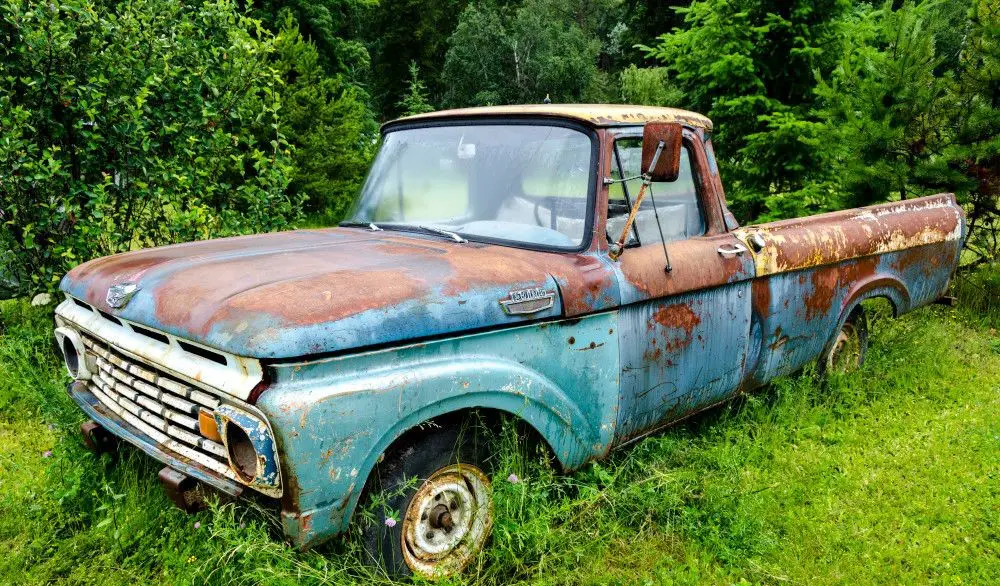
The Truck My Father Left Behind
I was standing before my father’s grave on a gray Tuesday morning, watching the groundskeepers lower his casket into the earth with mechanical efficiency. The funeral service had ended twenty minutes ago. Most of the mourners had already left—business associates paying respects out of obligation, employees looking appropriately somber, neighbors who’d known my father for decades standing in uncomfortable clusters near the parking lot.
My sister Sophia stood beside me, dabbing at her eyes with a tissue. Her husband Patrick stood slightly behind her, one hand on her shoulder in what was probably supposed to look like supportive comfort but struck me as something more possessive. Proprietary.
My father, Richard Walsh, was dead at sixty-eight. Cancer had taken him quickly once it was discovered—six months from diagnosis to death, barely enough time to process what was happening before he was gone.
And now Patrick—my brother-in-law, my sister’s husband of twelve years, a man who’d started as a skilled worker at my father’s construction company—was about to inherit everything.
The reading of the will happened three days after the funeral, in the sterile conference room of my father’s attorney’s office. Gray carpet, mahogany table, leather chairs that were probably meant to convey gravitas and tradition but just felt cold.
Patrick sat across from me, looking like he was barely containing his excitement. Sophia sat beside him, still crying periodically, though I couldn’t tell if she was mourning our father or just overwhelmed by the situation. The attorney—a man named Gerald Hastings who’d worked with my father for thirty years—read through the document with practiced efficiency.
The construction company—Walsh & Associates, valued at approximately $500 million including assets, properties, contracts, and investments—went to Patrick. Ninety percent of the shares, complete operational control, the corporate accounts, everything.
Sophia received the family house and $2 million in cash.
I received a 1995 Nissan mini truck.
That was it. That was my inheritance from the father I’d spent thirty-four years trying to understand, trying to please, trying to connect with, trying to prove myself to.
A truck worth maybe $8,000 if you were generous.
Patrick didn’t even try to hide his satisfaction. The moment we left the attorney’s office, he turned to me with a smirk that made my stomach turn.
“I’ve got the company and the entire estate in my grasp,” he said, his voice dripping with barely concealed contempt. “That little truck suits you, Frank. Seems about right for a teacher’s salary, don’t you think?”
I stared at him, this man who I’d once considered a friend, a mentor even, and saw a stranger wearing his face.
“Patrick—” Sophia started, but he cut her off.
“What? I’m just stating facts. Frank walked away from the company, from the family business, from everything Richard built. He chose teaching over construction. He chose his principles over his family. And now Richard chose to leave him exactly what he deserved—a old truck he can drive to his little classroom job.”
Then he walked away, leaving me standing in the parking lot with Sophia looking uncomfortable and apologetic beside me.
“He doesn’t mean it like that,” she said weakly. “He’s just stressed. Taking over the company is a lot of pressure.”
But we both knew that wasn’t true.
My name is Frank Walsh, and my relationship with my father had always been complicated in the way that father-son relationships often are when expectations and reality refuse to align.
Richard Walsh built his construction company from scratch, starting with a single pickup truck and a toolbox in 1984, working his way up through sheer determination and competence until Walsh & Associates became one of the most respected construction firms in the region. By the time I was born—his first child, his son, his heir apparent—the company was already successful enough that we lived comfortably, vacationed occasionally, never worried about money.
And from the moment I was old enough to understand what my father did for a living, it was clear what he expected from me: I would join the company. I would learn the business. I would eventually take over and continue the Walsh legacy.
Except I didn’t want that.
I tried. God knows I tried. I spent summers during high school working for the company—manual labor at first, then gradually being given more responsibility, learning about project management and client relations and all the skills my father insisted were crucial for running a successful business.
But I hated it. Not the physical work—I didn’t mind the labor itself. I hated the constant competition, the aggressive bidding wars, the way everything came down to profit margins and contract negotiations. I hated the way my father talked about employees as resources to be managed rather than people with lives and families. I hated the casual cruelty of the construction industry, the way contractors would undercut each other without a second thought, the way my father would make decisions that benefited the bottom line while destroying smaller competitors.
What I loved was teaching.
I’d started tutoring in high school—helping classmates who struggled with math and science, discovering that I had a talent for explaining complex concepts in ways that made sense to struggling students. I’d volunteered at after-school programs during university, working with kids from difficult backgrounds, seeing the way education could genuinely change lives.
So right after graduating from university with a business degree that my father had insisted on—”You can always teach later, but you need to understand business first”—I made a choice.
I enrolled in a teaching credential program. Took out student loans to pay for it since my father refused to fund “throwing away your education.” Got certified to teach high school mathematics. Applied for positions at public schools in lower-income districts where teachers were desperately needed.
My father was furious.
“You’re wasting your potential,” he’d said during one of our last real conversations before I left home. “You’re throwing away everything I’ve built for you. For what? To make $40,000 a year teaching kids who probably won’t appreciate what you’re trying to do?”
“For purpose,” I’d said. “For doing something that actually matters instead of just making money.”
“Money matters, Frank. Money is what puts food on tables and roofs over heads. Money is what I’ve spent thirty years building for this family. And you’re spitting on that.”
“I’m choosing my own path.”
“You’re choosing to disappoint me.”
That conversation ended our relationship for nearly eight years. We didn’t speak except for obligatory holiday calls that lasted less than five minutes. I didn’t attend family gatherings. He didn’t come to my wedding or meet my wife until she and I separated three years later. We existed in parallel universes, connected by blood but separated by fundamental disagreements about what constituted a meaningful life.
The only bridge between us during those years was Patrick.
Patrick had started working for Walsh & Associates as a skilled carpenter when I was still in high school. He was talented, hardworking, detail-oriented—exactly the kind of employee my father valued. Over the years, he’d worked his way up from basic labor to project supervisor to eventually becoming my father’s right-hand man, the person he trusted with the most complex projects and difficult clients.
When Patrick started dating my sister Sophia, I was genuinely happy. Sophia had always struggled to find direction—bouncing between jobs and relationships, never quite settling into anything stable. Patrick seemed good for her. Grounded. Reliable. Kind.
I respected him immensely, admired the way he’d built his career through competence rather than nepotism, the way he treated workers with fairness, the way he genuinely seemed to care about quality craftsmanship rather than just profit.
After they got married, Patrick became the older brother I’d never had. We’d meet for coffee occasionally when I was home visiting Sophia. He’d ask about my teaching, seemed genuinely interested in the students I worked with, the programs I was developing.
“Live your own life, Frank,” he’d said during one of those conversations. “Make choices you won’t regret. Your father’s vision for you isn’t necessarily the right vision. You have to decide what success means for you.”
It was his words—his encouragement—that gave me the courage to fully commit to teaching instead of hedging my bets, keeping one foot in the business world just in case my father was right and I was making a terrible mistake.
But the man who greeted me when I returned home after my father’s diagnosis was nothing like the Patrick I’d known.
I’d gotten the call from Sophia late on a Wednesday night. “Frank, it’s Dad. Cancer. Pancreatic. Stage four. They’re saying six months, maybe less. You need to come home.”
I’d driven eight hours the next day, taking emergency leave from my teaching position, arriving at the family house exhausted and terrified and hoping desperately that I’d have time to repair the relationship with my father before it was too late.
Patrick was there when I arrived, standing in the kitchen like he owned it. Which, in a way, I suppose he did—Sophia and Patrick had moved into the family house two years earlier when my father’s health started declining, ostensibly to help take care of him.
“Came back in a hurry when you heard he was sick, didn’t you?” Patrick said when we were alone, his voice cold in a way I’d never heard before. “How convenient. How timely.”
“I came back because he’s my father and he’s dying,” I said, confused by the hostility.
“You came back hoping to get back in his good graces before the will is finalized,” Patrick corrected. “Don’t bother. You won’t inherit anything. Richard made his feelings about you very clear.”
“I don’t care about inheritance. I care about—”
“Save it,” Patrick interrupted. “You made your choice eight years ago when you walked away from the company. You chose teaching over family. You chose your principles over your father. Now you have to live with the consequences.”
That conversation set the tone for the next six months. Patrick was constantly there, constantly between me and my father, constantly making it clear that I was an outsider now, that whatever relationship I’d had with Richard Walsh was dead long before the cancer killed him.
I tried to spend time with my father during those final months. Sat by his bedside, read to him when he was too weak to hold a book himself, tried to have the conversations we’d never had about life and regrets and what mattered.
But Patrick was always there. Always inserting himself, always reminding my father about business matters that needed attention, always steering conversations away from personal topics and toward practical concerns.
“Patrick’s been running the company while I’ve been sick,” my father told me during one of our few private moments. “He’s good at it. Better than I expected. He understands the business.”
“That’s good,” I said, though something in his tone made me uneasy.
“He understands what I built. What I sacrificed for. What matters.”
The implication was clear: unlike you.
After the will reading, after Patrick’s cruel comments in the parking lot, after Sophia’s weak attempts at defending her husband’s behavior, I went to see the truck.
It was parked at my father’s office—the construction company headquarters that Patrick now controlled. A modest single-story building with a large lot where company vehicles and equipment were stored.
The truck was exactly as I remembered it: a 1995 Nissan mini truck, white paint faded to a dingy cream, some rust around the wheel wells, a dent in the passenger door from some long-ago accident. It was the truck my father had driven when he was first starting the company, before Walsh & Associates became successful enough to afford fancy vehicles and company cars.
He’d kept it even after buying newer trucks, kept it maintained and functional, occasionally driving it to job sites when he wanted to “remember where he came from,” as he’d put it.
To most people, it would look like junk. A worthless old vehicle that should have been scrapped years ago.
To me, standing in that parking lot staring at it, it felt like a final message from my father: This is what you’re worth. This is what you get for disappointing me. This is your inheritance—a piece of junk that represents the beginning I built everything from, which you abandoned.
But it was also the last thing my father had personally left for me. The only physical object he’d specifically designated as mine in his will.
So I decided to at least take care of it properly.
I spent the afternoon cleaning it. Washing the exterior carefully, scrubbing away dirt and grime that had accumulated from sitting unused for months. Vacuuming the interior, wiping down the dashboard, checking the fluids and tire pressure.
When I was finished, I sat in the driver’s seat—the same seat my father had occupied thousands of times, his hands on this steering wheel, his foot on these pedals, driving to job sites and client meetings and all the places that had built his empire.
That’s when I noticed the navigation system.
It was new—or at least newer than the truck itself. A small touchscreen mounted to the dashboard, clearly installed recently. Which was strange, because my father had never been particularly tech-savvy, had resisted even getting a smartphone until the last few years.
I touched the screen. It lit up immediately, and I saw that a single route was programmed into it. Not a recent destination or a favorite location, but a specific route marked as “FRANK—IMPORTANT.”
The destination was set to coordinates about an hour north of the city, in a rural area I didn’t recognize. No address, no business name, just GPS coordinates and that label: FRANK—IMPORTANT.
My father had programmed this. Had installed this navigation system and set this specific route and labeled it for me.
With nothing to lose and a desperate need to understand what this meant, I turned the key in the ignition. The engine started with a familiar rumble. I put the truck in gear and began to drive, following the navigation system’s directions away from the city and toward whatever my father wanted me to find.
The route took me north on highways that gradually became smaller roads, then rural routes, then finally a narrow two-lane road that wound through farmland and scattered houses. The navigation led me past fields where early summer crops were just starting to emerge, past small family farms with barns and silos, past the occasional cluster of mailboxes marking driveways that led to homes hidden from the road.
Finally, after about an hour of driving, the navigation announced: “You have arrived at your destination.”
I was in front of a small, modest house. Single story, probably built in the 1970s, with pale yellow siding and a neat lawn. A vegetable garden visible in the side yard. A swing set that looked relatively new. Nothing remarkable, nothing that gave any indication of why my father would have directed me here.
I sat in the truck for a moment, confused and uncertain. Was this a mistake? Had the navigation been programmed incorrectly? Was this even the right location?
But the screen clearly said “FRANK—IMPORTANT,” and this was definitely the coordinates that had been programmed.
I got out of the truck and walked to the front door, my heart pounding with a mixture of anxiety and curiosity. Rang the doorbell and waited, listening to footsteps approaching from inside.
The door slowly opened.
A woman stood there—maybe late thirties or early forties, with dark hair pulled back in a ponytail and tired eyes that widened in surprise when she saw me.
“Frank?” she said, her voice uncertain.
“Yes?” I said, confused. “I’m sorry, do we know each other? I found this address programmed in my father’s truck and—”
“Richard’s truck,” she interrupted. “Yes. He said you’d come. Please, come in.”
She stepped back, opening the door wider, and I walked into a small, comfortable living room. Children’s toys scattered on the floor. Photos on the walls. A life being lived.
“I’m sorry, I don’t understand,” I said. “Who are you? How do you know my father?”
The woman smiled sadly. “I’m Caroline Mitchell. I was your father’s accountant for the past fifteen years. And there’s something he wanted me to show you.”
She led me to a small home office—clearly her workspace, with a desk and computer and filing cabinets. She pulled out a folder, thick with documents, and handed it to me.
“Your father asked me to prepare this for you. He wanted you to have it after he died, wanted you to understand what really happened with his will.”
I opened the folder with shaking hands.
Inside were financial documents. Dozens of them. Bank statements, transaction records, account transfers, all meticulously organized and annotated.
And as I read through them, the truth began to emerge with sickening clarity.
Patrick had been stealing from the company for years.
Not small amounts. Not petty theft. Systematic embezzlement totaling nearly $47 million over the course of eight years.
He’d been careful, sophisticated in his methods—creating shell companies that submitted inflated invoices, diverting payments to accounts he controlled, manipulating contracts to skim percentages that went unnoticed in the larger flow of company finances.
“Richard discovered it about two years ago,” Caroline explained quietly. “He hired me to do a full audit, off the books, without Patrick knowing. It took me nine months to trace everything, to document the full extent of the theft.”
“Why didn’t he report it?” I asked, my voice barely above a whisper. “Why didn’t he go to the police, have Patrick arrested?”
“Because of Sophia,” Caroline said simply. “Patrick had been very clever about how he structured things. If Richard reported the theft, Patrick would go to prison—but Sophia was listed as a partial owner of several of the shell companies. She’d signed documents, probably without understanding what they were. Patrick had made sure that if he went down, she’d go down with him.”
I felt sick.
“Your father couldn’t bear the thought of his daughter going to prison,” Caroline continued. “So he came up with a different plan. He changed his will, making it look like he was giving Patrick everything—the company, the assets, complete control. But the reality is more complicated.”
She pulled out another document from the folder.
“The ‘company’ Patrick inherited is actually a legal entity that Richard created three months before he died. Walsh & Associates—the real company, with all the actual value—was quietly dissolved and re-formed under a new structure. What Patrick got was essentially a shell company with the old name, loaded up with $87 million in debt that Richard had strategically accumulated and transferred to the new entity.”
My head was spinning. “I don’t understand.”
“The real company—the one with all the contracts, the valuable properties, the actual assets—was transferred to a trust,” Caroline explained. “A trust that names you as the sole beneficiary. You don’t get access to it immediately—there’s a waiting period of one year from your father’s death. But after that, you’ll inherit the actual Walsh & Associates, worth approximately $620 million after accounting for the growth in the final months.”
“And Patrick?”
“Patrick inherited a company name, a building with a massive mortgage, and $87 million in debt that’s going to come due in various forms over the next two years. Your father’s attorneys structured it carefully to be completely legal—Patrick actually did inherit what was described in the will. It just wasn’t what he thought he was getting.”
I sat down heavily in Caroline’s desk chair, trying to process this information.
“There’s more,” Caroline said gently. “This house—my house—your father bought it for me. Paid it off completely. Set up a trust fund for my daughters’ education. I’d been his accountant for fifteen years, and when I discovered Patrick’s theft, I became a liability. Patrick threatened me, told me if I said anything to Richard about the irregularities I’d noticed, he’d destroy my career, make sure I never worked in accounting again. Your father found out, and he made sure I was protected.”
“Why are you telling me all this?” I asked.
“Because Richard wanted you to understand something,” she said. “He wanted you to know that he was proud of you. That he understood why you chose teaching over business. That he respected your choice, even if he couldn’t say it while he was alive.”
She handed me a letter—sealed in an envelope with my name written in my father’s distinctive handwriting.
“He wrote this for you. Asked me to give it to you when you came.”
I opened it with trembling hands and read:
Frank,
If you’re reading this, I’m gone, and you’ve followed the route I programmed in the truck. Good. That means you still have the curiosity and determination I always knew you had, even when we disagreed about everything else.
I owe you an apology. A real one, not the half-hearted kind I was always too proud to give when I was alive. You were right to choose teaching. You were right to follow your own path instead of the one I tried to force on you. I was too stubborn and too blind to see it at the time, but watching you these past few months, seeing how you talk about your students, seeing the impact you’ve had on kids who needed someone to believe in them—I finally understood.
You didn’t throw away your potential. You used it for something that actually mattered. And I’m sorry it took me so long to understand that.
Patrick stole from me. From the company. From our family. But more than that, he stole from Sophia—turned her into an accomplice, made it impossible for me to report him without destroying her life too. I couldn’t let that happen. So I built a trap instead.
In one year from my death, you’ll inherit the real Walsh & Associates. Not the gutted shell I left Patrick, but the actual company, rebuilt and restructured and positioned for growth. You’ll also inherit properties I acquired over the past two years, investments I made carefully to preserve value.
I don’t expect you to run the company. I know that’s not what you want. But I’m giving you the choice. You can sell it, invest the proceeds however you like, fund education programs, do whatever you think is right. Or you can hire managers to run it and use the profits to support your teaching while knowing you’re preserving what I built.
The truck—I know it seems like a cruel joke, leaving you my old beater while Patrick got “everything.” But that truck represents the beginning of what I built. It represents starting from nothing and making something real through hard work and determination. That’s what I wanted you to have—not just money or property, but the reminder that you can build something meaningful from humble beginnings.
I’m proud of you, son. I should have said it more often when I was alive. I should have told you that your choice to teach took more courage than my choice to build a business. I should have told you that making a difference in people’s lives matters more than making money.
But I’m telling you now. I’m proud of you. I love you. And I’m sorry I wasn’t the father you deserved.
Live your life with no regrets.
Dad
I read the letter three times, tears streaming down my face, unable to speak.
Caroline sat quietly, giving me space to process, to grieve, to finally understand what my father had been trying to tell me through this elaborate plan.
“What happens to Patrick?” I finally asked.
“He’ll figure it out eventually,” Caroline said. “Probably in the next few months, when debts start coming due and he realizes the company he inherited doesn’t have nearly the assets he thought it did. He’ll try to sell, but there’s nothing of real value to sell. He’ll try to investigate, but the restructuring was completely legal. Your father’s attorneys were very thorough.”
“And Sophia?”
“She’ll be okay. The house she inherited is paid off and legitimately hers. The $2 million she received is real money, not entangled with Patrick’s debts. When the truth comes out—and it will come out—she’ll have to decide what to do about her marriage. But she’ll have resources to start over if she needs to.”
That was thirteen months ago.
I’m standing in front of my father’s grave again, on a sunny afternoon in June. The headstone has been placed now—simple gray granite with his name, dates, and a quote he’d selected himself: “Build something that matters.”
The year waiting period ended last week. I officially inherited Walsh & Associates—the real one, the one with actual value—along with properties, investments, and assets totaling approximately $680 million after final accounting.
I haven’t quit teaching. I’ve hired a management team to run the construction company, people who understand the industry better than I ever will, people committed to maintaining the quality and integrity that made Walsh & Associates successful.
But I’m using the resources differently than my father did.
I’ve established scholarship funds for students pursuing education degrees—covering full tuition and living expenses for teachers who commit to working in low-income school districts.
I’ve funded after-school programs in twelve different cities, providing tutoring, mentoring, and enrichment activities for kids who need extra support.
I’ve invested in building affordable housing through the construction company, using our expertise to create quality homes for families who’ve been priced out of the market.
I’m teaching half-time now instead of full-time, using the other half of my schedule to oversee these initiatives, to make sure the money is being used effectively, to build something that matters in a different way than my father built his company.
Patrick figured out the truth about eight months after the will reading. He tried to sue, claiming fraud and manipulation. The attorneys my father had hired demolished every argument. The restructuring was completely legal. The will was valid. Patrick had inherited exactly what was described—it just wasn’t what he’d assumed.
The debts started coming due six months ago. Patrick had to declare bankruptcy. Lost the company building. Lost his reputation in the construction industry. Lost his marriage—Sophia filed for divorce when she realized the extent of his theft and manipulation.
He sends me angry emails sometimes. Calls me a fraud, says I stole his inheritance, says my father was a vindictive old man who screwed him over.
I don’t respond. There’s nothing to say.
Sophia and I are rebuilding our relationship slowly. She’s living in the family house, going back to school, figuring out who she is outside of her marriage to Patrick. We have coffee every few weeks, talk about Dad, share memories, process our grief together.
She understands now why our father did what he did. How Patrick had trapped him between protecting his daughter and exposing a thief. How the elaborate restructuring was the only way to preserve the company while keeping Sophia safe.
“He loved us,” she said during our last coffee meeting. “Both of us. Even when we disappointed him or made mistakes. He just showed it in complicated ways.”
She’s right.
The truck sits in my driveway now. I’ve had it fully restored—new paint, engine rebuilt, interior reupholstered. It drives like new, though I’ve kept it looking vintage, kept the character that made it my father’s truck.
I drive it to school sometimes. My students love it, ask me about it, want to hear stories about my father and the company he built from nothing.
“Why’d your dad leave you an old truck instead of money?” one of my students asked recently.
“Because the truck represents something more important than money,” I told him. “It represents starting from nothing and building something real. It represents having the courage to take a risk and work hard and create something that matters. And it represents having the wisdom to know that what you build doesn’t have to look like what someone else built—it just has to be true to who you are.”
The student thought about that for a moment, then nodded. “That’s pretty cool, actually.”
“Yeah,” I agreed. “It is.”
I’m thirty-five years old now. I’m a teacher. I’m the inheritor of a construction empire. I’m the steward of resources that can genuinely change lives.
And I’m finally, finally at peace with my father’s memory, understanding that his final gift wasn’t money or property or even the letter explaining everything.
His final gift was the choice.
The choice to use what he built in my own way, to honor his legacy while staying true to my own values, to build something that matters using my own definition of what that means.
The navigation system in the truck led me to answers, to truth, to understanding.
But more than that, it led me to freedom—the freedom to be exactly who I am while still honoring where I came from.
And that’s worth more than $500 million, more than any company, more than any inheritance.
That’s worth everything.
THE END

Ethan Blake is a skilled Creative Content Specialist with a talent for crafting engaging and thought-provoking narratives. With a strong background in storytelling and digital content creation, Ethan brings a unique perspective to his role at TheArchivists, where he curates and produces captivating content for a global audience.
Ethan holds a degree in Communications from Zurich University, where he developed his expertise in storytelling, media strategy, and audience engagement. Known for his ability to blend creativity with analytical precision, he excels at creating content that not only entertains but also connects deeply with readers.
At TheArchivists, Ethan specializes in uncovering compelling stories that reflect a wide range of human experiences. His work is celebrated for its authenticity, creativity, and ability to spark meaningful conversations, earning him recognition among peers and readers alike.
Passionate about the art of storytelling, Ethan enjoys exploring themes of culture, history, and personal growth, aiming to inspire and inform with every piece he creates. Dedicated to making a lasting impact, Ethan continues to push boundaries in the ever-evolving world of digital content.