They Were Moving Into My House While I Was Away
I came home three days early from a Chicago trip and found a silver Mercedes in my driveway—then my daughter-in-law smiled like my kitchen already belonged to her, and my son wouldn’t meet my eyes.
It was barely 7 a.m., the kind of cold Midwestern morning that wakes you up before coffee does. My suitcase wheels whispered over the pavement, but my heart was loud, pounding at the sight of that car sitting in my spot like it had always lived there. I’d cut my conference short because something in my gut wouldn’t settle. Now I understood why.
My front door was unlocked.
When I pushed it open, the hinges didn’t squeak. Someone had oiled them. The air inside didn’t smell like home—no lavender, no warm, lived-in comfort—just fresh paint and sawdust. I heard laughter from the kitchen. The clink of mugs. Easy voices, unbothered, like people who had nothing to hide.
I stepped into the hallway and stopped so fast my breath caught. The family photos were gone. Decades of frames stripped off the walls, leaving pale rectangles behind, as if my life had been peeled away in clean, deliberate squares. The gold-framed mirror my grandmother left me was missing from the entry table—the table where my keys landed every single day for years.
From the kitchen, a woman’s voice said, casually, “These cabinets are so outdated. We should replace them entirely.”
I knew that voice.
Sutton. My daughter-in-law of eight months.
My son Desmond answered with a softness I hadn’t heard in a long time. “Whatever you want, babe.”
Then he said something quieter, like he thought the house itself couldn’t hear him: “It’s all ours now.”
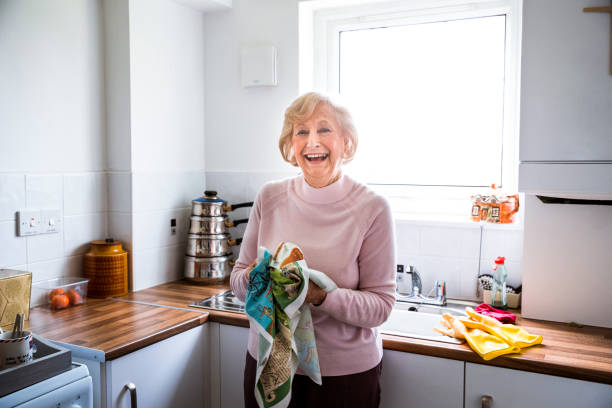
I walked into the kitchen and my stomach dropped. Drop cloths covered the floor. Cabinet doors leaned against the wall like broken ribs. The floral wallpaper I’d hung with my own hands—blue hydrangeas Randall used to smile at—was torn and dangling in strips. My old rooster cookie jar, an anniversary gift from Randall, sat wrapped up like it was waiting to be carried out.
Desmond was at my kitchen table with his chair tilted back, phone in his hand, feet propped up like a guest who planned to stay. Sutton stood in expensive athleisure with a paint swatch pressed to the wall, platinum ponytail swinging as she turned.
“Excuse me,” I said.
They both jolted. Desmond shot up so fast the chair scraped. “Mom—You’re not supposed to be back until Friday.”
Sutton recovered first. Her smile slid into place—polished, practiced, and strangely empty. “Cordelia, what a surprise. We’re just freshening things up before we move in!”
“Move in,” I repeated, slow enough to make the words feel heavy. “Into my house.”
She glanced at Desmond like he’d promised her this conversation would be easy. “He said you were downsizing. Something more manageable.”
I didn’t raise my voice. I didn’t have to. I stepped forward, looked past her, and saw a cardboard box on the counter with thick marker across the side: GIVE AWAY. Inside, stacked carefully like they meant nothing, were my mother’s ceramic mixing bowls—three generations of hands reduced to a label.
“How long has this been going on?” I asked Desmond.
His face flushed. “Two weeks.”
Two weeks. While I was gone, trusting him with keys and quiet access to everything I built.
I lifted my phone—not to make a scene, just to make a point. “This stops today,” I said. “Leave. Now.”
Sutton’s smile finally cracked. “Desmond told me you agreed to this. He said you wanted to move closer to your sister in Florida, that you were tired of maintaining such a big house alone.”
I looked at my son. “Is that what you told her?”
He couldn’t hold my gaze. “Mom, we can talk about this—”
“No,” I interrupted, my voice steel. “You can leave my house. Both of you. Now.”
They moved fast after that. Too fast. Like they already knew they were wrong. Sutton grabbed her designer purse, whispering furiously to Desmond as they headed for the door. He tried to speak to me once, reaching out, but I stepped back.
“The keys,” I said, holding out my hand.
“Mom, please—”
“The keys, Desmond.”
He pulled them from his pocket and placed them in my palm without touching my skin. The silver Mercedes reversed out of my driveway at 7:23 a.m., and I watched until the taillights disappeared around the corner.
When the door finally closed behind them, I locked every bolt I had and stood alone in the paint-and-sawdust silence, staring at the blank walls where my memories used to hang.
They hadn’t been “freshening up” anything. They’d been rewriting me out of my own home.
I spent the rest of that morning piecing together what had been taken. The list grew longer with each room I entered: Randall’s vintage record collection, my mother’s silver tea service, the antique quilt my grandmother had stitched by hand. All gone. Boxed up and presumably moved to storage or already decorating whatever space Sutton had deemed worthy.
In the bedroom, my jewelry box sat open and nearly empty. My wedding ring from Randall—I still wore it on a chain around my neck, thank God—but my mother’s pearls, her engagement ring, the garnet bracelet that had been in our family for four generations. All missing.
I sat on the edge of my bed, the one Randall and I had bought together thirty-two years ago, and I let myself feel the full weight of the betrayal. Not just Sutton’s presumption, but Desmond’s. My son. The boy I’d raised alone after Randall’s heart attack twelve years ago. The child I’d worked two jobs to put through college.
My phone buzzed. A text from Desmond: Mom, I’m so sorry. Can we talk? Sutton got ahead of herself. I never meant for it to go this far.
I didn’t respond. Instead, I called my sister Caroline in Tampa.
“Cordie?” Her voice was warm, familiar. “How was Chicago?”
“I came home early,” I said. “Caroline, I need you to tell me the truth. Did Desmond call you recently? Ask about me moving to Florida?”
Silence. Then, carefully: “He called three weeks ago. Asked if I’d talked to you about downsizing, about moving closer to family. I told him I hadn’t, that you loved that house. Why?”
My hands were shaking. “He’s been planning this for weeks. Maybe longer.”
I told her everything—the Mercedes, the stripped walls, the missing heirlooms, Sutton’s casual redecorating like she was already mistress of the house.
“That calculating little—” Caroline stopped herself. “Cordie, you need a lawyer. Today.”
“I need to understand why first,” I said. “Why would he do this? We’ve had our differences, but I’m his mother.”
“Money,” Caroline said bluntly. “It’s always money. That house is worth what, half a million? More? And you’re only sixty-two. Sutton probably decided she didn’t want to wait for you to die or go into a nursing home.”
The words stung because they rang true. I thought about Sutton’s Instagram-perfect lifestyle, her luxury car, her designer everything. I thought about Desmond’s vague explanations about his “consulting work” and how they’d afforded their downtown loft.
“I’m calling David Winters,” I said. David had been Randall’s attorney and mine for twenty years. “And Caroline? Thank you.”
“I’m booking a flight,” she said. “I’ll be there tomorrow. Don’t do anything alone.”
That afternoon, I met David at his office downtown. He was seventy now, silver-haired and sharp as ever, and when I finished telling him what had happened, his expression was grim.
“Cordelia, what your son has done could constitute several crimes. Breaking and entering, theft, possibly even elder abuse under Michigan law.”
“I gave him keys,” I protested. “For emergencies.”
“Did you give him permission to strip your home of valuables? To begin renovations? To move in?”
“No.”
“Then he exceeded the scope of your permission.” David pulled out a legal pad. “I need you to make a complete list of everything that’s missing. Photos if you have them. Receipts, appraisals, anything that establishes ownership and value.”
I spent the next three hours in David’s conference room, writing down everything I could remember. My mother’s jewelry alone was worth over twenty thousand dollars. The antique furniture, the silver, the artwork—the total climbed past sixty thousand.
“There’s something else,” I said as we finished. “He told Sutton I’d agreed to downsize, that I wanted to move to Florida. He’s been laying groundwork, creating a narrative.”
David’s jaw tightened. “Has he ever had access to your financial accounts?”
My blood ran cold. “He’s listed as my emergency contact at the bank. And on my investment accounts. In case something happened to me.”
“We need to check those immediately,” David said, already reaching for his phone.
The next morning, Caroline arrived with her usual efficiency—rolling suitcase, laptop bag, and a determination that reminded me why we’d survived our mother’s death and our father’s distance. We sat at my stripped kitchen table with David’s paralegal on speakerphone, going through my financial records line by line.
“There,” Caroline said, pointing at my screen. “What’s that withdrawal? Fifteen thousand dollars, two months ago.”
I stared at the transaction. I hadn’t made that withdrawal. The memo line read: Home renovation deposit.
We found three more. Over the past four months, thirty-eight thousand dollars had been moved from my accounts—always in amounts just under the reporting threshold, always with plausible-sounding memos.
“He had my passwords,” I whispered. “I wrote them down in case of emergency. They were in my desk drawer.”
“Not anymore,” Caroline said grimly, showing me the empty drawer. “Cordie, he’s been planning this for months. This wasn’t Sutton getting ahead of herself. This was systematic.”
David’s paralegal spoke up from the phone. “Mrs. Harrison, we have enough to file charges. Theft, financial exploitation of a vulnerable adult, fraud. The DA would take this case.”
“What about getting my things back?” I asked.
“Civil court,” David said. “We file for immediate return of property, plus damages. And Cordelia, I strongly recommend changing all your locks, passwords, and bank access today.”
I looked at Caroline. “He’s my son.”
“He stole from you,” she said gently. “He lied to you. He was erasing you from your own home. Whatever you thought your relationship was, that’s not what it is anymore.”
The hardest call I’ve ever made was to Desmond that afternoon. He answered on the first ring, his voice eager, hopeful.
“Mom, I’m so glad you called. We really need to talk—”
“You stole thirty-eight thousand dollars from my accounts,” I said. “You took my mother’s jewelry. You stripped my house while I was gone. And you lied to your wife about my consent.”
Silence.
“Desmond, I’m giving you one chance. Return everything you took—the jewelry, the furniture, the silver, all of it—and replace the money. Do it by Friday, and I won’t press charges.”
“Mom, you don’t understand. Sutton and I, we have debts. The loft, her car, we’re underwater and I thought—”
“You thought you’d steal from your mother to fund your lifestyle.”
“It’s not stealing!” His voice rose, defensive. “You’re going to leave me everything anyway, I just needed it sooner—”
“I’m not dying, Desmond. And after this, you’re not in my will anymore.”
“You can’t do that!”
“Watch me,” I said, and ended the call.
I sat shaking in my kitchen, Caroline’s hand on my shoulder, and let myself cry for the son I’d lost—not to death, but to greed.
Friday came and went. Nothing was returned. Instead, my doorbell rang at 6 p.m., and when I answered it—with Caroline standing behind me and my phone ready to call 911—I found a process server with papers.
Desmond was suing me for “promised inheritance,” claiming I’d verbally agreed to sign the house over to him, that I was mentally incompetent, and that Caroline was manipulating me for her own financial gain.
David read the filing and actually laughed. “This is the worst legal strategy I’ve seen in thirty years. He’s just created a paper trail of his own fraud.”
“What do we do?” I asked.
“We bury them,” David said. “Legally, thoroughly, and permanently.”
The next week was a blur of depositions, financial audits, and evidence gathering. David’s team was ruthless. They pulled bank records showing Desmond’s unauthorized withdrawals. They tracked my mother’s jewelry to a pawn shop where Sutton had sold it for eight thousand dollars. They found the furniture in a storage unit rented in Desmond’s name.
But the most damning evidence came from Sutton herself.
Apparently, she’d been documenting their “renovation journey” on Instagram—including photos of my stripped house, my missing heirlooms arranged in their loft, and captions about “finally getting the inheritance we deserved.”
“She posted evidence of theft to social media,” David said, showing me the screenshots his paralegal had compiled. “This is the dumbest crime I’ve ever prosecuted.”
“We’re not prosecuting,” I reminded him. “Just getting my things back.”
“Cordelia,” he said carefully, “your son committed multiple felonies. Even if you don’t press charges, the DA might independently.”
I thought about Desmond—the boy who used to bring me dandelions, who cried when his goldfish died, who’d held my hand at Randall’s funeral.
“Let me talk to him one more time,” I said.
We met at a coffee shop, neutral ground. David waited in his car outside, and Caroline sat two tables away, close enough to intervene if needed.
Desmond looked terrible. His suit was rumpled, his eyes bloodshot. Sutton wasn’t with him.
“Where’s your wife?” I asked.
“She left,” he said bitterly. “Moved back to her parents’ place in Bloomfield Hills. Said she didn’t sign up for this kind of drama.”
“The kind where you face consequences for stealing?”
He flinched. “Mom, I messed up. I know that. But I’m your son. Doesn’t that mean anything?”
“It used to,” I said. “Before you decided I was worth more to you as a source of money than as a mother.”
“That’s not fair—”
“Fair?” My voice rose despite my best efforts. “You stole my mother’s jewelry. The pearls she wore on her wedding day. The ring my grandmother gave her. You sold them to a pawn shop for eight thousand dollars.”
“I was desperate!”
“You were greedy,” I corrected. “There’s a difference. Desperate people ask for help. Greedy people take what isn’t theirs and convince themselves they deserve it.”
He sat back, arms crossed, looking so much like his father I almost couldn’t bear it. Randall had been stubborn too, but never cruel. Never dishonest.
“I’m prepared to return everything,” Desmond said finally. “The furniture’s in storage. I can get the money back, it’ll just take time—”
“The jewelry’s gone,” I said. “Already sold and scrapped by the pawn shop. Those pieces that survived the Depression, World War II, my father’s bankruptcy, my mother’s cancer—you destroyed them for eight thousand dollars.”
“I’ll buy you new—”
“It’s not the same!” I was crying now, not bothering to hide it. “Desmond, you didn’t just steal things. You stole my history. My connection to my mother, my grandmother. You can’t replace that.”
He looked down at his coffee, and for a moment I thought I saw remorse. Then he said, “So what happens now?”
I slid the papers across the table. “You sign this. It’s an agreement to return all property, repay all money taken, and accept a permanent restraining order prohibiting you from coming within five hundred feet of my home.”
“A restraining order? Mom, I’m your son!”
“You were my son,” I said quietly. “Now you’re someone who committed crimes against me. Sign it, Desmond. Sign it, or I let David file criminal charges and you go to prison.”
His hand shook as he picked up the pen.
Three weeks later, I stood in my refinished kitchen with Caroline, surveying the work. New locks on every door. New passwords on every account. A security system that would alert me and the police if anyone unauthorized approached.
Most of the furniture had been returned, though some pieces were damaged. The money was being repaid in installments—Desmond had to take a second job to manage it. The jewelry was gone forever.
But the house felt like mine again.
“What will you do now?” Caroline asked, pouring us both coffee in new mugs—the old ones had been casualties of Desmond’s renovation.
“Live,” I said. “Maybe travel more. I spent so much of my life taking care of others—first Randall, then Desmond. Maybe it’s time to take care of myself.”
“What about Desmond? Do you think you’ll ever reconcile?”
I thought about that. About the son I’d raised and the stranger he’d become. About trust broken so thoroughly I couldn’t imagine rebuilding it.
“I don’t know,” I admitted. “Right now, I can’t. Maybe someday, if he genuinely changes. But Caroline, I learned something these past weeks.”
“What’s that?”
“That loving someone doesn’t mean letting them destroy you. That being a mother doesn’t mean sacrificing yourself on the altar of your child’s greed. That I deserved better than what Desmond gave me.”
She hugged me then, fierce and strong. “You always deserved better, Cordie. I’m glad you finally see it.”
That night, alone in my reclaimed home, I hung new photos on the walls—not replacing the old ones, but adding to them. Pictures of Caroline and me in Tampa. My book club friends. The garden I’d planted last spring. Memories I was making now, not just preserving from the past.
I found a box in the garage labeled “RANDALL” and opened it for the first time in years. Inside were his favorite books, his reading glasses, the watch I’d bought him for our twentieth anniversary.
At the bottom, I found a letter in his handwriting, dated the week before he died. It was addressed to Desmond, meant to be read when he turned thirty.
Son, if you’re reading this, I’m gone. Take care of your mother. Not because she’s weak—she’s the strongest person I’ve ever known—but because she’s spent her whole life taking care of others. She deserves someone to take care of her for once.
Don’t make the mistake I almost made, of taking her for granted. Don’t assume she’ll always be there, waiting, forgiving. She will forgive, because that’s who she is. But she shouldn’t have to.
Your mother is worth more than anything I could leave you. Remember that.
Love, Dad
I folded the letter carefully and placed it in my own safe—not for Desmond, not anymore. For me, as a reminder that Randall had seen my worth even when I sometimes forgot it myself.
Six months after that terrible morning when I’d come home to find strangers in my kitchen, I received a letter. Handwritten, postmarked from Detroit, no return address.
Mom,
I know I don’t have the right to write to you. I know the restraining order says I can’t come near you, and I’m respecting that. But I need you to know something.
Sutton and I are divorced. Turns out she was only interested in the money I promised her from “our” house. When that disappeared, so did she.
I got a job. A real one, not the consulting fiction I’d been telling everyone. I’m working construction, paying you back dollar by dollar. It’ll take years, but I’ll do it.
I joined a therapy group for people who’ve committed financial crimes against family members. Yeah, apparently there are enough of us for a whole group. It’s humbling.
I’m not asking for forgiveness. I don’t deserve it. I’m just asking you to know that I finally understand what I did. Not just the stealing, but the betrayal. The way I convinced myself I was entitled to what you’d built, like your life was just a waiting room for mine to begin.
You were right to cut me off. I was greedy. I was cruel. I was everything Dad would have been ashamed of.
I’m trying to become someone he wouldn’t be ashamed of. Someone you wouldn’t be ashamed of. I don’t know if I’ll ever get there, but I’m trying.
I love you, Mom. I’m sorry I forgot how to show it.
Desmond
I read the letter three times, then put it in my desk drawer. Not forgiveness—not yet, maybe not ever—but acknowledgment. He was trying. Whether that would be enough remained to be seen.
Caroline, visiting for the holidays, found me sitting in the kitchen with the letter in my hand.
“What are you going to do?” she asked.
“Nothing,” I said. “For now, nothing. He needs to prove his change with actions, not words. And I need to keep healing.”
“Fair enough,” she said, then smiled. “Speaking of healing, I booked us a trip to Italy for spring. Rome, Florence, Venice. My treat.”
I looked at her—my sister, my ally, my friend—and felt something I hadn’t felt in a long time: excitement for the future.
“Italy,” I said. “With you?”
“Unless you’d rather go with your book club ladies.”
“No,” I laughed. “You’ll do.”
That Christmas, I hosted dinner for the first time since Randall died. Not family—I’d learned that family could be chosen, not just inherited—but friends. My book club, my neighbors, Caroline and her partner Marcus. People who valued me not for what I could give them, but for who I was.
We ate around my refinished table, on new dishes, with new traditions. And when someone asked me about Desmond—because small towns talk, and everyone knew what had happened—I said simply, “We’re not in contact right now. Maybe someday, but not today.”
“Good for you,” Mrs. Patterson from next door said firmly. “You can’t let people treat you like a doormat, even if they’re family. Especially if they’re family.”
I raised my glass. “To new traditions. To chosen family. To knowing our worth.”
“To Cordelia,” Caroline added, her eyes bright. “Who finally learned to put herself first.”
We clinked glasses, and I felt something settle in my chest—not quite peace, but the beginning of it. The knowledge that I had survived my son’s betrayal, that I had reclaimed my home and my life, that I was more than what others needed from me.
I was enough, just as I was.
Two years later, I was in my garden when I heard the gate creak. I looked up, trowel in hand, and saw Desmond standing at the fence line—exactly five hundred and one feet away, respecting the restraining order down to the foot.
He looked different. Older, leaner, weathered by honest work. He held an envelope.
“I’m not breaking the order,” he called. “I just wanted you to know—I made the last payment. Every dollar, plus interest. It’s all repaid.”
I stood slowly, wiping dirt from my hands. “Okay.”
“And I wanted to give you this.” He placed the envelope on the fence post. “It’s a letter from my therapist. Confirming I’ve completed the program. I’m not asking to be let back into your life, Mom. I’m just asking you to know I did the work.”
I walked to the fence but didn’t cross it. Didn’t touch the envelope.
“Why now, Desmond?”
“Because I finally understand that I can’t earn your forgiveness by paying back money. That’s just the bare minimum, the legal obligation. Forgiveness—if it ever comes—has to be freely given, not bought.”
“And if I never forgive you?”
He nodded, like he’d expected that. “Then I’ll live with that. But I’ll keep being better anyway, because that’s who I want to be. Not for you, for me.”
“Good,” I said. And meant it.
He started to leave, then turned back. “Mom? I know you probably won’t believe me, but I’m proud of you. For standing up to me. For not letting me destroy you. Dad would be proud too.”
My throat tightened, but I didn’t let myself cry. Not for him. Not anymore.
“Goodbye, Desmond.”
“Goodbye, Mom.”
I watched him walk away, then picked up the envelope. Inside was the therapist’s letter, as promised, and a check for an additional five thousand dollars.
For the jewelry that can’t be replaced. I know it’s not enough, but it’s all I have right now. —D
I stood in my garden, holding that check, and realized something profound: I didn’t need his money anymore. I didn’t need his apology. I didn’t need anything from him at all.
I was whole without him.
That evening, I deposited the check and donated it all to a women’s shelter. Money that had come from greed, now turned toward helping people rebuild their lives after betrayal.
It felt right.
Caroline called that night, video chat from Tampa. “So?” she asked. “I heard he showed up.”
Small towns really do talk.
“He did. Paid back everything. Gave me a letter from his therapist.”
“And?”
“And nothing,” I said. “It doesn’t change what happened. It doesn’t erase the betrayal. But Caroline, I realized something today.”
“What’s that?”
“I don’t hate him anymore. I don’t love him like I used to, either. I just… accept that he’s out there, trying to be better, and that’s separate from me. His journey is his own now.”
“That’s very evolved of you, Cordie.”
“Or maybe I’m just tired of carrying the anger. Either way, I’m done.”
“Done forgiveness or done anger?”
“Both,” I said. “I’m just done. And that feels like freedom.”
Three years after that terrible morning when I came home early from Chicago, I sold the house. Not because I had to, not because Desmond pressured me, but because I wanted to. Caroline and I bought a condo together in Sarasota, right on the beach, splitting our time between Florida and Italy, where we’d fallen in love with a little village in Tuscany.
I didn’t tell Desmond I was selling. He found out from the real estate listing, and sent a brief email:
I hope your new place makes you happy, Mom. You deserve happiness.
I didn’t respond. Some bridges, once burned, don’t get rebuilt. They just become lessons in what not to do next time.
On my last day in the house, I walked through empty rooms, remembering not just Randall and Desmond, but myself—the woman I’d been, the woman I’d become. I’d raised a child here, loved a husband here, grieved here, survived here, healed here.
And now I was leaving, on my own terms, for my own reasons.
Mrs. Patterson came over with cookies. “You’ll be missed, Cordelia.”
“I’ll miss you too,” I said honestly. “But it’s time.”
“What will you do with all that freedom?”
I smiled. “Everything I’ve ever wanted and nothing I don’t.”
The closing was quick, efficient. The new owners were a young couple, expecting their first child, full of hope and plans. They walked through with reverence, appreciating the bones of the house, the history in its walls.
“We’ll take good care of it,” the wife promised.
“I know you will,” I said, and handed over the keys.
That night, Caroline and I sat on our new balcony overlooking the Gulf of Mexico, drinking wine and watching the sunset paint the sky in shades of orange and pink.
“Any regrets?” she asked.
I thought about everything I’d lost—my son, my marriage, my mother’s jewelry, years of my life to taking care of others.
And I thought about everything I’d gained—self-worth, boundaries, freedom, chosen family, adventures still to come.
“No,” I said finally. “No regrets. Just lessons learned and a future I actually want.”
“To the future,” Caroline said, raising her glass.
“To the future,” I echoed. “Whatever it brings.”
And sitting there, sixty-five years old and finally, truly free, I understood that the best revenge isn’t getting even. It’s getting on with your life—better, stronger, and completely unbothered by those who tried to break you.
They’d tried to write me out of my own story. Instead, I’d written a better ending than they ever could have imagined.

Lila Hart is a dedicated Digital Archivist and Research Specialist with a keen eye for preserving and curating meaningful content. At TheArchivists, she specializes in organizing and managing digital archives, ensuring that valuable stories and historical moments are accessible for generations to come.
Lila earned her degree in History and Archival Studies from the University of Edinburgh, where she cultivated her passion for documenting the past and preserving cultural heritage. Her expertise lies in combining traditional archival techniques with modern digital tools, allowing her to create comprehensive and engaging collections that resonate with audiences worldwide.
At TheArchivists, Lila is known for her meticulous attention to detail and her ability to uncover hidden gems within extensive archives. Her work is praised for its depth, authenticity, and contribution to the preservation of knowledge in the digital age.
Driven by a commitment to preserving stories that matter, Lila is passionate about exploring the intersection of history and technology. Her goal is to ensure that every piece of content she handles reflects the richness of human experiences and remains a source of inspiration for years to come.