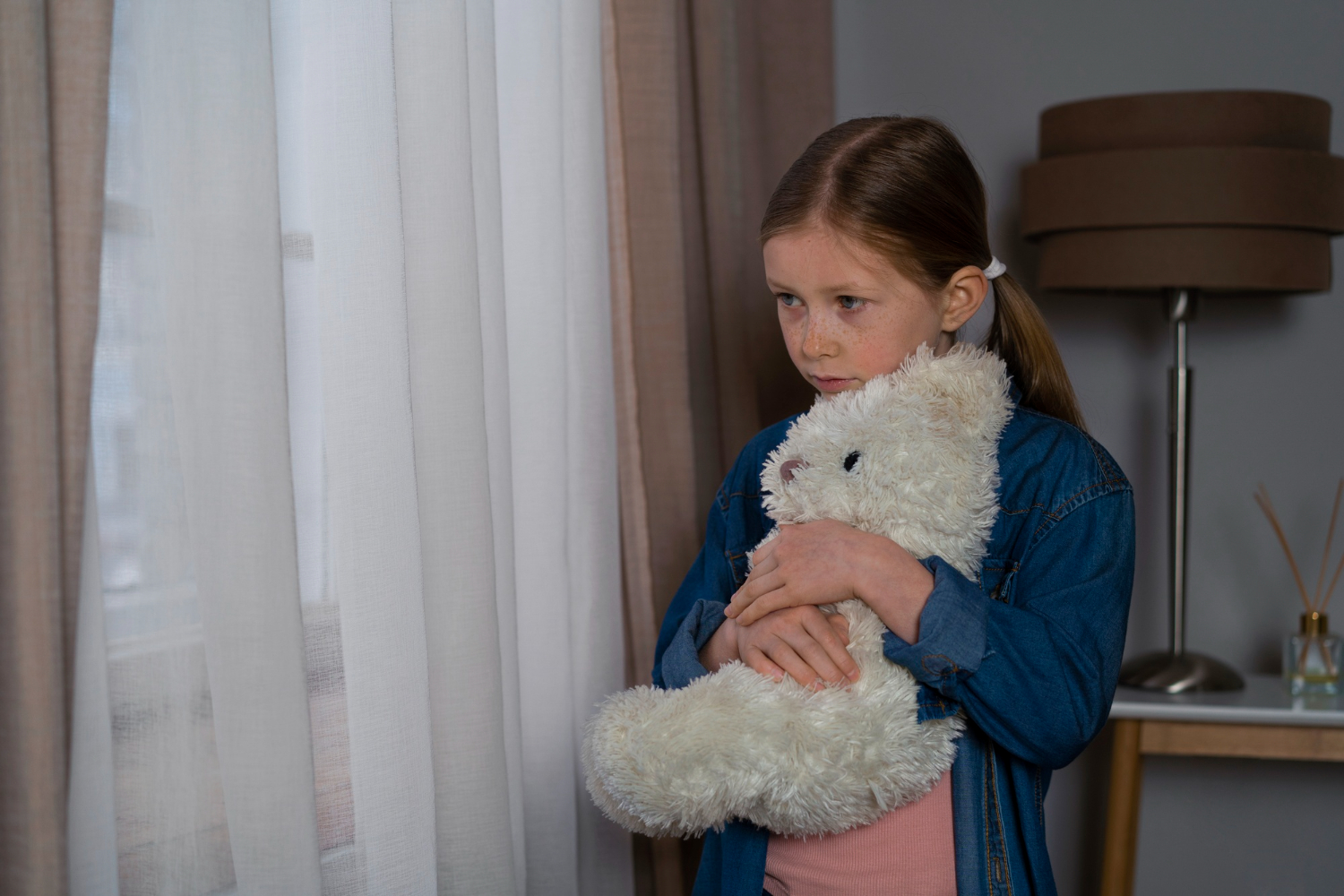
When I saw my eight-year-old granddaughter sitting alone in that crowded airport terminal, her pink backpack clutched between her knees and her eyes brimming with unshed tears, I knew something inside me had changed forever. I didn’t yell or run or cause a scene. I just walked toward her steadily, my heart pounding so loudly I thought everyone around me could hear it echoing through the cavernous space.
Lucy looked up and recognized me immediately. Her lips trembled, but she didn’t say anything—didn’t ask where her father was, didn’t explain why she was alone, didn’t cry. She just sat there with the heartbreaking stillness of a child who’d learned that making noise only made things worse. I took her small hand in mine, picked up her worn suitcase that looked like it had seen better days, and we walked out of there in complete silence, past families reuniting and travelers rushing to catch flights and the ordinary chaos of people going places while my granddaughter had been left behind like forgotten luggage.
On my phone, the text message still glowed like an open wound, the words searing themselves into my memory with each reading: “The family has decided she’s staying with you. Don’t try to contact us during the trip.”
My daughter-in-law Christine had sent it barely thirty minutes earlier—thirty minutes that my granddaughter had waited alone in one of the busiest airports in the state, surrounded by strangers, while her father Daniel boarded a first-class flight with his wife and her two children from a previous marriage. They were headed to Hawaii for two weeks, a “family bonding vacation” that apparently didn’t include his own daughter.
They didn’t ask me if I could take her. They didn’t warn me she was coming. They didn’t even tell Lucy what was happening until they’d already checked their luggage and were walking toward security. They just used me as a convenient drop-off point for what they no longer wanted to carry, discarding an eight-year-old child as casually as checking an unwanted bag.
I drove the entire way home in silence, my hands gripping the steering wheel so tightly my knuckles went white. Lucy stared out the window with her hands clenched in her lap, small fists balled up like she was trying to hold herself together through sheer physical force. I could feel her fear radiating through the car—her confusion, her shame, the terrible understanding that comes when a child realizes they’ve been abandoned. This wasn’t the first time they’d pushed her aside, made her feel unwanted, treated her like an inconvenience in their carefully curated life. It was just the first time they’d done it so cruelly, so publicly, so definitively that even Lucy couldn’t pretend anymore that she was part of their family.
When we arrived at my small house, I made her hot cocoa the way her mother used to make it—Lucy’s biological mother, my former daughter-in-law Anna, who had died in a car accident when Lucy was only four years old. I offered her the homemade chocolate chip cookies I always kept on hand for her visits. She ate quietly, slowly, carefully, as if she were afraid that making any sound or sudden movement might trigger some punishment or rejection she’d learned to anticipate.
I sat across from her at my kitchen table and just watched, really looked at this child I loved so fiercely it physically hurt. Lucy had her mother’s rich brown hair that fell in soft waves past her shoulders, my son’s distinctive green eyes that I’d once been so proud to see reflected in his face, and a sadness that no eight-year-old should ever have to carry in her small body. Her clothes were clean but obviously worn—hand-me-downs from Christine’s sons Ethan and Franklin, boys who were eleven and thirteen and whose outgrown clothing hung awkwardly on Lucy’s smaller frame. Her shoes had soles so worn through I could see her socks, and everything about her screamed the kind of neglect that comes from deliberate indifference rather than poverty.
That night, after I tucked her into the guest room I’d been slowly transforming into her permanent space over the past year as her visits grew longer and more frequent, I sat in my living room and reread Christine’s text message. Then I opened our entire message history, scrolling back through months and months of communications until my thumb went numb and my eyes burned with unshed tears.
There was so much more there than I’d let myself see before. So much evidence I’d been willfully ignoring because acknowledging it would have meant admitting my son had become someone I didn’t recognize.
For the past two years—ever since Daniel married Christine barely eighteen months after Anna’s death—the signs had been accumulating like storm clouds on a horizon I’d refused to look at directly. Texts where Christine complained that Lucy was “difficult,” “problematic,” “jealous of her boys and resentful of our new family dynamic.” Messages where Daniel asked me to watch Lucy more and more frequently, visits that stretched from weekends to weeks, always wrapped in transparent excuses: a last-minute business trip, an important client meeting, a romantic anniversary getaway to reconnect as a couple.
I had agreed every single time because I loved my granddaughter desperately, and because she was all I had left of Anna—the warm, funny, creative woman my son had loved before grief and loneliness had driven him into Christine’s calculated arms. Daniel had taken a year to rebuild his life after the accident, a year where I’d watched him struggle with single parenthood while working full-time and trying to help a traumatized four-year-old process the loss of her mother. Then he’d met Christine at some professional conference, and suddenly everything had moved at lightning speed.
Christine was divorced with two sons, polished and confident in ways that probably seemed like strength to my grieving, overwhelmed son. According to Daniel, she was perfect—organized, successful, mature, ready for commitment. They were engaged within four months and married two months after that. I’d raised concerns about the speed, about Lucy needing more time, about whether Christine was truly ready to be a stepmother to a grieving child. Daniel had dismissed every worry with the same reassuring phrases about Christine being amazing with kids, about blended families being completely normal now, about how this was exactly what Lucy needed—a stable mother figure and the structure of a complete family again.
He’d been so wrong.
From day one, Christine had made it painfully clear that Lucy was a problem to be managed rather than a child to be loved. She never said it directly, of course—she was far too clever for such obvious cruelty. It was always subtle, death by a thousand small cuts: comments about how Lucy was “overly shy and socially awkward,” how her boys were “so much more active and well-adjusted,” how it would be “better for everyone” if Lucy spent more time with me because I had “experience dealing with difficult children who needed extra attention.”
I’d swallowed my anger, my suspicions, my growing fears about what was happening in that house. I’d told myself repeatedly that things would improve with time, that blended families always struggled at first, that Daniel would eventually see what was happening and protect his daughter the way any decent father should.
He never did.
Every time Christine complained about Lucy’s supposed behavioral problems, Daniel nodded in agreement. Every time she suggested Lucy should spend another week or month with me, he called and presented it as doing me a favor—giving me quality time with my granddaughter, helping me avoid loneliness in my retirement. Every single time I tried to talk to him directly about how they were treating Lucy, about the changes I was seeing in her, about my concerns for her emotional wellbeing, he changed the subject or told me I didn’t understand how complicated it was to form a blended family, how Christine was doing her best, how I was being overly critical and making things harder.
Now, sitting in my living room with my phone in my trembling hands and the heavy silence of night pressing in around me, I understood something I should have understood months—maybe years—ago. This wasn’t an accident or a misunderstanding or a momentary lapse in judgment during a stressful travel day. This was a plan, carefully executed over time. Christine had systematically convinced my son that Lucy didn’t fit into their new family configuration, that she was a burden and a complication they’d be better off without. And Daniel—my own son, the boy I’d raised to value kindness and family and protecting those weaker than himself—had agreed to abandon his daughter in an airport as if she were a piece of unwanted luggage they could simply check and forget about.
I took a deep breath, trying to steady myself against the wave of rage and grief threatening to pull me under. My hands were trembling, but not from fear or uncertainty. It was something else entirely—a cold clarity, an absolute determination, the kind of focused purpose that comes when you finally stop hoping things will get better and start taking action to make them better yourself.
I stood up and walked quietly to the room where Lucy was sleeping. I opened the door carefully and saw her curled under the quilted comforter my mother had made decades ago, hugging the only stuffed animal she’d brought in her small suitcase—a gray bunny with a torn ear and fur worn smooth from years of desperate nighttime clutching. That bunny had belonged to Anna, had been one of the few items Lucy had been allowed to keep from her mother’s belongings after Daniel had packed everything else away with unseemly haste once Christine moved in.
It was the only thing Lucy had left of her mother, and they had abandoned Lucy with only that threadbare toy for company.
I closed the door silently and returned to the living room, where I picked up my phone with steady hands and scrolled through my contacts until I found the name I needed: Robert Hayes, my attorney and friend of more than thirty years, a man who had handled my divorce decades ago and had seen enough cases of family cruelty in his long career to know exactly what needed to be done and how to do it efficiently.
I sent him a brief text message: “I need to see you tomorrow morning. Urgent family matter. I have evidence of child abandonment and need to file for emergency custody.”
His reply came in less than five minutes, despite the late hour: “I’ll be at your house at 9 AM. Bring everything—texts, photos, any documentation you have. We’re going to fix this, Edna.”
I set the phone down and stared out my window at the quiet suburban street, lights glowing in neighboring houses where presumably normal families were going about their normal evening routines without having to contemplate filing legal action against their own children. Outside, the world continued its indifferent rotation, but inside my chest something fundamental had broken open—and something else, something harder and more determined, had been born in its place.
I didn’t cry that night. I didn’t allow myself the luxury of grief or the weakness of despair. I just breathed slowly and deeply, and I waited for morning, and I began planning the systematic legal destruction of my son’s comfortable new life.
The next morning arrived with autumn sunlight filtering through my kitchen window, painting everything in shades of gold that felt almost mocking given the darkness of what I was about to set in motion. I’d barely slept, my mind churning through scenarios and strategies and the thousand ways this could all go terribly wrong. But when Lucy shuffled into the kitchen around seven o’clock, still wearing the same clothes from yesterday because she hadn’t packed enough for an extended stay, I pushed all those fears aside and smiled at her with what I hoped looked like normal grandmotherly warmth.
“Good morning, sweetheart. Would you like pancakes?”
She nodded without speaking, those green eyes watching me warily as if expecting some trap or trick, some adult betrayal she’d learned to anticipate. I made breakfast while she sat at the table in silence, and when I placed a stack of fluffy pancakes in front of her with butter and syrup, she whispered an almost inaudible “Thank you” that broke my heart all over again.
We ate together without much conversation. I didn’t want to pressure her or force her to talk about what had happened before she was ready. Words would come when she felt safe enough, and my job now was to create that safety through consistency and patience and the kind of unconditional love she clearly hadn’t been receiving at home.
At exactly nine o’clock, my doorbell rang with the punctuality I’d always appreciated in Robert. I let him in and introduced him to Lucy as naturally as I could manage. “This is Mr. Hayes, honey. He’s an old friend of mine and we need to talk about some grown-up matters for a little while. Why don’t you watch television in the living room? I’ll join you in a bit.”
Lucy nodded and disappeared without questions, and I felt a pang of concern at how easily she complied, how little curiosity she showed about adult conversations that clearly involved her. That kind of passive acceptance wasn’t normal for an eight-year-old—it was learned behavior from a child who’d discovered that asking questions only led to trouble.
Robert and I settled at my dining room table, and I spent the next hour telling him everything while he took meticulous notes in his leather portfolio. I showed him Christine’s text message about leaving Lucy at the airport. I scrolled through the complete message history showing months of complaints about Lucy being “difficult” and “problematic,” Daniel’s increasingly frequent requests for me to take her for extended periods, the pattern of systematic exclusion that had been building for two years.
I showed him the photos I’d taken that morning of Lucy’s worn clothing, the shoes with holes in the soles, the small suitcase that barely contained two changes of clothes and a broken stuffed animal. I described the physical and emotional state I’d found her in—the dark circles under her eyes, the way she flinched at sudden movements, her fearful silence.
Robert listened without interruption, his expression growing progressively grimmer as the full scope of the situation became clear. When I finally finished, he looked up from his notes and met my eyes with the kind of serious intensity that had made him such an effective attorney for four decades.
“Edna, this is child abandonment—a serious criminal offense. They left an eight-year-old girl alone in a public airport without adult supervision for over thirty minutes. That constitutes criminal neglect by any legal standard.” He didn’t soften the words or wrap them in euphemisms. “We also have clear documentary evidence of a sustained pattern of emotional abuse and systematic exclusion. With what you’ve shown me, we can file for emergency temporary custody immediately and build toward permanent custody within a few months.”
I nodded slowly, feeling the weight of what I was about to trigger settle onto my shoulders like a physical burden. “What do you need from me?”
Robert closed his notebook with a decisive snap. “First, document everything from this point forward—every interaction with Lucy, her emotional state, her physical condition, anything she tells you about life at home. Second, take her to a pediatrician today for a complete medical evaluation. I want a professional assessment on record.”
He held up a third finger. “Third, and this is crucial—do not respond to any messages from Daniel or Christine. Nothing at all. When they return from their vacation and realize what’s happening, they’re going to try to manipulate you, threaten you, probably attempt to gaslight you into thinking you’re overreacting. Do not engage. Let me handle all communication through official legal channels.”
He paused, making sure I was following. “Fourth, I’m filing an emergency custody petition this afternoon. By tomorrow morning, you’ll have temporary legal custody of Lucy until we can arrange a full hearing.”
I sat back in my chair, processing the speed and scope of what he was proposing. Robert leaned forward with the kind of serious expression that demanded complete honesty.
“Edna, I need you to be absolutely certain about this path. Because once we file these papers, there’s no going back without serious consequences. This is going to permanently destroy your relationship with Daniel—there will be no reconciliation, no going back to how things were. There will be criminal charges filed against him and Christine. It’s going to be ugly, protracted, and emotionally devastating for everyone involved. So I’m asking you directly: are you truly ready for this?”
I met his gaze without flinching. “Robert, my son abandoned his eight-year-old daughter alone in an airport terminal while he boarded a first-class flight to Hawaii with his new family. He left her crying and terrified and completely alone while he chose his own comfort over her safety. There is no relationship left to destroy—he already destroyed it completely. I’m not doing this to punish him. I’m doing this because it’s the only way to protect my granddaughter from parents who have proven they’re willing to discard her when she becomes inconvenient.”
Robert nodded slowly, apparently satisfied with my answer. “Then we start today, and we don’t stop until Lucy is safe.”
He stood, gathered his notes, and gave my shoulder a brief squeeze before heading toward the door. “I’ll call you as soon as the emergency order is filed. In the meantime, take care of her—and document absolutely everything.”
After he left, I stood in my entryway for several long moments, feeling the enormity of what I’d just set in motion. My son was about to discover that his mother wasn’t the passive, compliant woman he’d apparently come to expect. He was about to learn that there were consequences for cruelty, and that some betrayals couldn’t be smoothed over with excuses and charm.
But when I looked into the living room and saw Lucy curled on my sofa clutching her worn bunny while cartoons played unwatched on the television, her expression still carrying that terrible blankness of a child who’d learned not to hope for anything, I knew with absolute certainty that I’d made the only choice possible.
That afternoon I took Lucy to see Dr. Patricia Morrison, a pediatrician I’d found who had extensive experience working with children from troubled home situations. Dr. Morrison was in her forties, with a warm smile and gentle manner that immediately put Lucy at ease. She conducted a thorough examination and then asked me to step outside for a few minutes so she could speak with Lucy privately.
When she called me back into the examination room twenty minutes later, her expression had shifted from professional warmth to barely concealed concern. “Mrs. Hayes, your granddaughter is physically healthy—no signs of physical abuse or serious neglect of basic needs. However, her emotional and psychological state is extremely concerning. Lucy exhibits classic symptoms of complex trauma: severe anxiety, deep-seated feelings of worthlessness, fear of abandonment, and what she described as feeling like she’s ‘always in the way’ and ‘making everyone’s life harder just by existing.'”
She handed me a thick manila folder. “These are not normal thought patterns for an eight-year-old child. They’re indicative of sustained emotional abuse and systematic rejection by primary caregivers. I’m recommending immediate therapeutic intervention with a child psychologist who specializes in trauma. I’m also documenting everything in her medical file with my professional assessment that this child has been subjected to significant psychological harm.”
She met my eyes directly. “If you need this documentation for legal purposes, everything is in this report. Use it however necessary to protect this child.”
We left the doctor’s office with the evidence I needed, and I took Lucy shopping for clothes that actually fit her properly. At first, she gravitated toward the cheapest items on the clearance racks, pointing at plain t-shirts and generic jeans with the practiced eye of a child who’d learned that expressing preferences or desires was dangerous. I gently encouraged her to choose things she actually liked rather than things that wouldn’t cause problems.
“Pick whatever makes you happy, sweetheart. Price doesn’t matter—this is about you having clothes that fit and that you enjoy wearing.”
Gradually, tentatively, she began selecting items that reflected actual personality rather than pure utility: a lavender dress with small white flowers, two pairs of comfortable jeans that weren’t hand-me-downs, several colorful shirts in her favorite shades of purple and blue, shoes that fit perfectly and weren’t falling apart, and a bright yellow backpack that made her smile—actually smile—for the first time since I’d found her at that airport.
At the register, the total came to over three hundred dollars. I didn’t care even slightly. Seeing that small, genuine smile on Lucy’s face was worth far more than money could measure.
When we returned home, Lucy tried on all her new clothes and paraded through my living room showing me each outfit with growing confidence. I applauded and told her how beautiful she looked, and for brief, fragile moments I caught glimpses of the child she should have always been allowed to be: happy, confident, secure in the knowledge that she was loved and valued.
That night we ordered pizza and watched a animated movie together. Lucy fell asleep halfway through, curled against my side with her head on my shoulder, and I carefully carried her to bed, tucked her in, and kissed her forehead the way I used to when she was tiny and her mother was still alive and the world hadn’t yet taught her that love was conditional.
As I was leaving her room, my phone vibrated with a text from Robert: “Emergency custody order approved by Judge Martinez. Effective immediately. Official documentation will be delivered tomorrow morning. Well done, Edna. Phase one complete.”
I sat in the darkness of my living room and allowed myself one small moment of triumph. Lucy was legally safe now, protected by court order from parents who had proven themselves unfit. The temporary custody was just the first step on what would be a long and difficult path, but it was a crucial step—one that meant Daniel and Christine could no longer simply take Lucy back on a whim or continue their pattern of abandonment and neglect.
Outside my window, the city continued its nightly rhythm of traffic and lights and the ordinary chaos of people living their lives. But inside my house, something fundamental had shifted. Lucy was under my protection now, legally and completely, and I had taken the first step on a path I knew would be painful and complicated but was absolutely necessary.
The following days settled into a routine that felt almost surreally normal given the legal chaos I knew was brewing beneath the surface. Lucy and I established simple patterns: breakfast together at the kitchen table, her drawing or watching approved television shows while I handled household tasks, lunch followed by homework or visits to the nearby park, evening story time before bed. Slowly, almost imperceptibly, I watched her begin to relax—shoulders that had been perpetually tense gradually dropping, responses that had been whispered monosyllables developing into actual sentences, even occasional questions about ordinary things like why leaves changed colors or whether we could plant flowers in the spring.
Every question was a small victory, every smile a minor miracle that filled me with hope and rage in equal measure—hope for Lucy’s recovery, rage at the people who had damaged her so badly she’d forgotten how to simply be a child.
But my nights were spent differently. After Lucy fell asleep, I sat with a glass of wine and forced myself to revisit memories I’d been avoiding, examining the past two years with new clarity and understanding all the warning signs I’d missed or deliberately ignored.
I remembered meeting Christine for the first time at a dinner Daniel had organized with too much enthusiasm and not enough genuine thought. She’d arrived with Ethan and Franklin, loud boys who dominated every space they entered with the confident entitlement of children who’d never been told no. Christine herself had been polished and charming, with perfectly styled hair and expensive clothes and that particular brand of corporate professionalism that some people mistake for actual personality. She’d talked extensively about her marketing career, her extensive travel, how wonderful it was to have found Daniel after her “difficult divorce” from a man she painted as incompetent and unreliable.
I’d listened politely while every instinct I possessed screamed warnings I chose to ignore. There was something calculated in the way Christine looked at Lucy—a coldness beneath the practiced smiles, a distance that felt deliberate rather than accidental. Lucy had been silent throughout that entire dinner, sitting at the corner of the table eating slowly without ever looking up or volunteering a word. When I’d tried to include her in conversation, Christine had smoothly interrupted with anecdotes about her own sons. When Lucy had accidentally spilled some water, Christine had sighed with theatrical patience while Daniel rushed to clean it up and told Lucy to be more careful next time.
I’d clenched my fists under that table and forced myself to keep smiling, to not ruin my son’s evening by pointing out that his new girlfriend was already treating his daughter like an unwanted burden.
The months that followed had been worse. Daniel started canceling our regular visits with Lucy, always with plausible excuses: Christine had planned a family outing to bond with her boys, the boys had sports activities that required everyone’s attendance, it would be better for Lucy to stay home because she needed to work on “adjusting to the new family dynamic.” When I finally managed to see Lucy again after a six-week gap, the change in her had been shocking—she’d lost weight, had dark circles under her eyes, spoke even less than before. When I’d asked if she was okay, she’d said yes in a voice so small I’d barely heard it.
I’d confronted Daniel, asked him directly what was happening to my granddaughter. He’d told me Lucy was going through a “difficult adjustment period” to the blended family situation and asked me to be patient while they worked through normal growing pains.
I’d given him that patience, and it had been a terrible mistake.
Seven days after filing the emergency custody order, everything erupted exactly as Robert had predicted. I was making lunch for Lucy when my phone began vibrating with the relentless intensity of an emergency—call after call, text after text, notifications flooding in like a digital avalanche. I looked down at the screen and saw Daniel’s name appearing over and over: once, twice, ten times, fifteen times within the span of three minutes.
I didn’t answer. Robert had been absolutely clear about maintaining no direct contact until the hearing. I let the phone continue its frantic buzzing on the kitchen counter while I calmly finished making sandwiches for Lucy, who was coloring in the living room, blissfully unaware of the chaos her father was creating.
The text messages flashed across my screen in increasingly desperate succession:
“Mom, what the hell is going on? Why do I have a court summons? Call me immediately.”
“This is insane. You can’t just take my daughter. Lucy is MY daughter, not yours.”
“We need to talk about this like rational adults. This is a huge misunderstanding.”
“Mom, PLEASE. Christine is hysterical. You’re destroying our family.”
Each message grew more frantic, more accusatory, more revealing of the panic that came from realizing that actions have consequences and that I wasn’t the pushover grandmother they’d apparently assumed I would always be.
Then Christine’s messages started arriving from her own phone, and these carried a different tone entirely—not panic, but calculated threat:
“Edna, I don’t know what Lucy has been telling you, but you need to understand that she exaggerates everything for attention. She’s always been a dramatic child who makes up stories to get sympathy. We never abandoned her—we just needed some family time with my boys without complications. If you don’t withdraw this ridiculous lawsuit immediately, you are going to regret it. I have lawyers who will destroy you.”
I read every word with a calmness that surprised even me. I felt no anger, no fear, no doubt. Just absolute certainty that I had made the right choice and that their reaction—the threats, the gaslighting, the attempts to rewrite reality—only confirmed everything I’d accused them of.
I took careful screenshots of every message and forwarded them all to Robert with a brief note: “Evidence of consciousness of guilt and attempted witness intimidation.”
His response was immediate and satisfied: “Perfect. This demonstrates they know exactly what they did and are trying to manipulate you into silence. Save everything. This helps our case considerably.”
An hour later, my phone rang from an unknown number. I answered cautiously, and a woman’s voice—professional, cold, calculated—introduced herself as Monica King, attorney representing Daniel and Christine in “this unfortunate matter.” She wanted to discuss reaching an “out-of-court settlement before things escalate unnecessarily.”
I listened in silence as she delivered what was clearly a rehearsed speech about misunderstandings and overreactions and how her clients were willing to acknowledge they “could have handled the situation better” and were prepared to establish a formal visitation schedule for me and even provide “reasonable financial compensation for any inconvenience.”
When she finally paused for breath, I laughed—a short, sharp sound that made her stop mid-sentence.
“Ms. King, you can tell your clients that abandoning an eight-year-old child alone in an airport isn’t a misunderstanding or a situation that could have been handled better. It’s a crime. And I’m not interested in visitation schedules or money. I’m interested in permanent custody of my granddaughter because her parents have proven they’re unfit to care for her. Good day.”
I hung up before she could respond, and my hand trembled slightly afterward—not from fear, but from adrenaline, from the rush of finally standing up to people who’d spent two years assuming I would always back down and accommodate their cruelty.
The attacks intensified over the following days. Text messages arrived from distant relatives I hadn’t spoken to in years, from friends of Daniel’s I barely knew, all repeating variations of the same script: “Don’t you think you’re overreacting? Kids are resilient, they bounce back. Don’t destroy your son’s life over one mistake. Think about how this affects his career, his reputation.”
Every call confirmed that Daniel and Christine were mobilizing their entire social network, building a narrative where I was the unreasonable villain and they were victims of a vindictive grandmother’s revenge fantasy. But I had something they didn’t: documented truth. Medical reports showing Lucy’s deteriorated emotional state. School records proving educational neglect—I’d discovered Lucy had missed forty-three days of school in the past year with no legitimate medical reasons. Screenshots of Christine’s complaints and Daniel’s complicity. Photographs of worn clothes and broken shoes and a child who looked like she was carrying the weight of the world on eight-year-old shoulders.
Robert compiled everything into a comprehensive file that was damning in its thoroughness. “Edna, you’re going to win this case,” he told me during one of our strategy sessions. “The evidence is overwhelming. But be prepared—they’re going to get uglier before this is over.”
The preliminary hearing arrived on a cold October morning. I dressed carefully in a conservative gray suit, pulled my hair into a neat bun, wore minimal makeup—Robert had advised me to look exactly like what I was: a responsible, serious, capable grandmother rather than someone emotional or dramatic. Lucy stayed home with my sister who’d traveled from out of state to help, and I was grateful she wouldn’t have to witness what was about to unfold.
The courtroom was smaller than I’d expected, more bureaucratic than dramatic, with beige walls and fluorescent lighting that made everything look slightly washed out and institutional. Daniel and Christine sat across the aisle with their attorney, and when Daniel’s eyes met mine for the first time since the airport, I saw rage and fear and something that might have been guilt fighting for dominance in his expression.
I felt nothing except determination.
The hearing proceeded with Robert presenting our evidence methodically: the airport abandonment, the text messages, Lucy’s medical evaluation, school records showing neglect, testimony from neighbors. Judge Martinez—a serious man in his sixties with white hair and an expression that suggested he’d seen every variation of human cruelty and stupidity—listened with growing severity.
When Daniel’s attorney tried to portray this as a “misunderstanding” and questioned whether I was physically capable of raising a young child at sixty-seven, the judge interrupted sharply.
“Counselor, I have reviewed the Child Protective Services report. This isn’t one mistake—this is a documented pattern of neglect spanning two years. Your client left an eight-year-old alone in an airport for thirty-two minutes without supervision. During that time, she could have been kidnapped, harmed, or lost. Are you seriously arguing that represents acceptable parenting?”
The attorney’s attempts to recover fell flat. Judge Martinez removed his glasses and delivered his ruling with cold precision: “I am granting temporary custody of the minor to her grandmother, Mrs. Edna Hayes, pending the permanent custody hearing in ninety days. During this period, the father may have supervised visitation twice monthly. All contact between the minor and Mrs. Christine is prohibited. I’m also ordering psychological evaluations of all parties before the final hearing.”
The gavel came down with finality, and I had won the first critical battle.
That night, when I told Lucy the news in age-appropriate terms—that she would be staying with me for a while, that a judge had said it was okay, that she was safe—she hugged me so tightly I could barely breathe and whispered, “Thank you for not leaving me, Grandma.”
The permanent custody hearing came ninety days later, after Daniel had missed most of his scheduled visitations and the psychological evaluation had confirmed everything I’d said: Lucy showed signs of complex trauma from systematic rejection, Daniel demonstrated inability to prioritize his daughter’s needs over personal convenience, and Christine exhibited narcissistic traits that made her actively harmful to Lucy’s development.
Judge Martinez granted me permanent legal custody, terminated Christine’s parental rights entirely, and reduced Daniel to monthly supervised visits contingent on completing therapy. He also ordered Daniel to pay $1,200 monthly child support.
When I returned home and told Lucy she would live with me forever, she smiled—genuinely, brilliantly smiled—and said, “I already knew. This feels like home.”
A year later, Lucy was thriving. Her grades had improved dramatically, she had friends, her nightmares had mostly stopped, and she laughed with the unselfconscious joy of a child who finally felt safe. We planted a garden together—sunflowers and lavender and daisies—and watched it grow from dark soil into something beautiful and bright.
Daniel eventually completed his court-ordered therapy and expressed genuine remorse, though our relationship would never recover. Christine disappeared entirely after her divorce from Daniel, moving out of state to escape the scandal.
One spring afternoon, sitting in our garden watching butterflies, Lucy asked me, “Do you ever regret fighting for me and losing Dad?”
I didn’t hesitate. “Never. Not for a single moment. Because you deserved to be protected, and that will always matter more than anything else.”
She smiled and leaned against my shoulder. “I don’t regret anything either. Because now I have a real home.”
And in that simple truth, I understood what victory actually meant—not a courtroom ruling or legal documents, but a child who had been broken learning to run free under open sky, secure in the knowledge that she was loved unconditionally and would never be abandoned again.
They had left her at an airport thinking they were solving a problem, but all they’d done was give me the opportunity to do what they should have done all along: choose her, protect her, love her without condition or reservation.
And I would keep choosing her, every single day, for the rest of my life.

Ethan Blake is a skilled Creative Content Specialist with a talent for crafting engaging and thought-provoking narratives. With a strong background in storytelling and digital content creation, Ethan brings a unique perspective to his role at TheArchivists, where he curates and produces captivating content for a global audience.
Ethan holds a degree in Communications from Zurich University, where he developed his expertise in storytelling, media strategy, and audience engagement. Known for his ability to blend creativity with analytical precision, he excels at creating content that not only entertains but also connects deeply with readers.
At TheArchivists, Ethan specializes in uncovering compelling stories that reflect a wide range of human experiences. His work is celebrated for its authenticity, creativity, and ability to spark meaningful conversations, earning him recognition among peers and readers alike.
Passionate about the art of storytelling, Ethan enjoys exploring themes of culture, history, and personal growth, aiming to inspire and inform with every piece he creates. Dedicated to making a lasting impact, Ethan continues to push boundaries in the ever-evolving world of digital content.