The Dinner That Changed Everything
I arrived at Carmichael’s that evening, slipping through the heavy mahogany doors into the warm amber glow of the restaurant’s interior. The place had that particular atmosphere of understated wealth—the kind where everything whispers money rather than shouting it. Crystal chandeliers hung like frozen waterfalls from the vaulted ceiling, and the air carried the mingled scents of aged wine, seared meat, and something floral I couldn’t quite place.
The hostess, a young woman in a crisp black dress with her hair pulled back so tightly it looked painful, greeted me with a smile that had been professionally calibrated to be welcoming without being warm. She consulted her leather-bound reservation book with the gravity of someone handling sacred texts.
“Mr. Harrison?” she asked, though she clearly already knew the answer.
I nodded, and she gestured for me to follow her through the main dining room, past tables occupied by couples leaning in toward each other and businessmen conducting deals over cognac. We moved toward the back, where the restaurant kept its private dining rooms—the spaces reserved for celebrations, proposals, and apparently, whatever this evening was about to become.
The sound reached me before I turned the corner. Laughter. Not the warm, inclusive kind that makes you smile even before you know the joke. This was different. This was the laughter that exists in the space between people who share a secret, the kind that creates an invisible wall between those who are in on it and those who aren’t.
I heard it pause as my footsteps approached, felt it hang in the air like a held breath, and then resume just slightly different—more controlled, more aware. The hostess pulled open the door to the private room, and I stepped inside to find exactly what I’d somehow known I would find.
The dinner was over.
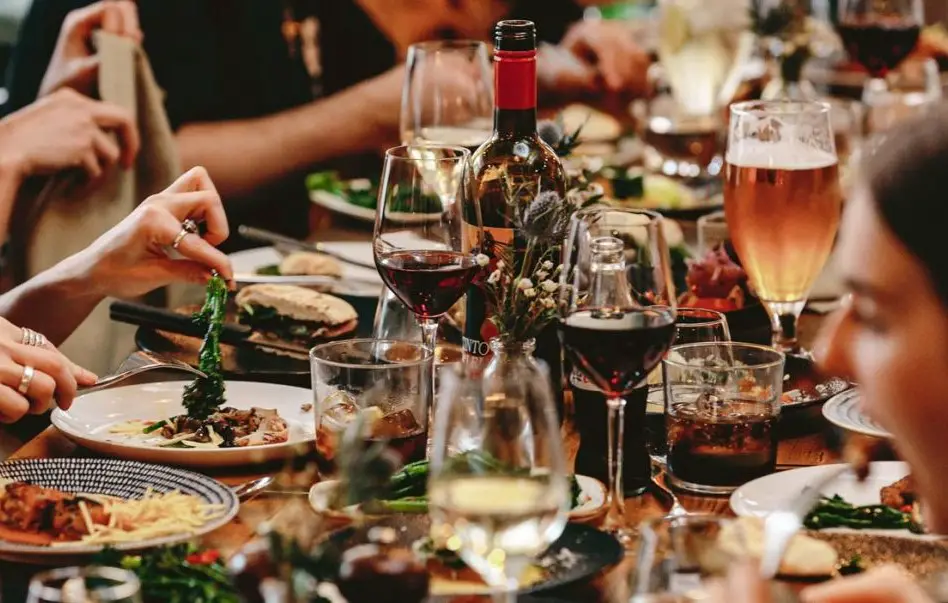
Not just the main course, but everything. The table before me was a landscape of completion. Plates sat empty, scraped so clean they could have gone back in the cupboard. Steak bones lay bare, stripped of every bit of meat worth having. Wine glasses stood at various levels of emptiness, some drained, others abandoned mid-sip like the drinker had lost interest. Crumpled napkins lay scattered like fallen flags. A cheese board had been picked over until only the rind remained.
At the far end of the table sat my son.
Daniel was thirty-two years old, dressed in a navy suit that probably cost more than my monthly rent, his hair styled with that casual precision that actually requires careful attention. He had inherited his mother’s sharp cheekbones and her ability to smile without conveying any actual warmth. The napkin beside his plate was folded with geometric precision, resting next to a dessert plate that bore the dark smears of what had probably been chocolate torte or flourless cake—something rich and final.
He looked up at my entrance, and I waited for him to stand, to come greet me, to offer some explanation for why I was arriving to a meal that had clearly ended thirty minutes ago. Instead, he remained seated, his posture relaxed in a way that felt deliberate, practiced.
“Dad,” he said, and that single word carried layers I wasn’t sure I wanted to unpack. “You made it.”
There was something in his tone—not quite mockery, not quite relief, but something that lived in the territory between acknowledgment and dismissal. His eyes held mine for exactly one second before sliding away, as if the effort of the connection had already exhausted him.
To his right sat Evelyn, my daughter-in-law of three years. She didn’t look up from her phone, which glowed in her hands like a talisman. Her blonde hair fell in careful waves over her shoulders, and she wore a dress the color of champagne that probably cost more than my car payment. Her fingers moved across the screen with practiced efficiency, scrolling, tapping, scrolling again. If she registered my arrival at all, she gave no sign of it.
At the head of the table, positioned like royalty surveying their domain, sat Thomas and Linda Carter—Evelyn’s parents. Thomas wore a charcoal suit with a pocket square that matched his silver hair, and his watch caught the light whenever he moved his wrist. Linda had that particular look of wealthy women of a certain age: impossibly smooth skin, strategic highlights, jewelry that whispered rather than shouted. They both turned to look at me with expressions that suggested they were evaluating a piece of furniture they were considering purchasing but weren’t quite sure would fit the décor.
The room itself felt too warm, too close. A single chandelier hung over the table, smaller than the ones in the main dining room but still elaborate enough to feel excessive. Dark wood paneling absorbed the light, and heavy curtains blocked out any view of the outside world. We could have been anywhere. We could have been nowhere.
My eyes scanned the table, looking for a place that had been set for me, some indication that my arrival had been anticipated and prepared for. There, near the wall, almost as an afterthought, sat a single empty chair. No plate. No silverware. No wine glass. Just a chair, pushed slightly away from the table as if it had been added at the last minute, grudgingly, when someone remembered that I was supposed to be included.
Daniel’s eyes followed mine to that empty seat, and then he said it—delivered the line with the casual confidence of someone who has rehearsed something so many times it sounds natural:
“You’re late. You’ll cover the bill, right?”
The words hung in the air like cigarette smoke.
Evelyn laughed—a sharp, bright sound like glass breaking. Thomas chuckled, a deep rumble of approval. Linda smiled behind her wine glass, her eyes glittering with something that might have been amusement or might have been something darker.
And I understood, in that moment, that this had been planned. Not just this evening, not just this dinner, but this exact moment. My arrival. My lateness. The empty table. The punchline.
I was the joke.
I could have left. Should have, probably. Could have turned around, walked back through that door, past the hostess, out into the cold evening air where my car sat parked three blocks away because I’d spent twenty minutes circling, looking for street parking rather than paying for the garage. Could have driven home to my small apartment with the leaking faucet I kept meaning to fix and the television that only got basic cable.
But I didn’t.
Instead, I walked to that chair near the wall and sat down, pulling myself toward the table even though there was no place set for me. I sat because leaving would have given them exactly what they wanted—confirmation that I could be dismissed, that I knew my place, that I understood the hierarchy and accepted it.
The conversation resumed almost immediately, flowing around me like I was a stone in a stream.
Thomas leaned back in his chair, swirling the wine in his glass with the kind of practiced motion that suggested he’d taken classes on it. “We were discussing investments,” he said, his eyes sliding toward me and then away, as if he’d looked at something vaguely distasteful. “Portfolio diversification, really. Probably not your area, Richard, but feel free to listen. You might learn something.”
His tone was so carefully calibrated—not outright rude, not explicitly dismissive, but containing just enough condescension to make his point clear. I was allowed to be present, but I was not expected to contribute. I was an observer, not a participant.
Linda set down her wine glass with delicate precision and tilted her head at me, her smile thin and sharp. “Don’t be cruel, Thomas,” she said, though her tone suggested she was enjoying the cruelty quite a bit. “I’m sure Richard has hobbies. Just… different ones. Simpler ones. Do you fish, Richard? Or maybe woodworking? I’ve always thought woodworking had a certain… rustic charm.”
The word “rustic” landed like a small stone dropped into still water, sending ripples of implication outward. Rustic meant unsophisticated. Rustic meant rural. Rustic meant less than.
Evelyn finally looked up from her phone, and for the first time, she seemed to truly see me. But there was no warmth in her gaze, no recognition of our shared history—the holidays I’d attended, the birthday gifts I’d carefully chosen, the times I’d tried to build a bridge between us. Instead, her look was calculating, measuring. She was taking inventory, cataloging my worth, and from her expression, finding the balance wanting.
“Richard’s more of a… practical person,” she said, addressing her parents rather than me, as if I wasn’t sitting right there. “Not really interested in the finer things. Prefers, what was it you told me, Daniel? Simple pleasures?”
Daniel shifted in his seat, finally looking up from the water glass he’d been studying with intense fascination. For a moment—just a brief flicker—I saw something in his face that might have been shame or discomfort. But it passed quickly, replaced by a carefully neutral expression.
“Dad likes what he likes,” Daniel said, which wasn’t a defense but wasn’t quite an attack either. It was a careful neutrality, the kind of statement that allowed him to avoid taking sides.
The conversation moved on, and I sat in my chair near the wall, listening to them discuss things I had no part in. They talked about vacation homes and market trends. They debated the merits of European travel versus Caribbean retreats. Linda mentioned a gallery opening. Thomas described a golf outing with someone whose last name I vaguely recognized from news headlines. Evelyn showed them something on her phone—photos of a house they were considering, apparently, or maybe remodeling plans for their current one.
“Our future,” Evelyn kept saying, and each time she did, Daniel nodded, and I noticed that “our” never seemed to expand to include anyone beyond the two of them. There was their future, and then there was everyone else, and I was definitely in the category of everyone else.
The waiter appeared once, asking if I’d like to order anything, and the table went quiet in a way that felt pointed. I could feel their eyes on me, waiting to see what I would do. If I ordered, I would be presumptuous—arriving late and still expecting to be fed. If I didn’t order, I would be confirming my role as an outsider, someone who wasn’t really part of the meal anyway.
“Just water,” I said, and the waiter nodded and disappeared, and the conversation resumed as if there had been no interruption at all.
Time passed—I’m not sure how much. Twenty minutes? Forty? The conversation washed over me in waves, and I found myself studying my son’s face, looking for traces of the boy I’d raised. The kid who used to sit on my shoulders at parades. The teenager who’d come to me, nervous, before asking a girl to prom. The young man who’d called me from college, homesick and overwhelmed.
Where had that person gone? Or had he ever really existed outside of my memory?
Finally, the waiter returned, and this time he carried a leather folder—the kind restaurants use to present the check when they want to make it feel like less of a transaction and more of a ceremony. He set it in the center of the table with a small nod and retreated quickly, as if he could sense the tension gathering like a storm.
No one moved.
The folder sat there, unopened, and I could feel the weight of expectation settling over the room. Thomas reached for his wine glass. Linda examined her nails. Evelyn returned to her phone. And Daniel… Daniel stared at that folder like it was something dangerous, something that might bite if approached too quickly.
Then, with a motion that was so casual it had to have been rehearsed, Daniel reached out and slid the folder across the polished wood surface. It glided smoothly, making a soft whisking sound, and came to rest directly in front of me.
I looked at it. At the smooth leather. At the restaurant’s embossed logo in gold. At the expectation made manifest.
I opened it.
$847.
Eight hundred and forty-seven dollars for food I had never touched, wine I hadn’t tasted, desserts I hadn’t seen. For a meal I had arrived to find already finished, a party I had been invited to but not included in, a family gathering where I was present but not welcome.
The itemized list told a story: oysters, appetizers I couldn’t pronounce, steaks aged and expensive, sides that cost more than I typically spent on groceries for a week, bottles of wine I recognized from magazines, desserts that were probably architectural marvels of chocolate and sugar.
For a long moment, I sat there, staring at those numbers. In my head, I did the math I’d been doing my whole life—the calculation of what I could afford versus what was being asked of me. The rent. The car payment. The medical bills I was still paying off in installments. The careful budgeting that was the architecture of my entire existence.
And I thought about all the other times. The graduation dinner where I’d picked up the tab. The wedding where I’d stretched my budget to the breaking point to give them what they wanted. The housewarmings and birthdays and celebrations where my gift had been my presence and my checkbook.
I thought about sitting in that chair near the wall, invisible and dismissed, while they laughed and planned their future and made it clear, without ever saying it directly, that I was an obligation, not a joy. An inconvenience, not a connection.
For years—decades, really—I had done what I thought fathers were supposed to do. I had provided. I had sacrificed. I had paid. Even when it hurt, even when it meant going without myself, I had shown up with my wallet open and my complaints swallowed.
Because that was love, wasn’t it? That was what family meant. You gave, even when it wasn’t easy. You supported, even when you weren’t appreciated.
But sitting there, in that overheated room with its dark paneling and elaborate chandelier, looking at a bill for a meal I hadn’t eaten while my son avoided my eyes and my daughter-in-law smirked at her phone and her parents regarded me like I was hired help, something inside me shifted.
Not with anger, exactly. Not with the hot, explosive fury that makes people raise their voices or storm out or make dramatic pronouncements.
No, this was something quieter. Colder. A stillness that settled into my bones like winter frost.
I looked at their faces—at the confidence written there, the entitlement so deep they didn’t even recognize it as entitlement. They simply expected. They simply assumed. They simply knew, with the certainty of people who had never been told no, that I would comply. That I would sigh and pull out my credit card and pay for the privilege of being ignored. That I would smile and nod and say it was fine, really, happy to do it.
And something in me said: No.
Not loudly. Not dramatically. Just… no.
I pulled out my phone, and the motion drew their eyes. They watched, curious, as I scrolled through my contacts. Found the number I needed.
“Excuse me,” I said, my voice perfectly calm, perfectly level. “Could I speak to the manager?”
The effect was immediate and electric.
Thomas’s hand froze mid-reach for his wine glass. Linda’s smile faltered, then fixed itself back in place, but with an edge of uncertainty now. Evelyn looked up from her phone, her expression sharp with sudden alertness. And Daniel—Daniel’s face went through a series of expressions so quickly I couldn’t track them all: surprise, confusion, fear, and something that might have been recognition.
“Dad—” he started, but I held up one finger—not rudely, just a small gesture asking for patience—and he fell silent.
The table had gone completely quiet. The laughter from before was a distant memory. Now there was only the sound of my phone ringing, and then a voice answering, professional and curious.
“Yes, this is Richard Harrison. I’m in the private dining room with the Carter party. I believe there may have been some confusion about the billing, and I’d appreciate if you could come help us sort it out. Thank you.”
I ended the call and set my phone down gently on the table.
“Richard,” Thomas said, and now his voice had lost that casual superiority. Now there was an edge to it, a warning. “I don’t think that’s necessary—”
“What are you doing?” Evelyn cut in, no longer pretending to be disengaged. Her eyes were sharp, calculating. “This is embarrassing.”
“Dad, just—” Daniel tried again, but whatever he was going to say died when the door opened.
The manager was a man in his fifties with silver at his temples and the kind of professional demeanor that comes from years of handling difficult situations. His name tag read “Marcus,” and his expression was pleasant but alert as he took in the scene: the cleared table, the uncomfortable faces, me sitting alone with the check in front of me.
“Good evening,” he said smoothly. “I understand there may be some confusion about the bill?”
I smiled at him—genuinely, because he hadn’t done anything wrong. “Actually, I was hoping you could help clarify something. When was the reservation made for this evening?”
Marcus glanced at the table, then back to me. “I’d need to check our system—”
“It was made last week,” Evelyn interrupted, her voice sharp. “What does that matter?”
“And,” I continued, addressing Marcus but speaking loud enough for everyone to hear, “what time was the reservation for?”
Now Marcus looked uncomfortable, sensing he was walking into something. “I believe… the reservation was for six o’clock, sir.”
“Six o’clock,” I repeated, letting the words settle. “And what time is it now?”
“It’s just after seven-thirty, sir.”
I nodded, keeping my voice level, factual. “I was invited for seven. My son sent me a text message last week saying the dinner would be at seven, and I should meet them here.” I pulled out my phone and scrolled to the message, holding it up. “Here it is. ‘Dinner at Carmichael’s, 7 PM, see you there.'”
The silence in the room was profound.
Marcus’s eyes swept the table again, and I could see him piecing it together—the timing, the empty plates, the single chair with no place setting.
“So you see,” I continued, still in that same calm tone, “I was invited to arrive after the meal was over. I was invited to a dinner that had already been eaten. And now I’m being asked to pay for food I never had the opportunity to touch.”
“That’s not—” Daniel started, but his voice cracked.
“Isn’t it?” I asked, looking at my son directly for the first time since I’d sat down. “Tell me, Daniel. Tell me honestly. Was this always the plan?”
He opened his mouth, closed it. His face had gone pale.
Thomas cleared his throat, trying to regain control. “Now, Richard, I think you’re making something out of nothing—”
“Am I?” I turned to face him. “Because from where I’m sitting, it seems pretty clear. You had a nice dinner. You enjoyed expensive wine and premium steaks. You had dessert and coffee. And then you invited me to arrive just in time to pay the bill. You turned me into a punch line and an ATM.”
Linda made a small sound—not quite a gasp, not quite a protest. Evelyn’s face had gone rigid with fury.
Marcus shifted his weight, and I could tell he was trying to figure out the diplomatic solution here, the way to smooth this over that wouldn’t cost the restaurant a future customer.
“Perhaps,” he said carefully, “we could discuss some accommodation—”
“Actually,” I said, cutting him off gently but firmly, “I’d like to propose something different. I’d like you to split this bill six ways—one for each person who actually ate this meal. Because I didn’t have a single bite. I didn’t have a sip of wine. I wasn’t even here for the dinner. I was invited to the aftermath.”
“This is ridiculous,” Evelyn hissed. “Thomas, are you going to let him—”
“Let me what?” I asked, my voice still calm but with steel underneath now. “Refuse to pay for something I didn’t consume? Set a boundary? Stop allowing myself to be used?”
Daniel flinched at the word “used,” and good—he should flinch. He should feel that.
“Dad, I…” He swallowed hard, and now, finally, he looked like he might cry. “I didn’t… Evelyn said…”
“Don’t you dare,” Evelyn snapped at him, her composure finally cracking. “Don’t you dare put this on me.”
But it was too late. The fissure had opened.
“She said what?” I asked quietly. “She said it would be funny? She said I wouldn’t notice? She said I’d pay anyway because I always do?”
The truth hung in the air, unspoken but deafening.
Marcus, to his credit, handled the situation with remarkable grace. “I’m going to step outside for a moment while you all discuss this. But I should mention that our policy is quite clear: individuals are responsible for their own meals unless prior arrangements have been made. We can certainly split the bill six ways if that’s what the party decides.”
He left, pulling the door closed behind him, and suddenly the room felt much smaller.
“You’re ruining everything,” Evelyn said, her voice low and venomous. “This was supposed to be a celebration of our—”
“Of your what?” I asked. “Because it certainly wasn’t a celebration that included me. I was the entertainment. The finale. The guy who shows up to clean up the mess.”
Thomas tried one more time, his voice carrying that particular authority wealthy men use when they’re accustomed to being obeyed. “Richard, you’re being unnecessarily difficult about a simple dinner—”
“There was nothing simple about this,” I said, cutting him off. “And you know it. Every single person at this table knows exactly what this was.”
Linda, who had been silent, finally spoke. Her voice was quieter than her husband’s, but somehow more cutting. “Well, I suppose we know now what kind of man you really are. Too proud to help his own son.”
The accusation hung there, designed to wound, to make me doubt myself.
But I didn’t doubt. Not anymore.
“You’re right,” I said, standing up slowly. “You do know what kind of man I am. I’m the kind of man who shows up when he’s invited, even when he has to circle the block looking for parking he can afford. I’m the kind of man who will sit in a chair against the wall while his family ignores him, because he hopes that maybe, somehow, it means something that he’s there. I’m the kind of man who has spent years trying to buy love with a checkbook because he’s too afraid to ask why love is the only thing he’s never been given freely.”
My voice didn’t rise, but each word landed with weight.
“But I’m also the kind of man who can finally see when he’s being played. When he’s being used. When he’s being treated not like family, but like a resource to be extracted.”
I looked at Daniel, and my heart broke a little, because underneath the expensive suit and the careful hair, I could still see my son. Still see the possibility of who he might have been, who he might still become, if he could find the courage to be his own person.
“I love you,” I told him, and I meant it. “But I won’t be doing this anymore. I won’t be the punchline. I won’t be the ATM. If you want a relationship with me—a real one—I’m here. But it’s going to be built on respect, or it’s not going to be built at all.”
I pulled out my wallet and removed a twenty-dollar bill. I set it on the table.
“That’s for the water I drank,” I said. “And the waiter’s time.”
Then I walked to the door, pulled it open, and stepped out into the main dining room. Marcus was waiting nearby, and I walked over to him.
“I apologize for any disruption,” I told him. “The bill should be split six ways, charged to the people who actually had the meal. If there’s any problem with that, they can call the police, and we can discuss fraud charges for deliberately inviting someone under false pretenses to stick them with a bill.”
Marcus nodded slowly. “I understand, sir. And for what it’s worth… I hope things improve for you.”
There was kindness in his eyes, and I felt a sudden swell of gratitude for this stranger who had witnessed my humiliation and responded with humanity.
“Thank you,” I said. “I think they already have.”
I walked through the restaurant, past the couples and the businessmen, past the elaborate chandeliers and the hushed conversations. I walked out into the cool evening air, and for the first time in what felt like years, I could breathe.
My car was three blocks away. The walk felt good.
I never heard from Daniel after that night. Not a call, not a text, not a letter. The silence stretched out for weeks, then months. I grieved it—grieved the relationship I’d thought we had, grieved the son I’d tried to be a father to, grieved all the years I’d spent trying to earn something that should never have had to be earned.
But I also felt lighter.
I sold some things I didn’t need. I paid off the medical bills ahead of schedule. I fixed the leaking faucet. I started taking morning walks and discovered I liked the quiet of the neighborhood at dawn. I joined a woodworking class—and yes, there was something rustic and satisfying about creating something with my hands that didn’t require anyone’s approval but my own.
I built a bookshelf. It wasn’t fancy, but it was sturdy and honest, and it held my books without asking anything in return.
Six months after that dinner, I got an email from Daniel. Just a few lines: “I’m sorry. I should have been better. I want to try again, if you’re willing. No restaurants. No parents. Just us. Coffee?”
I stared at that email for a long time. Read it over and over, looking for the catch, the angle, the hidden expectation.
But all I found were words that sounded like they came from someone who was finally ready to be honest.
I wrote back: “Coffee sounds good. Wednesday at ten?”
We met at a small place in a neighborhood neither of us had associations with—neutral ground. We were awkward at first, like strangers learning to speak the same language. But we talked. Really talked. And for the first time in years, I saw my son—not the performance he put on for his wife and her parents, not the person he thought he was supposed to be, but the human underneath all of that, flawed and scared and trying.
It wasn’t perfect. It wasn’t magically fixed. But it was real.
And real, I discovered, was worth so much more than the performance I’d been paying for all those years.
We met for coffee every Wednesday after that. Sometimes we talked about important things. Sometimes we talked about nothing at all. But he showed up. I showed up. And slowly, carefully, we built something that looked like a relationship—one that didn’t require a leather folder with a bill at the end.
That night at Carmichael’s taught me something I’d been avoiding my whole life: that love without respect isn’t love at all. It’s just transaction. And I was done being for sale.
I was done being late to dinners I was never meant to enjoy.
I was done being the punchline.
I was, finally, done.
THE END

Ethan Blake is a skilled Creative Content Specialist with a talent for crafting engaging and thought-provoking narratives. With a strong background in storytelling and digital content creation, Ethan brings a unique perspective to his role at TheArchivists, where he curates and produces captivating content for a global audience.
Ethan holds a degree in Communications from Zurich University, where he developed his expertise in storytelling, media strategy, and audience engagement. Known for his ability to blend creativity with analytical precision, he excels at creating content that not only entertains but also connects deeply with readers.
At TheArchivists, Ethan specializes in uncovering compelling stories that reflect a wide range of human experiences. His work is celebrated for its authenticity, creativity, and ability to spark meaningful conversations, earning him recognition among peers and readers alike.
Passionate about the art of storytelling, Ethan enjoys exploring themes of culture, history, and personal growth, aiming to inspire and inform with every piece he creates. Dedicated to making a lasting impact, Ethan continues to push boundaries in the ever-evolving world of digital content.