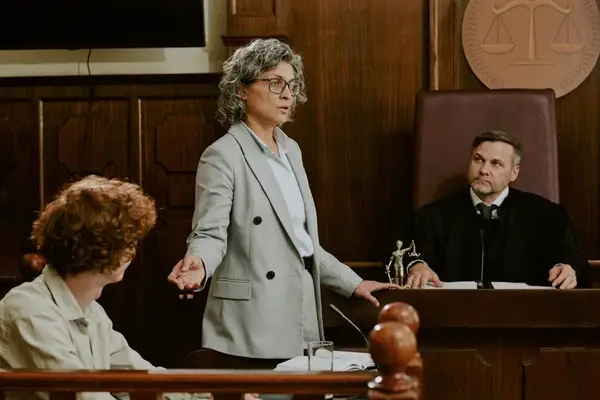
I never imagined that the most humiliating moment of my marriage would unfold in a courtroom packed with strangers, with my baby asleep in my arms and my husband publicly declaring me worthless.
But that’s exactly what happened.
The county courthouse smelled like old wood polish and stale coffee, with an underlying hint of that particular cold that seems to live permanently in government buildings. I remember adjusting my grip around my son Noah, who was barely six months old, his tiny body warm and solid against my chest. His miniature chest rose and fell with the steady rhythm of infant sleep, completely unaware that his parents were about to legally sever their marriage in front of a judge and a courtroom full of curious onlookers.
My husband Eric stood across the aisle in a tailored charcoal suit that probably cost more than my entire outfit. He looked confident—no, more than that. He looked almost smug, like someone who knew he was about to win a game that only he understood the rules to.
This wasn’t just a divorce hearing for Eric. This was a performance. A public declaration of his superiority and my complete dependence.
The Marriage That Slowly Erased Me
We had been married for seven years—seven years that felt, in retrospect, like watching myself disappear one small compromise at a time.
For most of that time, I’d been a stay-at-home mother. But that decision hadn’t really been mine, not in any meaningful way.
“You don’t need to work, Sarah,” Eric used to say in that confident tone that made disagreement feel like foolishness. “I make plenty. I’ll take care of everything. You just focus on making our home perfect.”
And like an idiot, I believed him.
I gave up my marketing coordinator position at a mid-sized firm where I’d been up for promotion. I moved three hours away from my closest friends when Eric got transferred to his company’s headquarters. I poured every ounce of my energy and creativity into our home, our marriage, and then—when Noah arrived—into our child.
Somewhere along the way, without me quite noticing when it happened, Eric decided that my lack of a paycheck meant I was replaceable. Disposable. Worth exactly nothing.
The affairs started around year five. I didn’t have proof at first—just that sick intuition that something fundamental had shifted. Late nights at the office that smelled like perfume. Business trips that included mysterious charges at expensive restaurants. A distance in his eyes when he looked at me, like I was furniture he’d grown tired of.
When I finally confronted him with the credit card receipts and the text messages I’d found on the phone bill, he didn’t even bother denying it.
“What did you expect?” he’d said coldly. “You let yourself go. You stopped being interesting. All you talk about is baby schedules and grocery shopping.”
As if seven years of him insisting I stay home, insisting I focus entirely on domestic life, hadn’t been exactly what created that situation.
When I said I wanted a divorce, he laughed.
“Go ahead,” he said. “You have nothing. No income, no savings in your name, no career to go back to. You’ll be lucky if I don’t get full custody and you end up living in some shitty apartment, paying me child support.”
That’s when I knew he didn’t just want a divorce. He wanted to destroy me.
The Courthouse Showdown
When the judge—the Honorable Patricia Morrison, a woman in her sixties with steel-gray hair and no-nonsense eyes—asked Eric to present his position on custody and asset division, he didn’t hesitate for even a second.
“Your Honor,” he began, his voice carrying that corporate presentation confidence, “I’m requesting full custody of our son Noah.”
He gestured toward me like I was an exhibit in a trial.
“My wife has been unemployed for six years. She has no current income, no assets in her name, no practical plan for supporting herself, let alone a child. I have a stable six-figure income, excellent health insurance, and a home environment that can provide for Noah’s needs.”
Audible gasps rippled through the courtroom. Several people in the gallery—mostly there for other cases on the docket—leaned forward with undisguised interest.
I felt my face burning with humiliation, but I stayed absolutely still. My lawyer, Rebecca Chen—a sharp woman in her forties who’d been recommended by a friend—gently touched my arm, silently signaling me to breathe and stay calm.
Eric was just getting started.
He turned to face me directly, and what I saw in his eyes was pure, calculated cruelty. This wasn’t about Noah’s best interests. This was about punishing me for daring to leave him, for threatening the image of the successful family man he presented to his colleagues.
Then Eric did something I will never, ever forget as long as I live.
He pointed straight at me—at me sitting there holding our six-month-old son—and said, his voice sharp and deliberately loud enough for the entire courtroom to hear:
“Take your kid and get out. You have nothing. You’ve always had nothing, and we both know it.”
The room absolutely froze.
I heard someone in the gallery whisper, “Oh my God, did he really just say that?”
Judge Morrison’s eyes narrowed dangerously, her expression shifting from professional neutrality to barely concealed anger.
I looked down at Noah, who stirred slightly in my arms, his tiny fingers curling reflexively around the fabric of my blouse. He trusted me completely, unconditionally, in that way only babies can. In that moment, staring at his peaceful sleeping face while his father publicly tried to destroy me, something inside me transformed from soft and wounded into something much harder.
Eric thought he had stripped me of everything—my career, my independence, my self-worth. He thought I was powerless.
He was catastrophically wrong.
Judge Morrison cleared her throat, her voice cutting through the shocked silence.
“Mr. Harris, you will mind your tone in my courtroom. This is a legal proceeding, not a personal vendetta platform.”
Eric shrugged, completely unrepentant, still radiating that absolute confidence. He genuinely believed the narrative he’d constructed—that I was weak, dependent, and completely at his mercy.
He believed he’d already won.
The Truth Emerges
Then it was Rebecca’s turn to speak.
“Your Honor,” she said calmly, standing with the kind of composed confidence that comes from holding all the cards, “before custody or asset division is discussed further, we need to submit some recently finalized documentation that significantly impacts the financial picture of this case.”
She handed a thick manila folder to the bailiff, who carried it to Judge Morrison’s bench with practiced efficiency.
Eric barely even glanced at the exchange. He was leaning back in his chair, arms crossed, probably mentally planning how he’d redecorate Noah’s room in his house after he won custody.
Judge Morrison opened the folder and began reading.
And then… she stopped.
Her eyebrows rose slightly. She flipped to another page. Then another. The silence stretched out, becoming heavier with each passing second until it felt like the air itself had thickened.
Eric frowned, his confidence flickering for the first time. “What is it?”
Judge Morrison looked up slowly, deliberately, her gaze moving from the documents to me.
“Mrs. Harris,” she said, her voice carefully neutral but with an undercurrent of something that might have been satisfaction, “this inheritance documentation was finalized two weeks ago?”
“Yes, Your Honor,” I replied, my voice steady despite my racing heart.
Eric’s head snapped toward me so fast I heard his neck crack. “Inheritance? What inheritance?”
The judge adjusted her reading glasses and spoke clearly, deliberately, making sure every word was heard by everyone in the courtroom.
“According to these documents, Mrs. Sarah Harris is the sole beneficiary of her late grandmother’s estate. This includes two fully paid residential properties—one in Portland, Oregon, and one in Ashland—multiple investment accounts with Vanguard and Fidelity, and a trust fund currently valued at just over four million dollars.”
Someone in the back row of the gallery actually gasped out loud. I heard the scratch of a reporter’s pen frantically taking notes.
Eric’s face drained of all color, going from confident tan to sickly pale in approximately three seconds.
“That—that’s not possible,” he stammered, his corporate composure completely shattered. “She never mentioned—she never said anything about—”
“She wasn’t required to disclose it to you, Mr. Harris,” Judge Morrison replied coolly. “The inheritance was finalized after separation proceedings began. It’s her separate property.”
The truth was both simpler and more complicated than Eric could have imagined.
My grandmother Eleanor had raised me after my parents died in a car accident when I was eight years old. She was a quiet, intensely private woman who’d worked as a librarian for forty years and invested carefully, lived frugally, and never, ever discussed money.
When she passed away eighteen months ago, I was seven months pregnant, overwhelmed with grief and hormones and the physical demands of late pregnancy. The inheritance process—probate, estate attorneys, endless paperwork—took over a year to finalize.
I didn’t tell Eric about any of it for two reasons.
First, because I wanted to be absolutely certain it was real, that the lawyers weren’t mistaken, that some distant relative wouldn’t appear to contest the will.
And second, because somewhere deep in my gut, I already knew what Eric would do the moment he learned about it. He’d have found a way to claim it was marital property, or he’d have convinced me to put it in a joint account “for safekeeping,” or he’d have pressured me to invest it in his business ventures.
So I stayed quiet. I met with the estate attorneys alone, during Noah’s nap times. I signed documents and provided information and waited patiently while the legal machinery ground forward.
And I never said a single word to the man who was already planning to leave me with nothing.
The Tables Turn
Judge Morrison continued, her voice taking on an edge of satisfaction that probably violated some judicial neutrality rule but which I appreciated nonetheless.
“According to the financial disclosure submitted by Mrs. Harris’s counsel, she is not financially dependent on Mr. Harris. In fact, based on these records and the income-generating capacity of her inherited assets, she is significantly more financially stable than he is.”
She glanced at the documents again.
“Mrs. Harris’s trust generates approximately $180,000 annually in dividends and interest, even without touching the principal. The Portland property is currently rented and produces another $36,000 yearly in rental income. The Ashland property, where Mrs. Harris is currently residing, is mortgage-free.”
Eric stood up abruptly, his chair scraping loudly against the floor. “This is absolutely ridiculous! She was a stay-at-home mom! She doesn’t even have job experience! This is—”
“Sit down, Mr. Harris,” Judge Morrison said, her voice sharp as a whip crack.
Eric sat.
For the first time in our entire seven-year marriage, I saw my husband look genuinely small. Diminished. The power dynamic that had defined our entire relationship—the successful breadwinner husband and the dependent housewife—had just been completely inverted, and he had no script for this scenario.
Judge Morrison turned her attention to the custody question, her expression now clearly unsympathetic to Eric’s position.
“Given Mr. Harris’s hostile outburst in this courtroom, his demonstrated lack of respect for the mother of his child, his public attempt to humiliate Mrs. Harris, and the complete absence of evidence supporting his claim that she’s an unfit parent, I am granting primary physical custody to Mrs. Harris.”
I felt my knees go weak. Rebecca squeezed my arm supportively.
“Mr. Harris,” Judge Morrison continued, clearly enjoying this now, “you will have standard visitation rights—alternating weekends and one evening per week, pending completion of a parenting plan to be submitted within thirty days. Additionally, you will pay child support based on Oregon state guidelines.”
Eric’s mouth opened but no sound emerged.
“Furthermore,” the judge added, “given that Mrs. Harris gave up her career at your insistence, and given the significant disparity in your ability to generate income—Mr. Harris through his employment, Mrs. Harris through her inherited assets—spousal support will be awarded. Temporary support of $3,000 monthly will begin immediately, with final spousal support to be determined after full financial disclosure.”
The absolute irony wasn’t lost on anyone in that courtroom. The man who’d told me I had nothing, who’d tried to paint me as a financial parasite, was now being ordered to pay me support.
Eric finally found his voice, though it came out strangled. “Your Honor, this is—I have a right to—”
“You have a right to appeal, Mr. Harris, which your attorney can explain to you. This hearing is concluded.”
Judge Morrison banged her gavel with what seemed like extra force.
Walking Out Free
As the hearing ended and people began filing out of the courtroom, I could hear the whispers following me like a wake.
“Did you hear that? Four million dollars!”
“And he told her she had nothing. Can you imagine?”
“That’s what he gets for being such an asshole.”
Some looked at me with sympathy. Others with something like awe. A few women gave me subtle thumbs up or encouraging nods.
Eric tried to approach me outside the courtroom, his confidence completely evaporated, replaced by something that looked uncomfortably like panic.
“Sarah, we need to talk,” he said quietly, no longer the commanding presence from inside the courtroom. “This doesn’t have to be adversarial. We can work something out that’s fair to both of us.”
Fair to both of us. As if he hadn’t just tried to take my son away and publicly humiliate me twenty minutes earlier.
I looked down at Noah, who was starting to wake up, his tiny face scrunching in that way that meant he’d be hungry soon. Then I looked back at Eric—really looked at him for probably the first time in years, seeing him clearly without the fog of love or hope or desperate dependence.
I saw a small, insecure man who needed to control and diminish others to feel powerful. I saw someone who’d mistaken my kindness for weakness and my love for stupidity.
I saw someone I no longer needed or wanted in my life beyond the minimal co-parenting the court required.
“No,” I said calmly, my voice steady and clear. “We really don’t need to talk. Everything will go through our attorneys. That’s what they’re for.”
“Sarah, please, be reasonable—”
“I am being reasonable. I’m being more reasonable than you were when you told me to take my kid and get out. More reasonable than you were when you cheated on me repeatedly. More reasonable than when you tried to convince a judge I was unfit to parent my own son.”
He opened his mouth to argue, but I was already turning away.
I walked out of that courthouse holding Noah a little tighter—not because I was scared anymore, not because I was desperate or lost or broken.
But because I was finally, genuinely free.
Six Months Later
The divorce was finalized four months after that courthouse hearing. Eric tried to contest the custody arrangement, hired a more expensive lawyer, submitted motions claiming I was somehow hiding additional assets or manipulating the inheritance value.
All of it failed.
The trust my grandmother had built through decades of careful investment and frugal living was mine, completely and legally. Eric had no claim to it whatsoever.
I now live in my grandmother’s beautiful Ashland house with Noah, who just turned one year old and is starting to take his first wobbly steps. The house has a garden where I’ve planted roses and vegetables, a sunny nursery where Noah plays with his toys, and a sense of peace I didn’t know was possible.
I’ve started taking online courses in digital marketing, updating the skills I let atrophy during my marriage. I’m in no rush—the trust income means I can take my time, focus on Noah, rebuild myself at my own pace.
Eric sees Noah every other weekend, as ordered. He’s always punctual for pickup and dropoff, always polite in that stiff, formal way people are when they’re following court orders rather than genuine caring. His new girlfriend—the woman he’d been cheating with, it turned out—left him three months after the divorce was finalized, apparently unimpressed by a man who had to pay his ex-wife support.
Last month, I ran into one of Eric’s colleagues at the grocery store. She recognized me and pulled me aside, lowering her voice conspiratorially.
“I just wanted you to know,” she said, “everyone at the firm knows what he did. What he said to you in court. It got around. And his reputation… well, let’s just say nobody looks at him quite the same way anymore.”
She paused, then added: “Good for you. Really. You deserved so much better than him.”
I thanked her, finished my shopping, and drove home to my son and my garden and my life that belongs entirely to me.
The Truth Eric Never Understood
Eric thought he had taken everything from me. My career, my independence, my sense of self-worth. He thought reducing me to “just a stay-at-home mom” meant reducing me to nothing.
What he never realized—what he couldn’t possibly understand—was that I had everything he could never take away.
I had the love of a grandmother who worked quietly for forty years to build something that would protect me long after she was gone.
I had the strength to endure his cruelty without becoming cruel myself.
I had the patience to wait, to stay silent, to let him believe his own lies until the perfect moment to reveal the truth.
And most importantly, I had Noah—a beautiful, perfect son who will grow up watching his mother stand up for herself, who will learn that kindness isn’t weakness, that quiet strength is real strength, that his grandmother’s legacy was about more than money.
It was about knowing your worth, even when others try to convince you you’re worthless.
Eric thought the inheritance was just money. He saw four million dollars and felt cheated, robbed of what he believed he deserved.
But what he still doesn’t understand is that the real inheritance wasn’t the money at all.
It was my grandmother teaching me, through her example, that you can survive anything if you’re patient, careful, and strong enough to wait for the right moment.
And that sometimes, the sweetest victory is simply walking away from people who tried to destroy you, leaving them to face the consequences of their own cruelty.
I took my kid. I got out.
And I’ve never been happier.
THE END
If this story resonated with you, please subscribe and share where you’re reading from. Sometimes the people who underestimate us give us the greatest gift of all—the motivation to prove them spectacularly wrong.

Lila Hart is a dedicated Digital Archivist and Research Specialist with a keen eye for preserving and curating meaningful content. At TheArchivists, she specializes in organizing and managing digital archives, ensuring that valuable stories and historical moments are accessible for generations to come.
Lila earned her degree in History and Archival Studies from the University of Edinburgh, where she cultivated her passion for documenting the past and preserving cultural heritage. Her expertise lies in combining traditional archival techniques with modern digital tools, allowing her to create comprehensive and engaging collections that resonate with audiences worldwide.
At TheArchivists, Lila is known for her meticulous attention to detail and her ability to uncover hidden gems within extensive archives. Her work is praised for its depth, authenticity, and contribution to the preservation of knowledge in the digital age.
Driven by a commitment to preserving stories that matter, Lila is passionate about exploring the intersection of history and technology. Her goal is to ensure that every piece of content she handles reflects the richness of human experiences and remains a source of inspiration for years to come.