The Sound of Breaking
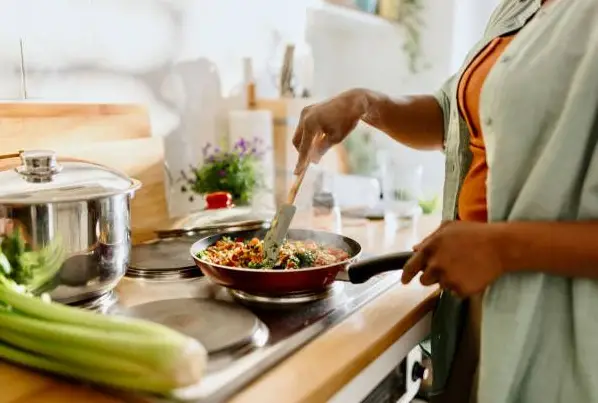
The steam rose from the pot in delicate spirals, carrying the scent of carrots, celery, and the bay leaves I’d brought from my old garden. I stirred slowly, watching the vegetables tumble in the broth, thinking about nothing in particular—which was perhaps the problem. When you think about nothing, you feel everything.
“Who told you to cook like that?”
The voice came from behind me, sharp and cold as the stainless steel countertop. I didn’t turn around immediately. I’d learned that turning around too quickly made me look defensive, guilty, like I’d been caught doing something wrong. So I kept stirring, kept my shoulders straight, and waited.
But no explanation would come that evening. No defense would be heard. Because in the living room, the television volume suddenly exploded—a roar of crowds, the thunder of commentary, the crash of helmets on a field thousands of miles away. And my son, my Robert, the boy I’d raised to stand up for what was right, sat there with his thumb on that remote control, making sure my voice would never reach his ears.
That’s when something inside me cracked.
Not broke—not yet. But cracked, the way ice cracks on a lake in early spring, that first sharp line that says: everything is about to change.
The crash that came from the kitchen ten minutes later would wake the neighbors. It would bring Robert running. It would make Dawn gasp and step backward in her expensive slippers, one hand flying to her throat.
But that crash was not the beginning of this story.
It was the end of my silence.
To understand what happened that November evening in a cramped apartment on the outskirts of Los Angeles, you’d have to go back further. You’d have to go back to a different country, a different language, a different version of me.
I was born Helena Kowalski in a small town in Poland where everyone knew everyone’s grandmother’s maiden name. I married Henry Novak when I was twenty-one, a young man with strong hands and a dream of America burning in his chest like a fever. We came to California in 1976 with two suitcases, forty-three dollars, and a dictionary we’d already worn soft at the edges.
Henry worked construction. I cleaned houses, took care of other people’s children, learned English from soap operas and grocery store clerks who spoke slowly when they saw the confusion in my eyes. We saved every penny. We bought a tiny house in a neighborhood where the lawns were patchy and the fences leaned, but the doors were never locked.
Robert was born two years later, in a hospital where I didn’t understand half of what the doctors said, but I understood the sound of my baby’s first cry. That sound was the same in every language.
I raised him to be American. I packed his lunches in paper bags with his name written in my careful, crooked letters. I learned to make peanut butter and jelly sandwiches, even though the combination seemed strange to me at first. I went to parent-teacher conferences and smiled and nodded, even when I only caught every third word. I wanted him to fit in, to belong, to never feel the kind of out-of-place I felt every single day.
And he did. Robert grew up tall and confident, with an easy smile and an American accent that had no trace of where his parents came from. He played baseball. He dated cheerleaders. He went to college on a partial scholarship, and Henry and I worked double shifts to cover the rest.
When Robert brought Dawn home for the first time, I knew immediately she didn’t like me. It wasn’t anything she said—Dawn was far too polished to be openly rude, at least not in front of Robert. It was the way she looked at our small house, at the lace curtains I’d sewn by hand, at the painted ceramic figurines on the shelf—things I’d brought from Poland or bought at yard sales. Her smile was thin and tight, the smile of someone who was already cataloging everything she’d change.
They married in a hotel ballroom with white orchids and a string quartet. Henry wore the only suit he owned, the one we’d bought for Robert’s high school graduation. I wore a dress I’d made myself, pale blue with embroidered flowers. In the wedding photos, Dawn’s family looked like they’d stepped out of a magazine. We looked like we’d stepped out of the past.
But we smiled. We danced. We toasted the happy couple.
And when Henry got sick three years ago, when the cancer came like a thief in the night and stole his strength piece by piece, Dawn sent a card. Robert called twice a week, his voice strained and distant. But neither of them came to help me change the sheets when Henry couldn’t get out of bed. Neither of them sat with me in the hospital waiting room at two in the morning. Neither of them held my hand at the funeral.
After Henry died, the house felt enormous and empty. Every room echoed. Every meal I cooked was too much food. I’d set the table for two out of habit, then stare at the empty chair until the food went cold.
When Robert called and said, “Mom, you shouldn’t be alone at your age. Dawn and I have been talking. Why don’t you move in with us?” it felt like a life raft thrown to a drowning woman.
I should have known better.
I should have heard the pause before he said it, the way his voice went too cheerful, too bright. I should have asked more questions.
But I was seventy-one years old, recently widowed, and tired of being alone. So I said yes.
I sold most of the furniture—the couch where Robert had done his homework, the dining table where we’d celebrated every birthday and holiday, the bed where Henry and I had slept for fifty years. I packed my clothes, my photos, my mother’s silver cross, and the small wooden box where Henry kept his important papers. Everything else went to charity or the dumpster.
Robert came with a rented truck on a Saturday morning. He was cheerful, talking about how great it would be to have me closer, how Dawn was excited to have help with the house. That word—help—should have been my first clue.
Their apartment was on the third floor of a modern building with a gym, a pool, and a lobby that smelled like expensive candles. Everything was white and chrome and glass. There were no photos on the walls, no personal touches, nothing that said people actually lived there.
“Your room is back here, Mom,” Robert said, leading me down a hallway to a small bedroom at the back of the apartment. It had a single bed, a narrow dresser, and a window that looked out at the parking lot. It was the kind of room you’d give a guest you didn’t particularly want to stay long.
“It’s perfect,” I lied.
The first week, I tried to be helpful. I did the dishes, wiped down the counters, folded the laundry Dawn left in the dryer. I thought I was being considerate, pulling my weight, showing my gratitude.
But Dawn had other ideas.
“Helen, the glasses go on the top shelf, not the bottom.”
“Helen, we use fabric softener, not dryer sheets.”
“Helen, could you not vacuum before nine? Some of us are trying to sleep.”
Every correction was delivered with a sweet smile and a patient tone, like she was teaching a slow child. And every time, Robert was conveniently elsewhere—at work, in the shower, on a phone call.
I started waking up earlier, trying to finish my chores before Dawn got up. I learned where everything went, how she liked things done. I made myself smaller, quieter, less visible.
But it was never enough.
One morning, I made coffee the way Henry and I had always made it—strong and dark, the way it’s made in Poland. Dawn took one sip and dumped the entire pot down the sink.
“We don’t drink it like that here, Helen. This is America.”
As if I didn’t know. As if I hadn’t lived in America for forty-eight years. As if the flag magnet on her refrigerator meant more than the citizenship papers I’d earned, the taxes I’d paid, the life I’d built.
But I didn’t say anything. I just made a new pot, weaker this time, and retreated to my room.
The pattern repeated itself over the following months. Dawn’s criticisms became more frequent, more pointed. The way I folded towels was wrong. The way I sliced vegetables was inefficient. My accent was too thick when I answered the phone. My clothes were too old-fashioned. My cooking was too ethnic, too heavy, not what Americans ate.
“Maybe you could learn to make something normal,” she suggested once, sliding a cookbook across the counter. “Like casseroles.”
I looked at the glossy photos of beige food covered in beige sauce and felt something inside me harden.
But still, I said nothing. Because I had nowhere else to go. Because my house was sold, my savings depleted, my husband dead. Because I was seventy-one years old, and the world is not kind to seventy-one-year-old women with thick accents and no money.
So I cooked the casseroles. I bit my tongue. I shrank.
And Robert? Robert watched football. Robert worked late. Robert developed a sudden fascination with his phone whenever Dawn started in on me. My son, who I’d taught to tie his shoes and ride a bike, who I’d sat up with through fevers and nightmares, who I’d worked myself to exhaustion to put through college—my son had turned into a stranger who couldn’t meet my eyes.
That’s the thing about disrespect. It doesn’t usually arrive as a slap across the face. It comes as a thousand small cuts, so tiny you barely feel them at first. A comment here. A sigh there. A door closing just a little too firmly. A conversation that stops when you enter the room.
Death by a thousand cuts, they call it. And by that November evening, I was bleeding out.
The soup I was making that night was kapuśniak—cabbage soup with chunks of potato, carrot, and kielbasa. It was one of Robert’s favorites when he was growing up. He’d come home from school, drop his backpack by the door, and head straight to the kitchen, sniffing the air.
“Is that kapuśniak, Mama?” he’d ask, and his face would light up.
I hadn’t made it in years. Not since he’d married Dawn, not since he’d stopped visiting the old house regularly. But I’d found some good cabbage at the market that week, and I thought… maybe this would remind him. Maybe the smell alone would bring back some memory of who we used to be, who he used to be.
So I stood at that gleaming stove in that sterile kitchen, stirring my soup, hoping.
The television was loud in the living room—some football game Robert was watching. Dawn was supposedly getting ready for bed, though she’d been “getting ready” for over an hour, which usually meant she was on the phone with her mother, the two of them discussing me in low, disapproving tones.
I didn’t mind. I was used to it. I’d developed a thick skin over six months. Or so I thought.
Then she appeared in the doorway, wrapped in her silk robe, her hair perfect even at nine o’clock at night. She walked to the stove, looked into the pot, and her nose wrinkled.
“This looks terrible. Who told you to cook like that?”
Not “What are you making?” Not “That smells interesting.” Just pure, undisguised contempt.
I opened my mouth. I was going to explain that it was a traditional Polish soup, that Robert used to love it, that I’d thought—
The television volume exploded. A roar of sound, announcers shouting, crowd noise, the manufactured excitement of a game happening somewhere far away. And through the doorway, I could see Robert on the couch, his thumb on the remote, his eyes locked on the screen.
He’d turned it up. Deliberately. To drown me out.
In that moment, standing in that kitchen with a wooden spoon in my hand and fifty years of silence pressing down on my chest, something inside me snapped.
I don’t remember making the decision. I don’t remember thinking about it at all. I just remember my hand moving, the spoon clattering into the pot, and then my hands were on the handle, lifting, tilting—
The soup hit the floor with a sound like thunder. Broth splashed across white tile, cabbage and potato chunks skidded under the refrigerator, the pot itself bounced once and rolled, clanging and spinning.
Dawn screamed.
But I wasn’t done.
The dishes drying in the rack—I swept my arm across them. Plates crashed, glasses shattered, the sound was enormous, catastrophic, beautiful.
The cabinet with the fancy matching bowls Dawn had registered for—I yanked it open and started pulling them out, one by one, letting them fall, watching them explode into pieces on the floor.
“Mom! Mom, stop!”
Robert was in the doorway now, his face white with shock. But I didn’t stop. I couldn’t stop. I was purging something, exorcising something, breaking free of something that had been suffocating me for months.
I grabbed the pot I’d been cooking in—my pot, actually, one of the few things I’d brought from my old kitchen—and I threw it. It hit the wall with a boom that must have woken half the building.
Then, finally, I stopped.
I stood there in the middle of the destruction, breathing hard, my hands shaking, soup soaking into my slippers, broken glass glittering like stars across the floor.
Dawn was pressed against the far wall, one hand over her mouth, her eyes wide.
Robert was frozen in the doorway, looking at me like I was a stranger. Like I was crazy. Like I was dangerous.
“Mom,” he whispered. “What did you do?”
What did I do?
I looked at the mess. I looked at my son. I looked at the woman who’d spent six months making me feel like dirt in my own family.
“I’m done,” I said. My voice sounded strange to my ears—calm, clear, certain. “I’m done being quiet. I’m done being invisible. I’m done.”
“Done with what?” Robert asked, but his voice was shaking now.
“With this.” I gestured at the kitchen, the apartment, everything. “With being treated like a servant in your home. With your wife’s disrespect. With you pretending not to see it.”
“Mom, Dawn wasn’t—”
“Don’t.” I held up one hand, and to my surprise, he stopped talking. “Don’t lie to me, Robert. Don’t lie to yourself. You know exactly what’s been happening here. You’ve known all along. You just didn’t care enough to stop it.”
His face flushed red. “That’s not fair.”
“Fair?” I laughed, and it came out bitter and harsh. “You want to talk about fair? I sold my home to move here. I gave up everything to be closer to you, because you said I shouldn’t be alone. But I’ve never been more alone than I have been in this apartment. At least in my old house, I had memories. I had dignity. I had Henry’s ghost to keep me company. Here? Here I have nothing but your wife’s criticism and your cowardice.”
“Mom—” His voice cracked.
But I was already moving, already walking toward the small bedroom at the back of the apartment. My feet crunched on broken glass, but I barely felt it.
I pulled my two suitcases from under the bed—I’d never fully unpacked them, some part of me always knowing this wouldn’t last. I started pulling clothes from the dresser, stuffing them in without folding, without caring.
Robert appeared in the doorway. “Mom, you’re upset. Just calm down, we can talk about this—”
“There’s nothing to talk about.”
“Where will you go?”
That stopped me. Because he was right—where would I go? I had maybe two hundred dollars in my purse. No house. No car. No friends close enough to impose on, not anymore. I was seventy-one years old, and I was about to be homeless.
But I’d rather be homeless than stay here.
“I’ll figure it out,” I said.
I finished packing, zipped the suitcases shut, and dragged them into the hallway. Dawn was still in the kitchen, surveying the damage, her phone already out—probably calling her mother to report this latest outrage.
Robert followed me to the door. “Mom, please. Don’t do this. Let’s just… let’s sleep on it, okay? We’ll talk in the morning.”
I looked at him—really looked at him—and saw a stranger. When had that happened? When had my brave, bright boy turned into this weak, conflict-avoiding man who’d let his wife bully his own mother?
Or maybe he’d always been this way, and I’d just been too close to see it.
“Goodbye, Robert,” I said.
I walked out the door, dragged my suitcases to the elevator, and rode down to the lobby. The night security guard looked up from his desk, surprised to see an old woman with luggage at ten o’clock at night, but he didn’t say anything.
Outside, the November air was cold and damp. The parking lot was mostly empty. The streetlights cast everything in sickly yellow light.
I stood there on the sidewalk, my suitcases on either side of me like loyal dogs, and felt the reality of my situation crash down.
I had nowhere to go.
The motel was called the Starlight Inn, which was optimistic considering there were no stars visible through the smog, and the only thing the place had in common with an inn was that people slept there, sometimes.
It was two miles from Robert’s apartment. I’d walked the first mile, dragging my suitcases, before a taxi driver took pity on me and pulled over. He charged me thirty dollars for the one-mile drive, which was robbery, but I was too tired to argue.
The motel was the kind of place that rented rooms by the week and didn’t ask too many questions. The man at the front desk was watching something on a small TV and barely glanced at me as he took my cash and slid a key across the counter.
“Room 7. Around the back. Checkout’s at eleven, but if you’re staying weekly, doesn’t matter.”
“Just tonight,” I said.
He shrugged, already looking back at his TV.
Room 7 was exactly what you’d expect: a saggy double bed with a faded floral comforter, a bathroom with rust stains in the tub, a single chair with cigarette burns in the armrest, and a smell that was part mildew, part old smoke, part despair.
I locked the door, dropped my suitcases, and sat on the edge of the bed.
Then, finally, I cried.
I cried for Henry, gone six months and still leaving a hole in my life. I cried for my little house with the porch swing. I cried for my son, who I’d lost long before tonight. I cried for myself, seventy-one years old and sleeping in a motel that charged by the hour.
I cried until there were no tears left, until I was empty and hollow and so tired I could barely hold my head up.
Then I forced myself to stand, to open my suitcase, to look for something to sleep in.
That’s when my fingers touched the envelope.
It was at the bottom of the suitcase, tucked into a folded sweater. I pulled it out, confused at first, then remembered—Henry’s papers. The wooden box I’d packed from his desk. I’d emptied it into my suitcase in a hurry, not really looking at what I was grabbing.
The envelope was yellowed with age, the handwriting on the front in Henry’s careful script: “For Helena. Just in case.”
My hands shook as I opened it.
Inside was a letter, written on a piece of notebook paper, and a smaller envelope with an address in New York City.
I unfolded the letter, and Henry’s voice rose from the page like a ghost.
My dear Helena,
If you’re reading this, I’m gone, and I’m sorry. I’m sorry I had to leave you alone. I’m sorry I won’t be there to hold your hand or make you laugh or dance with you in the kitchen on Sunday mornings.
But I want you to know something. You are the strongest person I’ve ever known. You left everything you knew to come to a strange country with me. You raised our son. You built a life from nothing. You survived things that would have broken other people.
And you’ll survive this too.
I don’t know what your life will look like without me in it, but I know it will be okay. Because you’re a survivor, Helena. You always have been.
There’s something else I need to tell you. You remember my cousin Zofia? The one who moved to Brooklyn in 1982? I never told you this, but she and I kept in touch over the years. She’s done well for herself—she owns a small bakery in a Polish neighborhood, and she has a big house with extra rooms.
I wrote to her last month. I told her about my illness, and I told her that if anything happened to me, you might need help. She wrote back immediately. She said you’d always have a place with her, for as long as you needed it. No questions, no conditions.
Her address is in the other envelope. If you need her, she’s there.
I love you, Helena. I’ve loved you since the day I met you in that tiny church in Poland, when you were wearing your mother’s blue dress and you smiled at me like I was the only person in the world.
Be strong. Be brave. And remember—you are never as alone as you feel.
Forever yours,
Henry
I read the letter three times, my tears falling onto the paper and smudging the ink. Then I opened the second envelope.
Inside was a phone number, an address in Brooklyn, and a short note in different handwriting—feminine, looping: “Helena, your Henry told me you might need a friend someday. I am here. Call anytime. —Zofia”
I looked at the motel room around me, at the stained carpet and the flickering light. I looked at the letter in my hands, at my dead husband’s words reaching across death to save me one more time.
Then I reached for my phone.
It rang four times. I was about to hang up—it was late, too late to call a stranger, even one who’d promised to help—when a woman’s voice answered, thick with sleep and a Polish accent that made my heart ache with homesickness.
“Hello?”
“Zofia?” My voice came out scratchy and small. “This is Helena. Helena Novak. Henry’s wife.”
There was a pause, then a sharp intake of breath. “Helena! Oh, my dear, I was so sorry to hear about Henry. He was a good man.”
“Thank you. I… I’m sorry to call so late. Henry left me your number. He said…” My voice broke. “He said I might need help.”
“Where are you?”
“California. Los Angeles. A motel. I… it’s a long story.”
“Then you’ll tell it to me on the plane. Tomorrow. I’ll send you money for a ticket. You’ll come here, you’ll stay with me, and we’ll figure everything out. Yes?”
I couldn’t speak. I just nodded, even though she couldn’t see me, tears streaming down my face again.
“Yes,” I finally whispered. “Yes. Thank you.”
“No thanks needed. We’re family. You sleep now, Helena. Tomorrow, you come home.”
She hung up, and I sat there in that terrible motel room, holding the phone and my husband’s letter, feeling something I hadn’t felt in months.
Hope.
Three days later, I was on a plane to New York. Robert had called twice, leaving voicemails I didn’t listen to. Dawn had sent a text: “We’re willing to forget this happened if you come back and apologize.”
I deleted it.
Zofia met me at JFK Airport, a round woman in her seventies with silver hair, bright eyes, and a smile that reminded me of home. She hugged me like we’d known each other for years instead of minutes, and she smelled like bread and cinnamon.
“Come,” she said, grabbing one of my suitcases. “We have much to talk about.”
Her house in Brooklyn was everything Robert’s sterile apartment wasn’t. It was cluttered and warm and full of life. There were photos on every surface, mismatched furniture that had been loved into comfort, and the smell of baking that never quite left the air.
She set me up in a guest room with a window that looked out onto a small garden. “This is yours,” she said. “For as long as you need it.”
I stayed a week. Then two. Then a month.
I helped in the bakery, learning to knead dough again, speaking Polish with the customers, feeling my old self slowly return. Zofia introduced me to her friends—other Polish immigrants, people who understood what it meant to be caught between two worlds, to love America while still missing home.
Robert called occasionally. The conversations were stilted and awkward. He wanted me to come back, but he wouldn’t hear anything against Dawn. He wanted me to apologize, but he couldn’t see that he was the one who owed me amends.
Eventually, the calls stopped.
It hurt. Of course it hurt. He was my son, my only child. But I’d learned something in that terrible apartment, in that moment of breaking: sometimes love isn’t enough. Sometimes people can’t see their own cruelty. Sometimes you have to save yourself.
Six months after I arrived in Brooklyn, Zofia made me a partner in the bakery. Not out of charity, but because I’d earned it. Because I worked hard, because the customers loved me, because I was good at what I did.
I bought a small apartment two blocks from the bakery. It was tiny, but it was mine. I hung my mother’s silver cross on the wall and put photos of Henry on every surface. I made the coffee strong, the way I liked it. I cooked Polish food and didn’t apologize for it.
On Sundays, I went to the Polish church and lit candles for Henry. On weekdays, I worked in the bakery and built a new life from the ashes of the old one.
I was seventy-one years old when I finally learned that you can start over at any age. That dignity matters more than security. That the crash of breaking dishes can be the sound of breaking free.
And sometimes, late at night, I think about that evening in that sterile kitchen in Los Angeles. The soup on the floor. The broken glass. Dawn’s shocked face. Robert’s cowardice.
I don’t regret a single shattered plate.
THE END

Ethan Blake is a skilled Creative Content Specialist with a talent for crafting engaging and thought-provoking narratives. With a strong background in storytelling and digital content creation, Ethan brings a unique perspective to his role at TheArchivists, where he curates and produces captivating content for a global audience.
Ethan holds a degree in Communications from Zurich University, where he developed his expertise in storytelling, media strategy, and audience engagement. Known for his ability to blend creativity with analytical precision, he excels at creating content that not only entertains but also connects deeply with readers.
At TheArchivists, Ethan specializes in uncovering compelling stories that reflect a wide range of human experiences. His work is celebrated for its authenticity, creativity, and ability to spark meaningful conversations, earning him recognition among peers and readers alike.
Passionate about the art of storytelling, Ethan enjoys exploring themes of culture, history, and personal growth, aiming to inspire and inform with every piece he creates. Dedicated to making a lasting impact, Ethan continues to push boundaries in the ever-evolving world of digital content.