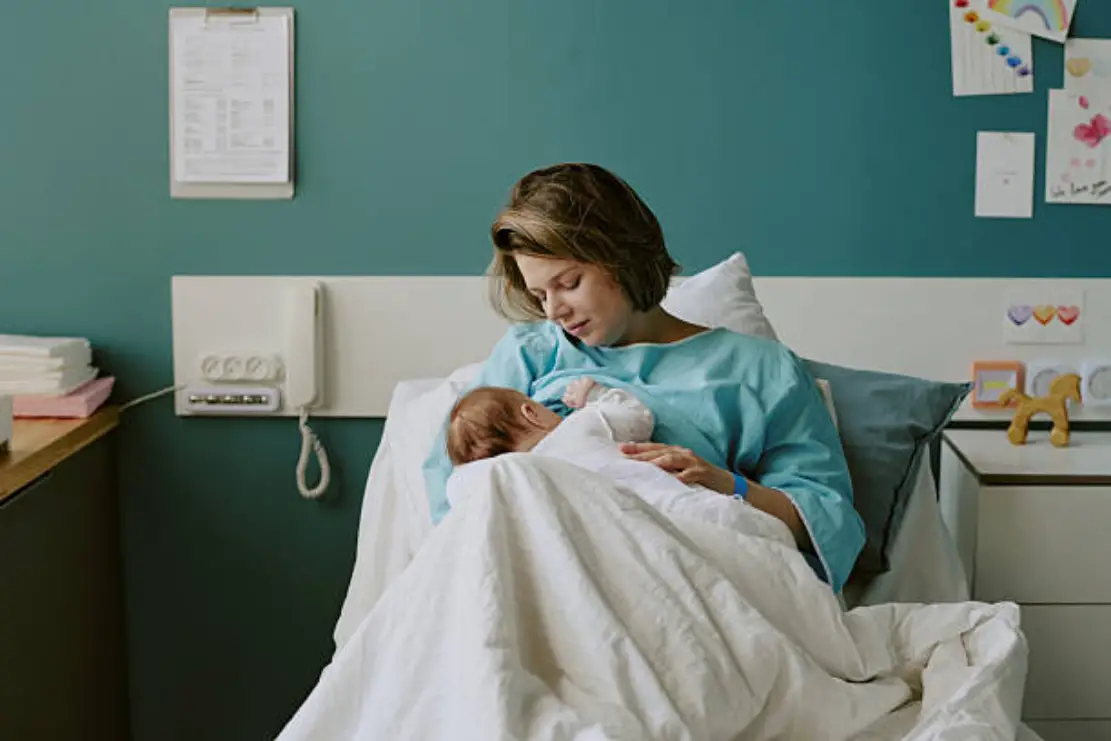
The epidural had worn off three hours ago, and every muscle in my body felt like it had been wrung out and left to dry. I lay in the private recovery suite—a luxury I hadn’t questioned because my husband Daniel said his insurance covered it—holding my daughter against my chest, marveling at her tiny, perfect fingers wrapped around my thumb. The afternoon sun streamed through the floor-to-ceiling windows, casting everything in that golden light that makes hospitals feel almost peaceful.
When my father walked in carrying a bouquet so extravagant it required both arms to hold, I smiled despite my exhaustion. He’d always been excessive in his displays of affection, a trait that had embarrassed me as a teenager but now felt comforting. He was a successful commercial real estate developer, the kind of man who wore custom suits even on weekends and considered anything less than the best a personal failure.
“There’s my girl,” he said softly, setting the flowers on the windowsill before approaching the bed. His eyes were damp as he looked at his granddaughter. “She’s beautiful, sweetheart. Just beautiful.”
“Thank you, Dad,” I whispered, adjusting the baby’s blanket. “Do you want to hold her?”
He did, with the careful reverence of someone who understands exactly how fragile new life is. For a few minutes, we just existed in that bubble of new-grandparent joy, the kind of moment that feels suspended outside of normal time.
Then he looked up at me with that expression I knew so well—the one that preceded difficult conversations. “Sweetheart,” he said gently, “isn’t four thousand dollars a month enough?”
I blinked, confused. The exhaustion was making it hard to process his words. “What money, Dad?”
The question came out innocently enough, but the effect it had on the room was immediate and electric. My father’s expression shifted from gentle concern to something much harder, much colder. Behind him, near the door where I hadn’t even noticed them standing, Daniel went absolutely rigid. My mother-in-law Karen, who’d been fussing with the baby’s receiving blankets on the chair, froze mid-motion like someone had pressed pause on her existence.
“What money?” my father repeated slowly, his voice taking on an edge that made my stomach clench. He carefully transferred my daughter back to my arms and turned to face Daniel and Karen fully. “The four thousand dollars I’ve been depositing into your account every single month since my daughter got married. That money.”
The silence that followed was so complete I could hear the heart monitor beeping, could hear someone’s shoes squeaking in the hallway outside, could hear my own pulse pounding in my ears.
“Dad,” I said carefully, my voice sounding strange and distant to my own ears, “I don’t know what you’re talking about. Daniel manages our finances. I’ve never seen any deposits like that.”
My father’s jaw set in that way that used to terrify opposing counsel when he was negotiating contracts. He pulled out his phone with deliberate movements, scrolled through something, then held it out to me. “Look.”
I looked. Bank transfer after bank transfer, each one clearly marked: For Emma – Living Expenses. Four thousand dollars. Every month. Going back twenty-six months to exactly one week after our wedding.
Over one hundred thousand dollars.
The room started to spin slightly, or maybe that was just the exhaustion and shock combining into something that felt like vertigo. I’d spent the last two years believing we were barely scraping by. I’d worn the same maternity clothes for months because Daniel said we couldn’t afford new ones. I’d skipped prenatal appointments because the copays were “too expensive right now.” I’d eaten cheaper food, given up small pleasures, felt guilty for every dollar I spent because we were “tight on money.”
And all along, my father had been sending four thousand dollars a month.
“Daniel,” my father’s voice was quiet, which somehow made it more terrifying than if he’d been shouting. “Would you like to explain to my daughter where that money has been going?”
Daniel’s face had gone from pale to gray. His mouth opened and closed several times before any sound came out. “I… Mr. Richardson, I was handling it. Emma was pregnant, she was overwhelmed, I didn’t want to stress her with financial management—”
“Financial management,” my father interrupted, his tone glacial, “would involve my daughter knowing that money exists. This is something else entirely.”
Karen stepped forward, her hands clasped in front of her in that gesture she used when she wanted to appear reasonable and maternal. “Now, James, let’s all calm down. We’re family here. That money has been supporting the household. Emma lives in our house, after all—”
“Your house that I was told we lived in rent-free because you were ‘helping us out,'” I heard myself say, my voice sounding eerily calm despite the panic rising in my chest. “Your house where I was told we couldn’t afford groceries some weeks. Your house where I hand-washed cloth diapers to save money on disposables.”
Every memory was clicking into place now, each one a small piece of a much larger, much uglier picture. The “tight months” that happened every month. Daniel’s insistence that I didn’t need to see the bank statements because “he had it handled.” The way Karen would sigh and mention how expensive it was to support “extra people” whenever I asked for anything. The guilt I’d felt for needing maternity care, for wanting proper nutrition, for existing as a pregnant woman with needs.
My father moved closer to Daniel, and despite being in his early sixties, he somehow seemed to expand, to fill the room with barely contained rage. “You get one chance,” he said quietly. “One chance to explain where every single cent of that money went. Because right now, I’m looking at my daughter who just gave birth, who I’m guessing has been told you can’t afford proper postpartum care, who’s been living like you’re poverty-stricken while I’ve been sending enough money every month to cover a luxury apartment and all her expenses.”
Daniel’s eyes darted to Karen, then back to my father, then to me. I watched him realize, in real-time, that there was no good answer here. No explanation that would make this acceptable. No words that would undo what had been done.
“Some of it went to expenses,” he started, his voice shaking. “The house, utilities, food—”
“Which I was told we contributed to from ‘our’ money,” I interrupted. “Money you said came from your job at the insurance company.”
“There were debts,” Karen added quickly. “The boutique I tried to open—we had to cover those losses. Family helps family, Emma. You benefited from our home, our support—”
“Support,” I repeated, looking at her with new eyes. This woman who’d made me feel like a burden for nine months. Who’d sighed dramatically when I was too tired to cook dinner. Who’d commented on every dollar spent, every need expressed, every moment of pregnancy that required resources. “You call stealing from me support?”
My father pulled out his phone again. “I’m calling my lawyer. Right now. Daniel, Karen—you don’t move, you don’t speak unless asked a direct question, and you start thinking very carefully about whether you want to tell the truth or whether you want this to get significantly worse.”
“James, please,” Karen’s voice took on a pleading quality. “We’re family. Emma’s our daughter now. We were just managing resources for the whole household—”
“She’s MY daughter,” my father’s voice cut through the room like a blade. “And what you’ve done is called financial abuse. Potentially fraud. Definitely theft. So you can either start explaining exactly where one hundred and four thousand dollars went, or I can have the police here in ten minutes to ask the same questions.”
One hundred and four thousand dollars. Hearing the number out loud made it real in a way that seeing the transfers on the phone hadn’t. That was a down payment on a house. That was financial security. That was everything we’d needed and more. And it was gone.
Daniel sank into the chair by the window, his face in his hands. “It wasn’t supposed to be like this,” he mumbled.
“Then how was it supposed to be?” I asked, surprised by how steady my voice sounded. Maybe it was shock. Maybe it was the clarity that sometimes comes when something breaks so completely there’s no possibility of putting it back together.
“Mom said it was family money,” Daniel said, not looking up. “She said your dad was helping all of us, not just you. The boutique needed startup capital, and we were going to pay it back once it was profitable—”
“It failed in four months,” I said, remembering. “You told me you’d lent your mother ‘a little money’ to help her. How much actually came from my father’s deposits?”
Silence.
“How much, Daniel?”
“Thirty thousand,” Karen said, her voice small now. “But it was going to be a success. It would have paid back tenfold. And some of that money did go to household expenses, Emma. You lived in my home, ate my food—”
“Food I cooked,” I said. “In your home where I was told we couldn’t afford rent anywhere else. Using ‘your’ utilities that apparently I was paying for all along without knowing it.”
My father’s lawyer arrived within the hour. Her name was Patricia Morrison, and she had the kind of calm, meticulous energy that made it clear she’d handled situations like this before. She set up at the small table in my hospital room, pulled out a legal pad, and began asking questions in a voice that permitted no evasion.
Where did the money go? Itemize everything.
Daniel and Karen tried to maintain their composure, but under Patricia’s questioning, the full scope of the deception emerged. The boutique had consumed thirty thousand. Daniel had bought a car—a car he claimed he needed for work but that I’d never been allowed to drive—for eighteen thousand. Karen had “borrowed” money for her mortgage when she was behind on payments: twenty-two thousand. There were credit card debts, personal loans to Karen’s friends, a timeshare in Florida I’d never heard about.
“And my daughter knew about none of this?” Patricia asked.
“I handled the finances,” Daniel said weakly. “She trusted me.”
“She trusted you,” Patricia repeated, writing something down. “And you used that trust to systematically steal from her while convincing her she was too broke to buy maternity clothes.”
When she said it like that, in that flat legal tone, the horror of it became undeniable. This wasn’t “managing household finances” or “family supporting family.” This was deliberate, sustained theft from someone in a vulnerable position.
My father hadn’t said much since Patricia arrived, but I could see him watching me, gauging my reactions. When Patricia finally closed her notepad and said she had enough to proceed legally, he spoke for the first time in an hour.
“Emma, you don’t have to decide anything right now. You just had a baby. You’re exhausted. But I want you to know—I’m getting you out of here. Today. You and my granddaughter are going somewhere safe, and you never have to see these people again if you don’t want to.”
“Dad—” Daniel started.
“You don’t get to call me that anymore,” my father said without even looking at him. “You stopped being family the first time you deposited my daughter’s money into your mother’s account.”
They tried to argue, to plead, to explain. Karen cried, insisting she’d only been thinking of the family. Daniel swore he’d been planning to tell me, to make it right, that he loved me and we could work through this. But I couldn’t hear them anymore. All I could hear was my daughter’s soft breathing, all I could feel was her weight in my arms, and all I could think was: I won’t raise you in a house built on lies.
My father arranged everything with the efficiency of someone used to handling crises. Within hours, I was being transferred to a different recovery suite, one that Daniel and Karen weren’t permitted to enter. Security had their photos. Hospital staff had instructions. Patricia filed emergency paperwork for separation and restraining orders.
By the time I was discharged three days later, my father had set up a furnished two-bedroom apartment ten minutes from his house. It wasn’t extravagant—he knew me well enough to know I’d refuse anything that felt like charity—but it was clean, safe, and mine. Completely, utterly mine.
The first night in that apartment, I sat in the nursery my father had somehow arranged to have set up, feeding my daughter in the dark, and cried harder than I’d cried since my mother died when I was sixteen. Not just for the money or the betrayal, but for the version of myself that had believed she deserved so little. The version that had accepted being told she was a burden. The version that had apologized for needing things while pregnant.
That version was gone now, and I mourned her even as I was grateful to be free of her.
The legal proceedings that followed were simultaneously more and less complicated than I’d imagined. More complicated because untangling twenty-six months of financial abuse required forensic accounting and extensive documentation. Less complicated because the evidence was so clear, so documented, that Daniel’s lawyer quietly advised him to settle rather than fight.
Some of the money was recovered. Not all of it—the boutique was long defunct, the car had depreciated, some expenses were impossible to recoup. But enough came back that I had a cushion, a safety net, breathing room.
Daniel moved back in with his mother. I heard through mutual friends that they’d had a falling out, that he blamed her for everything, that she blamed him for being weak. I felt nothing hearing this. The people who’d occupied so much of my emotional space for years had simply… stopped mattering.
My father wanted me to move in with him, but I needed to stand on my own. I’d gone from my father’s house to Daniel’s mother’s house, and somewhere in there I’d lost the experience of being accountable only to myself. So I returned to work part-time when my daughter was four months old, found a daycare I trusted, began the slow process of rebuilding my financial literacy.
I learned to read bank statements. I opened accounts in only my name. I made budgets and stuck to them, not out of scarcity but out of choice. Every financial decision, no matter how small, was mine to make. It was terrifying and exhilarating in equal measure.
Six months after leaving the hospital, Daniel called. He wanted to meet, to talk. He claimed he’d been in therapy, that he understood now what he’d done wrong, that his mother was out of his life. He said the words people say when they want forgiveness: I’m sorry. I’ve changed. I love you.
I met him at a coffee shop—neutral ground, public space. I listened to everything he had to say. And when he finished, when he looked at me with those hopeful eyes, I said no.
Not angry no. Not vengeful no. Just… no.
Because I’d learned something in those six months. I’d learned that healing doesn’t require reopening doors that should remain closed. That forgiveness doesn’t mean restoration. That I could acknowledge his pain and his growth without making them my responsibility to manage.
“I hope therapy helps you,” I told him. “I hope you become the person you’re trying to be. But I’m building something new, and there’s no space in it for who we were together.”
He cried. He asked me to reconsider. But I’d already reconsidered everything that mattered, and the answer remained the same.
A year after that hospital room revelation, my life looks nothing like I’d imagined it would. I live in a modest townhouse I’m buying with a mortgage in my name. My daughter is eighteen months old, walking, talking, filling our space with chaos and joy. I got promoted at work. I have friends who’ve never met Daniel, places I go that hold no memories of him, a future I’m building brick by brick.
My father and I have dinner every Sunday. He’s never once said “I told you so,” though he certainly could have. He’d raised concerns about Daniel before the wedding—subtle ones, questions about financial planning and long-term goals that I’d dismissed as my father being overprotective. He’d been right, but he’s never needed to point that out. The evidence speaks for itself.
What hurt most, I’ve realized, wasn’t the money. Money is replaceable, recoverable, just a tool. What hurt was how easily people justified taking from someone who trusted them completely. How seamlessly they’d woven lies into daily life until I couldn’t tell truth from fiction. How they’d used my love against me, weaponized my desire to be a good wife and daughter-in-law.
I ignored warning signs because I thought marriage meant unconditional trust. I thought love meant not asking difficult questions. I thought being accommodating meant accepting whatever I was told. I was wrong on all counts.
Now I teach my daughter—even at eighteen months, in small age-appropriate ways—about boundaries. About the difference between sharing and being taken from. About how love should feel safe, not scary. About how the people who really care for you want you to know the truth, even when it’s complicated.
Sometimes I think about that moment in the hospital, the look on Daniel’s face when my father asked that simple question: “Isn’t four thousand dollars enough?” The panic in his eyes. The way Karen went absolutely still. The physical manifestation of secrets being dragged into light.
That’s what financial abuse looks like. It doesn’t announce itself with obvious theft or dramatic confrontations. It hides behind phrases like “I’m handling it” and “Don’t worry about money” and “Trust me.” It makes you feel guilty for needing things, grateful for scraps, apologetic for existing with requirements.
And it works because we want to believe the people we love wouldn’t hurt us. Because questioning finances feels unromantic, ungracious, suspicious. Because we’ve been taught that good partners trust each other completely.
But trust and verification aren’t opposites. Transparency and love aren’t enemies. Knowing where your own money goes isn’t paranoia—it’s basic financial literacy and self-protection.
I share my story now, carefully, when it’s relevant. I tell pregnant friends to make sure they know about all household finances. I tell new wives to keep their own accounts, maintain their own credit, understand their own financial picture. I tell daughters to never, ever assume that someone else’s management of “our” money is the same as their own informed participation.
Some people think I’m jaded. Maybe I am. But I’m also free. Free from lies, from manipulation, from the constant low-grade anxiety of never quite understanding why money was always tight despite two incomes. Free to make my own mistakes, manage my own resources, build my own security.
My daughter will grow up watching me balance budgets, make financial decisions, handle my own accounts. She’ll see that independence is possible, that single motherhood isn’t failure, that walking away from harm is strength, not weakness.
She’ll also know her grandfather, see his genuine support, understand the difference between help that empowers and “help” that controls. She’ll learn that when someone who loves you gives you money, they don’t hide it from you. They don’t use it to manipulate you. They don’t attach invisible strings that trip you up later.
Last week, I ran into Karen at the grocery store. It was inevitable in a town this size—I’d known we’d cross paths eventually. She looked older, tired, diminished somehow. She tried to approach me, opening her mouth to speak, but I just walked past. Not rudely, not dramatically. I simply didn’t stop.
Because I’d learned something else in the past year: I don’t owe anyone my attention, my time, my emotional labor. Not even for an explanation, an apology, or closure. Especially not when they’d already taken so much.
That evening, my father called to check in like he does every few days. “How was your day?” he asked.
“Normal,” I said, watching my daughter stack blocks in concentration. “Good normal.”
“That’s my girl,” he said softly. And I knew he wasn’t just talking about surviving or getting by. He was acknowledging that I’d built something real from the wreckage—something sustainable, something mine.
This isn’t a fairy tale ending. I’m not rich. My life isn’t perfect. Single motherhood is exhausting. Work is challenging. Money is sometimes tight—actually tight, not artificially tight while someone steals from me.
But it’s honest. Every struggle is real, every victory is mine, every decision is made with full information. And that honesty, that clarity, is worth more than any amount my father could have sent.
I still sometimes wonder what would have happened if he hadn’t asked that question in the hospital. If he’d waited, or stayed silent, or just assumed I knew about the money. How much longer would the deception have continued? Would I have spent my entire marriage in the dark?
But he did ask. And I did answer honestly. And that combination of his advocacy and my truth-telling changed everything.
So when people ask if I regret marrying Daniel, I say no. Because my daughter exists, and I wouldn’t trade her for anything. Because I learned crucial lessons about myself—my worth, my strength, my requirements for relationships. Because sometimes you need to see exactly how low someone will go to understand exactly how high you need to set your standards.
What I regret is the time I spent believing I deserved less than I did. The apologies I made for needing things. The guilt I carried for existing as a person with requirements. The trust I gave without verification. The questions I didn’t ask because I thought asking meant not loving enough.
Those regrets have purpose now, though. They remind me to teach my daughter differently. To show her that love and awareness aren’t opposites. That trust is earned and maintained through transparency, not demanded through guilt. That she should always, always know where her money goes.
Because financial abuse isn’t just about money. It’s about power, control, and the slow erosion of autonomy. It’s about making someone feel small enough, uncertain enough, dependent enough that they stop asking questions.
And the answer to that kind of abuse isn’t just financial independence—though that’s crucial. It’s the knowledge, deep in your bones, that you deserve truth. That you’re entitled to full information about your own life. That “I’m handling it” is never an acceptable answer when it’s your money, your security, your future.
My father gave me more than four thousand dollars a month. He gave me the question that revealed the truth. And in that moment—even though it was painful, even though it destroyed my marriage, even though it upended my life—he gave me the greatest gift: the chance to know, and the strength to walk away.
If you’re reading this and something resonates, if you recognize yourself in any part of my story, I want you to ask yourself one question: If someone is “handling” your finances, do you actually know where the money goes?
Because that simple question—”What money, Dad?”—didn’t just reveal theft. It revealed who was really looking out for me, and who was looking out for themselves.
And knowing the answer to that question, however painful, is always worth more than living in comfortable lies.

Sophia Rivers is an experienced News Content Editor with a sharp eye for detail and a passion for delivering accurate and engaging news stories. At TheArchivists, she specializes in curating, editing, and presenting news content that informs and resonates with a global audience.
Sophia holds a degree in Journalism from the University of Toronto, where she developed her skills in news reporting, media ethics, and digital journalism. Her expertise lies in identifying key stories, crafting compelling narratives, and ensuring journalistic integrity in every piece she edits.
Known for her precision and dedication to the truth, Sophia thrives in the fast-paced world of news editing. At TheArchivists, she focuses on producing high-quality news content that keeps readers informed while maintaining a balanced and insightful perspective.
With a commitment to delivering impactful journalism, Sophia is passionate about bringing clarity to complex issues and amplifying voices that matter. Her work reflects her belief in the power of news to shape conversations and inspire change.