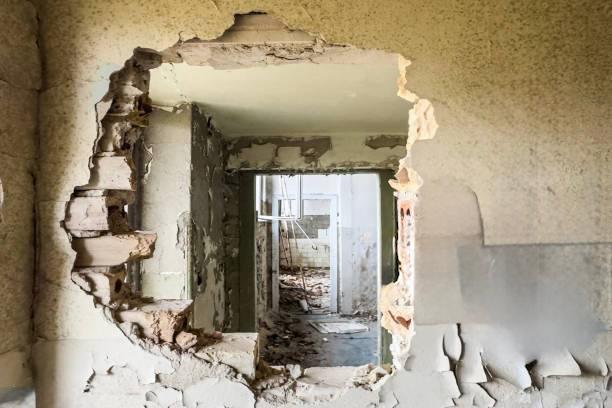
The Hidden Room
“Don’t come by yourself—bring your boys.”
A year after my husband passed, I finally hired a contractor to renovate his old office. I had just stepped out of church when the foreman called and said those words in a voice that didn’t belong to a renovation update.
“Ma’am… please. Bring both of your sons.”
My heart dropped before I even asked why.
The choir’s final notes were still drifting through the sanctuary when my phone buzzed against my palm. Morgan’s name lit up the screen—Morgan Fletcher, the contractor I’d hired three weeks ago to transform Thomas’s office into something I could bear to look at. But something in my chest tightened before I even answered, some animal instinct that recognizes danger before the mind can name it.
“Mrs. Halston,” he said, his voice too calm, too measured for a Sunday morning call. Not the easy drawl he usually had when discussing paint colors or floor refinishing. This was different. Careful. Like he was choosing every word to avoid breaking something fragile.
“We opened the wall behind your husband’s desk.”
I slipped out of the church vestibule into the spring sunlight, past smiling faces greeting each other, past Pastor James shaking hands and promising to see everyone next week. Their voices suddenly felt miles away, like I was underwater and they were all on the surface, living in a world that made sense.
“What did you find?” I asked, my voice barely more than a whisper.
There was a long breath on the other end of the line. The kind of breath someone takes when they’re about to change your life and they know it.
Then: “A hidden room. Ma’am… you shouldn’t come alone. Bring your sons. Both of them.”
The line went dead.
I stood there on the church steps, holding my phone like it was about to crack open in my hands, pulling my cardigan tighter against a breeze that didn’t feel like a breeze anymore. It felt like something cold crawling up my spine, something that knew things I didn’t.
My husband, Thomas Halston, had been gone for exactly one year, two months, and seventeen days. Heart attack at his desk on a Tuesday afternoon, papers still spread in front of him, coffee still warm in his mug. The doctors said it was quick, that he probably didn’t feel much, that sometimes the heart just gives out without warning.
Not one person had touched his office since that day. The door stayed shut, like an unspoken boundary we’d all agreed never to cross. His staff boxed up his things from the downtown office—the one at his law firm, the professional space with glass walls and mahogany furniture. But the home office, his private sanctuary, the room where he disappeared for hours on weekends and late nights? That remained exactly as he’d left it.
Until three weeks ago, when I finally broke that rule.
I told myself it was time—that grief needed a project, that his office could become a reading room, maybe a space for the grandchildren to play on rainy days when they visited. Something light and alive instead of this tomb I walked past every day, this door I couldn’t open without feeling my chest cave in.
What I didn’t admit, even to myself, was that I was afraid. Afraid of what I might find. Afraid of what I might learn. Afraid that the man I’d been married to for thirty-four years might have secrets I wasn’t ready to uncover.
So when Morgan said bring your sons, I didn’t waste a breath questioning it. I knew, in the way you know things in your bones, that whatever was behind that wall was something I couldn’t face alone.
I called my eldest first. David, forty-two, the lawyer who’d followed in his father’s footsteps, the one with Thomas’s sharp jawline and measured way of speaking. I heard weekend brunch sounds in the background—silverware clinking, his wife’s laughter, one of the kids asking about dessert, normal life happening without me.
“Mom?” he said, already wary. I’d never called him during Sunday brunch. Never interrupted his family time unless it was an emergency.
“Come home,” I told him, my voice steady even though my hands were shaking. “Bring your brother. Right now.”
“What’s wrong? Are you—”
“Just come. Please.”
I called Marcus next, my younger son. Thirty-eight, the artist, the one who’d never quite fit the mold Thomas had cast for him. He answered on the first ring, breathless like he’d been running.
“Mom?”
“The contractors found something,” I said. “In your father’s office. You need to come home. Now.”
“What did they find?”
“I don’t know yet. But Marcus… bring your brother. I need you both.”
The twenty-minute drive from church to my house in the suburbs felt like hours. My hands gripped the steering wheel so tightly my knuckles went white. I kept replaying Morgan’s words. A hidden room. What kind of man builds a hidden room in his own house? What kind of secrets require that level of concealment?
Thomas had been a defense attorney, one of the best in the state. Thirty years of high-profile cases, wealthy clients, situations where the stakes were always higher than they appeared. He’d always kept his work close to his chest. “Client confidentiality,” he’d say when I asked about cases. “Attorney-client privilege.” And I’d believed him, because why wouldn’t I? He was my husband. The father of my children. The man who kissed me goodbye every morning and told me he loved me every night.
But now, driving home with my heart hammering and Morgan’s voice echoing in my head, I wondered what else I’d believed simply because it was easier than questioning.
When I turned onto our street—tree-lined, peaceful, the kind of neighborhood where people walked their dogs and waved to neighbors—I saw two cars already in my driveway, parked crooked, like neither of my sons had bothered straightening out. Like they’d arrived in a hurry and abandoned their vehicles wherever they stopped.
Both of them stood on the front walkway, not talking, just waiting. David in his Sunday khakis and button-down, looking every inch the corporate attorney. Marcus in jeans and an old flannel, paint under his fingernails, looking like he’d been dragged away from his studio mid-project.
The tension between them was visible, wired through their shoulders, in the careful distance they maintained from each other. They’d never been close, my boys. Too different, too competitive for their father’s attention, too wounded by the different ways Thomas had loved them—or failed to.
Morgan opened the front door before I reached it, as if he’d been watching for me through the window. His shirt was dusted in sawdust, his work boots unlaced, and the tan on his weathered face looked washed out, almost gray.
“I’m glad you arrived together,” he said softly, stepping aside to let us pass. “It’s… better this way.”
Inside, the air smelled wrong. Like raw wood and old secrets, like something that had been sealed away too long and was now breathing again. Thomas’s study looked violated without its wallpaper—stripped bare, the old plaster exposed, vulnerable in a way that made my stomach turn.
And the wall behind his desk? It wasn’t a wall anymore.
It was open.
Not a simple access panel for wiring or plumbing. An entire section had been removed cleanly, professionally, revealing something that had never been meant to see daylight.
Behind it, a narrow room stretched back into what should have been empty space between walls. Maybe eight feet deep, six feet wide. Floor-to-ceiling shelves lined every surface, and every inch was filled with folders. Dozens of them. Maybe hundreds. All arranged with meticulous precision, labeled in my husband’s distinctive handwriting, organized by year and case number and names I didn’t recognize.
David moved first. He always did—the eldest, the one who felt responsible, the one who’d spent his whole life trying to be worthy of Thomas’s approval. He reached for the nearest folder, opened it, and his face drained of color so quickly my stomach lurched.
He read one page. Then another. Then he closed the folder fast, like he’d seen something he had no right to know, like touching it had burned him.
“Dad kept files,” he said, his voice hollow. “But these aren’t… Mom, these aren’t normal case files.”
Marcus didn’t touch anything. He stood at the threshold of that hidden room, his eyes skimming every row, every label, every folder, as if he were trying to understand a code without opening the pages. His face had gone very still, very careful—the expression he’d worn as a teenager when Thomas criticized his art, when he’d learned to hide everything he was feeling behind a blank mask.
“What are they?” I asked, even though some part of me already knew I didn’t want the answer.
Morgan pointed to a recessed corner at the back of the hidden room. My eyes had been so focused on the folders that I’d missed it—a metal safe, small and deliberately placed, built into the very bones of the house. The kind of safe you don’t install unless you need to hide something that can’t ever be found.
“We didn’t try to open it,” Morgan said quietly. “We thought you should be here.”
I stepped forward, past my sons, into that narrow space that smelled like old paper and my husband’s cologne—the same cologne I’d given him every Christmas, the scent that had clung to his clothes, that I still sometimes imagined I could smell in our bedroom late at night.
That’s when the doorbell rang.
Not a casual press. Not a friendly neighbor or a delivery. A firm, official chime that rolled through the entire house like a warning bell.
Morgan’s gaze flicked toward the hallway, then back to me—something sharp passing between us, something unspoken but understood.
Whoever stood on my porch had chosen this moment on purpose.
I walked to the front door on legs that felt disconnected from my body. Through the frosted glass panels, I could see two figures. Dark suits. Official posture.
When I opened the door, two men in FBI windbreakers stood on my porch, credentials already in their hands.
“Mrs. Patricia Halston?” the taller one asked, though he clearly already knew the answer.
“Yes.”
“I’m Special Agent Robert Chen. This is Special Agent Lisa Moreno. We’d like to speak with you about your late husband, Thomas Halston. May we come in?”
It wasn’t really a question.
I stepped aside, my mouth too dry to form words. They walked into my foyer with the careful awareness of people trained to observe everything—the family photos on the wall, the renovation equipment in the hallway, my sons standing frozen in the study doorway.
“We understand you’ve begun renovations,” Agent Chen said, his voice neutral but his eyes sharp. “Specifically to your husband’s home office.”
“Yes,” I managed. “We just… we found something.”
“We know,” Agent Moreno said gently. She was younger, with kind eyes that somehow made everything worse. “We’ve been monitoring this property since your husband’s death. When the contractor filed a permit for structural changes to the office, it triggered a flag in our system.”
“A flag,” I repeated numbly. “What kind of flag?”
“The kind that suggests your husband may have been involved in activities that warranted federal investigation,” Agent Chen said. “We’d like to see what you’ve found.”
David stepped forward, his lawyer instincts overriding his shock. “Do you have a warrant?”
“We can get one,” Agent Moreno said. “But we’d prefer to do this cooperatively. Mrs. Halston, we believe your husband was hiding evidence. Evidence that could be crucial to several ongoing investigations. We need to see that room.”
I looked at my sons. At David, whose face had gone carefully blank in that lawyer way. At Marcus, who was staring at the agents like they’d confirmed something he’d suspected for years.
“Show them,” I said.
We walked back to the study in a grim procession. When the agents saw the hidden room, something passed between them—a look of confirmation, of pieces falling into place.
Agent Chen pulled on latex gloves and carefully removed one of the folders. He opened it, scanned the contents, and his jaw tightened.
“Mrs. Halston,” he said quietly, “did your husband ever discuss his work with you? Any cases that seemed unusual? Any clients he was particularly protective of?”
“No. He said it was all confidential. Attorney-client privilege.”
“Did he travel frequently? Take calls at odd hours? Have visitors who didn’t go through normal channels?”
I thought about the late-night phone calls, the weekend trips he said were for depositions or client meetings, the study door that was always locked when he was inside.
“Sometimes,” I admitted. “But he was a busy attorney. I thought that was normal.”
Agent Moreno had moved to the safe. She examined it carefully, then looked at me. “Do you know the combination?”
“No. I didn’t even know it existed until an hour ago.”
“We’ll need to bring in a specialist,” Agent Chen said, pulling out his phone. “But Mrs. Halston, I need you to understand something. Based on what we’re seeing in these folders, your husband wasn’t just keeping client files. He was documenting something much bigger. And if what we suspect is true, this room contains evidence of multiple federal crimes.”
The room tilted. I reached for the desk to steady myself, and David was suddenly there, his hand on my elbow.
“Mom, sit down.”
“What kind of crimes?” I asked, even though I wasn’t sure I wanted to know.
Agent Chen closed the folder he’d been reading. “Money laundering. Wire fraud. Possibly witness tampering and obstruction of justice. Your husband represented some very powerful people, Mrs. Halston. People who paid him extremely well to make their problems disappear. And we believe he kept insurance—detailed records of everything he did for them. Everything they asked him to do.”
“Why?” The question came out as barely a whisper. “Why would he keep records if it would incriminate him?”
“Because powerful people become dangerous when they think you know too much,” Agent Moreno said gently. “This room was his insurance policy. If anything happened to him, if he was ever threatened or silenced, these files would be his leverage. His proof.”
Marcus laughed, a harsh sound with no humor in it. “So Dad wasn’t just a corrupt attorney. He was a corrupt attorney who was smart enough to cover his ass.”
“Marcus,” David snapped, but there was no real heat in it. He looked as shell-shocked as I felt.
“How long have you known about this?” I asked the agents. “About what Thomas was doing?”
Agent Chen exchanged a glance with his partner. “We’ve had Thomas Halston on our radar for eight years. But he was careful. Very careful. We could never get close enough to build a case. And then he died, and we thought our chance died with him. Until today.”
“You were waiting,” I said slowly, understanding dawning. “You were waiting for someone to open this room.”
“We hoped,” Agent Moreno admitted. “We knew it existed—we had surveillance suggesting he’d built something in this house. But without a warrant, without probable cause, we couldn’t search. We had to wait.”
“So you used me.” My voice came out flat. “You let me hire contractors, let me open his office, let me find this—knowing what it would contain.”
“Mrs. Halston—”
“You’ve been watching my house for a year. Waiting for me to do your job for you.”
Agent Chen had the grace to look uncomfortable. “We’re sorry. But yes. We needed someone with legal access to open that room. And we needed the discovery to be… organic. Defensible in court.”
I looked at the folders, at the safe, at this hidden life my husband had built literally inside the walls of our home. Thirty-four years of marriage. Two sons. A house in the suburbs. Sunday dinners and anniversary trips and arguments about whose turn it was to take out the trash.
And all of it, every moment of our life together, built on a foundation of lies.
“What happens now?” I asked.
“We secure the room. We inventory everything. We bring in forensic accountants and investigate every case, every transaction. And Mrs. Halston…” Agent Chen paused. “We’ll need to seize your assets. All of them. Your house, your bank accounts, your retirement funds. Everything your husband earned may be considered proceeds of criminal activity.”
The words hit like physical blows. “My house?”
“I’m sorry. We’ll do everything we can to minimize the impact on you and your sons. But the law is clear. If assets are gained through criminal activity—”
“My mother had nothing to do with this,” David said sharply. “She didn’t know.”
“We believe that,” Agent Moreno said. “But it doesn’t change the legal reality. We have to follow the money, and the money all leads back to Thomas Halston.”
I sank into Thomas’s desk chair—the leather chair he’d spent so many hours in, the chair where he’d died, where he’d built his empire of deception while I made dinner and planned vacations and believed our life was real.
“Mom.” Marcus crouched beside me, his hand on my knee. “We’ll figure this out. David and I, we’ll help. You won’t be alone.”
I looked at my sons—these men I’d raised, who were now watching their father’s legacy collapse into something unrecognizable. David with his rigid composure starting to crack. Marcus with tears streaming down his face that he wasn’t bothering to hide.
“Did either of you know?” I asked. “Did you suspect?”
David shook his head. “No. I thought he was just… successful. A good attorney.”
But Marcus didn’t answer right away. When he finally spoke, his voice was thick. “I knew something was wrong. I didn’t know what. But Dad was always so careful. So secretive. And the way he spent money, the trips, the clients he wouldn’t name… I thought maybe he was having an affair. I never imagined it was this.”
The safe specialist arrived an hour later—a thin man with careful hands who spent thirty minutes with his ear pressed to the metal, listening for tumblers. When it finally opened with a soft click, we all leaned forward, even the agents.
Inside: USB drives. Dozens of them, labeled and dated. A leather journal filled with Thomas’s handwriting. And a sealed envelope with my name written on it in his careful script.
Patricia.
My hands shook as I reached for it.
“Mrs. Halston,” Agent Chen said carefully, “that may be evidence.”
“It has my name on it,” I said, my voice stronger than I felt. “If my husband left me a letter, I’m going to read it.”
He nodded reluctantly.
I opened the envelope with everyone watching. Inside, a single page, dated three months before Thomas died:
Patricia,
If you’re reading this, then I’m gone and you’ve found the room. I’m sorry. I’m sorry for all of it—for the lies, for the danger I’ve put you in, for the life I’ve wasted on choices I can’t undo.
I started down this path thirty years ago with one client, one favor, one check that was too big to refuse. I told myself it was just once. But once became twice, and twice became a career, and before I knew it, I was in so deep that getting out would have meant losing everything.
So I kept going. I took their money. I made their problems disappear. I became the lawyer that powerful men called when they needed someone who wouldn’t ask questions.
But I did ask questions, Patricia. I asked them privately. I wrote everything down. Every name, every transaction, every crime they asked me to facilitate. I kept records because I thought someday, maybe, I could make it right. Or at least make sure that if I went down, I wouldn’t go down alone.
I know this is a coward’s confession. I know it doesn’t undo the damage. But I need you to know that I loved you. That was real. Our life together, our sons, the home we built—that was the only real thing in my entire corrupt existence.
The agents will use these files to prosecute people who deserve it. Let them. Don’t fight for my reputation. Don’t try to protect my memory. I don’t deserve it.
Take care of our boys. Tell them I’m sorry. Tell them their father was a better lawyer than he was a man.
I love you. I always loved you.
Thomas
I read it twice, then handed it to Agent Chen with hands that had finally stopped shaking. He read it, his face unreadable, then carefully slipped it into an evidence bag.
“He knew,” I said quietly. “He knew this would all come out eventually.”
“Heart attack,” Marcus said suddenly. We all turned to look at him. “Dad died of a heart attack. But what if… what if someone found out about this room? What if someone was threatening him?”
Agent Chen’s expression shifted. “We’ll investigate that possibility. But Mrs. Halston, if your husband was murdered, it would mean these files are even more dangerous than we thought. It would mean there are people who would kill to keep these secrets buried.”
“Then why haven’t they come after the files?” David asked. “Why wait a year?”
“Because until today, this room was sealed. Hidden. Safe. But now it’s open. Now we’re here. Now everyone involved is going to know their secrets aren’t secret anymore.”
Agent Moreno stepped forward. “Mrs. Halston, we’re going to need to put you in protective custody. You and your sons. Just until we can assess the threat level.”
“Protective custody?” I repeated. “You think someone might try to hurt us?”
“I think someone built a career on keeping powerful people’s secrets. And I think those people are going to be very unhappy when they learn those secrets are now in FBI hands.”
They moved us that night to a safe house forty miles outside the city. A bland apartment complex with security cameras and rotating agents posted outside our doors. David’s wife brought the grandchildren, her face pale with fear. Marcus’s girlfriend arrived with suitcases and questions no one could answer.
We spent three days in that apartment while the FBI processed the hidden room. Three days of terrible coffee and whispered conversations and news alerts about “massive federal investigation into judicial corruption” without naming names—not yet, but soon.
On the fourth day, Agent Chen arrived with updates.
“We’ve arrested six people so far,” he said, spreading photos across the dining table. “A state senator. Two judges. A real estate developer. A CEO. And a man named Vincent Russo who, according to your husband’s files, ordered at least three murders that Thomas helped cover up.”
I stared at the photos of these people—powerful, wealthy, respectable-looking people who smiled in their mugshots like they’d been mildly inconvenienced rather than exposed for crimes that would put them away for life.
“Your husband’s files are extraordinary,” Agent Moreno added. “Thirty years of evidence, meticulously documented. Financial records, recorded conversations, witness testimonies he preserved instead of destroying. It’s the biggest case our office has seen in twenty years.”
“Will Mom get her house back?” Marcus asked.
Agent Chen hesitated. “Eventually. But it’s going to take time. Years, probably. The courts will have to sort out which assets were legitimate and which were proceeds of crime. I’m sorry. I know that’s not what you want to hear.”
“What about Dad?” David asked quietly. “His death. Was it really a heart attack?”
The agents exchanged a glance. “The medical examiner ruled it natural causes,” Agent Chen said carefully. “But we’re reviewing everything. Looking at who he met with in the weeks before his death, any unusual communications or threats. It’s possible the stress alone killed him. Or…”
“Or someone helped,” I finished.
“We’ll find out,” Agent Moreno promised.
It’s been six months now since Morgan opened that wall.
Six months of depositions and investigations and news coverage that picked apart my husband’s life—and mine—in excruciating detail. Thomas’s law firm collapsed within weeks, his partners scrambling to distance themselves even though three of them have since been indicted. Our house is still tied up in federal proceedings. I’m living in a small rental with David’s family helping pay the bills because every asset Thomas left me is frozen.
But the prosecutions are moving forward. Vincent Russo was denied bail. The senator resigned in disgrace. One of the judges took a plea deal and is testifying against the others.
And Thomas’s secret is out. Not just what he did, but what he documented. The man I thought I knew—the husband, the father, the lawyer—turns out to have been someone else entirely. Someone who committed crimes but also compiled evidence against everyone around him. Someone who built a hidden room in his own house as insurance against the day his sins caught up with him.
I don’t know how to feel about that. Some days I’m angry—furious that he lied to me for thirty-four years, that he put me and our sons in danger, that he built our entire life on stolen money. Other days I’m sad—grieving not just the man I lost but the life I thought I had, the memories that are now tainted by the truth.
And some days, I’m strangely grateful. Grateful that he kept those records. Grateful that his insurance policy is putting dangerous people behind bars. Grateful that his final act, even if it was motivated by self-preservation, might save future victims from the criminals he helped protect.
My sons are healing too, in their own ways. David is rebuilding his practice, working with public defenders now instead of the corporate law that reminded him too much of his father. Marcus finished a series of paintings about the hidden room—dark, haunting pieces that sold out at his first gallery showing.
And me? I’m learning to live with uncertainty. With the knowledge that the man I loved was also a man I never really knew. With the reality that home isn’t always safe, that walls can hide more than you imagine, that sometimes the person sleeping beside you is keeping secrets that could destroy everything.
But I’m also learning that I’m stronger than I thought. That I can survive having my entire life dismantled. That I can face the truth even when it’s ugly, even when it shatters every assumption I built my identity on.
The FBI released Thomas’s letter to me—it’s mine to keep now, evidence logged and catalogued but returned. I read it sometimes, late at night, trying to find the truth between the lines. Trying to reconcile the man who wrote I love you with the man who built a criminal empire behind my back.
I don’t have answers. Maybe I never will.
But I have my sons. I have their families. I have the fragile, rebuilding thing we’re creating together in the wreckage of Thomas’s choices.
And that, for now, is enough.
THE END

Adrian Hawthorne is a celebrated author and dedicated archivist who finds inspiration in the hidden stories of the past. Educated at Oxford, he now works at the National Archives, where preserving history fuels his evocative writing. Balancing archival precision with creative storytelling, Adrian founded the Hawthorne Institute of Literary Arts to mentor emerging writers and honor the timeless art of narrative.