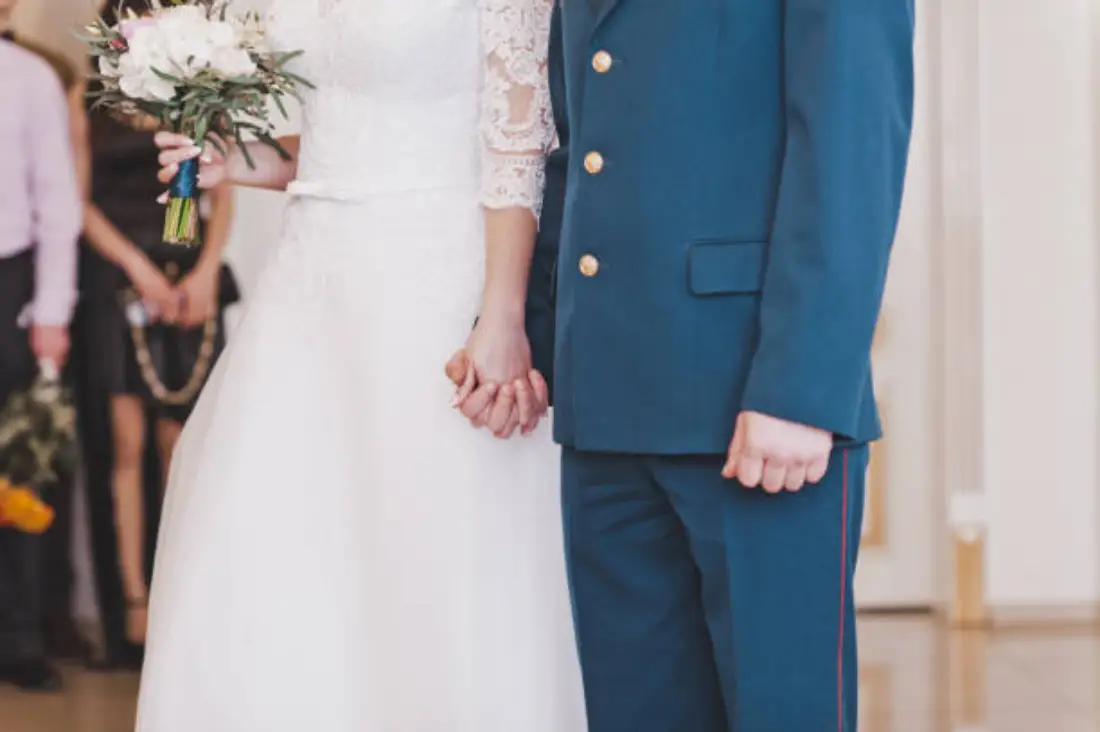
I never imagined I would walk down the aisle alone on my wedding day, but there I stood at the entrance of Riverside Gardens in Virginia, violin music drifting through the warm evening air, my ivory dress catching the last orange streaks of sunset. Three front-row chairs sat empty, each labeled with a name: Mother of the Bride, Father of the Bride, Brother of the Bride. All untouched. All cold.
Behind me, no footsteps. No family waiting to link arms with me. No father ready to give me away. Just the memory of my mother’s voice echoing in my head from that morning’s phone call: “Marrying a seaman. How embarrassing.” And my brother’s cruel laugh: “Who’d even show up to that wedding?”
They had turned their backs, literally and emotionally. But I walked anyway, because sometimes the family you choose matters more than the family you’re born into. What none of them knew—not that evening, not during their smug boycott—was that just weeks later, our wedding would air on national television and their phones would explode with calls from everyone they’d ever tried to impress.
But I’m getting ahead of myself. Let me take you back to where this really began.
My name is Grace Turner, and for most of my life I believed that being a good daughter meant earning my parents’ approval. I learned the hard way that some people’s approval isn’t worth the cost of your own happiness.
I met Ethan Brooks on a Tuesday morning that felt like any other. I was a lieutenant commander then, a logistics officer assigned to manage supply chains for three ships in the Atlantic fleet. My days were spent tracking shipments, signing maintenance schedules, wrangling spreadsheets, and answering emails that multiplied faster than I could delete them. Nothing glamorous, despite what my mother liked to brag about at her Connecticut country club.
“Grace works in Navy leadership,” she’d say. “She oversees entire warships.” I didn’t, but she liked to imagine it.
That morning, I’d been asked to board the USS Harrington to investigate a delayed parts request—a valve that had been stuck in bureaucratic limbo for weeks. The moment I stepped aboard, the smell of diesel and metal hit me, comforting in its own way. Ships smell alive: loud, busy, imperfect, human. I’d always preferred that to the sterile quiet of my parents’ mansion.
“Ma’am?” someone called behind me.
I turned and saw him—dark blond hair slightly too long for regulation, a smudge of grease across his cheek, sleeves rolled up, eyes the color of storm clouds. “Can I help you find something?” he asked.
Before I could answer, a deafening clang from the engine room startled me. He didn’t flinch. I did. He grinned. “You get used to the ship screaming at you.”
“I don’t usually make her mad,” I shot back.
He laughed—a low, easy sound. “I’m Seaman Ethan Brooks. Engineering. I’m guessing you’re here about the infamous valve.”
I expected a quick explanation. Instead, he led me below decks where the air was warmer and smelled faintly like burnt rubber and determination. His presence was calm, steady, like he knew exactly how to move through chaos. Chiefs stepped aside for him. Other sailors called him “Brooks” with the kind of respect an E-3 doesn’t always earn automatically.
He showed me the problem—not just the broken valve, but the chain of issues behind it. Supply mismatches. Old equipment. A system that needed someone who understood it. “You know a lot for someone your rank,” I said.
He shrugged. “Rank doesn’t tell you who knows what. It tells you who signs what.”
There it was: humility and truth in one stroke. We talked for thirty minutes, maybe longer. Long enough for two chiefs to start watching us with interest. Long enough for me to notice he had grease on his collar and didn’t care. Long enough for me to feel something familiar and dangerous—curiosity.
When we finished, he asked if he could walk me to the pier. I didn’t need an escort, but something about the way he asked—respectful, not presumptuous—made me nod.
As we walked, he told me about growing up outside Toledo, Ohio. His mother worked two jobs. He enlisted at nineteen, sent money home, loved anything mechanical. “People underestimate sailors like me,” he said. “But that’s okay. The ship doesn’t.”
We saw each other again the next week at the base coffee shop. Then again. Those meetings became regular—not dates exactly, just two people who enjoyed talking to each other despite the unwritten rules about officers and enlisted personnel socializing. We kept it professional at first, but feelings don’t care about rank charts.
One evening after duty, he found me walking alone on the pier, moonlight painting the water in silver streaks. “You’re thinking too hard,” he said gently.
“Am I that obvious?”
“Only to someone who watches you more than he should.”
There it was—the truth between us. I don’t know who leaned in first, but the kiss came soft and certain. Suddenly I realized I’d been waiting years for a moment that simple.
A few months later, during a quiet walk at Fort Story, he stopped and pulled out a small box. “Grace,” he said, looking genuinely afraid, “I know the world will judge us for this, but will you marry me?”
He looked like he expected me to say no because of his rank, his job, the calluses on his hands that told stories of labor rather than privilege. I said yes without hesitation. We cried. We laughed. He lifted me into the air like the hero of a simpler, truer kind of story.
That night, I called my family to share the news.
The silence on the other end of the line should have prepared me, but hope is a stubborn thing. I flew to Connecticut the following week, believing that seeing my face and hearing the sincerity in my voice would soften them.
My parents’ house smelled like lemon polish and fresh flowers—the kind of home that looks picture-perfect but feels like a museum. My mother greeted me with an air kiss that never touched my skin. “You look tired,” she said.
My father appeared behind her, silver hair meticulously parted. “Travel long?” he asked, already turning toward the dining room, already uninterested in the answer.
My younger brother Mark sauntered in last, expensive haircut and expensive watch gleaming. “Look who finally remembered the family exists.”
At dinner, the table glittered under crystal and polished silver. My mother sat straighter than any officer I’d ever met. “So, what’s new with you? Any promotions? High-profile assignments?”
I swallowed. “Actually, I came to tell you I’m engaged.”
My mother paused mid-chew. My father froze. Mark leaned back with a smirk.
“Engaged?” my mother repeated. “To whom?”
“His name is Ethan.”
My father nodded, almost approving. “And what does he do? Intelligence? Aviation?”
“He’s a seaman,” I said quietly. “An engineer.”
Everything stopped. My mother set her fork down with a soft clink that somehow echoed through the dining room. Mark snorted.
“A seaman?” my mother said, her voice sharpening. “An enlisted man? Grace, you are a lieutenant commander. You manage operations, travel internationally, sit at tables with senior officers. And you’re telling us you’re marrying someone who—who works in a boiler room?”
“He’s an engineer,” I said. “He’s brilliant. Kind. He works harder than anyone I know.”
Mark laughed—a short, cruel sound. “Who’d even show up to that wedding? Ship rats and boiler-room buddies?”
My father stared at me with profound disappointment. “Grace, be serious. You’re marrying beneath you.”
“We raised you to have standards,” my mother added.
“No,” I said, feeling heat rise in my chest. “You raised me to have status.”
“Same thing,” she replied coldly.
“It isn’t.”
My father leaned back. “Call off the engagement. You’re making an emotional decision based on loneliness.”
The word landed like a slap. “I’ve been serving for fifteen years. Deployed multiple times. Missed holidays and birthdays. You never once said you were proud. And now that I’ve found someone who loves me—someone who shows up—you want me to leave him because of his rank?”
My mother sighed dramatically. “This isn’t about rank. It’s about reputation.”
“Don’t drag the Turner name through the mud,” Mark added.
I almost laughed. “The mud? You mean honest work? Service?”
My blood went cold as I realized these were the people who raised me—impeccable manners, impoverished hearts.
“Whether you come or not,” I said, “I’m marrying him.”
My mother’s voice dropped to a whisper laced with venom. “Then don’t expect us to attend.”
My father pushed back his chair. “Nor will we acknowledge this marriage socially.”
“And if you think I’m flying to Virginia for some ship deck wedding,” Mark added, “you’ve lost your mind.”
I didn’t cry. Something inside me hardened—not anger, but clarity. “Thank you for dinner,” I said, because old habits die hard. “I’ll see myself out.”
None of them stood. As I drove away, my phone buzzed. It was Ethan. “How’d it go?”
I pressed my forehead against the steering wheel. “They said they won’t come.”
After a long silence, he whispered, “I’m sorry.”
“They think I’m making a mistake.”
“Are you?” he asked softly.
I looked out at the dark driveway. “No. Not even close.”
“Then come home. We’ll get through it.”
The week before the wedding, I tried one last time. I called my mother three days before the ceremony.
She answered on the third ring. “Yes?”
“The ceremony is Saturday at five. I wanted you to know you’re still welcome.”
“Grace,” she cut in sharply, “we already said we aren’t attending. You are making a decision that reflects poorly on us. I don’t want to be photographed at a wedding like that.”
“Mom, it’s not about how it looks—”
“It’s always about how it looks. Your father agrees. And your brother refuses to take time off for a social disaster.”
“A social disaster,” I repeated. “It’s my wedding.”
“Yes. And you’re marrying beneath you. Actions have consequences.”
“Mom—”
“Goodbye, Grace.” Click.
When I told Ethan, he didn’t respond right away. He just pulled me into his arms and held me, his dress whites smelling faintly of detergent and something steady, grounding.
The morning of the wedding dawned soft and misty, the kind of gentle coastal fog that makes everything look painted in watercolors. I sat in the tiny bridal cottage behind the venue, sipping lukewarm coffee and listening to rustling leaves. My best friend Heather arrived carrying donuts and hairspray.
“How are we feeling?” she asked with forced brightness.
“Like a woman who might cry before the ceremony even starts.”
She laughed and squeezed my shoulders. “You’re allowed to feel all of it.”
Guests trickled in throughout the afternoon—sailors from Ethan’s division, friends from officer candidate school, neighbors who insisted no one should get married surrounded by strangers. Everyone brought warmth. But none were the people who raised me.
When it came time to finalize seating, Heather held up three elegant white signs. “What do you want to do with these?” she asked quietly.
I took them—Mother of the Bride, Father of the Bride, Brother—and carried them outside. I placed them on three empty front-row chairs. Not out of guilt, but out of acknowledgment. A kind of goodbye that didn’t need words.
I was adjusting my veil when a knock came at the door. Master Chief Wilcox stepped in, ribbons gleaming, back straight, face softer than I’d ever seen during inspections.
“Ma’am,” he said gruffly. “You ready?”
“You’re still offering to walk me down the aisle?”
“I said I would. And a sailor keeps his word.” He cleared his throat. “Your family doesn’t know what they’re missing.”
“I can’t make them show up,” I said.
“No,” he replied. “But you can choose who walks beside you.”
The ceremony began. Soft violin strings drifted through the garden. Guests stood. Sunlight filtered through magnolia branches in golden streaks. Master Chief offered his arm.
“Ready, ma’am?”
I nodded, exhaling a breath I didn’t know I’d been holding.
Together, we stepped into the aisle. Every face turned toward me—not judging, not measuring, just witnessing. I saw Ethan beneath the pergola wrapped in white flowers, his uniform bright against the fading light. His eyes softened the second he saw me.
Halfway down, I caught sight of those three empty chairs. My heart twinged. But then I saw Ethan’s mom and sister sitting right behind them, smiling through tears. The moment didn’t break me. It anchored me.
When we reached the end, Master Chief placed my hand gently into Ethan’s. “Take good care of her,” he whispered.
“Always,” Ethan said.
The ceremony was simple, honest, beautiful. When the officiant said, “You may kiss the bride,” the small crowd cheered. Somewhere, a photographer snapped a candid picture—me and Ethan laughing under the pergola lights, surrounded by people who showed up.
The picture that would later change everything.
Ethan and I started married life in a one-bedroom duplex right outside the base—mismatched furniture, a balcony barely big enough for two folding chairs, a kitchen that required acrobatics. But it was ours, and for the first time in my life, I didn’t feel like I was performing for anyone.
Every morning before duty, Ethan made real coffee and handed me a mug with a sleepy smile. “Morning, ma’am.”
“Keep calling me that and I’m filing a complaint.”
“Good luck. Engineering loses every complaint on purpose.”
Then he’d kiss my forehead and head out the door. Simple. Steady. What love looks like when no one is watching.
Ethan excelled at everything he touched—not because he wanted praise, but because he took pride in doing things right. His hands fascinated me: calloused, scarred, strong, hands that knew the inside of a ship better than most officers knew their desk drawers.
“Engines don’t care who your parents are,” he told me once. “They care if you know what you’re doing.”
About three months after our wedding, the Harrington began struggling with an aging water control system. Flooding alarms weren’t syncing properly with the engineering console—the kind of thing that can cost lives. Ethan spent off-hours in the engine room sketching ideas, tinkering with sensors, rerouting ancient wires.
“What are you working on?” I asked one evening.
He shrugged. “Just trying something.”
That “something” became a prototype allowing real-time pressure data to display on waterproof tablets throughout the ship. Cheap. Efficient. Shockingly effective.
During a late-night training scenario, a pipe in the lower engineering compartment burst—the kind of rupture that floods a space in seconds. The alarms lagged behind reality by a full minute. But Ethan’s prototype didn’t. He grabbed two sailors and sprinted toward the compartment, sealing it before the waterline reached critical levels.
An admiral visiting the next week heard about it. So did a television producer working on a segment about enlisted innovation in the military.
One afternoon, I got a call from a bright-voiced woman. “Is this Lieutenant Commander Grace Turner? We’d love to interview you and your husband for a national feature on sailor ingenuity.”
I actually looked around my apartment as if someone were pranking me. “You want us?”
“Your husband’s design is remarkable. And we heard you had a beautiful Navy wedding. We’d like to feature some photos. Human interest.”
When I told Ethan, he laughed. “Me? Why? I’m not interesting.”
“Apparently, you are.”
He protested—worried about attention, about looking proud. But eventually he agreed.
The interview took place on base. They filmed his hands working on equipment, captured him teaching a junior sailor, recorded him speaking about ship safety with quiet passion. When it was my turn, they asked about our wedding.
I didn’t mention the empty chairs or harsh words directly. But I did say one thing, quietly and sincerely: “I didn’t marry a rank. I married a man who shows up when it counts.”
The producer cried real tears.
Then she asked for wedding photos. I sent the candid shot under the pergola—me laughing, Ethan brushing a leaf from my hair, our friends in uniform behind us. A picture that felt like love. Like truth.
“We’ll air the segment in two weeks,” she said. “Prime time.”
The night it aired, I almost forgot it was happening. We were both exhausted from long Navy days. By the time I got home, Ethan was already on the couch in sweatpants.
“Our ten seconds of fame are coming up,” he said.
“Ten? I thought it was five.”
The anchor finished a segment about gas prices, then smiled. “And now, a look at how one young sailor’s idea may change ship safety across the fleet.”
The screen cut to the Harrington at sea, then to Ethan standing in an engineering space, explaining his prototype with calm clarity. The camera caught the grease scars on his hands and the quiet certainty in his eyes.
Then they cut to me. “Lieutenant Commander Grace Turner,” the graphic read.
There I was, saying, “I didn’t marry a rank. I married a man who shows up when it counts.”
The piece ended on our wedding photo. The anchor closed with, “Sometimes the most important innovations come from the people closest to the work.”
For half a heartbeat, the living room went still. Then my phone buzzed. And buzzed again. And again.
I reached for it. The screen was full of missed calls and texts. My mother. My father. My brother. The counter climbed—six missed calls, eight, ten.
Names from my parents’ world flashed by. “Saw your daughter on TV. Is that your son-in-law? Incredible.” “So proud of Grace and her husband.” “Didn’t know he was such a genius.”
Their phones were blowing up because of the man they’d refused to meet.
I opened voicemail and put it on speaker. “Grace,” my mother’s voice poured out, breathless. “We just saw you on television. Why didn’t you tell us? You looked wonderful. And your husband spoke very well. Call me back.”
She still couldn’t say his name.
The next message was my father. “Impressive segment. I didn’t realize Ethan was working at that level. We may have been a bit harsh. We should catch up.”
A bit harsh.
My brother sounded different—less like the attorney who loved hearing himself talk. “Okay, that was wild. Guys at the firm saw the clip. His system is the real deal. Maybe we were wrong. We should do dinner. People would love to meet him.”
People would love to meet him. Not We’re sorry. Just Now that other people admire him, we do too.
Another text popped up from my mother: “We’re so proud of you two. When can we visit?”
Something small and old inside me stirred—the little girl who used to hope they’d notice she was trying.
Ethan watched me, waiting. “Whatever you want to do. If you want them here, if you don’t, I’m behind you.”
I looked at him—the man they’d written off without a single conversation. The man who’d held my hand when I walked past three empty chairs.
I took a slow breath and typed: “If you want to talk, come to Norfolk. We’re not traveling right now.”
The reply came almost immediately. “Of course, dear. We’ll come this weekend.”
My parents arrived on Saturday morning, dressed immaculately as always. They stood at the base of our apartment steps as if stepping into our world required psychological adjustment.
When I opened the door, my mother smiled too warmly. “Grace, you look radiant.”
“It’s ten in the morning.”
My father cleared his throat. “Where’s Ethan? We’d love to congratulate him.”
Ethan offered a polite nod. “Sir. Ma’am.”
They sat stiffly on our modest couch. My mother clasped her hands. “We were thinking we could host a gathering in your honor. Let people know how proud we are. We have connections who might be interested in Ethan’s work.”
There it was. Not love. Not remorse. Opportunity.
Ethan sat forward. “Ma’am, I’m not looking to become a showpiece for anyone’s social circle.”
My mother blinked. “That’s not what I meant—”
“It’s what it sounded like,” I said.
My father frowned. “We’re extending an olive branch.”
“No,” I said. “You’re extending a spotlight. There’s a difference.”
My brother shifted uncomfortably. “Maybe we all said things we regret. The past is the past, right?”
“Mark,” I said softly, “you didn’t just say things. You laughed at my wedding. Called it a joke. You said no one would show up.”
He opened his mouth, then closed it.
“And you were right,” I continued. “There were empty chairs. Three of them. With your names on them.”
The room went still. “Mom, Dad—you raised me to believe love had prerequisites. That worth depended on pedigree. That respect had to be earned through status, not character.”
My father flushed. “We didn’t say that.”
“You didn’t have to. You lived it.”
I took a breath. “I forgive you. But I’m not going to pretend you didn’t hurt me. Or that your sudden interest is pure.”
My mother’s eyes softened, her voice cracking for the first time in years. “We were wrong. We didn’t see him. We didn’t see you. We thought we were helping you stay safe. Respected.”
“Loved,” I corrected gently.
She nodded, ashamed.
My father cleared his throat. “I watched that segment. All I could think was—I misjudged him. And I misjudged the kind of woman my daughter became.”
It wasn’t a full apology. But it was the closest he’d ever come.
Ethan leaned back. “Sir, ma’am—we’re not asking you to grovel. But if you want to be in our lives, you need to respect what we’ve built. Not because it made the news. Because it’s ours.”
Silence settled—heavy, but honest. Finally, my mother nodded. “We want that.”
Reconciliation didn’t happen overnight. But a foundation was laid that day, built not on appearances but on truth.
They came around slowly, authentically. My mother began asking about Navy life out of genuine curiosity. My father started calling Ethan for advice on things he didn’t understand. Mark visited once with takeout and awkward jokes, trying to dismantle years of distance with small offerings.
We didn’t become perfect. But we became honest.
A few months later, Ethan received a Navy Achievement Medal at a small ceremony on base. My parents attended, sitting in the second row with quiet pride that came not from prestige but from witnessing good work.
Afterward, my father shook Ethan’s hand. “You make our daughter better. Thank you.”
Ethan replied simply, “She makes me better too, sir.”
My mother wiped her eyes discreetly.
Looking back, I realize this was never just about a wedding or a TV segment or three empty chairs. It was about the dignity in every uniform, the value of every honest job, and the courage it takes to choose love over approval.
If you’ve ever been underestimated, if someone made you feel small because of who you loved or the path you chose, remember this: your worth isn’t determined by the people who walk away. It’s revealed by the people who stay.
And sometimes, when you choose character over status and love over approval, life has a way of proving you were right all along—not with revenge, but with something better. With peace. With truth. With a life you can be proud of, built on your own terms, with someone who shows up when it counts.
That’s the real victory. Not the cameras or the vindication, but the quiet certainty that you chose well, loved deeply, and walked your own aisle with dignity—even when you had to walk it alone.

Ethan Blake is a skilled Creative Content Specialist with a talent for crafting engaging and thought-provoking narratives. With a strong background in storytelling and digital content creation, Ethan brings a unique perspective to his role at TheArchivists, where he curates and produces captivating content for a global audience.
Ethan holds a degree in Communications from Zurich University, where he developed his expertise in storytelling, media strategy, and audience engagement. Known for his ability to blend creativity with analytical precision, he excels at creating content that not only entertains but also connects deeply with readers.
At TheArchivists, Ethan specializes in uncovering compelling stories that reflect a wide range of human experiences. His work is celebrated for its authenticity, creativity, and ability to spark meaningful conversations, earning him recognition among peers and readers alike.
Passionate about the art of storytelling, Ethan enjoys exploring themes of culture, history, and personal growth, aiming to inspire and inform with every piece he creates. Dedicated to making a lasting impact, Ethan continues to push boundaries in the ever-evolving world of digital content.