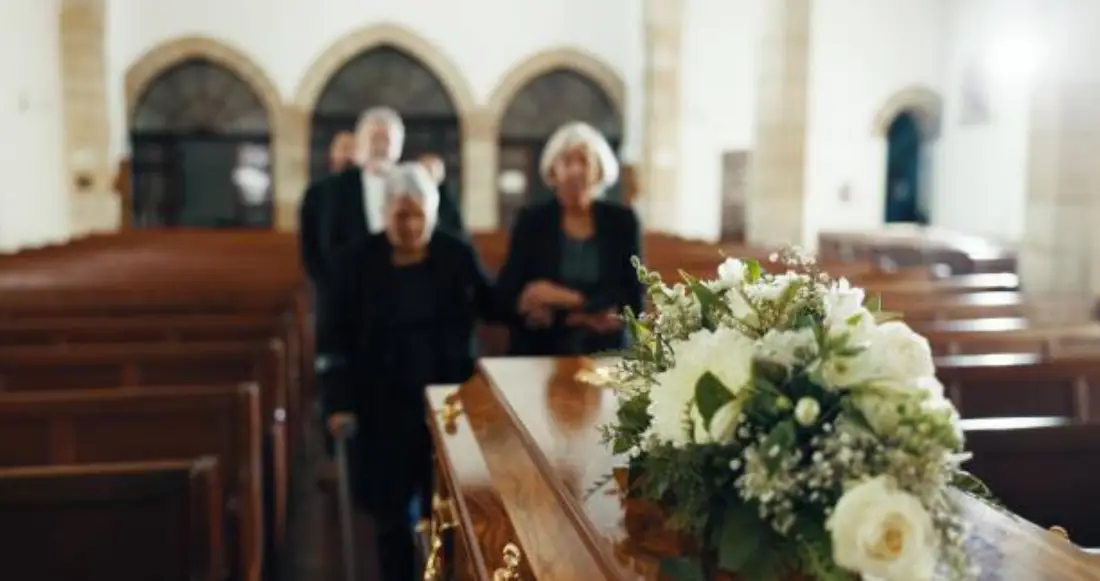
I walked in from the funeral and my husband wouldn’t even let me sit down. He looked straight at me, his voice ice-cold and deliberate, and said: “Mom left everything to me. You have two days to pack.”
I had cared for my mother-in-law Margaret for ten years. Ten years of doctor’s appointments scheduled around her pain levels, of crushing pills into applesauce when swallowing became impossible, of midnight fevers that sent me scrambling for cold compresses and thermometers. Ten years of lifting her frail body without letting her see how much my back protested, of cleaning what no one should have to clean, of swallowing my own exhaustion so completely that she would never glimpse the weight I carried.
And yet that day—after the funeral service where a pastor who’d met her twice spoke about peace and rest, after I’d watched the casket disappear into frozen February ground, after I’d stood alone at the grave while others hurried to their warm cars—I came home to find Ryan, his sister Lisa, and a man in an expensive suit already waiting in what I still thought of as my living room.
On the coffee table sat a neat stack of papers, arranged with the kind of precision that comes from rehearsal. They weren’t scattered or casual. They were staged, positioned at exact angles, waiting for an audience.
The man in the suit didn’t stand when I entered. He simply opened the folder in his lap and began reading in a voice that carried no inflection, no humanity, just the flat delivery of someone reciting terms and conditions. “The house goes to Ryan Mitchell. Elena Mitchell receives five thousand dollars in recognition of her service. The estate requests that she vacate the premises within forty-eight hours.”
In recognition of her service. As if ten years of my life could be summarized with the language you’d use for a housekeeper or landscaper. As if love and sacrifice were billable hours.
I didn’t argue. I didn’t cry. I didn’t demand to see documentation or ask about witnesses or question the legality of a will I’d never known existed. I just stood there in my damp coat with cemetery mud still clinging to my shoes, feeling something fundamental crack inside my chest—not loudly, but with the quiet finality of ice breaking on a frozen lake.
Then I walked outside, past the furniture Margaret and I had chosen together, past the photographs we’d framed, past a decade of my life that had just been reduced to a dollar amount and an eviction notice. I walked out like a stranger leaving someone else’s home.
Three days later, alone in a motel room that smelled of industrial bleach and old regrets, I opened the envelope Margaret had pressed into my hand two weeks before she died. Inside was a key, a lawyer’s name, and a note written in her careful, shaking handwriting: “The will they show you is not the real one.”
That’s when everything began.
The funeral had been held on a Tuesday morning in mid-February, one of those Midwest days where the sky presses down like a gray ceiling and the cold seeps through every layer of clothing you wear. The cemetery grass was wet and matted, the folding chairs arranged by the funeral home sank slightly into soft earth, and mourners shifted their weight from foot to foot, pulling scarves tighter and checking watches when they thought no one was looking.
I’d stood at the front, closest to the casket, because that’s where daughters-in-law who spend a decade caregiving are expected to stand. Ryan stood beside me, his posture rigid and uncomfortable, the way he always looked at family events he couldn’t leave early. Lisa stood on his other side, dabbing at dry eyes with a tissue she’d pulled from her designer purse.
The pastor—a kind man who’d visited Margaret twice in hospice and was doing his best with limited material—spoke about her strength, her kindness, her love of gardening back when her hands could still hold pruning shears. He mentioned her children and her gratitude for family, and I felt Ryan shift beside me as if accepting an award.
No one mentioned the woman who’d spent three thousand six hundred and fifty nights sleeping in the next room, listening to Margaret’s breathing through a baby monitor, counting each inhale to make sure another one followed.
After the service, people filed past offering condolences that felt formulaic and hurried. Distant cousins I’d met once. Neighbors who’d stopped visiting years ago when the cancer made Margaret’s appearance too uncomfortable to witness. Church friends who’d sent cards but never returned calls asking for help.
They shook Ryan’s hand. They hugged Lisa. They patted my shoulder and said things like “You’re so strong” and “She’s at peace now” before hurrying toward their cars and the warm restaurants where they’d decided to have lunch.
I was the last to leave the graveside. I stood there after the funeral home workers had begun folding chairs and dismantling the canopy, watching two men in work clothes wait patiently at a respectful distance with shovels in their hands. They needed to finish their job, and I was in the way, but I couldn’t quite make my feet move.
Finally, one of them approached gently. “Ma’am, we need to… if you’d like a few more minutes, we can wait.”
I shook my head. There was nothing left to say standing over a hole in the ground. I thanked them and walked to my car, mud from the cemetery clinging to my shoes in thick clumps.
I expected to go home to silence. To an empty house where I’d make tea and sit in Margaret’s room and begin the slow, painful process of boxing up a life. I expected space to breathe, to cry, to feel something other than the numbness that had settled over me like fog.
Instead, I walked into an ambush.
They were waiting in the living room when I unlocked the front door—Ryan on the couch with his legs crossed like he was conducting a business meeting, Lisa perched beside him with her spine straight and her hands folded in her lap, and a stranger in a gray suit sitting in Margaret’s favorite chair by the window.
For a moment, I stood frozen in the entryway, my keys still in my hand, my coat dripping onto the hardwood floor Margaret and I had refinished together five years ago.
No one stood. No one said “I’m sorry for your loss.” No one asked if I was okay or if I needed anything or if I wanted to sit down.
They just looked at me with expressions that ranged from Ryan’s uncomfortable determination to Lisa’s barely concealed satisfaction.
The man in the suit cleared his throat. He was younger than I’d initially thought—maybe forty, with perfectly styled hair and the kind of expensive watch that catches light when he moved. He introduced himself as James Whitmore, attorney at law, though his name slid past me without sticking.
“Mrs. Mitchell,” he said, his tone professionally neutral, “I’m here to execute the last will and testament of Margaret Anne Mitchell.”
I stayed where I was, near the door, my bag heavy on my shoulder. “Now? Today? We just buried her.”
Lisa let out a small sound—something between a sigh and a laugh—and looked at Ryan as if I’d said something charmingly naive.
Mr. Whitmore didn’t acknowledge my question. He simply opened his leather folder and began reading in that flat, emotionless voice lawyers must practice. “I, Margaret Anne Mitchell, being of sound mind and body, do hereby bequeath the following…”
The words washed over me in a wave of legal terminology I couldn’t quite process. Estate. Assets. Beneficiaries. Distributions.
Then came the specifics.
“The house located at 428 Maple Avenue, including all furnishings and contents, shall pass to Ryan Mitchell.”
My stomach dropped.
“All financial accounts, including savings, checking, and investment portfolios, shall pass to Ryan Mitchell.”
I gripped my bag tighter.
“Elena Mitchell shall receive a one-time payment of five thousand dollars in recognition of her service as primary caregiver.”
The word “service” landed like a slap. Not “love.” Not “dedication.” Not “the ten years she gave up her entire life.”
Service.
As if I’d been hired help.
Mr. Whitmore continued reading, his voice never wavering. “The estate requests that Elena Mitchell vacate the premises within forty-eight hours to allow for the orderly transfer of property to its rightful owner.”
Rightful owner.
I looked at Ryan, waiting for him to object, to tell this lawyer there’d been some mistake, to remember who I was and what I’d done.
He didn’t meet my eyes.
Lisa did, though. She looked directly at me with something that might have been triumph or might have been relief that a burden had finally been lifted.
“Forty-eight hours,” Mr. Whitmore repeated, as if I might not have heard. “After that time, if you remain on the property, we’ll be forced to pursue legal eviction proceedings.”
The word “eviction” echoed in my head, strange and foreign. I’d been evicted from apartments in my twenties when money was tight. I’d never imagined being evicted from a home I’d lived in for a decade, from a life I’d built one exhausting day at a time.
Ryan finally spoke, his voice careful and measured. “Mom wanted to make sure you were taken care of. Five thousand dollars is generous. It’ll give you time to find a place, get settled.”
I stared at him. This man I’d married twelve years ago. This man whose mother I’d cared for when he couldn’t be bothered to visit more than once a month. This man who was now sitting in our living room, discussing my eviction as if it were a reasonable business transaction.
“Ryan,” I said quietly, and something in my tone made Lisa shift uncomfortably. “Where were you when your mother couldn’t get out of bed? Where were you when she was screaming from pain at three in the morning? Where were you during chemo, during radiation, during the hospice nurses?”
His jaw tightened. “I was working. I was providing. Someone had to pay the bills.”
“I paid the bills,” I said. “I worked from home so I could be here. I gave up my career, my friends, my life—”
“And Mom appreciated that,” Lisa interrupted smoothly. “That’s why she left you five thousand dollars. That’s a lot of money, Elena. Most people wouldn’t get anything.”
Most people wouldn’t spend ten years of their lives caring for someone else’s mother while their own family pretended she didn’t exist.
I looked around the room—at the photos on the walls that I’d arranged, at the furniture Margaret and I had picked out together, at the small garden visible through the window that we’d planned during her good days when she could still imagine spring.
None of it was mine.
It had never been mine.
I’d just been living in someone else’s story, playing a role that could be written out the moment it became inconvenient.
“Two days,” Mr. Whitmore said, standing and tucking his folder under his arm. “After that, we proceed with legal action. Do you understand?”
I understood perfectly.
I understood that I’d spent ten years caring for a woman who’d apparently valued me at exactly five thousand dollars. I understood that Ryan had waited until his mother was in the ground before showing me who he really was. I understood that Lisa had probably been counting down the days until she could claim her share.
What I didn’t understand was how I’d been so blind.
I nodded once, turned, and walked upstairs to the small room where I’d slept for the past decade. I packed one bag with clothes, toiletries, and the few personal items that fit. I didn’t take anything that belonged to Margaret. I didn’t take anything they could later claim I’d stolen.
I took only what was undeniably mine.
When I came back downstairs, they were still there, watching me like I might change my mind and cause a scene. Mr. Whitmore was putting on his coat. Lisa was checking her phone. Ryan was staring at the floor.
I walked past all of them without a word. I walked out the front door, got in my car, and drove away from ten years of my life with nothing but a suitcase and five thousand dollars that hadn’t even been transferred yet.
I didn’t scream. I didn’t cry. I didn’t slam doors or make threats or demand justice.
I just left.
Because ten years of caregiving teaches you something most people never learn: you don’t waste energy fighting battles you can’t win in the moment. You save your strength for what matters.
And what mattered was the envelope Margaret had pressed into my hand two weeks before she died—the envelope I’d promised not to open until she was gone.
The envelope that was currently sitting in my bag, still sealed, waiting.
The motel I found was called the Crossroads Inn, a name that felt unintentionally prophetic. It sat just off the highway in a part of town I’d driven past a thousand times but never really seen—the kind of place where people stayed when they had nowhere else to go.
The sign flickered in the twilight, one letter dimmer than the others, buzzing faintly in the February cold. VACANCY glowed in sick neon red.
Inside, the lobby smelled like burnt coffee and the chemical optimism of industrial cleaning products trying to cover something older and more stubborn. The man behind the desk looked up briefly when I entered, took in my single suitcase and probably my expression, then slid a clipboard toward me without asking questions.
I was grateful for that. I didn’t have answers anyway.
The room was small and exactly what I’d expected. Worn carpet with paths of traffic worn into it. A bed with a comforter that had seen better decades. A bathroom the size of a closet with a shower that dripped steadily and a heater that rattled and coughed in the corner, producing bursts of warm air at random intervals.
I set my suitcase on the chair and sat on the edge of the bed, still wearing my coat, and waited for something to happen inside me.
Crying seemed appropriate. Screaming. Breaking something.
Nothing came.
I felt hollowed out, like someone had scooped out everything essential and left only the shell.
The first night passed without sleep. Every time I closed my eyes, my mind replayed the scene in the living room in fragments I couldn’t control. Ryan’s voice. Lisa’s barely concealed smile. The word “service.” The lawyer’s indifferent professionalism.
I stared at the ceiling and counted the hours by the sound of cars rushing past on the highway, their headlights briefly illuminating the room before disappearing into darkness.
In the morning, I counted the money in my account. Five thousand dollars, already deposited with ruthless efficiency. I did the math automatically, the way I’d always done when managing Margaret’s medications and our limited budget.
Motel: $45 per night. Food: maybe $20 a day if I was careful. Gas: minimal if I stayed put.
The money would last six weeks, maybe eight if I stretched it.
Then what?
I went to a grocery store and bought the cheapest items I could find. Bread. Peanut butter. Soup. I stood in line watching the total climb and felt my stomach tighten with each dollar added.
I’d spent thousands on Margaret’s medications without thinking twice. Now every purchase felt like a small crisis.
The days blurred together in a haze of cheap meals and cheaper cable television I didn’t actually watch. I sat on the bed and stared at the screen without seeing it, listening to the heater rattle and the world continue outside my window as if nothing had changed.
On the third day, I finally pulled out the envelope.
It had been sitting in my bag since I’d left the house, a small rectangle of thick paper that weighed far more than it should. I’d thought about it constantly—wondered what was inside, imagined scenarios ranging from a heartfelt letter to nothing at all.
But I’d made Margaret a promise, and keeping promises to the dying felt sacred in a way I couldn’t quite explain.
Now, sitting in a motel room that smelled like bleach and loneliness, I understood why she’d asked me to wait.
She’d known what was coming. She’d known I’d need to be alone, stripped of everything comfortable and familiar, before I’d be ready to hear the truth.
I turned the envelope over in my hands, studying Margaret’s handwriting on the front. My name in careful letters, slightly shaky but deliberately formed.
I remembered the moment she’d given it to me. It had been late afternoon about two weeks before she died, during one of those rare windows when the morphine fog lifted and her eyes cleared and she sounded like herself again.
I’d been changing her sheets, moving carefully, apologizing constantly even though she was the one who always apologized.
She’d reached for my wrist, her grip surprisingly strong. “Elena,” she’d said, and the way she said my name made me stop immediately.
I’d sat on the edge of the bed and taken her hand.
She’d studied my face for a long moment, as if memorizing it. “I know what’s going to happen after I’m gone.”
I’d tried to tell her not to worry, that we’d figure things out, the same meaningless reassurances I’d been offering for years.
She’d shaken her head. “No. I mean I know what Ryan and Lisa will do.”
The certainty in her voice had chilled me.
She’d asked me to open her nightstand drawer, the one where we kept her medications. Underneath everything, taped to the bottom, was this envelope.
She’d pressed it into my hand and closed my fingers around it. “Don’t open this until I’m gone. Promise me.”
I’d promised, and she’d smiled—sad and knowing and already saying goodbye.
Now I slid my finger under the seal and tore it open slowly.
Inside was a small key taped to a folded piece of paper. The key was old-fashioned, heavy, the kind used for safe deposit boxes. A tag attached to it read: First National Bank – Box 247.
I unfolded the paper with shaking hands.
Elena, it began in Margaret’s handwriting—shakier than the envelope but still unmistakably hers.
If you’re reading this, I’m gone, and I need you to listen to me the way you always have.
I know my children. I’ve made excuses for them too long—the same way you have. But I see clearly now what they’ve become.
I know what they’ll try to do. The will they show you is not the real one. The real will is in the safe deposit box, along with something else I need you to see.
I’ve already arranged everything with Mr. Harris at the law firm downtown. His number is at the bottom of this page. Call him. He’s been waiting for you.
I’m sorry I couldn’t make this easier. You deserve better than what comes next. But I need you to fight, Elena. For once in your life, I need you to fight for yourself.
I love you more than you’ll ever know.
The note ended there, followed by a phone number carefully written in the margin.
I sat holding the paper for a long time, reading it again and again, feeling something shift inside me—not hope exactly, but something steadier.
Margaret had known. She’d anticipated every move, every manipulation. And she’d left me a weapon.
The question was whether I was brave enough to use it.
I called the number the next morning, my hands shaking as I dialed. The line rang twice before a calm, measured voice answered.
“Harris and Associates.”
I took a breath. “My name is Elena Mitchell. I was told to call Mr. Harris.”
A pause. “Yes, Mrs. Mitchell. We’ve been expecting you. Can you come to the office this afternoon?”
The law office was in an older part of downtown I hadn’t visited in years, above a bakery on a quiet street lined with brick buildings that had stood there since before I was born. I could smell fresh bread as I climbed the narrow staircase to the second floor.
Inside, the office was modest—wooden furniture, framed degrees on the walls, everything worn but well-maintained. A receptionist smiled and gestured toward an open door.
The man who stood when I entered was older than I’d expected, with white hair and kind eyes that looked like they’d seen everything and judged very little.
“Mrs. Mitchell,” he said, extending his hand. “I’m Robert Harris. Please, sit down.”
I sat, clutching my bag like a lifeline.
He settled into his chair and folded his hands on the desk. “Your mother-in-law came to see me eight months ago. She was very clear about what she wanted—and very worried about what would happen to you.”
“She knew,” I said quietly. “She knew they’d do this.”
“She suspected. And she wanted to protect you.” He paused. “May I ask what happened after the funeral?”
I told him everything. The lawyer, the fake will, the forty-eight hours, the five thousand dollars. His expression darkened as I spoke, but he didn’t interrupt.
When I finished, he pulled out a folder and slid it across the desk. “This is Margaret’s actual will, properly executed and notarized. The document they showed you has no legal standing whatsoever.”
I stared at the folder but didn’t open it yet.
“There’s also a video,” he continued. “Margaret recorded it here six months ago. She wanted to make sure her intentions were absolutely clear.”
He turned his computer monitor so I could see it, then pressed play.
Margaret’s face filled the screen—thinner than I remembered, but her eyes were clear and determined.
“If you’re watching this,” she said, looking directly into the camera, “it means Elena has come to you, and it means Ryan and Lisa have done exactly what I feared.”
She took a breath. “I want to state clearly, for the record, that my son and daughter have not visited me more than once a month for the past ten years. They’ve made excuses, promised to help, and disappeared when things got difficult. The only person who has been here—day after day, night after night—has been my daughter-in-law Elena.”
Her voice strengthened. “Elena gave up her career, her friends, her entire life to care for me. She never complained. She never asked for anything in return. She loved me when my own children couldn’t be bothered.”
She looked directly into the camera. “I am leaving my house, all my savings, and everything I own to Elena Mitchell. She earned it. She deserves it. And if Ryan or Lisa contest this will, they will receive nothing.”
The video ended.
I sat in silence, tears streaming down my face for the first time since Margaret had died.
Mr. Harris handed me a tissue and waited patiently while I composed myself.
“The will,” he said gently, “leaves everything to you. The house, the savings accounts, the investments. Margaret’s estate is worth approximately $340,000.”
I couldn’t breathe.
“Ryan and Lisa are named in the will, but only to specifically disinherit them if they contest. She was very thorough.” He paused. “What would you like to do?”
I looked at him. “What happens now?”
“Now we notify them that they’ve presented a fraudulent will. We give them the opportunity to withdraw quietly. If they don’t…” He smiled slightly. “We take them to court, and we win.”
Three days later, Mr. Harris sent a certified letter to Ryan and Lisa outlining the situation. Within a week, Ryan called me, his voice shaking.
“Elena, we need to talk. There’s been a misunderstanding—”
“There’s been no misunderstanding,” I said quietly. “You tried to steal your mother’s estate. You presented a fake will. You evicted me from my own house.”
“It wasn’t like that—”
“It was exactly like that. You have forty-eight hours to return every item from the house, vacate the property, and withdraw any claim to Margaret’s estate. If you don’t, I’ll see you in court.”
I hung up.
The confrontation happened at the house. Mr. Harris insisted I have legal representation present when they returned the keys. I walked through the front door with him beside me to find Ryan and Lisa waiting in the living room—the same room where they’d ambushed me three weeks earlier.
But this time, I wasn’t alone. This time, I had the truth.
“Elena,” Lisa started, her voice conciliatory. “We can work this out. We’re family—”
“Family,” I repeated. “Where was family when your mother needed you? Where was family during the hundreds of nights I spent awake listening to her breathe? Where was family when I begged you both for help?”
Ryan stepped forward. “Mom was confused at the end. The medications—”
“Stop.” Mr. Harris’s voice was sharp. “Mrs. Mitchell’s mental capacity has been documented by three physicians. The video was recorded when she was completely lucid. You have no legal standing, no case, and no defense.”
“We can contest—” Lisa began.
“Contest, and you’ll owe legal fees on top of receiving nothing. The will specifically disinherits anyone who challenges it.” He looked at them both. “You have forty-eight hours. Use them wisely.”
They left that day. I watched them load their belongings into Lisa’s car, watched them drive away from the house they’d tried to steal, and felt something settle inside me.
Not triumph. Not revenge.
Just the quiet certainty that justice, when it finally arrives, doesn’t need to be loud.
Six months later, I sat in Margaret’s garden—my garden now—planting the roses she’d always wanted. The house was mine. The savings had allowed me to breathe again. I’d returned to work part-time, rebuilt connections with friends I’d lost touch with.
Ryan and Lisa didn’t speak to me. I didn’t miss them.
What I missed was Margaret—her laugh, her stories, the way she’d say “thank you” for things that never needed thanks.
But I understood now what she’d done. She’d protected me the only way she could. She’d given me back the life I’d surrendered, and she’d made sure the people who’d tried to take it would never succeed.
I planted the last rose and sat back, my hands dirty and my heart finally, finally at peace.
In the distance, a cardinal landed on the fence—bright red against the green, impossibly beautiful.
I smiled.
Margaret would have loved that.

Ethan Blake is a skilled Creative Content Specialist with a talent for crafting engaging and thought-provoking narratives. With a strong background in storytelling and digital content creation, Ethan brings a unique perspective to his role at TheArchivists, where he curates and produces captivating content for a global audience.
Ethan holds a degree in Communications from Zurich University, where he developed his expertise in storytelling, media strategy, and audience engagement. Known for his ability to blend creativity with analytical precision, he excels at creating content that not only entertains but also connects deeply with readers.
At TheArchivists, Ethan specializes in uncovering compelling stories that reflect a wide range of human experiences. His work is celebrated for its authenticity, creativity, and ability to spark meaningful conversations, earning him recognition among peers and readers alike.
Passionate about the art of storytelling, Ethan enjoys exploring themes of culture, history, and personal growth, aiming to inspire and inform with every piece he creates. Dedicated to making a lasting impact, Ethan continues to push boundaries in the ever-evolving world of digital content.