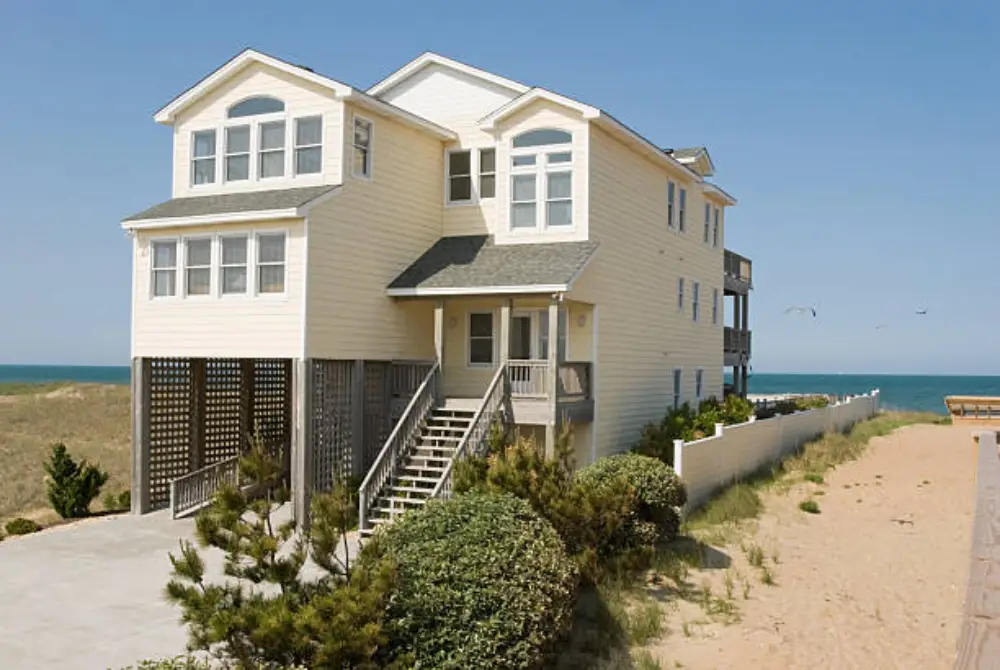
They banned me from the family reunion like I was a stain they needed to scrub out. And now I’m sitting in a rental car, watching my mother lead the pack up the driveway of the beach house she thinks is a lucky rental. She enters the code I set myself. They haul in coolers and confidence, oblivious that the deed has my LLC on it. I’ll let them settle in for twenty minutes before I remind them who really holds the keys.
My name is Skyla Morales, and right now I am invisible. I am sitting in the driver’s seat of a rented silver sedan with tinted windows, parked just far enough away to be mistaken for a neighbor’s guest but close enough to see the sweat glistening on my mother’s forehead. The engine is off. The air conditioning died five minutes ago, and the Georgia heat is already starting to press against the glass like a heavy, wet blanket. It’s ninety degrees in Seabrook Cove today, with humidity that makes the air feel thick enough to drink.
I don’t mind the heat. The heat keeps me focused. It reminds me that I am real, even if the people currently invading my property believe I have ceased to exist.
Through the windshield, I watch the caravan arrive. It’s a spectacle of entitlement. Three large SUVs pull into the driveway of the pristine three-story beach house that sits proudly against the backdrop of the Atlantic Ocean. The house is a beauty, if I do say so myself. I spent six months renovating it, choosing every slat of the siding and every tile in the master bath. It stands tall, painted a soft, dusty blue that mimics the twilight sky, with white trim that gleams under the midday sun.
It looks expensive. It looks exclusive. It looks like exactly the kind of place my family feels they deserve, despite never having worked hard enough to earn it.
My mother, Linda, is the first to exit the lead vehicle. She steps onto the crushed-shell driveway wearing a wide-brimmed straw hat and a flowing floral caftan that screams vacation matriarch. She claps her hands, shouting directions at my father and my brother, Kyle, who are dragging coolers out of the trunk. Even from here with my windows rolled up, I can imagine her voice. It’s a frequency that cuts through glass. She points at the stairs leading up to the main deck, her fingers stabbing the air, directing traffic in a driveway she does not own for a house she did not rent.
I watch her lips move. I know exactly what she is saying. She is telling them to be careful. She is telling them not to scratch the paint. She is acting like the guardian of the estate, the benevolent queen who has bestowed this luxury upon her subjects.
My phone vibrates in the cup holder. The screen lights up, displaying a notification from a messaging group titled “Family Reunion 2026.” I am not a participant in this group anymore. Not really. I was removed as an active member weeks ago, but thanks to a glitch in the app—or perhaps the sheer incompetence of the admin, my sister Bridget—I can still see the preview of the broadcast messages on my lock screen.
The message is from Bridget. It reads, “Final reminder to everyone. Skyla is not to be given the address. She is not invited. If anyone shares the location with her, you are ruining the vibe for Mom. Let’s keep this drama-free.”
I stare at the words. They are sharp, concise, and cruel. A few years ago, reading that would have sent me spiraling into a panic attack. I would have called my father, begging to know what I did wrong. I would have texted Bridget apologizing for sins I had not committed just to be allowed back into the circle. I would have driven down here with a store-bought cake and a desperate need for validation, hoping they would let me sleep on the couch.
But today I feel nothing. No, that’s not accurate. I feel a cold, precise satisfaction. It’s the feeling of a trap springing shut exactly when you intended it to.
I look back at the house. Bridget has stepped out of the second car. She is holding her phone up, already recording a video for her social media. She spins in a circle, capturing the ocean view, the swaying dune grass, and the impressive façade of the house. She is framing the narrative for her followers: Look at us. Look at our success. She poses near the front stairs, flashing a smile that doesn’t quite reach her eyes, selling a lifestyle that is entirely fraudulent.
They approach the front door. This is the moment. This is the test. The front door is equipped with a high-end smart lock. It requires a six-digit code. My family walks up to it with zero hesitation. They do not fumble for keys. They do not call a host. Linda steps up to the keypad, her posture radiating confidence.
She punches in the numbers: 1-9-8-5-0-7.
It is my birthday. July 5th, 1985. The irony is thick enough to choke on. They are using the date of my birth to enter a house they have explicitly banned me from. They likely assume the code was set by the rental agency or perhaps by whatever contact Linda claims to have used to secure this place. They do not know that I set that code remotely three hours ago. I set it specifically because I knew it was the one number my mother would never forget. Not because she cares about me, but because it was the day her body was ruined by childbirth—a fact she has reminded me of at every birthday dinner for three decades.
The lock mechanism whirs. The small light on the keypad turns green. A distinct, cheerful chime echoes from the porch. The door opens. I watch them freeze for a split second as if they can’t believe it actually worked. And then a cheer goes up. Kyle high-fives my father. Bridget squeals, clapping her hands together before rushing inside. Linda turns back to the driveway, hands on her hips, looking at the rest of the relatives pouring out of the third car. She waves them in, benevolent and grand.
They stream into the foyer. I can see the movement through the large bay windows on the first floor. They are reacting to the interior now. I know what they are seeing. They are seeing the hand-scraped oak floors I imported. They are seeing the massive abstract oil painting in the entryway that I commissioned from a local artist in Savannah. They are seeing the chef’s kitchen with the dual industrial ranges and the marble island that seats twelve.
They are screaming with delight. I can see Bridget jumping up and down in the living room. She rushes to the window, looking out at the ocean, and for a second she looks right at my car, but she does not see me. She sees only her own reflection in the glass, superimposed over the sea. She sees only what she wants to see—her own grandeur.
To understand why I’m sitting in a hot car watching my family break into my home, you have to understand who Skyla Morales is supposed to be. I am a non-entity. I am thirty-four years old. I work in cybersecurity for a firm called Arborvale Tech Solutions. When people ask what I do, I tell them I work in data compliance. It is a boring phrase designed to make people’s eyes glaze over, and it works every single time. It stops the questions. It prevents anyone from digging deeper.
If I told them I hunt down vulnerabilities in banking infrastructures or patch zero-day exploits that could cripple a hospital network, they might think I’m interesting. They might think I am powerful. And in the Morales family, there is only room for one kind of power, and I am not the one who is allowed to hold it.
Our family operates on a very specific, rigid operating system. My mother, Linda, is the sun, the gravity, and the heat death of the universe all wrapped into one. She dictates the emotional weather of the household. If she is happy, we are allowed to breathe. If she is unhappy, it is our job to fix it—usually by sacrificing our own comfort or dignity.
My father, Mark, is the master of avoidance. He’s a good man in the theoretical sense, meaning he never raises his hand and he goes to work every day, but he is a coward in the practical sense. He learned long ago that the path of least resistance was to agree with Linda. Even when she was wrong. Even when she was cruel.
Then there is Bridget, my older sister. The star. The golden goose who never actually lays any eggs. Bridget was born to be looked at. She consumes attention the way a fire consumes oxygen. Growing up, if Bridget had a recital, the world stopped. If Bridget had a breakup, the house went into mourning. She is loud, chaotic, and charming in that superficial way that works on strangers but exhausts anyone who actually knows her.
And finally, Kyle—the baby, the boy. In a traditional structure like ours, the son can do no wrong. Kyle is thirty-one now, but to my mother he is still a toddler who needs his shoes tied. He floats through life on a raft of excuses constructed by my parents. If he loses a job, it is the boss’s fault. If he gets a speeding ticket, it is the cop’s fault.
And then there is me. Skyla. My role was simple. I was the insulation. I was the shock absorber. I learned early on that I was not the smart one or the pretty one or the special one. I was the reliable one. That sounds like a compliment. But in a toxic family dynamic, it is a curse. It means you are the one who remembers the birthdays. You are the one who drives the relatives to the airport at four in the morning because Bridget needs her beauty sleep and Kyle lost his license. You are the one who lends money that never gets paid back.
I learned that if I did something well, I was not praised. I was simply given more work. If I got straight A’s, it was expected. If I cleaned the kitchen, nobody noticed until I stopped doing it. The lesson was carved into my spine by the time I was twelve: Do not ask for things. Do not cause trouble. Do not expect anyone to defend you.
So I learned to dissolve. I learned to let their words pass through me like I was made of smoke. But I also started building. I did not build with bricks or wood. Not at first. I built with silence. I got my degree without asking for a dime. I worked three jobs. I ate instant noodles and lived in an apartment the size of a closet so I would never have to ask my father for rent money.
When I got hired at Arborvale, I started making real money—serious money, the kind of money that changes lives. But I knew the rules. In my family, resources are communal, but debts are personal. If they knew I had money, it would not be my money. It would be the family’s money. So I became a hoarder of secrets. I drove a ten-year-old sedan with a dent in the bumper. I wore clothes from discount racks. I never talked about promotions.
When the company went public and my stock options vested, netting me a payout that made my knees weak, I went to work the next day with a bagged lunch and told my mother I was worried about layoffs. I lied to them every single day. And every lie bought me another brick of freedom.
The decision to buy the beach house in Seabrook Cove was the culmination of ten years of deception. I found it two years ago. It was a wreck then—a battered old structure that had taken a beating from a hurricane and been left to rot—but it sat on a stretch of sand that felt isolated, quiet. I bought it under an LLC, Seaglass Harbor Holdings. I hired a lawyer to handle the paperwork so my name would never appear on a public registry. I paid for the renovations in cash, wire transfers sent from accounts my family could not imagine existed.
I spent my weekends driving down here, telling my family I was working overtime or taking certification courses. I stripped wallpaper. I sanded floors until my hands were blistered. I chose every fixture, every paint color. I built a sanctuary designed for one person: me. I never intended to tell them. That was the point. This house was the one thing in the world that was mine.
The digital execution happened exactly thirty days before the cars pulled into the driveway at Seabrook Cove. My phone had buzzed at seven sharp. It was a calendar invitation titled “Family Sync Regarding Reunion Logistics.” I remember staring at the notification while I was heating up leftover Thai food in my kitchen. A cold knot tightened in my stomach—the kind of visceral warning system that only activates when you know you’re about to walk into an ambush.
I accepted the invite and opened my laptop. The screen flickered to life, revealing the familiar grid of faces. My mother was sitting in her sunroom, the lighting perfectly arranged to soften the lines around her eyes. She was wearing a crisp white blouse, the kind she usually reserved for church or bank appointments. That was the first bad sign.
“Hello, everyone,” I said. My voice sounded thin in the quiet of my apartment.
“Hi, sweetie,” Linda said. Her voice was warm, dripping with that sickeningly sweet syrup she used to coat her poison. “We just wanted to hop on a quick call to finalize some details for the trip next month. We have made some executive decisions.”
I set my fork down. I knew better than to have an appetite when Linda was in executive mode.
“Well, we have been talking,” Linda continued. “Your father and I and Bridget, we have been discussing the vibe of this year’s reunion. We want this trip to be about relaxation. Total decompression. No stress, no work talk, no tension.”
I waited. Silence is the best counter to manipulation.
“And we have to be honest with each other. Skyla, lately you seem overwhelmed. You are always so high-strung. Even when you are with us, you are checking your emails. You are taking calls. It creates a certain energy, a heavy energy.”
I felt the blood rise to my cheeks. It was a lie. I had not taken a work call during a family event in three years.
“I am not stressed,” I said, keeping my voice level. “I actually have plenty of vacation time saved up. I was planning to leave my laptop at home.”
Linda smiled, a sad, pitying smile. “See, that is exactly it. You are already defensive. You are already debating. This is what we mean, Skyla. You have this intensity that just doesn’t fit with the flow we are trying to create.”
Then Bridget chimed in. She took a sip of her wine and swirled the glass. “Look, Skye, it’s not a big deal. Mom just thinks—well, we all think—that maybe you’d be happier skipping this one. You know, you clearly hate hanging out with us anyway. You always sit in the corner and judge everyone. It’s a buzzkill.”
“This isn’t about my attitude, is it?” I asked. The words left my mouth before I could stop them. “This is about the loan.”
Two weeks prior, Bridget had come to me with a brilliant business proposal. She wanted to start a curated lifestyle brand—essentially selling repackaged candles and tote bags. She needed fifty thousand dollars for inventory and website design. She had asked me to co-sign a business loan because her credit score was in ruins. I had said no. I had said it politely. I had offered to help her build the website myself for free. I had offered to help her write a business plan. But I refused to put my name on a fifty-thousand-dollar debt for a company that existed only in her imagination.
Linda’s face hardened. The mask of concern slipped, revealing the steel beneath. “This is not about money, Skyla. It is about support. It is about loyalty. When your sister needs you, you turn your back. You act superior. You hoard your success like it makes you better than us. That attitude. That is what we do not want at the beach house.”
So that was it. The verdict was in. I had refused to pay the toll. So I was barred from the bridge.
“We think it is best for your mental health,” Linda said, pivoting back to the script. “We want you to take that week for yourself. Stay in the city. Work on your projects. We will send you pictures.”
Bridget laughed. “Yeah, it’s honestly better this way. Less drama. Better for everyone, right, Dad?”
I looked at my father’s square on the screen. “Dad?” He looked up for a split second. His eyes met mine, and I saw the apology there. I saw the fear. He knew this was wrong. But he also knew that if he sided with me, he would be the one sleeping on the couch for the next six months.
He looked back down at the table. “Your mother just wants everyone to have a good time, Skyla,” he mumbled. “Maybe… maybe next year.”
“Fine,” I said. I did not argue. I did not beg. “If you do not want me there, I will not come.”
“Good,” Linda said, clapping her hands together once, briskly. “I’m glad we could handle this like adults. Now, for the rest of us, I am sending the final itinerary in the group chat. We managed to secure that property I told you about, the one right on the water in Seabrook.”
I saw Bridget’s eyes light up. “The big one with the double deck?”
“Yes,” Linda beamed. “The owner finally approved the booking. It was a hassle, but I pulled some strings. It’s going to be spectacular.”
The screen went black. The call ended. Ten seconds later, my phone buzzed. I picked it up. It was a notification: You have been removed from the group “Reunion 2026 Planning.”
But in their haste to cut me off, they made a mistake. A split second before the removal notification appeared, a final message from Linda had come through to the group. It was a link to a digital brochure, accompanied by the text: “Here is the place. Everyone save the address.”
The preview of the link was still visible in my notification history: 42 Dune Grass Lane, Seabrook Cove, Georgia.
I froze. I stared at the tiny text on my lock screen. I knew that address. I knew it because I had typed it into insurance forms. I had typed it into tax documents. I had typed it into the GPS of my car a hundred times during those long weekend drives to check on the contractors.
It was my house.
I sat down on the kitchen stool, my mind racing. They had somehow found my property. They had seen it listed somewhere—probably on a fake rental listing that I had never authorized. Or perhaps they had simply driven through Seabrook and spotted it, assuming it was available for rent because it looked like a vacation home. My mother, always resourceful when it came to securing things she wanted, had probably contacted the property management company I used for maintenance, Tidemark Property Care, and somehow convinced them she had permission to book it.
But she didn’t. And now they were planning to spend a week in my house, celebrating their success in exiling me, completely unaware that they were trespassing on my property.
The realization settled over me like a warm blanket. This was no longer just about being excluded. This was about them walking into the perfect trap of their own making. I could have called Tidemark immediately and had them cancel the booking. I could have changed the door code. I could have sent a lawyer’s letter.
But where would be the poetry in that? Where would be the justice in a simple cancellation email? They wanted me erased from their lives. They wanted to pretend I didn’t exist. Fine. I would let them. I would let them walk right into the house I built with my own hands and my own money. I would let them celebrate their cruelty in the very sanctuary I created to escape them.
And then I would show them exactly who Skyla Morales had become.
Now, sitting in this rental car, watching them laugh and unpack, I check the time on the dashboard. It is three-sixteen in the afternoon. They have been inside for fourteen minutes. I need to give them a little more time. I need them to get comfortable. I need them to break a seal on a bottle of wine. I need them to use the bathroom. I need the forensic evidence of their presence to be undeniable.
I reach for the folder on the passenger seat. Inside is the deed to the house, the formation documents for Seaglass Harbor Holdings LLC, and a printed copy of the text message banning me from the reunion. It is my arsenal.
I watch as the lights flicker on in the upstairs bedrooms. They are claiming their territories. I know Linda is taking the master suite on the top floor, the one with the private balcony and the soaking tub that overlooks the dunes. Bridget will take the second-best room, the one with the queen bed and the vanity lighting I installed specifically for makeup application. Kyle will take the bunk room on the main floor because it is closest to the seventy-five-inch television and the oversized leather sectional.
I roll down my window just a crack. The sound of the ocean is drowned out by the noise coming from the house. They have opened the sliding glass doors to the deck. Music is already blaring, some generic pop hit that Bridget loves. I hear the clinking of glass bottles. Someone is dragging a heavy cooler across the hardwood floor.
Linda’s voice drifts out, shrill and commanding. “Be careful with that cooler. Don’t scratch the floor. This place is worth millions.”
I almost smile. She is right. It is worth two-point-four million dollars, to be exact. And she is terrified of damaging it—not because she respects property, but because she wants to pretend she belongs in it.
I check my security app. I have cameras installed in the main living areas and the exterior. I tap the screen, bringing up the feed from the living room. The image is crisp, high definition. There they are. My father is sinking into the white linen sofa, a beer already in his hand. He looks tired but relieved. He thinks he has a week of free luxury ahead of him.
Bridget is in the kitchen opening cabinets. She pulls out a crystal wine glass—my crystal wine glass—and holds it up to the light. She laughs, saying something to her fiancé, Dylan, who is leaning against the marble counter, looking impressed. They look like a commercial for the perfect American family: successful, happy, united. They have erased me completely.
I close the camera app. My heart is beating a steady, slow rhythm against my ribs. It is a calmness I have had to learn. Years of therapy and years of working in cybersecurity have taught me one thing: Emotion is a vulnerability. Patience is a weapon.
I look at the digital clock on the dashboard. It is three-twenty-two in the afternoon. They have been inside for twenty minutes. It’s time.
I pick up my phone and dial a number I have saved as “Tidemark Management – Emergency Line.” It rings once, twice. A woman answers, her voice professional and crisp.
“Tidemark Property Care. This is Sarah. How can I help you?”
I clear my throat, ensuring my voice is steady. There is no tremor. There is no hesitation. “Hello, Sarah. This is Skyla Morales. I am the owner of the property at 42 Dune Grass Lane.”
There is a pause, the sound of typing on a keyboard. “Yes, Ms. Morales. We have your file right here. We were not expecting you until tomorrow for the inspection. Is everything all right?”
“No,” I say, my eyes fixed on my mother’s silhouette on the balcony. “Everything is not all right. I am currently outside the property. I have reason to believe there are unauthorized individuals inside my home. They have bypassed the security code and are currently occupying the premises.”
The tone on the other end changes instantly, from polite to alert. “Oh my goodness. Are you safe? Do you want us to call the police immediately?”
I watch Linda laugh at something my father says. She looks so happy. She looks so secure. “Yes,” I say. “Please contact the sheriff’s department and let them know we have a breaking-and-entering situation. And send your on-call property manager as well. I’ll meet them at the property.”
“Absolutely, Ms. Morales. We are on it right now. Are you certain you’re safe where you are?”
“I’m fine,” I say. “I’m in my car. Just please send help quickly.”
I hang up the phone and place it gently back in the cup holder. Then I step out of the rental car. The heat hits me immediately, but I don’t care. I straighten my shoulders, pick up the folder, and begin walking toward the house.
My footsteps crunch on the crushed-shell driveway. The sound is loud enough that Kyle, who is standing on the deck with a beer, turns to look. He squints at me, confused. He doesn’t recognize me at first. I am backlit by the afternoon sun, just a silhouette approaching their paradise.
Then his eyes widen. “Skyla?”
The music stops. Faces appear in the windows. Bridget comes rushing to the sliding glass door, her phone still in her hand. “What the hell? What are you doing here?”
I don’t answer. I keep walking. I climb the stairs to the main deck, my eyes locked on my mother, who has emerged from inside, her wine glass still in hand. Her face goes through a rapid series of emotions: confusion, anger, fear.
“Skyla,” she says, her voice sharp. “You need to leave. Right now. You are not welcome here. This is our vacation rental.”
I reach the top of the stairs and stop. I look at each of them in turn. My father, frozen on the couch. Kyle, his beer halfway to his mouth. Bridget, her phone raised as if she’s considering calling someone. And Linda, standing there in her caftan, trying to look authoritative in my house.
“Your vacation rental,” I repeat slowly. “That’s interesting. Because I own this house.”
The silence is immediate and absolute. Even the ocean seems to quiet.
Bridget laughs, a nervous, brittle sound. “What are you talking about? Mom rented this place months ago.”
I open the folder and pull out the deed. I hold it up so they can all see it. “This is the deed to 42 Dune Grass Lane, Seabrook Cove, Georgia. It is registered to Seaglass Harbor Holdings LLC. That’s my company. I am the sole owner. I bought this property two years ago. I renovated it myself. And you are currently trespassing.”
Linda’s face has gone pale. “That’s impossible. I spoke to the property manager. They gave me the code. They confirmed the booking.”
“You spoke to a property management company that handles maintenance for me,” I say. “They do not have authorization to rent this property. They never did. Whoever you spoke to made a mistake. Or perhaps you misrepresented yourself. Either way, you do not have permission to be here.”
My father stands up slowly. “Skyla, sweetheart, there must be some misunderstanding. We can figure this out.”
“There is no misunderstanding, Dad,” I say. My voice is calm, measured. “You all made it very clear that I was not welcome at this reunion. You banned me. You removed me from the group chat. You told everyone not to give me the address. And yet here you are, in my house, using my things, drinking my wine.”
Bridget’s face has gone from confused to furious. “You did this on purpose. You set us up.”
“I didn’t set you up,” I say. “You found this house on your own. You decided you deserved it. You walked right in without ever checking if you actually had the right to be here. I simply watched you do it.”
The sound of vehicles approaching cuts through the tension. Two sheriff’s department SUVs pull into the driveway, followed by a sedan marked with the Tidemark Property Care logo. Car doors slam. Footsteps on the stairs.
A deputy appears on the deck, his hand resting on his belt. “We got a call about a breaking and entering. Who’s the property owner here?”
I raise my hand. “That would be me, officer. Skyla Morales. These individuals entered my home without permission using a security code they should not have had access to.”
The deputy looks at my family, then back at me. “Ma’am, do you have documentation proving ownership?”
I hand him the deed. He examines it, then nods. He turns to my family. “Folks, I’m going to need you to gather your belongings and vacate the premises immediately. If there’s a dispute about a rental agreement, you’ll need to handle that through civil court, but right now you’re on private property without the owner’s consent.”
Linda’s mouth opens and closes like a fish. “But we… we had a code. The door opened.”
“That doesn’t constitute legal entry, ma’am,” the deputy says. “The owner is here, and she’s asking you to leave. You need to comply.”
I watch as the reality sinks in. Bridget looks like she wants to scream. Kyle looks confused, like he still can’t quite process what’s happening. My father won’t meet my eyes. And Linda, for perhaps the first time in her life, is truly speechless.
They gather their belongings in a chaotic scramble. Coolers are dragged back to the cars. Suitcases are hauled down the stairs. Bridget is crying now, angry tears streaming down her face as she shoves her things into the trunk of her car. The deputies watch, making sure nothing is taken that doesn’t belong to them.
Linda approaches me one last time as she’s leaving. Her eyes are red, her voice shaking. “How could you do this to your own family?”
I look at her, this woman who gave birth to me but never truly saw me. “You banned me from this reunion because I wouldn’t bankroll Bridget’s fantasy business. You told me I wasn’t welcome. You erased me from your plans. And then you showed up at my house—the house I built with my own money, the house I never told you about because I knew you would find a way to take it from me—and you acted like it was yours. So I ask you, Mom: How could you?”
She has no answer. She turns and walks to her car, her caftan dragging in the crushed shells.
Within twenty minutes, the driveway is empty. The SUVs are gone. The deputies have taken their statements and left. The property manager has apologized profusely and promised a full investigation into how the booking was made. And I am alone.
I walk back into my house. The living room still smells like the perfume Bridget wears. There are wet rings on the coffee table where they set their drinks. I’ll clean it tomorrow. Right now, I walk through each room, reclaiming my space.
I climb the stairs to the master suite and step out onto the private balcony. The sun is starting to set, painting the sky in shades of orange and pink. The ocean stretches out before me, endless and indifferent. I take a deep breath, feeling the salt air fill my lungs.
My phone buzzes. It’s a text from a number I don’t recognize: “This is your father. I’m sorry. You were right about everything. I should have stood up for you.”
I read it twice, then delete it. His apology comes too late and costs him nothing.
Another buzz. This time it’s Bridget: “You’re a vindictive bitch and I hope you’re happy ruining our vacation.”
I delete that one too without responding.
I stand there on the balcony as the sky darkens, watching the waves crash against the shore. For thirty-four years, I have been the invisible daughter, the forgotten sister, the family ATM and punching bag. I have been told I am too much and not enough, too intense and too boring, too successful and too selfish.
But standing here in the house I built with my own hands, the house I paid for with money I earned, the house that represents every sacrifice and every lie I told to keep my family from destroying what I was building, I finally understand something.
I am not invisible. I never was. They simply refused to see me because acknowledging my success would mean acknowledging their failures. They refused to see me because I was useful as a shadow, as someone they could diminish to make themselves feel bigger.
But shadows disappear when you step into the light.
I am Skyla Morales. I am a cybersecurity specialist who protects critical infrastructure. I am a woman who turned pain into power and silence into strategy. I am a homeowner, a businesswoman, and someone who finally learned that the people who hurt you most are often the ones who deserve you least.
The beach house stands tall behind me, a monument to my resilience. Tomorrow I will change all the codes. I will upgrade the security system. I will make sure this sanctuary remains exactly what it was always meant to be: mine.
And if my family ever wonders what happened to the quiet daughter who never fought back, who never stood up for herself, who let them walk all over her for three decades, they can remember this day.
They can remember the day they broke into her house and discovered that the invisible girl had been building an empire they never saw coming.
The ocean roars in approval, and for the first time in my life, I smile without apologizing for the space I take up in the world.

Adrian Hawthorne is a celebrated author and dedicated archivist who finds inspiration in the hidden stories of the past. Educated at Oxford, he now works at the National Archives, where preserving history fuels his evocative writing. Balancing archival precision with creative storytelling, Adrian founded the Hawthorne Institute of Literary Arts to mentor emerging writers and honor the timeless art of narrative.