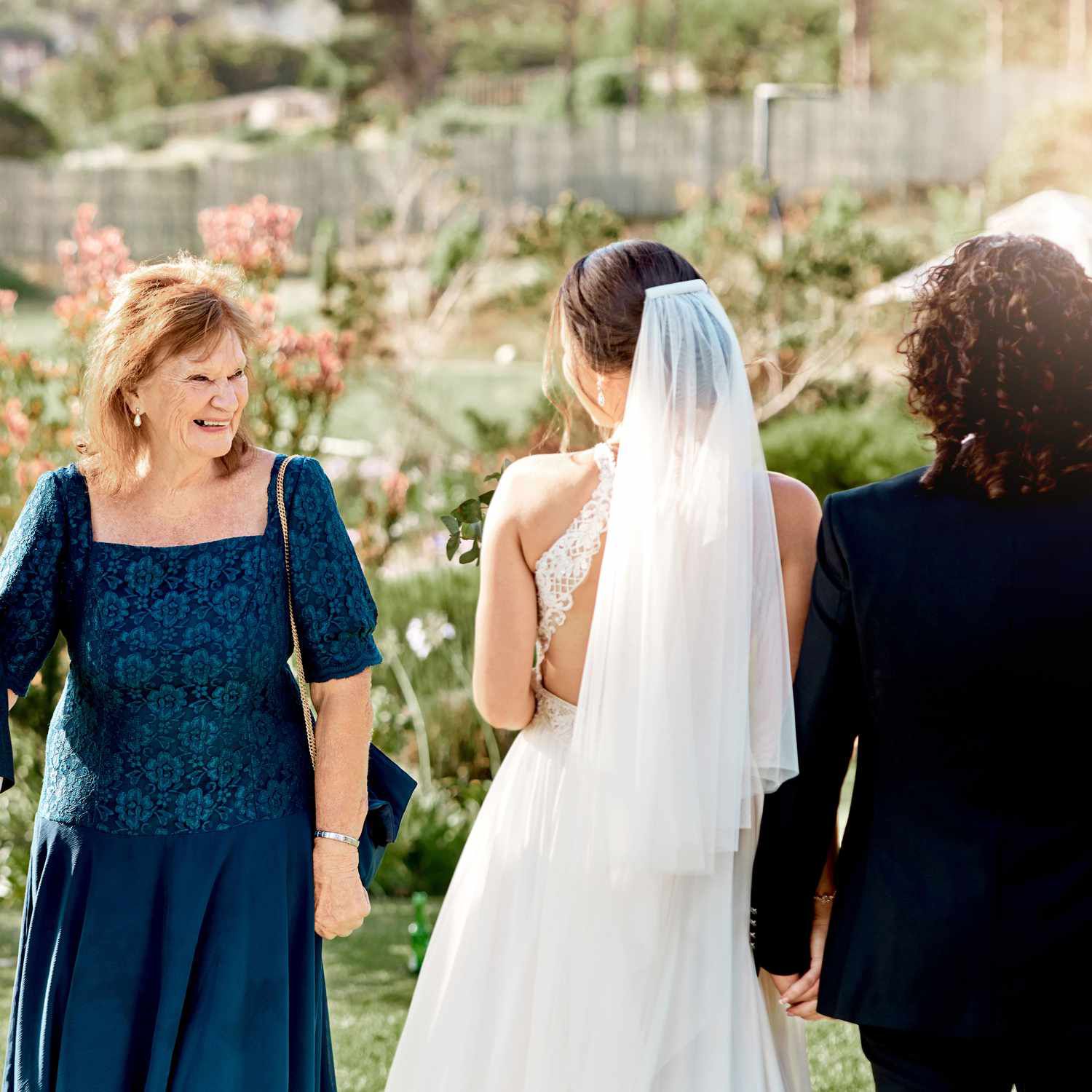
The Wedding That Never Was
The banquet hall erupted in a strange mixture of nervous laughter and confused murmurs. I stood frozen near the third row of white folding chairs, my hands gripping my small navy clutch so tightly that the clasp dug into my palm. Around me, guests shifted uncomfortably, uncertain whether this was part of some elaborate performance or an actual catastrophe unfolding in real time.
My name is Katherine Reynolds, and I’m sixty years old. I’ve lived through enough weddings, funerals, and family gatherings to know when something is terribly wrong. This morning, I had spent nearly an hour in front of my bedroom mirror, carefully pinning back my silver hair and smoothing the fabric of my navy dress. I practiced my smile, rehearsed gracious responses to small talk, and reminded myself that today was about my son’s happiness—nothing else mattered.
The venue itself was stunning, almost painfully so. The Whitmore Estate sat on the edge of town, a sprawling property with white colonial columns, perfectly manicured hedges that looked like they belonged in a magazine spread, and a long driveway lined with miniature flags tucked carefully into flower beds. Inside, the banquet hall glowed with warm amber lighting from crystal chandeliers, and every table was draped in champagne-colored linens with centerpieces of ivory roses and baby’s breath.
But even surrounded by all that beauty, I couldn’t shake the feeling that something fundamental was off.
Michael is my only child. At thirty-four, he’s the kind of man any mother would be proud of—steady, thoughtful, genuinely kind without needing recognition for it. He calls me every Sunday afternoon without fail, remembers my birthday weeks in advance, and still asks for my advice even when he doesn’t take it. When he told me six months ago that he’d met someone at an art gallery downtown, there was a brightness in his voice I hadn’t heard since his college years.
“She’s different, Mom,” he’d said over coffee at my kitchen table, his hands wrapped around a mug I’d given him when he was twelve. “She’s cultured, sophisticated. She actually listens when I talk about my work.”
I wanted desperately to believe him. I wanted to see what he saw—this polished, elegant woman who seemed to have stepped out of a lifestyle magazine. Tamara Westbrook was thirty-one, a self-described “event consultant” with impeccable taste and an Instagram feed that looked professionally curated. She wore designer labels I recognized from department store windows, spoke fluent French, and could discuss modern art with the kind of casual authority that made people lean in to listen.
But there were moments—small, fleeting moments—when her performance seemed to slip.
The compliments that sounded just slightly too rehearsed. The way her smile never quite reached her eyes, stopping somewhere around her perfectly contoured cheekbones. How she’d pause for just a fraction of a second before responding to personal questions, as if calculating the most advantageous answer.
I told myself I was being paranoid. Mothers are supposed to be protective, but they’re also supposed to trust their adult children’s judgment. Michael was happy, or at least he seemed happy, and who was I to question that?
Then came the phone call from the bank.
It was a Tuesday afternoon, exactly four weeks before the wedding. I’d been sorting through my late husband’s old files—Harold had been gone three years, but I was still finding documents tucked into folders and drawers—when my cell phone rang with an unfamiliar number.
“Mrs. Reynolds? This is David Chen from First National Bank. I’m calling about some paperwork that requires your immediate attention.”
The tone in his voice made my stomach tighten. This wasn’t a routine call about account updates or promotional offers.
I drove to the bank that same afternoon. Mr. Chen was a serious man in his fifties with wire-rimmed glasses and the kind of expression that suggested he’d seen too many people make terrible financial decisions. He slid three documents across his desk, each one stamped and notarized, each one bearing a signature that looked remarkably like mine but absolutely wasn’t.
“These are loan applications,” he explained carefully. “Two for credit lines totaling fifty thousand dollars, and one for a personal loan of twenty-five thousand. All filed within the last six weeks using your identity and financial information.”
My hands trembled as I picked up the papers. The signatures were good—whoever had forged them had practiced. But I could see the differences in the loops of my R’s, the angle of my Y’s. This was someone who had studied my handwriting carefully but couldn’t quite capture the unconscious rhythm of how I actually wrote.
“I didn’t sign these,” I managed to say, though my throat felt tight. “I’ve never applied for any of these loans.”
Mr. Chen nodded slowly. “I suspected as much. That’s why I called you directly rather than processing them. Mrs. Reynolds, do you have any idea who might have access to your personal information? Old tax returns, bank statements, identification documents?”
I sat there in his sterile office with its motivational posters about financial planning and retirement savings, and my mind immediately went to the obvious answer. But I couldn’t say it out loud. Not yet. Not without being absolutely certain.
“I need to look into this,” I told him. “Please don’t process anything. I’ll be in touch soon.”
I drove home in a daze, gripping the steering wheel so hard my knuckles turned white. In my driveway, I sat in the car for nearly twenty minutes before I could force myself to go inside. Harold’s wedding ring hung on a chain around my neck—I’d worn it every day since the funeral—and I found myself clutching it like a talisman.
My husband had been a detective for thirty-two years before his retirement. He’d taught me to trust my instincts but verify everything. “People lie, Katie,” he used to say over dinner, recounting cases with the identifying details changed. “They lie about big things and small things. The trick is figuring out which lies matter and which ones are just noise.”
So I started investigating quietly. Carefully. The way Harold would have done it.
I checked my credit report and found three inquiries I hadn’t authorized. I went through my files and discovered that several important documents—my social security card, an old tax return, a photocopy of my driver’s license—were missing. I’d hosted a small engagement party for Michael and Tamara at my house two months earlier, and I remembered Tamara asking to use the bathroom upstairs, then taking an unusually long time to return.
My home office was upstairs. So was my filing cabinet.
I pulled my phone records and noticed several calls to my home number during hours when I was always at my weekly volunteer shift at the library. Someone had been calling to see if I was home. Testing my schedule.
The pattern became clearer with each piece of evidence, and my dread deepened with each discovery. I told myself there could be another explanation. Perhaps someone had stolen my identity remotely. Perhaps this was unrelated to the wedding, just terrible timing.
But mothers know. We know in the same instinctive way we know when our children are lying about homework or sneaking out at night. It’s a sense that develops over decades of reading facial expressions and listening to tones of voice that don’t quite match the words being spoken.
Two weeks before the wedding, I tried to talk to Michael about my concerns. We met for lunch at the Italian restaurant where he’d celebrated every birthday since he was seven. I’d rehearsed what I wanted to say, tried to frame it as concern rather than accusation.
“Michael, honey, I need to talk to you about something important.”
He looked up from his menu with the patient expression he reserves for what he thinks are my unnecessary worries. “Mom, if this is about the seating chart again, Tamara already fixed—”
“It’s not about the seating chart. It’s about Tamara.”
His expression changed immediately, closing off in a way that made my heart sink. “Don’t.”
“Please just listen. I’ve discovered some irregularities with my financial accounts, and the timing—”
“Stop.” He set down his menu with deliberate care. “I know what you’re doing, and I’m asking you not to do this.”
“Michael, someone forged my signature on loan applications. Someone who had access to my personal documents.”
“And you immediately assume it was my fiancée?” His voice rose slightly, drawing glances from nearby tables. “You can’t just accept that I’m happy. You have to find something wrong.”
“I’m not trying to find something wrong. I’m trying to protect you.”
“From what? From someone who loves me? From someone who actually makes me happy?” He stood up, pulling out his wallet. “I’m sorry, Mom. I thought you’d be supportive. I thought you’d want to see me happy.”
He left cash on the table and walked out, leaving me sitting alone with two menus and a growing pit of despair in my stomach.
I went home and sat in my kitchen for hours as the afternoon light faded into evening. Harold’s ring was warm against my skin from body heat, and I found myself talking to him the way I sometimes did when I was alone and overwhelmed.
“I don’t know what to do,” I whispered into the empty room. “I don’t know how to protect him from this.”
But I kept digging anyway. I contacted a private investigator—a retired colleague of Harold’s who owed him a favor. I hired a handwriting analyst who confirmed what I already knew: those signatures weren’t mine. I filed a police report about the identity theft, though I didn’t mention my suspicions about who was responsible.
And I prayed—genuinely, desperately prayed—that I was wrong about everything.
Then came the wedding day.
I arrived early, as mothers of the groom are expected to do. I greeted guests, accepted compliments on my dress, and made small talk about the weather and the beautiful venue. Tamara’s mother, Patricia Westbrook, was there in a silver gown that probably cost more than my car, watching everything with the sharp-eyed attention of a general surveying a battlefield.
When our eyes met across the room, she smiled. It was the kind of smile that didn’t involve warmth so much as territorial satisfaction.
The ceremony began with all the traditional elegance. The string quartet played Pachelbel’s Canon. The bridesmaids processed down the aisle in their champagne-colored gowns. Michael stood at the altar looking handsome and nervous in his tailored suit, his hands clasped in front of him.
And then Tamara made her entrance.
She was stunning, objectively speaking. Her dress was a masterpiece of lace and silk that must have cost a small fortune. Her makeup was flawless. Her hair was arranged in an elaborate updo that probably required three hours and a professional stylist.
But her eyes, as they swept the assembled crowd, were calculating rather than joyful.
The ceremony proceeded normally at first. The officiant—a friend of Tamara’s family—spoke about love and commitment with the practiced delivery of someone who performed weddings every weekend. Michael and Tamara exchanged traditional vows, their voices clear and steady.
And then, during what should have been the transition to the ring exchange, Tamara suddenly stopped.
She turned to face the assembled guests, and her expression shifted into something I couldn’t quite read. Triumph, perhaps. Or vindication.
“Before we continue,” she said, her voice projecting beautifully through the hall, “I need to address something that’s been bothering me.”
The officiant looked confused. Michael’s expression flickered with uncertainty. A strange tension rippled through the crowd.
Tamara raised one perfectly manicured hand and pointed directly at me.
“That woman there,” she said clearly, “is not Michael’s real family. She’s been interfering in our relationship from the beginning, trying to sabotage our happiness, spreading vicious lies about me to anyone who will listen.”
For a split second, the whole banquet hall reacted like it was some kind of joke. Phones went up to capture what people thought was an unconventional wedding moment. A few guests laughed nervously, too loudly, unsure how to respond. Someone near the back whistled as if this were entertainment and not a wedding.
My cheeks burned the way they used to when I was young and couldn’t hide my emotions. Every eye in the room turned toward me, and I felt simultaneously exposed and invisible, reduced to a prop in whatever script Tamara had written for this moment.
Patricia Westbrook watched me with that same satisfied smile, and suddenly I understood. This wasn’t spontaneous. This had been planned, perhaps even rehearsed. This was meant to humiliate me publicly, to isolate Michael from anyone who might question his choice, to establish Tamara’s narrative as the official version of reality.
But my son didn’t laugh.
He didn’t freeze in embarrassment or look away in shame. His expression didn’t show the confusion or mortification I’d expected.
Instead, Michael’s face went utterly still—not angry, not confused, but crystal clear with purpose.
He stepped forward, raising one hand in a gesture that commanded immediate attention. The band stopped playing mid-note. The murmuring crowd fell silent. Even Tamara’s confident smile began to waver.
“That’s enough,” Michael said, his voice carrying through the hall with absolute authority.
Then, in front of three hundred guests, the officiant, the photographer, and every camera phone pointed at the altar, he reached into his jacket and pulled out a thick manila envelope I’d never seen before.
Tamara’s smile vanished completely. Her mother’s expression tightened with something that looked like barely controlled panic. The maid of honor took an unconscious step backward.
And suddenly, standing there in that beautiful venue surrounded by flowers and candlelight and the wreckage of what should have been a celebration, I understood something profound:
My son hadn’t been blind to Tamara’s deceptions. He’d been conducting his own investigation. And he’d waited until this precise moment—when she was at her most confident, when she thought she’d won—to reveal what he’d discovered.
Michael’s hand was steady as he opened the envelope and pulled out a stack of documents. His voice, when he spoke, was calm but carried clearly to every corner of the room.
“Two months ago,” he began, “my mother came to me with concerns about identity theft. She told me someone had attempted to open multiple fraudulent accounts using her personal information.”
Tamara’s face had gone pale beneath her professionally applied makeup. She opened her mouth to speak, but Michael continued.
“I didn’t want to believe it could be you. I wanted to think there was some mistake, some explanation that would make sense.” He held up the first document. “So I hired a private investigator. This is a full background report on Tamara Westbrook.”
He paused, letting that sink in before continuing.
“Tamara Westbrook doesn’t exist. Not legally, anyway. Her real name is Tamara Lynn Morrison, and she’s been running variations of this same con for eight years across four different states.”
The gasps from the assembled guests were audible now, no longer polite murmurs but genuine shock. Phones were still recording, but people had stopped treating this like entertainment.
“In Oregon, she was engaged to a software engineer named David Chen. She stole forty thousand dollars from his elderly mother before disappearing. In Arizona, she almost married a real estate developer. His family caught on just before the wedding when they noticed jewelry missing from his grandmother’s collection.”
Patricia Westbrook was moving toward the exit now, trying to slip out quietly, but two men in suits—private security Michael had apparently hired—blocked her path.
“In Texas,” Michael continued, his voice never wavering, “she convinced a widower to add her to his bank accounts three months before their planned wedding. He lost nearly seventy-five thousand dollars before his daughter got the police involved.”
Tamara finally found her voice. “This is insane! Michael, you can’t possibly believe—”
“The engagement ring you’re wearing,” Michael interrupted, “isn’t a family heirloom like you told everyone. You bought it yourself six weeks ago using a credit card you opened fraudulently in my mother’s name. I have the receipts.”
He held up more documents. Bank statements. Credit reports. Photographs of Tamara in other cities with other men, wearing different expensive clothes, using different last names.
“You’ve been systematically stealing my mother’s identity while pretending to plan our future together. You emptied her savings account last week—seventy-three thousand dollars that my father spent thirty years accumulating for her retirement.”
My hand flew to my mouth. I hadn’t known about the savings account. I’d been so focused on the loan applications that I hadn’t checked Harold’s old account, the one he’d set up for emergencies and my future.
“The thing is,” Michael said, his voice finally showing emotion—not anger, but profound sadness, “I might have forgiven a lot of things. I might have believed you had reasons, or circumstances that pushed you into desperate choices. But what I can’t forgive is what you just tried to do to my mother.”
He turned to look directly at Tamara, and his expression was heartbreaking in its disappointment.
“She raised me alone after my father died. She worked two jobs to send me to college. She sat with me through every difficult night when I doubted myself, every failure, every loss. And you just pointed at her in front of everyone I know and tried to convince the world that she doesn’t matter. That she’s not my real family.”
The banquet hall was completely silent now except for the quiet sound of someone crying—I thought maybe one of my cousins in the back row.
“So here’s what’s going to happen,” Michael said, his voice strengthening again. “The police are already on their way. You’re going to be arrested for identity theft, fraud, and forgery. Your mother—or whoever that woman is—will likely face charges as an accessory. And this wedding is over.”
He turned to the assembled guests, many of whom were still holding up their phones, capturing every word.
“I apologize to everyone who traveled to be here today. The reception will still happen because I’ve paid for it and the vendors deserve to be compensated for their work. But instead of a wedding celebration, consider it… I don’t know, a family reunion. A reminder of what actual family looks like.”
Then he stepped off the altar, walked past the frozen wedding party, and came directly to me.
My son, my beautiful boy who I’d raised and worried over and loved with every fiber of my being, wrapped his arms around me and held on tight while I finally let myself cry.
“I’m sorry, Mom,” he whispered against my hair. “I’m so sorry I didn’t believe you immediately. I had to be sure. I had to have proof that couldn’t be denied.”
“You’ve been investigating this whole time?” I managed to ask through my tears.
“From the day you first tried to warn me. I couldn’t let you see it because I needed her to feel confident, to keep thinking she was winning. If she’d known I was suspicious, she might have disappeared before we could build a case strong enough for the police to prosecute.”
Behind us, the sound of sirens grew closer. Tamara was screaming now, being restrained by the security guards, claiming this was all a misunderstanding, that Michael was having some kind of breakdown.
But no one was listening to her anymore. Patricia Westbrook had been cornered near the exit, her expensive silver gown catching the light from the chandeliers as she tried frantically to call someone on her phone.
The police arrived with practiced efficiency. Two officers took Tamara into custody while she continued to protest and cry, her elaborate makeup running in dark streams down her face. Two more officers escorted Patricia out in handcuffs.
And through it all, Michael stayed beside me, one arm around my shoulders, protecting me the way I’d always tried to protect him.
The guests began to disperse slowly, whispering among themselves, checking their phones to see if the videos they’d recorded were already going viral. Some people came up to offer support or ask if I was alright. Michael’s best friend, James, clasped his shoulder and said simply, “I’m proud of you, man.”
Eventually, when the police had taken their statements and left with their suspects, when most of the guests had either headed to their cars or migrated toward the reception hall where the caterers were gamely setting up for a very different kind of event, Michael and I sat together in the front row of chairs.
“Your father would have been proud of you,” I told him quietly. “The way you handled this—carefully, methodically, making sure you had everything documented before you acted. That was pure Harold Reynolds.”
Michael smiled, though his eyes were still sad. “I learned from the best. Both of you.”
“I’m sorry your wedding turned into… this.”
“Are you kidding?” He laughed, though it sounded slightly hysterical. “This is going to be the wedding everyone talks about for years. ‘Remember that time Michael Reynolds exposed his con-artist fiancée at the altar?’ I’m going to be famous.”
“That’s not exactly the kind of famous most people hope for.”
“No,” he agreed. “But at least it’s honest.”
We sat in silence for a moment, surrounded by the elaborate decorations that had been meant for a celebration of love and commitment but had instead witnessed the exposure of betrayal and deception.
“What happens now?” I asked finally.
“Now?” Michael stood and offered me his hand. “Now we go to the reception, we eat the expensive food I paid for, we drink the good champagne, and we spend time with the people who actually matter. The people who showed up because they care about us, not because they wanted to watch a spectacle.”
I took his hand and let him help me up. My legs felt shaky, and I was pretty sure my carefully applied makeup was ruined from crying, but Michael was right. The people who really mattered were still here.
At the reception, what should have been awkward or melancholic somehow transformed into something almost magical. Without the weight of Tamara’s presence and expectations, people relaxed. Real conversations happened. Laughter—genuine laughter, not the performative kind from earlier—filled the room.
My sister cornered me by the buffet table and hugged me so tightly I could barely breathe. “I never liked that girl,” she whispered fiercely. “Too polished. Too perfect. Real people have flaws.”
Michael’s college friends formed a protective circle around him, trading stories and jokes, reminding him that his worth wasn’t defined by one failed relationship or public embarrassment. The band, after a brief confused consultation, started playing upbeat music that had nothing to do with wedding standards.
And slowly, impossibly, the evening began to feel less like a disaster and more like a strange kind of victory.
Around midnight, after most of the guests had gone home with doggie bags of expensive catering and stories they’d be telling for decades, I found Michael standing alone on the venue’s back terrace. The night air was cool, and in the distance, I could hear crickets and the occasional sound of cars on the highway.
“You okay?” I asked, joining him at the railing.
He was quiet for a long moment. “I really thought I loved her, you know. Or at least, I loved who I thought she was. It’s hard to separate the real feelings from the manipulation.”
“That’s what makes con artists so dangerous,” I said softly. “They’re not just after your money. They’re after your ability to trust your own judgment.”
“Did Dad ever tell you about cases like this? People who built entire relationships on lies?”
“A few times. He always said the victims weren’t stupid or weak. They were just people who wanted to believe the best about someone they cared about. That’s not a character flaw. That’s actually a sign of a good heart.”
Michael turned to look at me, his expression vulnerable in the dim light from the reception hall. “I’m sorry I didn’t believe you right away. I’m sorry I thought you were just being an overprotective mother who couldn’t let go.”
“You don’t need to apologize for that. You needed to see the truth for yourself. If I’d pushed harder, you might have pushed back just as hard, and she might have won.”
“She almost did win.” He shook his head. “If I hadn’t started my own investigation, if I’d just accepted her version of events…”
“But you didn’t. You trusted your instincts and did the work to uncover the truth. That’s what matters.”
We stood together in comfortable silence, watching the stars appear one by one in the darkening sky. Somewhere inside, someone had convinced the band to play one more song, and I could hear the opening notes of an old jazz standard that Harold used to love.
“Want to dance?” Michael asked suddenly. “Since I don’t have a bride, maybe my mother will humor me?”
I laughed, surprised. “In the parking lot? In these shoes?”
“Why not? It’s been that kind of night.”
So we danced—mother and son—under the stars behind a wedding venue, to music drifting through open doors, while caterers packed up and the last few guests headed home. It was nothing like the formal mother-son dance that had been planned, the one that would have happened after dinner to carefully selected music while everyone watched.
This was better. This was real.
Two weeks later, Michael came over for Sunday dinner as he always did, though now it felt different—lighter somehow, like a weight had been lifted. The criminal investigation was proceeding quickly with all the evidence he’d compiled. The district attorney was confident about securing convictions for Tamara and her mother, who turned out to be her aunt and longtime accomplice.
“I got a message today,” Michael said over my pot roast, which had been his favorite since childhood. “From David Chen—the software engineer from Oregon.”
“The first victim?”
“Yeah. He saw the videos online and reached out. Wanted to thank me for finally getting evidence that could put her away. Apparently, he tried to press charges back then, but she’d covered her tracks too well.”
“How is he doing?”
“Better. It took him a long time to trust anyone again after what happened. But he’s married now, has a kid on the way. He said seeing her get caught helped him get closure on that chapter of his life.”
I set down my fork, considering. “And how are you doing? Really?”
Michael was quiet for a moment, thoughtful. “Honestly? I’m okay. I think I will be okay, anyway. It’s weird—I’m more angry about what she tried to do to you than what she did to me. The money can be recovered. My trust issues can be worked on. But the way she pointed at you, tried to convince everyone that you were the problem…” His jaw tightened. “That showed me exactly who she really was. And it made everything after that easier to process, somehow.”
“Your father used to say that people reveal their true character in how they treat those who can’t do anything for them,” I said quietly. “Tamara thought I was just an obstacle, someone to be managed or eliminated. She didn’t realize that you would see through that.”
“She underestimated both of us.” He smiled, and this time it reached his eyes. “That was her biggest mistake.”
We finished dinner, and I brought out apple pie with vanilla ice cream—another childhood favorite. As we ate, Michael told me about his plans for the future: taking some time to focus on his work, traveling with friends, rediscovering who he was outside of that relationship.
“And maybe,” he added with a slight smile, “being a lot more cautious about the next person I date.”
“Cautious is good,” I agreed. “But not so cautious that you close yourself off completely. What happened with Tamara doesn’t mean everyone is dishonest. It just means you’re wiser now about what red flags to watch for.”
“Will you help me with that? The red flag detection?”
“Always,” I promised. “Though hopefully next time your mother’s instincts won’t be quite so dramatically proven correct.”
He laughed at that—a real, genuine laugh that reminded me of the boy he’d been before loss and heartbreak had complicated things.
After he left that evening, I stood at my kitchen sink washing dishes and looking out at the backyard Harold had loved to tend. The garden was somewhat overgrown now—I didn’t have his patience with plants—but it was still beautiful in its own wild way.
I thought about the wedding that wasn’t, the public spectacle, the hundreds of strangers who would forever associate my family with that viral video of a groom exposing his con-artist bride. It wasn’t the story I would have chosen for us.
But as I dried the last plate and put it away in its proper place, I realized something important: we’d survived it. More than survived—we’d come through it with our relationship stronger, our trust in each other deepened by having weathered something genuinely difficult together.
And really, isn’t that what family is actually about? Not the perfect celebration or the flawless photographs or the ceremony that goes according to plan. Family is about standing together when everything falls apart. It’s about believing in each other even when belief is difficult. It’s about doing the hard work of protection and trust and forgiveness.
Three months later, on a quiet Sunday afternoon, Michael brought someone new by for dinner. Her name was Rachel, and she was a teacher at the local elementary school. She wore jeans and a simple sweater, carried a grocery bag with wine and flowers she’d picked up on the way over, and laughed at my stories about Michael’s childhood with genuine warmth.
When she excused herself to use the bathroom, Michael leaned across the table with a slightly anxious expression.
“So? What do you think?”
I considered carefully, remembering my promise to help him watch for red flags but also to not let past experiences poison future possibilities.
“I think,” I said slowly, “that she seems lovely. Down to earth. Real. She laughed at herself when she spilled wine on her sweater, which is a good sign—people who can find humor in small embarrassments are usually authentic.”
“But?” Michael prompted, hearing the hesitation in my voice.
“But nothing. I genuinely like her. Although…” I smiled slightly. “It might be wise to not give her access to your filing cabinet on the first date.”
Michael burst out laughing, and Rachel, returning from the bathroom, looked between us with confused amusement.
“Inside joke?” she asked.
“Very inside,” Michael confirmed, and we all laughed together.
As the evening progressed, I watched my son with this new woman—how he listened when she talked about her students, how she asked him genuine questions about his work, how they navigated conversation with the kind of ease that suggested real compatibility rather than performance.
Maybe it would work out. Maybe it wouldn’t. There were no guarantees in love or life or family.
But sitting there in my kitchen with good food and better company, watching my son smile without the shadow of manipulation hanging over him, I felt something I hadn’t expected after everything that had happened:
Hope.
And that, I thought, was worth more than any perfect wedding could ever be.

Ethan Blake is a skilled Creative Content Specialist with a talent for crafting engaging and thought-provoking narratives. With a strong background in storytelling and digital content creation, Ethan brings a unique perspective to his role at TheArchivists, where he curates and produces captivating content for a global audience.
Ethan holds a degree in Communications from Zurich University, where he developed his expertise in storytelling, media strategy, and audience engagement. Known for his ability to blend creativity with analytical precision, he excels at creating content that not only entertains but also connects deeply with readers.
At TheArchivists, Ethan specializes in uncovering compelling stories that reflect a wide range of human experiences. His work is celebrated for its authenticity, creativity, and ability to spark meaningful conversations, earning him recognition among peers and readers alike.
Passionate about the art of storytelling, Ethan enjoys exploring themes of culture, history, and personal growth, aiming to inspire and inform with every piece he creates. Dedicated to making a lasting impact, Ethan continues to push boundaries in the ever-evolving world of digital content.