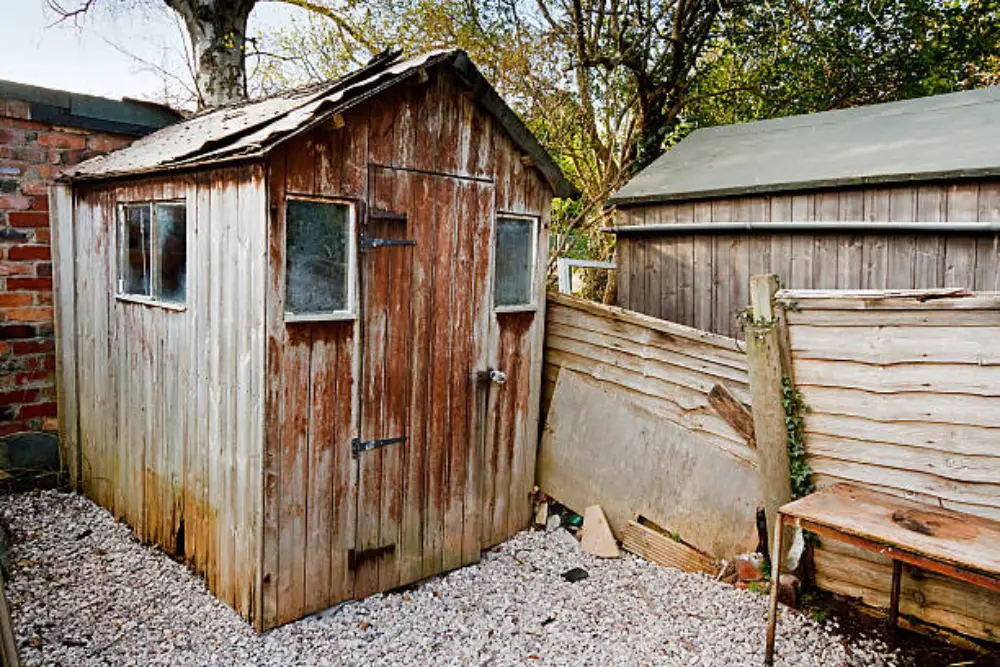
After my husband died, I inherited his old shed. My son said, “Sell it—it’s just junk.” But when I moved an old cabinet, I discovered a room I hadn’t known about for thirty-five years. What I found inside changed everything.
I used to think my life had settled into a quiet routine after Mark passed away. I cooked simple meals, walked the same few blocks every morning, and watered the small line of potted plants he’d left on the back porch. Days were predictable, which made the grief easier to bear. I knew where everything was, or at least I thought I did. That illusion lasted until the moment I pulled the old wardrobe away from the back wall of his shed.
Tom and Sarah visited on Sundays, always in a hurry. They’d stay for coffee, exchange polite words, and then Sarah would check her watch like she’d left something urgent waiting. I told myself she was just busy, but the truth was she didn’t like being in my house. She never said so directly—she didn’t have to. She’d glance around the living room with that tight, assessing look that made me feel as though the cushions weren’t straight or the air smelled wrong.
Tom used to stay longer. Before Mark died, he and his father would talk in the yard for hours, repairing things that barely needed fixing. But after the funeral, he began drifting—slowly at first, then all at once. Sarah filled the silence between us with cheerful suggestions that sounded harmless on the surface.
“You could downsize,” she’d say lightly, tapping her nails on the kitchen table. “It would be easier for everyone.”
Everyone. I knew she meant Tom, and probably herself.
One Sunday, she brought up the shed—Mark’s shed, the space he’d always jokingly called his castle of lost treasures. I hadn’t touched anything inside since the funeral.
“What are you keeping it for?” she asked, stirring her coffee though I hadn’t given her sugar. “It’s full of junk, isn’t it?”
I didn’t answer right away. She pushed again. “You could sell it, clear the space, maybe even get a little money out of it.”
Tom nodded along. He rarely spoke first anymore. That was the first sharp sting, the first tiny tear in the fabric of trust. I remember sitting at the table, my hands wrapped around my cup, wondering when they’d started talking about my property in private. Wondering what else they discussed without me.
Nothing pushed me toward action until a week later, when a letter arrived addressed to Mark from an official-looking law firm. My heart knocked hard against my ribs. I’d thought all his legal matters were already handled. When I opened it, I expected something small—an old bill, maybe, or a delayed insurance note. Instead, it was a notice about a storage contract renewal for secondary inventory holdings.
I had no idea what that meant. Mark never mentioned owning a second storage unit or any inventory. The phrase alone made me feel like an outsider in my own marriage. What else hadn’t he told me?
I sat in the kitchen staring at that envelope until the light shifted across the floorboards. Later that afternoon, I walked out to the shed. Maybe I thought I’d find some explanation, or maybe I just wanted to inhale that thick, dusty smell that still reminded me of him.
The tools hung exactly where he’d left them. The workbench was cluttered with bolts and washers and small envelopes of seeds he never planted. But the far corner held the wardrobe—heavy, its back pressed against the wall. I’d never bothered to move it before. It had always looked too cumbersome.
Something in me shifted that day—a restless, unsure feeling, a need to see, to confirm something I couldn’t put into words. I pressed my palms against the wood and pushed. At first, nothing happened. Then, slowly, the legs scraped across the concrete. Dust shook loose from the top and drifted into my hair. I pushed again, harder, gritting my teeth.
That’s when I saw it. A door. A narrow wooden door, almost the same color as the wall behind it. No knob, just a small metal latch, old and slightly rusted.
My breath caught. Mark had built this shed himself thirty-five years ago. I’d watched him level the ground, pour the concrete, raise the frame. How could there be a door I didn’t know about?
I reached for the latch, then stopped. Why had he hidden it?
My heart pounded as I lifted the latch with the tips of my fingers. The metal clicked softly. The hinges creaked. I opened it just a few inches at first, and then I saw what was inside.
The hidden room was small, barely more than a narrow rectangle carved into the far corner of the shed. The air that drifted out carried a staler smell, untouched, as if time had stopped in there. I finally stepped forward, slow and careful, steadying myself with a hand against the wall.
Boxes were stacked neatly, labeled in Mark’s handwriting. My throat tightened. These weren’t random items—these were things he kept separate, things he didn’t want caught up with everything else.
I knelt beside the first box and brushed a hand over the marker writing. House Papers 1985–1990. Another: Contracts. Another: Personal.
I didn’t open any of them. Not then. I was too overwhelmed, too afraid of what I might find. A sick, spiraling thought crept into my mind: if he hid this from me, what did he think I would do with it? And worse—what would Sarah do if she found out this existed?
That question jolted me back to my feet. I closed the door carefully and backed out into the open air, breathing in the crisp afternoon breeze. The shed felt different now, like a witness to something I wasn’t prepared for.
By the time Tom called that night, I was already exhausted. “Mom, Sarah wonders if you need help sorting the shed. If you want, we can come by this weekend.”
I almost said yes out of habit, out of the part of me that still wanted them close. But all I pictured was Sarah walking into the shed, scanning the space, and then noticing the wardrobe had been moved. Noticing the door behind it.
“No,” I said, sharper than I intended. “I’ve already started on it. I’ll handle it.”
After we hung up, I sat at the kitchen table and stared at the dark window. For the first time, I thought about what I’d already lost: Mark, the easy relationship with my son, the comfort of being sure of my place in the family. If Mark had hidden something for thirty-five years, it had to be important. If Sarah was circling my home like a hawk, ready to clean out “junk,” then whatever he left behind might be exactly what she hoped I wouldn’t find.
The next morning, I opened the box labeled House Papers. Inside were folders, loan information, renovation receipts, old land surveys, and a set of keys I didn’t recognize. Too organized, too intentionally separated. I opened another box: Contracts. More documents, some with his signature, some without. One envelope was sealed, unmarked. I slipped it into my pocket.
Then I reached the box labeled Personal. Inside were letters—bundles of them. Some addressed to Mark, some written by him but never mailed. My breath caught as I saw one with my name on it. Unopened. The edges yellowed slightly with age.
Why would he write to me and hide it?
I didn’t open the letter. Not yet. I needed a plan, a clear head, and I needed protection. I had to stay ahead of Sarah. First: keep the room secret. Second: go through everything myself. Third: find someone neutral I could trust—a lawyer, not the family lawyer Tom and Sarah used.
I found Mark’s old phone book with a circled name: Daniel Rhodes, Attorney at Law. Next to it, in Mark’s handwriting: Honest, good. Had Mark planned to call him? Why keep the number circled but never mention it?
I called the next morning. A woman answered with a warm voice. I scheduled an appointment for that afternoon.
Daniel Rhodes’s office was small, tucked between a barbershop and a fishing supply store. When he came out to greet me, he looked older than I’d imagined—white hair, wire-rimmed glasses, a calm, deliberate way of moving.
In his cramped office, I explained about the hidden room, the boxes, the documents I’d never seen before. “I don’t know why he hid them.”
He nodded once, slowly. “You brought some with you?”
I slid the envelopes toward him. He opened them carefully, spreading papers across the desk. I watched his face more than the documents, trying to read any flicker of concern. When he finally spoke, his voice was lower.
“These aren’t random. They’re about the property line. This shows an adjustment your husband made years ago—a transfer of a small strip of land, but it wasn’t filed with the county.”
“Why wouldn’t he file it?”
He shook his head. “Hard to say. Maybe he meant to. Maybe he didn’t want attention drawn to it. But if someone were to discover this now, after his passing, there could be complications.”
“What kind of complications?”
“If someone questioned the integrity of the property boundaries, they could argue the validity of your ownership—especially if they claimed your husband concealed something intentionally.”
My stomach dropped. Sarah’s voice echoed in my head: You could downsize. It would be easier for everyone.
“Could someone use this to pressure me into selling?”
He looked at me directly. “Yes. If they wanted to.”
Cold washed through me. “My daughter-in-law has been pressuring me already.”
His voice stayed measured but firm. “Then in my professional opinion, you should not tell her—or anyone—what you’ve found, and you shouldn’t give them access to your property until we sort this out.”
As I left his office, I didn’t notice the familiar gray sedan parked across the street. I didn’t see the silhouette behind the wheel—not until I opened my car door and heard a sharp knock on the window.
I turned, and there was Sarah, smiling too wide. “Funny running into you here.”
In that moment, I knew she suspected something.
Sarah leaned against my car, arms folded. “Daniel Rhodes, huh? Didn’t know you two knew each other.”
“I had an appointment.”
“About what?”
She asked it lightly, but there was steel underneath.
“That’s personal,” I said, opening my car door.
But she stepped forward, placing a hand on the frame. “Tom’s worried about you. You’ve been distant.”
“I’m fine.”
Her eyes flicked toward my handbag. “You look unsettled.”
My heart kicked hard, but I didn’t let it show. “I’m fine.”
She studied me, searching for cracks. Then she leaned closer, lowering her voice. “You know, Margaret, secrets have a way of making things messy.”
The words struck like a cold slap. She couldn’t know about the shed, but she could sense something was shifting.
“I’m not keeping secrets,” I said quietly.
Sarah smiled. “Good. Because Tom and I want to help you. But we can only help if you’re honest.”
I shut the door firmly and drove away, watching her in the rearview mirror. She stood there, still smiling, but the smile had sharpened into something thin and calculating.
Back home, I finally opened Mark’s letter to me. His handwriting hit me like a ghost sitting across from me.
Margaret, if you’re reading this, I couldn’t say it out loud. I needed time, and maybe I ran out of it. There are things about the property I should have explained years ago, decisions I made trying to protect us, but I went about them the wrong way. Maybe I was ashamed. Maybe I was afraid you’d think I’d made a mess of it.
If anything ever happens to me, don’t let anyone push you into selling before you understand what’s yours. I kept copies of everything. Hidden—not because I didn’t trust you, but because I didn’t trust other people to stay out of what wasn’t their business.
Please, Maggie, be careful who you talk to about it.
He’d known. He had known people might circle, looking for opportunity and vulnerability.
I called Daniel. “I need to move the documents out of the shed. Someone might snoop.”
“Good instinct. I can hold some of them in my office until we sort out what matters.”
“I’ll bring them tomorrow.”
That evening, Tom called. “Mom, Sarah said she saw you downtown today. She thought you looked upset.”
“I wasn’t upset.”
“What were you doing at a law office?”
“Tom, why does that matter?”
“It just sounded unusual.”
There it was—the pressure, soft but present.
“You don’t have to worry about me. I handle my own affairs.”
After a long silence, he muttered, “I’ll talk to Sarah,” as if that solved everything.
The next morning, I got up before sunrise to pack the important documents. Halfway through, I heard a car door slam. My blood froze. I stepped out of the shed, forcing myself not to look startled.
Sarah stood at the edge of my yard, arms crossed. “What are you doing?”
My pulse hammered. I gestured to the gardening tools. “Sorting things.”
She tilted her head. “Looked like you were packing.”
“I wasn’t.”
She stepped closer, eyes narrowing. “If there’s something you need help understanding, Tom and I—”
“I don’t.”
Another step. “We don’t want you making mistakes.”
I straightened. “Sarah, this is my property. Don’t come here uninvited.”
She blinked, taken aback. For the first time, she lost her composure. Then she forced a polite smile. “We just want what’s best.”
I held her gaze. “For who?”
She didn’t answer. After a few seconds, she turned and walked back to her car without another word.
When she drove away, my knees finally loosened. I carried the tote bags inside, locked the door, and sank onto the couch, shaking. But beneath the fear, beneath the anger, something else was growing: clarity. A cold steadiness. She had overplayed her hand.
Over the next two weeks, Daniel and I worked through the documents methodically. What we discovered was both simpler and more significant than I’d imagined. Years ago, Mark had quietly purchased an adjacent strip of land from a neighbor who was facing foreclosure. He’d done it to protect our property value and to help someone in need, but he’d structured it in a way that left the paperwork incomplete—probably intending to file it properly but never getting around to it before his health declined.
The documents in the hidden room were his insurance policy, proof that the land was legally purchased and paid for, even if the county records didn’t reflect the full transaction. If someone challenged the property boundaries now, these documents would be essential to proving ownership. Without them, Sarah could have manufactured a dispute, claimed the boundaries were unclear, and pressured me into a sale that would benefit her and Tom while leaving me with a fraction of what the property was actually worth.
“She was planning to do exactly that,” Daniel said one afternoon, showing me notes he’d compiled. “If you’d sold without understanding what you owned, you would have lost tens of thousands of dollars.”
I felt sick. “How did she even know?”
“She didn’t,” he said. “But she suspected Mark might have left assets or complications you didn’t understand. She was fishing, hoping you’d panic and sell before you could get proper advice.”
The realization settled over me like cold water. My own daughter-in-law had been circling me like a vulture, waiting for me to stumble.
Daniel helped me file the corrected documents with the county, establishing clear title to the full property. He also drafted a letter to Tom and Sarah, politely but firmly informing them that my property matters were being handled by legal counsel and that any future discussions about selling would go through Daniel’s office.
The response came two days later. Tom called, his voice tight with frustration. “Mom, what are you doing? Sarah says you’ve hired a lawyer to shut us out.”
“I hired a lawyer to protect myself,” I said calmly. “And it turns out I needed one.”
“What’s that supposed to mean?”
I took a breath. “Tom, did Sarah ever tell you she thought there might be complications with the property boundaries? That maybe I didn’t own everything I thought I did?”
Silence.
“Did she?” I pressed.
“She… she mentioned it might be worth checking,” he admitted quietly. “She thought maybe Dad had made some mistakes with the paperwork.”
“And what were you planning to do if that turned out to be true?”
Another silence, longer this time.
“Tom,” I said gently, “your father didn’t make mistakes. He made careful, deliberate decisions to protect what was ours. And those decisions are now properly documented. No one is taking anything from me.”
“Mom, we weren’t trying to—”
“Maybe you weren’t,” I interrupted. “But Sarah was. And I need you to understand something: this is my home. My life. My property. And I’m not selling it to make things convenient for anyone.”
The line went quiet for so long I thought he’d hung up. Then I heard him exhale shakily.
“I’m sorry,” he whispered. “I didn’t know. I should have… I should have asked more questions.”
“Yes,” I said. “You should have.”
After we hung up, I sat in my kitchen with sunlight streaming through the window, and for the first time in over a year, I felt something close to peace.
A week later, my neighbor Linda knocked on my door with a casserole and a knowing smile. “I heard through the grapevine that you got everything sorted out.”
“I did,” I said, inviting her in. “Thanks to a good lawyer and a little backbone I didn’t know I still had.”
She laughed, setting the dish on my counter. “Margaret, you always had backbone. You just needed a reason to use it.”
Over tea, I told her the whole story—the hidden room, the documents, Sarah’s manipulation, Tom’s complicity born of willful ignorance. Linda listened without judgment, nodding in all the right places.
“What are you going to do now?” she asked.
I looked around my kitchen—the house Mark and I had built together, the life we’d shared, the space that was fully, legally, unquestionably mine.
“I’m going to live here,” I said simply. “For as long as I want. And when I’m ready—if I’m ever ready—I’ll make my own decisions about what happens next.”
Linda raised her teacup in a small toast. “To making your own decisions.”
“To making my own decisions,” I echoed, and meant it.
Tom visited the following Sunday, alone. Sarah, he explained awkwardly, had decided to stay home. We both knew what that meant: she was too embarrassed to face me after being outmaneuvered.
We sat on the back porch, drinking lemonade in the afternoon warmth. For a while, neither of us spoke. Then Tom cleared his throat.
“I’ve been thinking a lot about Dad,” he said. “About how he always said the most important thing was taking care of family. I thought that meant… I thought it meant making things easier, simpler. But I think maybe he meant protecting what matters, even when it’s hard.”
I reached over and squeezed his hand. “Your father loved you very much. And he loved me. Everything he did—even the things that seemed complicated—he did because he was trying to take care of us.”
Tom’s eyes filled. “I miss him.”
“I do too,” I said.
We sat together as the sun dipped lower, and something between us began to heal—not completely, not overnight, but enough. Enough to remember that we were still family, still connected by more than property and paperwork and old resentments.
As he left, Tom paused at the gate. “Mom? I’m proud of you. For standing up for yourself. Dad would be proud too.”
After he drove away, I walked back to the shed. I stood in front of the wardrobe, now pushed back against the wall, covering the hidden door once more. I placed my hand on the wood and whispered, “Thank you, Mark. For protecting me even when you couldn’t tell me why.”
The evening air was cool and sweet with the smell of cut grass. Inside the house, my life waited—not perfect, not uncomplicated, but mine. Fully, completely mine.
I locked the shed door and walked back across the yard, feeling the solid ground beneath my feet, the weight of my own choices settling comfortably on my shoulders.
Sarah never came back to my house uninvited. Tom and I rebuilt our relationship slowly, carefully, with new boundaries and new honesty. And I learned something I should have known all along: that sometimes the greatest inheritance isn’t money or property, but the courage to protect what you love—even from the people who claim to love you back.
The hidden room had held Mark’s secrets, yes. But it had also held his final gift to me: the truth, carefully preserved, waiting for the moment I’d need it most.
And when that moment came, I’d been ready.

Sophia Rivers is an experienced News Content Editor with a sharp eye for detail and a passion for delivering accurate and engaging news stories. At TheArchivists, she specializes in curating, editing, and presenting news content that informs and resonates with a global audience.
Sophia holds a degree in Journalism from the University of Toronto, where she developed her skills in news reporting, media ethics, and digital journalism. Her expertise lies in identifying key stories, crafting compelling narratives, and ensuring journalistic integrity in every piece she edits.
Known for her precision and dedication to the truth, Sophia thrives in the fast-paced world of news editing. At TheArchivists, she focuses on producing high-quality news content that keeps readers informed while maintaining a balanced and insightful perspective.
With a commitment to delivering impactful journalism, Sophia is passionate about bringing clarity to complex issues and amplifying voices that matter. Her work reflects her belief in the power of news to shape conversations and inspire change.