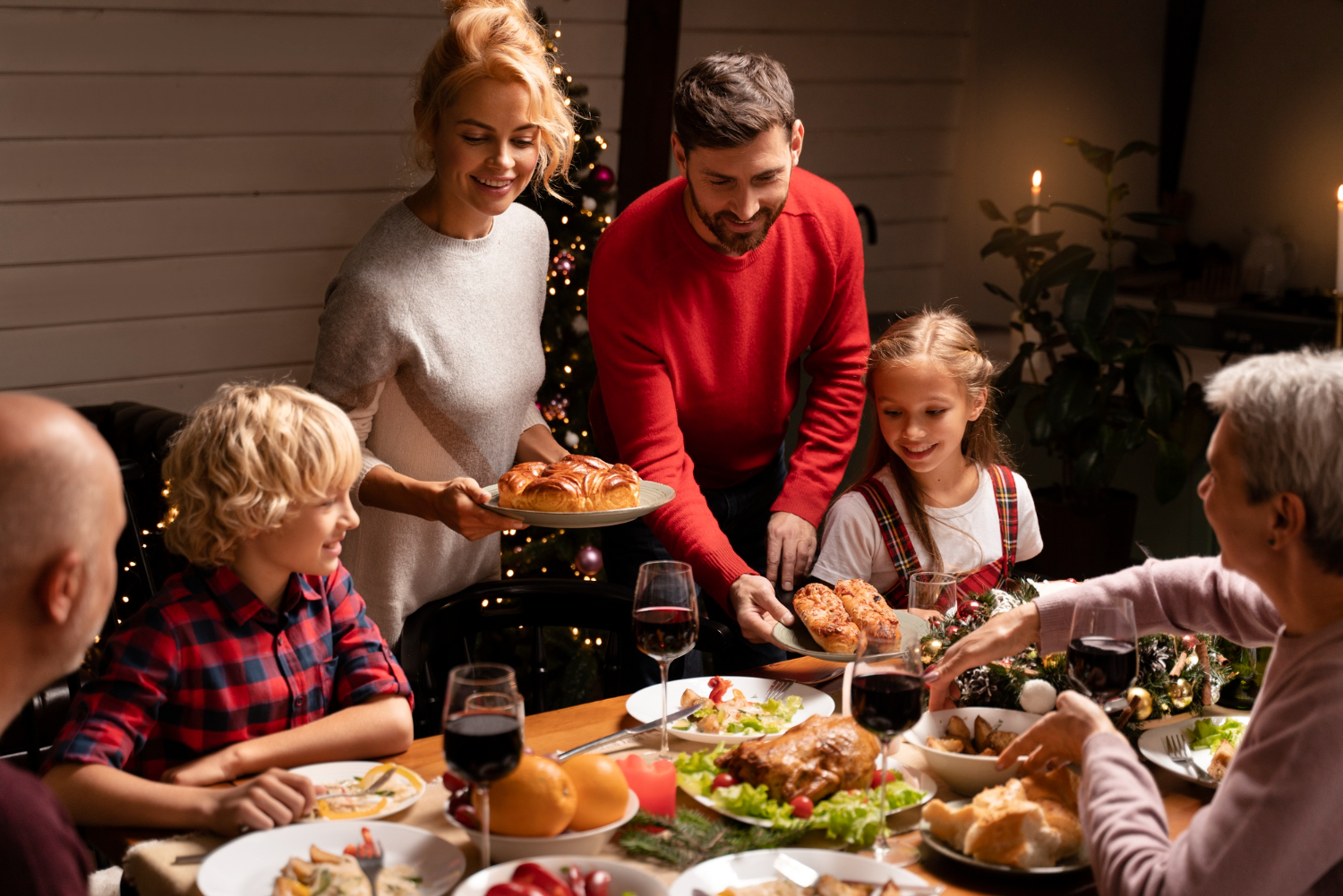
If you asked my family to describe me in one word, they’d say “dependable.” What they really mean is: I show up early, bring extra napkins, pick up checks no one mentions, and smooth over the uncomfortable silences. That was my plan for Christmas dinner—smile, keep things civil, get through the meal, and escape before the inevitable drama started its predictable countdown.
The house looked exactly like every December from my childhood: the plastic nativity set from 1994 with baby Jesus’s paint chipping off, the one-eyed inflatable snowman Dad refused to replace, the same scratched CD labeled “XMAS MIX 2008” playing Mariah Carey on loop. The familiar orbit remained unchanged too—everything and everyone spinning around my younger sister Natalie and her eight-year-old son Mason, the golden child and the golden grandchild.
My husband Ethan carried the green bean casserole I’d spent two hours making that morning. I balanced a bag of carefully wrapped gifts. My seven-year-old son Liam clutched a crayon drawing he’d made for his grandparents: stick-figure people standing under a crooked Christmas tree, “FAMILY FOREVER” spelled out in wobbly block letters across the top.
“Shoes off, I just had the floors done,” Mom said without looking up from the stove.
Dad nodded from his position by the oven, barely glancing our way. “Hey there, Champ.” He’d been calling me that since I was ten years old, back when I’d been the one bringing home straight A’s and soccer trophies. Before Natalie was born and recalibrated everyone’s attention like a magnet reorganizing iron filings.
We slid into our designated spots in the hierarchy. The dining table glowed under soft yellow light—red velvet runner, polished silverware, eight plates set like a magazine spread from Better Homes and Gardens.
Liam climbed onto his chair with the careful deliberation of a child who’d been taught good manners. He sat up straight, folded his hands, ready to say grace like we’d practiced. Then he blinked, his small face registering confusion.
His placemat was bare. No plate. No fork. No napkin. Just a sticky square where a candy cane had apparently melted sometime around 2012 and never been properly cleaned.
I kept my voice even, reasonable. “Mom, we need a place setting for Liam.”
She didn’t pause in her task of scooping an enormous helping of mashed potatoes onto Mason’s plate. “Oh, there wasn’t enough china,” she said dismissively. “Besides, he upset Mason earlier, remember? We don’t reward bad behavior in this house.”
Natalie sipped her wine—a expensive Pinot Noir I’d noticed she hadn’t brought herself—and shrugged. “He knocked over Mason’s block tower in the playroom before dinner. I gave him a timeout. He needs to learn there are consequences.”
“He apologized,” I said, my voice still calm but with an edge creeping in. “He said sorry three times. He’s seven years old.”
Mom waved her hand through the air like she was shooing a fly. “Growing boys need proper portions,” she cooed—to Mason, not to Liam. She placed the heaping plate in front of her favorite grandson with a warm smile I couldn’t remember ever being directed at me.
Liam folded his small hands in his lap. He stared at the empty spot in front of him the way children do when the rules of the world suddenly stop making sense, when adults fail the basic test of fairness that kids instinctively understand.
Something in me—something that had been quiet and compliant for three decades—clicked into place with an almost audible sound.
I stood up, my chair scraping against the hardwood floor.
“We’re leaving.”
Mom actually laughed, a dismissive sound. “Rose, don’t be ridiculous. Sit down.”
“It’s Christmas,” Natalie added with a smirk. “You’re really going to make a scene over a plate?”
“Yes,” I said simply. “I really am.”
Ethan rose without a word, bless him. His hand landed warm and protective on Liam’s shoulder. We gathered our wrapped gifts—the ones we’d spent weeks choosing carefully, the ones no one here would have appreciated anyway. Liam picked up his drawing, still warm from the hope he’d carried it with.
No one else moved. Dad went dim and silent like a television on pause, standing by the oven with a serving spoon frozen mid-air. Mom’s mouth hung open. Natalie’s wine glass stopped halfway to her lips.
“Merry Christmas,” I said to the room, and walked out.
Outside, the December air was sharp enough to bite exposed skin. In the car, after I’d buckled Liam into his booster seat, he whispered, “Mommy, did I do something really bad?”
“No, baby,” I said, turning to look at his beautiful face in the overhead light. “You did everything right. You were polite and kind. Some people just forgot how to see that.”
“Oh,” he said quietly. Then, after a pause: “Can we have chicken nuggets for Christmas?”
Ethan laughed from the driver’s seat, breaking the tension. “Absolutely, buddy. The good kind, too. With the dinosaur shapes.”
Back home, we created our own Christmas. Chicken nuggets arranged on plates like a fancy dinner. Carrot sticks. A blanket fort that smelled like fabric softener. Liam laughed too loud at a cartoon about a talking dog, the kind of laugh that’s just a little too enthusiastic, the kind kids do when they’re trying very hard to show they’re okay.
He didn’t ask about the dinner table again.
My phone lit up the kitchen counter like a flare. Nine missed calls from Mom. Four from Dad. Two from Natalie. A brand-new group chat had appeared with a name that made my stomach clench: “We need to talk about Rose.”
I didn’t open it.
At nine forty-seven that night, another text came through from Dad, separate from the group chat: “Rent’s due tomorrow.”
Not “are you okay.” Not “we’re sorry about dinner.” Not “is Liam alright.”
Just the monthly assumption that my paycheck belonged to them, the same text I’d been receiving on the twenty-sixth of December for the past three years.
Ethan leaned against the kitchen counter, watching me stare at the screen. “What now?”
I turned my phone so he could see the message. He exhaled slowly. “Of course. Of course that’s what they’d lead with.”
Something in my chest hardened. Not with meanness or anger, but with something solid and immovable, like bedrock finally surfacing after years of erosion.
I opened the family group chat. Scrolled past brunch photos from last weekend and Natalie’s gleeful post: “Mason absolutely crushed gift opening this year! So blessed!” I attached two items: a photo I’d taken on my way out—eight perfectly set places and one bare, sticky placemat where my son had sat with his hands folded. Then a ten-second video clip I’d recorded while pretending to check my phone: Mom serving Mason generous seconds while Liam sat perfectly still, watching.
I typed slowly, deliberately: “Last night there was no plate for my son at Christmas dinner. When I asked about it, I was told there wasn’t enough china and that he didn’t deserve one because he upset Mason. Mason got seconds. We left.”
My thumb hovered over the send button for approximately two seconds.
Send.
Three dots appeared immediately, pulsing like a warning light.
Mom: “You’re taking this completely out of context, Rose. There’s a whole side to this you’re not mentioning.”
Natalie: “Seriously? Grow up. You embarrassed everyone over a PLATE. Do you know how dramatic you look right now?”
Dad: “Whatever this is about, rent comes first. We can argue after the bills are paid.”
I didn’t argue. I didn’t defend. I didn’t explain.
I started a new text, slower this time, choosing each word with surgical precision.
“I’ve covered your rent twelve times this year. That’s $18,000. I paid for Dad’s car repair in March—$3,200. Mom’s dental work in July—$1,800. Natalie’s ‘temporary’ loan that was never paid back—$2,500. I never complained. I never asked for thanks. But last night you crossed a line that can’t be uncrossed. I’m not paying your rent anymore. I’m not paying for anything anymore.”
I stared at the blue bubble until it stopped wobbling. My chest did that tight, electric thing it does when you step off a curb that’s higher than you expected.
Ethan stood behind me, close enough that I could feel his warmth. “Say it,” he murmured. “Say the thing you’ve never been allowed to say.”
I hit send.
Silence. Then the chorus I should have predicted.
Mom: “How DARE you tally up our kindness like some kind of accountant. We RAISED you, Rose. We gave you a HOME.”
Natalie: “You think you’re better than us because you adopted? Because you got some rescue kid to make yourself feel important?”
The words hit like a slap. I typed back without shaking this time: “Never talk about my son like that again.”
A clown emoji appeared in response.
I blocked Natalie’s number. Then I left the group chat. Then I muted Mom’s contact.
The quiet that followed didn’t feel empty. It felt clean, like a room after you’ve finally thrown out the broken furniture you kept promising yourself you’d fix.
Ethan pulled me into a hug. “Proud of you,” he said into my hair.
“I should have done it years ago.”
“You did it when you were ready. That’s what matters.”
That night, I couldn’t sleep. I kept seeing Liam’s face as he sat in front of that empty placemat, trying so hard to be good, to be small, to not make trouble. I saw my own childhood face superimposed over his—the same expression I’d worn countless times, trying to earn love that should have been freely given.
I’d spent thirty-two years being “dependable.” Being the one who fixed things. Being the one who absorbed the chaos and smoothed everything over. I’d thought that was love. I’d thought that was family.
But watching them deny my son a plate at Christmas dinner—watching them literally exclude a child from the table—had shown me the truth with brutal clarity. This wasn’t love. This was a transaction. And I was always going to be the one paying.
Two mornings later, three slow knocks sounded at our front door. The specific rhythm my father used when he didn’t want my mother to hear he was nervous.
Ethan glanced up from his coffee. “Expecting someone?”
“Nope.”
I checked the peephole. Dad stood on our small porch, wearing his good coat, breath fogging in the cold morning air. No flowers. No casserole. No apology gift. Just a thick envelope in his hand, the kind he always brought when he needed something.
“You want me to stay?” Ethan whispered behind me.
“Yes,” I said immediately.
I slid the chain lock into place and opened the door exactly two inches.
Dad tried a smile that lived more in his memory than on his actual face. “Morning, Rosie. Can we talk?”
“We can talk through the chain.”
His smile faltered. He lifted the envelope. “Come on, sweetheart. Let’s be adults about this. Help your old man out. Just one more month, then we’ll be square. I promise.”
My fingers curled around the doorframe. Behind me, the heater hummed. From the living room, Liam’s laughter floated out—he was watching cartoons with Ethan, safe and warm and loved.
“What exactly did you come here to ask me, Dad?” I said, my voice steady but not sweet.
His jaw flexed. He glanced past me, trying to see into our small home. His eyes caught on our modest Christmas tree with Liam’s handmade paper stars hanging from every branch. Then they landed on the whiteboard attached to our refrigerator, visible from the door. In Ethan’s handwriting: “HOUSE RULES—No one makes Liam small. No one makes Rose small.”
His eyes flicked back to mine. “You’ve changed,” he said softly, and it sounded like an accusation.
“I had to,” I answered. “It was either that or keep apologizing for existing.”
The envelope rustled between us in the cold air. He swallowed hard.
“Rose, please—”
I held up my palm, stopping him.
“Not on the porch, Dad. Not like this. If you want to have a real conversation, it starts with an apology. To Liam. For excluding him. For making him feel like he wasn’t good enough for a plate at the table.”
“It was just a misunderstanding—”
“It wasn’t,” I said firmly. “It was a choice. Mom chose to serve Mason seconds instead of setting a place for Liam. You chose to stand there and say nothing. Natalie chose to make it about punishment instead of family. Those were choices.”
Dad’s face reddened. “You’re blowing this way out of proportion. The boy is fine. Kids are resilient.”
“Kids shouldn’t have to be resilient against their own family.”
He shifted his weight, uncomfortable. “Your mother and I, we’ve been good to you—”
“Stop,” I interrupted. “Please just stop. You haven’t been good to me. You’ve been conditionally tolerant of me as long as I paid your bills and didn’t make waves. That’s not the same thing.”
“We raised you—”
“You raised me to believe I had to earn love by being useful. That’s not parenting, Dad. That’s training someone to be exploited.”
The words hung in the frozen air between us. I watched him process them, saw the defensiveness rise in his eyes.
“I don’t have to listen to this,” he said, his voice hardening. “After everything we’ve done for you—”
“Name one thing,” I said quietly. “Name one thing you’ve done for me in the last five years that wasn’t transactional. One time you showed up for me without needing something.”
Silence.
The envelope lowered slightly in his hand.
“That’s what I thought,” I said. “I love you, Dad. I really do. But I can’t keep setting myself on fire to keep you warm. And I definitely won’t let you make Liam feel the way you made me feel growing up.”
“How did we make you feel?” he asked, and for the first time, he sounded genuinely curious rather than defensive.
“Invisible,” I said. “Unless you needed something. Then I was very, very visible.”
His shoulders sagged slightly. For just a moment, he looked old and tired instead of entitled and demanding.
“I didn’t know,” he said quietly.
“You didn’t ask.”
We stood there in the doorway, cold air seeping in around the chain lock. Behind me, I heard Liam laugh at something on TV—pure and unselfconscious and safe.
“What do you want from me, Rose?” Dad asked finally.
“I want you to see me. Really see me. Not as a solution to your problems, but as your daughter. I want you to apologize to Liam for excluding him. I want you to acknowledge that what happened at Christmas was wrong. And I want you to stop expecting me to fund your life while getting nothing but criticism in return.”
“And if I can’t do that?”
My heart hurt, but my voice stayed steady. “Then I guess we don’t have much of a relationship to salvage.”
He stared at me for a long moment. The envelope crumpled slightly in his grip.
“You’re really not going to give me the money.”
“No, Dad. I’m really not.”
He nodded slowly, processing this new reality. “Your mother’s going to be furious.”
“She already is.”
“This is going to cause problems.”
“It already has. But they’re your problems now, not mine.”
Something shifted in his expression—not acceptance exactly, but recognition. He was finally understanding that the old dynamic was gone, that I wasn’t going to fold.
“I should go,” he said.
“Yeah.”
He turned to leave, then paused. “For what it’s worth, Rosie… Liam’s a good kid.”
“I know he is.”
“He deserved a plate.”
My throat tightened. “Yes. He did.”
Dad walked down our porch steps, got into his car, and drove away. The envelope went with him, unopened and undelivered.
I closed the door, slid the chain lock free, and leaned against the wall.
Ethan appeared in the hallway. “You okay?”
“Ask me in an hour.”
He pulled me close. “You did good, Rose. You protected our family.”
“I should have done it sooner.”
“You did it when you were ready. That’s what counts.”
That afternoon, I blocked my parents’ numbers. Not out of spite, but out of necessity. I needed space to breathe, to build the life Liam deserved, the life I deserved.
Two weeks later, a letter arrived. Handwritten, from my father.
Rose,
Your mother doesn’t know I’m writing this. She’s still angry, still convinced you’ll come around. But I’ve been thinking about what you said on the porch. About being invisible. About feeling like you had to earn our love.
I don’t know if this matters now, but you weren’t wrong. We did take you for granted. We did expect you to always be the one who bent, who compromised, who paid. And when Natalie came along, it got worse. She was easier somehow. She demanded attention and we gave it. You never demanded anything, so we assumed you didn’t need anything.
That was wrong. I’m sorry.
I can’t promise your mother will change. I can’t promise Natalie will see what she’s done. But I’m trying to see it. I’m trying to understand.
Liam deserved a plate at the table. You deserved better than we gave you. I can’t fix the past, but I want you to know I see it now.
I love you, Rosie. I should have said it more.
—Dad
I read the letter three times. It wasn’t perfect. It didn’t fix everything. But it was something.
I wrote back.
Dad,
Thank you for the letter. I needed to hear it.
I love you too. But love isn’t enough on its own. It requires action, respect, and boundaries. I’m building a life where Liam grows up knowing he’s valued for who he is, not for what he can provide. That’s non-negotiable.
If you want to be part of our lives, you’re welcome. But it has to be on terms that don’t harm us. That means:
— No financial requests
— No comparing Liam to Mason
— No expecting me to manage your relationship with Mom or Natalie
— Treating Liam with the same love and respect you show Mason
If those boundaries don’t work for you, I understand. But I won’t compromise on them.
I hope someday we can rebuild something real. But it has to be built on honesty this time, not obligation.
—Rose
I sent it.
Three months passed. Spring arrived. No response came from Dad, but no demands came either. Mom and Natalie stayed blocked. The silence was peaceful.
Liam thrived. His teacher sent home a note: “Liam is such a joy in class. His kindness to other children is remarkable.”
I put it on the refrigerator next to the house rules.
One Saturday morning, a knock came at the door. I checked the peephole.
Dad stood there, alone. No envelope. He held a wrapped package and looked nervous.
I opened the door—no chain this time.
“Hi, Rosie.”
“Hi, Dad.”
“I got this for Liam. For his birthday next month. I remembered you mentioned he likes dinosaurs.”
I took the package. “Thank you.”
“Can I… can I come in? Just to talk?”
I considered it. Looked at his face, really looked. Saw remorse there, and uncertainty, and hope.
“Okay. But Liam’s at a friend’s house. It’s just me and Ethan.”
“That’s fine. I actually wanted to talk to you both.”
We sat in the living room. Dad perched on the edge of the couch, uncomfortable but present.
“I read your letter about fifty times,” he said. “Your boundaries. They’re fair. All of them. I want to try.”
“What about Mom?”
“We’re separated. As of last month. She refused to admit any wrongdoing. I couldn’t do it anymore. Being married to someone who won’t see what’s right in front of them.” He paused. “Turns out I learned that from you.”
My eyes burned with unexpected tears.
“I’m sorry it took so long,” he continued. “I’m sorry I let it get this bad. I’m sorry about the plate, about the money, about all of it. You and Liam deserved better.”
“Yes,” I said. “We did.”
“Can I try to give you better now?”
I looked at Ethan. He nodded slightly.
“You can try,” I said. “But Dad, if you mess this up—if you hurt Liam or make him feel less than—there won’t be another chance.”
“I understand.”
“And no money. Ever. That door is closed.”
“I know. I got a second job. I’m figuring it out.”
We talked for an hour. Really talked. He asked about Liam’s interests, my work, our life. He didn’t complain about Mom or ask me to fix anything. He just listened.
When he left, he hugged me at the door. “Thank you for not giving up on me,” he whispered.
“Thank you for finally showing up,” I whispered back.
The following Christmas, we hosted dinner at our house. Just me, Ethan, Liam, and Dad. Four plates on the table, each one set with care.
Liam said grace: “Thank you for family who sees us. Amen.”
“Amen,” we echoed.
As we passed dishes around the table—everyone getting equal portions, everyone included—I caught Dad’s eye. He smiled, a real smile this time.
“This is nice,” he said quietly.
“Yeah,” I agreed. “It is.”
Liam chattered about school, about his dinosaur obsession, about the snow we were supposed to get next week. Dad listened with full attention, asked questions, laughed at Liam’s jokes.
After dinner, as Liam played with his new dinosaur set in the living room, Dad helped me with dishes.
“He’s a great kid, Rose.”
“I know.”
“You’re a great mom.”
I paused, hands in dishwater. “Thank you.”
“I mean it. You’re giving him what we should have given you. You broke the cycle.”
I looked at him through eyes that threatened to spill over. “I had to. For him. And for me.”
“I’m proud of you.”
Those four words—words I’d waited my whole life to hear—landed soft and true.
The empty plate from last Christmas was gone now, replaced with full ones. The silence and exclusion replaced with laughter and belonging.
It turned out that the hardest thing I ever did—walking away from that dinner table, refusing to fund their dysfunction, setting boundaries that felt impossible—was also the most important.
Because sometimes love means saying no. Sometimes family means choosing the people who choose you back. And sometimes the only way to save yourself is to finally, finally refuse to be small.
That night, after Dad left and Liam was asleep, I stood in our kitchen looking at the whiteboard. Our house rules.
Ethan came up behind me, wrapped his arms around my waist.
“You did it,” he said.
“We did it.”
“How does it feel?”
I thought about Liam’s laughter. About Dad’s apology. About the future we were building—messy and imperfect but ours.
“It feels like peace,” I said.
And it did.

Adrian Hawthorne is a celebrated author and dedicated archivist who finds inspiration in the hidden stories of the past. Educated at Oxford, he now works at the National Archives, where preserving history fuels his evocative writing. Balancing archival precision with creative storytelling, Adrian founded the Hawthorne Institute of Literary Arts to mentor emerging writers and honor the timeless art of narrative.