The Line I Finally Drew
The wildflowers were still in my hand when I heard the car.
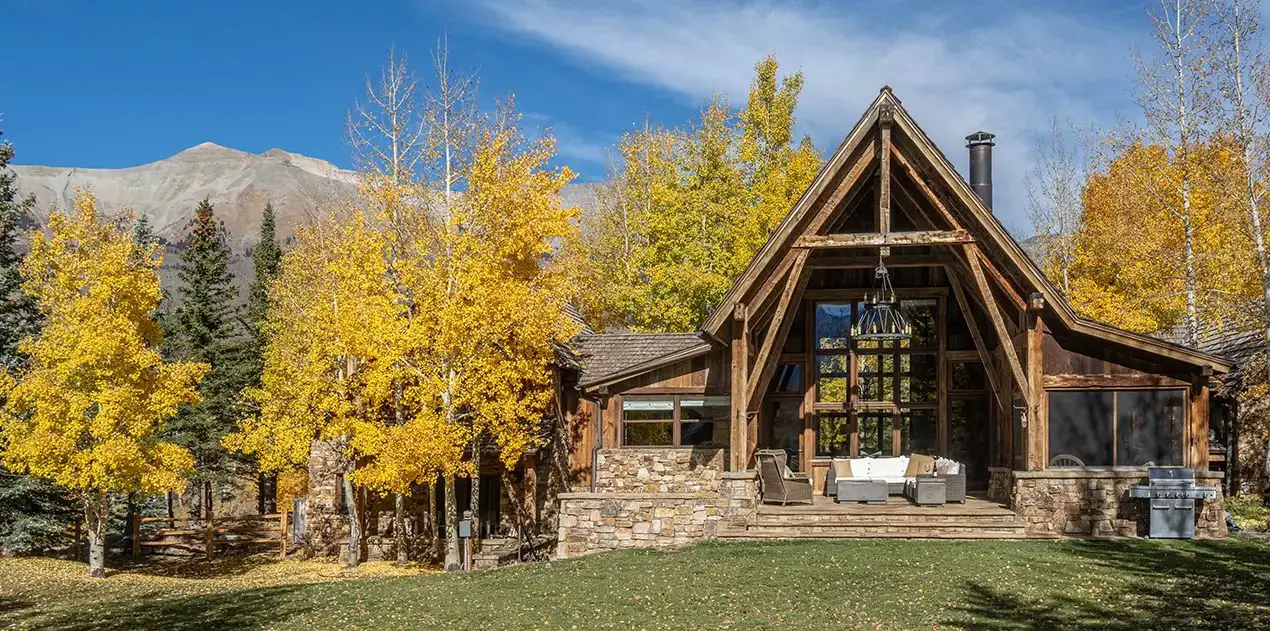
I was standing on my front porch in the Colorado Rockies, where the morning air tastes like pine and possibility, watching the American flag on my railing catch the mountain breeze. Saturday morning. My Saturday morning. The kind I’d waited fifty-nine years to claim as entirely my own.
Then I heard gravel crunching under tires—not the slow, uncertain approach of someone checking an address, but the confident acceleration of people who’d already decided they belonged here.
I knew before the car even came into view. Some part of me simply knew.
The black sedan crested the last curve of my drive with the kind of velocity that suggested urgency, or entitlement, or both. Two doors opened in quick succession—driver’s side, passenger side—and closed with that particular slam that communicates impatience.
I set the flowers down carefully on the porch rail.
Preston emerged first. My son. Forty-two years old, wearing a blazer that probably cost what I used to spend on groceries for a month, his hair cut in that style men adopt when they want to look successful without appearing to try. He’d inherited his father’s build—tall, broad-shouldered, the kind of frame that photographs well—and his father’s ability to walk into any room as though it owed him something.
Evangelene came around from the passenger side. My daughter-in-law. Thirty-seven, beautiful in the way that requires significant maintenance, wearing heels completely inappropriate for mountain gravel and a silk blouse that would wrinkle the moment she sat down. Her handbag probably cost more than my monthly mortgage.
They hadn’t called in four months. Not since I’d told them I was moving to Colorado, leaving behind the house where I’d raised Preston, leaving behind the city where his father’s memory was woven into every street corner. They’d been angry about the move, though they’d never quite said why. Something about “abandoning family” and “acting impulsive at your age” and “what will people think.”
I’d moved anyway.
Now here they stood at the base of my porch steps, looking up at me with expressions I recognized from Preston’s childhood—that particular blend of determination and righteousness he’d worn whenever he wanted something he’d convinced himself he deserved.
“Mother,” Preston said, as though my name were a greeting and a reprimand combined. “We need to talk.”
“We heard about the villa,” Evangelene added, her smile bright and sharp as a knife catching sunlight. “We came to live with you and make peace.”
She said it like an announcement, not a request. Like peace was a transaction we could complete by noon if we just got started.
Neither of them had luggage yet, but I could see the bags through the sedan’s rear window. Large bags. Multiple bags. Bags that suggested they hadn’t packed for a weekend visit.
“Live with me,” I repeated quietly.
“Well, yes.” Evangelene’s smile didn’t waver. “We thought it would be perfect—a fresh start, family together, plenty of space in a place like this. Preston, help with the bags.”
She moved toward the steps like the matter was settled, like my silence was consent, like doors existed only to be opened for her.
I didn’t move from my position at the top of the stairs.
“We haven’t spoken in months,” I said.
“Which is exactly why this is so important,” Preston replied, already pulling the first suitcase from the trunk. “Family shouldn’t stay distant. We want to repair things.”
“By moving in.”
“By spending time together. Building bridges.” He hauled the suitcase up the first two steps. “Come on, Mother, are you going to make us stand out here all morning?”
I looked at my son—the boy I’d rocked through fevers and nightmares, the teenager I’d driven to hockey practice before dawn, the young man I’d helped through his first heartbreak—and saw a stranger wearing a familiar face.
“Where’s Emma?” I asked. Emma was their daughter. My granddaughter. Seven years old. I hadn’t seen her since Christmas.
Preston and Evangelene exchanged a glance.
“She’s at camp,” Evangelene said. “We thought it would be better to have some adult time first. Work things out between us before bringing her into it.”
Adult time. In my house. For an indefinite period. Without asking.
Something cold and clear settled in my chest, the feeling you get when a decision makes itself.
I stepped aside.
Not because I agreed. Not because I welcomed them. But because I wanted to see exactly how far this would go. How much they’d assumed. How completely they’d planned my life without consulting me.
“Thank you,” Evangelene said, breezing past me with her suitcase wheels rattling across my porch boards. “Oh, this is charming. Very rustic. Preston, don’t scratch the doorframe with that bag.”
They crossed my threshold like tourists entering a hotel, looking around with the kind of assessment that prices everything and appreciates nothing. Evangelene paused in the entryway, touching the hand-stitched quilt hanging on the wall, the one I’d bought from a local artist at the farmer’s market. Her fingers traced the pattern with the distracted air of someone mentally redecorating.
“We’ll need to do something about the smell,” she murmured. “What is that? Lavender? Too strong.”
I said nothing. Just watched them move deeper into my home, trailing assumptions like mud from their shoes.
Preston set the luggage down in the hallway and turned to face me. “So. Where should we put our things? Which room?”
“We were thinking the primary suite would make sense,” Evangelene added. “Since we’re a couple. You wouldn’t mind taking one of the smaller rooms, would you? At your age, you probably don’t need as much space.”
At my age.
The phrase hung in the air like smoke.
“Let me show you the main hall,” I said quietly.
I walked ahead of them through the entryway, past the kitchen where morning light poured through windows I’d carefully chosen, past the living room with its stone fireplace and the leather armchair where I’d been reading before they arrived. My footsteps were soft on the pine floors. Theirs were louder—confident, expectant, already mapping out where they’d put their things, how they’d rearrange, what they’d change.
The main hall was at the center of the house, a large open space with exposed beams and a vaulted ceiling. Windows on three sides framed views of the mountains. A chandelier made from elk antlers hung overhead—not my taste, came with the house, but I’d grown fond of it.
They stepped through the archway behind me.
And stopped.
Stopped so completely that I heard Evangelene’s breath catch, heard Preston’s footsteps falter mid-stride.
Because covering the far wall, mounted on wood panels in a configuration that had taken the installer two full days to get right, were photographs. Dozens of them. Large format prints, professionally framed, arranged in a careful grid that told a story.
My story.
Pictures of me at twenty-three, graduating from college—the degree I’d finished at night while pregnant with Preston. Me at thirty, holding my first real estate license, wearing a blazer with enormous shoulder pads and an expression of fierce determination. Me at thirty-five, standing in front of my first property sale, a small commercial building I’d convinced a skeptical bank to let me list.
Me at forty, forty-five, fifty. Pictures chronicling deals I’d closed, properties I’d sold, buildings I’d helped people buy. Awards I’d won. Conferences where I’d spoken. The slow, steady accumulation of a career I’d built around the edges of motherhood, around my husband’s illness, around everyone else’s needs.
And there, in the center, largest of all: a photograph taken just two months ago. Me standing in front of this house, the Colorado peaks behind me, holding a folder—the deed, in my name alone, purchased outright with money I’d saved and invested for thirty years.
Below the photographs, mounted on a floating shelf: a single plaque. The text was simple, engraved in plain letters:
Miriam Foster – Real Estate Professional – 35 Years – $47 Million in Career Sales
The silence stretched. Lengthened. Became something you could touch.
Evangelene’s smile had frozen on her face, half-formed, like a machine that had lost power mid-operation. Preston’s jaw worked soundlessly, his eyes moving from photograph to photograph, calculation visible behind them.
“I don’t understand,” Evangelene said finally, her voice smaller than before.
“It’s a career wall,” I said pleasantly. “I had it installed last month. Thought it was time to acknowledge my work. Thirty-five years is significant, don’t you think?”
“You…” Preston cleared his throat. “You sold forty-seven million dollars worth of property?”
“In total career sales, yes. That’s the cumulative value. My actual commission on that, after brokerage splits and taxes and expenses, was considerably less. Still. Enough to be comfortable.”
Comfortable enough to buy this house. Comfortable enough to retire early. Comfortable enough to stop answering phones at midnight when buyers panicked, stop missing holidays for closings, stop putting everyone else’s dreams ahead of my own.
“But you…” Evangelene was still staring at the wall. “You always said you just did real estate on the side. Part-time. While Preston was growing up.”
“I did do it while Preston was growing up. That doesn’t mean it was just on the side.” I walked to the wall, touched the frame of one photograph—me at a closing table, shaking hands with a young couple buying their first home. “I worked. Every day. Early mornings before Preston woke up, evenings after he went to bed, weekends when he was at friends’ houses. I scheduled my career around motherhood, but I never stopped building it.”
“Dad always said—” Preston started.
“Your father said a lot of things.” My voice stayed even. “He believed what he wanted to believe. That I was ‘keeping busy.’ That real estate was a ‘hobby.’ That the real money came from his job.” I turned to face them. “Your father was a good man, Preston. But he was wrong about this. He was wrong about a lot of things.”
Evangelene’s eyes had sharpened, reassessing. “When you said you were buying a villa in the Alps—”
“I never said Alps. You said Alps. I said Colorado Rockies. But you heard what you wanted to hear. Something grand. Something extravagant. Something that suggested I’d come into money I couldn’t possibly have earned myself.”
The calculation in her expression was almost visible. “The inheritance from Aunt Martha—”
“There was no inheritance from Aunt Martha. She left her estate to a cat sanctuary, remember? You complained about it for three months.”
“Then how did you afford this?” Preston gestured at the house around us, at the windows framing mountain views, at the space and light and carefully chosen peace.
“I bought it,” I said simply. “With money I saved. From work I did. Over decades.”
“You never told us you had this kind of money.”
“You never asked how I was doing financially. You assumed.”
Evangelene’s face had gone through several expressions—surprise, confusion, recalibration—before settling on something harder. “So what, this is some kind of trick? You let us drive all the way up here just to humiliate us?”
“I let you drive up here,” I corrected, “because I wanted to see what you’d do. What you’d assume. How far you’d go before asking a single question.”
“We came to reconcile,” Preston said, his voice taking on that edge it got when he felt cornered. “We came to be family again.”
“You came when you thought I had a villa. When you thought I had space you could occupy. When being family became convenient for you.” I walked to the window, looked out at the mountains I’d chosen, the view I’d purchased, the life I’d finally claimed. “You didn’t call on my birthday. You didn’t call at Thanksgiving. You didn’t call just to talk, just to check in, just to say you were thinking of me. Four months of silence. Then you heard about the house—heard wrong, as it turns out, but heard enough—and suddenly reconciliation became urgent.”
“That’s not fair,” Evangelene protested.
“Fair.” I let the word sit. “You packed bags for an extended stay. You announced you were moving in. You told me which bedroom you wanted—my bedroom—and suggested I take a smaller room ‘at my age.’ You didn’t ask if I had space. You didn’t ask if I wanted company. You didn’t ask anything. You simply arrived and expected me to accommodate you.”
Preston was staring at his shoes now, the way he used to when I caught him in a lie as a child. “We thought you’d be happy to see us.”
“If you’d thought that, you would have called first.”
“We wanted to surprise you.”
“No. You wanted to position me. Show up before I could say no. Present the plan as already decided.” I turned from the window to face them both. “I spent thirty years accommodating surprises. Your father’s spontaneous projects. Your unexpected needs, Preston. Family emergencies that became my emergencies. I said yes when I meant no because saying no felt selfish, felt mean, felt like I was prioritizing my own comfort over everyone else’s happiness.”
“So now you’re choosing yourself,” Evangelene said, making it sound like an accusation.
“Yes. Finally. At fifty-nine years old, I’m choosing myself.”
The silence that followed was different from before. Heavier. Sharp-edged.
“Where does that leave us?” Preston asked quietly.
“That depends. Are you here because you want a relationship with me, or because you want access to what you think I have?”
“That’s a horrible question.”
“It’s an honest one.”
Evangelene crossed her arms. “If we leave now, we’re driving four hours back to Denver. It’s almost noon. We’d hit traffic.”
“There are hotels in town. Nice ones. The Pinewood Lodge has excellent reviews.”
“You’re seriously going to make your own son stay in a hotel?”
“I’m seriously going to maintain boundaries I should have set decades ago.”
Preston looked at me then, really looked, like he was seeing someone he’d never quite noticed before. “When did you become this person?”
“I’ve always been this person. You just never paid attention.”
They left twenty minutes later.
The conversation in between was circular and frustrating—protests and justifications and attempts to reframe their arrival as something spontaneous and affectionate rather than calculated and presumptuous. Preston tried guilt. Evangelene tried charm. Neither tried genuine apology.
Finally, standing on my porch with their luggage at their feet, Preston said, “So what now? We just don’t talk for another four months?”
“We can talk anytime you want to talk. Call me. Ask how I’m doing. Tell me about Emma. Have a conversation that isn’t about what you need from me.”
“And visiting?”
“Ask first. Respect the answer I give. Understand that I have a life here that doesn’t revolve around being available for your convenience.”
Evangelene opened her mouth, closed it, opened it again. “You’ve changed.”
“No. I’ve just stopped pretending I haven’t.”
They drove away slowly, more slowly than they’d arrived, the black sedan disappearing down the mountain road like a question mark fading into distance.
I stood on my porch until the sound of their engine dissolved into the general quiet of altitude and pine. A hawk circled overhead. Somewhere down the valley, wind moved through aspen leaves with a sound like water.
I picked up my wildflowers, carried them inside, arranged them in a blue glass vase on my kitchen table. Then I made a pot of coffee, poured a cup, and sat in my leather armchair by the stone fireplace, looking out at mountains that belonged to no one and everyone and somehow, in this moment, felt particularly mine.
My phone buzzed an hour later. A text from Preston.
“Got back to Denver. We’re okay. Tired. Need to process. Emma misses you. She wants to video chat tomorrow if you’re free.”
I smiled. Typed back: “I’m free. Tell Emma I love her. Talk tomorrow.”
A minute passed. Then: “Evangelene says we should have called first.”
“Yes.”
Another minute: “We’ll do better.”
“I hope so.”
I set the phone down and looked at my career wall, at the faces of the woman I’d been across thirty-five years, at the evidence of work that had been real even when no one treated it that way.
At fifty-nine, I was finally learning the thing I should have known all along: that peace isn’t a place people give you. It’s a boundary you defend. It’s the door you close when closing it is necessary. It’s the word “no” spoken clearly and without apology.
It’s choosing yourself even when—especially when—choosing yourself disappoints people who’ve grown comfortable with your accommodation.
Outside, the Colorado afternoon stretched long and golden across the peaks. Inside, my house was quiet and mine and exactly as I’d left it.
I picked up my book, settled deeper into my chair, and read until the light changed and the mountains turned purple with evening.
And for the first time in longer than I could remember, I felt completely, perfectly at home.
Three weeks later, Emma’s face filled my laptop screen, gap-toothed and grinning, holding up a drawing she’d made of mountains.
“Grandma, is your house really in the clouds?”
“Almost, sweetheart. Very high up.”
“Can I visit?”
I glanced at Preston, who was sitting beside her, visible in the frame. He looked tired. Maybe humbled. Maybe just older than I’d noticed before.
“Of course you can visit. Have your dad call me and we’ll pick a weekend. Just you and me. We can go hiking. I’ll teach you about the wildflowers.”
“Just me?”
“Just you. Grandma time.”
Her smile could have powered the whole mountain.
After we hung up, Preston texted again: “Thank you.”
I wrote back: “She’s always welcome. My door is always open to her.”
There was a long pause before his response: “And to me?”
I thought about it. Really thought. About who he’d been as a little boy and who he’d become as a man. About patterns and possibilities. About whether people could learn.
“Ask first,” I typed. “Respect my answer. Come alone, without expectations. Show up because you want to know me, not because you want something from me. If you can do that, yes. My door is open.”
Another pause: “I’ll try.”
“That’s all I’m asking.”
It was December when Preston came back.
Alone this time. No Evangelene. No luggage beyond an overnight bag. He called two days ahead, asked if he could visit, accepted when I said one night only, I had plans on Sunday.
We didn’t talk about the summer visit. Not directly. Instead, we took a long walk through snow-dusted trails, drank coffee on my porch wrapped in wool blankets, played gin rummy at my kitchen table the way we used to when he was young and I was the most important person in his world.
At one point, looking at the mountains turning pink with alpenglow, he said, “I never realized how hard you worked.”
“I know.”
“I always thought Dad provided everything.”
“He provided a lot. But not everything. Not even most things, if I’m honest.”
“Why didn’t you tell us? Why didn’t you make us see?”
I considered the question. “Because I was raised to believe that good mothers make things look easy. That asking for recognition was prideful. That sacrificing quietly was noble.” I turned to look at him. “But quiet sacrifice has a cost. It makes you invisible. And eventually, invisibility becomes permission for people to walk through your life without seeing you at all.”
He nodded slowly. “I’m sorry. For not seeing you. For assuming. For showing up that day like I owned the place.”
“Thank you.”
“Are we okay?”
“We’re getting there. These things take time.”
“More than one visit?”
“Probably many visits. Years of them, maybe. Rebuilding trust isn’t quick.”
“But possible?”
I smiled. “Yes. Possible.”
By the time spring returned to the mountains, the visits had developed a rhythm.
Emma came once a month, sometimes with Preston, sometimes without. We hiked. We baked. We sat on my porch and named clouds. She asked questions about my work, about the houses I’d sold, about whether she could be a real estate agent too when she grew up. I told her she could be anything she wanted as long as she remembered that women’s work is real work, whether anyone acknowledges it or not.
Preston came every six weeks or so, always calling ahead, always asking, always leaving when I said he should. We were learning each other again, slowly, the way you might learn a language you thought you knew until you realized you’d only ever memorized a few convenient phrases.
Evangelene never came back. I didn’t ask why. Some boundaries, once established, remain permanent.
And me? I sold three properties that year—consulting work for old clients who’d heard I’d retired but wanted my expertise anyway. I hiked every trail within twenty miles. I joined a book club in town. I learned to identify birds by their calls. I planted a garden that the deer immediately ate, then planted it again with deer-resistant varieties.
I lived.
Not quietly. Not invisibly. Not in service to anyone else’s story about who I should be.
Just lived. Fifty-nine years old and finally, finally comfortable in my own house, my own skin, my own carefully drawn boundaries.
On my sixtieth birthday, Preston and Emma arrived with flowers—wildflowers, the kind I’d been holding that Saturday morning when the black sedan had first rolled up my drive. Emma had picked them herself from a meadow near their house.
“We thought you might like these,” she said, handing them to me with ceremony.
I took them carefully, felt the stems damp in my palm, smelled the green-sweet scent of mountain summer.
“They’re perfect,” I said.
And they were.
Not because they were expensive or impressive or complicated. But because they were chosen. Because they were offered with attention and care. Because they came from people who’d learned that showing up in someone’s life means asking first where you’re welcome, then stepping carefully across the threshold, with respect.
I arranged them in my blue glass vase, the same one I’d used that first day, and set them on the kitchen table where morning light would find them.
Outside my windows, the Colorado peaks stood permanent and indifferent and beautiful. Inside, in a house I’d bought with money I’d earned through work that had always been real even when no one treated it that way, I was home.
Finally, completely, undeniably home.
THE END

Lila Hart is a dedicated Digital Archivist and Research Specialist with a keen eye for preserving and curating meaningful content. At TheArchivists, she specializes in organizing and managing digital archives, ensuring that valuable stories and historical moments are accessible for generations to come.
Lila earned her degree in History and Archival Studies from the University of Edinburgh, where she cultivated her passion for documenting the past and preserving cultural heritage. Her expertise lies in combining traditional archival techniques with modern digital tools, allowing her to create comprehensive and engaging collections that resonate with audiences worldwide.
At TheArchivists, Lila is known for her meticulous attention to detail and her ability to uncover hidden gems within extensive archives. Her work is praised for its depth, authenticity, and contribution to the preservation of knowledge in the digital age.
Driven by a commitment to preserving stories that matter, Lila is passionate about exploring the intersection of history and technology. Her goal is to ensure that every piece of content she handles reflects the richness of human experiences and remains a source of inspiration for years to come.