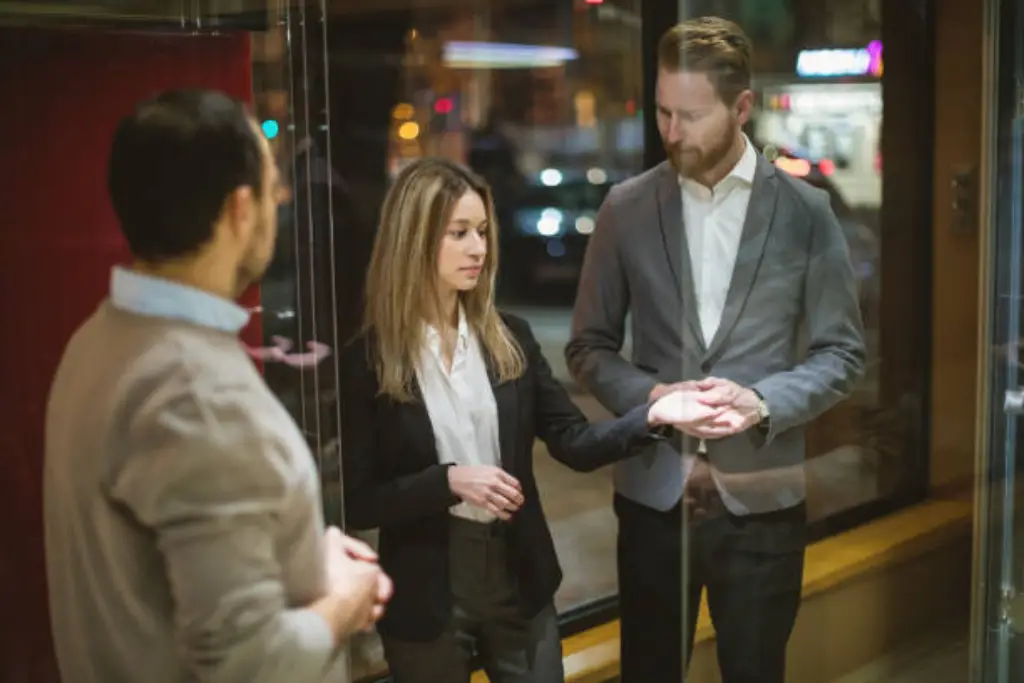
The blood rushed to my fingertips so suddenly that they began to tingle with a faint buzzing sensation, like static electricity building under my skin. I stood there on the polished granite steps holding the black-and-gold key card to my own hotel, watching my younger sister Vanessa physically block the entrance as if I were some unwanted stranger who had wandered in from the cold seeking shelter I didn’t deserve.
Inside the towering glass doors, I could hear my father’s distinctive booming laugh echoing across the grand lobby I had personally designed. The sound carried easily through the architectural acoustics I had tested and approved during construction three years ago. His laughter filled the space with warmth and joy, bouncing off marble surfaces and crystal chandeliers, while I stood outside like an unwelcome solicitor trying to sell something nobody wanted.
“You can’t seriously think you’re coming inside,” Vanessa said, her voice dropping to that particular condescending whisper designed to humiliate without attracting unwanted attention from passersby.
She adjusted the bodice of her designer dress with practiced precision, smoothing imaginary wrinkles. I recognized that dress instantly—every line, every detail. It was a knockoff, and not even a particularly good one. I knew this with absolute certainty because just last week, over lunch at a small bistro in Paris, my friend Elena who worked for the original design house had shown me the authentic sketches. She had laughed while telling me that someone had already attempted to copy the collection before the official runway debut.
“This is the Grand Azure, Ellie,” Vanessa continued, planting herself more firmly in the doorway like a bouncer outside an exclusive nightclub. “The tasting menu alone costs more than you probably make in an entire month managing whatever restaurant you’re working at now.”
If she only knew the truth. If she had any idea that I had personally developed that exact tasting menu over three intensive weeks with our Michelin-starred executive chef, Michelle Beaumont. If she knew I had rejected three earlier versions before finally approving the exquisite final iteration. If she knew the carefully curated wine pairing featured bottles selected from my own private collection stored in temperature-controlled cellars two floors below where we stood.
“He’s my father too,” I said quietly, surprised by how steady my voice sounded.
It didn’t shake with emotion. It didn’t rise with defensive anger. It remained calm, grounded, almost serene despite the absurdity of this confrontation.
Inside my Italian leather clutch, a small cream-colored envelope pressed against my fingers. The legal deed to a vacation villa in Tuscany—one of the Grand Azure Hospitality Group’s most exclusive and sought-after properties—felt suddenly heavier than mere paper had any right to feel.
“My name is Ellaner,” I reminded her gently, pronouncing each syllable with quiet dignity. “Not Ellie. I’m thirty-eight years old, Vanessa. I haven’t been ‘Ellie’ since high school.”
Vanessa rolled her eyes with theatrical exasperation, checking her reflection in the polished glass doors and adjusting her statement necklace. “Mom and Dad were extremely clear about this. They only want successful people at this celebration. People who won’t embarrass the family in front of important guests.”
The irony hit me with such force it was almost physical, like walking into an invisible wall. Just yesterday afternoon, in my executive office overlooking Central Park, I had signed off on the paperwork for a one-hundred-million-dollar expansion of the Azure Hospitality Group into Southeast Asia. Today, apparently, I was too embarrassing to enter my own hotel for my own father’s birthday celebration.
I fought the almost overwhelming urge to laugh as the sheer absurdity of this situation washed over me in waves. Ten years ago, when I made what my family still called “the mistake”—though I preferred to call it “the decision”—of leaving the family’s small accounting firm to pursue hospitality management, they had all but formally disowned me.
My father’s words from that terrible afternoon still rang in my ears with crystal clarity, as fresh as if he had spoken them yesterday instead of a decade ago.
“No daughter of mine is going to waste her education being a glorified waitress.”
So I let them believe exactly what they wanted to believe. I allowed them to construct whatever narrative made them comfortable. I let them think I was struggling financially, bouncing between restaurant jobs, scraping by on modest management salaries, wasting my business degree on service industry work they considered beneath our family’s standards. I didn’t correct them when they spoke about me with barely concealed pity at family gatherings I rarely attended. I didn’t defend myself when they dismissed my career choices as youthful rebellion or quarter-life crisis.
Meanwhile, quietly and methodically and relentlessly, I built something extraordinary.
Azure Hospitality Group had grown from one failing boutique hotel I purchased with my last savings and a dangerous amount of borrowed money into a luxury brand spanning three continents. Thirty-five five-star properties scattered across major cities and exclusive resort destinations. High-end restaurants helmed by celebrity chefs. Private villa collections in Tuscany, Bali, and the Greek islands. My name appeared on every single contract. My signature authorized every acquisition and expansion.
The glorified waitress now owned the table they were desperately trying to keep me from.
“Ellaner.” My mother’s sharp, clipped voice cut through my thoughts as she materialized behind Vanessa like a disapproving specter.
She wore an elegant navy suit I recognized from Bergdorf Goodman’s fall collection, her silver hair styled in that severe chignon she favored for important occasions. “What exactly are you doing here? We discussed this situation.”
No, I thought. You discussed it. I received orders.
That morning, I had received a text message from my mother while reviewing quarterly earnings reports. The message was brief and brutally direct: “Don’t come to Dad’s birthday dinner. It’s at the Grand Azure. You can’t afford it and we can’t afford the embarrassment. Please respect this.”
“I brought a gift for Dad,” I said softly, lifting the envelope containing the villa deed slightly so she could see I wasn’t empty-handed.
Vanessa laughed, a sharp sound like breaking glass. “Oh wonderful, what is it? A gift card to Olive Garden? Or did you manage to scrape together enough tips from your restaurant job to buy him something from the clearance section at Macy’s?”
My mother’s critical gaze flicked to my clutch—simple, understated, handmade Italian leather with minimal hardware. She examined it with the practiced eye of someone who prided herself on recognizing quality, or at least recognizing price tags.
She didn’t know that small clutch had cost more than Vanessa’s leased Mercedes.
“Whatever gift you’ve brought,” my mother said with weary dismissiveness, “I’m quite sure your sister’s present is more appropriate for the occasion. Vanessa just made junior partner at her law firm, you know. She’s doing exceptionally well.”
I nodded, keeping my expression neutral. I knew about the promotion. Just as I knew her prestigious law firm was currently desperate to lease additional office space in one of my commercial buildings in the financial district. A lease they needed urgently to accommodate their growth. A lease they were having considerable difficulty affording at market rates.
“Vanessa’s accomplishments are remarkable,” my mother continued with obvious pride, warming to her favorite subject. “New house in Westchester. Luxury car. Wonderful fiancé with such promising prospects in finance.”
She paused deliberately, looking me up and down with barely concealed disappointment. “And you? Well… at least you’re trying your best with what you have.”
I thought about my penthouse apartment overlooking Central Park, where floor-to-ceiling windows framed the Manhattan skyline like living artwork. I thought about my private jet waiting at Teterboro Airport, about my carefully curated collection of rare vintage sports cars housed in a climate-controlled garage. I thought about the eight-figure balance in my personal checking account.
“Yes, Mom,” I said with careful composure. “At least I’m trying.”
“Trying?” Vanessa echoed, the corner of her glossed mouth curling upward in practiced disdain. “That dress doesn’t exactly scream success, Ellie. This is the Grand Azure, not some roadside diner where you probably work weekends.”
I glanced down at myself, at the simple black silk dress I had chosen that morning. It was tailored perfectly to my frame, elegant without ostentation, nothing flashy or attention-seeking. The fabric moved like water. I could feel the familiar temptation rising—the urge to explain, to justify, to prove myself worthy. Old habits die hard, especially patterns formed during childhood when approval felt like oxygen.
“It’s what I could manage on my budget,” I said mildly, playing the role they had written for me.
“Well, you still can’t come inside,” Vanessa declared, straightening her posture as if delivering a final legal verdict. “We reserved the entire VIP floor for the evening. It’s exclusively for family members and distinguished guests only. No exceptions.”
The VIP floor. My VIP floor. The elegant space I had personally redesigned just last year, investing months of my time selecting every single element. Each piece of original artwork purchased from emerging artists. Each crystal chandelier imported from Murano. Each thread count on the Egyptian cotton linens chosen after testing dozens of samples. I remembered standing in that space late at night during renovations, my heels kicked off, blueprints spread across the marble floor, imagining the kind of guests who would feel genuinely at home there.
“And who exactly are these distinguished guests?” I asked, genuinely curious about who my mother considered important enough to exclude her own daughter.
My mother waved her hand with airy dismissiveness. “Oh, you wouldn’t know any of them, dear. The Andersons from the investment firm. The Blackwood family. Mr. Harrison who sits on several bank boards. Very important people from very respected circles.”
I pressed my lips together to suppress a smile. Thomas Anderson’s investment firm leased three of my commercial properties and was consistently late with rent payments. The Blackwoods had spent the better part of last year begging my membership director for access to one of my most exclusive resort properties in Bali. And Mr. Harrison’s bank had been circling my investment group for months, desperate for a substantial loan they weren’t certain they could qualify for based on their current portfolio performance.
“Right,” I said simply. “Very important people.”
Vanessa nodded with satisfaction, believing the matter settled. “Exactly. So you understand now why your presence would be inappropriate. What would people think if they discovered Dad’s… well.” She hesitated just long enough to make the pause sting. “If they learned his failure of a daughter was working here serving cocktails.”
“Vanessa,” my mother murmured, a token attempt at restraint, though her eyes shone with unmistakable approval of the sentiment. “Try to be kind. Ellaner made her own choices and has to live with the consequences.”
“If she had just stayed with the family accounting firm like you did,” my mother continued, turning to Vanessa with obvious pride, “everything would be so different. She’d have a respectable position, financial stability, a proper place in the family business.”
The family firm. The small accounting practice currently occupying a modest suite in one of my downtown buildings. The firm that was perpetually sixty to ninety days behind on their rent payments. The firm whose delinquency appeared monthly in the property management reports I reviewed personally.
Just then, my brother-in-law Gavin appeared through the glass doors, adjusting his silk tie with the self-important air of someone who believed his presence mattered greatly. His expression was already impatient, already annoyed by the delay.
“What’s taking so long out here?” he asked irritably. “Everyone’s waiting inside for the birthday toast to—” He stopped abruptly when he noticed me standing on the steps. “Ellaner? I didn’t expect to see you here tonight.”
“Clearly,” I said.
Gavin straightened his shoulders, puffing up slightly with self-importance. “I just made vice president at the bank last month,” he announced, glancing at my mother for her expected approval. “Youngest VP in the firm’s history.”
“Junior vice president,” I corrected automatically, before I could stop myself.
He frowned, his expression darkening. “Excuse me?”
“Nothing,” I said smoothly. “Congratulations on the promotion.”
I knew his exact title because my financial team provided exhaustively detailed reports on all of our banking partners and their key personnel. His bank handled several of my smaller business accounts, the ones I used for routine operational expenses.
“Well, whatever title semantics you want to argue about,” Vanessa snapped defensively, “it’s still considerably more impressive than whatever you’re doing now. What is your current position? Assistant manager at some chain restaurant? Shift supervisor at a hotel?”
I thought about the board meeting I had left early that very morning, where my executive team and I had spent three hours discussing a potential acquisition of Gavin’s bank. The preliminary financial documents were probably still sitting on my desk at this moment—in my private executive office occupying the entire top floor of this building.
“Something like that,” I said neutrally.
“This is absolutely ridiculous,” my mother said sharply, her patience clearly exhausted. “Ellaner, just leave. You’re creating an unnecessary scene and embarrassing all of us. I’ll tell your father you couldn’t make it tonight due to prior commitments.”
“Couldn’t afford it, you mean,” Vanessa added with a cruel laugh.
I looked past them, through the floor-to-ceiling glass doors, into the stunning lobby I had built from the ground up. The imported Italian marble floors that had taken four months to source and install. The custom chandeliers I had commissioned from a master craftsman in Prague. The carefully curated contemporary artwork I had personally selected from galleries in New York, London, and Tokyo.
All of it belonged to me. Every square inch.
For just a moment—one brief, tempting moment—I considered simply walking away. Letting them have their exclusive party in peace. Letting them continue believing whatever comfortable narrative they had constructed about my supposed failures. It would be easier. Simpler. Less confrontational.
Then I remembered something my first business mentor had told me years ago, back when I was just starting out, exhausted and drowning in self-doubt, working eighteen-hour days to keep my first struggling hotel from bankruptcy.
“Success doesn’t mean anything if you can’t stand up for yourself when it matters most.”
My jaw tightened with resolve. The tingling in my fingertips faded, replaced by a calm, crystalline clarity.
“Actually,” I said quietly, “I think I’ll stay for the party after all.”
My mother opened her mouth to deliver what was undoubtedly a scathing response, but before she could form the words, the heavy glass entrance doors swung open with smooth precision.
Owen stepped outside into the cool evening air.
He was tall and broad-shouldered, impeccably dressed in a perfectly tailored dark suit that had been custom-made by our corporate tailor. Owen had been with me since the very beginning—since I had purchased my first struggling boutique hotel seven years ago with more courage than common sense and transformed it into the flagship property of what would become the Azure brand.
He scanned the scene once with his characteristically sharp eyes, immediately assessing the tension, reading the body language, understanding the situation completely within seconds.
“Is everything all right here, Madam CEO?” he asked, his voice carrying clearly across the entrance area with unmistakable authority and respect.
The formal title hung in the air like a detonated grenade.
“Your usual table has been prepared exactly to your specifications,” he continued professionally, “and Chef Michelle is personally holding the tasting menu for your final approval before service begins.”
The silence that followed his words was absolute and suffocating.
Vanessa’s mouth fell open in shock, her carefully applied lipstick suddenly looking too bright and artificial against her pale skin. My mother gripped the polished brass door handle like it was the only thing keeping her physically upright. Gavin’s expression cycled rapidly through confusion, disbelief, and dawning horror.
“Owen,” I said with a warm, genuine smile. “Your timing is absolutely perfect as always.”
I turned slowly to face my family members, taking in their stunned expressions one by one.
“They were just explaining to me how I couldn’t possibly afford to dine here tonight,” I said conversationally.
Owen blinked, his confusion entirely authentic. “Ma’am… forgive me, but you own this entire hotel. You own the entire international chain. You’re the founder and CEO of Azure Hospitality Group.”
“Yes,” I said simply, letting the truth settle over them like falling snow. “I am.”
I met their shocked, disbelieving faces individually—Vanessa, then my mother, then Gavin.
“Shall we go inside now?” I asked politely. “I believe you’ve reserved the VIP floor for this evening’s celebration.”
I paused for effect.
“My VIP floor, in my hotel, that I designed and built and own.”
Gavin found his voice first, though it emerged thin and unsteady, lacking his usual confident bluster. “This has to be some kind of elaborate joke. Some prank or misunderstanding. Ellaner’s been working as a restaurant manager for years. She’s always struggled financially.”
Owen didn’t even glance in his direction. His attention remained focused on me with unwavering professional respect, exactly the way it always was during our countless business interactions.
“Miss Ellaner is the founder and Chief Executive Officer of Azure Hospitality Group,” Owen stated calmly, as if reciting simple, indisputable facts. “She owns and operates all thirty-five Grand Azure luxury hotels worldwide, along with our exclusive resort properties and our portfolio of Michelin-starred restaurant divisions. The company’s current valuation exceeds three billion dollars.”
The words landed like a controlled demolition, bringing down the entire structure of lies and assumptions my family had built over the past decade.
Vanessa’s designer clutch slipped from her trembling fingers and struck the granite steps with a sharp, almost musical crack. She didn’t notice. She was staring at me as if trying to reconcile two completely incompatible realities that couldn’t possibly coexist in the same universe.
“That’s impossible,” she whispered, her voice barely audible. “The Grand Azure chain is worth billions. You’re just… you’re supposed to be…”
“A failure?” I finished gently. “Yes, I know that’s what you all believed. What you needed to believe.”
I stepped forward decisively, moving past Vanessa’s frozen form, past my mother’s stricken expression, through the pristine glass doors that had never actually been closed to me—not really, not ever.
Inside the magnificent lobby, the space responded exactly the way it always did when I entered. Heads turned with recognition. Spines straightened with respect. The shift in energy was subtle but unmistakable to anyone paying attention. This wasn’t fear or intimidation. This was genuine respect earned through years of fair treatment, ethical leadership, and personal investment in every employee’s success.
“Good evening, Miss Ellaner,” Rachel, my front desk manager, called out with a welcoming smile. “The executive suite has been prepared according to your specifications for your father’s birthday celebration. Chef Michelle would like to review the final menu with you when you have a moment.”
“Thank you, Rachel,” I said warmly. “Tell Michelle I’ll stop by the kitchen shortly.”
I turned back to face my family members, who remained frozen near the entrance like museum statues depicting shock and disbelief.
“Are you coming?” I asked pleasantly. “The celebration is about to begin.”
They followed me inside slowly, moving through the lobby in stunned silence as if walking through a dream or nightmare they couldn’t quite wake from. As we proceeded across the gleaming marble floor, every single staff member we passed greeted me by name. Not because they had been instructed to or threatened with termination. Because they genuinely knew me. I had worked alongside them during my early years building this business. I had personally trained many of them. I had listened to their concerns and ideas. I had earned that respect one day at a time through actions rather than demands.
My mother glanced around continuously, her expression evolving with each step. Confusion giving way to disbelief giving way to something dangerously close to panic.
“But your dress,” she finally blurted out desperately, as if clinging to the last remaining thread of her previous understanding. “It’s so plain. So simple and understated.”
“Custom designed and handmade in Paris,” I replied lightly, almost offhandedly. “By a private atelier that doesn’t take public clients. Around thirty thousand dollars, I think, though I’ve developed the terrible habit of not checking price tags anymore.”
Vanessa made a small choking sound.
I led them toward the private executive elevator reserved exclusively for penthouse access and VIP floor guests. I pulled a slim platinum key card from my clutch—the master access card that opened every door in every property I owned.
The elevator doors opened smoothly and silently, revealing mirrors and polished wood paneling.
“Unlike your dress,” I added almost as an afterthought, stepping inside, “which is a knockoff of the Valentino spring collection. The authentic pieces haven’t been released to the public yet. I know this with certainty because I attended the private showing in Milan last month as Elena’s personal guest.”
The elevator doors closed with a soft whisper.
Nobody spoke during the ascent. The silence was profound and uncomfortable.
When the doors opened again, we emerged onto the VIP floor where the celebration was already well underway. Soft ambient lighting created an intimate atmosphere. Crystal glasses caught and reflected light like scattered diamonds. Guests dressed in understated luxury conversed in small groups. The sophisticated hum of conversation stopped abruptly the moment we stepped into the space.
My father stood near the head of an elegantly appointed table, a champagne flute halfway to his lips.
“Ellaner?” he said, his voice thick with confusion. He rose partially from his chair, his substantial frame blocking the view of guests behind him. “What are you doing here? Your mother specifically said you couldn’t afford to attend tonight—”
“I know exactly what Mom said,” I replied gently, walking toward him with measured steps. “Happy birthday, Dad. I hope you don’t mind me crashing your celebration.”
I paused, letting my gaze sweep across the assembled guests.
“In my own hotel. That I own. That I built.”
A ripple of shocked murmurs moved through the crowd like wind across water.
Mr. Harrison from the bank stepped forward immediately, his weathered face breaking into an expression of profound relief mixed with surprise. “Miss Ellaner! We’ve been trying desperately to secure a meeting with you for the past six months regarding that substantial loan package we discussed. Your assistant keeps telling us you’re unavailable.”
Thomas Anderson, the investment firm partner, joined him quickly, his eyes wide with recognition and something approaching awe. “You’re that Ellaner? The Ellaner who’s been systematically acquiring premium real estate across Manhattan? The one all the business journals are profiling?”
My father sank slowly back into his chair, the color draining from his face like water from a broken vessel. His champagne flute trembled in his hand.
“All this time,” he said slowly, each word seeming to cost him effort, “we thought you were just managing restaurants. Struggling to make ends meet. We thought…”
“You thought I was a glorified waitress?” I finished softly, without malice. “Those were your exact words, Dad. From the day I left the family accounting firm to pursue hospitality management. You said no daughter of yours would waste her education being a glorified waitress.”
“But why didn’t you tell us the truth?” my mother demanded, her voice sharp but trembling with emotion she was struggling to contain. “Why did you let us believe you were struggling all these years?”
I looked at her for a long, measured moment, considering my answer carefully.
“Would you have believed me if I had told you?” I asked quietly. “You didn’t believe in me when I needed your support most. When I was terrified and exhausted and working eighteen-hour days. When I mortgaged everything I owned to buy my first failing hotel. When I was one month away from bankruptcy.”
I paused, letting that sink in.
“Why would I share my success with people who only measure worth after it’s already been proven? Who only offer approval when it costs them nothing?”
The room fell into profound silence. Even the soft background music seemed to fade.
“I didn’t reveal this tonight to hurt any of you,” I continued, my voice steady. “I did it because I’m finally done hiding who I am to protect your pride and your comfortable narrative about my supposed failures.”
I turned to address the assembled guests, many of whom were trying unsuccessfully to hide their fascination with this family drama unfolding before them.
“Please continue enjoying the celebration,” I said with genuine warmth. “Everything tonight is complimentary—on the house.”
I paused, allowing myself a slight smile.
“My house. My hotel. My hospitality.”
As I turned to walk away, I suddenly remembered the envelope still tucked inside my clutch. I pulled it out, feeling its weight in my palm.
“Oh,” I said, turning back toward my father. “Dad, that gift Vanessa refused to let me present to you earlier—it’s the legal deed to a private villa in Tuscany. One of my most exclusive properties that normally rents for fifteen thousand dollars per week.”
I placed the envelope on the table in front of him.
“Consider it a birthday present from your failure of a daughter.”
Vanessa collapsed into the nearest chair as if her legs had simply stopped supporting her weight.
The next hour unfolded with the inexorable momentum of an avalanche. People who had ignored me for years suddenly desperately wanted meetings, wanted introductions, wanted access. The Blackwoods cornered me near the windows, begging for membership consideration at my Bali resort. Mr. Harrison followed me relentlessly, trying to discuss favorable loan terms. Vanessa’s fiancé disappeared entirely after someone helpfully informed him that his firm’s future viability depended almost entirely on securing a lease in my downtown building—a lease I personally approved or rejected.
My mother cried quietly in a corner, tears streaking her carefully applied makeup. Then, in a remarkable display of psychological gymnastics, she began rewriting history in real-time, telling anyone who would listen how she’d always known I would be successful, how she’d always supported my dreams, how proud she’d been all along.
My father sat largely in silence, occasionally accepting congratulations from guests while looking increasingly shell-shocked.
Later in the evening, after the cake had been cut and most guests had departed, I found him alone on the private terrace overlooking the glittering Manhattan skyline.
“I was wrong,” he said finally, not looking at me. His voice was heavy with regret. “So terribly, unforgivably wrong about everything.”
“Yes,” I replied simply. “You were.”
He turned to face me, his expression haunted. “When you look at this skyline, how many of those buildings belong to you?”
“Enough,” I said. “Including the one where your accounting firm rents office space.”
He nodded slowly, processing this information. “The firm has been struggling to make rent. I didn’t know… I never imagined…”
“I know,” I said. “My property managers send me detailed reports.”
He was quiet for a long moment. “Can you ever forgive us? Your mother and me?”
I thought carefully about his question, weighing my words.
“Forgiveness isn’t really the issue here, Dad,” I said slowly. “Respect is. Trust is. You taught me that love should be unconditional, but you made yours entirely conditional on me meeting your definition of success. You rejected me when I chose a different path. You didn’t just disapprove—you actively excluded me, belittled me, treated me like an embarrassment.”
I looked out at the city lights.
“Tonight wasn’t about revenge or rubbing your faces in my success. It was about finally refusing to pretend I’m less than I am just to make you comfortable.”
“I understand,” he said quietly. “And for what it’s worth, I’m genuinely proud of what you’ve built. Not just the business—but the person you’ve become despite our failures as parents.”
I nodded, appreciating the honesty even if it couldn’t erase the past.
“That means something,” I acknowledged. “But it doesn’t immediately fix ten years of rejection.”
I left him on the terrace and made my way to my private executive office occupying the entire top floor of the hotel. The space was expansive—floor-to-ceiling windows on three sides, modern furniture balanced with carefully chosen art pieces, a view of Central Park that never failed to take my breath away.
I kicked off my expensive heels and sank into the leather chair behind my desk. Alone finally. The city spread out below me like a carpet of lights and possibilities.
Tonight I had finally taken my rightful seat at the table. Not a table I was granted access to through family connections or inherited privilege. A table I had built myself. In a room I owned. Under a roof I had paid for with years of sacrifice and work and determination.
And that, I realized as I looked out at the empire I had created, was worth infinitely more than any belated family approval could ever be.
The glorified waitress had become the owner of the restaurant. And she was never giving up her seat again.

Ethan Blake is a skilled Creative Content Specialist with a talent for crafting engaging and thought-provoking narratives. With a strong background in storytelling and digital content creation, Ethan brings a unique perspective to his role at TheArchivists, where he curates and produces captivating content for a global audience.
Ethan holds a degree in Communications from Zurich University, where he developed his expertise in storytelling, media strategy, and audience engagement. Known for his ability to blend creativity with analytical precision, he excels at creating content that not only entertains but also connects deeply with readers.
At TheArchivists, Ethan specializes in uncovering compelling stories that reflect a wide range of human experiences. His work is celebrated for its authenticity, creativity, and ability to spark meaningful conversations, earning him recognition among peers and readers alike.
Passionate about the art of storytelling, Ethan enjoys exploring themes of culture, history, and personal growth, aiming to inspire and inform with every piece he creates. Dedicated to making a lasting impact, Ethan continues to push boundaries in the ever-evolving world of digital content.