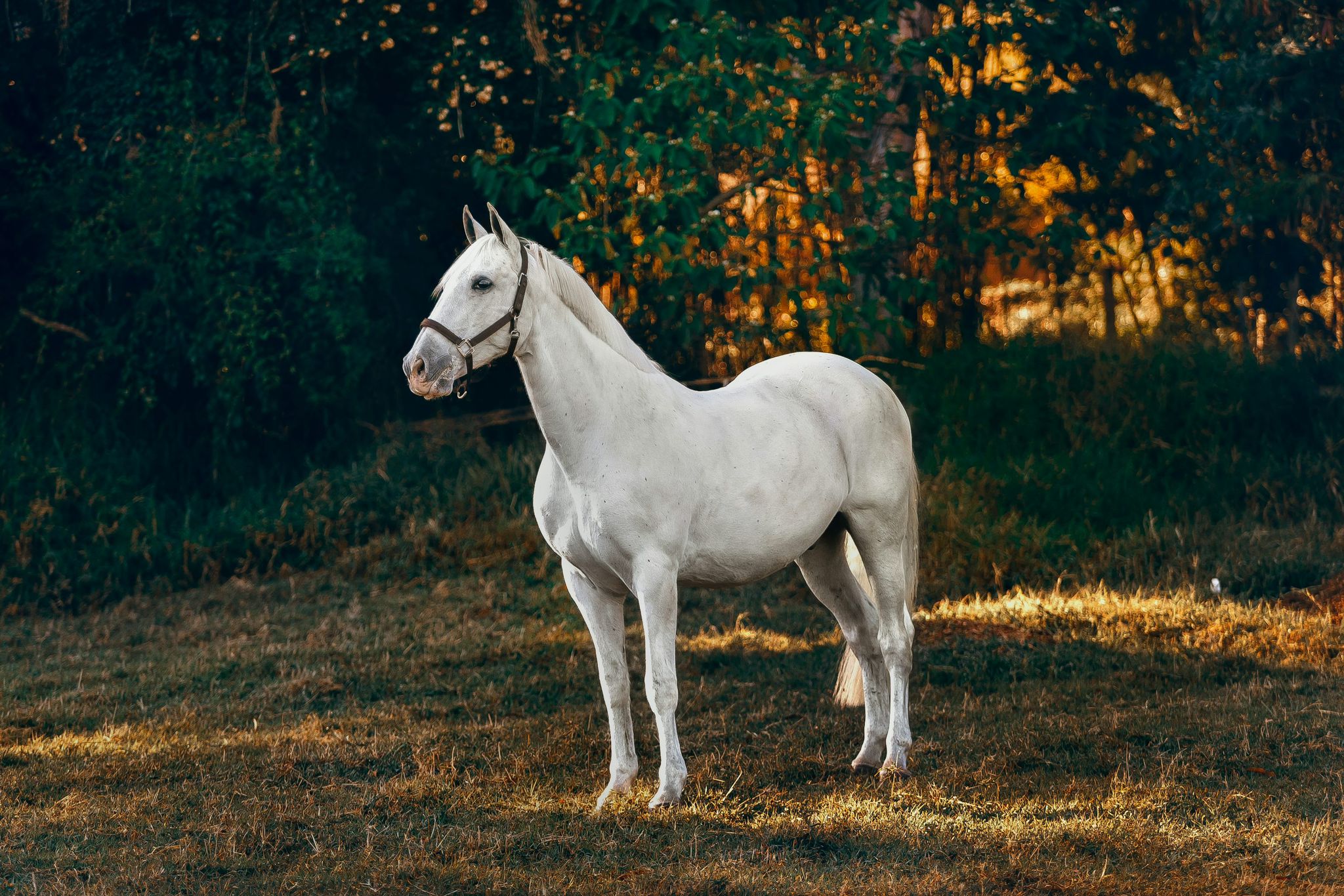
The Nameless Horse
The auction house fell silent as the white horse entered the ring. Not the respectful kind of silence that greets a champion, but the heavy, uncomfortable quiet that settles over a crowd when something dangerous draws near. In the stifling afternoon heat, with dust motes dancing through shafts of sunlight that pierced the weathered tin roof, the atmosphere grew thick with tension and unspoken warnings. This was the moment everyone had been waiting for, yet nobody wanted to see.
Outside, the desert stretched endlessly in all directions, its vastness broken only by the occasional mesquite tree and the shimmering heat waves that made the horizon dance and blur. Inside the Red Willow Livestock Auction, however, the world had contracted to this single arena, this moment, this horse.
The Burden of History
The white stallion had become something of a legend in the Southwest ranching community, though not the kind of legend anyone celebrated. Its story was whispered in feed stores and truck stops, passed along telephone lines between ranchers who traded information as readily as they traded livestock. The horse had been through seven owners in three years—a fact that appeared in bold letters at the top of its file, which had grown thick with incident reports, veterinary notes, and insurance claims.
Auction after auction, it remained the same: a heavy silence, a few mocking laughs, and the clanging of hooves on the metal floor, like a creature rebelling against its predetermined fate. The pattern had become so predictable that some regulars attended specifically to witness the spectacle, the way people slow down to observe an accident on the highway. They came with their coffee and their cynicism, ready to shake their heads and mutter “I told you so” to no one in particular.
The scars that covered the horse’s hide told their own story, a map of violence written in raised tissue and patches where hair no longer grew. Some were straight lines—evidence of barbed wire encounters in desperate escape attempts. Others were irregular, the signatures of kicks from other horses or impacts with solid objects during panicked flights. The pale color of its coat made every mark visible, a permanent record of trauma that couldn’t be hidden or forgotten.
But it was the eyes that truly unsettled people. Pale blue, almost white, they seemed to look through rather than at the humans gathered around the ring. They held no trust, no hope, no recognition of the bond that was supposed to exist between horse and human. Instead, they reflected only wariness and something deeper—a profound exhaustion that came from constantly living on the edge of survival.
The trainers hired to work with the horse had all reached the same conclusion, though they expressed it in different ways. “Unrideable,” said one, a fourth-generation horse breaker whose grandfather had trained horses for Hollywood westerns. “Dangerous,” declared another, pointing to the bruises on her ribs where the horse had slammed her against a fence. “Lost cause,” muttered a third, a man who prided himself on never meeting a horse he couldn’t gentle, until he met this one.
Even experienced riders, the kind who competed in rodeos and broke wild mustangs for a living, avoided the white horse. They recognized in its movements the particular kind of unpredictability that came not from natural wildness but from deep psychological damage. This wasn’t a horse that could be dominated or sweet-talked or bribed with treats. This was a horse that had learned humans were threats, and no amount of conventional training could unwrite that lesson.
The Marine
Then one afternoon, as the sun beat down mercilessly and the auctioneer’s voice grew hoarse from calling out prices that no one would meet, a soft-spoken woman in a worn Marine coat emerged from the crowd.
She moved with a distinctive gait, not quite a limp but something close to it—the careful walk of someone whose body remembered pain and had learned to compensate. The Marine insignia on her sleeve had faded to almost white, stained by sun and time, not by new stitching. The coat itself was desert camouflage, the pattern designed for landscapes much like the one surrounding the auction house, though it had been worn in places far more hostile than rural Arizona.
Her face bore the particular weathering that came from years in harsh climates, skin tanned and lined in ways that made her age difficult to guess. She could have been thirty-five or fifty; the desert and deployment aged people differently than ordinary life. Her hair, pulled back in a practical ponytail, showed streaks of premature gray at the temples. But it was her eyes that drew attention—dark brown and deeply observant, constantly scanning, cataloging, assessing. They were the eyes of someone trained to spot threats before they materialized, to read terrain and situation with the kind of attention that meant the difference between life and death.
She stood tall, her feet firmly planted shoulder-width apart, a posture honed long ago on the bases where names were etched into muscle memory. It was a stance that spoke of readiness without aggression, of capability without bravado. Where others saw madness in the white horse’s behavior, she noticed the small details that everyone else had missed or dismissed.
The blinding fluorescent lights mounted on the ceiling made the horse tense, its pupils contracting to pinpoints as its head tossed nervously. The sudden noise of a dropped clipboard caused it to tremble, every muscle beneath that scarred hide contracting simultaneously. When a ranch hand reached toward it with a lead rope, the horse exploded backward not because of the touch itself, but because the approach had come from its blind spot, without warning.
It was a pattern she recognized intimately from sleepless nights when harmless sounds transformed into something entirely different. She knew what it was like to react to stimuli that others couldn’t understand, to live in a state of constant hypervigilance where the nervous system refused to accept that danger had passed. She understood the aftermath of trauma in ways that no textbook could teach, because she carried it in her own body.
Her name was Claire Donovan, though she rarely offered it without being asked. She had served two tours in Afghanistan as a combat medic, a role that required her to remain calm while everything around her descended into chaos. She had learned to read situations quickly, to triage not just physical injuries but psychological states, to recognize when someone—or something—was on the edge of breaking.
The Question
She didn’t ask the price. She only asked the horse’s name.
In the dry heat of a cattle ranch somewhere in the American Southwest, with a faded silver flag fluttering overhead and country music blaring from an old radio in a pickup truck parked near the entrance, that question was more painful than any hammer blow.
At the time, everyone knew the horse, or thought they did. Ranchers who bid on livestock by the pound, trainers who assessed animals with clinical detachment, truck drivers who transported cattle across states on routes that wore grooves in their memories—they all had nicknames for it. “Widow-maker,” some called it, a term usually reserved for the rankest rodeo bulls. “The White Devil,” others said, with a mixture of fear and dark humor. “That crazy son of a bitch,” was perhaps the most common, delivered with the weary tone of people who had given up trying to understand.
None of the names were nice. None of them were real. They were labels that reduced the horse to its worst moments, its most dangerous reactions, its utility as a cautionary tale.
The animal was a burden, a bad headline waiting to happen, a liability that insurance companies wouldn’t cover and no rancher wanted on their property. It was the kind of problem that people threw money at trying to solve, then wrote off as a loss when all solutions failed. Every time it appeared at the Red Willow auction, whispers clung to it like flies, and its file sat dormant in the same dreary stack marked “final auction.”
That phrase—”final auction”—carried a grim implication that everyone understood but nobody spoke aloud. It meant that after this, if no one bid, the horse would be transported to a facility that specialized in equine disposal. In the livestock business, such euphemisms were common. No one said “slaughterhouse” or “rendering plant,” but everyone knew what happened to animals that couldn’t be sold, couldn’t be trained, couldn’t be saved.
The Ordinary Day
That day should have been an ordinary day at Red Willow. The sun had risen over the Sonoran Desert at 5:47 AM, painting the sky in shades of orange and pink that photographers traveled thousands of miles to capture. By 9:00 AM, the temperature had already climbed to eighty-five degrees, and the weatherman on the local radio station was predicting it would hit one hundred and three by mid-afternoon.
Coffee was steaming in paper cups clutched by callused hands. The brew was strong and bitter, made in a twenty-gallon percolator that had been serving the auction house since the 1970s. People drank it black or with powdered creamer, standing in small clusters and talking about feed prices, water rights, and the new regulations coming down from the Bureau of Land Management.
Dust clung to boots and jeans, the fine alkaline powder that got into everything in this part of the world. It settled in the creases of clothing, worked its way into the treads of tire, and coated every surface with a film that no amount of wiping could completely remove. The smell of it mixed with the odors of livestock, leather, and diesel fuel to create the distinctive perfume of the American ranch land.
Men in baseball caps leaned against the railing with the weary confidence of those who had seen too much and were no longer surprised by anything. They were third and fourth-generation ranchers, mostly, whose families had worked this land since before Arizona was a state. They knew cattle and horses with the kind of intuitive understanding that came from a lifetime of observation. They could spot a lame horse from fifty yards away, estimate a steer’s weight to within five pounds just by looking, and tell from the set of an animal’s ears whether it was sick or healthy, calm or agitated.
When the white stallion was herded into the arena, its entire weight pressing against the iron fence until the metal groaned in protest, most people instinctively recoiled as if danger might leap over the barrier. The horse moved with the explosive energy of a thunderstorm, all that power barely contained by the physical barriers around it. Its hooves struck the metal floor with sounds like gunshots, and the whites of its eyes showed in a way that horsemen recognized as a sign of extreme distress.
The woman, however, did not step back. Claire Donovan remained exactly where she was, her body language unchanged, her breathing steady and controlled.
Recognition
She had seen this before, though not in horses. She had seen it in young soldiers fresh from firefights, their hands trembling as they tried to light cigarettes with matches that wouldn’t cooperate. She had seen it in civilians pulled from bombed buildings, their eyes unfocused and their bodies locked in protective positions they couldn’t release. She had seen it in her own reflection during the months after she returned home, when loud noises sent her diving for cover and she couldn’t sleep without checking every lock twice.
The clinical term was post-traumatic stress, a phrase that had entered popular vocabulary but remained poorly understood by most people. It wasn’t cowardice or weakness or an inability to “get over it.” It was what happened when a nervous system adapted to survive in extreme conditions, then couldn’t adapt back when the danger passed. It was the body’s alarm system stuck in the “on” position, constantly scanning for threats, constantly ready to fight or flee.
The symptoms in horses looked remarkably similar to those in humans. Hypervigilance—that constant state of alertness, the inability to relax. Exaggerated startle response—explosive reactions to minor stimuli. Avoidance behaviors—refusing to enter certain areas or allow certain types of contact. Aggressive outbursts that seemed disproportionate to the trigger. And underneath it all, the profound exhaustion of a nervous system running on high alert twenty-four hours a day.
Claire watched the horse’s reactions with the trained eye of someone who understood trauma from the inside. She noted which stimuli provoked the strongest responses. She observed how the horse positioned itself in the arena, always keeping potential threats in view, always maintaining maximum distance from the humans around it. She saw how its breathing came in short, rapid bursts, the respiratory pattern of a creature that couldn’t believe itself to be safe.
“Ma’am, this one’s bad news,” someone called out from the crowd, half-warning, half-joking. It was an older rancher, a man with sun-damaged skin and a face like cracked leather. He had been coming to these auctions for forty years and had seen enough dangerous horses to know them on sight. His tone suggested he was doing her a favor by offering the warning, though it also carried a hint of condescension—the assumption that a woman, especially one who didn’t look like a typical rancher, wouldn’t understand what she was getting into.
A forced laugh escaped from someone else, a nervous sound that broke the tension without relieving it. A few other men nodded in agreement with the warning, their body language suggesting they thought anyone who would bid on this horse was either foolish or crazy.
Claire didn’t answer. She didn’t defend herself or explain her interest or justify her presence at the auction. She simply took another step forward, moving with deliberate slowness, her approach as non-threatening as possible.
The Failed Auction
The auctioneer began to call out the price, his voice settling into the rhythmic patter that was part business, part performance, part hypnotic incantation. “All right folks, we’ve got a four-year-old gelding here, white coat, approximately fifteen hands high. Let’s start the bidding at five hundred dollars. Do I hear five hundred? Five hundred, five hundred, who’ll give me five hundred?”
Silence. Not a single hand raised. Not a single card waved. The only sounds were the horse’s agitated movements and the creak of the metal fencing as it continued to press against the barriers.
“Okay, how about three hundred? Three hundred dollars for a young horse with plenty of years ahead of him. Three hundred, three hundred, who’ll say three hundred?”
Still nothing. The auctioneer’s voice carried a note of desperation now, the recognition that this wasn’t going to be a normal sale.
“Two hundred? Folks, I’ve got to start somewhere. Two hundred dollars, that’s less than scrap value. Somebody give me two hundred.”
The horse rubbed against the gate again, the metal clanging together with a jarring crash that made several people flinch. Dust flew everywhere, hanging in the still air like smoke. The crowd froze, collective breath held, everyone aware that they were watching something that could turn dangerous in an instant.
For a moment, even the auctioneer lost his composure, his practiced patter faltering as he watched the horse’s escalating agitation. His hand moved unconsciously toward the radio clipped to his belt, ready to call for backup if the situation deteriorated further.
The Voice in Chaos
Then she spoke, her voice steady and decisive, a familiar voice amidst the chaos. It was the voice she had used in field hospitals when soldiers were screaming and bleeding and the generators were failing. The voice that had talked frightened civilians through emergency procedures they didn’t understand. The voice that had remained calm when everything else was falling apart.
She didn’t ask how many riders it had thrown or what the insurance premium would be. She didn’t ask why it had been moved so many times or what treatments had been attempted or whether anyone had gotten hurt. Those questions focused on the wrong things—on liability and risk and the horse’s utility to humans.
Amid the chaos, she repeated the question, this time louder, her words cutting through the noise and nervous conversation: “What is its name?”
Silence spread like a choked breath, suffocating and complete. The auctioneer paused mid-sentence, his mouth still open. Staff members shuffled papers nervously, suddenly very interested in the documents in their hands. A stablehand who had been standing near the gate avoided eye contact, finding something fascinating to study in the dust at his feet.
The auctioneer, a man named Tommy Breckenridge who had been running livestock auctions for twenty-three years, rummaged through his ledger. He flipped pages back and forth, his finger tracing down columns of information: birth dates, weights, previous owners, health records, behavioral notes. Everything except what she was asking for.
Finally, he looked up, his weathered face showing something that might have been embarrassment or might have been resignation. “It has no name,” he said, the words coming out flat and final. “No one kept it long enough to give it one.”
The statement hung in the air like an accusation. It revealed more than just a bureaucratic oversight. It exposed the way the horse had been treated not as an individual but as a problem, not as a living creature but as inventory that couldn’t be moved. Each owner had seen it as temporary, a mistake to be corrected, something to be passed along before it cost them too much money or caused too much trouble.
Understanding
Something flickered across Claire’s face—not sadness, not fear, not anger. It was understanding, the deep recognition that comes when you see your own experience reflected in another’s suffering. It was the look of someone who knew what it felt like to be remembered for their wounds rather than their identity, to be defined by the worst things that had happened to them, to be treated as a liability instead of a person.
She had felt it when she returned from deployment and saw the way people looked at her once they learned where she had been. The carefully neutral expressions that masked discomfort. The changes in conversation when she entered a room. The way old friends suddenly didn’t know what to say to her, as if her experiences had transformed her into someone unrecognizable.
She had felt it in the offices of the Veterans Administration, where she became a claim number and a disability rating and a file to be processed. Where well-meaning counselors asked her to rate her symptoms on scales from one to ten, as if trauma could be quantified like blood pressure or cholesterol levels.
She had felt it in the job interviews where potential employers praised her service, then found reasons not to hire her. Where her military experience was simultaneously revered and feared, respected in the abstract but considered too risky in the particular.
The horse, she realized, had been treated the same way. It had become its trauma, its scars, its dangerous reactions. Everything else—whatever personality or preferences or potential it might have—had been erased by the single fact that it was difficult, damaged, unsuitable for normal use.
The First Contact
Claire placed her hand on the warm railing that separated the viewing area from the arena. The metal was hot from the sun beating down on the tin roof, hot enough that it would have been uncomfortable to grip tightly. She leaned just enough for the horse to feel her presence, to register that a human was near but not threatening, observing but not demanding.
The horse’s ears perked up slightly, a minute change in position that most people wouldn’t have noticed. It was the first sign that something had shifted, that some fragment of curiosity had penetrated the wall of fear and aggression.
Claire took a deep, steady, calm breath—the kind taught in meditation classes and therapy sessions, the four-count inhale and six-count exhale that activates the parasympathetic nervous system and signals to the body that it’s safe. She did it consciously, knowing that animals responded to human emotional states, that the horse would sense her calmness or anxiety, her confidence or fear.
Then she spoke a single word, barely audible to the people standing near her, but clear enough: “Easy.”
That word, uttered amidst the dust and heat and skepticism, was the first turning point. Not because it was magical or special, but because it was offered without expectation. She wasn’t commanding the horse or trying to control it. She was simply acknowledging its existence, offering presence without pressure.
The Decision
“I’ll take him,” Claire said, her voice louder now, addressing the auctioneer directly.
Tommy Breckenridge blinked at her, momentarily confused. “Ma’am, I haven’t finished the bidding. I haven’t even gotten a starting bid yet.”
“I’ll pay whatever you need to sell him. Just tell me the price.”
A murmur ran through the crowd, a mixture of disbelief and concern. The older rancher who had warned her earlier stepped forward. “Miss, I don’t think you understand what you’re buying here. That horse is dangerous. It’s put three people in the hospital that I know of. One of them was airlifted to Phoenix with a crushed pelvis. You can’t just—”
“I understand perfectly,” Claire interrupted, not rudely but firmly. “And I’ll take full responsibility. Whatever liability forms you need signed, I’ll sign them. Whatever warnings you need to give me, consider them given. Now, what’s the price?”
Tommy looked down at his paperwork, then at the staff members clustered near the gate, then back at Claire. “Two hundred dollars,” he said finally. “Two hundred plus the auction fee of thirty-five, plus transport if you need it.”
“I’ll pay three hundred,” Claire said. “And I’ll transport him myself.”
“Ma’am, you don’t have to pay more than—”
“Three hundred,” she repeated. “Final offer. Take it or tell me where else to wire the money.”
The transaction was completed in minutes, though it felt much longer. Papers were signed, copies made, fees collected. Claire provided her driver’s license, which showed an address in a town called Silver Hollow, population 847, about ninety miles north of the auction house. She wrote a check from an account at a small regional bank, her handwriting neat and precise, the signature practiced.
Throughout the process, the white horse remained in the arena, watching. Its agitation had decreased slightly, though it still maintained maximum distance from all humans. Its ears swiveled constantly, tracking sounds and movements, cataloging potential threats.
When the paperwork was finished, Tommy Breckenridge looked at Claire with an expression that mixed concern, curiosity, and something that might have been respect. “You sure about this?” he asked one final time.
“I’m sure,” she said.
“You got experience with problem horses?”
“No,” she admitted. “But I have experience with trauma. And I think that’s what this is really about.”
The Journey Home
Loading the horse into Claire’s trailer turned out to be a four-hour ordeal that required patience, strategy, and several near-disasters. The horse refused to approach the ramp, backing away violently whenever anyone tried to guide it forward. It reared twice, hooves flashing dangerously close to the heads of people trying to help. At one point, it broke free from the temporary restraints and galloped in frantic circles around the auction house’s parking lot, scattering gravel and causing three people to dive behind trucks for safety.
Claire watched it all with clinical calm, not trying to force the issue, not adding her voice to the chorus of frustration. She simply waited, observing, letting the horse exhaust its panic. When it finally slowed, sides heaving and coat dark with sweat despite the white color, she approached with the same deliberate slowness she had shown in the arena.
“Easy,” she said again, that same word. “Nobody’s going to hurt you. We’re just going home.”
She didn’t move toward the horse directly. Instead, she walked to the trailer, opened the door, and stepped inside. She stood there, visible but not threatening, letting the horse see that the space was safe, that she could enter and exit without harm.
It took another hour of patient waiting, but eventually, the horse’s curiosity overcame its fear. Step by cautious step, it approached the trailer, nostrils flaring as it tested the scent of the space, ears forward in tentative investigation. When it finally walked up the ramp and into the trailer, everyone watching released a collective breath they hadn’t realized they were holding.
The drive to Silver Hollow took three hours, mostly on rural highways that cut through desert landscape so vast it seemed to swallow civilization whole. Claire drove carefully, conscious of the precious cargo behind her, checking the rearview mirror constantly to ensure the trailer remained stable. She had padded the interior with extra rubber mats and removed anything the horse might injure itself on during transport.
The town of Silver Hollow appeared suddenly out of the desert like a mirage made real—a cluster of buildings surrounded by struggling cottonwood trees and irrigation ditches that brought water from a spring fifteen miles away. It had been founded in 1882 as a silver mining camp, boomed for twenty years, then slowly declined as the ore ran out. Now it persisted as a ranching community, too stubborn to die but too small to thrive.
Claire’s property sat on the eastern edge of town, forty acres of scrubland that she had purchased two years earlier with money saved from her military service and disability compensation. It wasn’t prime ranch land—the soil was poor, the water limited, the summer heat brutal. But it was hers, and it was quiet, and it was far enough from everything else that she could breathe.
She had built the structures on the property herself, working mostly alone, following YouTube tutorials and library books. The stable was modest but sturdy, constructed from recycled lumber and corrugated metal. The fencing was good—she had made sure of that, knowing that inferior barriers were dangerous for both animals and humans. The house was a small manufactured home that she had renovated extensively, adding insulation and solar panels and a rainwater collection system.
The First Night
Unloading the horse was easier than loading it had been, as if the animal recognized on some level that this place was different from the others. It emerged from the trailer with trembling legs and wild eyes, but it didn’t bolt. Instead, it stood in the dusty yard, head high, nostrils flaring, taking in every detail of its new surroundings.
Claire led it to the stable slowly, giving it time to process each step. She had prepared a large box stall, bigger than standard, with deep bedding and good ventilation. Feed and water waited in buckets she had positioned carefully, in locations where the horse could access them without feeling cornered.
She didn’t try to touch the horse, didn’t attempt to groom it or examine its scars or assert any kind of dominance. She simply showed it where everything was, then stepped back and left the stall, closing the door quietly behind her.
That first night, Claire didn’t sleep. She sat on the porch of her house, wrapped in a blanket despite the lingering heat, watching the stable. She could hear the horse moving restlessly in its stall, hooves shuffling, body shifting, occasionally banging against the walls. She recognized the sounds of insomnia, of a mind that couldn’t settle, of a nervous system stuck in high alert.
She knew that feeling intimately. She had spent countless nights just like this, unable to sleep, unable to relax, her body convinced that danger lurked in every shadow despite the rational knowledge that she was safe. The medications prescribed by VA doctors had helped somewhat, as had the therapy sessions with a counselor who specialized in combat trauma. But the real healing had come from time, from patience, from learning to trust herself and her environment again.
The horse, she knew, would need the same things. Time to learn that this place was different. Patience to work through reactions that seemed irrational but were entirely logical given what it had experienced. Trust built through countless small interactions, each one proving that safety was possible.
As the stars wheeled overhead and the desert cooled from scalding to merely warm, Claire made a decision. She would give the horse something it had never had before: a name that wasn’t about its trauma, its scars, its dangerous reputation. A name that looked forward rather than backward.
“Ghost,” she said quietly to the darkness. “Your name is Ghost.”
THE END

Adrian Hawthorne is a celebrated author and dedicated archivist who finds inspiration in the hidden stories of the past. Educated at Oxford, he now works at the National Archives, where preserving history fuels his evocative writing. Balancing archival precision with creative storytelling, Adrian founded the Hawthorne Institute of Literary Arts to mentor emerging writers and honor the timeless art of narrative.