Keys sang a small, bright song in my hand as I stood on the porch of my first home in Holland, Michigan, trying not to cry like someone who gets emotional over drywall and mortgage documents. The house wasn’t big in any magazine-worthy way—just a modest two-bedroom with good bones and a history I didn’t yet know. But it was big in the way that mattered most: my name was on the deed, and nobody could rearrange my life without permission anymore.
The late afternoon sun hit the fresh paint, making it glow like a promise. I’d chosen a soft gray-blue for the exterior, the kind of color that looks different depending on the light, the kind of color that feels like possibility. The porch light was new, gleaming brass I’d installed myself after watching three YouTube videos and making two trips to the hardware store. Even the little brass house numbers beside the door looked proud of themselves, like they understood the significance of finally marking a space that was genuinely mine.
I put my palm flat against the door, feeling the slight warmth from the sun-heated wood. “Hello, beautiful,” I whispered, because I’ve always been the kind of person who names things and talks to them when they’re the only ones listening without judgment or expectation.
The lock turned with a satisfying click that seemed to echo through my chest. The door swung open with a soft creak—an old-house sigh that sounded less like complaint and more like welcome, like the house itself was relieved to finally meet its new owner.
For one perfect, crystalline heartbeat, everything aligned exactly with the vision I’d been holding in my mind for months: a quiet foyer with afternoon light streaming across hardwood floors, that particular almost-silence you only get in an empty house where nothing has yet argued with you or demanded things you can’t give.
Then my eyes adjusted to the interior lighting, and my imagination tripped over a reality it couldn’t decorate or explain away.
Where my brand-new furniture was supposed to be arranged—the cream-colored sofa I’d saved for months to afford, the clean-lined glass coffee table, the matching end tables I’d selected after weeks of research—there was instead a lopsided collection of what looked like thrift-store casualties that had lost a prolonged fight with time and use.
A couch with stuffing poking through a seam like a small white tongue mocking me. A coffee table so thoroughly scarred with water rings and scratches it looked like a topographical map of someone else’s carelessness. Shelving units that leaned precariously, the way people lean when they’re drunk on denial and cheap wine. And pervading it all, a smell—damp, stubborn, with the unmistakable sharpness of old mildew and something organic that should never have been invited indoors.
I knew this furniture. I recognized every stain, every broken piece, every failure to maintain basic standards.
It was Miranda’s. My sister had brought her entire discarded life and dumped it directly in the center of mine.
My mouth opened, but no decent words emerged. My body did what it always does when confronted with shock: it went quiet and excessively polite, as if perfect manners might somehow protect me from the reality of what I was seeing. At the windows, my new smart curtains hung pristine and elegant, their expensive fabric smooth and untouched, responding automatically to the changing light outside. I’d splurged on those curtains because my work as a home décor influencer depended on understanding what beauty looked like in a space, on knowing how to create environments that felt intentional and cared for.
The curtains made everything else look exponentially worse, like strands of pearls draped across a raccoon.
My phone vibrated in my pocket with that particular insistence that meant someone wanted my immediate attention.
A text from Miranda materialized on my screen before I could talk myself into ignoring it: a photo of my two nephews—sticky-faced and grinning with that unself-conscious joy only children can manage—bouncing on my cream sofa in her cramped apartment across town. Their hands grabbed at the pristine cushions like they were climbing a mountain, leaving what I could already see were juice-stained fingerprints across fabric I’d specifically chosen for its stain resistance.
Underneath the photo, her message read: Thanks sis! Mom said it was a housewarming gift for me. My old stuff is at your place but you’re so good at decorating you’ll make it look great.
My hand started shaking in that particular way it used to shake when I was small and someone told me I’d done something wrong without explaining what it was or how to fix it.
This house represented my first real “mine” in thirty-two years of existence. Not a rental where landlords could enter with twenty-four hours notice. Not a room in someone else’s life where I had to negotiate for basic privacy. Mine. A space I’d worked brutal overtime hours to afford, a down payment I’d saved through years of saying no to vacations and new clothes and the small luxuries other people seemed to acquire without deliberation.
And somehow, in the single hour I’d spent in a mandatory work meeting I couldn’t reschedule, my mother and sister had transformed it into a storage facility for Miranda’s discarded furniture, taking what was mine and treating it like it had always belonged to them.
My name is Peyton Brooks. I’m thirty-two years old, and I’ve spent most of my adult life being what my family calls “the responsible one”—which is a kind way of saying I’m the person they call when they need money, solutions, or someone to absorb the consequences of their poor decisions.
Five days earlier, I’d made what felt like an innocent mistake. I’d announced my upcoming housewarming party in the family group chat too early, before I’d fully processed the implications of giving my family advance notice about anything good happening in my life. I’d been excited in that unguarded, childlike way I don’t often allow myself anymore, wanting someone—anyone—in my family to witness the thing I’d built through my own effort and patience and those tired mornings when I questioned whether homeownership was worth the sacrifice.
I’d wanted someone to say, “Peyton, you did it. We’re proud of you.”
My mother—Linda Brooks, a woman who has perfected the art of being “reasonable” while doing profoundly unreasonable things—had responded within minutes with an enthusiasm that should have alerted me to danger: I want to see it before everyone else! Let me come over early. Let me be involved.
The words had warmed something in my chest that I’d thought had gone cold years ago. For once, my mother seemed genuinely interested in participating in my life rather than just monitoring Miranda’s.
Then the furniture delivery company had called to confirm their Friday morning arrival—today—right when I had a crucial meeting with a potential brand partnership I absolutely couldn’t reschedule. Before I could figure out an alternative solution, my mother’s voice had cut through my panic like a knife through soft bread: Let me accept the delivery for you. I’ll be there Friday morning. Just give me the spare key.
It had seemed not just practical but almost generous. My mother, offering to help without being asked. My mother, showing up for me instead of making everything about Miranda’s endless crises.
So I’d handed over the spare key, the one I’d had made specifically for emergencies, the one that represented trust and access and the belief that family meant safety.
Now I stood in my violated living room, staring at Miranda’s furniture like it was an insult wearing upholstery, and understood with devastating clarity exactly what kind of emergency my mother had been preparing for.
I didn’t scream. I didn’t cry. I didn’t do any of the dramatic things that might have felt temporarily satisfying. Instead, I did something far more dangerous: I sat down on Miranda’s filthy couch, the one that had been in her apartment for at least a decade, the one I’d helped her move twice before suggesting she might want to replace it.
Dust puffed up around me like a small, vindictive cloud. My jeans absorbed the immediate filth. My pride took the heavier damage.
I stared at my beautiful smart curtains—the only thing in the room that still belonged to the woman I was trying to become—and felt something fundamental shift inside me, something that had been bending for thirty-two years finally reaching its breaking point.
Being “the responsible one” starts so small you barely notice it happening. When I was twelve, Miranda forgot her lunch money for the third time that week and my mother had looked at me like I was a wallet with legs, like my entire purpose was solving Miranda’s self-created problems. “Peyton, you’re so responsible. Help your sister.” At seventeen, I’d paid for my own SAT prep courses because Miranda “needed” a new phone that month and there was apparently only enough money in the family budget for one daughter’s future. At twenty-two, fresh out of community college with student loans I’d be paying off for the next decade, I’d quietly paid off Miranda’s first credit card because my mother had said, “You know your sister is sensitive. Don’t let her stress about money.”
At twenty-eight, what was supposed to be temporary financial support became permanent when Miranda had kids and “things got hard”—as if being a single mother working two jobs hadn’t also been hard, as if my struggles only counted when they could be useful to someone else.
At thirty-two, I was still sending six hundred dollars every month because I genuinely adored my nephews and because guilt is a rope you don’t notice wrapped around your waist until you try to walk away and discover how tightly it’s been binding you all along.
Somewhere across those years, my family had absorbed a lesson they never had to study for: Peyton will pay. Peyton will fix it. Peyton will smile and absorb and never, ever make demands of her own.
My phone buzzed again with another text from Miranda: The boys absolutely LOVE the sofa! Mom said you wouldn’t mind anyway. You’re so independent—you don’t need fancy things like the rest of us.
Independent. In normal families, that word might be a compliment. In mine, it had always functioned as a way of saying I didn’t require care, didn’t deserve the same consideration, could be expected to handle everything alone because I’d already proven I was capable of surviving without support.
I stood up so quickly the couch made a small, defeated groan beneath me. I pressed my fingers against my forehead, trying to breathe around the smell and the rage and the accumulated weight of three decades of being useful instead of valued.
Outside, the winter wind scraped at the siding with that particular aggressive sound it makes when the temperature drops and the season has opinions about your choices. A crow landed on my new mailbox and stared through the window at me like it was waiting for the inevitable breakdown, like it had seen this particular show before and knew exactly how it ended.
I looked down at my keys, still clutched in my hand, the metal teeth biting into my palm hard enough to leave small red marks.
A thought arrived in my mind, calm and clear as ice water: Not this time.
I walked back to the front door without bothering to lock it behind me. There was nothing worth stealing in there anyway—Miranda had already taken the only things that mattered.
I got in my car and drove.
The ten-minute drive to Miranda’s apartment felt substantially longer because every red light gave my mind unwanted space to catalog all the other times I’d made this exact journey to rescue her from consequences she’d engineered herself. The grocery store parking lot where she’d called crying because her debit card had been declined and could I please just cover this one bill. The school office where her oldest son had gotten in trouble and she “couldn’t possibly leave work,” which was usually code for “didn’t want to feel judged by administrators.” The urgent care facility where my mother had called to say, “Peyton, you’re so much better in a crisis than the rest of us.”
I had been better. I’d been an entire crisis management department compressed into one exhausted human body.
As I pulled into Miranda’s apartment complex, passing the dumpsters that always seemed to be overflowing and the playground equipment that had needed repair for years, my hands remained perfectly steady in a way that actually frightened me. This wasn’t the shaking anger of temporary upset. This was the calm of someone who has finally, definitively decided.
I climbed the exterior stairs to her second-floor unit, my boots echoing on metal steps. I didn’t knock with the polite hesitation of a guest. I used the key Miranda had given me years ago for “emergencies”—which, like my mother’s use of my house key, had apparently been defined very differently than I’d understood.
The key slid into the lock as smoothly as betrayal. The door opened onto a scene so surreal I had to blink several times to confirm I wasn’t hallucinating from shock and mildew exposure.
My cream sofa dominated Miranda’s cramped living room like stolen goods on display. My glass coffee table reflected the overhead light with that perfect clarity I’d specifically chosen. My matching end tables bracketed the space like they’d been kidnapped and forced to participate in someone else’s life.
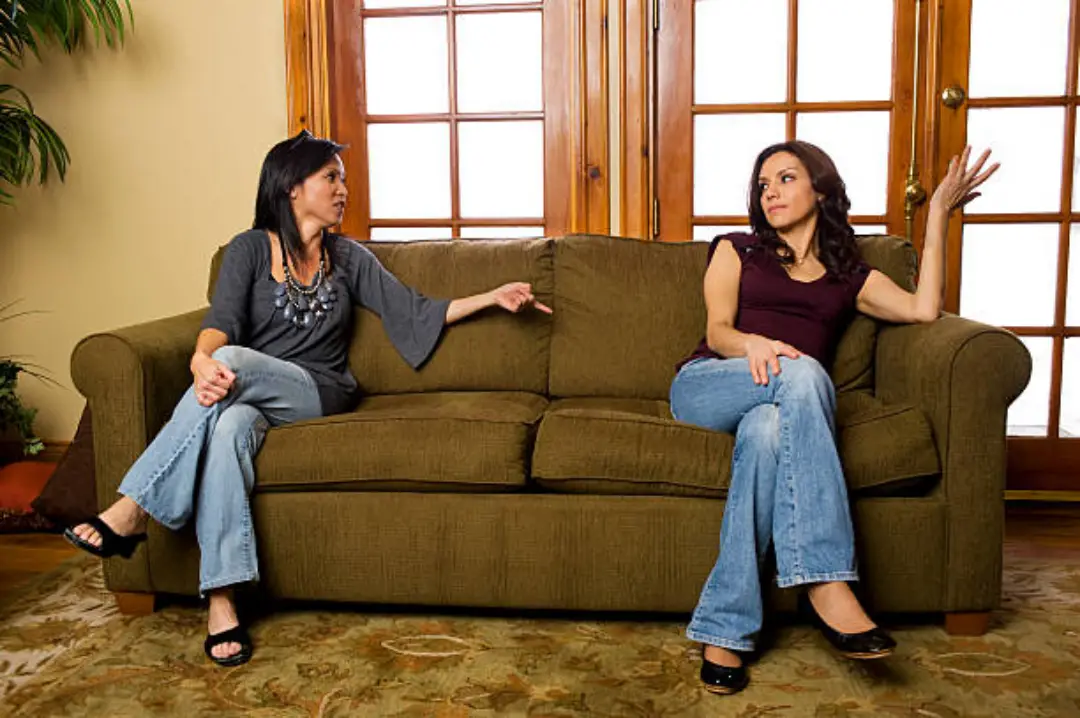
My mother sat on my sofa—on my cushion, in my life—sipping tea from a china cup she only brought out when she wanted to look like she belonged in other people’s decisions. Miranda stood nearby with her arms folded across her chest, her face already assembling itself into the expression of defensive offense she’d perfected over thirty-two years of avoiding accountability.
My nephews peeked around the hallway corner with wide, uncertain eyes, sensing the adult tension the way children always do, absorbing the atmosphere like small emotional sponges.
I stepped fully inside and closed the door behind me with a soft click that felt definitive, like the sound of something ending.
My mother set her teacup down with exaggerated care, the china making that delicate ringing sound against the saucer. “Peyton. There’s no need for that expression.”
My voice emerged lower than I’d expected, surprising even me with its steadiness. “Where is my furniture delivery receipt.”
Miranda blinked rapidly. “What?”
“The receipt,” I repeated, enunciating each word with precision. “From the delivery company. The one that shows who accepted my furniture and where it went.”
My mother’s eyes narrowed fractionally, just enough to reveal the calculation happening behind her carefully maintained expression of maternal concern. “We’re family, Peyton. Sit down. Let’s discuss this reasonably.”
I looked at her sitting on my sofa—the sofa I’d saved for, selected carefully, waited weeks to have delivered—and something in me started to laugh. Not hysterical laughter, not the kind that tips into crying. Small, sharp, almost genuinely amused laughter at the audacity of it all.
“I will not sit down,” I said with absolute clarity. “That furniture belongs to me. I purchased it with money I earned. It was delivered to my home, which I own. You intercepted it and brought it here without my knowledge or consent.”
Miranda lifted her chin in that particular way she does when she’s preparing to make herself the victim of circumstances she created. “Mom said it was a housewarming gift. She said you’d be happy to share.”
My mother’s voice took on the syrupy, dangerous tone she uses when she’s about to say something that will sound reasonable to anyone who hasn’t spent decades being used by her. “You live alone in that big house, Peyton. Why do you need expensive things when Miranda has two growing boys who need stability?”
My chest tightened, my lungs struggling to pull in air around the accumulated weight of thirty-two years of this exact argument. I spoke slowly, carefully, like I was defusing a bomb built from guilt and manipulation. “Because I bought those things. With my own money. For my own home. Those are complete sentences that don’t require additional explanation.”
Miranda’s mouth twisted into that smug half-smile I’d seen countless times before, the expression that said she already knew how this would end because it always ended the same way: with me absorbing the damage and everyone else walking away unscathed. “You’re a décor influencer, Peyton. You’re literally famous for turning trash into treasure. That’s your whole brand. Take my old stuff and make it look cute for your Instagram.”
I thought about the smell currently permeating my living room, about the mildew that had probably already started spreading into my new hardwood floors, about walking into my first home—my first real achievement—and being greeted by the physical manifestation of my family’s contempt.
“I can make a lot of things look beautiful,” I said quietly. “I cannot make disrespect look acceptable.”
My mother’s eyes flickered to my coat pocket where my phone created a slight bulge in the fabric. “You have that important photoshoot next week. With Serafina’s curtain brand. You can’t afford to create family drama right before a major professional opportunity.”
The temperature in my body dropped so rapidly I actually felt dizzy. My skin went cold, my hands clenched involuntarily. “How do you know about the Serafina contract?”
My mother smiled too quickly, the expression not reaching her eyes. “You must have mentioned it, sweetheart.”
“No,” I said, and my voice went even quieter, which somehow made it sound more dangerous. “I specifically did not mention it. I didn’t tell anyone in the family because I learned years ago that sharing good news with you turns it into leverage.”
Miranda’s face changed—just a flicker, lasting maybe two seconds. Not guilt, which would have required some capacity for shame. Calculation. She was deciding whether to admit what they’d done or maintain the pretense of innocence.
I saw it then with the clarity of winter sunlight through clean windows: the spare key wasn’t just for furniture delivery. It was for access. For searching through my home office. For reading my emails, checking my calendar, gathering information that could be weaponized later.
The furniture swap wasn’t simple theft. It was a message, delivered with all the subtlety of a brick through a window: You can buy a house, Peyton. You can build a career and create a life and think you’ve escaped. But you still belong to us. You’re still the family resource we can draw from whenever we decide we need something.
My nephews stepped forward from the hallway, moving with the tentative caution of children who’ve learned that adult conflicts are landmines they might accidentally trigger. The younger one grabbed my leg, tears already forming in his eyes with that practiced ease that made my chest ache. “Auntie Peyton, please,” he said, his voice wavering. “We love the new sofa. It’s so comfortable.”
My heart did that old, familiar lurch—the automatic response I’d been conditioned to have for years, the feeling that if I just gave in one more time, maybe it would finally be enough, maybe they’d finally be satisfied and stop taking.
But something different happened this time. The lurch stopped halfway, interrupted by something harder and clearer.
I knelt down carefully, placing my hands gently on his small shoulders. “Sweetheart,” I said softly, looking directly into his eyes, “you didn’t do anything wrong. Nothing about this is your fault, and I love you more than you can possibly understand.”
His brother edged closer, sniffling, staring at me like I might disappear or transform into someone frightening.
I looked at both of them, these children I adored, these innocent casualties of adults who’d never learned that love isn’t supposed to hurt. “You are always welcome in my house,” I continued quietly. “You can sit on my furniture. You can spill juice and I’ll sigh dramatically and then we’ll clean it together. That’s what family is supposed to do—share space and solve problems together.”
My mother’s mouth opened like she was preparing to reclaim the word “family” and twist it into her preferred shape.
I kept talking before she could interrupt. “But what family does not do—what people who genuinely love each other never do—is take things without asking and then tell children to beg so the adults can avoid facing consequences for their choices.”
Miranda’s face flushed deep red, mottled patches spreading across her cheeks and down her neck. “You’re deliberately making them feel guilty. You’re using children as weapons.”
“I’m telling them the truth,” I replied calmly. “I’m showing them what actual boundaries look like so maybe they don’t grow up thinking love means letting people steal from you.”
From the corner of the living room, my father—Robert Brooks, a man who’d perfected the art of being present while simultaneously absent—shifted his weight and cleared his throat uncomfortably. He’d been sitting so still in an armchair that I’d initially failed to register his presence, which was basically his defining characteristic as a parent.
“Miranda,” he said quietly, not quite meeting anyone’s eyes, “maybe you should just return your sister’s furniture.”
My mother turned her head with glacial slowness, and the look she directed at him could have frozen gasoline mid-combustion. Robert’s shoulders immediately sank inward, his brief moment of something resembling courage evaporating as quickly as it had appeared. He went silent again, shrinking back into the upholstery like a man who’d just remembered why he chose silence as his survival strategy.
Something in me ached for him, which was absurd considering he’d spent my entire life watching my mother and sister treat me like an ATM with legs and never once interceding with any real conviction.
I stood up, straightened my spine, and addressed the room. “Pack up my furniture. Return everything to my house. Today.”
Miranda let out a short, ugly laugh. “You can’t actually make us do anything.”
My mother lifted her chin imperiously. “Be reasonable, Peyton. Think about your professional reputation. Think about the Serafina partnership. You can’t afford a family scandal right now.”
Reputation. That word had been wielded against me like a weapon since childhood. Don’t embarrass the family. Don’t be dramatic. Don’t make waves. Don’t prioritize your own needs over maintaining the illusion that we’re normal.
I felt something settle in my chest—not anger exactly, but a cold, crystalline calm that didn’t come from being accommodating. It came from being completely, irrevocably finished.
I pulled out my phone with deliberate slowness.
My mother’s eyes widened fractionally. Miranda’s smug smile faltered and flickered like a candle in wind.
“I’m calling to report stolen property,” I said clearly, and I didn’t raise my voice, didn’t inject drama or threat into the words. I just stated it like the simple fact it was.
My mother stood so abruptly her teacup rattled dangerously on its saucer. “Peyton. Don’t you dare.”
Miranda stepped toward me, one hand outstretched. “Stop it right now.”
Robert half-rose from his chair, one hand lifting in a gesture somewhere between intervention and surrender, fundamentally uncertain which role he was supposed to perform.
I met his eyes directly. “Dad,” I said quietly but with absolute firmness. “Don’t.”
His hand dropped. He sank back into the chair, and for just a moment something that might have been respect flickered across his face before the familiar resignation returned.
I didn’t actually call the police. I didn’t want sirens and police reports and the kind of public spectacle that would make this about drama instead of about establishing real consequences. I wanted my family to understand that their actions had weight, that taking from me without permission wasn’t a charming family quirk but actual theft that real adults don’t tolerate.
So I called my lawyer instead.
Not some television-drama attorney who shouts objections and makes speeches. A calm, methodical middle-aged woman named Janine Westfield who spoke like she’d spent her entire career translating emotional chaos into comprehensible legal language.
Janine answered on the second ring. “Peyton. What’s wrong?”
“I need you,” I said, and my voice sounded like it belonged to someone else—someone who’d finally stopped apologizing for existing.
My mother froze mid-gesture, listening with that particular intensity people develop when they realize they might actually face consequences.
I turned slightly away, walking toward the kitchen area of the apartment, and spoke in clear, measured tones. “My mother used the spare key I gave her for furniture delivery to intercept that delivery at my house. She and my sister moved my new furniture to my sister’s apartment without my knowledge or consent. They left my sister’s old, damaged furniture at my property. I have purchase receipts, delivery confirmations, and text messages from my sister acknowledging they took my furniture. I need a cease-and-desist letter and a formal property demand letter drafted immediately.”
Janine didn’t gasp or express shock or waste time with unnecessary drama. She asked precise, practical questions: addresses, documentation, timeline, estimated value.
I answered each question while my mother’s face transformed through several distinct stages—offended indignation, genuine alarm, burning fury, and finally cold calculation, like a storm system trying on different shapes to see which would be most effective.
When I disconnected the call, Miranda was staring at me like I’d revealed myself to be a completely different person. “You actually brought lawyers into this. Over furniture.”
“I’m bringing appropriate consequences into a pattern of theft and boundary violations,” I replied. “The furniture is just the most recent example.”
My mother’s voice dropped into that low, dangerous register she uses when she’s transitioning from manipulation to threats. “You will regret this decision. You’ll regret choosing material possessions over your own family.”
I looked at her—really looked at her, maybe for the first time in years with clear eyes instead of the desperate hope that she might transform into someone capable of genuine maternal care. “The only thing I regret is spending thirty-two years paying rent to be part of a family that treats me like an appliance that dispenses money on demand.”
Miranda’s mouth opened and closed several times like she was a fish processing the sudden absence of water. She was realizing, perhaps for the first time, that the words she’d always relied on might not work anymore, that the script had changed without her permission.
My nephews watched from their position near the hallway, silent and confused, their young faces creased with worry that children shouldn’t have to carry.
I softened my voice deliberately when I addressed them. “Go get your shoes and jackets on. I’m taking you to the library for a couple hours.”
Miranda blinked rapidly. “What? No. You’re not taking my children anywhere.”
“The library,” I repeated patiently, like I was explaining something to someone who genuinely couldn’t process simple English. “Where there are books and quiet corners and adults who don’t use children as shields against consequences. You can come if you want, Miranda. But silently. No dramatic speeches or attempts to make this about you.”
My mother scoffed. “You think hiding at a library solves anything?”
“No,” I said calmly. “I think removing the children from the middle of adult dysfunction while the adults handle their business solves several things simultaneously.”
The boys’ faces lit up immediately at the mention of the library. I’d always been the aunt who transformed ordinary errands into small adventures, who made the library feel like a treasure hunt and the grocery store an expedition. Their expressions had been too tense lately, too careful, like they were navigating weather systems they couldn’t predict or control.
Forty minutes later, I’d successfully extracted the boys and driven them to the Holland Public Library, a warm, welcoming building near a small park where snow was currently tucked into the grass like neatly folded blankets. Inside, the air smelled like paper and clean radiator heat—that particular combination that signals safety and possibility and spaces where you’re allowed to exist without constantly performing.
At the circulation desk sat Ruthie Martinez, the head children’s librarian, a woman with genuinely kind eyes and a voice that sounded like she’d read every book ever published about people trying their absolute best in difficult circumstances.
“Well,” she said, registering our arrival and immediately assessing the situation with the expertise of someone who’d seen countless family dramas play out in library spaces, “this looks like a Tuesday that desperately needed assistance.”
I smiled tightly, feeling my facial muscles struggle with the expression. “The boys need story time. And maybe some space where adults aren’t making everything complicated.”
Ruthie’s gaze flickered across my face, reading volumes in the tension around my eyes and mouth. “I have exactly what you need.”
She led the boys to the children’s section and handed them a carefully curated stack of books like she was distributing essential tools rather than entertainment. They settled onto a large rug shaped like a cheerful whale, and Ruthie began reading in that gentle, rhythmic cadence that makes even chaos temporarily sit down and behave itself.
I collapsed onto a wooden bench positioned near the large windows overlooking the snow-dusted park. The trees outside stood bare but somehow not bleak—just resting, waiting for spring with patient confidence.
My chest tightened and released in waves, like my body couldn’t decide whether we were safe yet or if another crisis was still approaching.
I had the strange urge to name the bench I was sitting on, because naming things has always been my particular method of transforming fear into something manageable. The bench was simple and worn smooth where countless hands had rested over the years, dark wood and metal painted forest green.
I named it The Boundary Bench in my mind. Not because boundaries are cold or unfriendly, but because they’re the clear line that prevents your life from being overrun by people who’ve learned to take without asking.
When Ruthie finished the first story, the boys ran to select additional books with that unselfconscious enthusiasm children display when adults aren’t actively ruining the atmosphere. I watched them, thinking about how children automatically believe adults are the ones maintaining stability in the world, not realizing that adults are frequently just taller children repeating whatever patterns were taught to them without ever questioning whether those patterns were healthy or sustainable.
My phone buzzed with an incoming text. I glanced down to see Luna’s name—Luna Chen, my best friend since college, the one person I’d told about the Serafina contract because Luna treated good news like fragile glass requiring careful handling rather than information to be weaponized.
Where are you? I’m coming.
Luna always showed up. Not with grand dramatic gestures, but with coffee and paper towels and that steady, unshakeable presence that communicates “you’re not facing this alone” more effectively than any words.
I typed back: Public library. Sitting on what I’ve named The Boundary Bench.
Twelve minutes later, Luna walked through the library’s automatic doors, her cheeks pink from cold, her perpetually messy bun already surrendering to gravity because Luna moved through the world like she had more important things to worry about than perfect hair.
She spotted me immediately, crossed the space without hesitation, and slid a still-warm coffee into my hands before sitting down beside me.
“I brought the good kind,” she murmured. “Not the kind that tastes like despair and resignation.”
A small, surprised laugh escaped me—the first genuine sound of amusement I’d made in hours.
The boys waved enthusiastically at Luna from their position among the bookshelves, comfortable with her presence because she’d been a constant in my life long enough to become automatically safe in their understanding of the world.
Ruthie approached our bench with quiet footsteps, her voice low and respectful. “Do you want to tell me what’s actually happening,” she asked gently, “or would you prefer I just keep reading stories about whales to children until the universe becomes sensible again?”
“Definitely the second option,” I said.
Ruthie nodded, looking pleased. “Excellent choice. I’m exceptionally skilled at postponing confrontations with reality through strategic deployment of children’s literature.”
While the boys disappeared into books with the complete absorption only children can achieve, I gave Luna the abbreviated version of events: the furniture swap, the invasion of privacy, my mother’s knowledge of the Serafina contract she shouldn’t have possessed.
Luna’s face went very still, her expression shifting into something harder and more focused. “She went through your personal emails. She actually went through your private correspondence.”
“She had my house key,” I said simply.
“A key to your house is not blanket permission to violate every boundary you possess,” Luna said firmly.
“I know,” I said quietly. “My mother apparently never learned that particular life lesson.”
Luna leaned closer, her voice dropping. “What are you going to do? What’s your actual plan here?”
I stared out at the snow, watching how it softened the sharp corners of the playground equipment without entirely erasing the underlying shapes. “I already did it. I called Janine. Legal demand letters are being drafted right now.”
Luna exhaled like she’d been holding her breath on my behalf for thirty-two years, waiting for this exact moment. “Finally.”
That single word landed with tremendous weight—simultaneously gentle and heavy, supportive and slightly accusatory, acknowledging both how long I’d waited and how necessary this action was.
My phone buzzed again. I didn’t need to look to know it was my mother, but I glanced at the screen anyway. Three missed calls and a text that simply read: This is going too far.
I didn’t respond. Instead, I watched my nephews bent over their books, their small shoulders finally relaxing, their faces losing that tight, worried expression children shouldn’t have to wear.
The library felt like genuine belonging—not because it belonged to me specifically, but because it was a space that welcomed people without demanding payment or performance or perfect gratitude.
By late afternoon, Janine had completed and sent the legal documents: calm, clear, professional letters that didn’t argue or plead or explain. They simply stated facts and requirements: Return the property within twenty-four hours. Provide written confirmation of return. Cease all unauthorized entry to the property. Immediately return all keys.
There was something profoundly soothing about that language—not emotional, not begging, just a clear line drawn in professional ink on official letterhead.
My mother called six more times. Miranda texted repeatedly: You’re destroying this family over furniture. Do you even hear yourself?
I didn’t respond to any of it. I just sat on The Boundary Bench, drank coffee Luna kept refreshing, and watched my nephews discover the magic of books while adults either learned or refused to learn the basic concept of consequences.
The next morning arrived with pale winter sunlight and wind that scraped at my windows with the sound of nature having opinions about human choices. I stood in my kitchen sipping coffee, staring at the empty space where my dining table should have been, the air still carrying faint traces of mildew from Miranda’s furniture like an insult that had settled into the molecular structure of my home.
My doorbell rang at exactly nine o’clock.
I looked through the peephole and saw Miranda standing on my porch with our mother positioned behind her like a general positioning troops. Behind them both, a moving truck idled at the curb.
I opened the door but didn’t step aside to invite them in.
My mother produced what she probably thought was a warm, conciliatory smile. “Peyton. Good. You’re home. We can talk about this rationally now.”
Miranda’s eyes were hard, her jaw clenched. “We’re returning your stuff. Are you satisfied?”
“Put everything inside exactly where you found it,” I said calmly. “All of it. Then leave.”
My mother’s smile flickered and died. “There’s no need to be so cold. We’re still family. We can discuss—”
“We cannot discuss anything,” I interrupted, keeping my voice level. “You can return my property that you stole, and then you can leave my home.”
Miranda’s mouth tightened into a thin line. “The boys absolutely loved that sofa. You’re taking away something that made them happy.”
“The boys will love many things throughout their lives,” I said. “What they don’t need to learn is that stealing gets relabeled as sharing when it’s convenient for adults who want to avoid accountability.”
My mother’s eyes went sharp and calculating. “You’re being deliberately cruel. You’re punishing children.”
“No,” I said clearly. “I’m establishing boundaries that will teach those children what healthy relationships actually look like. That’s probably the most loving thing anyone’s done for them in years.”
The movers brought everything inside piece by piece: my sofa, my coffee table, my end tables, all wrapped in plastic and carried by professionals who kept their eyes carefully neutral. My mother tried to direct the placement like she was hosting some kind of charity furniture distribution event. Miranda stood to the side radiating bitterness like heat.
My father wasn’t there. That absence hurt in ways I wasn’t prepared to acknowledge.
When the last item had been positioned, Miranda thrust a clipboard at me. “Sign the delivery confirmation.”
I signed with clear, decisive strokes.
My mother stepped closer, lowering her voice into that particular register she uses when attempting intimacy as manipulation. “You’ve embarrassed me in front of your sister. You’ve made this into something it never needed to be.”
I held her gaze without flinching. “You entered my home without permission and removed property you didn’t own. The embarrassment is entirely self-created.”
“After everything we’ve done for you,” my mother said, her voice taking on that injured tone she deploys when she wants me to feel guilty for having boundaries.
That phrase—”after everything we’ve done for you”—had been used against me like a blunt weapon for so long I’d started believing my gratitude obligated me to accept mistreatment indefinitely.
I said very quietly, “Name one specific thing you’ve done for me in the last five years that didn’t ultimately benefit you or Miranda.”
Her eyes flickered, searching for an answer that would sound convincing.
Miranda jumped in with practiced outrage. “Mom raised you. She gave you a home and food and—”
“She performed the basic legal requirements of parenthood,” I said calmly. “And then she taught me that love is something you earn by being perpetually useful. I learned that lesson extremely well. Too well, actually.”
My mother’s face hardened into something cold and immovable. “You’re ungrateful. You’re selfish. You’re—”
“I’m done,” I said simply. “I’m done being the family ATM. I’m done absorbing everyone else’s chaos so you can avoid facing consequences. I’m just done.”
Miranda’s laugh was bitter and sharp. “So that’s it? You’re cutting us off completely? After all these years?”
“I’m stopping,” I corrected her. “There’s a significant difference between those two concepts.”
My mother’s voice turned syrupy and dangerous. “Think very carefully about your reputation. Think about your professional opportunities. The Serafina photoshoot is in three days. You can’t afford family drama affecting your—”
“Leave my house,” I said, my voice going even calmer and quieter. “Right now.”
My mother’s eyes narrowed. “You can’t keep the boys away from their grandmother.”
“I didn’t say anything about the boys,” I replied evenly. “I said leave my house. The door is behind you.”
There are specific moments in life when you realize the person you’ve been afraid of for decades is simply someone who’s never heard the word “no” delivered with genuine conviction. The fear drains away like water from a bathtub, leaving behind something clearer and lighter.
My mother opened her mouth to continue the argument, to deploy whatever manipulation she’d prepared.
I pointed toward the porch. Not dramatically, not with shaking hands. Just a simple, clear gesture. “Now.”
Miranda grabbed our mother’s arm. “Come on. Let’s go.”
They left. The door closed behind them with a quiet, final click.
Silence rushed into my house like a friend I’d been waiting years to welcome home.
I stood in my living room with my furniture returned to its proper place, the glass coffee table gleaming under the overhead light, and it would have been so easy to call this victory, to believe the story ended here with me triumphant and them vanquished.
But when I looked more carefully, I saw evidence of their carelessness: a faint stain on the sofa cushion, a scratch on the coffee table that definitely hadn’t been there before, a torn tag on one end table like someone had ripped it off out of spite rather than carefully removing it.
The damage wasn’t catastrophic. It was just proof—visible evidence that they’d handled my belongings the way they’d always handled my life: carelessly, assuming I’d repair whatever they broke.
I didn’t cry about it. I took out my phone and began methodically documenting everything, because adulthood isn’t always about big emotional releases. Sometimes it’s about creating thorough documentation that can be referenced later if necessary.
Luna arrived within an hour carrying cleaning supplies and the kind of determined calm you want around you when you’re trying not to regress into old patterns.
“Your furniture is back,” she said, surveying the room.
“My furniture is back,” I agreed.
“And your spine,” she added with a slight smile.
That evening, I sat down at my laptop and created a spreadsheet—not because I love spreadsheets, but because sometimes numbers are the only language certain people pretend to respect.
I titled it: Final Accounting.
Then I listed everything I could document: credit card debt payments I’d made on Miranda’s behalf, emergency childcare I’d funded, “temporary” rent assistance that became permanent, the monthly six hundred dollars multiplied across years, furniture storage fees, car insurance payments, utility bills.
The total wasn’t the point. The point was seeing in black and white exactly what “being the good daughter” had cost me in quantifiable terms.
I saved the file and stared at the screen until the numbers stopped looking like mathematics and started looking like a life I’d been living on behalf of people who’d never once asked if I was okay.
The next three days passed in a blur of preparation for the Serafina photoshoot. I cleaned obsessively, arranged and rearranged furniture, tested lighting angles, made sure every surface gleamed. The morning of the shoot, Serafina’s team arrived promptly at nine with lighting equipment, cameras, laptops, and the quiet efficiency of professionals who understand that panic is counterproductive.
Serafina herself walked through my door and paused, her sharp eyes scanning the space with the expertise of someone who’d built a brand on understanding aesthetics.
Her gaze landed on the smart curtains, swept across the room’s arrangement, then returned to my face.
“Good,” she said simply. Just that one word, but it carried the weight of approval I’d been working years to earn.
The photoshoot transformed my living room into a small production set. The photographer, Eli, directed me with gentle precision, adjusting pillows and lighting and asking me to relax my shoulders because apparently I looked like I was “bracing for impact.”
“I have recent experience with that,” I said.
His mouth twitched in an almost-smile. “The camera responds well to authentic emotion. It does not respond well to defensive tension. Show me calm.”
“Calm costs extra,” I muttered, but I tried.
The finished images on the monitor looked like a life I’d been working toward for years: elegant, intentional, belonging to someone who understood that beauty required both vision and boundaries.
After the team departed and Luna and I collapsed on the sofa, she raised her coffee cup in a tired salute. “You survived attempted sabotage.”
“I survived family,” I corrected.
“Same fundamental skill set,” Luna said, and we both laughed with the exhaustion of people who’d just barely made it through something difficult.
That night, I opened my email and attached the Final Accounting spreadsheet. I addressed the message to my mother, my father, and Miranda.
Subject line: Final Accounting.
In the body of the email, I wrote exactly three sentences:
This is what being the family ATM has cost me.
This is my notice that the ATM is permanently closed.
Do not contact me again.
I hit send. Then I systematically blocked my mother and Miranda from every form of communication I possessed.
My thumb hovered over my father’s contact information for a longer moment. Robert had been quiet my entire life—not always from cruelty, often from cowardice dressed as peacekeeping. Quiet isn’t the same as abuse, but it enables abuse to flourish unchallenged.
I blocked him too.
The silence that followed felt disorienting at first, like stepping into a room after a radio that’s been playing for thirty-two years suddenly goes quiet.
Then slowly, gradually, that silence began to feel less like absence and more like rest.
Weeks became months. My career flourished. The Serafina campaign exceeded expectations, leading to additional brand partnerships and opportunities. My follower count grew. People responded to what they called my “authenticity,” which made me smile because authenticity often looks remarkably like someone else’s chaos that you’ve learned to manage under good lighting.
Then one afternoon, my doorbell rang unexpectedly. I opened the door to find my father standing on the porch, looking older and more uncertain than I remembered.
“Peyton,” he said quietly. “Can we talk?”
I considered closing the door. I considered a lot of things in the space of that moment.
Finally, I stepped aside. “Five minutes.”
He entered my home carefully, taking in the space like he was seeing evidence of a life he’d failed to protect.
“The boys ask about you constantly,” he said. “They miss you.”
“I miss them too,” I replied honestly.
Robert’s hands twisted together, a nervous gesture I recognized from childhood. “Your mother… she’s very angry. Miranda is struggling. The boys…”
“If you came here to guilt me on their behalf, you can leave now,” I said firmly.
“No.” He shook his head. “I came to say you were right. About all of it.”
The words hung in the air between us.
“I spent your entire life staying quiet because it was easier than confronting your mother,” he continued, his voice raw. “I let you become the solution to everyone else’s problems because it meant I didn’t have to be uncomfortable. I failed you.”
I stared at him, this man who’d raised me without ever quite protecting me.
“What changed?” I asked.
“You did,” he said simply. “When you stopped enabling them, Miranda had to face her own choices. She got a second job. She stopped relying on constant financial rescue. The boys are actually… calmer. They’re not caught in the middle of adult chaos as much.”
He looked directly at me for maybe the first time in years. “You saved them by saving yourself.”
I felt something shift in my chest—not forgiveness exactly, but maybe the beginning of understanding that people can learn, even late, even poorly.
“I can’t have Mom and Miranda back in my life,” I said clearly. “Not the way it was.”
“I know,” Robert said. “But the boys. Could I… could I bring them to visit sometimes? Just me and them?”
I considered this carefully. Boundaries aren’t walls that trap you—they’re gates that open selectively.
“Once a month,” I said finally. “You and the boys. No surprise visits. No messages from Mom or Miranda delivered through the boys. If they send messages, you take them home immediately.”
“Deal,” he said quickly, relief flooding his face.
And that’s how it began: careful, monthly visits where I made pancakes and we went to the library and I taught my nephews that love doesn’t require tolerating mistreatment, that family can be chosen and protected and shaped into something healthier than what you inherited.
Six months after that first terrible day with the furniture, I stood in my living room as afternoon light streamed through my smart curtains, making the space glow with that particular quality of belonging. My cream sofa sat exactly where it should. My glass coffee table gleamed. My home felt like mine.
My phone buzzed with a photo from Robert: the boys at the library, holding books, their faces relaxed and happy.
The caption read: See you Saturday. They’re excited.
I smiled and set the phone down.
Outside, spring had finally arrived after a long winter. The trees wore new green like hope. The world continued forward because that’s what the world does—it keeps moving regardless of individual human drama.
I’d learned to name my furniture, my spaces, my boundaries. I’d learned that saying no doesn’t make you cruel—it makes you honest. I’d learned that family isn’t defined by who shares your blood but by who respects your humanity.
And I’d learned that sometimes the most loving thing you can do for children is refuse to teach them that self-sacrifice equals love.
My house stood quiet and clean and entirely mine. The lock I’d changed worked perfectly. The keys I’d kept worked exactly as intended.
And for the first time in thirty-two years, when I stood in my living room and looked around, everything—absolutely everything—was exactly where it belonged.

Ethan Blake is a skilled Creative Content Specialist with a talent for crafting engaging and thought-provoking narratives. With a strong background in storytelling and digital content creation, Ethan brings a unique perspective to his role at TheArchivists, where he curates and produces captivating content for a global audience.
Ethan holds a degree in Communications from Zurich University, where he developed his expertise in storytelling, media strategy, and audience engagement. Known for his ability to blend creativity with analytical precision, he excels at creating content that not only entertains but also connects deeply with readers.
At TheArchivists, Ethan specializes in uncovering compelling stories that reflect a wide range of human experiences. His work is celebrated for its authenticity, creativity, and ability to spark meaningful conversations, earning him recognition among peers and readers alike.
Passionate about the art of storytelling, Ethan enjoys exploring themes of culture, history, and personal growth, aiming to inspire and inform with every piece he creates. Dedicated to making a lasting impact, Ethan continues to push boundaries in the ever-evolving world of digital content.