The Names on the Contracts
The morning started with sunlight streaming through lace curtains in our bedroom, warm and golden the way June mornings are supposed to be. I’d been awake since five, unable to sleep through the mixture of anticipation and anxiety that had been building for months. Today was my daughter’s wedding day. The day I’d imagined since she was born twenty-six years ago—the moment she’d look beautiful and happy and loved, and I’d be there to witness it all.
I lay in bed listening to Richard’s steady breathing beside me and tried to identify the knot in my stomach. Excitement, I told myself. Just excitement. Normal mother-of-the-bride nerves.
But it felt like something else. Something I couldn’t quite name.
My hair appointment was at seven. I’d made it months ago at a salon I normally wouldn’t go to—too expensive, too fancy—but this was a special occasion. Eighty-five dollars to have my hair styled properly, to look like I belonged at the kind of wedding my daughter was having. The kind of wedding that had consumed the past year of our lives and a significant portion of our savings.
I showered carefully, trying not to think about the number. The total. The amount we’d spent on flowers and venues and photographers and all the things Olivia had insisted were “absolutely necessary” for her dream day.
$32,000.
Thirty-two thousand dollars for a single day. For six hours. For a ceremony and reception that would be over before midnight.
Richard had blanched when I showed him the running total three months ago. We’d been sitting at our kitchen table—the same table where we’d done homework with Olivia, where we’d had family dinners, where we’d planned our own modest wedding forty-five years ago.
“Maybe we should talk to her about scaling back,” he’d suggested carefully. “That’s… that’s a significant amount of money.”
“It’s her wedding,” I’d replied, the words automatic, reflexive. “You only get married once. We want her to have the day she’s always dreamed of.”
What I didn’t say: I want her to be happy. I want her to look at me with warmth again instead of that cool distance that had crept into our relationship over the past two years. I want to feel like her mother again instead of an obligation she checks off a list.
The Distance
It started subtly. So subtly I convinced myself I was imagining it.
Olivia had always been independent—strong-willed, determined, confident in a way that made me proud even when it made parenting difficult. She’d gone to a good college on partial scholarships we’d supplemented with careful savings. She’d graduated with honors, gotten a job at a marketing firm in the city, moved into her own apartment.
We were close, then. She’d call every Sunday evening. Visit for holidays. Text me photos of her life with captions like “thought you’d like this” and “remember when we used to do this together?”
Then she met Tyler.
Tyler was handsome, polished, successful—a financial analyst with a expensive apartment and expensive tastes. He came from money—the kind of family where “summer” was a verb and everyone had opinions about wine regions.
When Olivia brought him home for the first time, I’d tried so hard. Made his favorite foods (which required three trips to specialty stores). Asked interested questions about his work. Complimented his achievements.
He’d been polite but distant, the way you are with service workers. Pleasant smile, minimal engagement, checking his phone periodically like he had more important places to be.
After they left, Richard said what I’d been thinking: “He seems… fine.”
Fine. Such a damning word.
But Olivia was happy, or seemed to be, so we smiled and welcomed him into our lives and tried not to notice how our daughter was changing.
The Sunday calls became monthly, then sporadic. The visits grew shorter. Her texts shifted from warm to functional—logistics about meeting times, brief responses to our questions, radio silence between.
When she announced the engagement—via a group text that included us, Tyler’s parents, and what appeared to be at least twenty other people—I’d felt a strange mix of joy and hurt.
A group text. Not a phone call. Not a visit. Not even a private message before the public announcement.
But I pushed that hurt down, the way mothers do, and focused on being happy for her.
“We’re getting married at Ashford Gardens,” the text continued. “Save the date for June 15th!”
Ashford Gardens. The most exclusive wedding venue in the county. The kind of place featured in bridal magazines and society pages. The kind of place I’d driven past dozens of times and never imagined my daughter’s wedding would be there.
The kind of place that probably cost more money than we’d spent on our entire wedding, honeymoon, and first year of marriage combined.
The Planning
The planning process should have been exciting. Bonding time. Mother-daughter moments I’d imagined since Olivia was little.
Instead, it felt like being a contractor.
Olivia would text: “Need to book the caterer by Friday. Can you handle the deposit?”
Or: “Photographer requires 50% upfront. The link to pay is below.”
Or: “Florist needs final numbers. Also she has some upgrade options I want to add.”
Every conversation was transactional. Every interaction was about money or logistics or things that needed to be done.
When I tried to engage beyond that—”Are you excited?” “How are you feeling?” “Want to grab lunch and talk about everything?”—her responses were brief and dismissive.
“I’m swamped at work, Mom.”
“Tyler and I are handling most of the details with the wedding planner.”
“We’ve got it under control.”
We. Meaning her and Tyler. And apparently a wedding planner I hadn’t known existed until invoices started arriving in my email.
Richard noticed too. “She barely talks to us anymore,” he said one evening after another terse text exchange about a rental company.
“She’s stressed,” I defended, automatic. “Planning a wedding is overwhelming.”
“We planned ours in six weeks while working full-time jobs and didn’t need a planner,” he pointed out.
“Times are different now.”
“Are they? Or is she different?”
I didn’t answer because I didn’t want to admit he was right.
The few times we did see Olivia—brief meetings to approve choices or sign contracts—Tyler was always there. Always with his hand on her shoulder or her back, always steering conversations, always with opinions about what “we” wanted, what “we” had decided, what “we” expected.
I noticed that Olivia rarely said “I” anymore. Only “we.” Like she’d been absorbed into some corporate entity where her individual preferences no longer existed.
And I noticed how she looked at us sometimes—at our older car, our off-the-rack clothes, the way we pronounced certain words or didn’t know certain references. A look I couldn’t quite categorize but felt in my chest like disappointment.
Still, I told myself this would pass. That after the wedding, things would go back to normal. That she was just caught up in the stress and expense and pressure of it all.
I told myself the $32,000 we were spending—money pulled from retirement accounts, money that represented years of careful saving—was an investment in our relationship. In her happiness. In staying connected to our only child.
I told myself a lot of things that turned out to be lies.
The Morning
The salon was lovely. Too lovely for a Tuesday morning in a strip mall, but the stylist had come highly recommended, and I wanted everything to be perfect.
“Mother of the bride?” she asked as I settled into the chair, and I nodded, feeling a small swell of pride at the title.
“First wedding?”
“Only wedding,” I replied. “Our only daughter.”
“How exciting! Tell me about the wedding.”
So I did. I told her about Ashford Gardens, about the flowers we’d chosen—white roses and blue hydrangeas, classic and elegant. About the string quartet, the six-tier cake, the photographer who’d flown in from New York. About the dress Olivia had found at an exclusive boutique, about Tyler’s family who’d be there, about the two hundred guests.
I talked about all the beautiful details while the stylist twisted and pinned my hair into something far more elegant than my usual style.
What I didn’t mention: that I hadn’t actually seen Olivia in three weeks. That our last conversation had been a terse text about whether champagne flutes needed to be crystal or if glass was acceptable. That when I’d suggested having lunch before the wedding, just the two of us, she’d replied, “Too busy, sorry.”
The stylist finished, and I looked at myself in the mirror—hair swept up, subtle makeup that made me look younger, polished in a way I rarely achieved.
“You look beautiful,” she said warmly. “Your daughter is lucky to have you.”
I wanted to believe that. I paid the $85—wincing internally but maintaining my smile—and drove home to meet Richard.
He was already dressed in his pressed suit, the good one we’d bought specifically for this occasion. He looked handsome, distinguished, like the kind of father who should be proudly walking his daughter down the aisle.
“You look wonderful,” he said when he saw me, and kissed my cheek carefully to avoid disturbing my hair.
I’d laid out my dress hours earlier—pale blue, tea-length, modest but elegant. Olivia’s colors were blue and white, and I’d chosen carefully to complement without competing. To look appropriate. To look like I belonged.
The dress cost more than I’d spent on clothing in the past year combined, but again: special occasion. Worth it to look right.
I dressed slowly, carefully, checking my reflection multiple times. Richard waited patiently, his own nervousness showing in how he kept adjusting his tie.
“We should go early,” I said. “I have something I want to give her before the ceremony.”
I’d wrapped it that morning—my mother’s necklace, the one she’d given me on my wedding day, the one her mother had given her. Silver and pearl, delicate and timeless, worn by three generations of Wilson women.
Olivia had loved it as a child. Would beg to wear it for dress-up, would stand in front of the mirror and imagine her own wedding day. “I want to wear it when I get married, Mama,” she’d say, her small fingers tracing the pearls.
I’d promised her then that she would. That on her wedding day, I’d clasp it around her neck and tell her about her grandmother, about tradition, about love that spans generations.
The gift box sat on our kitchen counter, silver wrapping paper catching the light. I picked it up carefully, feeling the weight of it—not just the physical weight but the emotional weight of everything it represented.
“Ready?” Richard asked.
I nodded, though I wasn’t sure I was ready for anything.
The Arrival
Ashford Gardens was stunning. More beautiful than the photos on their website, more perfect than I’d imagined during all those months of planning.
The entrance drive was lined with flowering trees. The gardens themselves sprawled over acres of manicured lawns, carefully tended flower beds, winding stone paths that led to various ceremony sites and reception areas.
We’d chosen—or rather, Olivia had chosen and we’d paid for—the Rosewood Terrace package. Premium location. Maximum capacity. Every upgrade and add-on the venue offered.
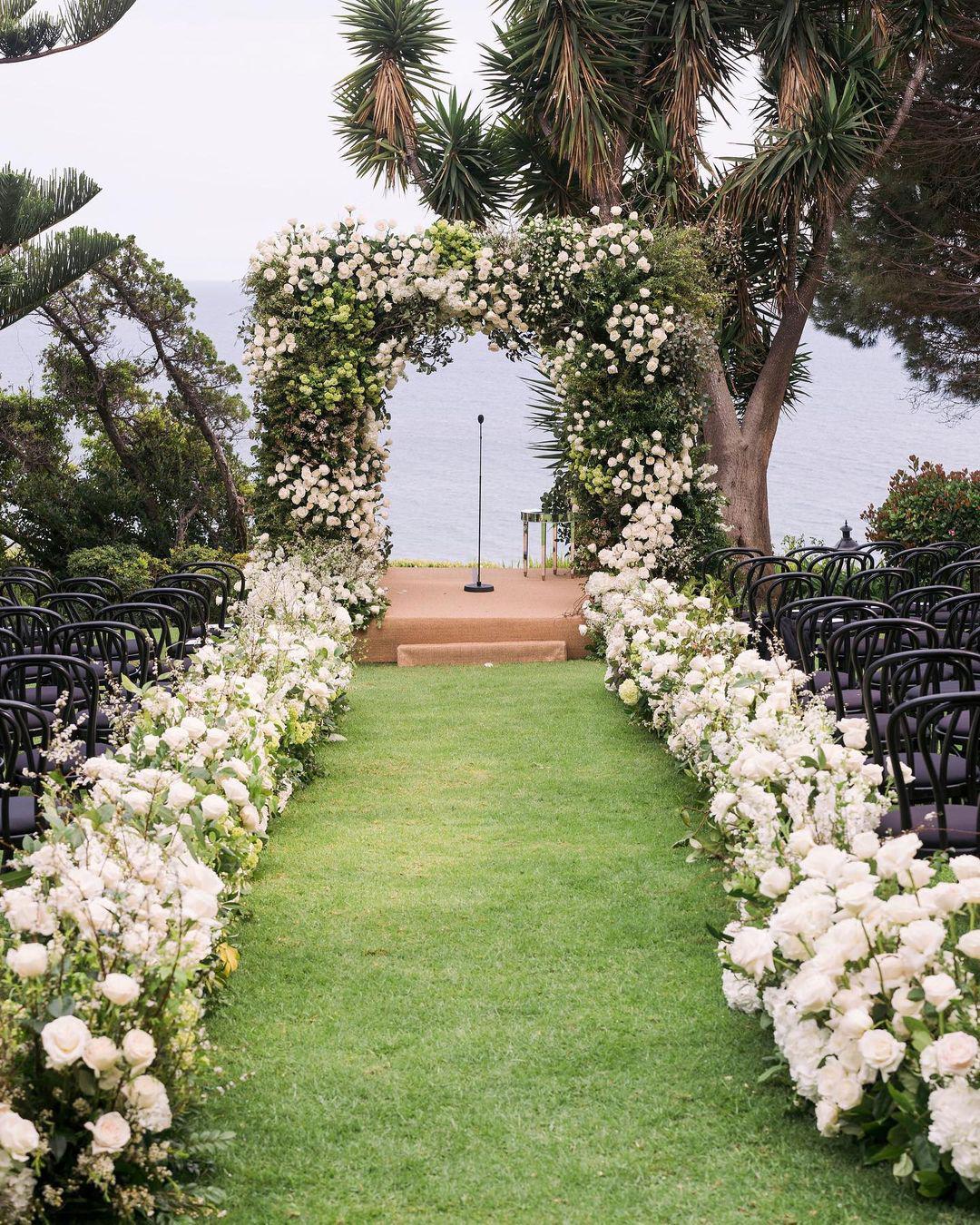
As we drove up, I could see the setup was already complete. White chairs arranged in perfect rows facing an elaborate floral arch. Blue hydrangeas and white roses exactly as planned, cascading in elegant arrangements that probably cost more per stem than seemed reasonable.
A string quartet was set up near the seating area, musicians in formal attire tuning their instruments. White fabric draped artfully. Lighting that would look magical as the sun set. Every detail executed with the precision that comes from spending obscene amounts of money.
Richard parked in the guest lot, and we sat for a moment, both of us taking it in.
“It’s beautiful,” I said quietly.
“It is,” he agreed. Then, after a pause: “Are you okay?”
“Of course,” I replied automatically. “Why wouldn’t I be?”
He didn’t answer, just looked at me with the expression of someone who’s been married for forty-five years and knows when his wife is lying.
“I just want today to go well,” I admitted. “I want Olivia to be happy. I want her to look back on this day and remember it was perfect.”
“It will be,” Richard said, but his voice carried uncertainty that matched the knot in my stomach.
We got out of the car. I smoothed my dress, checked that the gift box hadn’t been crushed. Richard offered his arm, and we walked toward the gardens like we belonged there, like we weren’t acutely aware of how much this was costing us, like we hadn’t noticed how our daughter had barely spoken to us in weeks.
A coordinator met us at the entrance—a young woman with a tablet and an efficient smile. “You must be the Wilsons! Olivia mentioned you’d be arriving early.”
“We wanted to see her before the ceremony,” I said. “Give her something special.”
The coordinator’s smile flickered—just for a moment—and something in my chest went cold.
“Of course,” she said smoothly. “Follow me.”
She led us through the gardens, along stone paths, past elaborate floral displays and elegant staging. Everything looked perfect. Everything looked expensive. Everything looked like a wedding that belonged to someone other than my daughter.
We reached a small building near the ceremony site—the bridal suite, designated for final preparations. Through the windows, I could see movement, hear laughter and chatter.
The coordinator knocked gently. “Olivia? Your parents are here.”
The sounds inside stopped. A pause that felt too long.
Then the door opened, and there was my daughter.
She was breathtaking. Makeup applied by professionals, hair styled in an elaborate updo I didn’t recognize, wearing a wedding gown that wasn’t the one we’d chosen together months ago. This dress was different—more expensive, more elaborate, probably custom-made.
For half a second, maternal pride overwhelmed everything else. My baby girl, grown and beautiful and about to get married.
Then I saw her eyes.
Cool. Distant. Looking at us like we were an inconvenience she hadn’t planned for.
“Mom. Dad.” Her voice was flat, professional, the tone you use for unwanted salespeople. “What are you doing back here?”
The question landed wrong. What were we doing there? At our daughter’s wedding? The wedding we’d paid for?
I forced a smile, lifted the gift box. “We wanted to see you before the ceremony. I brought Grandma’s necklace—the one you always loved. I thought you might want to wear it today.”
It was supposed to be a tender moment. A tradition. A connection between generations.
Olivia didn’t reach for the box. Didn’t smile. Didn’t soften.
Instead, she stepped into the hallway and pulled the door mostly closed behind her, blocking our view of the bridal suite, of her bridesmaids, of whatever world existed in there that apparently didn’t include us.
“There’s been a change of plans,” she said, her voice low and controlled.
The words hung in the air like something toxic.
“What kind of change?” Richard asked, his voice tight.
Olivia looked at him, then at me, her expression unreadable. When she spoke, her words were precise and rehearsed.
“You’re not invited to the ceremony or the reception. Tyler and I have decided to keep the wedding intimate—just our friends and his family. We need you to leave.”
The Break
I’ve spent a lot of time since that moment trying to understand how I reacted. Or didn’t react. The words should have hit me like a physical blow. Should have made me cry or shout or demand an explanation.
Instead, I felt nothing. A weird, floating numbness like my brain couldn’t process what was happening.
“Not invited,” I repeated slowly, the words foreign in my mouth. “To your wedding.”
“To our wedding,” Olivia corrected, and the emphasis on “our” felt pointed. “This day is about me and Tyler, not about you.”
Richard’s voice came out rough, strained: “Olivia… we’re your parents.”
She shrugged. Such a small gesture. Such a devastating dismissal.
“This isn’t personal,” she said, though everything about it felt intensely personal. “We just want to celebrate with people who are part of our lives now. Our future, not our past.”
The gift box in my hands suddenly felt impossibly heavy. The necklace inside—three generations, promises made to a little girl, traditions and love and connection—reduced to something unwanted.
“We paid for this wedding,” I said quietly. Not accusatory. Just stating a fact. “Every vendor. Every deposit. Every—”
“And we appreciate that,” Olivia interrupted, her tone suggesting she didn’t appreciate it at all. “But financial contributions don’t entitle you to anything. This is our day, our choice.”
Tyler appeared beside her then, materializing like he’d been waiting just out of sight. He wore an expensive suit, looked comfortable in a way that suggested he’d been to many events like this, belonged in places like this.
He didn’t greet us. Didn’t acknowledge us beyond a brief, dismissive glance.
His hand settled on Olivia’s shoulder—possessive, controlling, the gesture of someone marking territory.
“The ceremony starts in twenty minutes,” he said to Olivia, not to us. “We need to stick to the timeline.”
A bridesmaid peeked out from the bridal suite—someone I didn’t recognize, someone who was apparently more important than the parents who’d raised Olivia, loved her, sacrificed for her.
She whispered something to Olivia. They both laughed—soft, private, the kind of laugh that makes you realize you’re the punchline.
“You should go,” Olivia said, turning back to us with finality. “The ceremony will be starting soon, and we don’t want any… complications.”
Complications. We were complications.
Richard’s jaw was so tight I could see the muscle jumping. His hand found mine, squeezed once—a question, a lifeline, a silent conversation we’d perfected over forty-five years of marriage.
I squeezed back. We’re leaving.
We turned and walked away. Past the elaborate floral arch. Past the white chairs we’d approved and paid for. Past the catering van—the caterer we’d hired, the menu we’d selected, the $8,000 food bill that was in our name.
Past everything we’d created and everything we were now excluded from.
I didn’t cry. Not yet. I was too numb, too disconnected, moving on autopilot.
Richard opened the car door for me. I slid in with the gift box still in my lap—unopened, unwanted, a symbol of everything I’d misunderstood about our relationship with our daughter.
We sat there for a long moment. The engine off. The gardens visible through the windshield—beautiful and perfect and hosting a wedding we weren’t welcome at.
“Where do you want to go?” Richard asked finally, his voice hollow.
I looked down at the gift box. At the silver wrapping paper I’d chosen so carefully. At the necklace inside that represented love and tradition and promises made to a little girl who’d become someone I didn’t recognize.
Then I looked at my husband—this man who’d worked overtime for months to help pay for this wedding, who’d never complained about the cost, who’d been so proud to walk his daughter down an aisle she’d now barred him from.
Something crystallized in that moment. Something cold and clear and absolutely certain.
“Where’s the nearest place with Wi-Fi?” I asked.
Richard looked at me, question in his eyes.
For forty-five years, I’d been the peacemaker. The one who smoothed over conflicts, who forgave first, who swallowed hurt to keep relationships intact. I’d taught Olivia to be strong and independent, had supported her choices even when they hurt me, had loved her unconditionally through every phase of her life.
But this—this was different.
This wasn’t a phase or a misunderstanding or stress-induced poor behavior.
This was cruelty. Calculated. Deliberate. Without remorse.
And suddenly I was done being the person who absorbed that cruelty silently.
“Wi-Fi,” I repeated. “Somewhere with good Wi-Fi. Now.”
Richard started the car without another question.
The Café
We found a café two miles away—one of those generic chain places with burnt coffee and motivational quotes on the walls. It was nearly empty on a Saturday afternoon, just a few people working on laptops or reading.
We sat at a corner table. Richard brought me coffee I didn’t want, and I pulled out my phone with hands that had stopped shaking and started feeling purposeful.
For months—nearly a year—I’d been copied on emails. Invoices. Confirmations. Contracts. Every vendor for Olivia’s wedding had sent correspondence to me because I was the one making payments. Because my name and Richard’s name were on every contract, every agreement, every financial obligation.
I opened my email and started scrolling. Past recent messages. Past casual correspondence. Back to the beginning of wedding planning when everything had seemed hopeful and exciting rather than hurtful and cruel.
There. The first contract. Ashford Gardens venue rental. Signed by me. My name. My credit card on file. My contact information as primary.
Then the florist. My signature. My payment.
Caterer. My name.
Photographer. My name.
Band. My name.
Rentals. My name.
Every single vendor. Every single contract. All in our names, not Olivia’s. Not Tyler’s. Ours.
Because they’d asked us to handle it. Because “it would be easier.” Because “the planner can work directly with you.” Because we were paying, and that’s how these things work.
I showed Richard the emails, the contracts, the signatures.
His expression shifted as he read—from confusion to understanding to something harder. Something I’d rarely seen on my gentle husband’s face.
“They don’t own any of this,” he said slowly. “Legally, we do.”
“Yes,” I replied.
“The wedding is in our names.”
“Yes.”
“So if we wanted to—” He stopped, the implication too large to voice.
I looked at him steadily. My husband. My partner. The man who’d supported me through everything, who’d worked extra hours to pay for this wedding, who’d been so excited to walk his daughter down the aisle before she told him he wasn’t invited to do so.
“For forty-five years,” I said quietly, “I’ve been the one who forgives. Who keeps peace. Who lets things go.”
“I know,” Richard said.
“I’m tired of being that person.”
“I know,” he repeated, and something in his voice suggested he’d been waiting for this moment longer than I realized.
I pulled up the first contact. The venue coordinator at Ashford Gardens. Her number was in the email signature, easily accessible.
My finger hovered over the call button.
This was it. The point of no return. The moment I chose myself over my daughter’s happiness, chose consequences over unconditional forgiveness, chose to be something other than the endlessly accommodating mother I’d always been.
I looked at Richard one more time. A question. Permission. Confirmation.
He nodded once, his eyes meeting mine with absolute certainty.
I pressed call.
The phone rang twice before a professional voice answered: “Ashford Gardens, this is Michelle.”
“Hi Michelle,” I said, my voice steadier than I expected. “This is Carol Wilson. I’m calling about the Olivia Wilson wedding happening today.”
“Oh yes!” Her voice brightened. “Everything is going beautifully. The ceremony starts in just a few minutes.”
“That’s what I’m calling about,” I said. “I need to cancel the event immediately.”
Silence on the other end. Then: “I’m sorry, what?”
“I’m canceling the wedding. The venue rental, the ceremony, all of it. Effective immediately.”
“Mrs. Wilson, I don’t understand. The wedding is literally starting—”
“I’m aware,” I interrupted calmly. “But my name is on the contract. My credit card is on file. And I’m exercising my right to cancel services I’m paying for.”
“But there are two hundred guests arriving—”
“That’s not my concern anymore. My husband and I were just uninvited from our own daughter’s wedding—the wedding we paid for—and I’m not comfortable continuing to provide services for an event we’re not welcome at.”
More silence. I could hear typing in the background, probably Michelle pulling up the contract, confirming what I already knew.
“You… you’re right. The contract is in your name. But Mrs. Wilson, this is highly unusual—”
“I’m sure it is,” I said. “But it’s also highly unusual to pay $32,000 for your daughter’s wedding and then be told you can’t attend. So here we are.”
“What about the deposit? The payments already made?”
“According to the contract, cancellation fees are—”
“I’ve read the contract,” I interrupted. “I know what I’m losing financially. I’m doing this anyway.”
I heard Michelle take a breath, probably trying to figure out how to handle a situation that definitely wasn’t covered in her training manual.
“I need to speak with my manager,” she said finally.
“That’s fine. But the answer won’t change. We’re canceling. Immediately.”
I hung up and looked at Richard. He was already pulling up contacts on his own phone.
“Florist?” he asked.
“Yes,” I said. “Then caterer. Then photographer.”
We sat in that café and systematically called every vendor. Every contract holder. Every person providing services for a wedding that was supposed to start in fifteen minutes.
Some were understanding. Some were confused. Some were angry about the short notice and the complications we were causing.
We didn’t care.
With each call, I felt lighter. Freer. Like I was shedding weight I’d been carrying so long I’d forgotten it was there.
My phone started buzzing during the fifth call. Olivia’s name lit up the screen—once, twice, three times in rapid succession.
I silenced it and kept calling vendors.
Richard’s phone rang next. Then mine again. Then his. Back and forth like an alarm we’d both learned to ignore.
Text messages started flooding in:
Mom what are you doing
Mom call me NOW
This isn’t funny
You’re ruining everything
How could you do this
I set my phone face-down on the table and called the next vendor.
The Aftermath
We didn’t go home. Didn’t answer calls or respond to texts. Just drove to a quiet park by the lake and sat on a bench watching the sunset—the same sunset that should have been providing magical lighting for wedding photos that would never happen.
My phone died around 7 p.m., the battery drained from constant calls and messages I’d been ignoring. Richard’s followed an hour later.
We sat in peaceful silence and watched the sky turn pink and orange and purple.
“Do you think we did the right thing?” Richard asked as darkness fell.
I thought about that question. About my daughter’s face when she told us we weren’t invited. About the years of growing distance. About $32,000 spent on a wedding we were explicitly excluded from. About the necklace still sitting in the gift box in my purse.
“I don’t know if it was right,” I said honestly. “But it was necessary.”
We drove home after full dark. Plugged in our phones and waited for the inevitable explosion.
It came immediately—dozens of missed calls, hundreds of texts, voicemails that went on so long they were automatically cut off.
I listened to one. Just one.
Olivia’s voice, raw with rage: “How could you do this to me? How could you ruin my wedding? I will never forgive you for this. Never. You’re dead to me. Both of you.”
I deleted the voicemail and blocked her number.
Richard did the same.
We sat at our kitchen table—the same table where we’d planned this wedding, where we’d calculated costs, where we’d convinced ourselves $32,000 was worth it to stay connected to our daughter—and we didn’t speak.
There was nothing to say. We’d drawn a line. Made a choice. Burned a bridge.
And somewhere in that silence, I felt something unexpected: peace.
The Days After
The calls didn’t stop. They just came from different numbers.
Tyler’s parents—cold, angry, threatening legal action for the embarrassment and expense of guests who’d traveled only to arrive at a canceled wedding.
Olivia’s friends—people I’d never met, telling me I was cruel, vindictive, the worst mother they’d ever heard of.
Extended family—cousins and aunts expressing shock and disappointment, trying to mediate, suggesting I was overreacting.
We ignored them all.
Our lawyer—contacted as a precaution—reviewed the contracts and confirmed what we already knew: we had every legal right to cancel services we were paying for. No laws broken. No liability. Just consequences.
“You’ll lose most of the deposits,” she warned. “The cancellation fees are substantial.”
“How substantial?” Richard asked.
She named a number. About $18,000 of the $32,000 unrecoverable.
“Worth it,” I said without hesitation.
Three days after the wedding-that-wasn’t, a letter arrived. Certified mail. From Olivia.
I almost didn’t open it. Richard said I didn’t have to, that we could return it unread and let that be our answer.
But curiosity—or maybe masochism—won. I opened it at our kitchen table while Richard watched.
The letter was typed, formal, probably drafted with Tyler’s help or maybe by an actual lawyer.
It detailed the damage we’d caused. The humiliation. The financial loss—not just to them but to Tyler’s parents who’d paid for rehearsal dinner and other extras. The relationships destroyed. The trust broken.
It concluded with an ultimatum: apologize, reimburse them for all wedding-related expenses, and agree to pay for a replacement wedding, or consider our relationship with our daughter permanently severed.
I read it twice, then handed it to Richard.
He read it once, then calmly tore it into pieces.
“Should we respond?” he asked.
“No,” I said. “The answer is no to all of it, and they don’t need a letter to know that.”
So we didn’t respond. Didn’t apologize. Didn’t reimburse. Didn’t agree to fund a replacement wedding.
We just… stopped.
Stopped engaging. Stopped hoping. Stopped being the parents who would do anything, sacrifice anything, forgive anything.
And in that stopping, something unexpected happened: we found ourselves again.
Six Months Later
I’m writing this from our living room on a Tuesday evening in December. Richard is beside me doing a crossword puzzle. We’re drinking wine—not expensive wine, just wine we like—and the house is quiet in a way that used to feel lonely but now feels peaceful.
We haven’t heard from Olivia in six months. Haven’t seen her. Don’t know if she got remarried quietly or if the relationship with Tyler survived the canceled wedding.
We don’t know, and we’ve stopped asking.
Some of our friends and family have stayed in touch. Others haven’t. We’ve learned who valued our relationship beyond our willingness to be endlessly accommodating.
The $18,000 we lost in cancellation fees hurt. It was money we’d saved carefully, money we’d earmarked for retirement, money we’ll probably never fully recover.
But we’re managing. Richard picked up some part-time consulting work. I’m working a few extra hours. We’ve adjusted our retirement plans. We’ll be okay.
More importantly: we’re okay.
The necklace—my mother’s necklace—sits in its original box on my dresser. Sometimes I take it out and remember my mother wearing it, remember Olivia as a little girl saying “I want it when I get married.”
She never will now. It’ll skip a generation. Maybe I’ll have a granddaughter someday—though not from Olivia—who’ll appreciate what it represents.
Or maybe it’ll just stay in that box, a symbol of love that was offered and rejected, of traditions that ended, of connections that broke.
People ask me sometimes—the few who dare—if I regret what I did. If I wish I’d just endured the humiliation, attended the wedding I wasn’t invited to, maintained the relationship at any cost.
The answer is complicated.
I regret that my daughter became someone who could treat her parents with such casual cruelty. I regret that our relationship deteriorated to the point where canceling her wedding felt necessary. I regret the loss of the future I’d imagined—grandchildren, family holidays, growing old while watching her build her own family.
But do I regret canceling the wedding? Refusing to be treated as an ATM with no human feelings? Drawing a boundary and enforcing it even when it hurt?
No. I don’t regret that.
Because here’s what I learned: you can love someone with your whole heart and still refuse to let them treat you like you’re worthless. You can be a good parent and still require basic respect. You can sacrifice for your children without sacrificing yourself entirely.
And sometimes—sometimes—the most loving thing you can do is let them face the consequences of their choices.
Olivia chose to exclude us from her wedding. We chose to stop funding that exclusion. Both were choices. Both had consequences.
The difference is we can live with ours.
I don’t know if she can live with hers. I don’t know if she lies awake at night thinking about the necklace she never wore, the parents she pushed away, the relationship she destroyed for reasons I still don’t fully understand.
I don’t know, and I’ve made peace with never knowing.
Because after forty-five years of being the one who forgives first, who sacrifices most, who loves unconditionally even when that love is weaponized against me, I’ve learned something crucial:
You can’t fix a relationship with someone who sees you as a problem to manage rather than a person to love.
And you shouldn’t destroy yourself trying.
Richard just looked up from his crossword and asked if I wanted more wine. I said yes. We poured two glasses and sat in comfortable silence, two people who’ve weathered storms and came through them together, who chose each other and keep choosing each other even when—especially when—choosing each other means walking away from someone we both loved.
The house is quiet. Peaceful. Ours.
And that’s enough.
THE END

Ethan Blake is a skilled Creative Content Specialist with a talent for crafting engaging and thought-provoking narratives. With a strong background in storytelling and digital content creation, Ethan brings a unique perspective to his role at TheArchivists, where he curates and produces captivating content for a global audience.
Ethan holds a degree in Communications from Zurich University, where he developed his expertise in storytelling, media strategy, and audience engagement. Known for his ability to blend creativity with analytical precision, he excels at creating content that not only entertains but also connects deeply with readers.
At TheArchivists, Ethan specializes in uncovering compelling stories that reflect a wide range of human experiences. His work is celebrated for its authenticity, creativity, and ability to spark meaningful conversations, earning him recognition among peers and readers alike.
Passionate about the art of storytelling, Ethan enjoys exploring themes of culture, history, and personal growth, aiming to inspire and inform with every piece he creates. Dedicated to making a lasting impact, Ethan continues to push boundaries in the ever-evolving world of digital content.