My daughter had just turned thirteen, and I’d spent my Friday lunch break finalizing details for the galaxy cake she’d circled weeks ago—dark blue frosting scattered with tiny edible stars, a silver “13” topper that made her smile when I showed her the bakery’s Instagram post. The cake wasn’t enormous or elaborate, just the kind of careful, thoughtful thing a kid chooses when she wants her moment to feel special without being loud about it.
Lena had shown me the picture on her phone with that particular deliberate seriousness she gets when she’s trying not to look like she cares too much, when she’s protecting herself from potential disappointment by pretending it doesn’t matter that much anyway.
“Can we do this one?” she’d asked, like she was negotiating for permission to check out a library book rather than asking for her own birthday cake.
I’d screenshot the post immediately and texted the bakery before she could change her mind or talk herself out of wanting something nice.
My name is Mia Taylor. I’m thirty-nine years old, and I live in Columbus, Ohio, in a two-bedroom rental on a quiet street where the mailboxes all match and the neighbors wave but don’t ask too many questions. It’s the kind of neighborhood where you can maintain the illusion that everything’s fine as long as your grass isn’t too tall and your porch light stays functional.
I work as a recruiter for a healthcare network, which is a professional way of saying I spend my days reading résumés and convincing people to accept jobs that pay slightly more than they think they deserve to ask for. I’m good at it because I can read tone, can hear the insecurity under a confident voice, can identify the exact moment when someone is about to apologize for wanting more than they’ve been given.
It’s funny, really, because I spent most of my adult life apologizing for wanting even the bare minimum for myself.
I’m a single mother to Lena. Her father and I split when she was six, and he moved two states away shortly after. He calls most Sundays, sends cards on birthdays and holidays, and apparently believes that participating from a comfortable distance is functionally equivalent to actually being present. I don’t hate him—I just don’t lean on him anymore. I leaned once, early in our separation, and learned exactly what it feels like to hear silence in the space where support should exist.
My family—my father, my mother, my older brother Adam—all live within fifteen minutes of me. In our family dynamic, I’ve been assigned the role of “the responsible one” since we were kids. My mother used to joke when I was young, “If we put Mia in charge of the pantry, we’ll never run out of essentials.” As I started making decent money in my career, the jokes morphed into expectations: “Ask Mia, she knows how to handle financial matters.”
It felt good at first, being useful, having a clear role that meant something to people I loved.
That’s the trap, though, isn’t it? They praise you for being reliable until you’re so deep in the role that asking for reciprocity feels like betrayal. They train you to believe that love is something you earn through service, something you purchase with your time and money and endless willingness to absorb everyone else’s chaos.
Lena doesn’t ask for much, which breaks my heart in ways I’m only now beginning to articulate. She doesn’t want loud parties with rented bounce houses and hired entertainers. She doesn’t want elaborate gift hauls filmed for social media. She wants things that feel authentically hers—quiet, detailed, thoughtfully constructed.
She draws constantly. Not doodles in margins or quick sketches, but drawings that look like she’s building entire worlds she could step into if the paper would just let her through. Her sketchbook lives in her backpack, on her nightstand, in the passenger seat of my car, and somehow always under the couch cushions when I’m trying to clean.
She draws galaxies the way other kids draw hearts—swirls of ink, tiny precise dots for stars, bright planets with rings that look like jewelry designed by someone who understands beauty differently than everyone else. Sometimes she draws houses too, complete floor plans with little porch lights and windows that look like they belong to families who remember your name and notice when you’re gone.
She doesn’t like getting grease on her drawings, which is why the snacks I’d set out for her party were pizza rolls and cut fruit instead of chips and wings that would leave orange dust fingerprints on everything she touched. I put out napkins anyway, arranged in a neat stack beside the food table, because distributing napkins is how I pretend I can manage chaos with paper products and good intentions.
We had purple streamers looped across the living room ceiling, a playlist she’d spent three evenings carefully curating, and that beautiful galaxy cake sitting in its pristine white box on the kitchen counter, waiting for its moment. I’d added a small bowl of star-shaped sprinkles just in case she wanted to decorate something else—that part was mostly for me, if I’m being honest, like having sprinkles in the house could somehow guarantee the evening would end sweetly.
The house smelled like vanilla buttercream and pepperoni grease and that faint clean lemon scent of the all-purpose spray I use when I’m trying to manage my anxiety with cleaning products and the illusion of control. I’d vacuumed twice that afternoon even though nobody would notice. I’d wiped fingerprints off the refrigerator handle like it mattered, like someone would be inspecting my housekeeping instead of celebrating my daughter.
The cousins were crammed around our dining table when the moment arrived, shoulders bumping, knees knocking against the cheap folding chairs I keep stored in the hall closet specifically for gatherings I somehow keep agreeing to host. Lena’s school friends were there too—two girls from art club who always smelled like strawberry shampoo and sketchbook paper, and one boy who wore a NASA hoodie and talked to Lena like she was an actual person rather than a punchline waiting to happen.
My nephew Oliver was positioned front and center with that particular restless energy he develops when he knows adults will clean up whatever mess he creates. He’d been bouncing on the balls of his feet for over an hour, grabbing at streamers like props, picking up decorations and putting them down in wrong places, radiating that specific chaos of a child who’s learned that “boys will be boys” functions as an eraser for consequences.
Oliver is twelve years old. He’s not a monster. He’s not evil. He’s just been raised in a household where accountability evaporates before it can stick, where someone always laughs instead of corrects, where every destructive impulse gets reframed as “high energy” or “spirited” instead of what it actually is: poor behavior that nobody bothers to address.
Earlier in the evening, when Lena had opened her presents—gifts wrapped carefully by friends who’d saved their allowances and chosen things they thought she’d genuinely like—Oliver had said, “That’s it?” like the offerings weren’t enough to meet his standards. When Lena’s friends suggested playing a card game they’d brought, Oliver complained it was “baby stuff” and tried to commandeer the playlist. My brother Adam had laughed and said Oliver was “just high-energy,” as if labeling bad behavior with cheerful adjectives somehow transformed it into something acceptable.
High energy is what people call it when they don’t want to do the actual work of parenting.
I lit the thirteen candles carefully, one at a time, watching the small flames catch and hold. Lena tucked a loose strand of hair behind her ear, her cheeks flushing pink all the way up to her eyes in that way they do when she’s forcing herself to be present, to absorb a moment of joy even though years of experience have taught her how quickly small joys get swallowed in our family.
Everyone started singing “Happy Birthday,” voices blending in that off-key, chaotic-but-sweet way that happens when you gather people who don’t perform together regularly. The sound filled my small living room, bouncing off walls I’d painted myself, surrounding my daughter in a moment that should have felt safe.
Lena took a breath, leaning forward slightly to blow out the candles.
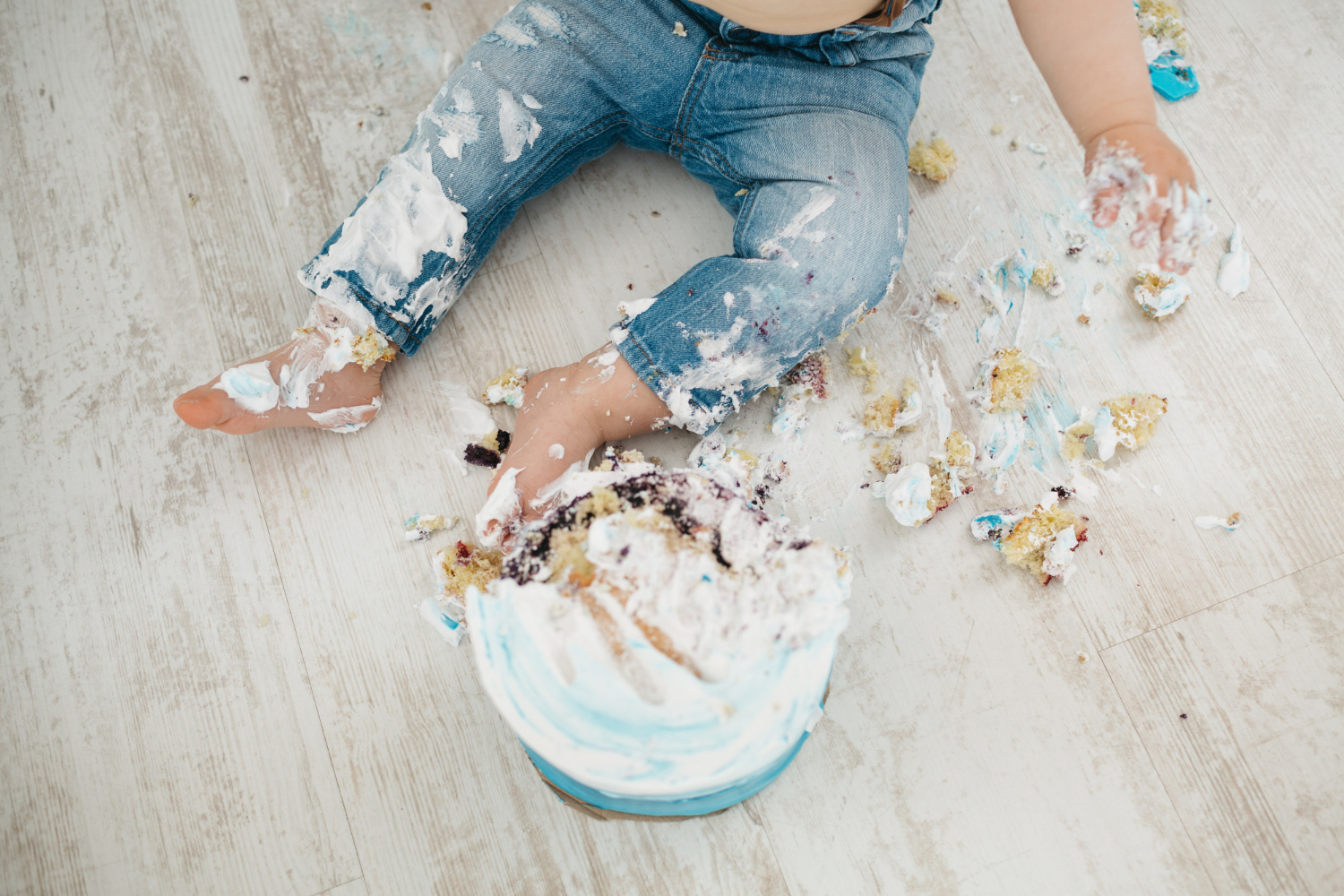
Oliver reached across the table and slammed his hand directly into the center of the cake.
Full palm. No hesitation. Maximum impact.
Frosting exploded outward like a small detonation. The silver “13” topper tilted sideways and slid, and that entire carefully constructed galaxy collapsed under his hand like a crater forming in slow motion, like watching a planet die.
“Boring!” he yelled, voice pitched to carry, performing for an audience he assumed would find this hilarious.
A few guests actually chuckled—nervous laughter, maybe, or genuine amusement at what they perceived as a harmless prank. My father, sitting in the armchair he always claims at family gatherings, let out a short laugh and shook his head with that expression he gets when he thinks something is simultaneously inappropriate and funny, when he wants everyone to know he sees the transgression but doesn’t take it seriously enough to care.
Lena’s mouth went flat. She didn’t cry. She didn’t scream. She didn’t even look up from the ruins of her cake. She just stared at the frosting-covered destruction like she was trying to will time backward, like if she concentrated hard enough she could undo what had just happened and reclaim her moment.
That’s what gutted me more than tears would have. Tears would have meant she still expected comfort, still believed the room would rush toward her with concern and apologies. But Lena has learned over thirteen years of being marginalized in her own family that the safest response to being hurt is to go quiet and small and unremarkable, to disappear into herself where she can’t be hurt again because she’s no longer visible enough to target.
My throat constricted in that way it does when you’re about to say something you can’t unsay, when you’re standing at the edge of a decision that will permanently alter relationships. My hands began to shake.
I set the lighter down on the kitchen counter with deliberate care and looked around the room.
Oliver was standing there with frosting smeared across his shirt and both hands, and nobody had told him to go wash up. Nobody had said his name in that sharp parental voice that signals a boundary being enforced. Nobody had moved toward Lena with any urgency or concern. They were all just watching me, waiting to see if I would swallow this the way I’d swallowed everything else for years—the forgotten stockings, the exclusions from family outings, the casual dismissals of my daughter’s feelings.
They were waiting to see if I would perform my assigned role: the one who smooths things over, who makes excuses, who prioritizes family harmony over my child’s dignity.
“The party’s over,” I said, my voice calm but somehow not my own, like the words were coming from a version of myself I’d buried years ago. “Please leave.”
The room went completely still. You could hear the refrigerator humming in the kitchen, the distant sound of a dog barking down the street, the collective held breath of people who’d expected me to bend.
My brother’s eyebrows shot up like I’d physically struck him. A couple of Lena’s school friends glanced at each other and reached for their jackets with the practiced efficiency of polite children who understand when adult situations have turned unpredictable and uncomfortable.
I walked to the front door and opened it, then stood there holding the knob, waiting.
People began to shuffle, to mumble awkward half-apologies about sugar highs and kids being wild. Someone made a joke about needing to check on their dog. Someone else suddenly remembered an early morning commitment. The adults performed the elaborate choreography of pretending this was normal, that nothing significant had just occurred, that my daughter’s ruined birthday was simply one of those things that happens.
Tasha—my cousin, the only person in my immediate family who has ever called out Oliver’s behavior in front of Adam and survived the social fallout—squeezed my arm gently and started helping the kids locate their shoes and jackets without making a production of it. She understood what I was doing, and she made it efficient, like she was helping evacuate a building that had caught fire.
Oliver was wiping his frosting-covered hands on my tablecloth. Not on one of the napkins I’d carefully stacked. Not on a paper towel. On my tablecloth, leaving blue smears across white fabric.
“Adam,” I said to my brother, my voice still in that strange calm register, “get him to the car.”
My father was shaking his head, that smirk still playing at the corners of his mouth. “Mia, don’t be so dramatic,” he said, like my reaction was the problem, like the destruction of my daughter’s birthday cake was merely an amusing anecdote we’d all laugh about later. “It’s just cake.”
I held the door open wider. I didn’t trust myself to respond without my voice shaking, without the calm facade cracking to reveal the rage underneath.
Chairs scraped against my floor. Coats rustled. The air filled with the particular sound of discomfort being hastily packed up and removed. Lena stood very small in the corner near the bookshelf, her hands hanging at her sides like she didn’t know what to do with them, like someone had stolen the instruction manual for how to exist in her own body.
When the last person stepped onto my porch, when the final murmured goodbye had dissolved into the evening air, I closed the door and engaged the lock.
The house went quiet except for the kitchen clock, its second hand ticking forward with mechanical indifference, counting down toward something I couldn’t yet name.
I stood in the entryway for a long moment, taking deep breaths and trying to convince my nervous system that we weren’t actually in danger, that this was just family, just cake, just another small humiliation in a long series of them.
But I should have known this was coming. I should have recognized the pattern, should have understood that Oliver didn’t destroy that cake spontaneously. He did it because he’s been taught—through laughter, through shrugging, through my father’s smirks and Adam’s dismissals—that Lena’s feelings are optional, that her joy is something that can be sacrificed for someone else’s amusement without consequence.
Tasha helped Lena gather the scattered remains of wrapping paper and ribbon, then hugged her gently before slipping out with her own daughter. She didn’t make it performative or force Lena to respond or accept comfort she wasn’t ready for. She just made sure Lena knew that at least one adult in our family had witnessed what happened and understood it was wrong.
After everyone left, I stood at my kitchen sink staring out the window at my dark backyard, at the porch light casting its dull yellow circle across overgrown grass I kept meaning to mow. Somewhere down the street, a dog barked once and went silent again.
My laptop sat open on the dining table beneath a tangle of purple streamers.
And I already knew what I was going to do.
But before I did anything else, I went upstairs to check on Lena.
She was sitting on her bed with the door half-closed, knees pulled up to her chest, staring at nothing in particular. She wasn’t crying. She wasn’t having a dramatic breakdown. She was just… still. Frozen in that terrible quiet that happens when children learn early not to make trouble, when they’ve been trained to believe that their pain isn’t worth addressing.
I sat on the edge of her bed, the mattress dipping slightly under my weight.
“Hey,” I said softly. “Come here.”
She leaned into me like she was exhausted from holding her body upright, like the effort of existing through that party had depleted every reserve she had.
“I didn’t even get to blow out the candles,” she whispered, and the flatness in her voice—like she was reciting a fact from a textbook rather than expressing pain—broke something in my chest.
“I know,” I said. “I saw what happened.”
“He said it was boring,” she continued in that same affectless tone, like she was trying to make sense of why someone would deliberately destroy something she’d been looking forward to for weeks.
I took a slow breath through my nose, trying to steady myself before responding.
“Your party wasn’t boring,” I said firmly. “Your party was exactly what you wanted. You made a playlist. You chose the cake. You picked the snacks. You invited people you care about. You did nothing wrong.”
She didn’t answer immediately. She stared at the poster above her desk—an illustration of the solar system she’d taped up crooked and refused to straighten because, as she’d explained, “Space isn’t perfect, Mom. Why should the poster be?”
Then she asked the question that shattered me completely.
“Do they not like me?”
That’s what children ask when adults treat them as invisible or disposable. They don’t say, “Is our family system fundamentally dysfunctional?” They don’t analyze power dynamics or emotional manipulation. They simply ask: “Is it me? Am I the problem?”
I brushed my thumb gently across her cheek.
“Some people don’t know how to be gentle,” I said slowly, choosing words carefully. “Some people only know how to pay attention to the loudest person in the room. That’s their failing, not yours.”
She swallowed hard. “I tried,” she said, voice small and defeated. “I tried to make it fun.”
“You don’t have to perform to be loved,” I told her, and I felt the words land inside me too, like I’d been waiting years to say them out loud, like I’d needed to hear them as much as she did. “You don’t have to earn basic kindness by being entertaining enough or quiet enough or anything enough. You’re enough exactly as you are.”
She nodded, a small movement, and I saw something shift slightly in her expression.
“Can we still… have cake?” she asked, and the question made my throat hurt because she still wanted the ritual even after it had been destroyed, still wanted to salvage something from the wreckage.
“We’re absolutely going to have cake,” I promised. “We’re going to light a candle, make a wish, and keep your topper. Nothing that happened tonight takes that away from you.”
She blinked, and for the first time that evening, her eyes looked a little less empty, a little less like she’d disappeared completely into herself for safety.
I went back downstairs and stood in my kitchen, hands braced against the counter, and understood with sudden clarity that this wasn’t just about cake. It wasn’t about frosting or candles or one ruined moment. It was about the pattern I’d been refusing to name for years, the systematic way my family had shown my daughter—over and over again—that she was optional, that her feelings were negotiable, that other people’s comfort would always take precedence over her pain.
For a long time, I’d told myself the slights were accidental, thoughtless rather than malicious. I’d convinced myself that if I just kept showing up, kept paying, kept smoothing over the rough edges, they would eventually see Lena the way I did—as gentle and funny and careful, as someone whose love was precious because she chose to give it rather than scattering it indiscriminately.
But the truth I’d been avoiding was simpler and more devastating: my family had always had a gravitational center, and it wasn’t my child. It was Adam. It was his needs, his moods, his son’s noise and chaos. And I’d been orbiting them for so long I’d forgotten I could stop, could step out of that orbit and build something different.
When I’d started making decent money in my recruiting career, I’d gradually taken over the invisible jobs nobody else wanted—the forms, the accounts, the phone calls to utility companies and insurance providers. I became the person who “handled things” because I was good at it, because it made other people’s lives easier, because being useful felt like love.
I’d set up my parents’ electric and internet on autopay from my account when my father had his hours cut one winter. One hundred twenty dollars for electric, sixty-five for internet, every single month. I’d told myself it was temporary, just until they got back on their feet.
That was four years ago. The arrangement had never changed. If you asked my mother about it, she’d say I’d insisted, that I’d wanted to help. If you asked my father, he’d say we were family, we did for each other. And if you asked Adam, he’d shrug and say I was good with that kind of stuff, like managing other people’s bills was a hobby I enjoyed rather than a burden I’d accepted.
When Oliver was born, I’d set up a 529 college savings account for him as a surprise. One hundred dollars a month at first, then two hundred, then two hundred fifty once I got my promotion. I was the account owner. Oliver was the beneficiary. I’d added Adam’s email as an interested party so he’d receive statements and could watch the balance grow.
I’d told myself I was breaking a cycle, that I was ensuring my nephew would have opportunities I hadn’t had when I’d scraped together community college tuition through scholarships and night shifts and student loans I was still paying off.
The money had never bothered me as much as the way it was assumed. Like how the week my annual bonus hit my account, my mother had sent a group text: “Family beach week! Mia found us a deal!” That deal had been a rental property I’d put a twenty-four-hundred-dollar deposit on using my credit card, a vacation I’d essentially funded for everyone.
We’d arrived at the beach house and the room I’d specifically requested for Lena had somehow been reassigned to “the cousins’ room,” which meant three kids and my kid sharing a blowup mattress in the living room because she was the smallest, the most adaptable, the one who wouldn’t complain.
I could still see Lena dragging her suitcase into that living room, pausing when she realized the couch would be her bed, and then asking quietly, “Do you want me to put my stuff in the corner so it’s not in the way?”
I’d walked on the beach alone that night and screamed into the wind until the urge to cry had passed, then I’d come back and made her the neatest little nest on that deflating air mattress, like if I tucked her in perfectly enough I could compensate for everyone else’s casual cruelty.
There had been so many moments like that. Last Christmas, my parents had hung stockings for every grandchild except Lena. “Oops, we didn’t know which name to put,” my mother had said, laughing. Lena had written her name in glitter on three different Christmas crafts that week, had labeled her gift tags clearly, had provided every possible spelling cue. They’d simply chosen not to notice.
When I’d bought a family pass to the county fair so all the cousins could go together, I’d handed the laminated cards to my father and assumed we were included. My phone had later filled with photos of cotton candy and carnival rides. Lena wasn’t in any of them. “You were at your mom’s work thing,” Adam had texted when I asked. I hadn’t been at any work event. I’d been at home, waiting for a phone call that never came.
They’d assumed my kid was shy, that she wasn’t a joiner. What they really meant was that she didn’t automatically agree with whatever Oliver wanted to do, didn’t orbit his chaos with appropriate enthusiasm, didn’t subordinate her preferences to his demands.
Last spring, I’d paid Adam’s car insurance for three months while he “looked for a new job”—a hundred and ten dollars monthly that I’d never seen repaid. I’d Venmoed him on Fridays for Oliver’s basketball camp because “it would mean the world, auntie”—seventy-five dollars weekly that I’d absorbed into my budget without complaint. I’d bought my parents a new sofa when their old one collapsed because I was tired of hearing my father complain about his back.
They’d been appropriately grateful in those moments, had thanked me effusively. But that gratitude hadn’t translated into making space for Lena at family gatherings, hadn’t meant remembering her name on stockings or including her in group photos or noticing when she was excluded.
The small slights had accumulated like unpaid invoices. The jokes about how Lena “isn’t really a Taylor” because she carried her father’s last name. The cousins’ group chat that excluded her because she didn’t have Snapchat yet. The time she’d made an elaborate drawing of our entire family at Thanksgiving—every person carefully rendered, “Nana” written clearly at the top—and I’d found it in my mother’s recycling bin the next day beneath a pie tin.
“I didn’t know it was hers,” my mother had said when I’d asked. It had Lena’s signature style, had included details only she would notice, had been labeled with my mother’s name.
I’d kept telling myself they didn’t mean harm, that I was being oversensitive, that if I just kept showing up and paying and smoothing over difficulties, they would eventually see my child the way I did—as valuable, as worthy of care and attention and basic consideration.
Two months ago, I’d finally told Adam no. He’d asked me to add him as an authorized user on my credit card “just for gas” and I’d said I wasn’t comfortable with that. His response had been three paragraphs about how family helps family, how I was being selfish and controlling. He hadn’t said please. He’d ended the message with: “You act like a bank manager, not a sister.”
The last few family events had carried a particular edge, a subtle punishment for my refusal. Lena’s birthday had been the first time I’d watched that punishment land directly on her, publicly, with everyone bearing witness.
It wasn’t about cake. It was about the moment I understood with devastating clarity that my child could do everything right—be kind, be thoughtful, be perfectly behaved—and they would still treat her as expendable, as less important than Oliver’s whims, as someone whose feelings could be sacrificed for someone else’s entertainment.
After I’d sent everyone home and the house had gone quiet, I wanted to scream. Instead, I got two trash bags and gently lifted what remained of the cake, placing it carefully in one bag while setting the silver “13” topper on a paper towel to clean later.
Lena stood beside me with her wrists tucked into her sleeves like she used to do in kindergarten when she wanted to make herself smaller, when she wanted to disappear.
I rinsed a plate, dried it, and carefully cut a slice from the side of the cake that had survived Oliver’s assault. I placed a single candle in the middle of that slice and lit it.
“Make a wish,” I said, and my voice was steady again, calmer than I’d been all evening.
She closed her eyes, took a small breath, and blew. The candle went out, the thin trail of smoke rising and dissipating.
That was the moment it clicked completely into place, when I understood exactly what I needed to do.
I walked to the dining table, moved the purple streamers aside, and opened my laptop. The screen woke up to the 529 account page because I checked it every first of the month to confirm the automatic transfer had processed correctly.
College Advantage. Account Owner: Mia Taylor. Beneficiary: Oliver James Taylor. Recurring Contribution: $250. Next scheduled transfer: the 15th.
Tasha had stayed, quietly loading cups into the dishwasher, being present without demanding my attention or explanation.
“You okay?” she asked softly. She’s the only person in my immediate family who has consistently called out Oliver’s behavior in front of Adam and lived to tell about it.
“I’m done paying for this,” I said, and I wasn’t talking about just the cake, just this evening. I was talking about the entire performance, the whole exhausting show. “I’m done funding a family that treats my daughter like she’s optional.”
I clicked “Manage Contributions.” The page loaded slowly, like the website understood this was significant and wanted to stretch the moment.
Edit Recurring Contribution. My bank information appeared on the screen: Huntington checking account ending in 0431. Amount: $250. Frequency: Monthly.
I clicked “Cancel Recurring Contribution.”
A popup asked: “Are you sure you want to cancel the recurring contribution for Oliver James Taylor?”
I read it twice, making sure I understood exactly what I was doing, what I was choosing. Then I clicked “Yes.”
Another screen loaded: “Your recurring contribution has been cancelled. Confirmation number CA-7294-557.”
Because I’d added Adam as an interested party years ago—thinking it would make him feel included, thinking it was generous to keep him informed—he received transaction alerts. It was a checkbox I’d ticked when Oliver was a baby because I’d thought transparency was kindness.
Within sixty seconds, my phone buzzed. Email subject line: College Advantage Contribution Schedule Update. To: me. CC: Adam.
“This is to confirm the cancellation of your scheduled contribution for beneficiary Oliver James Taylor.”
I set the laptop down carefully. I didn’t draft a speech. I didn’t compose a paragraph for the family group chat explaining my reasoning. I didn’t prepare a defense.
I just stopped a stream of money that had been flowing from my account into theirs since before Oliver could sit up unassisted, since before he had teeth, since before I’d understood that my generosity would never translate into kindness toward my own child.
Tasha watched me from the kitchen, then nodded once—a small, deliberate movement that felt like she’d been waiting years for me to finally choose my daughter over the performance of family harmony.
She dampened a paper towel and gently wiped a smear of blue frosting from Lena’s cheek.
“We’ve still got cake,” she said quietly, and cut two more slices from the surviving portion.
My phone lit up on the table with an incoming call from Adam. I declined it.
It rang again immediately. I declined that one too. Then my father’s name appeared. Then my mother’s. I put the phone face-down on the table and silenced it completely.
I took Lena to the couch and we ate slightly smooshed cake together with forks, sitting close enough that our shoulders touched. She leaned her head against my arm.
“Did I do something wrong?” she asked, voice so small I almost missed the words.
“No, baby,” I said firmly. “You didn’t do anything wrong. Not one single thing.”
She nodded and kept eating, and after a few bites, she said, “Can we save the topper?”
I rinsed it carefully, dried it with a clean towel, and placed it on the bookshelf right beside her collection of paperbacks about girls who solved mysteries and built things and didn’t need anyone’s permission to be extraordinary.
Later that night, after Lena had finally fallen asleep and the house had settled into that particular quiet hum of dishwashers and settling foundations, I checked my banking app. The 529 transfer usually created a noticeable gap on the fifteenth of each month, a small crater in my checking account balance.
For the first time in thirteen years, there would be no crater. The money would simply remain in my account until I decided where it actually belonged.
I didn’t sleep much that night, but not because I was anxious about their reactions or second-guessing my decision. I felt strangely clear, like I’d finally done the adult thing I’d been avoiding for over a decade. I’d drawn a line in permanent marker at the exact place where my daughter’s wellbeing began, and I’d done it without apology or explanation.
At two-fourteen in the morning, Lena’s father texted me: “Happy birthday to our girl. How’d the party go?”
My first instinct was to lie, to keep everything tidy and manageable, to protect the narrative that everything was fine. But I was too tired for performance, too depleted from years of pretending.
“It didn’t go great,” I typed honestly. “I’ll explain tomorrow.”
He responded simply: “Okay. Love you both.”
I stared at those words longer than I should have, because “love you both” from two states away felt like a postcard—pretty, decorative, ultimately insufficient to keep anyone warm.
Before I finally fell asleep, I opened my budgeting app and looked at that two hundred fifty dollars like it was a muscle I’d forgotten existed. I could restart the contribution anytime. I could pretend nothing had happened. I could return to being the quiet financial sponsor of a family that treated my daughter like furniture—present when convenient, easily overlooked when something shinier demanded attention.
Instead, I created a new line item in my budget spreadsheet: “Lena—Future Fund.”
I didn’t even label it “college” specifically. Lena might want college. She might want art school or architecture school or something neither of us could imagine yet. I just knew with absolute certainty that I was finished building someone else’s foundation with bricks that belonged to my child.
By morning, my phone displayed a wall of notifications. Five missed calls from Adam, two from my mother, one from my father. The family group chat showed forty-seven unread messages.
I made coffee before I looked at any of them.
Adam’s texts formed a cascade of escalating panic and anger: “What did you do?” “Are you insane?” “You’re punishing a child.” “You owe me a call.” “Fix this.”
Then a screenshot of the College Advantage cancellation email with “WHAT???” in all capitals.
Then: “You’re letting Lena control you. She needs to toughen up.”
I typed three different responses and deleted each one before it was complete. Then I remembered Tasha’s voice: “Don’t explain your boundary. Just state it.”
I called Adam. He answered on the first ring.
“What is wrong with you?” he said, skipping greetings entirely, launching straight into accusation.
“I cancelled my contribution to Oliver’s 529,” I said calmly. “I’m not funding his college anymore.”
“So you’re going to ruin his future because of a cake?” He said “cake” like it was the most absurd thing he’d ever heard.
“This isn’t about cake,” I replied. “It’s about how you all treat my child. I won’t fund a family system where Lena doesn’t matter.”
He made an exasperated sound. “This is vindictive. You know I can’t afford to replace that money.”
“I’m not your backup bank,” I said simply.
“You signed up for this,” he snapped. “You’ve been doing it for thirteen years. You can’t just stop.”
“And I changed my mind,” I said. “The money is mine. The decision is mine. I’m allowed to redirect my resources toward my own daughter.”
He started to escalate, his voice getting louder in that particular way he does when he’s performing for an audience I couldn’t see—probably my father standing nearby, coaching him through the confrontation.
“I’m hanging up now,” I said clearly, and disconnected before he could continue.
I sat holding my phone, and in the silence that followed, I realized something fundamental: Adam didn’t sound worried about Oliver’s education. He sounded worried about losing access to me, about losing the narrative where I was the reliable sister who always said yes, who always absorbed whatever chaos or expense they generated.
My mother showed up around noon carrying a grocery store sheet cake and wearing a shaky, hopeful smile like this was a sitcom and we were headed toward a tidy resolution.
“We can do a little redo,” she announced from my porch, holding the cake like a peace offering. “No harm done. Your father didn’t mean to laugh—it was just nerves.”
I opened the door only as far as the security chain would allow. I hate that I have a chain lock on my door. It feels simultaneously melodramatic and necessary.
“Mom, we’re not doing a redo,” I said quietly.
She blinked, recalibrating. “Mia, don’t be like this. Oliver is just a kid. He’s spirited.”
“Don’t call me dramatic for protecting my daughter. And don’t call him spirited. Those words don’t work in my house anymore.”
She shifted the cake to her hip. “We didn’t forget Lena’s stocking on purpose last Christmas. You always bring up old things that we’ve apologized for.”
“It’s all the same thing,” I said. “And I’m done paying for any of it.”
The chain stayed engaged. She huffed, looked down the street like maybe an audience would materialize to validate her position, then left the grocery store cake sitting on my doorstep.
I didn’t bring it inside. Later, I watched through the window as a squirrel discovered it and started nibbling through the plastic dome, and I had a strange, mean little thought about how appropriate that felt.
My father sent me one long text message about family unity and respecting elders and not punishing grandchildren for adult disagreements. I read it carefully twice and didn’t respond.
Apparently he called Tasha to complain about my behavior. She texted me immediately: “He tried to recruit me to his side. I told him I was there, I saw what happened, and I’m proud of you.”
I cried at that—not dramatic sobbing, just three quiet tears that slipped out while I sat at my kitchen table with my coffee going cold in its mug.
That afternoon, Tasha came over after work. She didn’t bring advice or lectures. She brought trash bags, paper towels, and a pack of fruit gummies for Lena—a small peace offering for a teenager who’d had her joy stolen.
We sat at my kitchen table while Lena did homework at the counter, quiet but present, absorbing the conversation without directly participating.
“You know what’s wild?” Tasha said, keeping her voice low. “They’re going to act like you did this to them.”
I laughed without any humor. “I know.”
Tasha’s eyes stayed steady on mine. “You can’t fix people who benefit from you being small. They’ve built their entire system around you absorbing chaos and funding their choices. The only way they change is if you stop participating.”
I looked at Lena’s back as she worked through math problems, her shoulders hunched in that particular way they get when she’s concentrating. She was drawing tiny planets in the corner of her worksheet because she apparently couldn’t help decorating even her homework.
“I’m scared,” I admitted quietly. “Not of them exactly. Of the silence that comes after. Of being… out.”
Tasha nodded. “Of course you are. You’ve been paying admission to the family circus for years. They trained you to believe love was something you purchased with money and service and endless patience.”
She reached across the table and squeezed my hand. “But you’re not buying love anymore. You’re building something different. Something real.”
Lena’s friend group texted her that evening asking if she was okay, if they could do anything. Two of them came by the next day with bubble tea and a hand-drawn card. Inside, someone had written: “We love your boring.”
Lena laughed at that—the soft, surprised kind of laugh that makes her shoulders relax and her face open up.
I immediately took the card and put it in a small frame I had in a drawer, then set it on the bookshelf next to the silver “13” topper, because Lena’s things never got displayed at anyone else’s house and I wanted her to know that in this house, her art mattered.
The following week, Adam tried a new approach. “We can pay you back,” he said when he called, his voice suddenly reasonable and conciliatory. “Just restart the contributions and we’ll cover the difference until we’re caught up.”
“I’m not taking IOUs,” I said. “And I’m not restarting it. You still owe me for three months of car insurance and two months of Dad’s electric bill.”
“So what—you’re just done with us?” he asked, and I could hear genuine confusion beneath the anger, like he genuinely couldn’t understand why I wouldn’t continue subsidizing them indefinitely.
“I’m done funding you,” I clarified. “If you want to visit Lena and you can be kind to her, the door is open. Those are the only terms.”
My mother tried last, calling me with her voice already wavering. “We love Lena. You know we do.”
“Then treat her like it,” I said simply. “Hang up her drawings. Spell her name correctly. Make space for her at events. Stop asking me for money. Those are the basics.”
“Your father is very hurt by all this,” she said, like his feelings were my responsibility to manage.
“I know,” I said. “And I’m tired, Mom. I’m so tired of protecting everyone’s feelings except my daughter’s.”
After that conversation, the family group chat went noticeably quieter. Photos still appeared occasionally—cousins at the trampoline park, a bowling night, a Sunday barbecue—and we weren’t invited to any of them. That old ache rose up in me, that longing to be included, to see Lena in those group photos, to be part of the narrative.
But I didn’t give in to it. I didn’t send money hoping to buy our way back in. I didn’t craft passive-aggressive comments in the group chat. I just held the boundary and kept my mouth shut.
A week later, my phone buzzed with a text from Oliver. Just two words: “Sorry about the cake.”
No punctuation. No elaboration.
I stared at it for a long time. He’s twelve years old. He’s a child. His father is the adult who should have taught him better.
I typed back: “Thanks for saying that.”
Then I set my phone down and didn’t engage further. I didn’t know if Adam had forced him to send it. I didn’t know if Oliver felt genuine remorse. I didn’t know if the apology was authentic.
But I knew something else: if I wanted Lena to grow up believing people could repair harm, I had to allow repair to exist when it appeared—without letting it automatically erase the boundary I’d established.
The following Saturday, we hosted what Tasha called a “do-over party” with the people who actually showed up for Lena consistently. Three girls from her school. Tasha and her daughter. My neighbor Dana, who always brought real fruit instead of fruit-shaped gummies and who’d never once asked me for money.
We spread a fresh tablecloth on the dining table, and Lena spent the afternoon decorating store-bought cupcakes with little fondant planets she sculpted herself. She made Saturn with a ring so delicate and precisely rendered I couldn’t understand how her thirteen-year-old fingers had managed it.
She carefully positioned the silver “13” topper on the center cupcake like a crown.
We sang “Happy Birthday” again. This time, nobody interrupted. Nobody smashed anything. Nobody performed cruelty for laughs.
Lena blew out the candles and actually smiled—not the careful, protective smile she uses when she’s trying not to care too much, but a real smile that reached her eyes.
After cake, her friends asked if they could see her “space wall”—that’s what they called the corner of her bedroom where she’d taped up prints of nebulas and distant galaxies and a magazine photo of the James Webb telescope that she’d saved because “it looks like a gold spider from the future.”
They lay on her bedroom floor pointing at the glow-in-the-dark stars I’d stuck to her ceiling when she was nine, and one of the girls whispered, “This is so cool,” with genuine awe.
Lena’s face softened in a way I hadn’t seen in months, maybe years.
I didn’t deliberately leave chairs empty, but there were empty chairs at that party. The absences sat there in the corner like ghosts we’d all agreed not to name.
Nobody mentioned it. The girls played card games and shrieked with laughter. Tasha told me a story about her boss catastrophically mispronouncing “quinoa” in a client meeting. Dana helped me wash cups and load the dishwasher.
I breathed easier than I had in over a year.
After everyone left, Lena taped the hand-drawn “We love your boring” card onto the refrigerator. Then she added her own drawing beside it: a simple sketch of a little house with purple streamers visible through the windows, three stick figures sitting on a couch with tiny forks in their hands and cake slices on their laps.
She’d written “HOME” in careful bubble letters at the top.
It might have been the simplest, least technically accomplished drawing she’d ever made. But I felt something unclench in my chest that had been tight and knotted since the day she was born—this constant low-grade panic that I wasn’t doing enough, wasn’t protecting her enough, wasn’t giving her the family she deserved.
That drawing told me she finally felt safe in her own house, in her own life, with the people who’d chosen to stay.
My parents didn’t call that weekend. The group chat stayed silent. The first of the month came and went, and my banking app didn’t show that familiar two-hundred-fifty-dollar withdrawal. The money just stayed there, stable and whole.
It was such a small thing on a screen—just numbers that didn’t decrease—but I felt the difference physically. Not like victory, not like triumph over enemies. Just like peace, like the exhausted relief of finally setting down weight you’d been carrying so long you’d forgotten it wasn’t part of your body.
I put the silver “13” topper back on the bookshelf next to the paperback Lena was currently reading. When she finished her homework on Sunday evening, we walked to the neighborhood park together, just the two of us, and sat on the swings without talking for a long time. The sky was exactly the shade of blue that cake had been before Oliver destroyed it.
Lena kicked her feet gently, setting her swing in motion, then asked quietly: “Are we in trouble?”
“We’re not in trouble,” I said firmly.
“What if Grandma and Grandpa don’t come over anymore?” The question was small, tentative, like she was testing whether she was allowed to care.
I could have lied. I could have promised things I couldn’t control, could have assured her that everything would magically resolve itself with enough time and patience.
Instead, I told her the truth as gently as I could: “People who really love you show up kindly. If they can’t manage kindness, then we don’t chase them. We just keep building our life with the people who can.”
She stared at the ground beneath her swing like she was thinking hard, processing the implications.
Then she nodded once, decisive. “Okay,” she said, like she was adding this new information to an internal blueprint she was constantly revising.
I can’t fix my family. I can’t make them see what they’re determined not to see, can’t force them to value my daughter the way she deserves to be valued.
But I can stop funding my own child’s erasure. I can make our house the place where she’s never optional, where her name is spelled correctly on stockings, where her cake gets eaten instead of smashed, where her drawings go in frames instead of recycling bins.
When the next family holiday arrived, I sent exactly one text to the group chat: “We’re hosting pie and board games at 3 PM if you’d like to join. If you can be kind to Lena, the door is open.”
Nobody from my immediate family came. Tasha came. Dana came. Two of Lena’s friends and their parents came.
We had more than enough pie.
At the end of that evening, Lena carefully slid her “HOME” drawing into a clear plastic sleeve and placed it in the front of the three-ring binder she uses for school.
Later, she told me she wanted to be an architect. She didn’t say it like a plea or a question. She said it like a plan, like something she’d already started building in her mind.
I kept the receipt from the store-bought cupcakes—frosting, decorating supplies, that package of fondant Lena used to sculpt her planets—tucked in the kitchen drawer where I store birthday supplies and old cards. It sat on top of a pile of invitations to family events I wouldn’t be attending anymore.
I closed that drawer and turned off the kitchen light, and the house settled into its evening rhythm—that particular hum of dishwasher and settling foundation and distant traffic that means home.
On the fifteenth of the month—the date that used to create that predictable crater in my checking account—I watched my bank balance stay intact. No automated withdrawal. No silent payment purchasing my place at someone else’s table.
I opened my budgeting app and moved two hundred fifty dollars into the account I’d labeled “Lena—Future Fund,” doing it without overthinking, without turning it into performance or sacrifice.
I didn’t announce it. I didn’t tell my parents or update the family chat. I just did what I should have been doing all along: I redirected my resources toward the child who actually lives in my house, whose emotional wellbeing is my responsibility to protect, whose name I will never forget or misspell or leave off a stocking.
Upstairs, Lena had fallen asleep with her sketchbook open beside her pillow, a half-finished drawing of a house under a sky full of stars visible on the page. I adjusted her blanket, paused in her doorway, and allowed myself to feel the quiet as something earned rather than something to fill with anxiety.
The boundary held. The money stayed where it belonged. My daughter slept safely in a house where she mattered most.
That was enough. That was everything.

Adrian Hawthorne is a celebrated author and dedicated archivist who finds inspiration in the hidden stories of the past. Educated at Oxford, he now works at the National Archives, where preserving history fuels his evocative writing. Balancing archival precision with creative storytelling, Adrian founded the Hawthorne Institute of Literary Arts to mentor emerging writers and honor the timeless art of narrative.