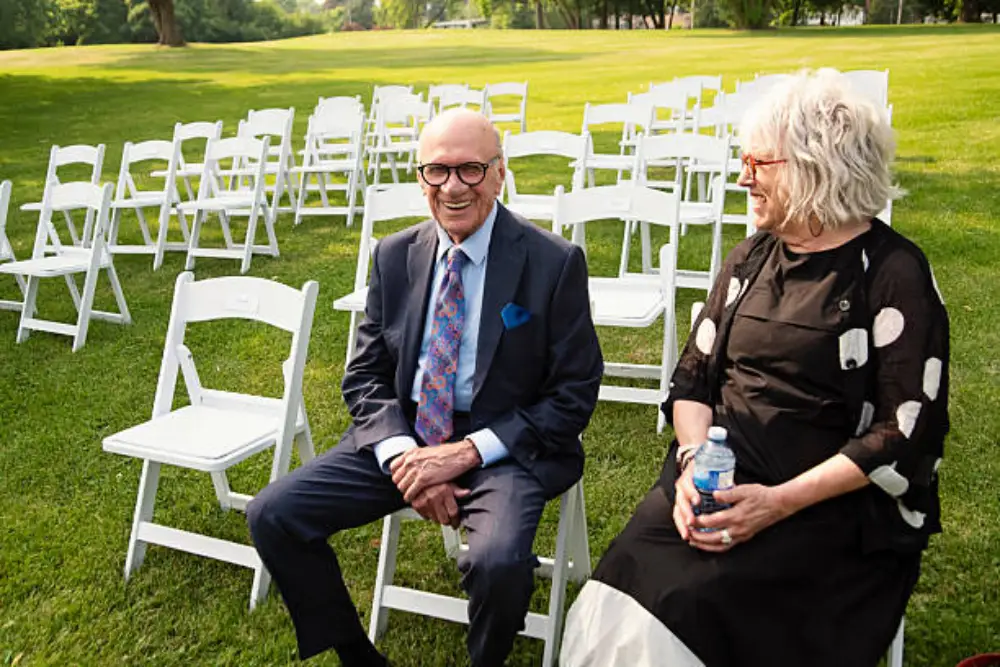
I raised my son to believe that dignity wasn’t something you wore—it was something you carried, quiet and unshakable, through every room you entered. I taught him that respect costs nothing but means everything, that kindness isn’t weakness, and that the people who love you shouldn’t have to earn visibility in your life.
That belief lasted right up until the morning of my only child’s wedding, when a young coordinator with a wireless headset and trembling hands walked me past the front rows like I was a delivery someone had ordered but didn’t particularly want to acknowledge, and pointed to a chair so far back I could smell the parking lot heat rising off the gravel beyond the tent.
She didn’t meet my eyes when she whispered, her voice apologetic but firm, “Mrs. Hargrove asked that you sit here.”
Mrs. Hargrove. That was Darlene Hargrove, my future daughter-in-law’s mother. The woman who said the word “class” the way some people say “clean”—like it was something you either possessed inherently, or you simply didn’t, and no amount of effort could bridge that gap.
I looked down at the chair she indicated with one manicured finger. It wasn’t even part of the main seating arrangement. It was a spare folding chair, positioned behind a towering arrangement of white hydrangeas and the second photographer’s tripod. If I leaned forward and craned my neck, I could just barely see the aisle where my son would stand. If I sat back naturally, all I would see were flower stems, equipment cases, and the shoulders of strangers who belonged here more than I apparently did.
The coordinator’s smile was strained, practiced, the kind of expression people use when they want you to accept humiliation without making them feel guilty for delivering it. She held a clipboard against her chest like a shield, and I could see her mentally calculating how quickly she could escape this conversation.
I swallowed once, my throat tight. Then I said, softly but clearly, “I’m the groom’s mother.”
She nodded quickly, her eyes darting away, as if my maternal status was unfortunate but ultimately irrelevant to the seating arrangements that had been determined by people more important than either of us.
“I know,” she murmured, shifting her weight from foot to foot. “But Mrs. Hargrove insisted the front rows are reserved for specific guests. She was very clear about the arrangements.”
Reserved for whom, exactly? Darlene’s accountant? Her tennis partner from the country club? The carefully curated couples who knew which fork belonged to which course and could discuss wine regions without needing to check their phones?
I almost laughed at the absurdity of it, but the sound stuck in my chest somewhere between bitterness and disbelief. Instead, I sat down carefully, smoothing the skirt of my dress so it wouldn’t wrinkle in the oppressive July humidity that hung over Savannah like a wet blanket.
It was a navy dress, simple and modest, with three-quarter sleeves and a hemline that fell just below my knees. Not new. Not designer. Certainly not the kind of dress that would photograph well in the society pages. But it was clean, carefully pressed that morning with steam and patience, and it was the nicest thing I owned. I’d bought it last year on clearance at a department store after saving up for three months, because I told myself I wanted to look “proper” at Evan’s wedding, wanted to be someone he could be proud to call his mother.
Evan. My son. My whole life, really, if I was being honest with myself. The boy I’d carried through fevers and scraped knees and growth spurts that seemed to happen overnight. The young man I’d worked double shifts for when he wanted to join the debate team and needed travel money. The adult I’d defended when he made mistakes I didn’t fully understand but loved him through anyway, because that’s what mothers do—we love past the disappointments, past the confusion, past the moments when our children become strangers.
I had pictured this day in my mind for years—maybe not as elaborate as this, not with the historic venue and the string quartet and the champagne fountain, but warm and meaningful nonetheless. I’d imagined myself in the front row, close enough to see my son’s face when his bride appeared. I’d imagined a proud smile exchanged between us, a small squeeze of the hand before the vows began, a look that said across the space between us: I see you. I know what you gave up to get here. I’m grateful.
Instead, I had this folding chair behind the hydrangeas and a message that couldn’t have been clearer if someone had written it in the wedding program: Sit down. Stay quiet. Don’t ruin the picture we’re trying to create.
Three days earlier, I’d seen the seating chart myself, laid out like evidence of a crime I hadn’t yet realized I was the victim of.
We’d been at Darlene’s house for what she called a “final coordination meeting”—the kind of house where every surface gleams with fresh polish, where the air smells perpetually like lemon cleaner and old money, where even the kitchen looks like it’s never seen actual cooking, just catered arrangements and expensive takeout containers. She had spread the seating chart across her massive marble kitchen island like she was presenting a legal document that required everyone’s signature and approval.
My future daughter-in-law Blaire stood beside her mother in a fitted ivory outfit that looked like it had been pulled straight from the pages of a bridal magazine—the kind of casual elegance that actually costs a fortune to achieve. Blaire was beautiful in a way that made rooms fall quiet when she entered, all sharp cheekbones and careful highlights and a smile that photographers loved. She also had a particular way of looking at people that made it clear whether they met her standards or fell short, and I’d learned quickly which category I occupied in her assessment.
Blaire tapped the seating chart with one perfectly manicured fingernail—pale pink, flawless—and said, almost casually, as if she were commenting on the weather, “We’ve kept you toward the back, Marianne. It’ll be less distracting that way.”
Distracting. The word landed in my chest like a stone dropped into still water, sending ripples of understanding through everything I’d been trying not to see for months.
I’d blinked, trying to process what I was hearing. “Less distracting to whom?”
Blaire’s eyes had flickered over me then, a quick assessment that took in my department store shoes, my practical purse, my hair that I styled myself because salon visits were a luxury I’d long ago accepted I couldn’t afford regularly. She didn’t have to say what she meant. The meaning was written all over her face, in the slight tightening around her mouth, the way she glanced at her mother for silent confirmation.
She meant: the guests. The photographs. The carefully constructed aesthetic of wealth and refinement that my presence, my ordinariness, my working-class realness might somehow compromise.
“It’s just better this way,” Blaire had continued, her voice taking on that patient tone people use when explaining something to a child. “You understand, don’t you?”
I’d looked at Evan then, standing slightly behind Blaire with his hands in his pockets, expecting him to do what he’d done his entire life when someone treated me unfairly or unkindly. I expected him to step forward, to say something, to defend me the way I’d defended him countless times when the world felt too harsh or expectations felt too heavy.
He stood there in expensive clothes I’d never seen before, tailored and pressed, looking like he belonged in this marble kitchen with these people who measured worth in thread counts and property values. He was quiet. Deliberately, pointedly quiet. His eyes wouldn’t meet mine, fixing instead on something over my shoulder, avoiding the moment with the practiced skill of someone who’d already made his choice.
“Evan?” I’d asked softly, my voice barely above a whisper, giving him one more chance to be the son I’d raised.
He cleared his throat, a small sound that somehow contained years of decisions I was only beginning to understand.
“Mom,” he said, his voice low and tight, “please don’t turn this into a thing. It’s just seating. It doesn’t mean anything.”
A thing. That’s what my dignity had become in his vocabulary. A potential inconvenience on his big day. An embarrassment to be managed rather than a mother to be honored.
I’d nodded then because I didn’t know what else to do, didn’t have the vocabulary yet for the betrayal that was washing over me in cold waves. I’d smiled like I was fine, like this was all perfectly reasonable, like mothers got relegated to back rows at their sons’ weddings all the time and it was just part of growing up, part of letting go. I’d driven home afterward with my hands gripping the steering wheel so tightly my knuckles went white, my chest aching in a way that felt embarrassingly adolescent, like I was a teenager who’d just learned that the world was crueler than she’d been taught to expect.
And now, on this sweltering wedding morning, the humiliation had a physical location. It had a folding chair and a view of flower stems and the knowledge that somewhere in the front rows, there were empty seats reserved for people more important than the woman who’d given birth to the groom.
The venue was gorgeous, I had to admit that much. It was a historic estate on the outskirts of Savannah, the kind of place that appeared in Southern Living magazine and charged prices that made most people’s annual salaries look modest. Ancient oak trees lined a long gravel path, their branches heavy with Spanish moss that hung like delicate lace against the summer sky. White wooden chairs stretched in perfect rows across the manicured lawn. White flowers—roses, hydrangeas, lilies—filled every available surface in arrangements that probably cost more than my monthly rent. A string quartet was warming up under an elegant white tent, their instruments gleaming in the afternoon light.
Guests began arriving in ones and twos, then small groups, gliding across the grass in their expensive shoes, holding champagne flutes that caught the sunlight. They wore pale linens and pastel dresses and jewelry that whispered wealth rather than shouting it. They laughed softly, greeted each other with air kisses and light touches, moved through the space like they owned it—or at least like they belonged to the same tribe of people who could own places like this.
I watched them from my position in the back row, these strangers who would witness my son’s wedding from better seats than his own mother. Some of them glanced in my direction and looked away quickly, uncomfortable with whatever they saw. A few stared a second too long, like they were trying to place me in the narrative of this elegant event, trying to figure out who I was and why I was sitting alone so far from everything that mattered.
“Who’s that woman in the back?” one guest whispered to another as they passed, not quite quietly enough.
“I think that’s his mother?” her companion replied, the statement rising into a question, confusion and pity blending together in her tone. “I heard she’s… well, you know. Not quite their circle.”
I kept my face carefully neutral, a skill I’d perfected over decades of working service jobs where showing your real feelings could cost you your paycheck. I kept my chin up and my hands folded in my lap and my spine straight despite wanting to curl into myself and disappear.
I told myself the same things I’d told myself through every hard moment of the past sixty-nine years: Don’t cry. Don’t beg. Don’t make a scene. Just get through it. Survive this, and you can fall apart later in private where it won’t embarrass anyone.
I’d buried my husband Frank three years earlier after watching him fade slowly in a hospital bed, machines doing the breathing he couldn’t manage anymore, monitors tracking the steady decline of a good man who’d worked his whole life and died with modest savings and a mortgage nearly paid off. I’d stood by his bedside and held his hand and told him it was okay to let go, even though nothing about it was okay. I’d walked out of the funeral home alone, carrying a folder of paperwork and a heart that felt hollow and exhausted.
If I could survive Frank’s death, I could survive one wedding. I could survive being invisible in my own son’s life for one afternoon.
The music began—soft strings playing something classical and slightly too perfect, the kind of music that’s meant to signal that important things are happening, that this moment matters and everyone should pay attention.
The officiant took his place at the altar, a distinguished-looking man in expensive robes. The groomsmen filed in, looking uncomfortable in their matching tuxedos. Then Evan appeared, stepping up to the front in a tailored suit that must have cost thousands of dollars, his posture confident, his hair perfectly styled, his face wearing the expression of a man who’d achieved something significant.
For just a moment, despite everything, my chest tightened with an involuntary swell of pride, because mothers are stubborn like that. We love even when love costs us everything. We feel proud even when pride makes us foolish.
Then Evan turned slightly and looked out over the assembled guests, his gaze sweeping across the front rows filled with Hargrove relatives and country club friends and business associates. His eyes moved over the faces, registering the people who mattered, the witnesses whose presence validated this moment.
His gaze slid past me like I was part of the landscape, like I was another flower arrangement or decorative element, visible but not actually seen.
I felt something drop in my stomach, a physical sensation of falling that had nothing to do with movement and everything to do with recognition. This wasn’t an oversight. This wasn’t a mistake in the seating arrangements. This was a choice my son had made about where I belonged in his new life.
Then—quietly, without fanfare or announcement—the empty folding chair beside me was suddenly occupied.
A man sat down with the kind of natural confidence that suggested he had every right to be there, that questioned nothing about his presence in this space. Not loud. Not flashy. Not drawing attention to himself. Just present in a way that somehow changed the air pressure around us.
I noticed him first by the way other people reacted. Heads turned. The whispering shifted in tone and volume. People sat a little straighter in their chairs, suddenly more aware of their posture and positioning.
He wore a charcoal gray suit that fit like it had been constructed specifically for his frame, with clean lines and expensive fabric that managed to look both formal and effortless. No flashy accessories. No attention-seeking watch or tie clip. Just understated elegance that spoke of real wealth rather than the kind that needs constant announcement. His hair was silver at the temples, distinguished rather than aging, and his hands rested calmly on his knees—steady, capable hands that looked like they’d built things, signed important documents, made decisions that mattered.
And then—this part is the part I still have trouble describing, even now—he leaned slightly toward me and said, in a voice low enough that only I could hear, pitched just beneath the string quartet’s music:
“Keep your eyes forward, Mari. And don’t shrink. Just act like you came with me.”
I froze completely, my breath catching somewhere between my lungs and my throat. My first thought was immediate and obvious: I don’t know this man. I’ve never seen him before in my life.
My second thought came more slowly, with creeping confusion: Why would anyone like this—anyone who so obviously belonged in the front rows, who carried himself like power and money and influence—why would he choose to sit back here in the forgotten section with the groom’s embarrassing mother?
Before I could formulate a response or even turn to look at him properly, his hand covered mine where it rested on my lap—warm, steady, familiar in a way that made my breath catch for entirely different reasons.
Not possessive. Not theatrical or showy. Not meant for the cameras or the watching guests. Just protective in a quiet way that felt like memory, like something my body recognized even if my mind was still catching up.
The whispers around us changed quality immediately, sharpening into something more urgent and confused.
“Is that—who is that?”
“Why is he sitting in the back?”
“Who is that woman with him? I thought she was alone.”
“That can’t be who I think it is.”
I felt my skin heat under the sudden weight of attention from people who’d been content to ignore me moments before. For years—decades, really—I’d learned to be invisible on purpose, had perfected the art of not being noticed because being noticed in my world usually meant criticism or demands or judgment. Being suddenly visible like this, being the focus of curious stares and urgent whispers, felt dangerous and exposing.
Up at the altar, Evan turned again, and this time his eyes found me—really found me, not the vague glance-over but actual recognition and focus.
He saw our hands, the way the stranger’s fingers rested over mine in a gesture that looked intimate and intentional.
His face changed instantly, color draining and then flooding back, like someone had pulled a rug out from under him and he was still trying to figure out how he’d ended up on the ground. His eyes widened. His mouth opened slightly. He leaned forward just a fraction, searching, as if he couldn’t quite believe what he was seeing and needed to verify it from multiple angles.
Blaire followed his gaze, her body stiffening with alarm. Her mother Darlene, seated in the prime position in the front row, stared openly at us, her carefully maintained smile faltering and cracking like old paint.
The man beside me smiled faintly, a small expression that somehow conveyed satisfaction and vindication and something almost sad all at once.
“Good,” he murmured, his voice still low and private between us. “Let them wonder. Let them work for their answers for once.”
I tried to pull my hand back out of pure instinct and panic, but he held it gently—not forcing anything, not restraining me, but not letting the moment break either, not allowing me to retreat into invisibility.
“Who are you?” I whispered, barely moving my lips, trying not to draw more attention than we’d already attracted.
He didn’t answer right away. Instead, he looked forward, watching my son standing at the altar as if he were observing something complicated and faintly disappointing, some equation that hadn’t balanced the way it should have.
Then he said quietly, each word deliberate and weighted, “Someone who should’ve been beside you a long time ago.”
My heart thudded hard against my ribs, a physical percussion that felt too loud for my chest to contain. Something in his voice, in the particular cadence and warmth of it, tugged at memories I’d buried so deep I’d almost convinced myself they belonged to someone else’s life.
The officiant began speaking, his voice carrying across the lawn in practiced tones. Guests rose from their seats in a coordinated rustle of fabric. Music swelled from the string quartet, something classical and romantic. Blaire appeared at the end of the aisle in lace and satin, looking radiant and rehearsed, every step calculated for maximum visual impact.
I should have been focused on the ceremony. On my son standing at the altar waiting for his bride. On the vows that were about to be spoken. On this milestone moment that mothers are supposed to treasure forever in their carefully curated memories.
But my entire body was locked into one overwhelming truth: the hand holding mine felt like a memory I’d spent fifty years trying to forget. The weight of it, the warmth, the particular way his thumb rested against my knuckle—all of it felt like an echo of something I’d convinced myself I’d imagined.
As Blaire reached the front of the aisle and took her place beside Evan, the man leaned closer again, and this time he spoke a single name—soft and devastating and impossible.
“Mari.”
Nobody had called me that in fifty years. Not since I was seventeen and reckless and desperately in love with a future that never arrived.
My breath left my lungs in a rush that felt like being punched. I turned slowly, my neck moving like it was operating through thick water, afraid and desperate at the same time to see who this was, to confirm what my body already seemed to know.
His eyes—dark brown, steady, edged with lines that came from years of living—met mine with an expression I couldn’t immediately name. Recognition. Apology. Something that looked like it might be hope or regret or both tangled together in a way that was impossible to separate.
And the world narrowed down to just his face, just this moment, just the impossible reality that was sitting in a folding chair beside me at my son’s wedding.
Because I knew him. Not as he was now, silver-haired and distinguished and clearly successful, but as he had been: sunburned and laughing, standing outside a diner with coffee in his hand, telling me I deserved more than the small, predetermined life I’d been taught to accept without question.
His name back then was Gideon Shaw. My first love. The first person who made me believe I could be more than what my limited circumstances seemed to promise.
The boy who left for an internship in New York one summer and never came back—at least not to me. Not in any way that I could see or understand at seventeen.
I stared at him until my eyes blurred with tears I absolutely could not afford to cry in this moment, at this place, in front of all these people.
“You,” I whispered, my voice cracking around the single syllable. “You disappeared. You left me.”
His jaw tightened, muscles flexing under skin that showed his age now. He didn’t look away, didn’t flinch from whatever he saw in my face.
“I didn’t,” he whispered back, his voice rough with emotion he was clearly trying to control. “Not by choice, Mari. Never by choice.”
The ceremony continued around us, words and music and applause and camera shutters fading into meaningless background noise. I couldn’t hear anything except my own heartbeat pounding in my ears and the quiet force in Gideon’s voice as he said my old name, the name I’d been before I became Mrs. Keller, before I became Evan’s mother, before I became the invisible woman in the back row.
The vows were spoken. Rings were exchanged. People cheered on cue. Evan kissed Blaire under a shower of flower petals that floated down like expensive snow.
And through all of it, every moment of the ceremony I’d imagined being part of, Gideon’s hand stayed on mine like an anchor keeping me from drifting away into the pain of being excluded from my own son’s most important moment.
When everyone rose to move toward the reception tent where champagne and hors d’oeuvres were waiting, Gideon stood first and offered me his arm like a gentleman from another era, from a time when men still understood that small gestures of respect mattered.
“Come with me,” he said, his voice gentle but firm. “We’ll talk where nobody can perform for an audience.”
I hesitated, decades of trained obedience and people-pleasing warring with something newer and rawer—a desire to understand what was happening, to know why the past had suddenly appeared in a folding chair beside me.
Then I stood, accepting his arm, and for the first time that day, I did not feel like I needed anyone’s permission to exist in the space I occupied.
We walked slowly past guests who stared too obviously, past Darlene who looked like all the air had been sucked from her lungs, past Ray Hargrove whose confident smile had been replaced with confusion and concern.
Evan’s eyes tracked us across the lawn, his expression shifting from shock to something that might have been panic as he watched his forgotten mother walk away on the arm of someone who clearly mattered, who clearly had the kind of presence that made people recalculate their assumptions.
Blaire’s smile was stretched tight as wire, her photographer-ready composure cracking around the edges.
We moved beyond the reception tent toward a quiet side garden shaded by ancient magnolias, away from the champagne fountain and the chatter and the performance of elegant celebration. The temperature dropped several degrees under the trees, and the air smelled like earth and green things growing, like real life existing beneath the manufactured perfection of the wedding.
The moment we were alone, I turned to face Gideon fully, pulling my hand from his arm because I needed physical distance to process what was happening, needed space between us to think clearly.
My hands were trembling now, my whole body shaking with decades of questions and hurt and confusion suddenly demanding answers all at once.
“You left,” I said, the words coming out raw and accusing despite my intention to stay calm. “I waited for you. I wrote letters. I called. I stood by that phone in the hallway of my parents’ house every evening for months, and you never—”
“I wrote too,” he cut in, his voice controlled but thick with emotion he wasn’t quite hiding. “Dozens of times, Mari. Letters, phone calls, even a telegram when I got desperate enough. I tried everything I could think of to reach you.”
I blinked hard against tears that were threatening to spill over despite my best efforts.
“I never got anything,” I whispered, my voice breaking. “Not a single word. Not one call. I thought—” I had to stop and swallow against the thickness in my throat. “I thought you forgot me.”
His expression shifted into something harder, colder, but not directed at me. He was looking past me at something in memory, some old injustice he was still angry about decades later.
“Your mother met me at the door,” he said quietly, each word precise and careful. “The summer I came back. I drove straight to your house from the airport, exhausted and desperate to see you, and she answered the door before I could even knock. Like she’d been watching for me.”
My stomach clenched, a physical sensation of dread as pieces started falling into place. I could picture my mother perfectly—her sharp red lipstick, her tight smile, her eyes that always seemed to be calculating something, making decisions about what was best for me without ever asking what I actually wanted.
“She told me you were engaged,” Gideon continued, his voice steady but strained. “To someone appropriate. Someone stable. She said you were embarrassed by me, by our relationship. She said you’d moved on and wanted a ‘real’ life with someone who could provide properly. She said I was a distraction that would ruin everything you’d been working toward.”
My throat tightened until breathing felt difficult. “That’s not true. None of that was ever true. I wasn’t engaged to anyone. I was waiting for you.”
He nodded once, a sharp movement that said he’d known, or at least suspected, but hearing me say it still mattered.
“I figured it out too late,” he said, pain evident in the set of his shoulders. “By the time I tracked you down again, months later when I’d finally saved enough to hire someone to find you, you were married. You had a baby on the way. And I couldn’t—” He exhaled slowly, deliberately. “I didn’t want to be the man who ruined your life because he couldn’t let go of the past. You’d made choices. You’d built something. What right did I have to destroy that?”
I stared at him, at the life he’d lived without me, at all the years we’d lost to my mother’s interference and both our assumptions about what the other wanted.
“My mother,” I whispered, almost to myself, understanding blooming like something poisonous in my chest. “She intercepted everything. She kept us apart.”
A sick clarity spread through me as I remembered my mother’s opinions about Gideon when we’d been dating. She’d hated everything about him—not because he was poor or inappropriate, but because he came from real money, from a family with a name people recognized in certain circles. To my mother, that made him dangerous, unpredictable. She couldn’t control someone like that. She couldn’t ensure he would stay in our small town, settle for our small life, accept our small expectations.
She’d wanted me safe, married to someone local who would never challenge her worldview or take me away from the life she’d planned for me. And when Gideon had threatened that carefully constructed future, she’d cut him out like a tumor.
“Fifty years,” I breathed, my voice shaking with anger and grief and waste. “All that time we could have—everything we could have been—”
Gideon’s eyes softened, and for a moment I saw the boy he’d been underneath the distinguished man he’d become.
“I looked for you,” he said simply, like it was the most important thing he could tell me. “All these years. I never completely stopped.”
My chest tightened so hard it hurt to breathe. Before I could respond, before I could even begin to process what he was saying, we heard footsteps approaching—fast, angry, purposeful.
Evan appeared first, his face flushed with color and emotion, his expensive suit somehow looking disheveled despite being perfectly pressed moments before. Blaire followed close behind, and behind her, Darlene moved like a storm in pearls, her face set in lines of fury and confusion.
“Mom,” Evan hissed, keeping his voice low but sharp, trying to maintain some semblance of control. “What is going on? Who is this?”
His eyes flicked to Gideon with an expression that was part confusion, part fear, like he couldn’t quite figure out who this man was but knew instinctively that he represented some kind of threat to the carefully managed narrative of the day.
Blaire’s gaze swept over Gideon with an assessing look I’d seen her use before—taking in his suit, his bearing, the quiet confidence he wore like a second skin. I could see her mental calculations happening in real time, trying to place him in her social hierarchy.
“Who are you?” she asked, her voice tight with barely controlled panic.
Gideon didn’t flinch or hurry. He simply extended his hand with old-fashioned courtesy, his movements calm and measured.
“Gideon Shaw,” he said, his voice pleasant and professional.
Blaire’s expression shifted immediately. The name had hit something in her, triggered some recognition that changed her entire posture.
Darlene’s face went pale so quickly it was almost comical, like someone had drained all the blood from her in one swift motion.
Evan blinked rapidly, processing. “Shaw… as in—”
“Shaw Holdings,” Gideon finished for him, his tone remaining calm and factual. “Yes.”
The air went brittle with new tension. Even I could feel the shift, though I didn’t fully understand what Shaw Holdings meant to these people who measured worth in business connections and property portfolios.
Blaire swallowed hard, her throat moving visibly. “Why are you here? At our wedding?”
Gideon glanced at me, a silent question in his eyes that I somehow understood: Do you want me to speak, or would you prefer to handle this yourself?
I gave the smallest nod, unable to trust my voice in that moment but wanting desperately to hear what he would say.
He turned back to my son and his new wife and his new family with the same steady calm.
“I came quietly,” he said. “I was invited, actually.”
Darlene’s eyes widened in alarm. “Invited by whom?”
Gideon’s gaze didn’t waver. “By Ray Hargrove. Your husband. We had lunch last month to discuss some business matters, and he mentioned his daughter’s wedding. He extended an invitation. I accepted.”
That made Darlene’s mouth tighten into a thin line. Ray Hargrove was the kind of businessman who used the word “legacy” the way his wife used “class”—as a weapon and a shield. His world revolved around property deals, commercial leases, buildings with brass nameplates declaring ownership and importance.
Evan looked even more confused now. “I don’t understand what’s happening.”
Gideon’s voice remained steady, but something colder entered it.
“I arrived early,” he said. “I sat in the back because I didn’t particularly want attention or conversation. I prefer to observe. And then I watched how you treated your mother.”
Evan’s face flushed deeper, color spreading from his collar to his hairline.
“She—” Evan started, then stopped because there was no way to finish that sentence that would sound acceptable when spoken out loud.
Blaire lifted her chin defensively, her jaw set. “This is a family event,” she said, her voice cold and clipped. “And we have a certain arrangement. Certain expectations about presentation.”
Gideon’s eyes narrowed slightly, the only indication of real anger breaking through his controlled exterior.
“Arrangement,” he repeated, letting the word sit in the air like something rotten. “Is that what you call humiliation?”
Darlene stepped forward, her voice tight with forced politeness and badly hidden panic.
“Mr. Shaw,” she said, “with all due respect, you don’t know the full situation. Family dynamics are complicated—”
“I know exactly what I saw,” Gideon replied, cutting her off with quiet authority. “I saw a mother seated where she couldn’t properly witness her only son’s wedding. I saw her excluded, marginalized, treated like an inconvenience. I know what I saw because I’ve spent my entire adult life learning to recognize when people are being treated as less than they deserve.”
Evan’s voice cracked slightly. “Mom, why didn’t you tell me you knew him? Why didn’t you say anything?”
I stared at my son—my only child, the person I’d sacrificed years of my life for, worked myself to exhaustion for, loved past reason and disappointment.
“Because you didn’t ask,” I said quietly, the simple truth landing harder than any accusation. “You didn’t ask about my life, or my past, or who I might have been before I became someone you could hide in the back row.”
That statement hit Evan visibly, like a physical blow. He blinked, stunned, as if it had genuinely never occurred to him that my existence included chapters he knew nothing about, that I’d had a whole life before he was born, dreams and losses and loves he’d never bothered to ask about.
Blaire’s mouth tightened with irritation and what might have been embarrassment. “This is ridiculous,” she snapped, her polished composure cracking. “We’re not going to let some stranger cause drama on our wedding day.”
Gideon didn’t react emotionally. He didn’t raise his voice or show anger. He simply looked at her the way you might look at a business problem you’d already solved but others hadn’t figured out yet.
“Blaire,” he said, his voice dangerously calm, “you should call your father. Right now.”
Darlene’s breath caught audibly.
Blaire stiffened, confusion and alarm crossing her face. “Why would I—”
“Because,” Gideon interrupted gently, “I closed on the Riverside Commerce portfolio two weeks ago. The papers were filed last Tuesday.”
The words might as well have been in a foreign language for all the meaning they held for me, but their impact on the Hargrove family was immediate and devastating.
Because Riverside Commerce wasn’t just any property portfolio, I would learn later. It was Ray Hargrove’s crown jewel, his legacy project, the collection of buildings and leases he’d spent three decades assembling and planned to pass down like a family heirloom.
It included the signature building Ray bragged about at every charity fundraiser and country club dinner—the one with his name on a brass plaque in the lobby, the one with the corner offices and the prestigious addresses that made tenants willing to pay premium rates.
Blaire’s eyes widened in shock and denial. “That’s not—that’s not possible. That’s my father’s—”
“It was,” Gideon corrected her smoothly. “My firm now holds controlling interest. The property management, the lease renewals, the tenant relationships—all of that runs through my company now.”
Darlene looked like her knees might buckle. She reached out and grabbed her daughter’s arm, whether for support or to keep herself from saying something she’d regret, I couldn’t tell.
Evan just stared, his mouth slightly open, completely lost in a conversation happening in a language of power and leverage he clearly didn’t speak fluently.
Blaire’s perfect composure was disintegrating in real time. “You can’t just—we have agreements. We have history. That building has been—”
Gideon stepped slightly closer, not aggressively but unmistakably, his presence suddenly taking up more space.
“I can,” he said quietly. “And I already did. The sale closed two weeks ago. Your father knows. He just apparently didn’t mention it to you before your wedding, probably because he didn’t want to worry you or distract from your special day.”
He paused, letting that information settle.
“I didn’t come here to threaten anyone,” Gideon continued, his voice still measured and calm. “I came to sit quietly at a wedding I’d been invited to. But I won’t sit quietly while a woman is treated like she’s disposable, like she doesn’t matter, like her dignity is negotiable for the sake of appearances.”
Darlene’s voice shook when she finally spoke. “This is completely inappropriate. This is not the time or place—”
“It’s exactly the time and place,” Gideon cut in, still calm but immovable. “Because this is when character becomes visible. This is when people’s priorities are on display. And what I saw today told me everything I needed to know about your priorities.”
Blaire’s perfectly applied makeup couldn’t hide how pale she’d gone. “You can’t hold business deals hostage over wedding seating arrangements—”
Gideon’s expression didn’t change. “I’m not holding anything hostage. I’m simply making business decisions based on the character of the people I’m in business with. Your father leases three floors in that building. He’s due for renewal in six months. Whether that renewal happens, and under what terms, depends entirely on the kind of relationship we build moving forward.”
He let that sink in for a moment.
“And relationships are built on respect, Mrs. Keller,” he said, addressing Blaire directly now. “Something you might want to think about.”
Silence fell over the garden, broken only by the distant sounds of the reception—laughter, music, the clink of glasses celebrating a union that was already showing its cracks.
Then Gideon turned to me, his expression softening completely, all the steel and leverage disappearing as he looked at my face.
“Mari,” he said gently, using the name that made me feel seventeen again, “do you want to stay here? Or would you rather leave?”
I looked at Evan, really looked at him, at the man who’d come from my body and my years of sacrifice. I looked at Blaire, who’d never once tried to know me as anything other than an obstacle to her perfect aesthetic. I looked at Darlene, who’d made her position clear from the first time we met.
And I realized something surprising: I wasn’t afraid of them anymore. Their judgments, their exclusions, their careful assessments of my worth based on my checkbook and my wardrobe—none of it had the power to diminish me unless I gave it that power.
“I want to leave,” I said, my voice steady and clear.
Gideon offered his arm again, and this time when I took it, it felt less like being rescued and more like choosing myself, choosing dignity, choosing to walk away from people who’d decided I didn’t deserve a front-row seat in my own son’s life.
We walked away from the magnolia garden without rushing, without drama, without giving them the satisfaction of seeing us run. Just a steady, dignified exit that said clearly: You don’t get to define my worth. You don’t get to own my dignity.
Behind us, I heard Evan call out, his voice cracking.
“Mom—wait! Please!”
I didn’t turn around. Not because I didn’t love him—I would probably always love him with that fierce, irrational mother-love that survives even the deepest betrayals. But because I finally loved myself enough not to chase someone who’d made the conscious choice to hide me, to minimize me, to make me invisible for the comfort of his new family.
Gideon drove us away from the estate in a car that was expensive but understated—clean lines, quiet luxury, the kind of wealth that doesn’t need to announce itself. We ended up at a small restaurant overlooking the Savannah River, all warm lighting and exposed brick and soft conversations, not trying to be impressive, just trying to be good at what it was.
I sat across from him, still feeling like I’d stepped out of my real life and into some alternate version where the past and present had collided and I didn’t know which one was more real.
He ordered tea for me without asking, which should have been presumptuous but instead felt oddly comforting.
I blinked at the gesture. “How did you remember?”
He gave a faint, sad smile. “You always ordered tea when you were nervous. Chamomile, two sugars. You said it was for the taste, but I knew better.”
My throat tightened with emotion I wasn’t prepared for. I stared down at my hands resting on the white tablecloth—these hands that had worked so hard for so long, that had never been soft or decorated with the kind of manicures Blaire wore, that had scrubbed floors and signed timecards and held my dying husband and raised my ungrateful son.
Nobody in the Hargrove world would have ever thought these hands were worth preserving in gold or commemorating in photographs. But Gideon was looking at them like they mattered, like the work they represented had value beyond what it could buy.
“I’m sorry,” he said quietly, breaking into my thoughts. “For not finding you sooner. For letting your mother’s lies become the truth we both lived with for five decades.”
“I built a life,” I said, my voice barely above a whisper. “It wasn’t the life I imagined when I was seventeen. It wasn’t the future we talked about in that diner. But I built something. I had a husband, and he was good to me even if he wasn’t you. I had a son, and I loved him even when he disappointed me. It wasn’t your life, but it was mine.”
“I know,” Gideon said gently. “I read about Frank when he died. I’m sorry. Losing someone is—” He paused, searching for words. “There’s no good way to finish that sentence.”
I flinched slightly at hearing my late husband’s name in Gideon’s voice. Frank had been my safe choice, my practical decision, the man my mother approved of because he was local and steady and would never take me away from the life she’d mapped out for me. He’d loved me in his quiet way, and I’d loved him back as much as I could with a heart that had never fully healed from losing Gideon.
“I didn’t come here to erase your past,” Gideon continued, as if he could read the guilt and confusion in my expression. “I didn’t show up today expecting you to forget forty years of marriage or pretend Frank didn’t matter. I came because I saw your name on a charity donor list that was connected to the wedding. I saw Evan’s engagement announcement with your photo. And I couldn’t—” He stopped, his voice thick with emotion. “I couldn’t stand the thought of you walking into that wedding alone, knowing how they were going to treat you.”
My chest ached with feelings I didn’t have names for. “How did you know how they’d treat me?”
His smile was sad and knowing. “Because I know people like the Hargroves. I’ve spent my entire adult life working with them, negotiating with them, watching how they operate. They’re not evil, Mari. They’re just so convinced of their own importance that they can’t see anyone else’s humanity unless it serves their interests.”
We talked for hours after that, the conversation flowing like no time had passed even though half a century lay between who we’d been and who we’d become.
I told him about raising Evan, about the years when money was so tight I counted pennies at the grocery store and did mental math before putting anything in my cart. About the nights I ate cheap cereal for dinner so my son could have real meals with protein and vegetables. About Frank’s slow death from cancer, how it had eaten away at him and our savings simultaneously. About the loneliness that had settled into my bones after he died, the way silence stops being restful and becomes a weight you carry everywhere.
Gideon listened like every word was precious, like my ordinary struggles and disappointments were worth his full attention. He didn’t interrupt with advice or try to fix problems that were long past fixing. He just sat there across the table and witnessed my life, gave it the dignity of being seen and heard.
Halfway through my story about Evan’s first day of school, my phone buzzed insistently in my purse. I pulled it out and looked at the screen, my stomach sinking as I read the messages.
Evan: Mom please call me
Evan: Where did you go?
Evan: Do you know who that man is??
Evan: Blaire’s dad is completely panicking
Evan: Mom PLEASE we need you to help us fix this
I stared at those messages, at the panic and need in them, at the way my son suddenly remembered I existed now that my presence served a purpose for him.
Gideon saw the screen and gave a quiet, almost sad smile that held years of experience dealing with people who only valued you when you could give them something they wanted.
“Amazing,” he murmured, “what power does to a person’s memory of who deserves their respect.”
I set the phone face-down on the table, a small gesture of choosing myself over their emergency.
“Are you going to ruin them?” I asked finally, needing to understand what came next, what consequences my son and his new family were facing.
Gideon’s eyes held mine across the table, dark and steady and honest.
“No,” he said clearly. “I’m not interested in revenge or destruction.”
I let out a breath I hadn’t realized I’d been holding, relief washing over me despite everything. Because underneath all the hurt and humiliation, Evan was still my son, and the thought of him being ruined—even by someone defending my honor—made my chest tight with maternal instinct I couldn’t turn off.
“Then what?” I asked. “What happens now?”
Gideon leaned back slightly in his chair, his posture relaxed but his expression serious.
“I’m interested in respect,” he said simply. “And accountability. Ray Hargrove will keep his leases. His building won’t collapse. His business won’t be destroyed. But he and his family will learn—probably for the first time in their privileged lives—that actions have consequences, that how you treat people matters, that dignity isn’t negotiable.”
He paused, considering his words carefully.
“They’ll have to earn their renewal. They’ll have to demonstrate that they’re capable of basic human decency. And if they can’t manage that, then they don’t deserve the privileged positions they’ve been taking for granted.”
I nodded slowly, understanding what he wasn’t saying directly: that power used wisely isn’t about crushing people, but about forcing them to see what they’ve refused to acknowledge.
Two weeks after the wedding, Evan and Blaire sent me a formal invitation to dinner. Not to their home, not to somewhere intimate where we could talk honestly. To the Hargrove Country Club, because apparently every interaction with their family had to happen in a space where appearances could be managed and witnesses could observe proper behavior.
The invitation was stiff, formal, printed on heavy cardstock that probably cost more than my weekly grocery budget. It looked like a business meeting dressed up as family reconciliation.
I didn’t want to go. Everything in me wanted to throw the invitation away and let them sit with the consequences of their choices without giving them an easy path back into my life.
But Gideon asked me quietly over coffee one morning, “Do you want closure? Do you need to hear what they have to say?”
I didn’t know what closure looked like at sixty-nine years old, didn’t know if there was such a thing as a clean ending to a relationship as complicated as mother and son.
So I agreed to go. And Gideon came with me, not as a weapon or a threat, but as support, as someone who’d chosen to stand beside me when everyone else had decided I belonged in the back.
The country club was exactly what you’d expect—all polished wood and brass fixtures and oil paintings of men in riding clothes. The kind of place where the silverware had weight and the napkins were cloth and the staff moved through the space like silent ghosts attending to needs before anyone articulated them.
Darlene was already seated when we arrived, wearing pearls that probably cost more than my car. Ray Hargrove sat beside her in a navy blazer, his smile too wide and too practiced, the expression of a man used to smoothing over difficult situations with charm and money. Blaire looked like she hadn’t slept well since the wedding, her flawless makeup unable to quite hide the shadows under her eyes.
Evan looked shaken. Pale. Smaller somehow than he’d looked standing at the altar in his expensive suit.
They seated us at the best table in the dining room, of course, the one with the view of the golf course and the natural light. Smiling staff appeared instantly with menus and water glasses and offers of drinks.
The same people who’d helped push me behind flower arrangements now acted like they’d always treated me like honored family. The reversal was nauseating in its transparency.
I didn’t smile back at any of them.
Ray cleared his throat, his voice warm and practiced and completely insincere.
“Marianne,” he said, as if we’d always been close, “we wanted this opportunity to clear the air, put the past behind us, move forward as family.”
Gideon didn’t speak. He just watched me, his presence beside me a reminder that I didn’t have to perform, didn’t have to make this easy for them.
Blaire jumped in quickly before anyone else could speak, her voice tight with poorly concealed anxiety.
“There was a misunderstanding about the wedding seating,” she said, the words sounding rehearsed, practiced in front of a mirror. “The logistics were complicated, and things got confused in the coordination—”
“Intentional,” I said calmly, the single word cutting through her carefully constructed excuse.
The table went completely still, silverware frozen mid-motion, water glasses paused halfway to lips.
Evan’s eyes flicked to me, surprised by the firmness in my voice, by my refusal to accept the lie they were offering.
I continued, keeping my voice even and clear.
“You didn’t misplace me,” I said, looking directly at Blaire. “You placed me exactly where you thought I belonged. In the back, where I wouldn’t be visible in photographs, where I wouldn’t embarrass you in front of your important guests, where I could be forgotten.”
Blaire’s cheeks flushed with color that her expensive foundation couldn’t quite hide.
Darlene’s smile tightened so severely it looked painful, like her face might crack from the effort of maintaining composure.
Ray turned his attention to Gideon, trying to redirect the conversation to more comfortable territory.
“Mr. Shaw,” he said smoothly, his salesman voice fully engaged, “we’d very much like to discuss the Riverside property situation. We’ve been in that building for over two decades. It’s become part of our legacy, our family identity. Surely we can reach an understanding—”
“An asset,” Gideon finished for him, his tone polite but unmoved. “Yes, I’m aware of its significance to you.”
Ray’s smile stayed fixed but his jaw tightened slightly. “We’re hoping to renew our lease. We’re prepared to negotiate favorable terms.”
Gideon nodded once, as if considering the request seriously. Then he turned to me, and his voice softened completely.
“Mari,” he said gently, “what do you think? Should they get what they’re asking for?”
The entire table held its breath in that moment. Blaire stared like she couldn’t believe he was asking me, like my opinion on their business dealings was incomprehensible. Evan looked down at his plate, shame coloring his neck and ears. Darlene’s lips parted in barely contained outrage.
I folded my hands neatly on the tablecloth, these working hands that had never been beautiful but had built a life anyway.
“Mercy,” I said slowly, tasting the word, “is something you earn. Not something you demand.”
Darlene couldn’t contain herself anymore. “This is absurd—”
Ray’s face hardened, his charm finally cracking. “Mrs. Keller, what exactly does that mean?”
“It means,” I said, still calm, meeting his eyes directly, “you don’t get to insult someone, humiliate them, treat them as less than human, and then ask for favors when it becomes convenient. You don’t get to use people and then demand they help you when consequences arrive.”
Ray’s practiced smile returned, thinner now, more desperate.
“We’re happy to apologize,” he said quickly. “Sincerely. We can make this right—”
Blaire’s eyes widened like she’d been slapped, like the idea of actually apologizing was physically painful.
Evan looked like he wanted the floor to open and swallow him.
I nodded once, acknowledging the offer.
“Good,” I said. “Because there will be conditions attached to any reconciliation.”
Ray stiffened, his businessman instincts recognizing a negotiation he wasn’t controlling. “Conditions?”
Gideon took a folder from his briefcase—he’d come prepared, professional, treating this like the business transaction it had become. He slid it across the white tablecloth to Ray.
Ray opened it with hands that weren’t quite steady and began reading. His face changed with each line, color draining and then flooding back, his expression shifting from confidence to confusion to barely suppressed anger.
Blaire leaned in, her eyes scanning the pages, her breathing becoming more rapid.
Darlene’s mouth opened and closed silently, like a fish pulled from water.
Evan’s hands clenched into fists on his lap, his knuckles white.
Ray looked up sharply, his voice dropping into something harder.
“This termination clause,” he said, “it says the lease can be cancelled if there’s ‘verified disrespect’ shown toward you. That’s completely unprecedented. That’s—”
“Fair,” I interrupted quietly.
“It’s subjective!” Blaire’s voice rose, panic breaking through her polished exterior. “What counts as ‘disrespect’ isn’t clearly defined. It’s completely unfair—”
“It’s not subjective at all,” I replied, my voice still calm. “Not when you’ve already demonstrated exactly what you’re capable of. Not when you’ve shown that without external accountability, you’ll default to treating people as disposable based on their bank accounts and social status.”
Darlene finally broke her silence, unable to hold back anymore.
“This is humiliating,” she hissed, her careful country club composure completely gone. “You can’t hold our business hostage over hurt feelings—”
I looked at her directly, and for the first time in our entire relationship, I didn’t shrink or soften or try to make her comfortable.
“Humiliating,” I repeated. “Like being seated in the last row at my own son’s wedding? That kind of humiliating?”
The silence that followed was absolute and damning.
Gideon’s voice cut through the tension, calm and professional.
“Any tenant can follow a basic code of conduct,” he said reasonably. “If treating people with fundamental respect is too difficult, then perhaps they shouldn’t be tenants at all.”
Ray’s face was red now, anger and embarrassment and powerlessness mixing together. “And this second requirement?”
I felt something settle in my chest, a strange combination of peace and power.
“A public apology,” I said clearly. “In front of the people who witnessed how your family treats those they consider beneath them.”
Blaire’s eyes went wide with horror, her worst nightmare made real.
Evan finally looked up, his voice barely a whisper.
“Mom, please—you can’t—”
I held his gaze without wavering, without softening the way I’d done his entire life when he asked me for something.
“No,” I said quietly but firmly. “Not ‘please.’ Not anymore. Not when you had every opportunity to treat me with basic decency and chose not to.”
Evan’s face broke a little, something in him finally cracking under the weight of seeing me as a person rather than an obliging mother who would always forgive, always accommodate, always accept whatever scraps he offered.
Blaire swallowed hard, her throat working visibly.
Ray looked like he might explode, but he couldn’t—not when the building that defined his legacy was no longer under his control, not when his carefully constructed business empire depended on the approval of the man sitting beside me.
He forced the words through clenched teeth, each syllable clearly painful.
“Fine,” he said. “A public apology. Where?”
Gideon’s mouth curved into the faintest suggestion of a smile, satisfaction evident in his eyes.
“At your annual charity gala next month,” he said. “The one your family hosts every year. The one where all your friends and donors and business associates gather to celebrate your generosity and community leadership.”
Darlene made a small sound of pure outrage.
Blaire stared down at her napkin like she wanted to disappear into it.
Evan looked at me like he was seeing me clearly for perhaps the first time in his adult life, seeing me as someone with agency and power and limits rather than as an infinitely accommodating mother who existed only in relation to him.
And maybe he was.
The charity gala one month later was exactly as grand and self-congratulatory as you’d expect from the Hargrove family. Black-tie required, crystal chandeliers, a ballroom full of people who’d never stood in line at a food bank or worried about making rent, who donated to charity the way other people tipped their servers—as a demonstration of status rather than genuine concern.
I wore a simple black dress that I’d bought specifically for this evening, not expensive but elegant, not trying to compete with their wealth but refusing to appear ashamed of my own circumstances. Gideon wore the same quiet confidence he always did, his presence beside me a reminder that power doesn’t have to announce itself to be real.
We arrived together, hand in hand, walking into that ballroom like we belonged there—which we did, though perhaps not in the way anyone expected.
The whispers started immediately, spreading through the crowd like wildfire. The same people who’d ignored me at the wedding now watched me like I was headline news, their eyes tracking our movement across the room, conversations pausing mid-sentence as we passed.
On the small stage at the front of the ballroom, Ray Hargrove welcomed everyone with his practiced smile and polished speech about community and responsibility and the importance of giving back—all delivered with the kind of sincerity that comes from years of saying words you don’t quite mean to audiences who don’t quite believe them but applaud anyway.
Then—because pride has its own gravity and the world has a sense of irony—he introduced Blaire to say a few words about the family’s commitment to kindness and inclusion.
The irony was so thick you could choke on it.
Blaire walked to the microphone like she was walking to her own execution, her face pale beneath professionally applied makeup, her hands trembling slightly as she gripped the podium.
She looked out at the crowd of familiar faces—friends, donors, social connections—and then, very briefly, her eyes found mine.
Something shifted in her expression in that moment. Not warmth. Not suddenly discovered compassion. But perhaps recognition that she could not perform or charm or buy her way through this, that consequences had finally arrived and would not be denied.
She took a visible breath, her chest rising and falling, and began to speak in a voice that shook despite her obvious efforts to control it.
“I want to address something that happened at my wedding,” Blaire said, each word clearly difficult. “Something I’m not proud of. Something that reflected poorly on my character and my family’s values.”
The room went absolutely silent, the kind of silence that happens when people sense drama unfolding and don’t want to miss a single word.
Darlene sat rigid in her seat near the front, her face a mask of barely controlled humiliation.
Evan stared straight ahead, his jaw clenched so tight I could see the muscles jumping.
Blaire continued, her voice cracking slightly.
“At my wedding, I made choices that were cruel and disrespectful,” she said, abandoning whatever carefully scripted words she’d probably prepared. “I seated my husband’s mother—Evan’s mother—in the last row, behind flower arrangements and equipment, where she couldn’t properly witness her son’s wedding. I did this deliberately because I was concerned about appearances, about photographs, about what people might think.”
A murmur ran through the crowd, shock and disapproval rippling outward.
Blaire’s composure was disintegrating in real time, her careful society-lady persona cracking to reveal genuine distress underneath.
“I treated her like she was an embarrassment,” Blaire continued, her voice breaking. “Like she didn’t matter. Like her years of sacrifice and love for her son were less important than my desire for perfect pictures and the right aesthetic.”
She paused, visibly struggling.
“Mrs. Keller, Marianne—” She looked directly at me now, tears visible in her eyes. “I apologize. Publicly, completely, without excuses or justifications. What I did was wrong. How I treated you was inexcusable. I’m sorry.”
The silence that followed was profound and uncomfortable, the kind of quiet that happens when people are forced to witness genuine accountability from someone they’d assumed was above such things.
Ray cleared his throat quickly, trying to move past the awkwardness, to redirect attention to more comfortable topics—
But Gideon stood.
Not dramatically. Not making a scene. Just rising from his seat with that same quiet authority that made people pay attention without him demanding it.
The movement made the entire room pause again, made Ray freeze mid-word, made every head turn to see what would happen next.
Gideon looked at me with an expression that asked a silent question: Do you want to respond? Do you need to say anything?
My heart was pounding so hard I could feel it in my throat, decades of training to stay quiet and accept apologies and smooth things over warring with something newer and stronger—a voice that said I deserved to be heard, that my response mattered, that I didn’t owe anyone my immediate forgiveness.
I stood slowly, carefully, feeling the weight of hundreds of eyes on me.
I walked to the microphone with steps that felt both terrifying and liberating, like crossing a bridge I’d been too afraid to walk across my entire life.
I looked at Blaire, seeing her genuine distress and fear. I looked at Evan, seeing shame and confusion in his face. I looked at Darlene and Ray, seeing their humiliation and anger barely contained beneath society manners. I looked at the crowd of wealthy strangers who’d judged me without knowing me.
And I said, in a voice that was steady and clear and completely my own:
“Your apology is noted.”
That was all. Not “I forgive you.” Not “it’s okay.” Not “let’s move past this.”
Just: noted. Acknowledged. Received without commitment to anything beyond that moment.
Then I stepped away from the microphone and walked back to my seat beside Gideon, who offered his hand as I sat down.
I took it, feeling truly like I had my spine back after years of bending it to accommodate other people’s comfort.
The room exhaled like it had been holding its breath collectively.
Life didn’t transform into a fairy tale after that night. Relationships don’t heal that quickly, and some wounds leave permanent scars that you learn to carry rather than erase.
Evan didn’t suddenly become the son I’d always wanted him to be. Blaire didn’t transform overnight into someone warm and generous. Darlene continued being exactly who she’d always been, just with more caution around me.
But something fundamental changed anyway. They learned—perhaps for the first time in their privileged lives—that I was not a decoration for their family narrative. I was not a problem to be managed or hidden. I was a person with my own dignity, my own limits, my own right to respect.
Evan began calling more frequently. At first, the calls were stiff and awkward, like he was speaking a foreign language he’d never quite learned. Like he didn’t know what to say to me now that I wasn’t automatically agreeing with him, automatically making myself smaller to fit his convenience.
One evening, about two months after the gala, he called and his voice was different—smaller, younger, more like the boy he’d been before the Hargrove influence had reshaped him.
“Mom,” he said quietly, “I didn’t realize how bad it was. How I was treating you.”
I almost laughed at the understatement, but I kept my voice neutral.
“Evan,” I said gently, “you didn’t realize because you didn’t look. You chose not to see.”
Silence stretched between us, filled with everything unsaid for years.
Then he said, his voice smaller than I’d heard since he was a child, “I’m sorry. Really sorry. Not because of the lease or business or any of that. I’m sorry because I should have been better. You deserved better.”
That apology mattered more than Blaire’s public performance because it wasn’t forced by legal clauses or business pressure. It was forced by genuine shame, by some crack in his worldview that finally let light into the dark places where his worst choices had been hiding.
And shame, when it’s real and painful, can sometimes become the seed of actual change. Sometimes.
Gideon and I took things slowly, cautiously, like two people who’d already lost each other once and understood how precious and fragile connection could be.
We weren’t teenagers anymore, didn’t have the energy or desire for grand romantic gestures or dramatic declarations. We needed truth more than passion, honesty more than performance.
We took long walks along the river, talking about the years we’d lost and the lives we’d lived separately. We ate quiet dinners that weren’t about impressing anyone. He showed me a box one afternoon—yellowed envelopes with my old address, letters that had been returned or redirected, evidence of my mother’s interference preserved like archaeological evidence of a crime.
“My assistant tracked them down,” Gideon said quietly, handling the old papers carefully. “Your mother had them redirected to a PO box she controlled. Some never even left town. She intercepted everything.”
I stared at those envelopes until my hands shook with anger and grief for the life we could have had, for the fifty years we’d lost to someone else’s fear and control.
Gideon covered my hand again, the same way he’d done at the wedding, his touch steady and warm.
“None of this was your fault,” he said firmly. “You couldn’t have known. You did the best you could with the information you had.”
I didn’t answer right away. Then I whispered, “I know.”
And for the first time in my entire life, I genuinely meant it. I believed it down to my bones.
Now, months later, Evan still invites me to family dinners and holiday celebrations. Sometimes I accept. Sometimes I politely decline. Not because I’m bitter or holding grudges, but because I’m finally, genuinely free.
Free to choose when I engage and when I protect my peace. Free to set boundaries without guilt. Free to love my son while also loving myself enough to say no when necessary.
Blaire is polite now, carefully respectful in that slightly stiff way people become when they’ve learned that actions have consequences they can’t charm away. She asks about my life sometimes, makes small efforts to include me in ways that suggest she’s trying, even if the effort is still clearly difficult for her.
Darlene barely looks at me during the few occasions when we’re in the same room, but when she does, the smirk is gone, replaced with something closer to caution or maybe even grudging respect.
Ray renegotiated his lease, signed every clause without argument, and learned the hard lesson that the world doesn’t actually revolve around name plaques and legacy buildings.
And me? I sit wherever I want now. Front row, back row, middle, aisle seat. Next to people who see me and value me, or sometimes contentedly alone.
Because here’s the strange, powerful truth that life teaches you late if you’re lucky enough to learn it at all:
Other people can try to place you in the last row, can try to define your worth by their narrow standards, can try to make you invisible for their convenience.
But they can’t actually keep you there once you remember who you are. Once you reclaim the dignity that was always yours to begin with.
They thought my worth depended on money, on social status, on fitting into their aesthetic preferences. They were completely wrong.
My worth depended on the part of me that survived everything—poverty and widowhood and exclusion and betrayal—and still stood up. Still walked away. Still said “no more.”
And the man who sat beside me at that wedding, after fifty years of separation and silence and lost possibilities, didn’t just bring his power and his business leverage into that moment.
He brought me back to myself. Back to the girl I’d been before the world taught me to shrink. Back to the woman I’d always deserved to be.
And that, it turns out, was the greatest gift anyone could have given me.

Lila Hart is a dedicated Digital Archivist and Research Specialist with a keen eye for preserving and curating meaningful content. At TheArchivists, she specializes in organizing and managing digital archives, ensuring that valuable stories and historical moments are accessible for generations to come.
Lila earned her degree in History and Archival Studies from the University of Edinburgh, where she cultivated her passion for documenting the past and preserving cultural heritage. Her expertise lies in combining traditional archival techniques with modern digital tools, allowing her to create comprehensive and engaging collections that resonate with audiences worldwide.
At TheArchivists, Lila is known for her meticulous attention to detail and her ability to uncover hidden gems within extensive archives. Her work is praised for its depth, authenticity, and contribution to the preservation of knowledge in the digital age.
Driven by a commitment to preserving stories that matter, Lila is passionate about exploring the intersection of history and technology. Her goal is to ensure that every piece of content she handles reflects the richness of human experiences and remains a source of inspiration for years to come.