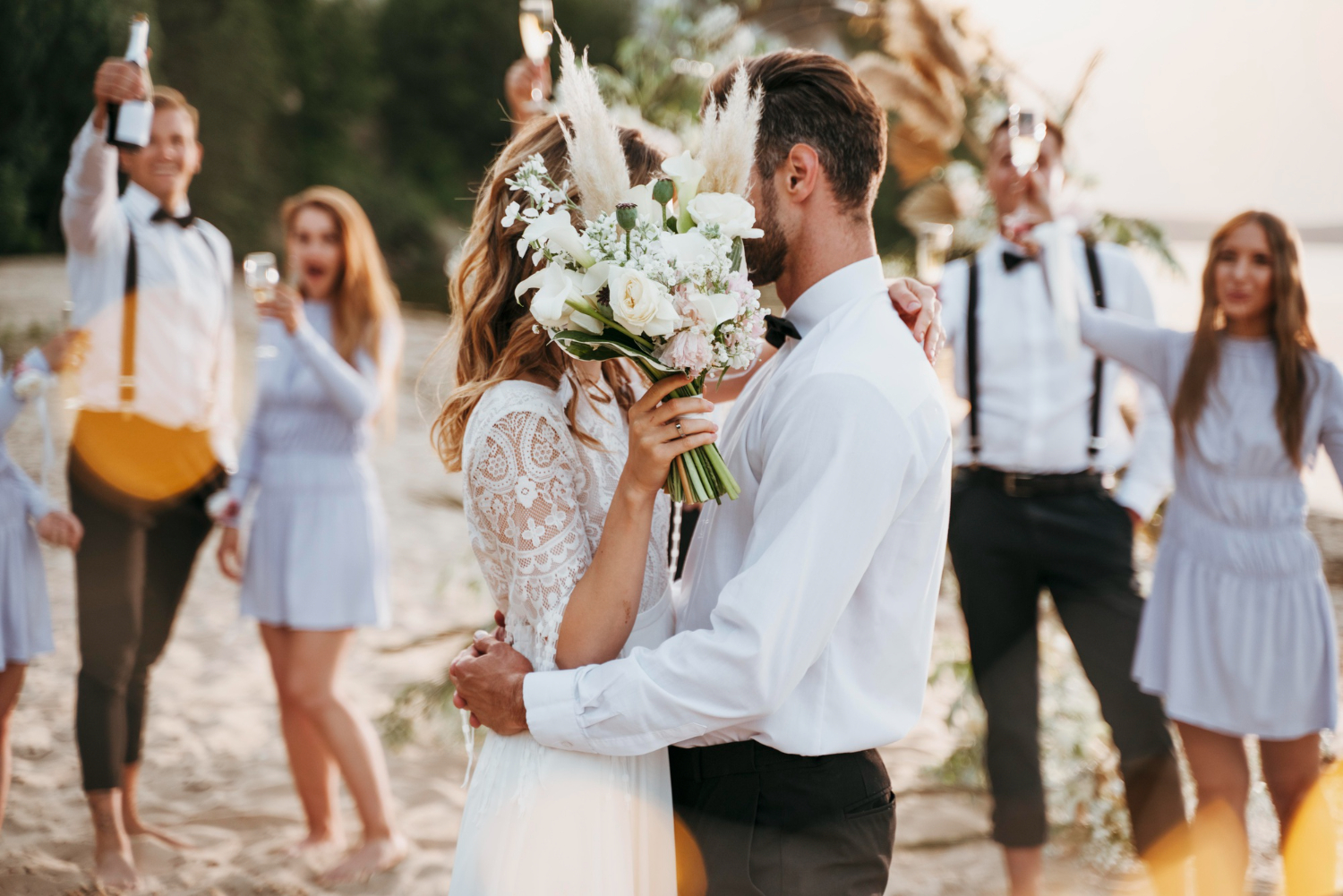
“At my sister’s wedding, my mom smiled too wide and said, ‘This is just a family friend.'” She delivered the words with that practiced lightness she’d perfected over years of church socials and country club luncheons, like she was introducing someone pleasant but ultimately forgettable—someone who didn’t really matter in the grand scheme of the day’s celebrations.
The problem was, she was talking about me. Her daughter. Standing right beside her in a dress I’d spent two months’ savings on because I wanted to look like I belonged at my own sister’s wedding.
We were clustered in the church foyer, late September sunlight streaming through the stained glass windows and painting everything in shades of amber and rose. Guests were laughing and taking selfies, their voices echoing off the vaulted ceiling while soft organ music played in the background, setting the scene for what everyone assumed would be a perfect, uncomplicated celebration of love. My sister Chloe looked absolutely radiant in her white lace gown, the kind of bride that makes people sigh and reach for their cameras. Everyone was calling her the miracle daughter, the golden one, the child my parents bragged about at every opportunity like they’d personally invented perfection and named it Chloe Marie Harlan.
And then I saw her.
A woman standing near the first pew, partially obscured by a massive flower arrangement but unmistakably present. She was slender, probably in her late sixties, with silver hair pinned in a neat bun at the nape of her neck. Her hands were clasped in front of her in that particular way my grandmother used to hold them when she was praying or worried—fingers interlaced, thumbs pressed together, a gesture I’d know anywhere because I’d spent my childhood watching those same hands comfort me when the world felt too big and confusing.
I hadn’t seen that face in ten years. Not in photographs. Not at family gatherings. Not anywhere.
Because I’d been told, very explicitly and with what seemed like genuine grief at the time, that she was dead.
My mother’s smile stayed rigidly fixed as she leaned slightly toward a cluster of guests—women from her book club, I thought, though I’d long ago stopped trying to keep track of her various social circles—and repeated with false warmth, “Oh yes, Margaret is just an old family friend. We go way back. So sweet of her to come.”
I froze completely, my entire body going cold despite the warmth of the crowded foyer. My heart started pounding so hard I could feel it in my throat, in my fingertips, behind my eyes. The floor felt unstable beneath my feet, like the church itself was tilting sideways.
Then the whispers started—quiet at first but growing sharper, more urgent, floating through the air like smoke from a fire nobody wanted to acknowledge.
“Wait, isn’t that Margaret Brennan?”
“I thought she died ten years ago…”
“Didn’t the Harlans have a funeral? I swear I sent flowers.”
“No, you’re thinking of someone else. It must be someone who looks like her.”
“I’m telling you, they said she had an accident. A car crash or something. It was tragic.”
My father materialized beside me so suddenly I actually flinched. His hand came down on my shoulder, and it wasn’t the comforting gesture it might have appeared to observers. His fingers dug into the fabric of my dress, crushing muscle and bone beneath, holding me in place with the kind of pressure that communicated a very clear message without a single word spoken aloud.
He leaned down, his mouth close to my ear so no one else could hear, and hissed through clenched teeth that were still arranged in what looked like a smile from the outside, “Don’t you dare ruin this. Not today. Not here. Do you understand me?”
I swallowed against the rage that was building in my chest, forcing it down, compressing it into something small and manageable that wouldn’t explode and embarrass anyone. I nodded mechanically, like one of those bobblehead dolls, playing the role I’d been trained to play since childhood: the good daughter who smiled when she was being erased from her own family history, who stayed quiet when something didn’t make sense, who protected the carefully constructed family image even when that image was built on foundations made entirely of lies.
But the lie had a pulse now. The lie had a face and silver hair and clasped hands. The lie was sitting in the front row of the church while my sister—beautiful, beloved Chloe—prepared to marry Ethan Caldwell, the kind of man who shook my father’s hand like they were sealing a business merger rather than welcoming a son-in-law into the family.
The ceremony began with all the traditional flourishes. The wedding coordinator ushered everyone to their assigned seats with practiced efficiency. The organ music swelled into something more formal and processional. The priest took his position at the altar, looking distinguished and solemn in his ceremonial robes. He spoke about truth and devotion and the sacred nature of marriage vows, about building a life on foundations of honesty and mutual respect.
The words sounded almost cruel in a room that had been built on a decade of carefully maintained silence and strategic omissions.
I sat near the back—not because I’d chosen those seats, but because that’s where my parents had placed me on the seating chart, far enough from the family section that no one would immediately identify me as the bride’s sister. My hands trembled in my lap as I watched my mother glance repeatedly at the “family friend” in the front row, her eyes constantly monitoring, assessing, making sure the secret stayed contained for just a few more hours until this performance could be safely concluded.
The ceremony proceeded through all its predictable stages. Chloe walked down the aisle on my father’s arm, beaming with joy that looked completely genuine because she had no idea what storm was gathering in the back pews. Ethan watched her approach with an expression of such open adoration that I felt a pang of guilt for what I was about to do to his perfect day. Readings were read. Songs were sung. Rings were presented on a small velvet pillow carried by Chloe’s best friend’s nephew.
Then the priest reached the part everyone always waits for, the moment that exists mostly as a formality in modern weddings, the question that almost never gets answered because who actually objects at weddings anymore outside of romantic comedies?
“If anyone here knows of any lawful reason,” the priest intoned, his voice carrying through the hushed church, “why these two should not be joined in holy matrimony…”
My father’s hand found my knee beneath my dress, his fingers tightening in warning, pressing down hard enough to hurt, hard enough to remind me of every time I’d been told to be quiet, to not make trouble, to remember that family loyalty meant protecting the narrative we’d all agreed to live inside.
“…speak now,” the priest concluded, “or forever hold your peace.”
The air in the church became thick and heavy, charged with expectation even though everyone assumed this was just a ritual, just words that would pass without incident. My throat felt like it was closing, my breath coming in short, insufficient gasps.
And then something inside me—the part that had been systematically silenced and diminished for years—made a decision that my conscious mind hadn’t fully approved yet.
I stood up slowly, my chair scraping against the floor with a sound that seemed impossibly loud in the waiting silence. I stepped into the center aisle, my legs shaking so badly I wasn’t sure they’d support my weight, and said in a voice that was soft but absolutely clear, carrying to every corner of the church, “I do. I object.”
The entire church went silent in a way that felt different from the expectant quiet that had preceded it. This was shock, pure and absolute. This was two hundred people collectively holding their breath.
My mother whipped around like she’d been physically struck, her face draining of color and then flooding with angry red. Chloe’s radiant smile died instantly, replaced with confusion and hurt and rising panic. Ethan’s eyes widened as he tried to process what was happening. My father half-rose from his seat, his face contorted with barely controlled fury.
I reached into my small clutch purse with hands that were trembling so badly I almost dropped it, and pulled out a single document that I’d been carrying with me for three months, ever since I’d found it hidden in my late grandfather’s lockbox. It was creased from being folded and unfolded dozens of times, but the official seal and case number were still perfectly visible and unmistakably legitimate.
The one document they never expected me to have. The one piece of paper that could unravel ten years of carefully constructed fiction.
And holding it up for everyone to see, I realized this wasn’t the ending of anything.
It was only the beginning.
For a full five seconds that felt like five hours, nobody moved. Nobody spoke. Nobody even seemed to breathe. The silence wasn’t just surprise or confusion—it was fear, palpable and spreading, because everyone in that church could sense it: whatever I was holding wasn’t a dramatic gesture made out of jealousy or spite. This was official documentation with legal weight, and its presence here meant something had gone very, very wrong.
My mother’s voice cut through the silence first, too loud and too sharp, abandoning all pretense of the gracious hostess persona she’d been maintaining. “Sit down,” she hissed, her eyes blazing with an anger I’d seen before but never quite this intense. “Right now. This is completely inappropriate.”
I didn’t look at her. I kept my eyes on the priest and held the document higher, my arm steady despite the adrenaline making my whole body shake. “Father,” I said, forcing my voice to stay level and clear, “this wedding cannot continue. It’s not lawful. There are legal restrictions that haven’t been satisfied.”
My sister Chloe’s face flushed bright red, her perfect bridal glow replaced with mortification and confusion. “What are you doing?” she cried, her voice breaking. “Have you lost your mind? This is my wedding!”
My father started moving down the aisle toward me, his face set in lines of cold rage, his hands clenched into fists at his sides. But Ethan—my sister’s groom, who I barely knew beyond a few awkward family dinners—stepped forward instinctively and put his hand out like a barrier between my father and me.
“Wait,” Ethan said firmly, his voice cutting through the rising tension. “What’s going on here? What is she talking about?”
I carefully unfolded the document, smoothing it with my fingertips, and spoke each word deliberately, as if the syllables themselves had the power to cut through decades of carefully maintained lies.
“This is a sealed court order,” I said, reading directly from the header. “Filed on October 15th, ten years ago, in the matter of case number JV-2016-04782. It states that Chloe Marie Harlan—my sister—was legally adopted and placed in this family under an identity change program following a sealed juvenile investigation. Her biological identity and family history were concealed under a court-mandated protection directive.”
A collective gasp rippled through the pews like a wave. I heard someone’s phone hit the floor. Someone else made a small, shocked sound.
Chloe’s bouquet slipped from her hands, white roses scattering across the altar steps. “That’s not true,” she whispered, but there was no conviction in her voice—only rising panic and dawning horror. “Mom? Dad? Tell her that’s not true.”
My mother’s carefully maintained composure was cracking in real time. “You don’t understand what you’re reading,” she snapped, trying to grab the document from my hands. “That’s confidential. That’s sealed. You have no right—”
“Oh, I understand perfectly,” I said, pulling it out of her reach. “Because I found this in Grandpa’s lockbox after he died last spring. The lockbox you tried desperately to get access to before I could go through his things. The one he specifically left to me in his will, probably because he knew what you’d do if you found it first.”
My father’s face had gone from angry red to ashen pale. “That lockbox contained private family documents,” he said, his voice low and dangerous. “Documents that were not meant for you.”
I met his eyes directly, no longer afraid of what I might see there. “Neither was my childhood,” I replied quietly. “But you took that from me anyway.”
The priest looked absolutely stunned, his prepared homily about love and commitment apparently not having covered this particular scenario. “Miss Harlan,” he said, his voice unsteady, “this is an extremely serious accusation. If what you’re saying is true—”
“It is true,” I interrupted, turning the document so he could see the official seal, the case number, the judge’s signature. “And there’s more. This order includes specific restrictions regarding Chloe’s future. She was not allowed to enter into any legal contract, including marriage, without first notifying her assigned legal guardian and the court that sealed these records. That notification has to happen thirty days before any such contract is executed.”
Ethan’s face changed completely, confusion giving way to something that looked like betrayal. “Legal guardian?” he echoed, his voice sharp. “Chloe, what is she talking about? You never mentioned anything about a legal guardian or sealed records or—any of this.”
Chloe turned to him, tears streaming down her face, ruining her professionally applied makeup. “I don’t know,” she sobbed. “I swear to God, Ethan, I don’t know what she’s talking about.”
I looked at my sister—really looked at her—and saw something I hadn’t expected to see: genuine ignorance. Chloe wasn’t lying to protect herself. She genuinely had no idea what I was revealing.
“I believe you,” I said to her, my voice softening slightly. “Because that’s how they operate. They don’t tell you the truth. They just build a story around you and hope you never ask the right questions.”
I turned back to the assembled guests, many of whom were pulling out their phones now, probably googling case numbers and legal procedures.
“This document also lists the reason the records were sealed in the first place,” I continued, my heart pounding so hard I thought it might break through my ribs. “The reason a ten-year-old child was removed from her biological family and placed with ours under a new identity.”
I paused, looking at my parents, giving them one last chance to tell the truth themselves.
They said nothing, frozen in their fear.
So I continued: “Because Chloe’s biological family—the Brennans—were under federal investigation for conspiracy to commit fraud, identity theft, and financial crimes. The child was removed for her own protection when her biological parents were arrested, and she was placed in foster care before my parents adopted her through a sealed proceeding.”
The church erupted into chaos. Not shouting—that would have been too crude for this crowd—but urgent whispers, shocked exclamations, the sound of two hundred people’s worldviews cracking simultaneously.
Chloe staggered backward like I’d physically pushed her. Ethan caught her elbow, steadying her, but his face had gone hard and closed.
My mother’s facade finally shattered completely. “You ungrateful, spiteful—” she started, her voice shaking with rage.
“The woman you introduced as a ‘family friend,'” I interrupted, pointing to Margaret Brennan in the front row, “is Chloe’s biological grandmother. The woman you told me died in a car accident ten years ago. The woman whose funeral I wasn’t allowed to attend because you said I was too young and it would be too traumatic.”
Margaret Brennan stood slowly, her face wet with tears. “I’m sorry,” she said, her voice cracking. “I’m so sorry, Chloe. They wouldn’t let me see you. The court order—they said it was for your protection—”
“You had no right to be here!” my mother shrieked, abandoning all pretense now. “You were supposed to stay away!”
“You invited her,” I said flatly. “Didn’t you? Because you felt guilty. Or maybe because she was blackmailing you. Which is it, Mom?”
My mother’s silence was answer enough.
The pieces were falling into place now, the full picture emerging from years of fragments and inconsistencies I’d noticed but been trained to ignore. My parents hadn’t just adopted Chloe out of kindness. They’d adopted her as part of a deal—maybe to protect the Brennan family assets, maybe to hide evidence, maybe for reasons I still didn’t fully understand.
And they’d erased me in the process. Made me the family friend. The distant relative. The one who didn’t quite fit the narrative they were selling to their community.
Ethan spoke, his voice tight with controlled anger. “Mr. Harlan, Mrs. Harlan—did you know about these restrictions when you agreed to this wedding?”
My father didn’t answer fast enough. That half-second of hesitation was the loudest confession in the entire church.
“You knew,” Ethan said, not a question anymore. “You knew she couldn’t legally marry without disclosure, and you let us plan this whole thing anyway.”
Chloe turned to our parents, her face a mask of betrayal. “You knew,” she repeated, her voice hollow. “You let me fall in love, plan a wedding, invite two hundred people—and you knew the whole time it couldn’t happen?”
“We were going to handle it,” my father said quickly, desperately. “We were going to file the paperwork after the wedding. Retroactively. We have lawyers who could—”
“That’s fraud,” Ethan said flatly. “You were going to let me enter into a fraudulent marriage.”
The priest cleared his throat, his face grave. “I cannot continue this ceremony with this information,” he said quietly. “I’m sorry, but until these legal matters are resolved—”
“No!” Chloe screamed, her composure completely gone now. “No, this is my wedding! This is my day! You can’t—”
But it was already over. Guests were standing, gathering their things, pulling out phones to call lawyers and gossip to friends. The wedding coordinator was frantically trying to signal to the organist to play something—anything—to cover the sound of a family imploding.
I stood in the aisle, still holding the document, watching ten years of lies collapse in real time.
And then my phone buzzed in my clutch.
I pulled it out, expecting angry messages from family members. Instead, there was a text from an unknown number.
“Stop now. You’re opening the wrong door. There are things you don’t understand. Things that will hurt you worse than them. Please.”
My blood ran cold. I looked around the church, trying to see who might have sent it, but everyone was focused on the chaos at the altar.
Another message came through: “The adoption wasn’t just about Chloe. Ask yourself why they kept YOU. What they needed you for.”
My hands started shaking for a different reason now. Because I’d spent the last three months investigating Chloe’s past, uncovering the lies about her adoption, finding the sealed records.
But I hadn’t asked the obvious question: Why did they need me to believe those lies so desperately? What role was I playing in this story that I didn’t understand?
The wedding had descended into complete chaos now. Chloe had collapsed into a chair, sobbing. Ethan was on his phone, presumably calling his lawyer. My parents were surrounded by confused, angry guests demanding explanations. Margaret Brennan was trying to approach Chloe, only to be blocked by my mother’s sister.
And I was standing in the middle of it all, staring at my phone, realizing that the truth I’d just revealed wasn’t the deepest secret my family was keeping.
It was just the first layer.
I looked up and caught my father’s eye across the chaos. He was staring at me with an expression I’d never seen before—not anger, not disappointment, but something that looked almost like fear.
And in that moment, I understood: I wasn’t the hero of this story, exposing my family’s lies for the sake of truth and justice.
I was a weapon they’d spent eighteen years carefully constructing, and I’d just been fired in the wrong direction.
The next three hours were a blur of accusations, explanations, and revelations that came faster than anyone could process them. The church was eventually cleared by the priest, who looked like he’d aged ten years in the span of an afternoon. Guests left in clusters, phones pressed to their ears, already spreading the story through their social networks. The wedding coordinator tried to salvage something—maybe the reception?—but Ethan shut that down immediately with a single phone call to the venue.
By the time the sun was setting, only the immediate family remained: my parents, Chloe, Ethan, Margaret Brennan, and me. We’d moved to a small conference room in the church basement, sitting around a table that was probably usually used for committee meetings about bake sales and vacation Bible school.
Nobody was talking. We were all just sitting in exhausted silence, the weight of the day settling over us like ash.
Finally, Chloe spoke, her voice raw from crying. “I want to know everything. No more lies. No more ‘protecting’ me. I want the whole truth.”
My father and mother exchanged a long look, some silent communication passing between them. Then my father sighed heavily and began to speak.
“The Brennan family,” he said slowly, “was involved in a sophisticated identity theft ring. They’d been operating for almost fifteen years before they got caught. They stole millions of dollars, destroyed hundreds of lives.”
Margaret Brennan flinched but didn’t contradict him.
“When the federal investigation started,” my father continued, “we were… involved. Not in the crimes, but in the financial side. We’d been doing business with them, handling some of their accounts. We didn’t know the money was stolen. At least not at first.”
“But you figured it out,” I said quietly. “And instead of reporting it, you made a deal.”
My father’s jaw tightened. “We had a choice. Lose everything—our business, our reputation, possibly face charges ourselves as accomplices—or cooperate with the investigation and help put the actual criminals away.”
“And adopting Chloe was part of that cooperation,” Ethan said, his voice flat.
“The prosecutor suggested it,” my mother said, speaking for the first time in an hour. “Chloe needed a home. Her parents were going to prison. Margaret here was too old and too implicated in the investigation to take her. We were already cleared as victims of the fraud, not perpetrators. It was… it was meant to be good for everyone.”
“Except you lied about all of it,” Chloe said, her voice breaking again. “You told me my parents died. You told me I had no other family. You erased my entire history and replaced it with a fairy tale.”
“We were trying to protect you,” my father insisted. “The details of that case were horrible. The things your biological parents did, the people they hurt—we didn’t want that to be your identity. We wanted you to have a fresh start.”
“And what about me?” I asked, the question that had been building inside me finally breaking free. “Where do I fit in this story you constructed?”
My parents looked at each other again, and I saw something pass between them that made my stomach drop.
“You,” my mother said slowly, “were our biological daughter. Our only child for the first eight years of your life. And you were… you were struggling. You had behavioral issues, attachment problems, difficulty in school.”
I blinked, shocked. “I don’t remember that.”
“We got you help,” my father said. “Therapy, medication, specialized programs. You got better. But when Chloe came to us… you were still fragile. The therapist suggested that maybe having a sister, someone to care for and protect, might give you purpose. Might help you heal.”
“So you used her,” I said, the realization hitting me like cold water. “You used her to fix me.”
“That’s not—that’s not how it was,” my mother protested, but her voice lacked conviction.
“And when it worked,” I continued, pieces falling into place with horrible clarity, “when I got better and Chloe became the golden child everyone loved, you just… let me fade into the background. Because she was easier. More perfect. Less complicated.”
The silence that followed confirmed everything.
Chloe was staring at me with new eyes, seeing me clearly maybe for the first time. “I never knew,” she whispered. “I never knew they were using us like that.”
Margaret Brennan spoke up, her voice shaky. “I tried to stay in touch with you, Chloe. I sent letters through the court. I wasn’t allowed direct contact, but I thought they were passing on my messages.”
“We weren’t,” my mother admitted. “We thought a clean break was better.”
“You thought maintaining your narrative was better,” Ethan corrected coldly. “You thought if you could keep everyone believing your version of events, you could avoid dealing with the messy truth.”
He turned to Chloe, his face softer now. “I love you. I want to marry you. But not like this. Not built on lies and sealed records and families that treat their daughters like chess pieces.”
Chloe nodded, tears streaming down her face. “I understand.”
“We’ll figure this out,” Ethan continued. “We’ll get the legal restrictions lifted properly. We’ll notify the court like we’re supposed to. We’ll do this right, with full transparency. But that means dealing with all of this—” he gestured at the room, “—not running from it.”
Over the next several weeks, the truth continued to emerge in pieces. My parents’ business dealings with the Brennan family had been more extensive than they’d initially admitted. While they weren’t criminally charged, they’d skirted dangerously close to the line, making decisions they knew were ethically questionable because the money was good.
When the investigation came down, they’d cooperated fully in exchange for immunity and the opportunity to adopt Chloe, which helped their public image tremendously. Look at the good people who took in the innocent child of criminals. Look at their charity and grace.
I spent hours with a therapist unpacking my childhood, recovering memories I’d suppressed or been told weren’t real. The behavioral issues my parents mentioned? They stemmed from me asking too many questions about money appearing and disappearing, about why we suddenly had new friends, about why Mom and Dad seemed scared all the time.
They’d medicated me into compliance, then used Chloe as a distraction to keep me occupied and quiet.
Chloe and I started meeting for coffee, slowly building a real relationship outside our parents’ framework. She’d filed the proper notifications with the court, worked with a lawyer to understand her rights and her history. She’d met with Margaret Brennan several times, carefully reconstructing the pieces of her identity that had been hidden from her.
The wedding was postponed indefinitely, not canceled—Ethan made that clear. He wanted to marry her, but he wanted to marry the real her, the woman who knew her full story and had made peace with it.
My parents tried to reconcile with both of us, but it was half-hearted, more about managing their public image than genuine remorse. They’d spent so many years inside their constructed narrative that they genuinely seemed to believe they’d done nothing wrong, that everything had been justified by good intentions.
I moved out of state six months later, taking a job in a city where nobody knew my family’s story. Chloe supported my decision, understanding better than anyone why I needed distance.
Before I left, we met one final time at a coffee shop downtown. She brought her grandmother Margaret with her, and the three of us sat together talking about truth and family and what we owed to each other.
“Do you regret it?” Chloe asked me as we were leaving. “Standing up at the wedding? Blowing up everything?”
I thought about it carefully, honestly. “No,” I said finally. “Because living inside a lie was destroying both of us. Maybe the truth was painful. Maybe it cost us both things we valued. But at least now we get to choose who we are instead of performing roles someone else wrote for us.”
She hugged me tight, and I realized that in destroying the family we’d been told we were supposed to be, we’d discovered the relationship we actually wanted: two women who’d been used as props in someone else’s story, choosing to write our own instead.
Six months after I moved, I got a text from Chloe with a photo attached. Her and Ethan at the courthouse, smiling, holding a marriage license. No big wedding. No performance. Just two people making a choice with full knowledge of who they were and what they were choosing.
The caption read: “We did it right this time. Thank you for making that possible.”
I smiled and sent back a simple heart emoji, because sometimes the truth doesn’t give you a fairy tale ending. Sometimes it just gives you the freedom to write your own story, messiness and all.
And that, it turned out, was worth more than any perfect wedding day could ever be.

Sophia Rivers is an experienced News Content Editor with a sharp eye for detail and a passion for delivering accurate and engaging news stories. At TheArchivists, she specializes in curating, editing, and presenting news content that informs and resonates with a global audience.
Sophia holds a degree in Journalism from the University of Toronto, where she developed her skills in news reporting, media ethics, and digital journalism. Her expertise lies in identifying key stories, crafting compelling narratives, and ensuring journalistic integrity in every piece she edits.
Known for her precision and dedication to the truth, Sophia thrives in the fast-paced world of news editing. At TheArchivists, she focuses on producing high-quality news content that keeps readers informed while maintaining a balanced and insightful perspective.
With a commitment to delivering impactful journalism, Sophia is passionate about bringing clarity to complex issues and amplifying voices that matter. Her work reflects her belief in the power of news to shape conversations and inspire change.