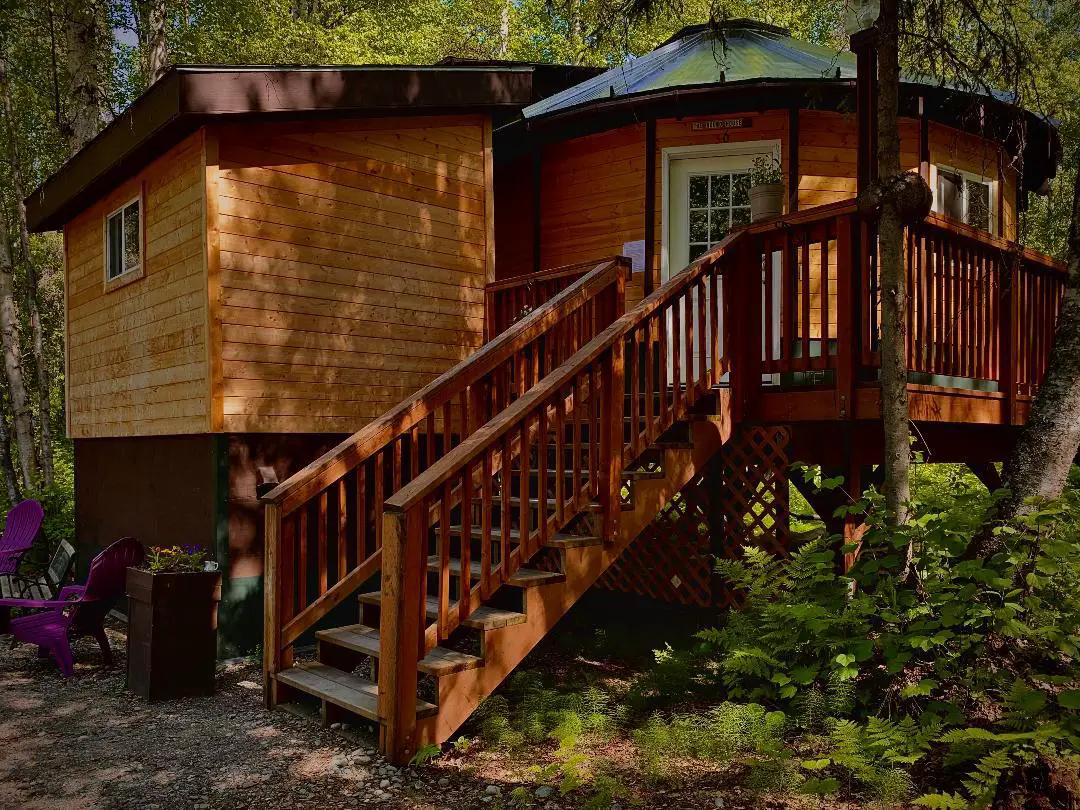
The Cabin in Talkeetna
The night Savannah got the Westchester house, Derek looked at my inheritance and laughed like it was a joke written specifically for me.
Not a polite chuckle. Not an uncomfortable laugh you make when you’re trying to smooth over an awkward moment. But a genuine, contemptuous laugh that said everything about how he saw me, how he’d always seen me, how I’d been too desperate to notice.
“A cabin in Alaska,” he said, shaking his head while adjusting his cufflinks—those expensive silver ones his mother had bought him, the ones he wore when he wanted to feel important. “Your sister gets three-quarters of a million dollars in property and you get… what? A shack in the woods?”
We were standing in our Brooklyn apartment—the one-bedroom we’d shared for two years, the one where I paid more than my fair share of rent while he “invested in his future.” The one that suddenly felt too small to contain my humiliation.
“It’s not about the money,” I said weakly, though I wasn’t sure I believed it.
“It’s always about the money, Maya.” Derek picked up my engagement ring from where I’d set it on the counter—the modest diamond I’d told him I loved because I’d trained myself to want less, to be grateful for whatever scraps people gave me. He turned it over in his fingers like he was appraising it. “You know what this tells me? That even your own family knows you’re a complete failure.”
The word hung in the air between us. Failure.
“Derek—”
“No, seriously. Think about it. Your parents had assets to distribute, and they gave your sister the valuable property—the house in a good neighborhood, the investment that will appreciate, the thing that says ‘we believe in you.’ And they gave you a literal shack in Alaska that’s probably worth less than my car.”
He placed the ring deliberately on the counter, like he was setting down a losing poker hand.
“I can’t do this anymore,” he said, his voice taking on that practiced quality that suggested he’d been rehearsing this speech. “I thought you had potential. I thought you were going to make something of yourself. But you’re thirty years old, you do freelance work that barely pays the bills, and now your own family has confirmed what I’ve been trying to ignore: you’re never really going to go far.”
He grabbed his jacket—the expensive wool one I’d bought him for Christmas last year, spending money I didn’t have because he’d mentioned wanting it—and walked toward the door.
“Good luck with your cabin,” he said without looking back. “I hope it keeps you warm.”
The door closed with a soft click that felt louder than a slam.
I stood in our kitchen—my kitchen now, I supposed—with nothing but an old brass key with flaking paint and a worn packet of papers nobody wanted. The key felt heavier than it should have, like it was made of something denser than metal. Like it carried weight beyond its physical presence.
My name is Maya Collins. I’m thirty years old, and I do quiet freelance work out of Brooklyn—the kind of job people pretend isn’t real until they need it.
I’m a researcher. A fact-checker. A digital archaeologist who helps writers and journalists and documentarians find the obscure details that make their work credible. I track down public records, verify sources, dig through archives that have been digitized badly or not at all. It’s meticulous work that requires patience and precision and the ability to see patterns in chaos.
It pays enough to cover rent and groceries and the occasional luxury of eating out somewhere that doesn’t have paper napkins. But it doesn’t pay enough to impress people like Derek. Doesn’t come with a title that sounds impressive at dinner parties. Doesn’t provide the kind of visible success that makes families proud.
I’m good at it, though. Really good. I just never learned how to make people see that.
The night Derek left was supposed to be my birthday celebration. I’d bought a cheap grocery store cake with “Happy Birthday” written in blue icing that was already starting to bleed into the white frosting. Two paper plates sat on the counter. My phone buzzed occasionally against the sticky surface, notifications I couldn’t bring myself to check.
Then the family attorney called.
Richard Pemberton had been my parents’ lawyer for twenty years—a man with silver hair and expensive suits and that careful tone people use right before they split a family down the middle.
“Maya,” he said after the briefest of pleasantries, “I need to discuss your parents’ estate distribution with you and your sister. Can you both be available tomorrow at two?”
“What happened to Mom and Dad?” I asked, my throat suddenly tight. They were only sixty-two and sixty-five, healthy, active, planning a trip to Italy in the spring.
“Nothing happened,” Richard said quickly. “They’re fine. This is about planned distribution. They’ve decided to transfer certain assets now rather than wait. Tax reasons, mostly. But they want to do it properly, with both of you present.”
The meeting took place in Richard’s office in Manhattan—all dark wood and leather chairs and windows that looked out over the city like a promise of the life some people got to live.
Savannah arrived first, as she always did, looking perfect in a cream-colored suit that probably cost more than my monthly rent. My younger sister—only two years younger, but a lifetime ahead in every way that seemed to matter to our parents.
She had the PR title at a prestigious firm. The Instagram feed full of charity galas and networking events. The curated smile that had been professionally whitened. The boyfriend who worked in finance and looked like he’d stepped out of a cologne advertisement.
She was everything our parents had wanted, and she knew it.
“Maya,” she said when I walked in, her tone pleasant but distant, like we were acquaintances rather than sisters. “You look… comfortable.”
I was wearing jeans and a sweater. Clean, presentable, but not magazine-ready. Not Savannah-ready.
“Thanks,” I said, taking a seat across from her.
Our parents arrived together—Mom in her designer pantsuit, Dad in his business casual that still managed to look expensive. They greeted Savannah warmly, hugging her, commenting on her suit, asking about her latest campaign.
They nodded at me. Said, “Hello, Maya.” Asked if I was still doing “that internet thing.”
Richard cleared his throat and opened a folder that contained the careful dismantling of any illusion I’d had about where I stood in this family.
“Your parents have decided to transfer ownership of the Westchester property to Savannah,” he said, reading from a document. “The house is currently valued at approximately $750,000, with strong appreciation potential given the neighborhood.”
Savannah’s smile was radiant. “Thank you,” she said, already crying perfectly—just enough tears to look moved, not enough to ruin her makeup. “This means everything.”
Mom reached over and squeezed her hand. “You deserve it, sweetheart. You’ve worked so hard.”
“And Maya,” Richard continued, flipping to another page, “you’ll be receiving the property in Talkeetna, Alaska. It’s a cabin that belonged to your grandfather—your father’s father. Along with the land it sits on, approximately three acres.”
I blinked. “A cabin in Alaska?”
“Yes,” Dad said, his voice carrying that defensive tone he used when he knew he was being unfair but didn’t want to admit it. “It’s been in the family for decades. Your grandfather built it himself. It’s very… rustic.”
“Rustic,” I repeated.
“It needs work,” Mom added quickly. “Probably a lot of work. But it’s yours. We thought you’d appreciate the space, the quiet. It matches your… lifestyle.”
My lifestyle. My choice to live simply, to not chase money and status, to do work I found meaningful even if it didn’t impress people at dinner parties—all of it reduced to a dismissive phrase that justified giving me a broken cabin while my sister got three-quarters of a million dollars.
“How much is it worth?” I asked.
Richard shifted uncomfortably. “The property value is difficult to assess. The cabin itself is in significant disrepair. The land has some value, but it’s quite remote. We estimate you could sell it for perhaps $50,000 to $75,000, depending on the buyer.”
Fifty thousand dollars. Maybe seventy-five if I was lucky. Versus three-quarters of a million for Savannah.
“This seems…” I started, then stopped because I didn’t have words for the enormity of the disparity.
“Fair,” Savannah said, her voice carrying that false sweetness she used when she wanted to sound magnanimous. “I mean, the Westchester house requires significant property taxes, maintenance, all sorts of ongoing expenses. The cabin is paid off. No taxes, no maintenance requirements. It’s actually much simpler for you.”
Simple. Like I was too simple to handle anything more complex.
“Plus,” she added, smiling at me with what I’m sure she thought was sisterly affection, “it totally matches your rustic vibe. You’ve always been more… outdoorsy than me.”
I’d been camping exactly twice in my life, and both times I’d complained about bugs and lack of cell service.
“Is this what you want?” I asked my parents directly. “To give Savannah the valuable property and give me something worth a fraction of that?”
“It’s not about money,” Dad said, using the same words I’d said to Derek hours later. “It’s about what fits each of you. Savannah has built a career in Manhattan. She needs to be here, and the Westchester property will serve as a good investment and eventual primary residence. You’re more flexible, more independent. The Alaska property gives you options.”
Options. Like exile disguised as opportunity.
I looked at the papers Richard slid across the table. Property deed. Transfer documents. An envelope stamped with my grandfather’s name: MERCER LOT – TALKEETNA, ALASKA.
Everyone was watching me, waiting to see if I’d make a scene. If I’d cry or yell or demand the fairness they’d never intended to give me.
Instead, I signed the papers.
“Thank you,” I said, my voice flat. “I appreciate you thinking of me.”
Savannah’s relief was visible. She’d been worried I might fight, might make this difficult. But I’d been well-trained—taught from childhood that asking for more, demanding fairness, pointing out obvious favoritism was unseemly. Ungrateful. The kind of thing difficult daughters did.
As we left the office, Savannah caught up with me in the elevator.
“You know,” she said, “if you need help with the cabin—like, selling it or whatever—I can connect you with a realtor who works with… unusual properties.”
Unusual. Unwanted. Worthless.
“Thanks,” I said. “I’ll let you know.”
She smiled and touched my arm in that patronizing way that was supposed to seem affectionate. “We’re still sisters, Maya. This doesn’t change anything between us.”
The elevator doors opened, and she walked out into the Manhattan afternoon, probably heading to a lunch meeting or shopping or whatever it was successful people did with their valuable afternoons.
I stood there watching her go and realized she was wrong.
This changed everything.
I could have sold the land sight unseen. Richard had already connected me with a local Alaska real estate agent who specialized in remote properties. Could’ve gotten my $50,000 or $75,000, paid off some debt, maybe taken a few months to figure out what came next.
Could’ve gone back to my small apartment, my crowded trains, my gray sidewalks, my freelance work that paid enough but never quite felt like enough. Could’ve kept smiling through family group chats where Savannah posted pictures of her new house and everyone congratulated her while my Alaska cabin became a family joke.
But something in me snapped. Not loudly. Not dramatically. Just a quiet, clean break—like a bone that’s been stressed too long finally giving way.
I went home to the apartment Derek had abandoned, looked at the papers spread across my kitchen counter, and made a decision that felt both crazy and like the first sane thing I’d done in years.
I booked a one-way flight to Anchorage.
Alaska didn’t welcome me. It swallowed me.
The flight was long and cramped and full of people who looked like they actually belonged in Alaska—outdoorsy types with expensive gear, workers heading to oil fields, families visiting relatives. And me, in my Brooklyn clothes, with one suitcase and a backpack, looking like exactly what I was: someone who had no idea what she was doing.
Anchorage was bigger than I’d expected, more urban, almost normal. But the cold was different—sharp and dry, the kind that made your nose hurt when you breathed. I’d bought a winter coat before leaving New York, but it already felt insufficient.
I’d arranged for a local driver—a man named Tom who’d posted on a community board that he did runs to Talkeetna for tourists and locals. He picked me up in a truck that had clearly seen better decades, the passenger door creaking when I opened it.
“You the one buying the Mercer place?” he asked as I climbed in.
“Inheriting it,” I corrected.
He grunted, which I was learning was Alaska for “I have opinions but I’m too polite to share them.”
The drive took two and a half hours through landscape that felt increasingly alien. Mountains that weren’t the gentle rolling hills of the East Coast but jagged, enormous things that made you understand why people used to think gods lived in high places. Forests so dense they looked black from the road. Snow that didn’t sparkle like in movies but lay heavy and gray under clouds that seemed to press down from above.
“You ever been to Alaska before?” Tom asked about halfway through the drive.
“No.”
“You picked an interesting time to visit. Spring’s coming, but that means the roads get muddy. The cabin you’re heading to—it’s pretty remote. You planning to fix it up and sell it?”
“I don’t know,” I admitted. “I haven’t seen it yet.”
Tom glanced at me like I was a puzzle he was trying to solve. “Fair enough. Just so you know, Talkeetna’s a small community. Good people, mostly. But they don’t love outsiders who come in trying to change things. You want to fit in, you show respect for the place and the people who’ve been here longer than you.”
“I can do that,” I said.
He grunted again, and we drove the rest of the way in silence.
Talkeetna was smaller than I’d imagined—one main street with a handful of shops and restaurants, houses scattered around the edges, everything dwarfed by the mountains in the distance. Tom drove me through town and out the other side, following directions from the property papers, until we turned onto a road that was barely a road.
“This is as far as I can take the truck,” he said, pulling over. “The cabin’s about a quarter mile up that path. You can walk it, but it’s rough terrain.”
I paid him, grabbed my suitcase and backpack, and started walking. The path was exactly as rough as he’d warned—rutted, muddy in places despite the cold, overgrown with vegetation that grabbed at my clothes.
When the cabin came into view, my heart sank.
It looked worse than the single grainy photo that had been included in the property papers. Much worse.
The roof sagged in the middle like a broken spine. Several windows were cracked, one covered with plywood. The front door hung slightly crooked. Paint—what was left of it—peeled in long strips. The porch steps were rotted through in places, creating gaps you could fall through if you weren’t careful.
Damp rot hung in the air, that smell of wood slowly decaying, of nature reclaiming what humans had tried to build.
This was what my parents thought I deserved. This was what I’d gotten while Savannah received a house worth three-quarters of a million dollars.
I stood there with my suitcase handle cutting into my palm, looking at the cabin my grandfather had built, and felt something complicated twist in my chest. Anger, yes. Humiliation, absolutely. But also… curiosity.
Why had my grandfather built this? Why here, in the middle of nowhere Alaska? And why had my parents been so quick to give it away, like it was worthless?
I pulled out the brass key—the one that had been in the envelope Richard gave me, old and tarnished and heavy. The lock was stiff, resistant, but eventually it turned with a grinding sound.
The door opened with a groan of hinges that probably hadn’t moved in years.
Inside was worse. Dust coated every surface. Furniture had been covered with sheets that were now more mold than fabric. Animal droppings suggested various creatures had made this place their home. The floor was warped, the walls water-stained, everything carrying that same smell of decay.
For two days, I cleaned.
Not because I thought I could make the cabin livable—I wasn’t that delusional. But because I needed to do something with my hands, needed to feel like I was accomplishing something, needed to process everything that had led me to this moment.
I dragged out furniture that was beyond saving. Scraped grime from walls. Hauled trash into piles outside that steamed in the cold like the cabin was breathing, releasing years of accumulated neglect.
My hands went raw. My back ached. I slept on the floor in my sleeping bag, ate protein bars and trail mix, and tried not to think about Derek’s laugh or Savannah’s smirk or my parents’ careful justification of blatant favoritism.
On the third day, I noticed something odd.
One section of the floor didn’t match the rest. The boards were darker, older-looking. The nails were different—hand-forged iron instead of the machine-cut ones used everywhere else. And there was a ring, barely visible under years of accumulated dirt and grime, set into one of the boards.
A rusted iron ring, like something you’d use to lift a hatch.
My heartbeat went loud for no reason except instinct. The kind of instinct that told early humans when something was wrong, when danger was near, when the world was about to shift.
I knelt down and pulled at the ring. The board resisted, then lifted with a groan that sounded almost alive. Beneath it was a narrow opening, maybe two feet square, with cold air rising up like breath from the ground.
A hidden compartment.
No—not a compartment. The opening went deeper than that. I could see rough-cut stairs descending into darkness.
A hidden staircase. Under my grandfather’s cabin. Leading to… what?
I stood there with my flashlight shaking in my hand, thinking about Savannah’s smirk when she’d said this matched my “rustic vibe.” Thinking about Derek’s ring sitting on the counter, his assertion that I’d never go far. Thinking about my grandfather’s stamped name on that envelope like it meant something nobody wanted me to understand.
Then I took one step down.
The stairs were steep, narrow, carved into earth that had been shored up with timber beams. My flashlight beam bounced off walls that were closer than they should be, creating shadows that moved wrong.
Twenty steps down. Thirty. The air getting colder, damper, carrying a smell that wasn’t rot but something older. Stone and metal and time.
The stairs ended in a small chamber—maybe fifteen feet square, carved from the earth itself, walls lined with the same timber beams that suggested someone had gone to enormous effort to build this space.
And filling that space were crates.
Wooden crates, dozens of them, stacked against the walls. Each stamped with faded black ink that was still readable: MERCER CO.
My grandfather’s company. The one he’d built from nothing, the one my father had inherited and grown, the one that now provided the comfortable life my parents enjoyed.
But why were crates from his company hidden under a cabin in Alaska?
I approached the nearest stack, my hands trembling as I reached for the top crate. It wasn’t locked, just sealed with old nails that came loose with some effort.
Inside was paper. Not ancient, but not recent either. Documents. Ledgers. Files with tabs labeled with years and locations and names I didn’t recognize.
I was about to start reading when I saw it—sitting on top of the nearest crate, positioned carefully like someone had placed it there recently, though that was impossible given the undisturbed dust.
A sealed envelope. Smaller than a standard letter, made of heavy paper that felt expensive even through my work gloves.
And written across the front in handwriting I’d never seen but somehow knew was my grandfather’s, like it carried genetic memory in the loops and slants:
Maya
My name. Just my name. Not “To whom it may concern” or “Current property owner” or any of the generic labels you’d use if you didn’t know who would eventually find this.
My name. Like he’d known. Like he’d been waiting for me specifically.
My hands were shaking so badly I could barely open the envelope. Inside was a single sheet of paper, the handwriting matching the envelope, dated ten years ago—before my grandfather died.
Maya,
If you’re reading this, it means you found what I built here. It means they gave you this property instead of selling it or destroying it. It means you’re smarter and braver than they gave you credit for.
What’s in these crates is the truth about Mercer Company. Not the version your father tells at board meetings. Not the sanitized history in the official company archives. The real truth—where the money came from, what we did to get it, who got hurt along the way.
I built this cabin as a hiding place. As insurance. As a legacy for whoever in the family had the courage to look beyond the surface and ask uncomfortable questions.
I always thought it would be you.
Your father never visited this place. Never asked about it. Never cared about anything except the money and status the company provided. Your mother enabled every bad choice he made. And based on everything I saw before I died, I suspect they’re raising Savannah the same way.
But you were different. Even as a child, you asked questions. You noticed things. You cared about truth more than appearance.
What you do with what you find here is your choice. You could burn it all, let the secrets stay buried, take your inheritance and walk away. You could use it to destroy the company and the family reputation. You could sell it to the highest bidder.
Or you could use it to build something better. To take what was corrupt and make it honest. To transform a legacy of exploitation into something worth being proud of.
The cabin needs work, but the foundation is solid. The land is paid for. The location is remote enough that no one will bother you while you decide what comes next.
I’m sorry they underestimated you. But I never did.
Welcome home, Maya.
— Your grandfather, James Mercer
I read the letter three times, standing in that underground chamber with crates of evidence surrounding me, my flashlight beam making shadows dance on the walls.
My grandfather had built this. Had hidden documentation of whatever Mercer Company had done. Had known the family would treat me as lesser, would give me what they thought was worthless. And had left me something that might be worthless—or might be the most valuable thing any of us had inherited.
I sat down on one of the crates and started reading.
It took me three days to go through all the documents. Three days of sitting in that underground chamber, reading by flashlight and headlamp, piecing together a story that explained everything about my family that had never quite made sense.
Mercer Company had made its fortune in lumber. That was the official story, the one my father told. My grandfather had built a logging business, grown it into a major supplier, made smart investments, left behind a company worth millions.
But the truth was darker.
The crates held evidence of illegal logging on protected lands. Of bribes paid to government officials to look the other way. Of contracts with suppliers who used questionable labor practices that might have crossed into actual forced labor. Of environmental damage deliberately concealed. Of communities displaced without proper compensation.
My grandfather hadn’t just built a successful company. He’d built an empire on exploitation and corruption, and he’d done it systematically, carefully, with documentation that suggested he knew exactly how wrong it was even while he was doing it.
But somewhere along the way, he’d changed. Or tried to. The dates on the documents showed a shift—from active participation to passive recording, from perpetrator to documenter. Like he’d realized what he’d become and decided to create a record of it, even if he couldn’t undo it.
The most recent files—dated from the last five years of his life—contained attempts at restitution. Payments made anonymously to communities that had been affected. Environmental restoration projects funded through shell companies. Whistleblower reports filed with regulatory agencies that had apparently gone nowhere.
My grandfather had tried to fix what he’d broken. But he’d died before finishing, leaving behind this archive of sin and attempted redemption hidden under a cabin his family wanted nothing to do with.
On the fourth day, I climbed back up the stairs, closed the hidden entrance, and sat in the cleaned cabin trying to decide what to do.
I could destroy the evidence. Protect the family reputation, preserve the company that provided my parents’ lifestyle, let Savannah enjoy her $750,000 house without the stain of knowing where the money came from.
I could expose everything. Send copies to journalists, regulatory agencies, environmental groups. Watch Mercer Company collapse under the weight of its own history. Watch my parents scramble to explain. Watch Savannah’s perfect life develop cracks.
Or I could do what my grandfather suggested. Use what I’d found to build something better.
I pulled out my phone—which had spotty service at best—and started making calls. First to Richard Pemberton, the family attorney. Then to contacts I’d made through my freelance work—journalists who specialized in corporate corruption, environmental lawyers who took on powerful companies, researchers who knew how to verify and contextualize historical documents.
By the end of the week, I had a plan.
Six months later, I stood in front of the newly renovated cabin—roof repaired, windows replaced, porch rebuilt, everything structurally sound though still rustic in the way Alaska buildings tend to be.
The transformation had cost most of the money from selling the documentation to a journalist collective working on a comprehensive investigation into the lumber industry. I’d kept copies of everything, structured the deal so I maintained some control over how the story was told, ensured that my grandfather’s attempts at restitution were included alongside the evidence of wrongdoing.
The story broke two months ago. “Mercer Company: A Legacy of Exploitation and Environmental Crime” had been published across multiple platforms, meticulously sourced, impossible to deny or dismiss.
My father’s company had survived, but barely. Regulatory agencies had opened investigations. Lawsuits had been filed by affected communities. The board had forced my father to resign. Stock value had plummeted.
My parents weren’t speaking to me. Savannah had called me once, crying, saying I’d destroyed the family for “absolutely nothing” and asking how I could be so selfish.
I’d hung up without answering.
But other calls had come too. From people in communities my grandfather’s company had harmed, thanking me for helping tell their story. From environmental groups who’d been fighting Mercer Company for years, grateful for evidence that supported their claims. From other families dealing with similar legacies, asking for advice on how to navigate corporate corruption and inherited guilt.
And one call from Derek, of all people. Asking if I wanted to “talk things through” now that I was “in the news.” I’d blocked his number.
The cabin had become something unexpected: a research center. I’d converted the underground chamber into a secure archive, properly climate-controlled, professionally organized. I’d partnered with a university that studied corporate accountability and environmental justice, giving them access to the documents in exchange for help preserving and contextualizing them.
I’d also started accepting research contracts again—but different ones. Companies wanting to audit their own histories. Families wanting to understand where their wealth came from. Organizations working on truth and reconciliation projects.
Turns out there’s a market for someone who knows how to find buried truths and present them clearly.
I was making more money than I ever had in Brooklyn. Not Savannah money, not $750,000-house money, but enough. Enough to fix the cabin, to build a life here, to feel like I was doing work that mattered.
Carl had visited last month—yes, Carl, the retired detective from the cruise ship story who’d somehow become a friend through a series of improbable connections involving other people I’d helped. He’d looked at the cabin, at the archive, at the mountains visible from the porch, and said, “You’ve built something real here.”
And for the first time in my life, I believed it.
One year after I’d flown to Alaska with nothing but a rusted key and wounded pride, I got a letter from Savannah.
Not an email or a text, but an actual handwritten letter sent through the mail, which suggested effort and intentionality.
Maya,
I’m writing this because Mom and Dad won’t, and because I think you deserve to know that we understand now what you did and why you did it.
The investigations into Mercer Company have revealed things none of us knew. Things that made us realize Grandpa’s guilt, Dad’s complicity through willful ignorance, and our family’s comfort built on suffering we never acknowledged.
You were right to expose it. You were right to choose truth over family loyalty. And I’m ashamed it took me this long to see that.
The Westchester house is being sold. I can’t live there anymore knowing what I know. I’m giving half the proceeds to the restitution fund you helped establish. The other half I’m investing in environmental restoration projects.
I don’t expect forgiveness. I don’t expect us to be close again. But I wanted you to know that what you did—the choice you made—it changed me. Made me look at my own life, my own choices, my own complicity in systems I claimed to care about but never challenged.
Thank you for being braver than the rest of us.
– Savannah
I read the letter sitting on my porch, coffee cooling in my hands, watching the sun set behind mountains that had stopped feeling alien and started feeling like home.
I didn’t respond immediately. Didn’t rush to forgive or reconnect. But I kept the letter, filed it with the other documents that told the story of how a family confronted its own legacy and tried to build something better from the ruins.
That night, I went down to the archive and looked at my grandfather’s letter one more time. The one that had started all of this.
I always thought it would be you.
He’d been right. Not because I was special or chosen or destined for anything. But because I’d been underestimated enough to be given something everyone else thought was worthless. And I’d been curious enough, stubborn enough, hurt enough to actually look at what I’d been given instead of just accepting everyone else’s assessment of its value.
The cabin in Talkeetna wasn’t worth $750,000. But it was worth something more important: the truth about who we were and the choice to become something different.
And that, I’d learned, was an inheritance beyond any price.
THE END

Sophia Rivers is an experienced News Content Editor with a sharp eye for detail and a passion for delivering accurate and engaging news stories. At TheArchivists, she specializes in curating, editing, and presenting news content that informs and resonates with a global audience.
Sophia holds a degree in Journalism from the University of Toronto, where she developed her skills in news reporting, media ethics, and digital journalism. Her expertise lies in identifying key stories, crafting compelling narratives, and ensuring journalistic integrity in every piece she edits.
Known for her precision and dedication to the truth, Sophia thrives in the fast-paced world of news editing. At TheArchivists, she focuses on producing high-quality news content that keeps readers informed while maintaining a balanced and insightful perspective.
With a commitment to delivering impactful journalism, Sophia is passionate about bringing clarity to complex issues and amplifying voices that matter. Her work reflects her belief in the power of news to shape conversations and inspire change.
I liked the post & Ms.River’s if you read this ,I do remember Carl from the ship.