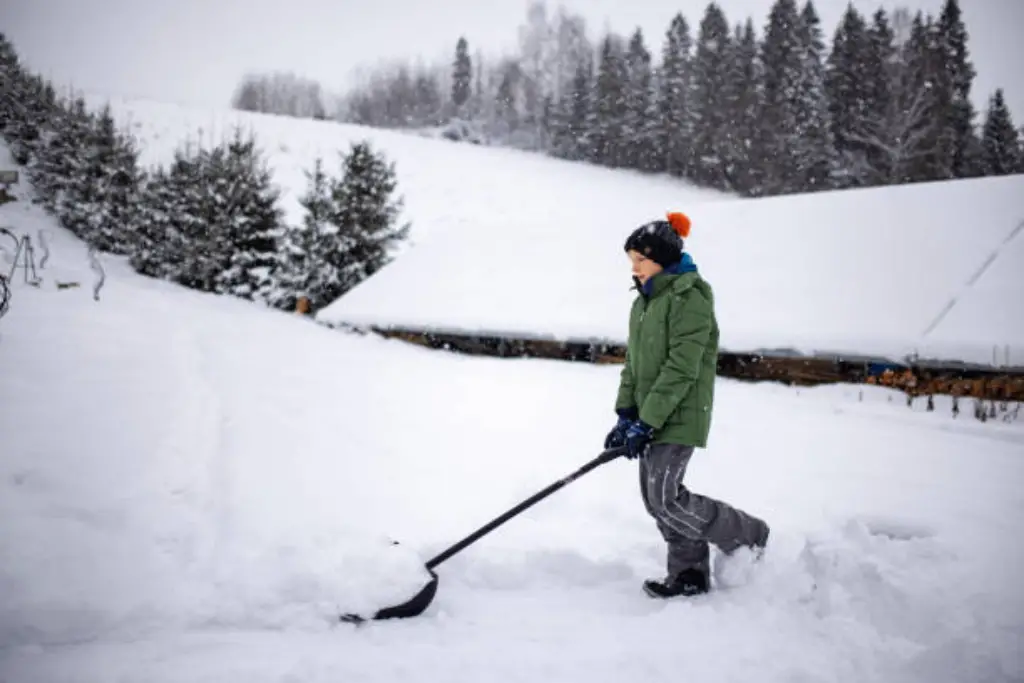
The first snow of December fell on a Tuesday, soft and persistent, the kind that transforms a neighborhood overnight into something that looks like a postcard but feels like work. I stood at my kitchen window watching the flakes accumulate on our driveway, calculating how early I’d need to wake up to clear it before my shift at the hospital, when my twelve-year-old son Ben appeared beside me with that particular gleam in his eye that meant he’d been thinking.
“Mom,” he said, pressing his face against the cold glass, “Mr. Dickinson’s driveway is huge.”
I followed his gaze to the house across the street—the one with the circular driveway that could accommodate four cars, the one with the decorative lamppost that probably cost more than my monthly mortgage payment, the one belonging to Richard Dickinson, a man who had a remarkable talent for making sure everyone in the neighborhood knew exactly how successful he was.
“It is,” I agreed carefully, wondering where this was going.
“I could shovel it,” Ben said, turning to me with the kind of hopeful expression that reminded me so much of his father—earnest, determined, already half-convinced he could do anything if he just tried hard enough. “I’m strong enough now. I’ve been doing ours, and the Hendersons’ when Mr. Henderson’s back acts up. I could do Mr. Dickinson’s too.”
My name is Sarah Mitchell, and I’m a single mother of two—Ben, who was twelve and experiencing that particular stage of adolescence where he was desperate to prove himself capable, and Emma, who was eight and still believed the world was fundamentally fair. I worked as a nurse at County General, pulling shifts that paid the bills but left me perpetually exhausted, perpetually calculating whether we could afford pizza for dinner or if it was another pasta night.
Money was tight. Not desperately so—we had a roof, food, heat—but tight enough that Christmas always involved careful planning, strategic shopping, and the kind of creative gift-giving that required more thought than money. Ben knew this, even if I tried to shelter both kids from the weight of it. He’d started noticing things, the way kids do when they reach a certain age: the way I’d sometimes skip lunch, the way I’d carefully examine price tags at the grocery store, the way I’d smile brightly while saying maybe next year when he asked about the gaming console all his friends had.
“That’s very entrepreneurial of you,” I said, using a word I knew would make him feel grown-up. “But you’d need to ask Mr. Dickinson first. And you’d need to be sure you could commit to it—snow doesn’t care about your schedule.”
“I know,” Ben said quickly. “I’ve been thinking about it. If I do it before school, it won’t interfere with anything. And if it snows on the weekend, I’ve got all day.”
I studied my son’s face—his father’s dark eyes, my stubborn chin, that particular mixture of childhood innocence and emerging independence that made my heart ache with pride and worry in equal measure. “Okay,” I said. “You can ask him. But Ben—get it in writing. Even a simple note about what you’ll do and what he’ll pay. It’s just good practice.”
He nodded enthusiastically, already pulling on his coat. I watched from the window as he trudged across the street through the fresh snow, his steps purposeful, his shoulders squared like a man heading into an important business meeting. Richard Dickinson answered the door in his usual attire—expensive casual, the kind of clothes that looked relaxed but probably cost more than my weekly paycheck. Even from across the street, I could see him looking down at Ben with that particular expression he wore when dealing with people he considered beneath his tax bracket.
They talked for maybe five minutes. I saw Mr. Dickinson gesture at his driveway, then laugh at something—not with Ben, but at him, in that way that adults sometimes do when they think a child’s ambitions are amusing rather than admirable. Then they shook hands, and Ben came running back across the street, nearly slipping on a patch of ice in his excitement.
“He said yes!” Ben burst through the door, snowflakes melting in his hair. “Ten dollars every time I shovel! Mom, that’s like—if it snows twice a week, that’s twenty dollars a week! By Christmas, I could have—” He stopped, calculating furiously with his fingers. “Maybe sixty dollars! Maybe more!”
His excitement was infectious and heartbreaking all at once. Sixty dollars wasn’t a fortune, but to Ben it represented possibility—the ability to buy Christmas gifts without asking me for money, the independence of earning his own way, the satisfaction of being useful and capable.
“That’s wonderful, honey,” I said, hugging him. “Did you get it in writing?”
His face fell slightly. “He said we didn’t need it. He said a handshake between men is as good as a contract. He said that’s how real business is done.”
Something cold that had nothing to do with the weather settled in my stomach. I knew Richard Dickinson’s type—I’d encountered them at the hospital, in parent-teacher conferences, at community meetings. Men who talked about integrity while demonstrating none, who used phrases like “real business” and “the real world” to justify behavior they’d never accept from others.
“Ben, I really think you should—”
“Mom, it’s fine,” he interrupted, with that particular teenage certainty that knows everything. “Mr. Dickinson is rich. He’s not going to cheat a kid out of a few dollars. Plus, he said he respects my work ethic. He said most kids today are lazy, but I seem different.”
I bit back my concerns. Maybe I was being overly cynical. Maybe Richard Dickinson, for all his insufferable name-dropping about his investment portfolio and his summer home in the Hamptons, would be decent enough to honor a simple agreement with a twelve-year-old boy. Maybe I was letting my own exhaustion and financial stress make me suspicious of everyone with money.
“Okay,” I said. “But keep track of every time you shovel, just in case. Write it down with the date and time.”
“I will,” Ben promised, already heading to his room to find a notebook.
That night, he appeared at dinner with a small spiral notepad he’d decorated with the words “BEN’S WORK LOG” in careful block letters. Emma giggled at his seriousness, but I saw the pride in the way he held it, the way he’d already written “Day 1” at the top of the first page.
The snow that December was relentless. It fell almost every other day, sometimes just a dusting, sometimes several inches that required real effort to clear. And Ben showed up every single time. I’d wake at 5:30 to get ready for my early shifts and find his bed already empty, hear the scrape of his shovel against pavement through the window. He’d work methodically, his breath visible in the frigid air, clearing Mr. Dickinson’s expansive driveway with a dedication that honestly humbled me.
Some mornings I’d watch him from the window as I drank my coffee, this boy who still looked so small in his puffy winter jacket, wielding a shovel nearly as tall as he was. He’d attack the snow in sections, careful to pile it neatly at the edges rather than just pushing it around, taking pride in doing the job well even when no one was watching. By the time he came in for breakfast before school, his cheeks would be blazing red, his gloves soaked through, his hair plastered to his forehead with sweat despite the freezing temperatures.
“How much am I up to now?” he’d ask, shaking snow off his coat in the mudroom, carefully adding another entry to his work log.
“Let’s see,” I’d say, peering at his meticulous records. “That’s… seventeen times? That’s one hundred seventy dollars, Ben.”
His eyes would go wide. One hundred seventy dollars was an impossible fortune to him—more money than he’d ever had at once in his life. He’d talk endlessly about what he’d buy. A scarf for me—a nice one, not from the discount store, he insisted, one that would actually keep me warm on my walk from the hospital parking lot. A stuffed animal for Emma—she’d been wanting this particular purple elephant she’d seen at the toy store. And maybe, if there was enough left, he could buy himself that book series his English teacher had recommended, the nice hardcover editions instead of borrowing worn paperbacks from the library.
“And I’m going to save some,” he told me one evening in mid-December, carefully organizing his work log as if it were a legal document. “For emergencies. Like you always say we should.”
I had to turn away and pretend to be very busy with the dishes because my eyes were suddenly burning. Here was my twelve-year-old son, working in freezing temperatures before dawn, thinking not just about gifts but about savings, about emergencies, about being responsible. While across the street, Richard Dickinson slept in his heated house with his expensive cars and his casual displays of wealth, not once coming out to check on the boy who was making his life more convenient.
The neighbors noticed. Mrs. Henderson, whose driveway Ben cleared for free because her husband’s back problems made snow removal impossible, stopped me at the mailbox one afternoon. “That boy of yours is something special, Sarah. Out there at dawn without being asked. You’re raising him right.”
Even Tom Patterson, two houses down, commented. “Saw Ben at it again this morning. Dickinson’s lucky to have him. Most kids today wouldn’t work that hard for any amount of money.”
I’d smile and thank them, feeling proud and worried in equal measure. Proud of Ben’s work ethic and character. Worried about what was increasingly feeling like inevitable disappointment.
Because as December wore on and Christmas approached, I never once saw Richard Dickinson pay my son. Not a single time. I’d see him coming and going—leaving for work in his Mercedes, returning in the evening, heading out on weekends in his wife’s Range Rover—but never stopping to hand Ben any money, never even acknowledging the cleared driveway that he walked across every single day.
“Has Mr. Dickinson paid you yet?” I asked Ben one evening, trying to keep my voice casual.
“Not yet,” Ben said, not looking up from his homework. “He said he’d pay me all at once before Christmas. He said it’s easier that way, keeps better records for taxes or something. He said that’s how professionals do it.”
The cold feeling in my stomach intensified. “Ben, I really think you should—”
“Mom, it’s fine,” he said again, with that teenage exasperation that suggested I was worrying over nothing. “He promised. We shook on it. And anyway, I have it all written down. Every single time.”
He showed me his work log again—nineteen entries now, nearly two hundred dollars’ worth of work, each entry carefully dated and timed. Some mornings he’d worked for over an hour, clearing not just the driveway but the walkway to the front door, the area around the mailbox, even the path to the side gate where Dickinson kept his garbage bins.
“You’re doing a wonderful job,” I told him, meaning it. “I’m proud of you.”
And I was. Whatever happened with the money, Ben had learned something valuable about commitment, about following through, about the satisfaction of honest work. I just wished the lesson wasn’t being taught by someone I increasingly suspected had no intention of honoring his end of the bargain.
December 23rd dawned gray and bitter, the kind of cold that makes your lungs ache when you breathe. Ben had shoveled that morning—entry number twenty-three in his work log—and come home talking about how this would probably be the last time before Christmas, how Mr. Dickinson would probably pay him today so he’d have time to shop.
I was frosting Christmas cookies with Emma when Ben came home that afternoon. I knew immediately that something was wrong. He came through the door moving differently—shoulders hunched, feet dragging, that careful blankness that children wear when they’re trying very hard not to cry in front of their parents.
“Ben?” I set down the frosting bag. “What’s wrong?”
“Nothing,” he said, the word clipped and brittle. “I’m fine.”
But he wasn’t fine. His hands were shaking as he took off his gloves, and when I touched his arm, he flinched away like the contact hurt. Emma looked between us with that particular awareness that younger siblings develop, understanding that something bad had happened even if she didn’t know what.
“Emma, honey, why don’t you go finish your show upstairs?” I said gently.
“But the cookies—”
“We’ll finish them later. Go on.”
She went reluctantly, casting worried glances back at her brother. Once I heard her door close, I turned to Ben. “What happened?”
For a long moment, he didn’t answer. He just stood there in the mudroom, still wearing his winter coat, staring at his snow-soaked boots. Then, in a voice that was trying so hard to be steady and failing completely, he said: “Mr. Dickinson said he’s not going to pay me.”
The words hit me like a physical blow. “What?”
“He said—” Ben’s voice cracked. He swallowed hard and tried again. “He said it was a business lesson. He said I should never work without a written contract. He said in the real world, a handshake means nothing and I need to learn that young. He said I should thank him for teaching me something valuable before I made this mistake with real money involved.”
I felt something crystallize inside me—a cold, focused fury that was somehow more powerful for being absolutely controlled. “Ben, look at me.”
He looked up finally, and the expression on his face broke my heart. It wasn’t anger—children can process anger. It was betrayal, confusion, the particular pain of learning that adults can be cruel for no reason at all, that hard work doesn’t always matter, that promises are sometimes just words.
“This is not your fault,” I said clearly, gripping his shoulders. “Do you understand me? You did everything right. You worked hard, you kept excellent records, you held up your end of the agreement. This is not a failing on your part.”
“But he said—”
“I don’t care what he said. He’s wrong. He’s wrong and what he did is shameful.” I pulled Ben into a hug, feeling him finally break, his shoulders shaking with silent sobs against my shoulder. “Some people,” I said quietly, “teach lessons without meaning to. They teach us what kind of people we don’t want to become.”
We stood there for a long time, Ben crying like he hadn’t since he was much younger, and me planning exactly what I was going to say to Richard Dickinson.
That evening, after dinner—after I’d assured Ben that we’d still have a good Christmas, after I’d tucked Emma in early because the day had been emotionally exhausting for all of us—I walked across the street to Richard Dickinson’s house. The windows glowed warmly, and through them I could see the kind of Christmas tree that comes from expensive stores rather than lots, professionally decorated, probably installed by a service rather than a family working together. The contrast with our own modest tree, decorated with years of handmade ornaments and uneven tinsel, couldn’t have been starker.
I rang the doorbell. Richard Dickinson answered in loungewear that probably cost more than my grocery budget for a month, holding a glass of wine, clearly relaxed and comfortable.
“Sarah,” he said with false warmth. “This is unexpected.”
“We need to talk about Ben,” I said, keeping my voice level.
His expression shifted to something I can only describe as performatively regretful. “Ah, yes. Look, I know he’s upset, but honestly, I did him a favor. Better to learn about contracts now than when there’s real stakes involved.”
“He’s twelve years old.”
“Exactly,” Richard said, as if this proved his point. “Perfect age to learn about the real world. You can’t coddle them forever, Sarah. My kids learned young that—”
“Your kids attend private school where tuition costs more than I make in a year,” I interrupted, my voice still calm but with edges now. “Your kids have never had to worry about money. Your kids have never shoveled snow at dawn in the freezing cold to buy their mother a Christmas present. Don’t you dare compare them to Ben.”
He blinked, momentarily taken aback by my directness. In our neighborhood, people generally allowed Richard Dickinson to hold forth without challenge. He recovered quickly, adopting a patronizing smile.
“Look, I understand you’re protective. But the boy needs to learn—”
“He learned,” I said. “He learned to work hard. He learned to keep records. He learned to honor his commitments. He learned every lesson that matters. The only person who needs to learn something here is you.”
“I don’t appreciate your tone,” Richard said, his smile vanishing.
“And I don’t appreciate you exploiting my son’s labor and then framing it as a lesson. Ben did twenty-three shoveling jobs for you. That’s two hundred thirty dollars. You owe him that money.”
“I don’t owe him anything,” Richard said, his voice hardening. “We had no contract. There was no written agreement. That was the whole point. In business—”
“This isn’t business. This is a man in his forties taking advantage of a twelve-year-old child.” I took a step closer. “Pay him what you owe him, Richard. Do the right thing.”
For a moment, I thought I saw something flicker across his face—maybe conscience, maybe shame. But then it hardened into stubbornness. “I’m not rewarding poor business practices. He’ll thank me someday for this lesson. You’ll see. Now if you’ll excuse me—”
He started to close the door. I stopped it with my hand.
“You should know,” I said quietly, “that lessons go both ways.”
He frowned. “Is that a threat?”
“It’s a promise,” I said. “You wanted to teach my son about the real world? Consider this my curriculum.”
I walked away before he could respond, my mind already working through what I was going to do.
That night, I couldn’t sleep. I kept thinking about Ben’s face, about the careful entries in his work log, about the scarf he’d wanted to buy me. Around 2 AM, I got up and made tea, standing at the kitchen window looking across at Richard Dickinson’s house, all lit up with expensive Christmas decorations on a timer.
And that’s when the idea came to me.
The next morning—December 24th, Christmas Eve—I woke Ben and Emma early. “I need your help with something,” I told them. “It’s going to take a few hours and it’s going to be cold, but I promise it will be worth it.”
Ben looked at me warily. “What kind of help?”
“The kind that teaches people about fairness,” I said.
I’d called in a few favors. Tom Patterson from down the street came over with his snow blower. Mrs. Henderson’s son Marcus, who was visiting for the holidays and owed me for setting his dislocated shoulder last year at no charge, showed up with two shovels and a grin. Even old Mr. Chen from the corner house, who rarely got involved in neighborhood affairs, appeared with his grandson and an extra shovel.
“Heard what happened to your boy,” Tom said. “Nobody likes that Dickinson fellow, but we all keep quiet because, well, he’s rich and connected and nobody wants problems. But what he did? That’s not right.”
“What are we doing?” Ben asked, looking confused as this strange group assembled in our driveway at seven in the morning on Christmas Eve.
“We’re teaching Mr. Dickinson the same lesson he taught you,” I said. “That in the real world, actions have consequences.”
It took four hours, but it was glorious. We cleared every single inch of snow from our property—the driveway, the walkway, the sidewalk in front of our house, even the decorative areas around the bushes and trees. And then, systematically and thoroughly, we transferred every shovelful across the street to Richard Dickinson’s property.
His meticulously cleared driveway disappeared under a growing mountain of snow. His walkway became impassable. The entrance to his garage, where his Mercedes and his wife’s Range Rover sat, became blocked by a wall of white that would take hours to clear. We piled it high and we packed it down, working with the focused determination of people who believed absolutely in the justice of what we were doing.
Neighbors came out to watch. Some brought hot chocolate. A few offered additional shovels. No one tried to stop us. If anything, there was a carnival atmosphere, the kind that comes when a community witnessing something they all know is petty revenge but feel is somehow deeply deserved.
“Is this legal?” Ben asked at one point, breathing hard from the work but grinning wider than I’d seen him smile in days.
“Completely,” I said. “It’s our snow, from our property. We’re just relocating it. No law against that.”
By noon, Richard Dickinson’s property looked like a snow dump. Cars couldn’t get in or out. The front door was barely accessible. The decorative lamppost he was so proud of was half-buried. And every single bit of it was snow that had been cleared from his driveway by my son over the past three weeks, now returned to sender.
We were packing up our shovels, satisfied with our work, when Richard Dickinson appeared at what had been his front door but was now barely accessible through the snow. His face was an extraordinary shade of red.
“What the hell do you think you’re doing?” he shouted across the street.
“Returning your property,” I called back calmly. “That’s snow from your driveway that Ben cleared over the past three weeks. Since you didn’t pay him for the removal service, we assumed you wanted it back. We’re just being good neighbors.”
Several of the watching neighbors laughed. Richard sputtered. “This is—you can’t—this is harassment!”
“No,” I said, crossing the street to stand at the edge of his buried property. “This is a business lesson. See, in the real world, when you don’t pay for services rendered, sometimes those services get reversed. Ben didn’t have a contract saying the snow removal was permanent. Just like he didn’t have a contract saying you’d pay him. So we’re both learning today, aren’t we?”
Richard’s wife appeared behind him, looking at the buried property with dismay. “Richard, what is going on?”
“Nothing,” he said quickly. “Just a misunderstanding. I’ll handle it.”
“A misunderstanding?” she repeated, looking between us. “Did you really not pay Sarah’s son for shoveling all this time?”
“It was a business lesson,” Richard said defensively. “He needed to learn—”
“He’s twelve years old!” she snapped, and I realized this was the first time I’d ever heard her contradict him. “What kind of lesson is that? No wonder they—” She stopped, looking at the mountain of snow with what might have been respect. “I’ll get my purse.”
“Susan, don’t you dare—”
“Get the checkbook, Richard,” she said firmly. “Right now.”
Twenty minutes later, Richard Dickinson stood on his buried front porch—he’d had to shovel just to open his door—and handed Ben an envelope. He wouldn’t meet anyone’s eyes, particularly not his wife’s, who stood behind him with her arms crossed in a way that suggested there would be more conversations later.
“Two hundred thirty dollars,” Richard said stiffly. “For services rendered.”
Ben took it with shaking hands, looking up at me for confirmation that this was real. I nodded.
“And?” his wife prompted.
Richard’s jaw worked. “And… I apologize for not paying you sooner. That was wrong of me.”
It wasn’t the most sincere apology I’d ever heard, but it was an apology from a man who clearly wasn’t used to admitting fault, which made it somehow more valuable. Ben nodded, not quite smiling, but standing a little taller.
“Thank you,” he said, with more grace than Richard Dickinson deserved.
As we walked back across the street, our neighbors dispersed with waves and well-wishes, satisfied that justice had been served. Tom Patterson clapped Ben on the shoulder. “Good work, kid. Both the shoveling and the standing up for yourself.”
That afternoon, Ben bought me the scarf he’d planned—soft and warm, in my favorite color. He bought Emma her purple elephant. And he carefully deposited one hundred dollars into the savings account we’d opened for him years ago, money for his future, for college, for emergencies.
That evening, as I helped him hang his stocking by our modest tree, he said quietly, “Mr. Dickinson did teach me a lesson. Just not the one he meant to.”
“What’s that?” I asked.
“That how you treat people matters more than how rich you are. And that having someone stand up for you—” his voice got thick— “that matters too.”
I hugged him tightly, this boy who was growing up too fast, learning lessons about the world that I wished he could avoid a while longer. “You did good work, Ben. You kept your promise, you worked hard, and you kept excellent records. Those are the lessons that matter.”
“And you taught him a lesson too,” Emma piped up from where she was arranging presents under the tree. “About how you shouldn’t be mean to kids.”
“I taught him about fairness,” I corrected gently. “About how actions have consequences, even for adults who think they’re too important for consequences.”
On Christmas morning, there was one extra present under our tree that hadn’t been there the night before—a box of expensive chocolates with a card that read simply “From the Hendersons, with gratitude.” Tom Patterson’s family sent over a plate of cookies. Even the Chen family, who we barely knew, dropped off a gift card to the grocery store.
The neighborhood had taken sides, and it wasn’t with Richard Dickinson.
I saw him once more before New Year’s, shoveling his own driveway—his wife had apparently put her foot down about hiring a service after what happened. He didn’t wave or acknowledge me. But he also didn’t quite meet my eyes, which told me everything I needed to know about whether the lesson had landed.
That January, as the snow kept falling and Ben kept his own promise to shovel our driveway without being asked, I watched my son working with the same dedication as before. But there was something different now—a certain wariness, yes, but also a confidence. The confidence of someone who’d learned that sometimes the world is unfair, but that doesn’t mean you stop doing what’s right. It just means you’re more careful about who you trust, and you make sure you have people who will stand up for you when things go wrong.
And sometimes, just sometimes, justice looks like a mountain of snow returned to sender, and a twelve-year-old boy learning that his mother will always, always stand up for him when the world tries to teach him the wrong lessons.
The scarf Ben bought me became my favorite. I wore it every shift that winter, and when people at the hospital complimented it, I told them the story—not to shame Richard Dickinson, but to brag about my son, who worked hard even when the world didn’t seem to be paying attention. I told them about a boy who learned that integrity matters, that documentation protects you, and that sometimes fairness has to be fought for rather than expected.
And I told them that sometimes the best lessons don’t come from the people who think they’re teaching them. Sometimes they come from watching someone you love stand tall even when they’ve been knocked down, from communities that rally when one of their own is wronged, and from understanding that being right matters more than being rich.
That was the lesson Ben really learned that winter. And it was worth more than any two hundred thirty dollars could ever buy.

Lila Hart is a dedicated Digital Archivist and Research Specialist with a keen eye for preserving and curating meaningful content. At TheArchivists, she specializes in organizing and managing digital archives, ensuring that valuable stories and historical moments are accessible for generations to come.
Lila earned her degree in History and Archival Studies from the University of Edinburgh, where she cultivated her passion for documenting the past and preserving cultural heritage. Her expertise lies in combining traditional archival techniques with modern digital tools, allowing her to create comprehensive and engaging collections that resonate with audiences worldwide.
At TheArchivists, Lila is known for her meticulous attention to detail and her ability to uncover hidden gems within extensive archives. Her work is praised for its depth, authenticity, and contribution to the preservation of knowledge in the digital age.
Driven by a commitment to preserving stories that matter, Lila is passionate about exploring the intersection of history and technology. Her goal is to ensure that every piece of content she handles reflects the richness of human experiences and remains a source of inspiration for years to come.