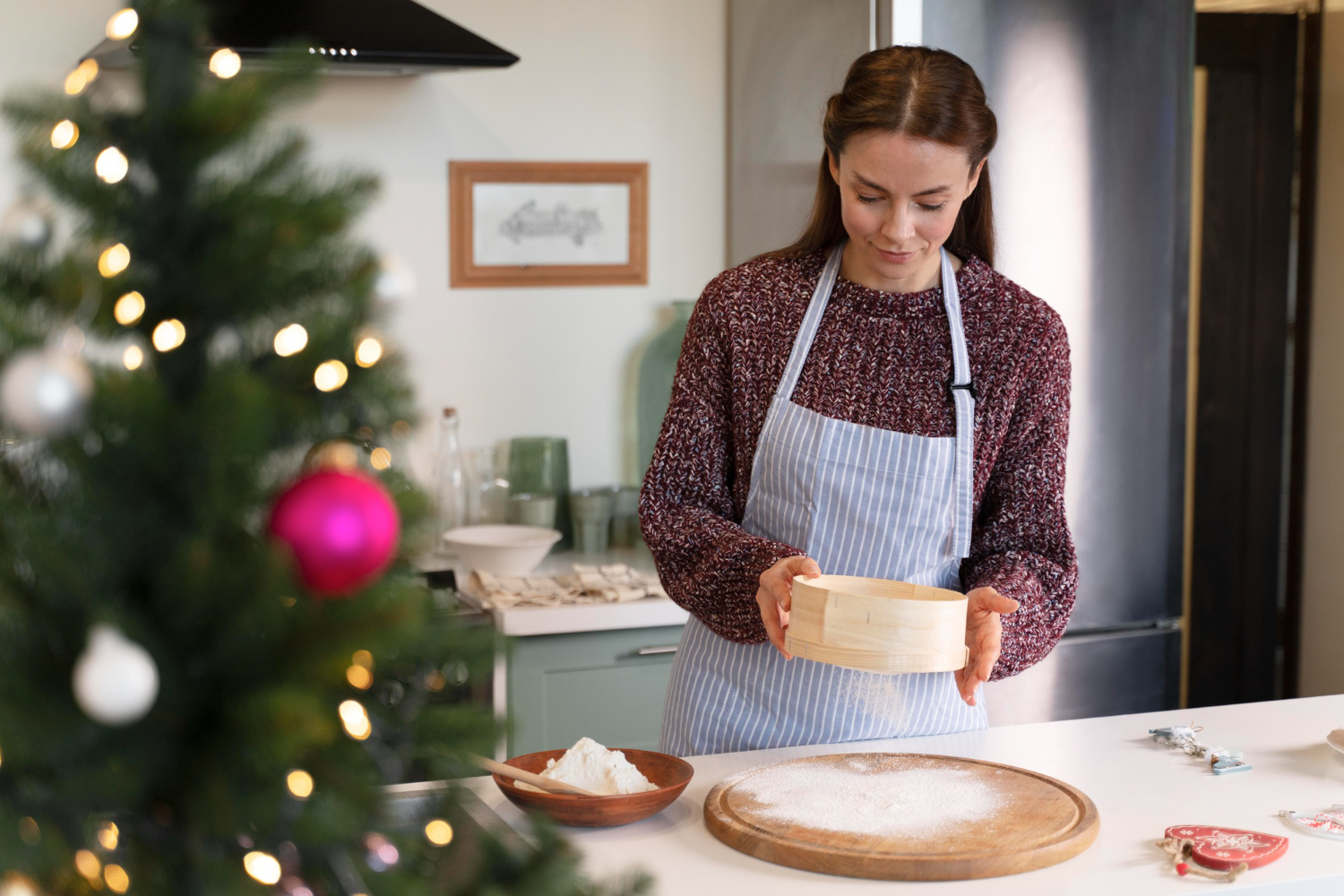
The kitchen smelled like exhaustion masquerading as holiday cheer—sage and butter and roasted turkey, cinnamon and brown sugar, the yeasty warmth of rising dough mixed with the acrid bite of stress sweat that no amount of expensive soap could quite wash away. Emily Tate wiped her forehead with the back of her wrist, leaving a streak of flour across her temple that she wouldn’t notice until hours later when she caught her reflection and barely recognized the woman staring back.
Five o’clock in the morning. That’s when her alarm had gone off, though she’d been awake since four-thirty, staring at the ceiling and mentally reviewing her checklist. Turkey in the brine. Pies assembled but not baked yet. Potatoes peeled. Green beans trimmed. The dining room table set with the good china—the china she’d bought last year after her mother mentioned how “embarrassing” it was to serve holiday meals on everyday dishes.
Her lower back throbbed with the particular ache that comes from standing too long in one place, shifting weight from foot to foot but never actually sitting down, never actually resting. She’d learned years ago that sitting down during holiday preparations was a luxury she couldn’t afford. The moment she sat, someone would need something, and the fact that she’d been working for six hours straight wouldn’t matter. What would matter was that she wasn’t immediately available.
“Mommy, I finished the potatoes.”
Emily turned to find her seven-year-old son Noah perched on the wooden step stool they kept specifically for him, his small hands pink and wrinkled from the cold water, a bowl of perfectly peeled potatoes sitting proudly in front of him. He was the only person in the house who’d asked if she needed help. He was the only one who’d noticed she’d been working alone since dawn.
“Thank you, sweetheart,” Emily said, and her voice cracked just slightly with the kind of emotion that had nowhere else to go. She leaned down and kissed the top of his head, breathing in the little-boy smell of his shampoo mixed with potato starch. “You’re the best helper I could ask for.”
Noah beamed up at her with gap-toothed pride, and for a moment—just a moment—the weight pressing down on Emily’s shoulders lifted slightly. Then the kitchen door swung open with enough force to bang against the wall, and her sister Chloe swept in on a cloud of expensive perfume and entitlement.
Chloe looked like she’d stepped out of a holiday catalog shoot. Her cream cashmere sweater—the one Emily had bought her for her birthday three months ago—was pristine, not a single stain or wrinkle marring its perfection. Her hair fell in glossy waves that had clearly been professionally styled that morning, and her nails were painted a deep, festive red that probably cost more than Emily’s weekly grocery budget.
“Why aren’t the appetizers out yet?” Chloe asked, not looking at Emily but checking her reflection in the polished stainless steel of the refrigerator door, turning her head to admire her own profile. “Mom and I are dying of thirst out there. And honestly, it’s a bit warm in here. Could you turn the AC down? I don’t want to sweat through this cashmere.”
Emily stood holding a twenty-pound roasting pan, her arms trembling slightly from the weight and the accumulated fatigue of seven hours of nonstop cooking. “I’m a bit busy with the main course right now, Chloe. The wine’s already uncorked in the fridge—it’s right behind you.”
Chloe turned, her perfectly shaped eyebrows rising in theatrical dismay. “Are you serious? I just got my nails done this morning. You want me digging through a greasy refrigerator? That’s what you’re here for, isn’t it? To handle the… logistics?”
Before Emily could formulate a response that wouldn’t turn into a scream, their mother glided into the kitchen. Martha Tate adjusted the pearl necklace at her throat—pearls Emily had given her last Mother’s Day as a “thank you for being such an amazing mom” gift—and sighed with the kind of dramatic weariness usually reserved for tragedy.
“Emily, don’t be so prickly with your sister,” Martha said, her voice carrying that particular tone of gentle disappointment she’d perfected over decades. “Chloe’s had a very stressful week at the boutique. You know how demanding her clients can be. You’re lucky you get to work from home in your pajamas while the rest of us have to actually face the world. Now chop-chop. Guests will be arriving soon, and your apron looks like you’ve been wrestling farm animals.”
Emily looked down at her stained apron, then at her mother’s pristine silk blouse—also a gift from Emily, purchased during a shopping trip where Martha had mentioned how “shabby” her wardrobe had become. She looked at Noah, who had stopped smiling and was now hunched over his potatoes, making himself as small as possible, having learned through painful experience that adult conflict was something to hide from.
“I’ve been cooking since five this morning, Mom,” Emily said, and she heard the tremor in her own voice, hated herself for it. “I’ve prepared twelve dishes. I cleaned the entire house yesterday. I did all the grocery shopping. Alone.”
“Well, that’s your love language, isn’t it?” Chloe said brightly, reaching out to pluck a piece of crispy skin from the turkey Emily had just spent twenty minutes basting to golden perfection. She popped it in her mouth without a second thought. “You love playing the martyr. Now get the wine. And don’t forget the linen napkins—not those cheap paper ones.”
They swept out as quickly as they’d entered, leaving behind the scent of expensive perfume and the echo of casual cruelty. Emily gripped the edge of the counter so hard her knuckles went white. Something cold and clear was crystallizing in her chest, replacing the warm, desperate need for approval that had governed her actions for thirty-two years.
Noah’s small hand touched her arm. “Mommy? Are you okay?”
Emily looked at her son and forced a smile. “I’m fine, baby. Let’s finish this turkey, okay?”
But she wasn’t fine. Something fundamental was shifting, like tectonic plates realigning deep beneath the surface. She just didn’t know yet what earthquake was coming.
The dining room was a masterpiece. Emily had spent two hours the previous evening transforming it into something out of a magazine spread—fine linen tablecloth she’d bought specifically for this dinner, beeswax candles in antique holders she’d found at an estate sale, fresh pine boughs arranged artfully down the center of the table. The china gleamed. The crystal sparkled. Twelve dishes sat steaming and perfect, representing hours of labor and hundreds of dollars in ingredients.
Emily sat at the far end of the table, Noah beside her, both of them picking at their food with the kind of careful quiet that had become their survival mechanism. For forty-five minutes, the conversation had revolved around Chloe—her promotion at the boutique (secured using presentation materials Emily had ghost-written over three weekends), her upcoming vacation to Cabo (subsidized by Emily under the guise of an early Christmas present), her brilliant fashion sense (enabled by the monthly “loans” Emily provided that were never paid back).
Martha beamed at her younger daughter like she’d personally invented success. “I’m just so proud of you, Chloe. You’re the star of this family. A true achiever. I tell all my friends about your accomplishments.”
Emily pushed green beans around her plate and said nothing. She’d learned years ago that her own accomplishments—her six-figure salary as a software engineer, the patents she held, the consulting offers she regularly declined—didn’t count as real achievements in her mother’s eyes. Something about working from home made it all seem less legitimate, less impressive than Chloe’s retail management position.
Then Chloe’s fork paused mid-air. She scanned the table with narrowing eyes, and Emily felt her stomach drop before her sister even spoke. She knew that look. That was the look of someone searching for ammunition.
“Where is my cranberry sauce?”
Emily’s mind went blank for a moment. “What?”
“The cranberry sauce!” Chloe’s voice rose, sharp enough to make Noah flinch. “I texted you last week, Emily. I told you I wanted the orange-zest-infused homemade sauce. The recipe from that cooking blog I sent you. I can’t eat turkey without it. You know the canned stuff gives me a migraine.”
Emily’s exhausted brain tried to process this. She’d made stuffing from scratch. She’d made three types of potatoes. She’d made green bean casserole and roasted Brussels sprouts and candied yams and homemade rolls and two pies and a chocolate cake. She’d spent over three hundred dollars on ingredients and twelve hours cooking. And she’d forgotten one dish.
“I’m sorry, Chloe,” Emily said, and she heard how tired she sounded, how defeated. “I made twelve other dishes. I stayed up until two in the morning baking pies from scratch. I just… I forgot the cranberry sauce.”
“You forgot?” Chloe slammed her hand on the table, making the wine glasses jump and Noah’s water slosh over the rim. “You did it on purpose! You always try to sabotage my favorite things because you’re jealous of my success. Mom, look! She ruined Christmas! This entire dinner is a failure now!”
Martha set down her wine glass—wine from the hundred-dollar bottle Emily had purchased—with a heavy thud. She looked at Emily with that particular expression of maternal disappointment that had shaped Emily’s entire personality, the look that said you’ve let me down again.
“Emily, this is really too much,” Martha said, shaking her head slowly. “You’ve always been thoughtless about the things that matter to other people. You know how important tradition is to Chloe. After everything she’s been through this year, you couldn’t do this one small thing for her?”
“Thoughtless?” The word came out of Emily’s mouth attached to a laugh that sounded wrong, hollow and sharp at the same time. “I’m thoughtless? I paid for every single item on this table. I cooked everything. I cleaned for it. I set up for it. And you’re calling me thoughtless over a bowl of cranberries?”
“Don’t you dare throw your money in our faces,” Chloe hissed, her face flushing red in a way that clashed with her carefully applied makeup. “Just because you have some fancy tech job doesn’t give you the right to treat us like charity cases. If you can’t be a gracious host to your own flesh and blood, if you’re going to hold every little expense over our heads, then maybe you shouldn’t be here at all.”
Martha nodded slowly, as if this was a reasonable conclusion she’d been coming to herself. “She’s right, Emily. The atmosphere has become quite toxic. Your negative energy is spoiling the holiday. If you’re going to be this resentful every time you do something nice, perhaps you and Noah should just… go home. We’ll finish dinner in peace.”
The room went very quiet. Emily could hear the antique clock ticking in the hallway, each second loud as a gunshot. She could hear Noah’s breathing beside her, rapid and shallow, the sound of a child who’d witnessed too many of these moments. She could hear her own heartbeat, slower than it should be, steady and cold.
She looked at Chloe, who was already reaching for the wine bottle again, confident that Emily would apologize like she always did. She looked at her mother, who wouldn’t meet her eyes, who was already mentally rearranging the narrative so Emily’s departure would be Emily’s fault. She looked at the feast she’d created, at the hundreds of dollars and dozens of hours spread across expensive china.
Then she looked at Noah. Her seven-year-old son was trembling slightly, his small hands gripping his fork too tightly, his eyes wide and wet. He was waiting for her to fold, to apologize, to make herself smaller so the peace—the false, toxic peace—could be restored.
But Emily was done making herself smaller. She was done apologizing for not being enough when she was the only one doing anything.
“You’re right, Mom,” Emily said quietly, and her voice had changed into something her mother and sister didn’t recognize. It was calm. It was clear. It was final. “Christmas will be much better without my negative energy.”
She stood up. She didn’t throw her napkin down dramatically. She didn’t raise her voice. She simply folded her napkin neatly, placed it beside her plate, and said, “Noah, get your coat. We’re leaving.”
“Oh, stop being dramatic, Emily,” Chloe said, rolling her eyes and reaching for another dinner roll. “Just go check if you have a can of the cheap stuff in the pantry. Maybe we can forgive you after that.”
Emily didn’t respond. She walked to the coat closet with Noah trailing behind her, his small hand clutching the hem of her shirt. She helped him into his jacket with steady hands, zipped it up, pulled his hat down over his ears.
“Mommy?” Noah whispered. “Are we really leaving?”
“Yes, baby. We really are.”
Martha called from the dining room, her voice carrying that edge of annoyance she got when people didn’t follow her script. “Emily, this is childish. Sit back down and stop making a scene.”
Emily walked back to the dining room doorway. Her mother and sister looked up at her expectantly, still certain she would crumble, still confident in their power over her.
“Enjoy your meal,” Emily said. “Eat every bite. Savor it. Because it’s the last meal you’ll ever eat for free under this roof.”
Chloe laughed, sharp and dismissive. “Under this roof? Emily, this is Mom’s house. You don’t get to make declarations about—”
“Actually,” Emily interrupted, and now her voice was cold enough to frost glass, “I bought this house from the bank three years ago when Mom defaulted on the mortgage Dad left behind. I’ve been paying the mortgage, the property taxes, the insurance, and the utilities ever since. The title is in Mom’s name because I was trying to preserve her dignity. But the house is mine. Every pipe, every wire, every shingle. Mine.”
The color drained from Martha’s face. Chloe’s mouth opened and closed without sound.
“So yes,” Emily continued. “This roof. My roof. Enjoy it while it lasts.”
She turned and walked out the front door with Noah, leaving behind a silence so profound it felt like the house itself was holding its breath.
The December air was sharp enough to sting, but Emily barely felt it. She buckled Noah into his car seat, her hands perfectly steady despite the adrenaline coursing through her system. The little boy looked up at her with wide, worried eyes.
“Mommy, are we in trouble?”
“No, sweetheart. We’re not in trouble. But Grandma and Aunt Chloe might be.”
Emily sat in the driver’s seat and looked at the house through the windshield. It was beautiful—a classic colonial with white trim and black shutters, glowing with thousands of LED lights she’d spent an entire weekend hanging by herself while Chloe and Martha sat inside drinking hot cocoa and criticizing her light-hanging technique.
She pulled out her phone and opened her banking app, navigating to the automatic payments section.
Mortgage Auto-Draft: $2,847.00 (Payer: Emily Tate) Property Tax Escrow: $425.00 monthly (Payer: Emily Tate) Home Insurance: $186.00 monthly (Payer: Emily Tate) Utility Master Account: $340.00 average monthly (Payer: Emily Tate)
Every single bill for this house came out of Emily’s account. Chloe lived in the basement apartment rent-free while she “pursued her passion” for fashion, a pursuit now in its fourth year and requiring regular financial infusions that Emily provided under the label of birthday gifts and Christmas presents and just-because surprises.
Emily looked at the kitchen window. She could see shadows moving inside, her mother and sister probably already dissecting what had just happened, crafting a narrative where Emily was ungrateful and dramatic and wrong.
“They wanted peace and quiet,” Emily whispered to herself. “I’m going to give them the quietest night of their lives.”
She opened the SmartHome app on her phone. She’d spent two months last spring installing the system—smart locks, smart thermostat, smart lighting, smart meter with landlord-level control. She’d done it to make her mother’s life easier, to let Martha control everything from her phone. What Martha didn’t know was that Emily’s phone was the master account. Every device, every system, ultimately answered to Emily.
First, she went to User Management. Two authorized users appeared: Martha Tate and Chloe Tate.
She selected both names. A confirmation dialog appeared: Remove users? This will revoke all access privileges.
Emily tapped Yes.
Next, she navigated to the Utilities section. The smart meter was registered in her name with landlord override capabilities—a feature designed for emergencies like gas leaks or electrical fires. She found the Emergency Service Disconnect option.
Her finger hovered over the button. This was the point of no return. Everything up until now could be walked back, apologized for, smoothed over. This was permanent.
She thought about Noah trembling at the dinner table. She thought about twelve hours of cooking dismissed over cranberry sauce. She thought about thirty-two years of trying to earn love from people who saw her as an ATM machine with a pulse.
She pressed the button.
Finally, she opened the climate control panel. The thermostat was currently set to a comfortable seventy-four degrees. She changed it to Off and enabled the security lock feature, setting a twelve-digit override code that only she knew.
The last step was the smart locks. Every entrance to the house—front door, back door, garage—was controlled through the app.
“Mommy, what are you doing?” Noah asked from the backseat.
Emily looked at her son in the rearview mirror. His eyes were wide but not scared. Curious. Maybe even a little bit excited, like he could sense something important was happening.
“I’m teaching your grandma and your aunt a very important lesson, sweetheart. I’m showing them that the roof over their heads isn’t held up by magic or by meanness. It’s held up by the person they just threw away.”
She activated the auto-lock feature on all entrances and set the authorization to Master Account Only.
Then she pressed Save.
Inside the house, Chloe was pouring herself another glass of wine, confident that Emily would come crawling back with apologies by tomorrow morning like she always did. “She’s so predictable,” Chloe said, laughing. “So emotional. Tomorrow she’ll be here with flowers and probably another expensive gift to make up for her little tantrum.”
Martha was nodding, already composing the speech she’d give about how disappointed she was in Emily’s behavior, how family should always come first, how—
The crystal chandelier above the dining table flickered once and died. The twinkling lights on the Christmas tree vanished. The soft holiday music playing through the house’s built-in speaker system cut off mid-note. Even the gentle hum of the refrigerator in the kitchen ceased.
The house was plunged into absolute darkness and absolute silence.
“What happened?” Chloe shrieked, her wine glass clattering against the table. “Mom! Did a fuse blow?”
“It must be the storm,” Martha said, though her voice was uncertain. “Alexa! Turn on the living room lights!”
Nothing.
“Alexa?” Martha tried again, louder, her voice taking on an edge of panic.
From somewhere in the darkness, the small device pulsed a single red light. “I’m sorry. I cannot connect to the internet. Please check your router power.”
Chloe fumbled for her phone, using its flashlight to navigate. “The Wi-Fi is down too? I’ll check the breaker box in the basement.”
She ran downstairs, but the smart electrical panel was completely dark. She flipped switches desperately, but nothing responded. The house remained tomb-dark and tomb-silent.
Then they heard it—a series of synchronized clicks from every entrance. The heavy-duty smart locks sliding into their secured positions.
“What was that?” Martha’s voice had gone shrill. “Chloe! The front door! I can’t turn the handle!”
They scrambled to the front window and yanked back the heavy velvet curtains. Outside, the neighborhood was bright with Christmas lights. The house across the street glowed with festive cheer. The streetlights worked perfectly.
And there, at the end of the driveway, was Emily’s SUV. Engine running. Headlights cutting through the falling snow.
Chloe pounded on the window. “Emily! Turn the power back on! The heat just stopped! It’s already getting cold in here!”
Emily lowered her driver’s side window just an inch. “I thought you wanted a quiet Christmas,” she called back, her voice carrying clearly through the cold air. “No negative energy. No drama. This is what you asked for.”
“You’re insane!” Martha screamed, her breath already starting to fog in the rapidly cooling air. “Open this door right now! The food will spoil! My tropical fish tank will freeze!”
“The food is mine. The fish tank is mine. The electricity that powers it is mine.” Emily’s voice was calm, almost gentle, which made it somehow more terrifying. “Everything in that house exists because I pay for it. And you just told me to take my resentment and leave. So I’m taking everything that’s mine. Which is everything.”
Chloe’s face pressed against the glass, distorted with rage and dawning fear. “Chloe, you told me not to throw money in your face,” Emily said. “So I’m removing it entirely. Use your star power to keep warm. Use your achievements to generate electricity. Let’s see how long your cashmere lasts in a house with no heat.”
“You can’t do this!” Chloe shrieked. “This is Mom’s house!”
Emily held up her phone, showing them the digital deed displayed on the screen. “Actually, it’s my house. I’ve been letting you play house. Consider this your eviction notice. You have sixty seconds to grab your coats and purses and leave. Starting now.”
“Emily, please!” Martha’s voice cracked, the imperious tone completely gone, replaced by desperate pleading. “I’m sorry! I didn’t mean those things! You’re the backbone of this family! Please, I’m an old woman, I can’t be in the cold like this!”
“Sister, please!” Chloe was crying now, mascara running down her face. “I was just stressed! I’ll buy the cranberry sauce myself! I’ll clean the entire kitchen! I’ll even apologize to Noah! Just let us back in!”
Emily watched them through the glass—two grown women shivering in the dark, begging for the comfort provided by the person they’d just treated like a servant. She’d spent fifteen years imagining this moment, thinking it would feel powerful.
Instead, she just felt tired.
They weren’t sorry for how they’d treated her. They were sorry they were cold. They were sorry the consequences had arrived.
“You have sixty seconds to get your coats and your purses,” Emily said. “I’m unlocking the front door for exactly one minute. If you’re not out by then, I’ll lock it again and you can call the police. But I should warn you—I have the deed, the mortgage statements, and the utility bills all in my name. You’re trespassing in my house.”
She pressed a button on her phone. The front door lock clicked open.
Chloe and Martha stumbled out into the snow wearing thin indoor clothing, clutching their designer purses. They looked small and pathetic standing in the harsh glare of the SUV’s headlights.
“Emily, don’t do this,” Martha sobbed. “Where are we supposed to go?”
“You know, Mom, that’s a really good question. Maybe you should have thought about that before you told me to leave my own house.” Emily put the car in reverse. “The locks are being changed tomorrow. I’ll have your belongings boxed up and on the porch by the twenty-seventh. Don’t call me. I’ve already blocked your numbers. Merry Christmas.”
She backed down the driveway, leaving two sets of tire tracks in the fresh snow. In the rearview mirror, she watched her mother and sister growing smaller, shrinking into the darkness until they disappeared entirely.
Noah was quiet in the backseat, processing what he’d witnessed. Finally, he said softly, “Mommy, where are we going?”
Emily realized she had no idea. She’d planned the confrontation but not the aftermath. She drove aimlessly for a few minutes, then spotted the neon sign of a 24-hour diner flickering in tacky red and blue.
“How about Christmas dinner, round two?” she said.
The diner was nearly empty—just a tired-looking waitress wearing a Santa hat and a couple of truckers hunched over coffee at the counter. Emily and Noah slid into a cracked vinyl booth, and Emily felt something unknot in her chest. The air smelled like cheap coffee and maple syrup and grease. It smelled like freedom.
The waitress walked over with a weary smile. “Merry Christmas, folks. What can I get you?”
“We’ll take two double cheeseburgers, a mountain of chili cheese fries, and two chocolate milkshakes with extra whipped cream,” Emily said.
“No turkey today?” the waitress joked.
Emily laughed—a real laugh, not the performative kind she’d been producing for years. “I think we’re done with turkey for a very long time.”
Noah was already busy with the crayons the waitress had brought, coloring on the back of the paper placemat. He looked happier than Emily had seen him in months. No one was shushing him. No one was telling him to sit still or act like a little gentleman.
“Mommy,” Noah looked up, a smudge of blue crayon on his cheek, “this is the best Christmas ever.”
Emily felt tears sting her eyes. “Why is that, baby?”
“Because you’re not sad anymore,” Noah said with the uncomplicated wisdom of children. “And because we get to eat fries.”
Emily’s phone buzzed. Then buzzed again. And again. Within five minutes, she had fifty-four missed calls and over a hundred text messages. She didn’t read them. She didn’t need to see the threats, the guilt trips, the manipulation disguised as apologies.
She swiped and selected Delete All. Then she toggled her phone to Do Not Disturb.
The waitress brought their milkshakes—tall glasses with swirls of whipped cream and a cherry on top. Noah’s eyes lit up like she’d brought him the moon.
“Mommy, look! It’s perfect!”
Emily picked up her straw and took a long sip. It tasted cold and sweet and absolutely nothing like obligation. It tasted like the first day of the rest of her life.
“You know what, Noah? You’re absolutely right. This is the best Christmas ever.”
Outside, snow was falling softly, covering the parking lot in clean white. Emily watched it through the window and thought about tomorrow. She’d call a real estate agent. She’d sell the house on Maple Drive and everything in it. She’d take the money and buy a smaller place—a place where only kindness was allowed through the door, where her son could laugh without fear, where she could finally, finally rest.
She’d spent thirty-two years cooking the perfect meals and buying the perfect gifts, trying to earn a seat at a table where she was never truly wanted. Tonight, she’d lost a family. But she’d found something more valuable—her self-respect, her peace, and the knowledge that she didn’t have to shrink herself to make room for people who only saw her as a resource to exploit.
“Mommy, the fries are here!” Noah cheered as the waitress set down a plate piled high with greasy, perfect comfort food.
Emily picked up a fry and bit into it. It was salty and hot and tasted like victory.
The diner’s jukebox flickered to life, playing an old jazzy version of “Silent Night.” Noah hummed along, swinging his legs under the table, completely content.
Emily looked at her son—really looked at him—and saw a child who was learning right now, in this moment, that it was okay to walk away from people who hurt you. That love wasn’t supposed to feel like servitude. That family was supposed to build you up, not tear you down.
“Hey, Noah?” Emily said softly.
“Yeah, Mommy?”
“I love you. And I’m sorry I didn’t do this sooner.”
Noah smiled, his mouth ringed with whipped cream. “It’s okay. We’re here now.”
Yes, Emily thought, reaching across the table to wipe the cream from his face. We’re here now.
And for the first time in longer than she could remember, here was exactly where she wanted to be.
Outside, the snow kept falling. Inside the diner, the coffee stayed hot and the music played soft. Emily Tate sat in a cracked vinyl booth with her son, eating cheap food that tasted expensive because it came with no strings attached, no guilt, no expectations beyond enjoy your meal.
She’d walked away from a Norman Rockwell painting of Christmas dinner. She’d walked away from tradition and obligation and the desperate need to be enough for people who would never be satisfied.
And she’d walked straight into something better—a shabby diner at midnight with her son, both of them wearing ketchup stains and happiness in equal measure.
That night, tucked into a modest hotel room Emily paid for with her own money, Noah fell asleep almost immediately, exhausted from the emotional upheaval but somehow more peaceful than Emily had seen him in months. She sat by the window watching the snow fall and making plans.
Tomorrow she’d call her lawyer. She’d begin eviction proceedings if necessary. She’d change every lock, every code, every password. She’d reclaim every inch of the life she’d built and defended it with the ferocity she should have shown years ago.
But tonight? Tonight she was just a woman who’d finally said enough. Who’d finally chosen herself and her son over the comfortable lie of family harmony.
Her phone lit up one more time. A text from an unknown number: You’ll regret this.
Emily smiled, deleted it, and turned off her phone.
She didn’t regret it. Not even a little.
She regretted the wasted years. She regretted the money spent trying to buy love. She regretted every apology she’d made for sins she didn’t commit.
But walking away? Standing up? Choosing peace over performance?
That she would never, ever regret.
Emily Tate closed her eyes and slept better than she had in fifteen years, dreaming not of the family she’d lost but of the life she was finally free to build.

Ethan Blake is a skilled Creative Content Specialist with a talent for crafting engaging and thought-provoking narratives. With a strong background in storytelling and digital content creation, Ethan brings a unique perspective to his role at TheArchivists, where he curates and produces captivating content for a global audience.
Ethan holds a degree in Communications from Zurich University, where he developed his expertise in storytelling, media strategy, and audience engagement. Known for his ability to blend creativity with analytical precision, he excels at creating content that not only entertains but also connects deeply with readers.
At TheArchivists, Ethan specializes in uncovering compelling stories that reflect a wide range of human experiences. His work is celebrated for its authenticity, creativity, and ability to spark meaningful conversations, earning him recognition among peers and readers alike.
Passionate about the art of storytelling, Ethan enjoys exploring themes of culture, history, and personal growth, aiming to inspire and inform with every piece he creates. Dedicated to making a lasting impact, Ethan continues to push boundaries in the ever-evolving world of digital content.