At My Daughter’s 13th Birthday, My Nephew Crushed Her Galaxy Cake With His Hand and Shouted, “Boring!”
The bakery called at eleven to say the cake was ready, which was perfect timing because I’d taken the afternoon off work and Lena’s party didn’t start until six. I’d been thinking about this cake for weeks—ever since she showed me the inspiration photo on her phone with that careful, practiced nonchalance that meant she cared more than she wanted to admit.
“Something like this,” she’d said, angling the screen so I could see. “But only if it’s not too expensive.”
She was always doing that. Adding disclaimers. Building in exit ramps so disappointment wouldn’t hit as hard if I said no.
I’d looked at the image—a galaxy cake, all midnight blue frosting swirled with deep purple and black, tiny edible sugar stars scattered across the surface like someone had spilled the Milky Way, and a silver 13 topper that caught the light like a promise.
“We’ll get it,” I’d told her.
“Mom, seriously, we don’t have to—”
“Lena. We’re getting it.”
By noon I’d picked it up from the bakery, driving home with both hands careful on the wheel and the box secured in the passenger seat like precious cargo. The woman at the counter had shown it to me before boxing it up, and even she seemed proud of how it turned out. The frosting was perfect—that deep cosmic blue that looked like you could fall into it, with silver stars that seemed to glow against the darkness.
Lena had chosen it herself, which was rare. My daughter doesn’t ask for much. She doesn’t demand attention or throw fits when things don’t go her way. She watches. She waits. She measures her own worth by how little space she takes up, and I’ve spent thirteen years trying to teach her she deserves to take up more.
She doesn’t want loud parties with fifty kids and a bounce house and a DJ. She wants moments that feel like hers—small, intentional, safe.
I’m Mia Chen, thirty-nine years old, raising my daughter in a two-bedroom rental in Columbus, Ohio, on a medical transcriptionist’s salary that covers rent and groceries but doesn’t leave much room for error. The apartment is small but clean, with Lena’s artwork taped to the refrigerator and a kitchen table that wobbles if you lean on it wrong. We’ve lived here for five years, ever since her father decided that fatherhood was optional and child support was more of a suggestion than an obligation.
My parents live fifteen minutes away in the house where I grew up—a modest ranch with a chain-link fence and a yard my father still mows himself every Sunday. My older brother Adam lives even closer, just ten minutes in the opposite direction, in a house he bought with his wife’s money and treats like a crash pad between his actual life.
In our family, I’m the reliable one. The fixer. The one who shows up when things break down and quietly handles whatever mess needs handling. I’m the one who drove my mother to her cancer appointments when Adam was “too busy with work.” I’m the one who loaned my parents money when their furnace died in January. I’m the one who remembers birthdays and organizes holidays and mediates fights and smooths over the friction that comes from people who love each other in theory but struggle with the practice.
Adam is present but rarely helpful. He shows up for the easy parts—the dinners, the photos, the moments that make him look good—but disappears when actual work needs doing. His wife, Jennifer, is pleasant in that distant way that suggests she’s already checked out of the marriage but hasn’t filed the paperwork yet. And his son, Oliver, is twelve years old and raised on laughs instead of limits.
Oliver is the kind of kid who tests boundaries like he’s conducting a scientific experiment to see how much he can get away with before someone actually stops him. He’s loud. He’s physical. He grabs things that don’t belong to him and treats other people’s spaces like extensions of his own playground. And every time he crosses a line, Adam laughs like it’s charming instead of concerning, and my parents—especially my dad—act like boys will be boys and discipline is just another word for crushing their spirit.
I’d invited them all to Lena’s birthday party because that’s what you do. Because they’re family. Because Lena had asked, quietly, if her cousins were coming, and I couldn’t tell my thirteen-year-old daughter that I didn’t trust her own family to behave themselves at her birthday party.
That evening, my living room was transformed into something that almost looked festive. Purple streamers hung from the ceiling—Lena’s favorite color—and I’d strung up fairy lights around the windows that gave everything a soft, magical glow. The kitchen table was pushed against the wall and covered with a purple tablecloth, loaded with pizza boxes, a fruit tray from the grocery store, and juice boxes because half the guests were still young enough to prefer them.
Lena had invited six friends from school—quiet girls who liked art and reading and spoke in those careful, earnest voices that suggested they’d all been through something that taught them to be gentle with each other. They sat clustered on the floor near Lena’s sketchbook, examining her drawings with the kind of serious attention that adults rarely give to children’s work.
Oliver arrived like a weather event—loud, disruptive, immediately testing every surface in the apartment to see what he could climb on or knock over. He bounced from the couch to the kitchen table, tugging at streamers, flicking the fairy lights, picking up decorations and setting them down in wrong places just to see if anyone would notice.
“Oliver, careful,” Jennifer said, but her voice had no teeth in it, just that tired resignation of someone who’d given up years ago.
Adam clapped his son on the shoulder and grinned at me. “He’s just excited. Kid’s got energy, what can you do?”
What you can do, I thought but didn’t say, is parent him.
My parents arrived last—my mother carrying a gift bag, my father already complaining about parking even though there was plenty of street parking directly in front of my building. They settled onto my couch like visiting dignitaries, accepting offered drinks and making small talk that somehow always circled back to Adam’s job or Oliver’s soccer team or literally anything except Lena.
We ate pizza. We played a game where the kids had to guess songs from their first three seconds, and Lena actually smiled—really smiled—when she got one right and her friends cheered. For about an hour, it felt like maybe this would work. Maybe the party would be normal. Maybe, for once, my family would just show up and be kind without needing to be managed.
Then it was time for presents.
Lena opened them carefully, the way she does everything—folding the wrapping paper instead of ripping it, reading each card before moving to the next gift. Her friends had gotten her art supplies: fancy colored pencils, a new sketchbook with thick paper, a set of watercolors that made her eyes light up in that quiet way she had when something mattered.
Oliver sat on the arm of the couch, watching with increasing irritation as Lena thanked each friend and carefully set each gift aside.
“That’s it?” he said, loud enough for everyone to hear. “Just art stuff?”
Lena’s smile flickered.
“Oliver,” Jennifer said, but again, no force behind it.
Adam chuckled. “Kid’s used to video games and sports equipment. Different interests, you know?”
He said it like it was harmless. Like his son hadn’t just dismissed my daughter’s joy as insufficient.
I felt something tighten in my chest but swallowed it down. “Different interests are good,” I said evenly. “Lena loves art.”
“Yeah, but it’s kinda boring though,” Oliver continued, emboldened by his father’s chuckle. “Like, what are you even gonna do with colored pencils?”
“Create something beautiful,” one of Lena’s friends said quietly, and I could’ve hugged her.
My father shifted on the couch, clearly uncomfortable with the tension but unwilling to actually address it. My mother made a vague sound that might’ve been agreement or just acknowledgment that words had been spoken.
“Time for cake,” I announced, because if I didn’t move this party forward I was going to say something I’d regret.
I brought out the galaxy cake and set it carefully on the kitchen table. Even in the dim light of my small apartment, it was stunning. The colors seemed to glow, the silver stars catching the fairy lights, the whole thing looking like Lena had asked the universe for a cake and the universe had delivered.
Lena’s face transformed. That careful guardedness she wore like armor melted away, and for just a second she looked like a little girl again—the one who used to believe in magic before life taught her to expect less.
“Mom,” she whispered. “It’s perfect.”
I lit thirteen candles—the thin, elegant kind that don’t drip wax—and stepped back. Everyone gathered around the table, and I started singing “Happy Birthday,” my voice cracking slightly on the high notes. Everyone joined in—off-key and loud, the way birthday songs are supposed to be. Even Oliver sang, though he made it deliberately off-key in a way that suggested he was mocking the whole ritual.
Lena leaned forward, her eyes closed, making her wish with that intense concentration she brought to important things.
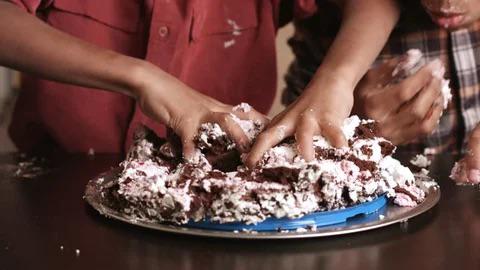
And then Oliver reached across the table and slammed his palm down into the center of the cake.
Not a gentle touch. Not an accident. A deliberate, violent motion that sent frosting jumping, made the silver 13 topper tip and fall, destroyed those carefully placed sugar stars and turned my daughter’s galaxy into a crater.
“BORING!” he shouted, and then he laughed—that sharp, performative laugh that’s designed to get other people to join in.
A couple of adults did laugh. Jennifer made a shocked sound that might’ve been amusement or disapproval, hard to tell. My father actually chuckled and shrugged like “kids, what can you do?”
Adam smirked. Didn’t say anything. Just smirked like his son had done something mildly naughty but ultimately harmless, the way you might smile at a puppy that chewed your shoes.
Lena didn’t cry.
She went completely still, staring at that ruined galaxy like she’d been erased. Like her wish had been destroyed before she could even finish making it. Her hands were still raised from where she’d been about to blow out the candles, frozen in mid-gesture like someone had paused her.
The room went quiet except for Oliver’s fading laughter.
My throat tightened with a rage so pure and focused it felt like ice rather than fire. But my voice, when it came out, was calm. Flat. The kind of calm that’s more dangerous than yelling.
“Party’s over,” I said. “Everyone needs to leave.”
“What?” Adam said, finally looking up from his phone.
“I said the party’s over. Please leave.”
“Mia, come on—” Jennifer started.
“Now.”
Coats rustled. Chairs scraped against the floor. Faces turned confused and offended, like I’d committed some social violation by asking people to leave after they’d destroyed my daughter’s birthday cake.
Lena’s friends moved quickly, gathering their things with that efficient politeness that suggested they understood something serious had happened even if they didn’t fully understand what. Their parents appeared in the doorway, looking uncertain, and I smiled at them—a real smile, not the tight one I was giving my family—and thanked them for coming.
Adam stood up slowly, his face darkening. “You’re seriously kicking us out because of a cake?”
“I’m asking you to leave because your son destroyed something important to my daughter and you thought it was funny.”
“He’s twelve. He was just playing around—”
“He’s twelve and he’s never learned that other people’s things matter. I wonder why that is.”
“Don’t talk to me about parenting—”
“Then don’t bring your badly parented child into my home and expect me to smile while he ruins my daughter’s birthday.”
My father stood up, trying to play peacemaker the way he always did when things got uncomfortable. “Mia, honey, don’t be dramatic. It’s just cake. We can order another one—”
“It’s not just cake, Dad. It’s respect. It’s boundaries. It’s thirteen years of watching you laugh at behavior that should’ve been corrected when he was six.”
“You’re overreacting,” my mother said, but her voice was weak, uncertain.
“Maybe. Or maybe I’ve been under-reacting for years, and this is what it looks like when I finally stop.”
I walked to the front door and held it open. The night air rushed in, cool and clean, carrying the smell of rain that hadn’t quite arrived yet.
One by one, they filed out. Jennifer wouldn’t meet my eyes. Adam muttered something under his breath about me being “impossible” and “just like always.” My father shook his head like I’d disappointed him. My mother touched my arm as she passed, a gesture that might’ve been sympathy or might’ve been reproach.
Oliver smirked at me on his way out, and I saw, clearly, that he didn’t think he’d done anything wrong. That he’d learned from years of watching adults laugh at his behavior that disruption was a form of power.
I clicked the lock behind them and stood in my small living room with its purple streamers and fairy lights and ruined cake, and took the first full breath I’d taken in hours.
Upstairs, I found Lena sitting on her bed with her knees pulled up to her chest, staring at the wall. She’d changed into her pajamas—the soft gray ones with the stars on them, which felt cosmically unfair given what had just happened—and her sketchbook sat unopened beside her.
I sat down next to her, and we stayed quiet for a moment, just breathing in the same space.
“I didn’t even get to blow them out,” she whispered finally, and the flatness in her voice terrified me more than tears would have.
I pulled her close, and she let me, which she didn’t always do anymore. At thirteen, she was caught in that strange space between childhood and whatever came next, sometimes wanting comfort and sometimes needing distance.
“You did nothing wrong,” I told her, meaning it with every cell in my body.
She was quiet for a long time. Then: “Do they not like me?”
The question landed like a punch to the chest.
“Oh, sweetheart—”
“Oliver always does stuff like that. And Grandpa always laughs. And Uncle Adam never stops him. So they must think… I don’t know. That I’m not worth protecting, or something.”
I kissed her hair, which still smelled like the baby shampoo she’d used since she was three, and tried to figure out how to explain adult dysfunction to a child who was too young to understand it but old enough to feel its effects.
“It’s not about you,” I said. “It’s about them not knowing how to set boundaries or enforce consequences. It’s about your uncle never learning to parent his son, and your grandfather thinking discipline is mean instead of necessary. It’s about broken patterns that have nothing to do with your worth.”
“Then why do I have to be around them?”
It was a fair question. One I’d been asking myself with increasing frequency over the past few years.
“You don’t,” I said. And saying it out loud felt like opening a window in a room that had been sealed for too long. “You don’t have to perform to be loved. You don’t have to accept bad behavior just because it comes from family. You can decide what you’re willing to tolerate and what you’re not.”
She absorbed this silently, and I could see her processing, filing it away for future reference.
“I’m sorry your party got ruined,” I said.
“It didn’t,” she said quietly. “The first part was good. My friends liked it.”
“We’ll do something else this weekend. Just us. Whatever you want.”
“Can we go to the art museum?”
“Absolutely.”
She nodded, and I could feel some of the tension leave her body. Not all of it—you don’t erase that kind of hurt in a single conversation—but enough that I knew she’d be okay. Eventually.
I kissed her forehead and left her with her sketchbook, heading back downstairs to deal with the aftermath.
The ruined cake still sat on the table, Oliver’s handprint visible in the destroyed frosting like a crime scene. Purple streamers drooped from the ceiling. Fairy lights blinked their oblivious pattern, unaware that the party was over.
My laptop glowed on the kitchen table where I’d left it earlier, open to the browser window I’d been using to track party RSVPs.
I sat down and opened a new tab, typing in a URL I knew by heart because I visited it every month: the education fund portal.
Seven years ago, when Oliver was five and Adam had just lost his third job in as many years, my parents had asked me to help set up an education fund for him. “Just temporarily,” they’d said. “Until Adam gets back on his feet.”
I’d been hesitant—I barely had enough for Lena’s future, much less my nephew’s—but family was family, and Adam was struggling, and wasn’t that what you did? Helped each other?
So I’d set up an automatic monthly contribution of two hundred fifty dollars from my checking account to Oliver’s 529 college savings plan. Not a huge amount, but significant for someone living paycheck to paycheck. Fifty dollars more than I put into Lena’s fund each month, actually, because my parents had convinced me that Adam needed more help.
That was seven years ago.
Seven years of two hundred fifty dollars a month, scheduled like a heartbeat, quietly depleting my account on the fifteenth of every month while I told Lena we couldn’t afford art classes or summer camp or the nicer apartment in the better school district.
Seven years of Adam never once thanking me. Never once acknowledging that I’d been keeping his son’s education fund alive while he bought new trucks and took vacations and lived like someone who didn’t have to think about consequences.
I’d been the one feeding that fund since day one. Not Adam. Not my parents, despite their initial promises to contribute. Just me, the reliable one, the fixer, quietly sacrificing pieces of my own daughter’s future to prop up someone else’s.
I clicked “Manage Account.”
The page loaded, showing the current balance: twenty-one thousand, three hundred and forty-two dollars. Every cent of it from my account. The contribution history showed no other sources—just “Mia Chen” month after month after month like a prayer I’d been reciting without knowing why.
A button at the bottom said “Modify Contribution.”
I clicked it.
A new page appeared with options: increase, decrease, or stop contribution. A text box asked me to confirm my choice.
My finger hovered over the mouse as my phone buzzed on the table next to the laptop, Adam’s name lighting up the screen with an incoming call.
I looked at the phone. Looked at the laptop. Looked at the ruined cake with my nephew’s handprint still visible in the frosting.
Then I moved my cursor to “Stop Contribution” and clicked.
A confirmation dialog appeared: “Are you sure you want to stop the monthly contribution? This action will take effect immediately.”
I clicked “Yes.”
Another screen: “Please provide a reason for stopping contribution.” A dropdown menu offered options: Financial hardship, Change in circumstances, Beneficiary no longer needs support, Other.
I selected “Other” and typed in the text box: “Beneficiary’s family has demonstrated that they don’t value the contributions being made or the person making them.”
My phone was still buzzing. Adam, persistent as always.
I hit “Submit.”
The screen refreshed. A banner appeared at the top: “Your contribution has been stopped. No further automatic payments will be processed.”
I closed the laptop and answered my phone.
“What the hell, Mia?” Adam’s voice came through hot and loud. “You kick us out like we’re criminals? Over a stupid cake?”
“Is there something you need, Adam?”
“I need you to stop being dramatic and apologize to Oliver. He’s upset that you yelled at him—”
“I didn’t yell.”
“You humiliated him in front of everyone—”
“He destroyed Lena’s birthday cake and you thought it was funny. I asked you to leave. That’s not humiliation. That’s consequences.”
“He’s twelve!”
“Exactly. He’s twelve and he still hasn’t learned that actions have consequences because people like you keep making excuses for him instead of parenting him.”
“Don’t tell me how to parent—”
“Then don’t bring your child into my home and expect me to tolerate his behavior while you do nothing to stop it.”
Silence on the other end. Then: “You’re being unreasonable.”
“Maybe. Or maybe I’m finally being reasonable and you’re not used to it.”
“Mom and Dad think you owe us an apology—”
“Mom and Dad enabled the behavior that led to this. They can think whatever they want.”
“This is about more than cake, isn’t it? This is about you being jealous that Oliver—”
“This is about me being done,” I said, and my voice was so calm it surprised even me. “Done making excuses. Done pretending bad behavior is harmless. Done sacrificing my daughter’s peace for the sake of family harmony that only ever seems to require my compliance.”
“You’re going to regret this—”
“I regret a lot of things, Adam. But standing up for my daughter isn’t one of them.”
I hung up before he could respond.
The apartment was very quiet. Outside, I could hear the distant sound of traffic, the hum of the refrigerator, the soft tick of the clock on the wall that was always three minutes fast.
I looked at the ruined cake. At the purple streamers. At the fairy lights that were still blinking their optimistic pattern.
Then I looked at my laptop, where the confirmation email from the education fund portal was already waiting in my inbox, timestamped at 8:47 PM.
Two hundred fifty dollars a month. Twelve months a year. Seven years.
Twenty-one thousand dollars I’d given to someone who couldn’t even teach his son to respect other people’s celebrations.
I opened the email and archived it, then opened my own banking app and looked at the budget I’d been maintaining for years. Next month, the fifteenth would come and go, and for the first time in seven years, two hundred fifty dollars would stay in my account.
I opened a new browser tab and navigated to Lena’s education fund. Created a new automatic contribution. Two hundred fifty dollars a month, starting next month, going to my own daughter’s future instead of someone else’s.
Then I closed the laptop and went upstairs.
Lena was asleep, her sketchbook open beside her to a half-finished drawing of what looked like a galaxy—blues and purples and tiny stars scattered across the page like she was trying to recreate what had been destroyed.
I pulled the blanket up over her shoulders and turned off the light, leaving just her nightlight glowing—a small moon that projected stars onto her ceiling.
Downstairs, my phone buzzed with texts. My mother: “Please call me. Let’s talk about this.” My father: “You were too harsh. He’s just a boy.” Jennifer: “This didn’t need to escalate like this.”
I turned off my phone and sat in the quiet of my small apartment, with its wobbling kitchen table and its purple streamers and its ruined cake, and felt something shift inside me.
Not anger anymore. Not rage.
Just clarity.
The kind that comes when you finally stop trying to fix things that were never your responsibility to fix in the first place.
THE END

Ethan Blake is a skilled Creative Content Specialist with a talent for crafting engaging and thought-provoking narratives. With a strong background in storytelling and digital content creation, Ethan brings a unique perspective to his role at TheArchivists, where he curates and produces captivating content for a global audience.
Ethan holds a degree in Communications from Zurich University, where he developed his expertise in storytelling, media strategy, and audience engagement. Known for his ability to blend creativity with analytical precision, he excels at creating content that not only entertains but also connects deeply with readers.
At TheArchivists, Ethan specializes in uncovering compelling stories that reflect a wide range of human experiences. His work is celebrated for its authenticity, creativity, and ability to spark meaningful conversations, earning him recognition among peers and readers alike.
Passionate about the art of storytelling, Ethan enjoys exploring themes of culture, history, and personal growth, aiming to inspire and inform with every piece he creates. Dedicated to making a lasting impact, Ethan continues to push boundaries in the ever-evolving world of digital content.