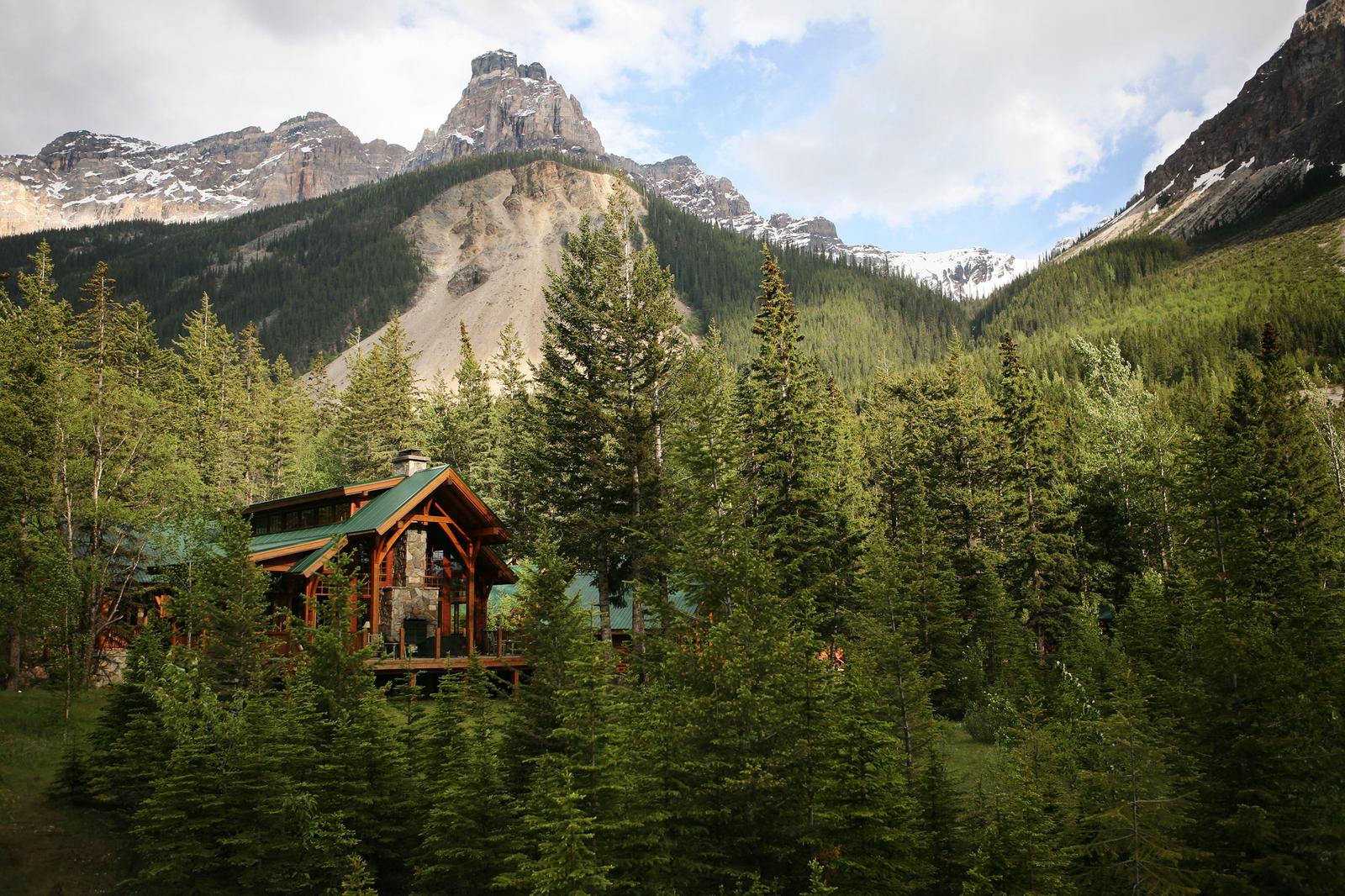
My Grandma Left Me Her $1,360,000 Mountain Lodge
The letter arrived on a Tuesday in March, when Denver was caught between winter’s last gasp and spring’s hesitant arrival. Heavy cream cardstock in a formal envelope with the return address embossed in navy: “Thompson & Associates, Estate Planning Attorneys.” The kind of mail that demands you sit down before opening it.
I knew what it meant before I broke the seal.
Grandma Dorothy had been gone for three weeks. The funeral had been small, held at the lodge she’d built from scratch forty years ago—the one perched on the edge of Willow Creek with views that made visitors go quiet and still. I’d stood in the back during the service, watching my father deliver a eulogy full of words like “beloved matriarch” and “family legacy” while my whole body hummed with the wrongness of him speaking for her at all.
Now I sat at my kitchen table in my small Denver apartment, the letter spread in front of me, reading the formal language that translated to: “You are required to attend the reading of Dorothy Anderson’s last will and testament.”
Required. Not invited. Required.
My name is Sophie Anderson, and at twenty-eight I’d finally built a life in Denver that felt quiet on purpose. A steady job as a graphic designer at a small firm that valued competence over drama. A one-bedroom apartment with secondhand furniture I’d chosen myself. Plants on the windowsill—a spider plant, a pothos, a stubborn succulent—that kept reaching toward the light even when I didn’t feel like I could.
That peace had cost me ten years.
The last time I’d lived under my father’s roof, I’d been eighteen and stupid enough to think honesty was the same as safety. I’d told him I wasn’t going to the college he’d chosen, wasn’t pursuing the degree he’d planned, wasn’t going to become the sanitized version of myself he needed me to be for his image.
He’d responded by slamming my suitcase onto the front porch, shoving a black trash bag full of my belongings into my arms, and saying, “If you walk out that door, don’t come back.”
So I hadn’t.
I’d slept on my friend Kara’s floor for four months, worked doubles at a coffee shop and a grocery store simultaneously, learned how to stretch twenty dollars across a week and swallow panic attacks before they showed on my face. I’d learned what it felt like to be erased by the people who were supposed to know you best.
My father—Richard Anderson, successful real estate developer, pillar of the community, man who donated to the right charities and smiled in the right photos—had told people I’d “chosen to go my own way” with a sad shake of his head that suggested I’d broken his heart rather than the other way around.
My mother had said nothing. Had done nothing. Had watched him pack my things and never once said “stop” or “wait” or “this is wrong.”
My younger sister Hannah had been fourteen then, and I’d watched her learn the lesson in real time: compliance keeps you safe. Dissent gets you disappeared.
But Grandma Dorothy had never asked me to swallow anything.
She’d shown up at Kara’s apartment six weeks after I’d been thrown out, carrying grocery bags and a check she pressed into my hand before I could protest. “Cookie money,” she’d said with a wink, though we both knew it was three months of rent.
She’d taught me the lodge like it was a heartbeat—how to stack firewood so it dried properly, how to polish the old pine floors until they glowed, how to leave an extra blanket folded on the guest bed for anyone who arrived tired and needed softness they couldn’t ask for out loud.
When my bank account hit zero during my second year of community college, she’d slipped envelopes of cash into my bag with notes that said things like “found this in the couch cushions” or “won it at bingo” even though Grandma Dorothy had never played bingo in her life.
She’d been the only one who called. Who remembered my birthday. Who asked how I was and actually waited for a real answer.
And now she was gone, and I was being summoned to watch my father perform grief for an audience.
The reading was scheduled for Friday at 2 PM at Thompson & Associates’ offices in downtown Denver, in one of those glass towers that made you feel small before you even walked through the door.
I took the afternoon off work, changed into the one good blazer I owned—navy, slightly too big in the shoulders, purchased from a thrift store three years ago for job interviews—and drove downtown with my hands too tight on the steering wheel.
The office was on the fourteenth floor, all polished wood and muted colors and the kind of quiet that comes from expensive soundproofing. A receptionist with perfect posture directed me to Conference Room B, and I walked down a hallway lined with oil paintings of mountains and forests that were probably meant to be calming but just made me think of everything I was about to lose.
I pushed open the conference room door and froze.
My father was already seated at the long mahogany table, coat off, tie loosened just enough to suggest casual confidence. He looked good—he always looked good, that was part of his power—with silver at his temples and the kind of tan that came from golf courses rather than actual labor. He saw me and smiled, warm and practiced, like the past ten years were just a minor misunderstanding we could smooth over now that we were both adults.
“Sophie,” he said, standing up and opening his arms slightly, like he might hug me. “It’s been too long.”
I stayed in the doorway. “Richard.”
The smile tightened almost imperceptibly at my use of his first name, but he recovered quickly. “Come in, come in. We’re just waiting for a few more people.”
I took a seat at the opposite end of the table, as far from him as I could get while still being in the same room.
My mother arrived next—Linda Anderson, perfectly coiffed, wearing a black dress that probably cost more than my monthly rent, her face arranged in an expression of dignified sorrow. She looked at me, through me, past me, and took the seat next to my father without a word.
Hannah came in checking her phone, twenty-four now, dressed like a catalog for a boutique I couldn’t afford. She glanced up long enough to register my presence, gave a tight smile, and sat down next to our mother. The three of them formed a unit, a wall, a family I used to belong to.
Then Mr. Thompson entered—sixties, gray beard, kind eyes behind wire-rimmed glasses—followed by a woman in a judge’s robes who introduced herself as Judge Patricia Brennan. Apparently Grandma Dorothy had requested judicial oversight for the reading of her will, which should have been my first clue that something significant was about to happen.
Mr. Thompson gave me one nod—small, deliberate—and I felt something in my chest unclench slightly. Grandma had trusted him with everything. If he was acknowledging me specifically, maybe that meant something.
“Thank you all for coming,” Mr. Thompson began, settling into his seat at the head of the table and opening a leather portfolio. “We’re here for the formal reading of Dorothy Mae Anderson’s last will and testament. Judge Brennan is here to witness and, if necessary, enforce certain provisions Dorothy included in her final wishes.”
My father leaned forward, hands clasped on the table in a posture of respectful attention. But I’d lived with him long enough to recognize the energy underneath—the barely contained eagerness of someone waiting for a prize.
“Before we begin,” my father said, his voice pitched to sound collaborative, “I want to say how much my mother meant to all of us. She was a remarkable woman, and I know we’re all committed to honoring her legacy as a family.” He turned to look at me specifically. “All of us.”
The word “family” in his mouth felt like a weapon.
Mr. Thompson’s expression didn’t change. “We’ll get to your mother’s wishes shortly, Richard. First, there are some preliminary items to address.”
He began reading through the first pages of the will—charitable donations to local organizations, small bequests to friends, personal items distributed to people who’d mattered in Grandma Dorothy’s life. Her vintage cookware to the woman who ran the diner in town. Her collection of quilts to the historical society. Her library to the elementary school.
My father’s patience was visibly thinning. His fingers began tapping against the table, a rhythm that got faster with each bequest that didn’t involve property or money. Across the table, Hannah’s heel bounced against the floor, a nervous tic she’d had since childhood. My mother stared at the wall, her face blank in that way that meant she was somewhere else entirely, a skill she’d perfected over years of marriage to a man who treated conversation like conquest.
Mr. Thompson read through it all with careful precision, his voice steady and professional, occasionally pausing to clarify details or answer questions that no one asked.
Then his tone changed—subtle, but distinct. He straightened slightly in his chair, and Judge Brennan shifted her attention from her notes to the room.
“Now we come to the primary asset of Dorothy Anderson’s estate,” Mr. Thompson said. “The Mountain Lodge and surrounding property on Willow Creek Road, comprising forty-two acres with the main lodge building, two guest cabins, and various outbuildings. The property has been professionally appraised at approximately $1,360,000.”
The air in the room shifted. My father’s smile snapped into place like a mask clicking into position, bright and confident. He’d been waiting for this—not just waiting, but planning, already calculating what that number meant, how it would be divided, what percentage he could claim.
“See?” he said, turning to me with that smile, his voice low and conspiratorial like we were in this together. “This is good, Sophie. This is very good. That property is valuable, but it needs proper management. We’ll turn it into a real family business. Together.”
The word “together” tasted like rust in my mouth.
Together, as if he’d been there for my rent when I couldn’t make it. Together, as if he’d shown up during my fevers when I had the flu and no insurance. Together, as if he’d answered a single one of the dozens of calls I’d made in those first terrible months after he’d thrown me out.
He reached across the table toward my shoulder, trying to physically claim me in public, re-establishing ownership now that there was something valuable at stake.
I pulled back before he could touch me.
Mr. Thompson didn’t look up from his papers. “I’m not finished,” he said, and something in his voice made my father’s hand freeze mid-reach.
Judge Brennan raised her hand slightly, a gesture that commanded silence more effectively than words.
“For the lodge and its surrounding property,” Mr. Thompson continued reading, his voice taking on the cadence of someone delivering words that had been very carefully chosen, “Dorothy Anderson wrote the following: ‘This property represents my life’s work, built from nothing with my own hands and maintained with my own labor. It also represents my deepest regret—that I did not protect my granddaughter when protection was needed most. This is my attempt at correction. This is my apology.'”
The room went absolutely still.
Every eye turned to me. I felt my whole body go cold, then hot, then cold again. My vision tunneled slightly, and I gripped the edge of the table to anchor myself in the room.
“‘I bequeath full ownership and control of the Mountain Lodge property to my granddaughter, Sophie Marie Anderson,'” Mr. Thompson read, each word landing like a stone dropping into still water. “‘Under the following conditions—'”
“Wait.” My father’s voice cracked through the silence like a gunshot. “That’s—that can’t be right. My mother wouldn’t—”
Judge Brennan spoke for the first time, her voice calm but absolute. “Mr. Anderson, you will not interrupt these proceedings again. Continue, Mr. Thompson.”
My father’s face had gone from confident to red to something approaching purple. My mother’s mask slipped, showing genuine shock underneath. Hannah looked between all of us like she was trying to solve an equation that didn’t make sense.
Mr. Thompson continued as if there had been no interruption. “‘Sophie will receive full ownership with the following stipulations: First, the property cannot be sold, subdivided, or significantly altered for a period of ten years from the date of my death. Second, if Sophie chooses not to accept this bequest, the property will be sold and all proceeds donated to charities supporting homeless youth, with specific priority given to LGBTQ young people who have been rejected by their families.'”
I couldn’t breathe. Couldn’t think. The words were rearranging reality faster than I could process.
“‘Third,'” Mr. Thompson read, and his voice softened slightly, “‘Richard Anderson is explicitly excluded from any ownership stake, management role, or decision-making capacity regarding this property. He is not welcome on the grounds except as a paying guest, and Sophie has full authority to refuse him even that access.'”
“This is insane.” My father stood up so fast his chair scraped backward. “She manipulated her! My mother was elderly, probably not in her right mind—”
“Your mother,” Judge Brennan interrupted, her voice cutting through his protest like a knife, “was evaluated by two separate physicians three months before her death and found to be in complete possession of her mental faculties. Those evaluations are part of the court record. She knew exactly what she was doing.”
“But the property value—that’s my inheritance! I’m her son!”
“You are her son,” Mr. Thompson agreed. “And she left you ten thousand dollars, which has already been deposited into your account.” He turned a page. “That deposit was made two weeks ago. I believe you’ve already spent approximately seven thousand of it.”
My father’s mouth opened and closed. Across the table, my mother’s face had gone completely white.
“Ten thousand?” Hannah’s voice came out small and confused. “That’s it?”
“That, and various personal items detailed in section seven,” Mr. Thompson confirmed. “Your mother receives fifteen thousand and jewelry detailed in section nine. You, Hannah, receive twenty-five thousand and Dorothy’s collection of first-edition books, which you expressed interest in during your last visit.”
“But the lodge—”
“Goes to Sophie,” Mr. Thompson said firmly. “As Dorothy explicitly intended.”
My father turned to me, and the mask was completely gone now. What was underneath wasn’t grief or shock—it was rage, pure and barely contained.
“You planned this,” he said, his voice low and venomous. “You manipulated an old woman who felt sorry for you—”
“I saw Grandma exactly twice in the last year,” I said, and my voice surprised me by staying steady. “Both times she called me. Both times you didn’t know about because she specifically asked me not to tell you.”
“You poisoned her against her own family—”
“You did that yourself,” I said. “When you threw me out. When you told me not to come back. When you pretended I didn’t exist for ten years.”
“You chose to leave!”
“I chose to be honest. You chose to treat that like a capital offense.”
Judge Brennan stood up, and the authority in that simple movement made everyone go quiet.
“This will is legal, binding, and will be upheld by this court,” she said. “Mr. Anderson, you have the right to contest it, but I’m required to inform you that Dorothy anticipated this possibility. Included in her estate planning documents is a detailed letter explaining her reasoning, witnessed by myself and two other officers of the court, along with video testimony recorded six months ago in which she explains, in her own words and with complete clarity, why she made these decisions.”
“I want to see that video,” my father demanded.
“It will be made available to you,” Judge Brennan said. “Though I’ll warn you, it’s not comfortable viewing. Dorothy was very specific about her disappointments.”
Mr. Thompson pulled out another document, this one thicker than the others. “There’s one more thing,” he said, looking at me directly now. “Dorothy left you a letter. Private. To be read after these proceedings.” He slid a sealed envelope across the table. My name in her handwriting, shaky but determined.
My hands trembled as I picked it up.
“The property transfer documents are ready for your signature,” Mr. Thompson continued. “There are also some immediate operational decisions that need to be made—the lodge has bookings scheduled through the summer, and there’s a staff of three who are currently uncertain about their employment status.”
“They’re employed,” I said, the words coming out before I’d fully processed what I was saying. “Whatever Grandma was paying them, they keep their jobs.”
Mr. Thompson smiled—a real smile, small but genuine. “She said you’d say that.”
My father was still standing, his face a mask of barely contained fury. “This isn’t over,” he said. “I’ll contest this. I’ll fight it. That property is family legacy—”
“That property,” I interrupted, “is mine. And you’re not welcome there. Ever.”
I stood up, the letter clutched in my hand, and looked at Judge Brennan. “Am I done here?”
“Yes,” she said. “Though we’ll need to schedule a follow-up meeting to sign transfer documents and review operational details.”
“Mr. Thompson can coordinate that,” I said. Then I looked at my father—really looked at him, maybe for the first time in ten years without the lens of fear or hope or desperate need for his approval.
He looked smaller than I remembered. Older. More ordinary.
“Grandma saw you,” I said quietly. “She saw what you did. And she made sure you couldn’t do it again.”
I walked out of that conference room without looking back, my sister’s shocked face and my mother’s blank stare and my father’s impotent rage all fading behind me like scenery from a life I’d already left.
In the elevator, alone, I opened the envelope with shaking hands.
The letter inside was two pages, written in Grandma Dorothy’s careful script:
“My dearest Sophie,
If you’re reading this, then you’ve just survived what was probably a very difficult meeting. I’m sorry I couldn’t be there to see Richard’s face, though I suspect it was satisfying.
I need you to understand something: this isn’t charity. This isn’t pity. This is justice, imperfect and late, but justice nonetheless.
I failed you when you needed me most. I saw what your father was doing—the control, the conditional love, the way he treated his family like employees he could fire—and I told myself it wasn’t my place to interfere. When he threw you out, I gave you money and visited you in secret, but I never stood up to him publicly. I never told him he was wrong. I never made him face consequences.
I was a coward, and you paid the price for my cowardice.
The lodge is yours because you’re the only person who ever loved it for what it was rather than what it was worth. You’re the one who learned every corner of it, who helped me with repairs, who understood that it was never just a building—it was a refuge.
Make it a refuge again. For yourself first, and then for anyone else who needs one.
Your father will fight this. He’ll tell people you manipulated me, that I wasn’t in my right mind, that you stole his inheritance. Let him. The truth doesn’t need his permission to be true.
Live your life, Sophie. Live it loudly and messily and exactly as you choose. And know that I am so, so proud of who you’ve become despite everything that tried to break you.
With all my love, Grandma Dorothy
P.S. The master bedroom needs new curtains. You’ll find fabric samples in my sewing room. Choose something that makes you happy. Life’s too short for practical beige.”
I read it twice, then folded it carefully and put it back in the envelope.
The elevator doors opened to the lobby. Outside, through the glass walls, I could see Denver stretching out in all directions—the city I’d built myself in, the life I’d carefully constructed from nothing.
And somewhere west of here, up in the mountains where the air was thin and clear and the stars were bright enough to navigate by, there was a lodge with my name on the deed.
A lodge that needed new curtains.
A lodge that needed someone to stack the firewood and polish the pine floors and leave extra blankets on the beds for people who arrived tired.
A lodge that was, impossibly, mine.
I walked out of that building into the cool March afternoon, pulled out my phone, and called my boss.
“Hey, it’s Sophie. I need to give my notice. Family emergency. Well, family inheritance. It’s complicated.”
Then I called Kara, who’d let me sleep on her floor a decade ago and never once asked for anything in return.
“How do you feel about mountain living?” I asked when she answered. “Because I just inherited a lodge and I have no idea what I’m doing.”
Her laughter came through the phone like sunlight. “When do we leave?”
“Tomorrow?” I said. “Is tomorrow too soon?”
“Tomorrow is perfect.”
I hung up and stood there on the sidewalk, people flowing around me like water around a stone, and felt something crack open in my chest—not breaking, but opening. Like a door that had been locked for so long I’d forgotten it was even there.
Somewhere in that glass tower above me, my father was probably still raging, probably still calculating, probably already calling lawyers to figure out how to undo what Grandma Dorothy had done.
Let him.
I had a lodge to run, a life to build, and curtains to choose.
And for the first time in ten years, I had a home that no one could take away.
THE END…

Lila Hart is a dedicated Digital Archivist and Research Specialist with a keen eye for preserving and curating meaningful content. At TheArchivists, she specializes in organizing and managing digital archives, ensuring that valuable stories and historical moments are accessible for generations to come.
Lila earned her degree in History and Archival Studies from the University of Edinburgh, where she cultivated her passion for documenting the past and preserving cultural heritage. Her expertise lies in combining traditional archival techniques with modern digital tools, allowing her to create comprehensive and engaging collections that resonate with audiences worldwide.
At TheArchivists, Lila is known for her meticulous attention to detail and her ability to uncover hidden gems within extensive archives. Her work is praised for its depth, authenticity, and contribution to the preservation of knowledge in the digital age.
Driven by a commitment to preserving stories that matter, Lila is passionate about exploring the intersection of history and technology. Her goal is to ensure that every piece of content she handles reflects the richness of human experiences and remains a source of inspiration for years to come.