The Envelope From Beyond
My son Michael called me two weeks ago sounding different than he had in years. There was warmth in his voice, genuine excitement, the kind I remembered from when he was young and still looked at me like I hung the moon. He had a proposition, he said. Something special. Something I deserved. I listened, my heart already beginning to hope before my mind could catch up and remind me to be careful.
I’m sixty-six years old, and I’ve learned that hope is a dangerous thing for women like me.
But when he told me about the weekend he and his wife Danielle had planned—a five-star hotel in New York, spa treatments, fine dining, my own suite overlooking the city—I let that hope bloom anyway. I let it fill my chest until I could barely breathe. Because in that moment, listening to my son tell me I deserved something beautiful, I forgot every lesson life had taught me about expecting disappointment.
I cried into the phone and said yes.
The drive to New York felt like crossing into another world. Michael picked me up himself, which hadn’t happened in over two years. He drove a sleek black car that still had that new leather smell, the kind I’d only ever experienced when cleaning the interiors of vehicles that would never belong to me. Danielle sat in the passenger seat, turning back occasionally to smile at me, her perfectly highlighted hair catching the sunlight through the window.
“You’re going to love this place, Sandra,” she said, using my first name like we were friends, like she hadn’t spent the last five Christmases finding excuses not to visit. “The spa is supposed to be incredible. I booked you a hot stone massage for tomorrow afternoon.”
I watched the landscape change from my small town’s tired storefronts to highways to the glittering skyline of Manhattan rising like a promise on the horizon. My whole life, I’d seen that skyline only in movies and magazines, a backdrop for other people’s stories. Never mine.
“How are you feeling, Mom?” Michael asked, catching my eye in the rearview mirror.
“Like I’m dreaming,” I answered honestly.
He smiled. “Good. That’s exactly how you should feel.”
The hotel appeared before us like a palace. The Grandmont—I’d seen the name in passing in the Sunday paper once, always in the society pages, always attached to words like “exclusive” and “elite.” The kind of place where doormen wore white gloves and remembered your name after one visit.
When we stepped out of the car, a valet in a crisp burgundy uniform immediately took Michael’s keys. Another young man in matching attire reached for my worn suitcase before I could protest. I stood there on the sidewalk in my best brown dress—the one I’d bought at a discount store six years ago for a funeral—and felt the weight of every eye that passed over me.
The revolving door spun us into a lobby that took my breath away.
Marble floors stretched in every direction, polished to such a shine I could see my reflection looking up at me—a small, weathered woman with gray hair pulled into a practical bun, shoulders curved from decades of bending over other people’s bathtubs and kitchen sinks. Crystal chandeliers hung from coffered ceilings painted with scenes of clouds and angels. Somewhere, a piano played soft jazz, and the air smelled like expensive flowers and money.
I didn’t belong here. Every cell in my body knew it.
But Michael slipped his arm through mine, warm and solid, and leaned down to whisper, “Relax, Mom. You deserve this. You belong here just as much as anyone.”
I wanted so badly to believe him.
Check-in was smooth, handled by a young blonde receptionist who smiled like she’d been trained to make everyone feel like royalty. Michael handled all the details while I stood slightly behind him, still clutching my old purse against my stomach like a shield. I caught glimpses of other guests—women in designer dresses and men in suits that probably cost more than my monthly rent, all moving through the space with the easy confidence of people who had never questioned their right to be anywhere.
“Here are your keys,” the receptionist said, handing Michael a small folder. “You’re in the Ambassador Suite on the fourteenth floor. The elevators are just past the concierge desk. Enjoy your stay, and please let us know if there’s anything at all we can do to make your visit more comfortable.”
The elevator was mirrored on all sides. I watched our reflection rise—Michael tall and confident in his expensive jacket, Danielle perfect beside him in her designer dress, and me, small and faded between them like a photograph left too long in the sun.
When the doors opened on the fourteenth floor, we walked down a hallway carpeted in deep burgundy, past numbered doors that probably concealed lives I couldn’t imagine. Michael stopped at 1447 and opened the door with a flourish.
“After you, Mom.”
I stepped inside and felt my knees go weak.
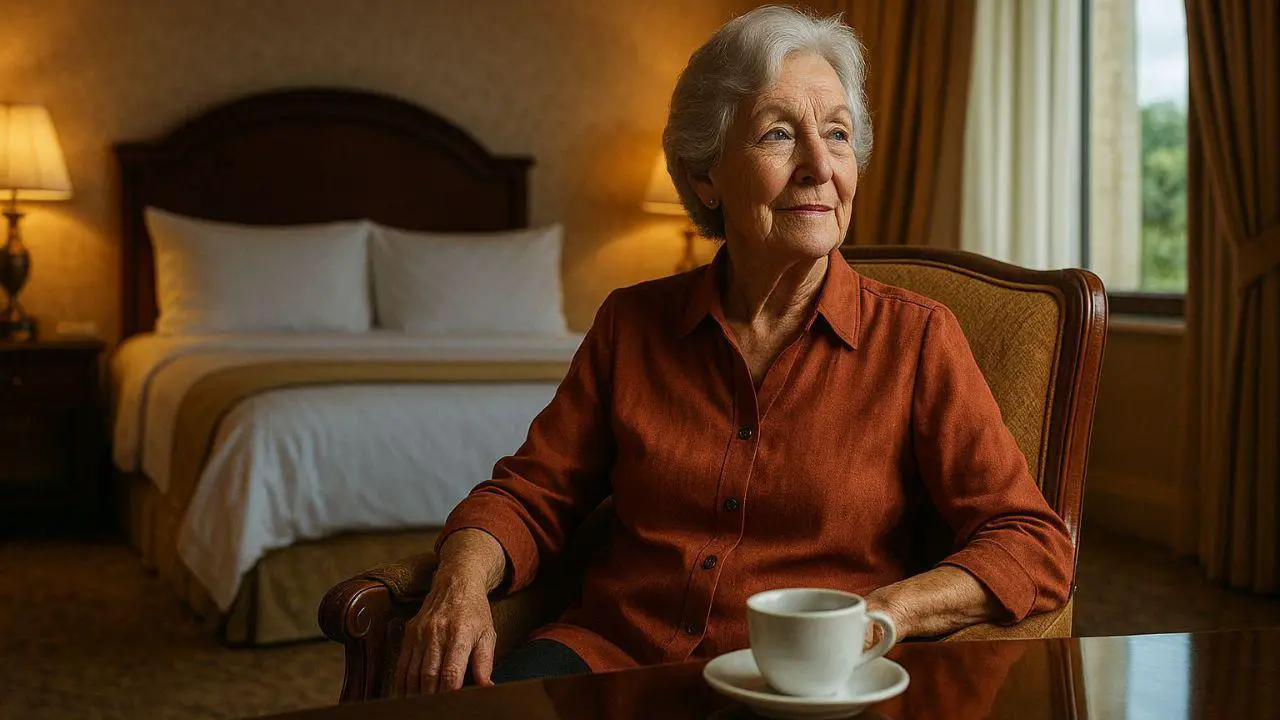
The suite was bigger than my entire apartment back home. Bigger than some of the houses I cleaned. Floor-to-ceiling windows overlooked a private garden courtyard, all manicured hedges and fountain sculptures. The bed was enormous, covered in white linens that looked like clouds, with more pillows than any single person could possibly need. A sitting area had its own sofa and coffee table and flat-screen television mounted on the wall.
But it was the bathroom that made me press my hand to my mouth.
Marble everywhere. A shower with glass walls and multiple showerheads. And a bathtub—deep, white, pristine—big enough to actually stretch out in, surrounded by candles and small bottles of bath oils and salts.
“Go ahead,” Danielle said from behind me, reading my expression. “Take a bath. Use everything. That’s what it’s all for.”
I turned to find both of them watching me with expressions I couldn’t quite read. Pride, maybe. Satisfaction.
“I don’t know what to say,” I managed.
“You don’t have to say anything,” Michael replied, pulling me into a hug. “Just enjoy it. This whole weekend is about you, Mom. About everything you’ve done for me. For us.”
That night, after they’d gone to their own room somewhere else in the hotel, I drew a bath and poured in oils that smelled like lavender and vanilla. I sank into water so hot it turned my skin pink, and I cried. Not sad tears—grateful ones. Overwhelmed ones. The kind that come when something you’ve wanted your whole life finally, impossibly, arrives.
I thought about all the years I’d spent on my knees scrubbing other people’s tile. All the meals I’d skipped so Michael could have seconds. All the double shifts I’d worked at the diner after my cleaning jobs, coming home when it was already dark, too tired to do anything but fall into bed and wake up to do it all over again.
I’d put him through college that way. Bought his textbooks, paid his dorm fees, sent him money for food when his part-time job wasn’t enough. I’d worn the same three dresses in rotation for five years so he could have a graduation ceremony where he walked across that stage in a rented cap and gown, his future bright and wide open before him.
And now, finally, he was saying thank you.
I fell asleep in that enormous bed feeling like maybe all of it had been worth something after all.
Friday morning began with room service—something I’d only ever seen in movies. A young man in a vest wheeled in a cart covered with silver domes and poured fresh orange juice into crystal glasses. When he lifted the covers, I found eggs perfectly cooked, toast cut into triangles, fresh berries I couldn’t name, and pastries that looked too beautiful to eat.
Michael and Danielle joined me, and we ate breakfast while the morning sun filled the suite with golden light.
“What do you want to do today, Mom?” Michael asked, spreading jam on his toast like this was all completely normal.
“I don’t know,” I admitted. “I’ve never… I don’t really know what people do in places like this.”
“Anything you want,” Danielle said. “That’s the point. There’s a spa downstairs—massages, facials, manicures. There’s a rooftop bar with incredible views. Shopping on Fifth Avenue is just a few blocks away. Or you could just relax here. Read a book. Watch the garden.”
The options felt overwhelming. Unlimited. I’d spent so long with my days dictated by other people’s needs and schedules that the idea of choosing how to spend my time felt almost frightening.
“Maybe… the spa?” I ventured.
“Perfect,” Michael said, pulling out his phone. “I’ll book you an appointment.”
That afternoon, I lay on a heated table while a woman with gentle hands worked scented oils into my shoulders and back, kneading out knots that had lived in my muscles for decades. Soft music played. Candles flickered. Someone had draped a warm towel over my eyes, and in the darkness behind it, I let myself float.
When had anyone last touched me with such care? When had anyone last tried to take away my pain instead of add to it?
I almost fell asleep right there on that table, and when the massage ended, I felt lighter than I had in years. My reflection in the spa’s mirrors looked different—softer somehow, younger, like someone had erased a few of the harder lines time had carved into my face.
That evening, we had dinner at the hotel restaurant—a place with cloth napkins and waiters who appeared silently at your elbow the moment your water glass dipped below half full. The menu was in French. I couldn’t read most of it, so Michael ordered for me, choosing dishes he said I would love.
He was right. Every bite was an experience—flavors I’d never tasted, textures I didn’t know food could have. When dessert came—some kind of chocolate creation with gold leaf on top—I actually laughed out loud at the absurdity of it all.
“What?” Michael asked, grinning.
“This,” I said, gesturing at the table, the restaurant, everything. “Two days ago I was cleaning Mrs. Henderson’s bathroom. Now I’m eating gold.”
“You deserve to eat gold every day,” he said, reaching across the table to squeeze my hand. “I mean that, Mom. You gave up everything for me. This is just a small way of saying thank you.”
Danielle raised her wine glass. “To Sandra. The strongest woman I know.”
They clinked their glasses against my water—I’d never developed a taste for alcohol—and I felt warmth spread through my chest that had nothing to do with the food.
Maybe this was real. Maybe my son had finally become the man I’d always hoped he’d be.
Saturday was even better. We walked through Central Park, where the spring flowers were just beginning to bloom. We had lunch at a café where people sat outside under umbrellas and watched the world go by like they had all the time in the world and nothing more important to do.
That evening, Michael had arranged for dinner at a restaurant on the top floor of a building that seemed to touch the sky. The elevator ride up made my stomach drop. The host led us to a table by the window, and when I looked out, the entire city spread below us like a carpet of lights, stretching to the horizon in every direction.
“This is too much,” I whispered.
“It’s not enough,” Michael replied. “It could never be enough to repay what you’ve done.”
When he raised his glass that night, with the city glittering behind him and Danielle smiling beside him, he said words I’d waited my whole life to hear: “To my mom, who sacrificed everything so I could have a future. I wouldn’t be here without you. None of this would exist without you. Thank you for every meal you skipped, every extra shift you worked, every time you put me first. I see it now. I see it all. And I love you.”
I cried into my napkin while strangers at other tables pretended not to notice.
That night, I fell asleep thinking that maybe all the hardship and loneliness had led to this—to a son who finally understood, who finally saw me not just as a mother who was supposed to sacrifice, but as a person who deserved recognition. Deserved gratitude.
Deserved love.
Sunday morning arrived too quickly.
I woke early, packed my small suitcase, and took one last long bath in that beautiful marble bathroom, trying to memorize the feeling of the hot water, the smell of the oils, the luxury of time and space and warmth.
When I came out, the suite felt different. Emptier. The magic was fading as reality crept back in. Tomorrow I’d be back in my tiny apartment, back to my cleaning jobs, back to my real life. But I’d have this weekend to remember. This proof that I mattered to my son.
Michael had told me to meet them in the lobby at eleven. “We’ll check out together, Mom,” he’d said.
I came down at 10:55, not wanting to make them wait, my small suitcase in hand and my heart still full enough to hurt. The lobby was busier on a Sunday morning—families checking out, business travelers in suits, the usual elegant chaos of a place where people were always coming and going.
I spotted Michael and Danielle at the front desk, talking to the same young blonde receptionist who’d checked us in. They were laughing about something, relaxed and beautiful in their expensive clothes. When Michael saw me approaching, he smiled—that warm, genuine smile that had convinced me this whole weekend was real.
He walked over and pulled me into a hug.
“Thanks for covering the stay, Mom,” he said into my ear. “It was unforgettable.”
Then he pressed something into my hand—a folded piece of paper—kissed my cheek, took Danielle’s hand, and walked straight toward the revolving doors.
I stood frozen, not understanding.
“Michael?” I called after him.
He didn’t turn around.
I watched my son and his wife push through those spinning glass doors and climb into a black sedan waiting at the curb. I watched the car pull away into Manhattan traffic. I watched until I couldn’t see them anymore, and only then did my fingers slowly unfold the paper he’d pressed into my palm.
It was a bill. An itemized hotel bill.
$11,000.
The number blurred as my eyes lost focus. Eleven thousand dollars. The suite, the room service, the spa treatments, the dinners, the everything. All of it itemized in neat lines with prices that made no sense to me—$400 for a massage, $650 per night for the room, $300 for a single dinner.
All of it charged to my name.
“Ma’am?”
I looked up to find the blonde receptionist watching me with careful professional courtesy. “Will you be paying in cash or by card?”
“I… I can’t,” I whispered. “I don’t have this kind of money.”
Her expression shifted—not unkind, but firm. “I’m sorry, ma’am, but the reservation was made under your name. You’ll need to settle the account before you can leave.”
The lobby tilted. Heat rushed to my face. I was suddenly, horribly aware of every person in that beautiful space—the families with their matching luggage, the business travelers with their briefcases, the elegant couples who belonged here in a way I never would.
They were all staring at me. The old woman in the cheap brown dress who couldn’t pay her bill.
I make $800 a month cleaning houses. Michael knows that. He’s always known that. Every dollar I’ve ever earned has gone to keeping a roof over my head and food in my stomach, with nothing left over for savings or emergencies or eleven-thousand-dollar hotel bills.
He knew exactly what he was doing.
The realization hit me like a physical blow. This whole weekend—the spa, the dinners, the thank-yous and the gratitude and the I-love-yous—all of it had been a lie. A setup. A trap designed to humiliate me in the worst possible way.
My knees went weak. I reached for the edge of the front desk to steady myself.
“Ma’am, are you all right?”
I couldn’t answer. Couldn’t breathe. Sixty-six years of hard work and pride and doing the right thing were collapsing in front of a lobby full of strangers, and there was nothing I could do to stop it.
That’s when I heard the footsteps.
Slow and shuffling, accompanied by the soft tap of a cane on marble. They came from somewhere behind the front desk, growing closer.
An elderly woman emerged from a side door I hadn’t noticed before. She wore the same burgundy uniform as the other hotel staff, but hers was an older style, more formal, with brass buttons and crisp white collar. Her white hair was pulled back in a neat bun, and her face was a map of deep wrinkles that spoke of decades of smiles and sorrows.
But it was her eyes that stopped me—sharp and honey-colored, studying my face with an intensity that made me feel like she was looking straight through to my bones.
She moved slowly, leaning on her cane, until she stood directly in front of me on the other side of the desk.
“You’re Mr. Harrison’s daughter, aren’t you?” she asked softly.
The sound of my father’s name in that place, at that moment, felt like the ground opening beneath me.
“Yes,” I managed, my voice barely a whisper. “Robert Harrison was my father.”
Tears filled her honey-colored eyes. Her hand—spotted with age, trembling slightly—reached up to touch her throat.
“I worked for your father for thirty-three years,” she said. “Before he died, he gave me something. He said…” She paused, her voice catching. “He said, ‘One day my daughter will come here. You’ll know her when you see her—she’ll be lost and alone, carrying a weight she can’t bear. When that day comes, give her this.'”
She reached into the pocket of her uniform and pulled out a yellowed envelope, corners soft with age, my name written across the front in handwriting I recognized immediately—my father’s shaky script, written in the last years of his life when Parkinson’s had begun to steal his control.
Sandra.
Just my name, in his hand.
“He told me to wait,” the elderly woman whispered. “I’ve been waiting three decades.”
I took the envelope with trembling fingers. It felt old and fragile, like it might crumble to dust if I held it too tightly. The weight of it in my hand was nothing—a few ounces of paper—but it felt like it might pull me through the floor.
“I don’t understand,” I said.
“Open it,” she replied gently. “He said you would, when the time was right.”
I broke the seal—dried glue that cracked easily after thirty years—and pulled out two things: a rusted metal key attached to a faded leather tag, and a letter written on the hotel’s stationery, yellowed with age.
My father’s handwriting filled the page, shakier than I remembered but unmistakably his.
My dearest Sandra,
If you’re reading this, then you’ve finally found the truth about our family. I’m sorry I couldn’t tell you while I was alive. I was a coward. I was ashamed. And I thought keeping you in the dark would protect you.
I was wrong.
The key you’re holding opens a storage unit on the edge of the city—the address is on the tag. Inside, you’ll find documents. Bank statements. Letters. Proof of everything I should have told you years ago.
Your son, Michael, has known about this for three years. He came to me before I died, asking about his inheritance, about what you would get when I was gone. I told him the truth—that everything I had built, everything I owned, was meant for you. Not him. You.
He didn’t take it well.
My hands started shaking so badly I almost dropped the letter.
He asked me how much it was worth. When I told him, I saw something change in his eyes. Something dark. He asked me not to tell you. Said he wanted to “handle it himself” when the time was right. Said he wanted to make sure you were “taken care of properly.”
I should have told you then. I should have warned you. But I was dying, Sandra, and I wanted to believe my grandson was better than what I saw in that moment. I wanted to believe you had someone in your life who would look after you when I was gone.
The woman who gave you this letter—her name is Margaret—is the only person I trusted with the truth. I’ve paid her a stipend every month to stay at this hotel, to wait for the day you would come. Because I knew, somehow, that Michael would eventually bring you here. That he would set a trap. That you would need a way out.
The storage unit contains everything. Property deeds. Bank account information. Stock certificates. Everything I built in my life, Sandra, I built for you. Because you were the only one who never asked me for anything. The only one who loved me without wanting something in return.
I’m sorry I couldn’t be a better father when I was alive. I’m sorry I was absent for so much of your childhood. I’m sorry you had to work so hard, had to sacrifice so much.
But I made sure you would be taken care of. Everything is yours. It always was.
The storage unit address is: 2847 Industrial Way, Unit 23B.
Go there. Claim what’s yours. And don’t let anyone—not even your son—take it from you.
I love you. I always did, even when I didn’t know how to show it.
Your father, Robert Harrison
I read the letter three times before the words finally made sense. Then I looked up at Margaret, the elderly receptionist who’d been waiting for me for thirty years.
“He really said all that?” I asked.
She nodded, tears streaming down her wrinkled cheeks. “Every word. He talked about you all the time, you know. In the last years. He was so proud of you. So ashamed of himself. He wanted to make it right, but he didn’t know how.”
“Did you know Michael was going to do this?” I gestured at the bill still sitting on the counter.
“No,” she said firmly. “But your father predicted something like it would happen. He said Michael would try to trap you somehow. Use you. That’s why he made sure I would be here when you needed help.”
I looked down at the key in my hand—rusted and old, but solid. Real.
Then I looked at the bill. $11,000 I didn’t have.
“I still can’t pay this,” I said quietly.
Margaret smiled. “Yes, you can. Look at the letter again. The last paragraph.”
I found it—a section I’d been too overwhelmed to process the first time.
P.S. I’ve already paid for the hotel stay. Whatever bill Michael presents to you is fraudulent. Show this letter to Margaret. She’ll handle it.
“He paid for this weekend thirty years ago?” I asked, incredulous.
“He set up a fund,” Margaret explained. “Enough to cover any expenses that might be charged to your name at this hotel. He thought of everything.” She turned to the young blonde receptionist. “Sarah, please void this bill. Ms. Harrison’s account has been settled.”
The girl looked confused but nodded, typing something into her computer. “Of course.”
Just like that, the bill disappeared.
The weight that had been crushing my chest lifted. I could breathe again.
“Thank you,” I whispered to Margaret.
She reached across the desk and took my hand in both of hers. “Your father was a good man who made mistakes. But he loved you, Sandra. Everything he did at the end was for you.”
I stood in that lobby for another minute, trying to process everything. My son had betrayed me in the worst possible way—had spent an entire weekend making me feel valued and loved, only to abandon me with a debt he knew would destroy me. But my father, who I’d barely known, who’d been absent for most of my childhood, had somehow seen it coming and had left me a way out.
I looked at the address on the key tag again. 2847 Industrial Way, Unit 23B.
“Do you know what’s in the storage unit?” I asked Margaret.
“No,” she admitted. “Your father never told me. But he said it would change your life.”
I took a taxi to the address—a drive that carried me from the gleaming towers of Manhattan to the industrial edges of the city, where old warehouses and storage facilities crouched behind chain-link fences. The driver seemed uncertain when I gave him the address, but he took me anyway, dropping me off in front of a long building divided into units, each with its own rolling metal door.
Unit 23B was at the far end.
I stood in front of it for a long moment, the rusted key heavy in my palm, my heart pounding so hard I could hear it in my ears. Everything I’d believed about my life had been turned upside down in the span of a few hours. My son had betrayed me. My father had saved me. And behind this door was supposedly proof of… what? Everything I’d been denied my whole life?
I slid the key into the lock. It stuck at first—rust and age—but with some effort, it turned.
The door rolled up with a screech of metal on metal.
Inside, the unit was larger than I’d expected—maybe fifteen feet deep, ten feet wide, lit by a single bulb hanging from the ceiling. Metal shelving lined the walls, and on those shelves were boxes. Dozens of them. Labeled in my father’s handwriting.
Property Deeds. Bank Statements 1975-1995. Stock Certificates. Insurance Policies. Business Records—Harrison Hotels.
Harrison Hotels.
My father had owned hotels? Not just worked at them, but owned them?
I pulled down the first box with shaking hands and opened it.
Inside were property deeds—legal documents transferring ownership of buildings from various sellers to Robert Harrison. The Grandmont Hotel in Manhattan. The Harrison Plaza Hotel in Boston. The Riverside Hotel in Philadelphia. Five properties in total, all purchased between 1970 and 1985, all owned by my father.
All now, according to the documents, transferred to my name upon his death.
The next box contained bank statements. Accounts I’d never known existed, with balances that made my vision blur. Hundreds of thousands of dollars. In some cases, millions. All in accounts bearing my name as the sole beneficiary.
Stock certificates. Insurance policies worth more than I’d earn in ten lifetimes of cleaning houses.
I sank onto the concrete floor of the storage unit, surrounded by boxes that contained proof of a life I’d never known my father had lived. While I’d been scrubbing toilets and skipping meals, he’d been building an empire. While I’d been working myself to exhaustion to put my son through college, I’d been the heir to a fortune I didn’t know existed.
And Michael had known. For three years, he’d known.
That’s why he’d suddenly reappeared in my life after years of distance. That’s why he’d planned this elaborate weekend, this cruel trap. He’d thought that if he could humiliate me badly enough, break me completely, I might just… disappear. Give up. Maybe even…
I couldn’t finish the thought.
But I understood now. He’d been trying to destroy me so he could claim what he thought should be his. The inheritance. The hotels. The money. Everything my father had meant for me.
I sat in that storage unit until the light outside began to fade, reading through documents, piecing together the life my father had lived in the years after he left us. He’d built something. He’d been successful. And at the end, consumed by guilt and love, he’d tried to make sure I would be taken care of.
He’d protected me from beyond the grave.
The next weeks were a blur of lawyers and accountants and documents that needed signing. Margaret helped me navigate it all, honoring the promise she’d made to my father three decades ago. She’d been his assistant back then, she told me. Had watched him build his small empire, had watched him grieve over the family he’d left behind.
“He talked about you all the time,” she said over coffee one afternoon. “Wondered what you were doing. If you were happy. If you hated him.”
“I didn’t hate him,” I admitted. “I just didn’t know him.”
“He knew that. It ate at him.”
The properties were mine now—five hotels across the East Coast, all professionally managed, all generating income I’d never imagined possible. The bank accounts, the stocks, the insurance policies—all of it legally transferred to me years ago, just waiting for me to claim it.
I was, according to my new accountant, a very wealthy woman.
But more important than the money was the truth. The knowledge that my father had loved me, even if he hadn’t known how to show it. That he’d spent his final years trying to make amends for his absence. That he’d seen through Michael’s mask and had prepared a way to protect me.
As for Michael, I didn’t hear from him for two weeks after that Sunday at the hotel. Then one evening, my phone rang with his number.
I almost didn’t answer. But curiosity won out.
“Mom?” His voice was tight, nervous. “We need to talk.”
“About what?”
“I know you went to the storage unit. I know you found… everything.”
“Yes.”
A long pause. “Look, I can explain. Grandpa… he made promises to me too. Before he died. He said—”
“He said everything was mine,” I interrupted quietly. “He told you that three years ago, and you’ve been planning this ever since. The weekend at the hotel. The bill. All of it was designed to break me.”
“That’s not—Mom, you don’t understand—”
“I understand perfectly.” My voice was steady, calm. “You wanted the inheritance. You thought if you could humiliate me badly enough, maybe I’d just give up. Disappear. Make it easier for you to claim what you thought should be yours.”
“I’m your son,” he said, and there was anger creeping into his voice now. “I deserved—”
“You deserved nothing,” I said softly. “Nothing but what you earned. And you chose to earn cruelty. Betrayal. You spent an entire weekend making me believe you finally saw me, finally valued me, just so you could hurt me more deeply than anyone ever has.”
“So what now?” he asked, bitter. “You’re going to cut me off? Pretend I don’t exist?”
I thought about it—really thought about it. I could punish him. Exclude him from my life the way he’d tried to exclude me from his future. But that would make me like him, wouldn’t it? And I’d spent too many years working to be better than the worst of what life had offered me.
“I’m going to do something worse than cutting you off,” I said. “I’m going to forgive you.”
“What?”
“I forgive you, Michael. For all of it. Because holding onto anger and hurt would only poison me, and I’ve spent enough of my life suffering. You’ll have to live with what you’ve done. That’s punishment enough.”
“I don’t want your forgiveness,” he spat.
“I know,” I said gently. “But you have it anyway. Goodbye, Michael.”
I hung up before he could respond.
Six months have passed since that Sunday at the Grandmont Hotel. I still live in my small apartment—not because I can’t afford better, but because it’s mine, and it’s enough. I’ve donated most of the money to charities that help single mothers and elderly people who work long past the age when they should be able to rest. I’ve set up scholarships for students who have to work their way through college like Michael did—except these students actually appreciate it.
I kept the hotels. Not to run them—I hire people for that—but because my father built them, and keeping them feels like honoring the man he tried to become at the end of his life.
Margaret and I have lunch once a month. She’s become the closest thing to family I have now—someone who knew my father, who kept her promise, who helped me when I needed it most.
I haven’t seen Michael or Danielle since that weekend. I heard through mutual acquaintances that he’s angry, that he’s talking to lawyers about contesting the inheritance. Let him try. My father’s will was ironclad, witnessed and notarized and designed to survive exactly this kind of challenge.
Some days I think about calling Michael. Reaching out. Trying one more time to build a bridge between us. But then I remember his face as he walked away from me in that lobby, remember the bill pressed into my hand like a final betrayal, and I realize that some bridges aren’t worth building. Some people show you exactly who they are, and you have to believe them.
I’m sixty-six years old. For the first time in my life, I don’t have to work. Don’t have to scrub other people’s floors or skip meals or choose between medicine and rent. But the strangest thing is this: I still clean houses.
Not because I have to. Because after a lifetime of service, I’ve discovered that I actually like making things beautiful for other people. So now I only take clients who remind me of who I used to be—single mothers struggling to keep their heads above water, elderly people who can’t manage on their own anymore. And I clean their houses for free, and I leave envelopes on their tables with checks that will help them breathe a little easier.
My father built his empire and left it to me out of guilt and love.
I’m using it to make sure other people don’t have to suffer the way I did.
And maybe that’s the real inheritance—not the money or the properties, but the choice to take what we’re given and transform it into something better than ourselves.
Michael took what he was given and tried to turn it into cruelty.
I took what I was given and turned it into grace.
In the end, that’s the difference between us. That’s the legacy I choose.
On the shelf in my apartment, next to a photograph of me as a young woman holding baby Michael—back when I still believed the world would be kind to us—I keep three things: the yellowed envelope with my name in my father’s handwriting, the rusted key that unlocked my future, and a note Margaret wrote me after our first lunch together.
It says simply: He was proud of you. And he would be proud of the woman you’ve become.
I read it every morning. And every morning, I choose to believe it.
My son taught me that love can be a weapon. My father taught me that love can be a shield. Both lessons were painful. Both lessons were necessary.
And now, finally, I’m teaching myself that love can also be a gift—one we give freely, without expecting anything in return, without keeping score, without building traps.
That’s the hardest lesson of all.
But it’s the one worth learning.
THE END

Lila Hart is a dedicated Digital Archivist and Research Specialist with a keen eye for preserving and curating meaningful content. At TheArchivists, she specializes in organizing and managing digital archives, ensuring that valuable stories and historical moments are accessible for generations to come.
Lila earned her degree in History and Archival Studies from the University of Edinburgh, where she cultivated her passion for documenting the past and preserving cultural heritage. Her expertise lies in combining traditional archival techniques with modern digital tools, allowing her to create comprehensive and engaging collections that resonate with audiences worldwide.
At TheArchivists, Lila is known for her meticulous attention to detail and her ability to uncover hidden gems within extensive archives. Her work is praised for its depth, authenticity, and contribution to the preservation of knowledge in the digital age.
Driven by a commitment to preserving stories that matter, Lila is passionate about exploring the intersection of history and technology. Her goal is to ensure that every piece of content she handles reflects the richness of human experiences and remains a source of inspiration for years to come.